
Chapter Three The Managers Changing Work Environment Responsibilities
Chapter Three The Manager’s Changing Work Environment & Responsibilities
Major Questions v Stockholders are only one group of stakeholders. v Who are stakeholders important to me inside the organization? v Who are stakeholders important to me outside the organization? v What does the successful manager need to know about ethics and values? v Is being socially responsible really necessary? v What trends in workplace diversity should managers be aware of? v Do I have what it takes to be an entrepreneur? Mc. Graw-Hill/Irwin © 2006 The Mc. Graw-Hill Companies, Inc. All rights reserved.
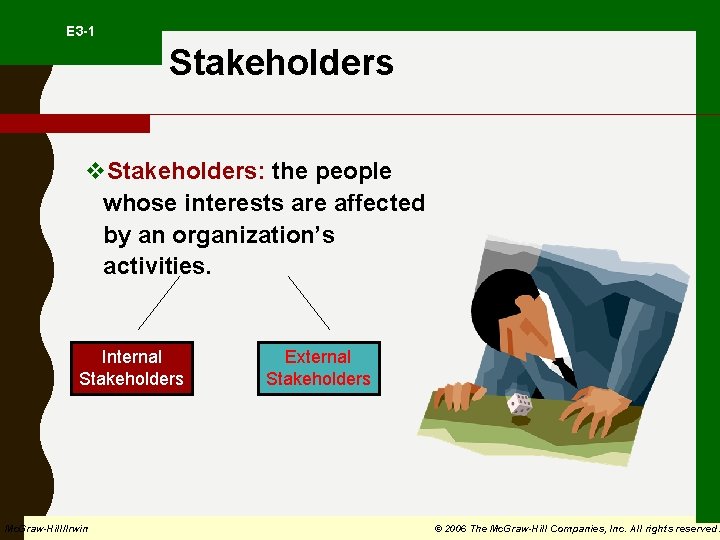
E 3 -1 Stakeholders v. Stakeholders: the people whose interests are affected by an organization’s activities. Internal Stakeholders Mc. Graw-Hill/Irwin External Stakeholders © 2006 The Mc. Graw-Hill Companies, Inc. All rights reserved.
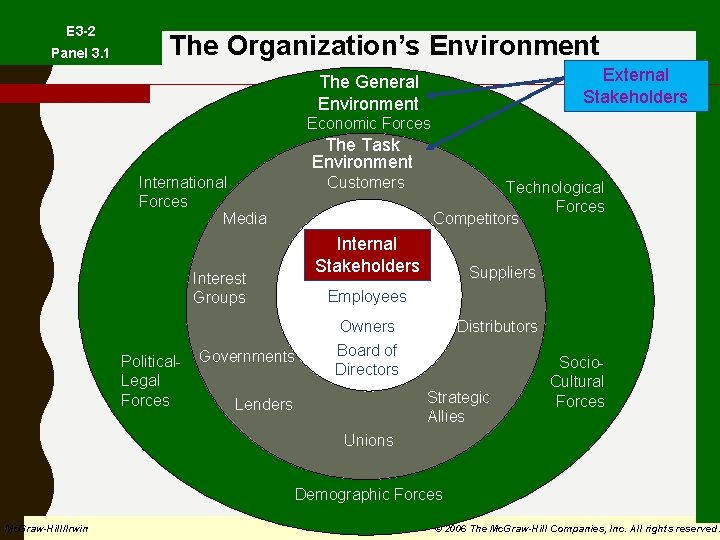
E 3 -2 Panel 3. 1 The Organization’s Environment External Stakeholders The General Environment Economic Forces The Task Environment International Forces Media Customers Internal Stakeholders Interest Groups Political. Legal Forces Technological Forces Competitors Suppliers Employees Governments Owners Board of Directors Distributors Strategic Allies Lenders Socio. Cultural Forces Unions Demographic Forces Mc. Graw-Hill/Irwin © 2006 The Mc. Graw-Hill Companies, Inc. All rights reserved.
E 3 -3 Internal Stakeholders v. Internal Stakeholders: consist of employees, owners, and the board of owners, directors, directors if any. Mc. Graw-Hill/Irwin © 2006 The Mc. Graw-Hill Companies, Inc. All rights reserved.
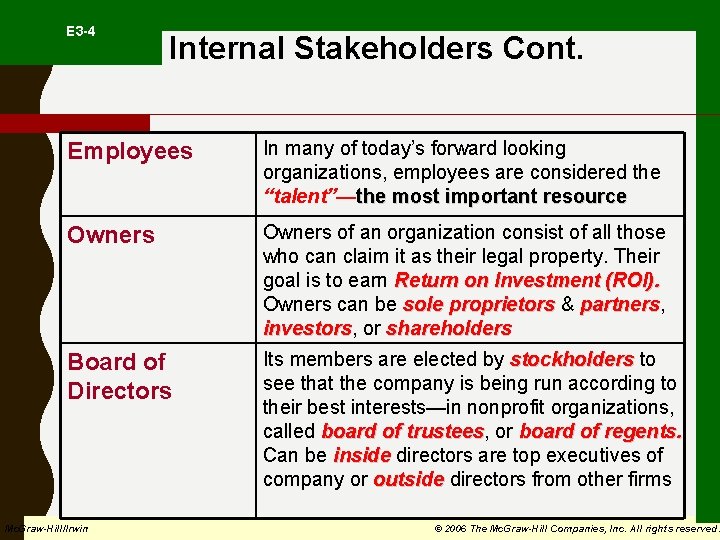
E 3 -4 Internal Stakeholders Cont. Employees In many of today’s forward looking organizations, employees are considered the “talent”—the most important resource Owners of an organization consist of all those who can claim it as their legal property. Their goal is to earn Return on Investment (ROI). Owners can be sole proprietors & partners, partners investors, investors or shareholders Board of Directors Its members are elected by stockholders to see that the company is being run according to their best interests—in nonprofit organizations, called board of trustees, trustees or board of regents. Can be inside directors are top executives of company or outside directors from other firms Mc. Graw-Hill/Irwin © 2006 The Mc. Graw-Hill Companies, Inc. All rights reserved.
E 3 -5 External Stakeholders v. External Stakeholders: people or groups in the organization’s external environment that are affected by it. v. The environment consists of: v. The task environment v. The general environment Mc. Graw-Hill/Irwin © 2006 The Mc. Graw-Hill Companies, Inc. All rights reserved.
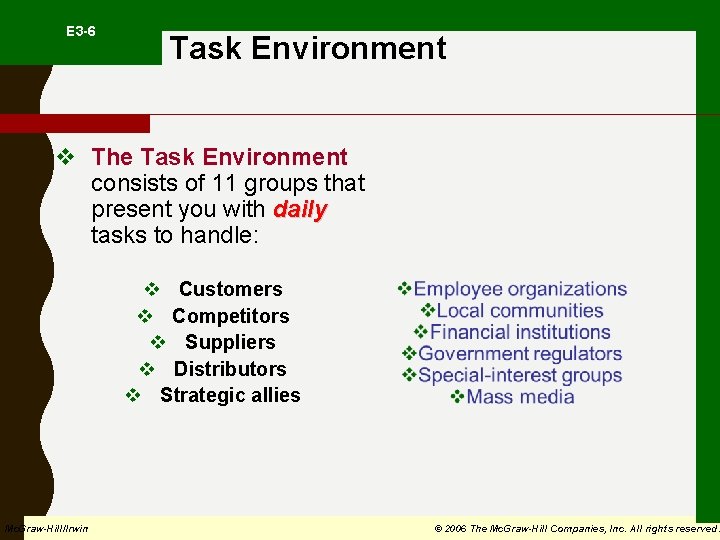
E 3 -6 Task Environment v The Task Environment consists of 11 groups that present you with daily tasks to handle: v Customers v Competitors v Suppliers v Distributors v Strategic allies Mc. Graw-Hill/Irwin © 2006 The Mc. Graw-Hill Companies, Inc. All rights reserved.
THE TASK ENVIRONMENT • Customers – those who pay to use an organization’s goods or services • Competitors – people or organizations that compete for customers or services • Suppliers – Provide raw materials, services, equipment, labor or energy to other organizations
THE TASK ENVIRONMENT (CONT. ) • Distributor – a person or organization that helps another organization sell its goods and services to customers • Strategic allies – describes the relationship of two organizations who join forces to achieve advantages neither can perform as well alone
THE TASK ENVIRONMENT (CONT. ) • Employee Organizations – Unions tend to represent hourly workers. Professional Associations tend to represent salaried workers. Union membership has declined. Today, they tend to focus on benefits and maintaining a “living-wage” • Local Communities – Neighborhoods that rely on organization for financial support • Government regulators – regulatory agencies that establish ground rules under which organizations may operate. Often create legal regulations impacting the company and decision-making
THE TASK ENVIRONMENT (CONT. ) • Special interest groups – groups whose members try to politically pressure on specific issues through picketing and boycotts • Mass Media • Radio, TV, Internet, newspaper – Public relations manager
CHALLENGE: WHO ARE OUR STAKEHOLDERS? Pair & Share • Can you identify the stakeholders for an organization like: v. Customers – Merck v. Competitors – Apple v. Strategic allies – Ford Motor Company 1. Name at least three for each category. 2. Be ready to justify who and why you think they are the right choice or selection.
E 3 -7 The General Environment v The General Environment or macro environment includes six forces you can not control: v Economic v Technological v Sociocultural v Demographic v Political-legal v International Mc. Graw-Hill/Irwin © 2006 The Mc. Graw-Hill Companies, Inc. All rights reserved.
THE GENERAL ENVIRONMENT • Economic forces – consist of the general economic conditions and trends – unemployment, inflation, interest rates, economic growth – that may affect an organization’s performance • Technological forces – new developments in methods for transforming resources into goods and services
THE GENERAL ENVIRONMENT • Sociocultural forces – Influences and trends originating in a country’s, a society’s, or a culture’s human relationships and values that may affect an organization • Demographic forces – influences on an organization arising from changes in the characteristics of a population, such as age, gender, or ethnic origin
THE GENERAL ENVIRONMENT • Political-Legal forces – changes in the way politics shape laws and laws shape the opportunities for and threats to an organization • International forces – changes in the economic, political, legal, and technological global system that may affect an organization
CHALLENGE: • What potential challenges do we face today as a new auto maker? – We are a new automobile manufacturer looking to enter the US market with three models (initially) v v v Economic Technological Sociocultural Demographic Political-legal International
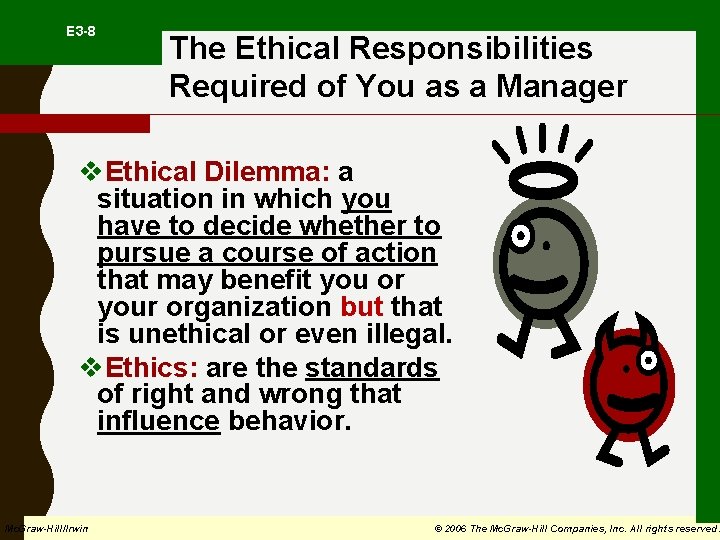
E 3 -8 The Ethical Responsibilities Required of You as a Manager v. Ethical Dilemma: a situation in which you have to decide whether to pursue a course of action that may benefit you or your organization but that is unethical or even illegal. v. Ethics: are the standards of right and wrong that influence behavior. Mc. Graw-Hill/Irwin © 2006 The Mc. Graw-Hill Companies, Inc. All rights reserved.
E 3 -8 The Ethical Responsibilities Required of You as a Manager v. Ethics: Vary from country to country and even internal cultures. v. Ethical Behavior: is behavior that is accepted as “right” as opposed to “wrong” according to those standards. v. Ethical Dilemmas: Occur due to conflicts of value within an organization, also known as the value system. v. Values: Permanent, deeply held beliefs within a company that affect behavior and are the underpinning for ethical actions Mc. Graw-Hill/Irwin © 2006 The Mc. Graw-Hill Companies, Inc. All rights reserved.
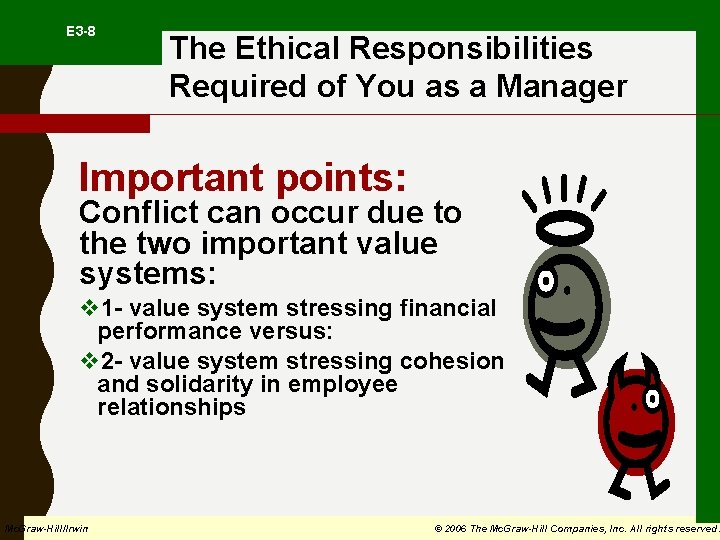
E 3 -8 The Ethical Responsibilities Required of You as a Manager Important points: Conflict can occur due to the two important value systems: v 1 - value system stressing financial performance versus: v 2 - value system stressing cohesion and solidarity in employee relationships Mc. Graw-Hill/Irwin © 2006 The Mc. Graw-Hill Companies, Inc. All rights reserved.
QUESTION? Two drug companies agree to work together to pool their research and development funds to develop a new drug for arthritis. In doing so, these two organizations have: A. Formed a union B. Formed a strategic alliance C. Analyzed their internal environment D. Influenced the mass media
QUESTION? Chem. Tech International is being picketed by a group of people who live by their biggest plant. The group is concerned about Chem. Tech’s disposal of waste products into nearby waterways. In this instance, Chem. Tech is dealing with the _____ part of its _______ environment. A. B. C. D. special-interest groups; task local communities; task sociocultural; general sociocultural; task
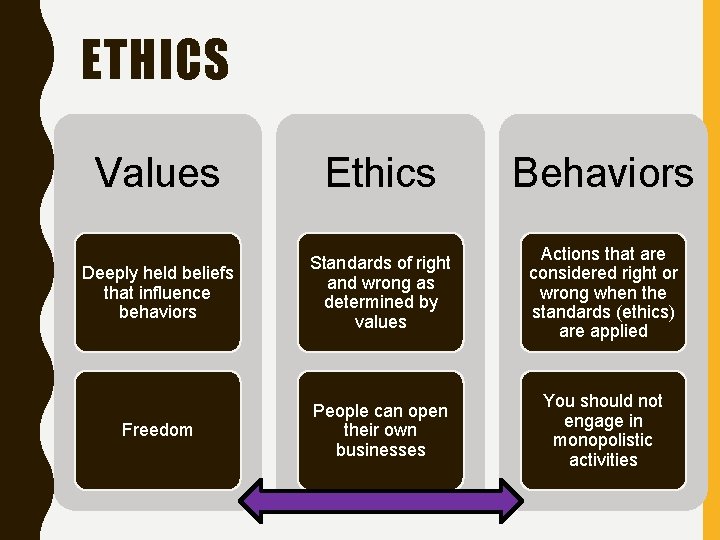
ETHICS Values Ethics Behaviors Deeply held beliefs that influence behaviors Standards of right and wrong as determined by values Actions that are considered right or wrong when the standards (ethics) are applied Freedom People can open their own businesses You should not engage in monopolistic activities
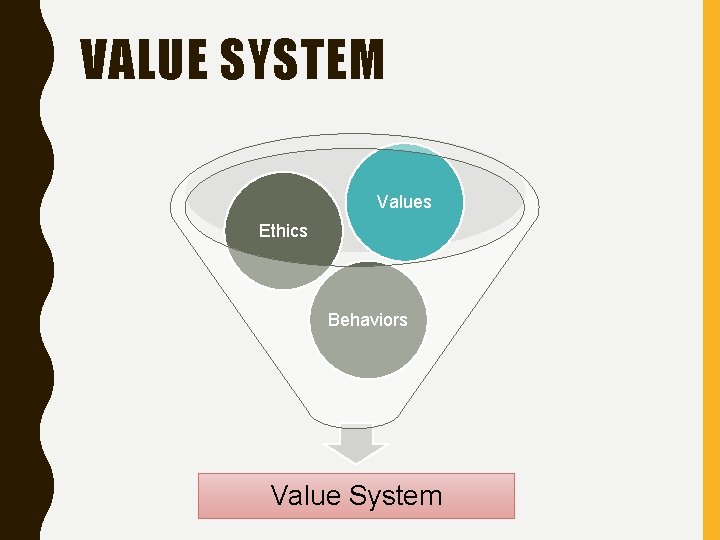
VALUE SYSTEM Values Ethics Behaviors Value System
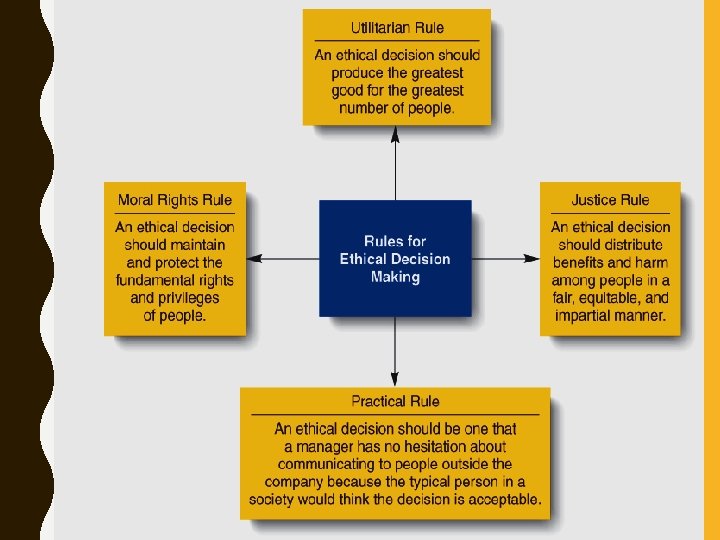
E 3 -9 Four Approaches to Deciding an Ethical Dilemma v. The utilitarian approach: is guided by what will result in the greatest good for the greatest number of people. v. The individual approach: is guided by what will result in the individual’s best long-term interests which ultimately are in everyone’s best interest. v. The moral-rights approach: is guided by respect for the fundamental rights of human beings. v. The justice approach: is guided by respect for impartial standards of fairness and equity. Mc. Graw-Hill/Irwin © 2006 The Mc. Graw-Hill Companies, Inc. All rights reserved.
E 3 -11 Social Responsibility v Corporate Social Responsibility: is a manager’s duty to take actions that will benefit the interests of society as well as the organization. v Often refers to business practices involving initiatives that benefit society… Mc. Graw-Hill/Irwin © 2006 The Mc. Graw-Hill Companies, Inc. All rights reserved.
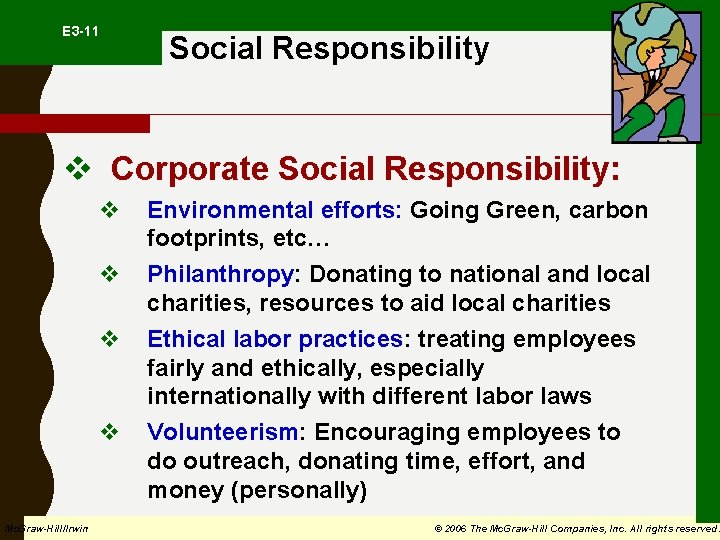
E 3 -11 Social Responsibility v Corporate Social Responsibility: v v Mc. Graw-Hill/Irwin Environmental efforts: Going Green, carbon footprints, etc… Philanthropy: Donating to national and local charities, resources to aid local charities Ethical labor practices: treating employees fairly and ethically, especially internationally with different labor laws Volunteerism: Encouraging employees to do outreach, donating time, effort, and money (personally) © 2006 The Mc. Graw-Hill Companies, Inc. All rights reserved.
E 3 -11 Social Responsibility • Opponents to CSR (Corporate Social Responsibility): Milton Friedman claims that “the social responsibility of business is to make a profit” because this is the best way to provide goods and services, services – Benefit the shareholders, shareholders create jobs, jobs and expand economic growth • Supporters of CSR: like Paul Samuelson argue that a company must be concerned for society’s welfare as well as corporate profits because business needs to solve some of the problems they contribute too – Businesses often have greater responsibility to solve responsibility problems. Especially ones they contributed too! Mc. Graw-Hill/Irwin – In addition, by working with the community, businesses can enjoy a more favorable public image © 2006 The Mc. Graw-Hill Companies, Inc. All rights reserved.
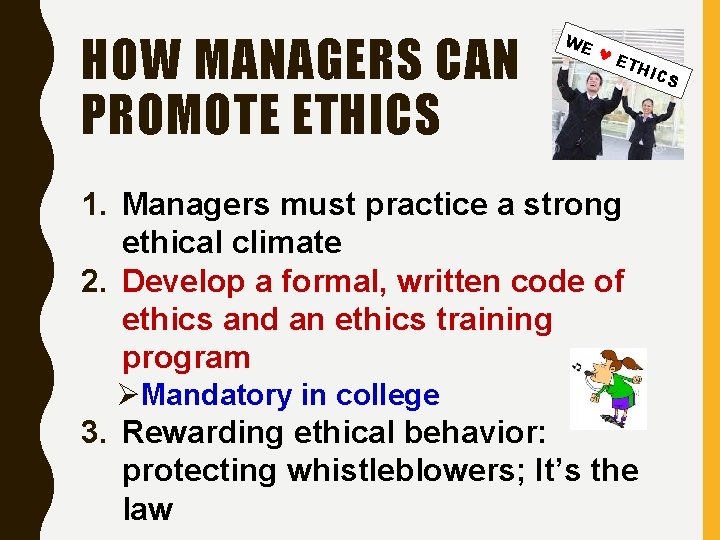
HOW MANAGERS CAN PROMOTE ETHICS WE E TH 1. Managers must practice a strong ethical climate 2. Develop a formal, written code of ethics and an ethics training program ØMandatory in college 3. Rewarding ethical behavior: protecting whistleblowers; It’s the law ICS
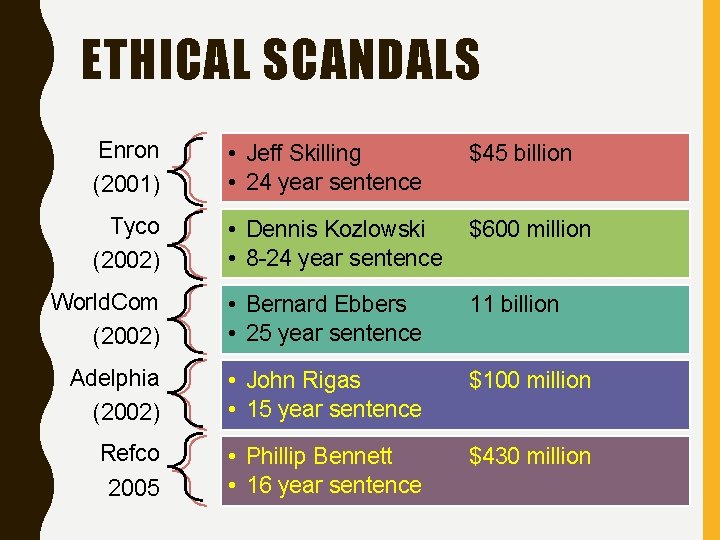
ETHICAL SCANDALS Enron (2001) Tyco (2002) World. Com (2002) Adelphia (2002) Refco 2005 • Jeff Skilling • 24 year sentence $45 billion • Dennis Kozlowski • 8 -24 year sentence $600 million • Bernard Ebbers • 25 year sentence 11 billion • John Rigas • 15 year sentence $100 million • Phillip Bennett • 16 year sentence $430 million
RESULT OF SCANDALS • Sarbanes-Oxley Act (Sar. Box or SOX) – establishes requirements for proper financial record keeping for public companies and penalties for noncompliance • Need for Ethics Education – 26% of business majors admitted to serious cheating on exams – 54% of business majors admitted to cheating on written assignments
DRAFT A PERSONAL CODE • Your challenge: Draft a personal code of ethics to care and follow – Must Have: • Four (4) principles you live by – I will statements… • I will always be truthful in my dealings with others. • Four (4) values you will demonstrate in life and career to achieve these 4 Ps – My focus will be to always be honesty, act with integrity, support and value fairness, and keep confidences…. – Print out small enough to match CC

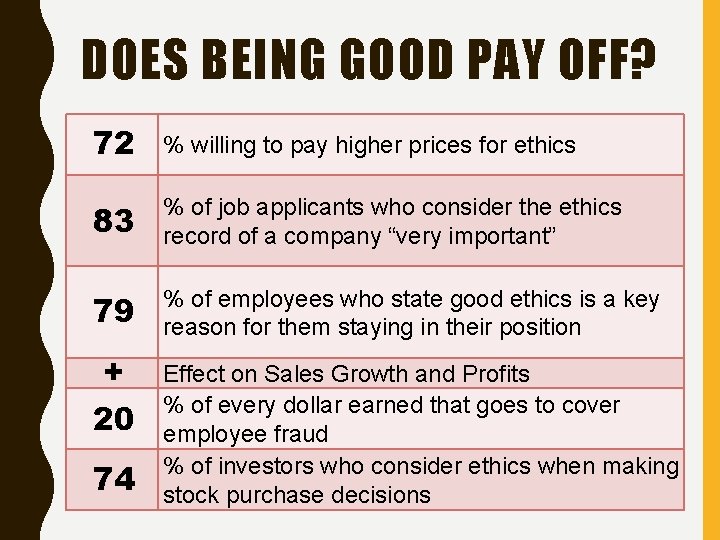
DOES BEING GOOD PAY OFF? 72 % willing to pay higher prices for ethics 83 % of job applicants who consider the ethics record of a company “very important” 79 % of employees who state good ethics is a key reason for them staying in their position + 20 74 Effect on Sales Growth and Profits % of every dollar earned that goes to cover employee fraud % of investors who consider ethics when making stock purchase decisions
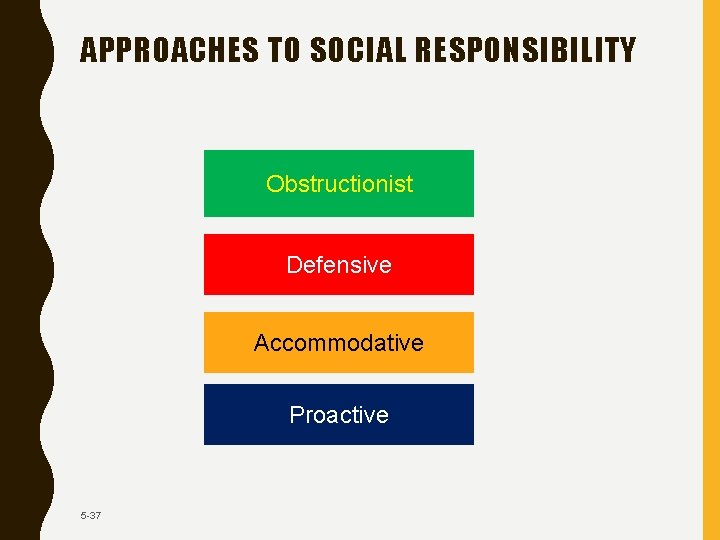
APPROACHES TO SOCIAL RESPONSIBILITY Obstructionist Defensive Accommodative Proactive 5 -37
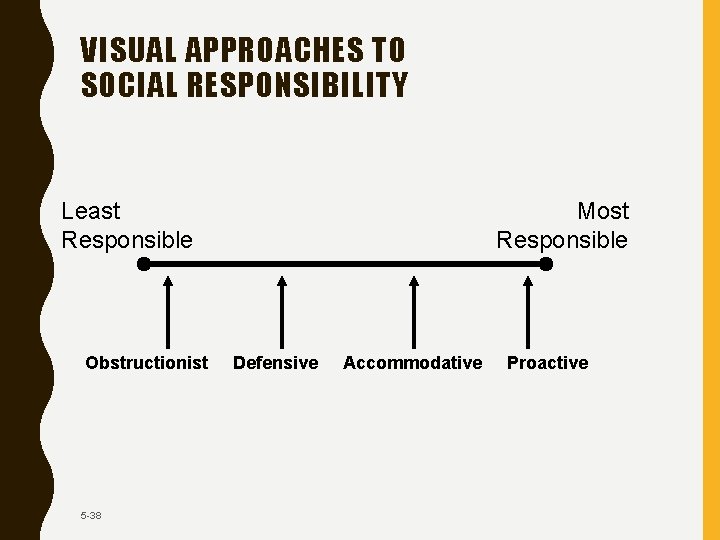
VISUAL APPROACHES TO SOCIAL RESPONSIBILITY Least Responsible Most Responsible Obstructionist Defensive Accommodative Proactive 5 -38
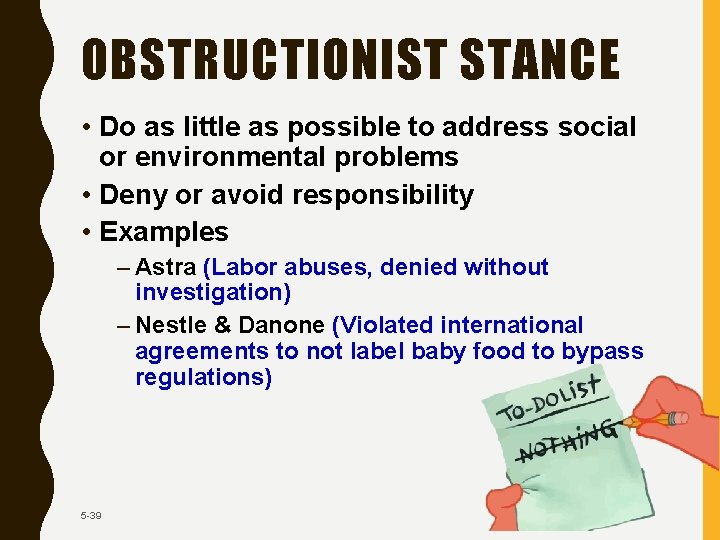
OBSTRUCTIONIST STANCE • Do as little as possible to address social or environmental problems • Deny or avoid responsibility • Examples – Astra (Labor abuses, denied without investigation) – Nestle & Danone (Violated international agreements to not label baby food to bypass regulations) 5 -39
DEFENSIVE STANCE • Do what is required legally, but nothing more • Corporate responsibility is to generate profits • Example – Philip Morris • Minimal warnings in U. S. • Aggressive marketing in other countries • U. S. advertising rules followed to letter • Varied formulas in foreign companies to make the product more addictive 5 -40
ACCOMMODATIVE STANCE • Meet ethical and legal requirements and more • Agree to participate in social programs • Match contributions by employees • Respond to requests from nonprofits • No proactive behavior to seek such opportunities 5 -41
PROACTIVE STANCE • Strong support of social responsibility • Viewed as citizens of society • Seek opportunities to contribute • Examples – Mc. Donald’s – The Body Shop – Ben & Jerry’s 5 -42
THE NEW DIVERSIFIED WORKFORCE SECTION 3. 5
E 3 -14 Thinking about Diversity v Diversity: represents all the ways people are unlike or alike—the differences and similarities in age, gender, race, religion, ethnicity, sexual orientation, capabilities, and orientation, capabilities, socioeconomic background. Johnson and Johnson Video Clip Mc. Graw-Hill/Irwin © 2006 The Mc. Graw-Hill Companies, Inc. All rights reserved.
THE NEW DIVERSIFIED WORKPLACE • Personality – stable physical and mental characteristics responsible for a person’s identity • Internal dimensions of diversity – human differences that exert a powerful, sustained effect throughout every stage of our lives. Internal dimensions are visible and salient and are often associated with stereotypes.
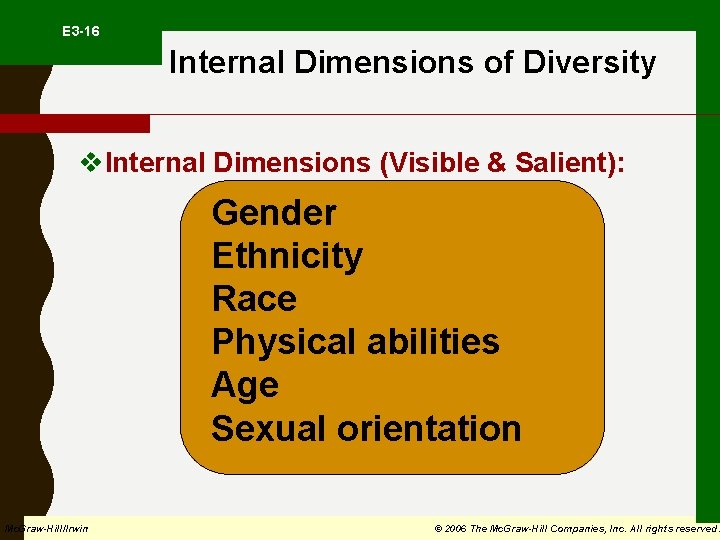
E 3 -16 Internal Dimensions of Diversity v. Internal Dimensions (Visible & Salient): Gender Ethnicity Race Physical abilities Age Sexual orientation Mc. Graw-Hill/Irwin © 2006 The Mc. Graw-Hill Companies, Inc. All rights reserved.
THE NEW DIVERSIFIED WORKPLACE • Ethnocentrism – belief that one’s native country, culture, language, abilities, or behavior is superior to those of another culture – Differences are viewed as a weakness – Leads to belief that diversity hiring will lessen competence and quality
E 3 -17 External Dimensions of Diversity v. External Dimensions: includes an element of choice: they consist of personal characteristics that people acquire, discard, or modify throughout their lives. Mc. Graw-Hill/Irwin © 2006 The Mc. Graw-Hill Companies, Inc. All rights reserved.
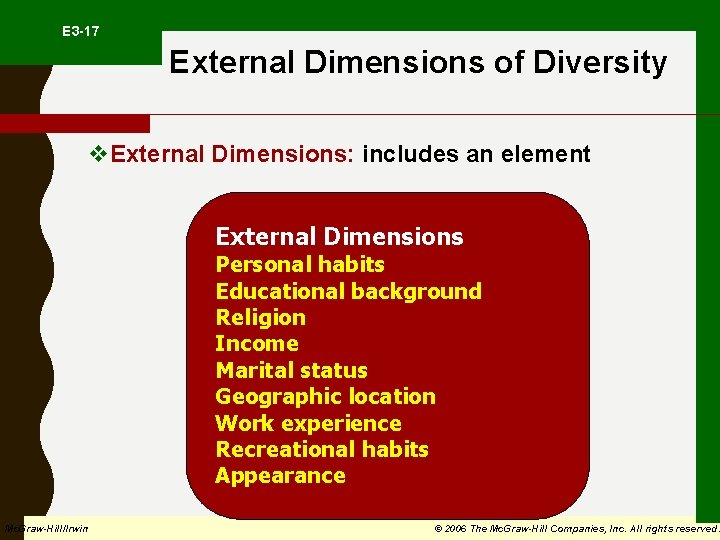
E 3 -17 External Dimensions of Diversity v. External Dimensions: includes an element External Dimensions Personal habits Educational background Religion Income Marital status Geographic location Work experience Recreational habits Appearance Mc. Graw-Hill/Irwin © 2006 The Mc. Graw-Hill Companies, Inc. All rights reserved.
E 3 -18 Organizational Dimensions of Diversity Organizational Dimensions: vcharacteristics that one has based on his or her job within an organization vmany times hold meaning only to those within the organization itself Mc. Graw-Hill/Irwin © 2006 The Mc. Graw-Hill Companies, Inc. All rights reserved.
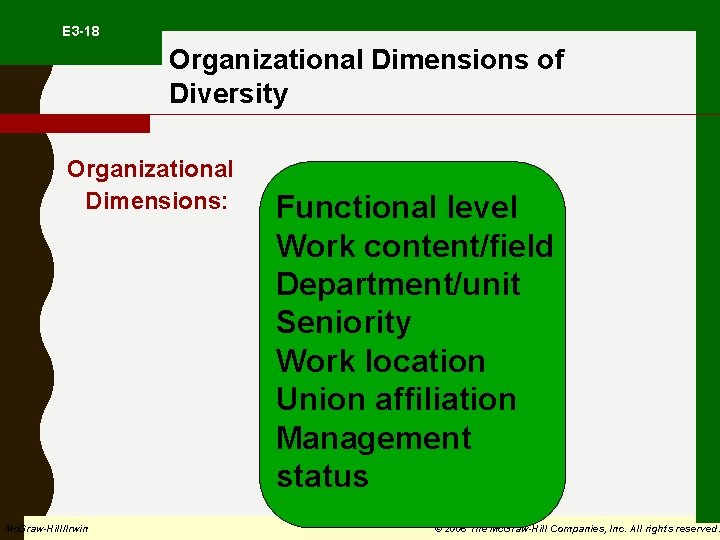
E 3 -18 Organizational Dimensions of Diversity Organizational Dimensions: Functional level Work content/field Department/unit Seniority Work location Union affiliation Management status Mc. Graw-Hill/Irwin © 2006 The Mc. Graw-Hill Companies, Inc. All rights reserved.
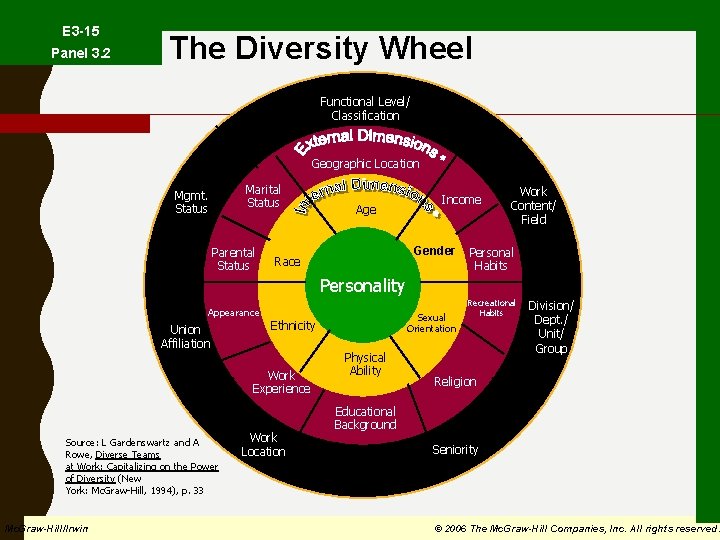
E 3 -15 Panel 3. 2 The Diversity Wheel Functional Level/ Classification Geographic Location Marital Status Mgmt. Status Parental Status Age Income Gender Race Work Content/ Field Personal Habits Personality Appearance Union Affiliation Ethnicity Work Experience Source: L Gardenswartz and A Rowe, Diverse Teams at Work: Capitalizing on the Power of Diversity (New York: Mc. Graw-Hill, 1994), p. 33 Mc. Graw-Hill/Irwin Sexual Orientation Work Location Physical Ability Recreational Habits Division/ Dept. / Unit/ Group Religion Educational Background Seniority © 2006 The Mc. Graw-Hill Companies, Inc. All rights reserved.
E 3 -19 Trends in Workforce Diversity v. Age: More Older People in the Workforce v. Gender: More Women Working v. Race & Ethnicity: More people of color and differing cultures in the workforce v. Sexual Orientation: Gays & lesbians become more visible v. People with differing physical & mental abilities: Accommodations by law v. Educational Levels: Mismatches between education & workforce needs Mc. Graw-Hill/Irwin © 2006 The Mc. Graw-Hill Companies, Inc. All rights reserved.
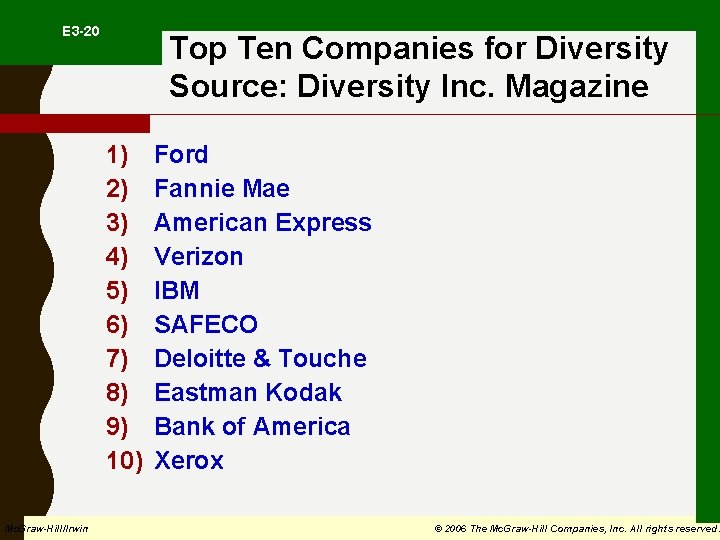
E 3 -20 Top Ten Companies for Diversity Source: Diversity Inc. Magazine 1) 2) 3) 4) 5) 6) 7) 8) 9) 10) Mc. Graw-Hill/Irwin Ford Fannie Mae American Express Verizon IBM SAFECO Deloitte & Touche Eastman Kodak Bank of America Xerox © 2006 The Mc. Graw-Hill Companies, Inc. All rights reserved.
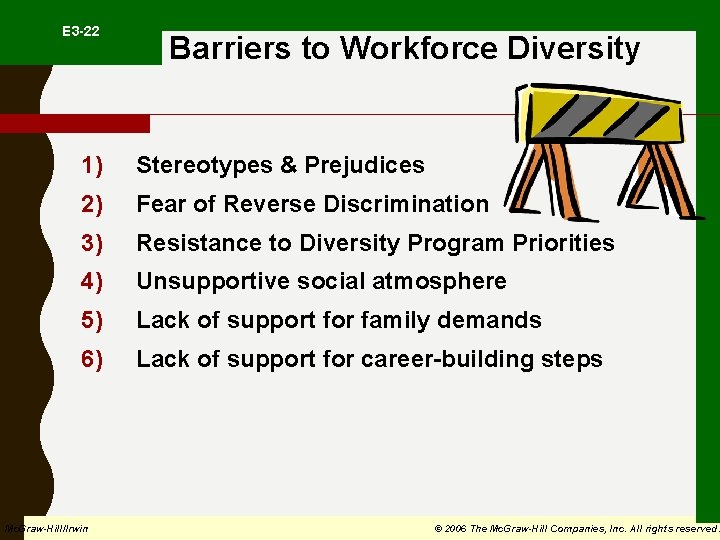
E 3 -22 Barriers to Workforce Diversity 1) Stereotypes & Prejudices 2) Fear of Reverse Discrimination 3) Resistance to Diversity Program Priorities 4) Unsupportive social atmosphere 5) Lack of support for family demands 6) Lack of support for career-building steps Mc. Graw-Hill/Irwin © 2006 The Mc. Graw-Hill Companies, Inc. All rights reserved.
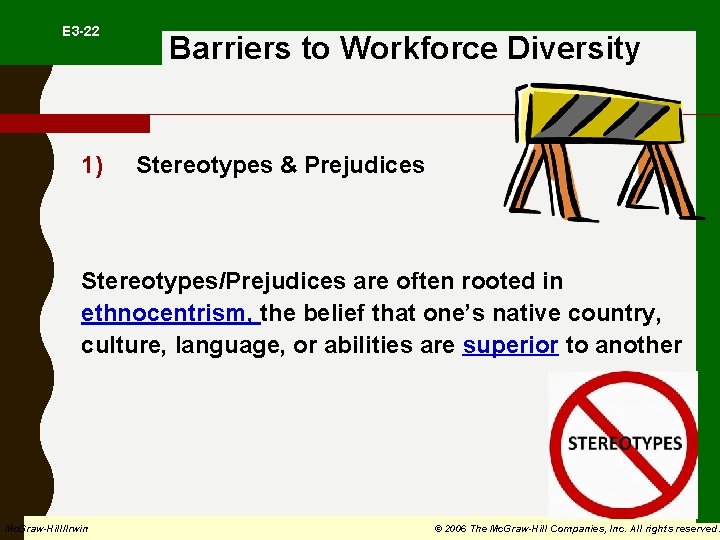
E 3 -22 1) Barriers to Workforce Diversity Stereotypes & Prejudices Stereotypes/Prejudices are often rooted in ethnocentrism, the belief that one’s native country, culture, language, or abilities are superior to another Mc. Graw-Hill/Irwin © 2006 The Mc. Graw-Hill Companies, Inc. All rights reserved.
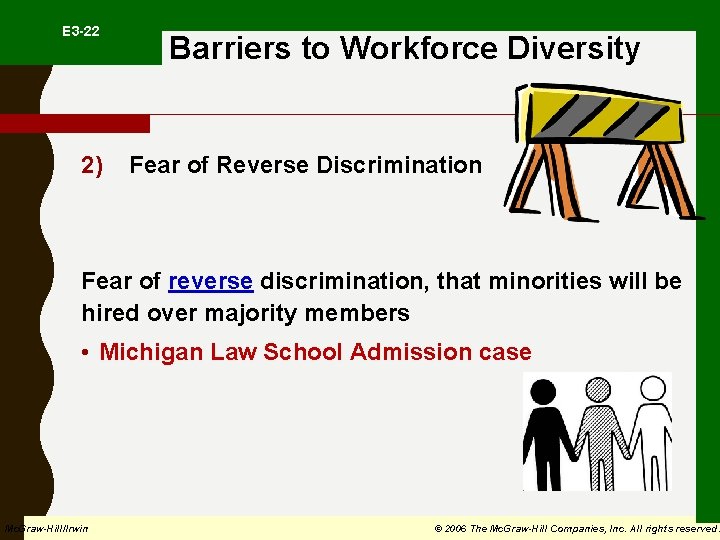
E 3 -22 2) Barriers to Workforce Diversity Fear of Reverse Discrimination Fear of reverse discrimination, that minorities will be hired over majority members • Michigan Law School Admission case Mc. Graw-Hill/Irwin © 2006 The Mc. Graw-Hill Companies, Inc. All rights reserved.
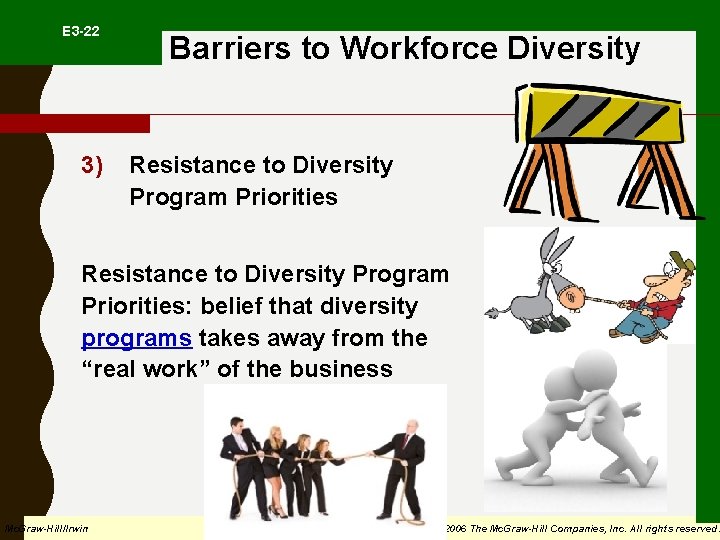
E 3 -22 3) Barriers to Workforce Diversity Resistance to Diversity Program Priorities: belief that diversity programs takes away from the “real work” of the business Mc. Graw-Hill/Irwin © 2006 The Mc. Graw-Hill Companies, Inc. All rights reserved.
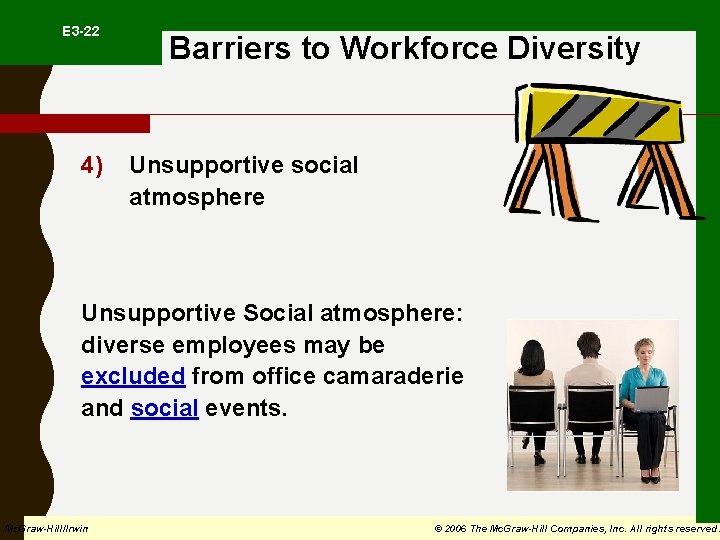
E 3 -22 4) Barriers to Workforce Diversity Unsupportive social atmosphere Unsupportive Social atmosphere: diverse employees may be excluded from office camaraderie and social events. Mc. Graw-Hill/Irwin © 2006 The Mc. Graw-Hill Companies, Inc. All rights reserved.
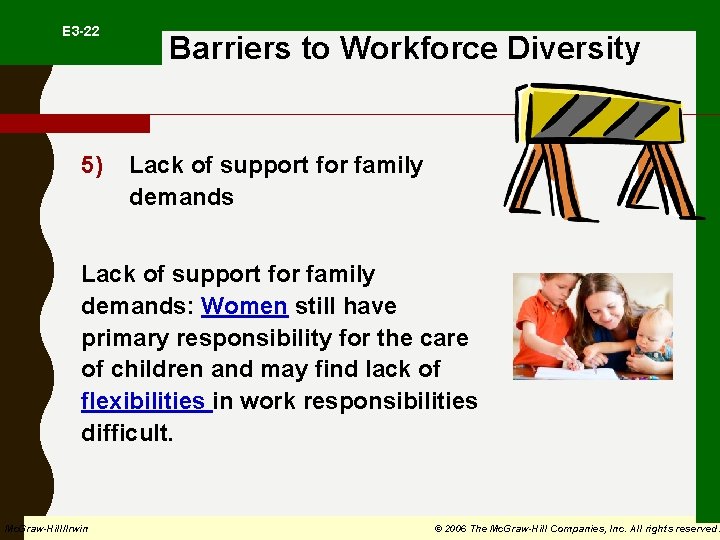
E 3 -22 5) Barriers to Workforce Diversity Lack of support for family demands: Women still have primary responsibility for the care of children and may find lack of flexibilities in work responsibilities difficult. Mc. Graw-Hill/Irwin © 2006 The Mc. Graw-Hill Companies, Inc. All rights reserved.
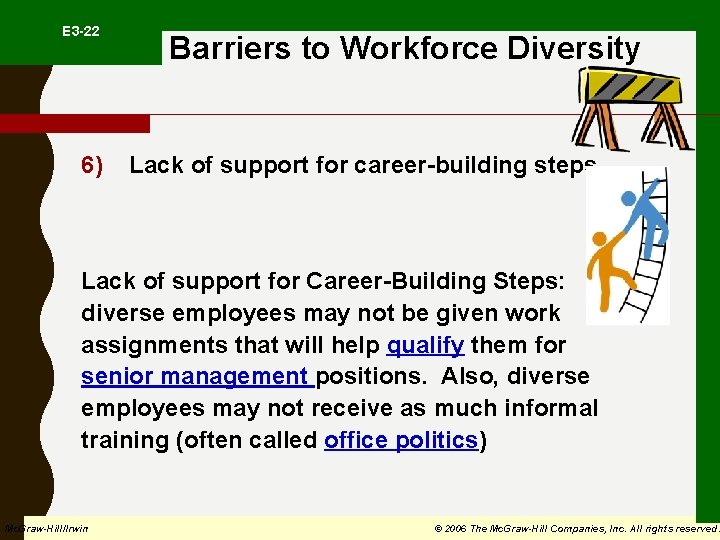
E 3 -22 6) Barriers to Workforce Diversity Lack of support for career-building steps Lack of support for Career-Building Steps: diverse employees may not be given work assignments that will help qualify them for senior management positions. Also, diverse employees may not receive as much informal training (often called office politics) Mc. Graw-Hill/Irwin © 2006 The Mc. Graw-Hill Companies, Inc. All rights reserved.

ENTREPRENUER INTRAPRENEUR
THE ENTREPRENEURIAL SPIRIT • Section 3. 6 – The Entrepreneurial Spirit – Entrepreneurship is defined as taking a risk in pursuit of success and wealth. – An Entrepreneur is someone who sees a new opportunity for a product or service and launches a venture to try and realize it.
THE ENTREPRENEURIAL SPIRIT • Section 3. 6 – The Entrepreneurial Spirit – An Intrapreneur is someone who works inside an existing organization who sees a new opportunity for a new product or service and mobilizes the organization’s resources to try and realize it.
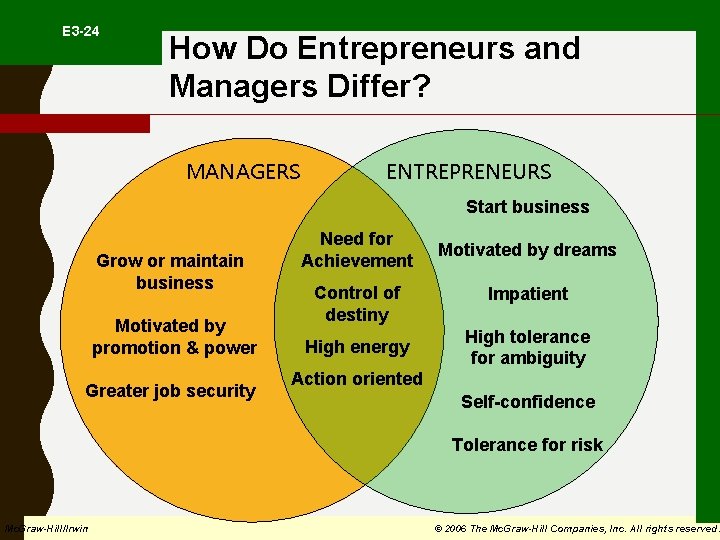
E 3 -24 How Do Entrepreneurs and Managers Differ? MANAGERS ENTREPRENEURS Start business Grow or maintain business Motivated by promotion & power Greater job security Need for Achievement Control of destiny High energy Motivated by dreams Impatient High tolerance for ambiguity Action oriented Self-confidence Tolerance for risk Mc. Graw-Hill/Irwin © 2006 The Mc. Graw-Hill Companies, Inc. All rights reserved.
• Work packet review exam due next class • Review Wednesday & Clean Up • Exam Friday REVIEW EXAM IN WORK PACKET Due next class worth 35 Points
- Slides: 66