
CHAPTER THREE SECURITY MARKETS TYPES OF SECURITY MARKETS

- Slides: 33
CHAPTER THREE SECURITY MARKETS
TYPES OF SECURITY MARKETS n CALL MARKETS • have posted hours for trading only • “called” securities are for sale to those buyers or sellers
TYPES OF SECURITY MARKETS n CONTINUOUS MARKETS • trading may occur at any time during a regular trading day • dealers (market makers) 3 provide liquidity to brokers who cannot find a suitable buyer or seller 3 usually are temporary positions
MAJOR U. S. SECURITY MARKETS n THE NEW YORK STOCK EXCHANGE (NYSE) • established as a corporation, with a charter and regulations for membership • approximately 1, 366 members • Board of Directors: 26 elected
MAJOR U. S. SECURITY MARKETS n NYSE SEATS: • purchased from a current member • give privileges to members to execute trades • held by individuals as well as brokerage firms
MAJOR U. S. SECURITY MARKETS n LISTED SECURITIES: Some criteria to list • the degree of national interest • relative position and stability in the industry • prospects of maintaining its relative position
TRADING HALTS n THE EXCHANGE MAY IMPOSE TRADING HALTS AND CIRCUIT BREAKERS • Trading Halts: 3 are temporary suspensions of trading in a listed firm’s shares
TRADING HALTS • Circuit Breakers: Rule 80 A 3 rule states that if the Dow Jones Industrial Average (DJIA) moves 50 or more points from a previous closing price, all index arbitrage orders will be subject to the “tick test. ”
TRADING HALTS • Circuit breakers: Rule 80 B 3 if a 350 point change before 3 PM occurs, the NYSE shuts down for one-half hour 3 if a 550 point change (total) occurs after the reopen, NYSE shuts down for 1 hour.
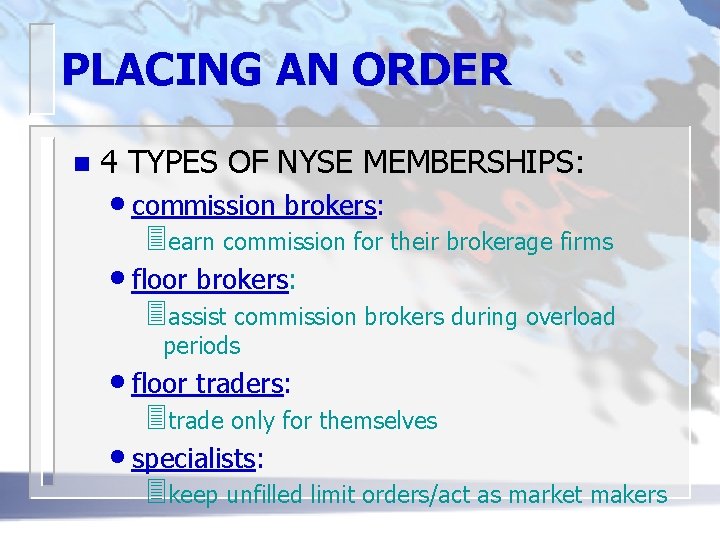
PLACING AN ORDER n 4 TYPES OF NYSE MEMBERSHIPS: • commission brokers: 3 earn commission for their brokerage firms • floor brokers: 3 assist commission brokers during overload periods • floor traders: 3 trade only for themselves • specialists: 3 keep unfilled limit orders/act as market makers
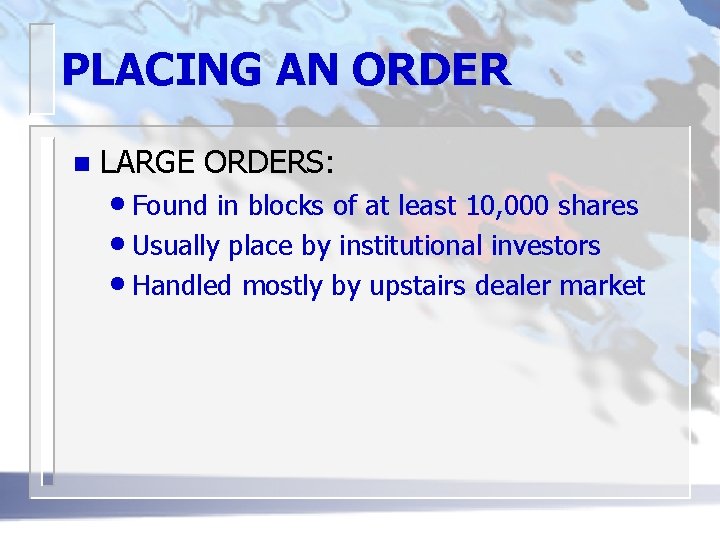
PLACING AN ORDER n LARGE ORDERS: • Found in blocks of at least 10, 000 shares • Usually place by institutional investors • Handled mostly by upstairs dealer market
PLACING AN ORDER n SMALLER ORDERS: • in the past these orders were often overlooked in favor of larger orders
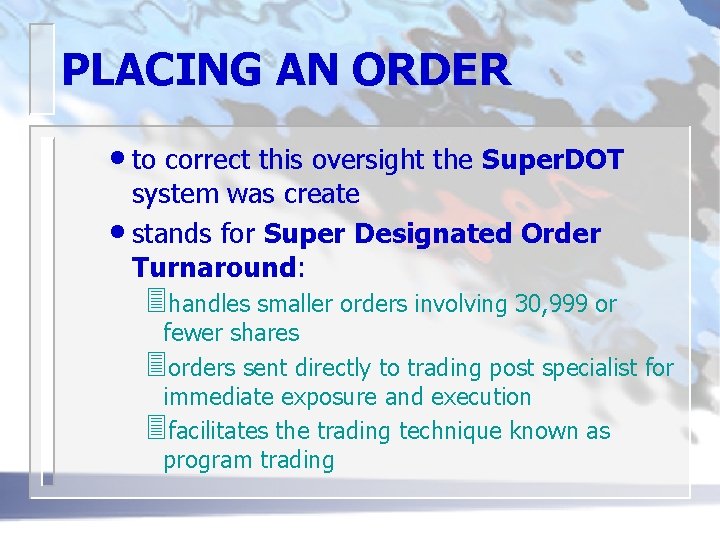
PLACING AN ORDER • to correct this oversight the Super. DOT system was create • stands for Super Designated Order Turnaround: 3 handles smaller orders involving 30, 999 or fewer shares 3 orders sent directly to trading post specialist for immediate exposure and execution 3 facilitates the trading technique known as program trading
OTHER EXCHANGES n THE AMERICAN STOCK EXCHANGE: • Lists stocks of smaller-sized companies
OTHER EXCHANGES n REGIONAL EXCHANGES: • Boston • Cincinnati • Chicago • Pacific • Philadelphia
OTHER EXCHANGES n REGIONAL EXCHANGES: • Options 3 Chicago Board Options Exchange – one of the largest • Futures 3 The Chicago Mercantile Exchange – offers interest rate, commodities, and index futures contracts
OVER-THE-COUNTER MARKET n NASDAQ is an o-t-c market: • created by the National Association of Securities Dealers (NASD) • the NASD created the NASD automated quotation system (NASDA) to clear transactions 3 a nationwide communication network allows instant access to all major dealers
OVER-THE-COUNTER MARKET n NASDAQ CLASSIFICATION OF STOCKS: • National Market System (NMS) 3 stocks with larger trading volumes 3 stocks that are eligible for margin and short transactions 3 Small Cap Issues
OVER-THE-COUNTER MARKET n SMALL ORDER EXECUTION SYSTEM • electronic order-routing system 3 limit: 100 shares
THIRD AND FOURTH MARKETS n THIRD MARKET: • A name for a market where 3 any trading of NYSE security is permitted 3 trading hours are not fixed 3 trading is not bound by NYSE trading halts or circuit breakers
THIRD AND FOURTH MARKETS n THE FOURTH MARKET: • Direct trading in exchange-listed securities • Between investors without the benefit of a broker • Trading facilitated by an automated system: INSTINET 3 give quotations and executions information immediately
OTHER METHODS OF ORDERING THE GROSSING SYSTEM n PREFERENCING n INTERNALIZATION n
FOREIGN MARKETS n LONDON STOCK EXCHANGE: • Significantly changed by the “Big Bang” of 1986: 3 ending fixed commissions 3 introduced SEAQ (Stock Exchange Automated Quotations) 3 attracted trading in non-UK stock
FOREIGN MARKETS n TOKYO STOCK EXCHANGE: • Has introduced major reforms: 3 introduced CORES (Computer-Assisted Order Routing and Execution System) 3 introduced FORES (Floor Order Routing and Execution System) 3 Saitori System of Trading 3 follows IYATOSE Method at market open similar to a call marekt – Zaraba used where orders are process continuously
FOREIGN MARKETS n TORONTO STOCK EXCHANGE: • Uses CATS (Computer-Assisted Trading System) • Similar to IYATOSE trading in Tokyo
INFORMATION- AND LIQUIDITYMOTIVATED TRADERS n THE DEALER’S DILEMMA: Adverse Selection • Assume there are two types of traders that a dealer may confront during the trading day: 3 informed traders whose information and identity are unknown to the dealer 3 uninformed (liquidity) traders
INFORMATION- AND LIQUIDITYMOTIVATED TRADERS n THE DILEMMA: How to quote the correct price and make a profit? • Solution: 3 set the bid-ask spread wide enough so that the gains from the uninformed traders offsets the mistaken price quotes to the informed traders.
REGULATION OF SECURITIES MARKETS n THE FOUR PILLARS OF SECURITY REGULATION: • The Securities Act of 1933 • The Securities Exchange Act of 1934 • The Investment Company Act of 1940 • The Investment Advisors Act of 1940
REGULATION OF SECURITIES MARKETS • Provisions of the Securities Act of 1933 3 known as the “truth in securities” law 3 requires registration of new issues 3 disclosure of relevant information by issuer 3 prohibits misrepresentation and fraud
REGULATION OF SECURITIES MARKETS • Provisions of the Securities Exchange Act of 1934 3 requires national exchanges, brokers, and dealers to be registered 3 made possible creation of Self Regulatory Organizations (SROs) to oversee the industry 3 established the Securities Exchange Commission (SEC)
REGULATION OF SECURITIES MARKETS • Provisions of the Investment Company Act of 1940 3 extends disclosure and registration requirements to investment companies
REGULATION OF SECURITIES MARKETS • Provisions of the Investment Advisors Act of 1940 3 required registration of those providing advice
END OF CHAPTER 3