
Chapter Three Money and Payments How We Use
- Slides: 14
Chapter Three Money and Payments
How We Use Money • Medium of Exchange – lowers transactions costs in exchanges of goods and services • Unit of Account – item in which prices are denoted; useful in making comparisons among goods • Store of Value – money maintains its value, except for inflation • Standard of Deferred Payment – loan repayments are stated in money terms Copyright © Houghton Mifflin Company. All rights reserved. 3|2
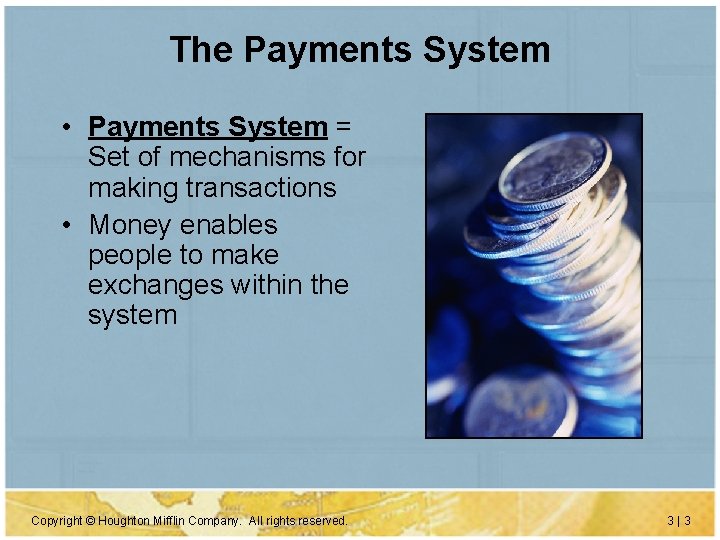
The Payments System • Payments System = Set of mechanisms for making transactions • Money enables people to make exchanges within the system Copyright © Houghton Mifflin Company. All rights reserved. 3|3
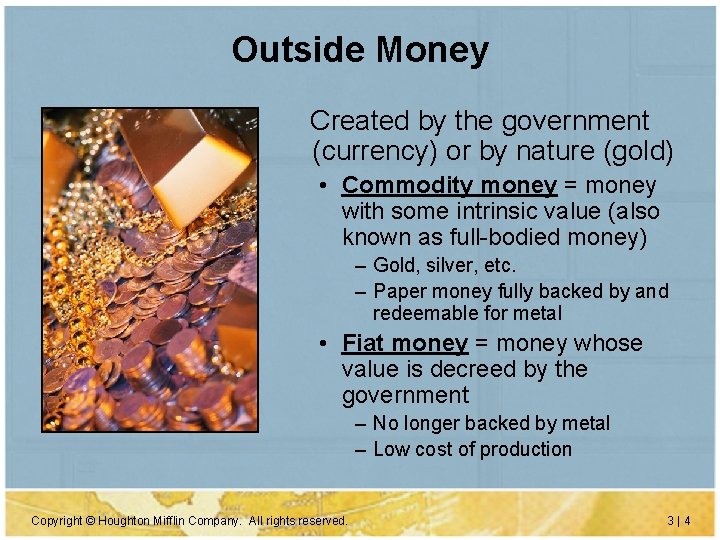
Outside Money Created by the government (currency) or by nature (gold) • Commodity money = money with some intrinsic value (also known as full-bodied money) – Gold, silver, etc. – Paper money fully backed by and redeemable for metal • Fiat money = money whose value is decreed by the government – No longer backed by metal – Low cost of production Copyright © Houghton Mifflin Company. All rights reserved. 3|4
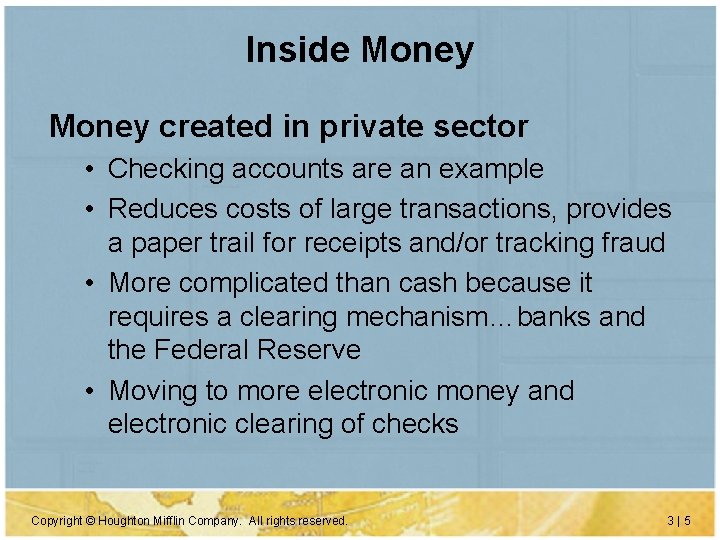
Inside Money created in private sector • Checking accounts are an example • Reduces costs of large transactions, provides a paper trail for receipts and/or tracking fraud • More complicated than cash because it requires a clearing mechanism…banks and the Federal Reserve • Moving to more electronic money and electronic clearing of checks Copyright © Houghton Mifflin Company. All rights reserved. 3|5
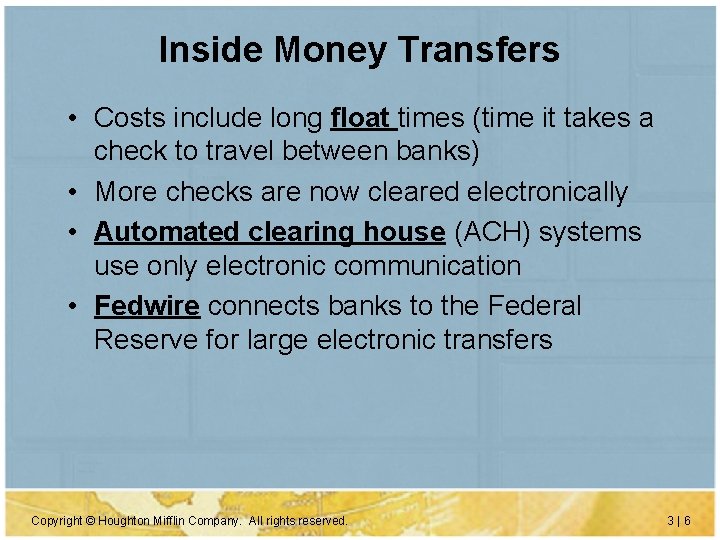
Inside Money Transfers • Costs include long float times (time it takes a check to travel between banks) • More checks are now cleared electronically • Automated clearing house (ACH) systems use only electronic communication • Fedwire connects banks to the Federal Reserve for large electronic transfers Copyright © Houghton Mifflin Company. All rights reserved. 3|6
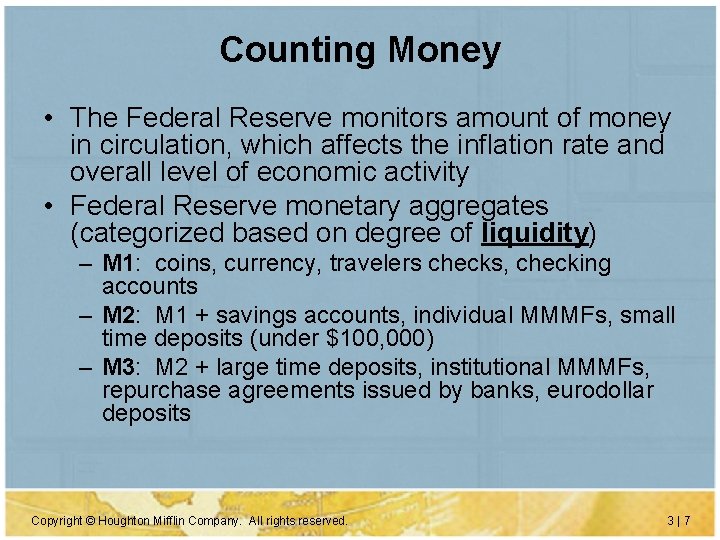
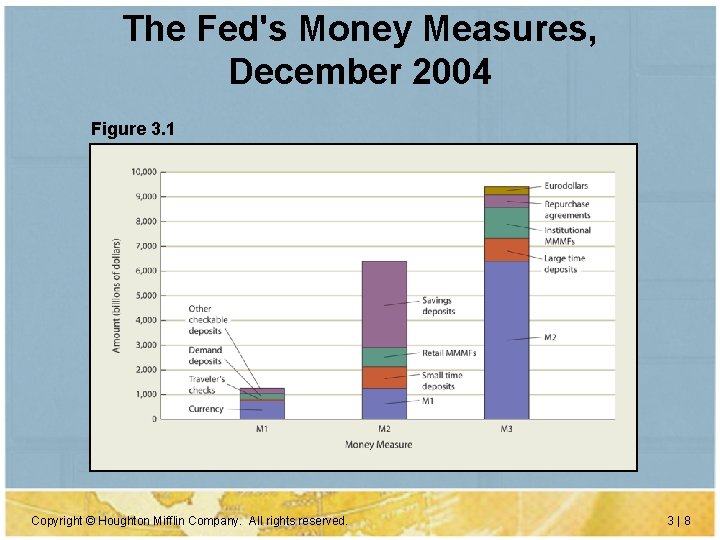
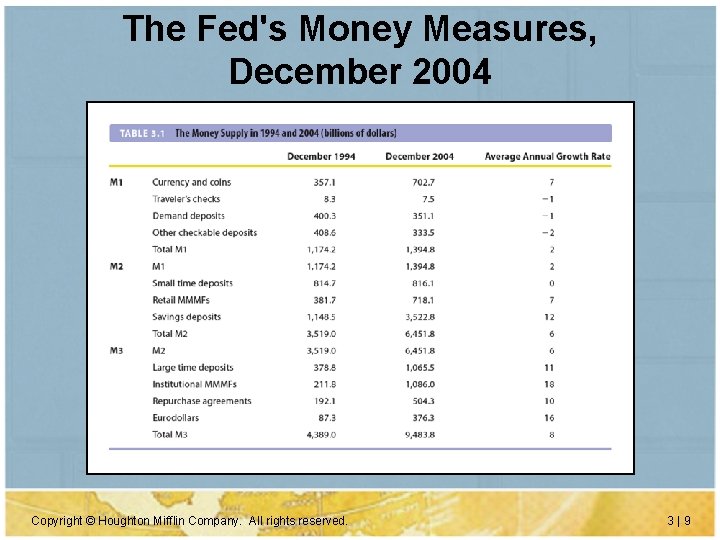
Counting Money • The Federal Reserve monitors amount of money in circulation, which affects the inflation rate and overall level of economic activity • Federal Reserve monetary aggregates (categorized based on degree of liquidity) – M 1: coins, currency, travelers checks, checking accounts – M 2: M 1 + savings accounts, individual MMMFs, small time deposits (under $100, 000) – M 3: M 2 + large time deposits, institutional MMMFs, repurchase agreements issued by banks, eurodollar deposits Copyright © Houghton Mifflin Company. All rights reserved. 3|7
The Fed's Money Measures, December 2004 Figure 3. 1 Copyright © Houghton Mifflin Company. All rights reserved. 3|8
The Fed's Money Measures, December 2004 Copyright © Houghton Mifflin Company. All rights reserved. 3|9
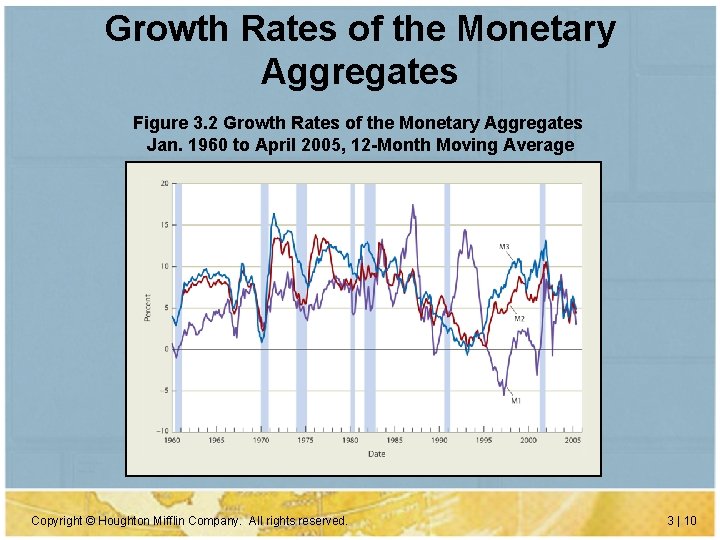
Growth Rates of the Monetary Aggregates Figure 3. 2 Growth Rates of the Monetary Aggregates Jan. 1960 to April 2005, 12 -Month Moving Average Copyright © Houghton Mifflin Company. All rights reserved. 3 | 10
The Case of the Missing Currency • Over $2, 000 in currency person in U. S. • Where is it all? – Some money is used in illegal activities – Almost 80% of U. S. money is held abroad (places with weak local currency hold U. S. dollars as a store of value) Copyright © Houghton Mifflin Company. All rights reserved. 3 | 11
Alternative Money Measures • Divisia monetary aggregate – Scientific approach to weighting components of M 1, M 2, and M 3 by their interest rates • MZM (Money with zero maturity) – M 2 – Small time deposits + institutional MMMFs – Idea: Money that can be spent immediately • M 2 + bond funds + equity funds Copyright © Houghton Mifflin Company. All rights reserved. 3 | 12
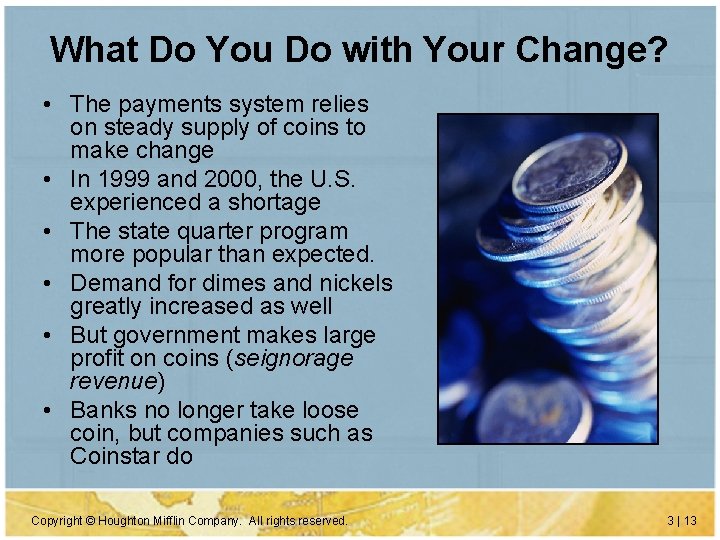
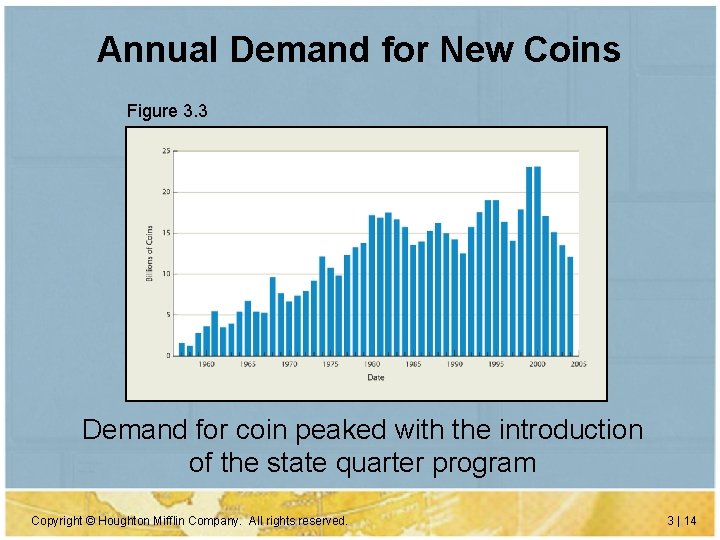
What Do You Do with Your Change? • The payments system relies on steady supply of coins to make change • In 1999 and 2000, the U. S. experienced a shortage • The state quarter program more popular than expected. • Demand for dimes and nickels greatly increased as well • But government makes large profit on coins (seignorage revenue) • Banks no longer take loose coin, but companies such as Coinstar do Copyright © Houghton Mifflin Company. All rights reserved. 3 | 13
Annual Demand for New Coins Figure 3. 3 Demand for coin peaked with the introduction of the state quarter program Copyright © Houghton Mifflin Company. All rights reserved. 3 | 14