
Chapter Three Maps Between Spaces I III IV
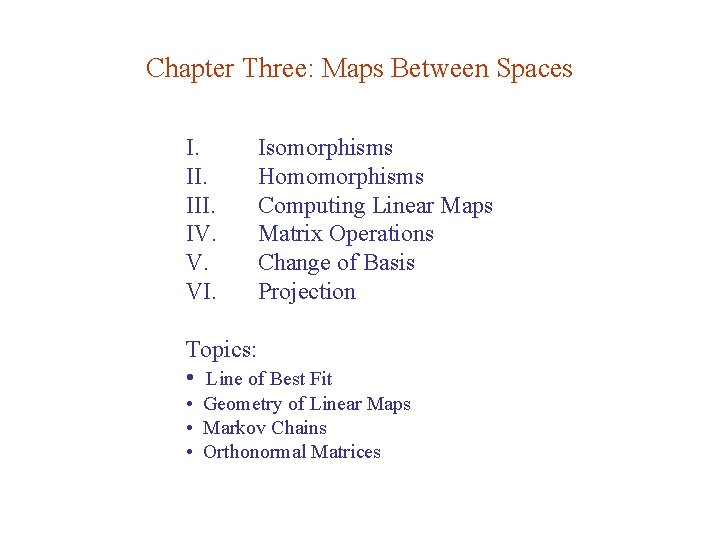
Chapter Three: Maps Between Spaces I. III. IV. V. VI. Isomorphisms Homomorphisms Computing Linear Maps Matrix Operations Change of Basis Projection Topics: • Line of Best Fit • Geometry of Linear Maps • Markov Chains • Orthonormal Matrices
3. I. Isomorphisms 3. I. 1. Definition and Examples 3. I. 2. Dimension Characterizes Isomorphism
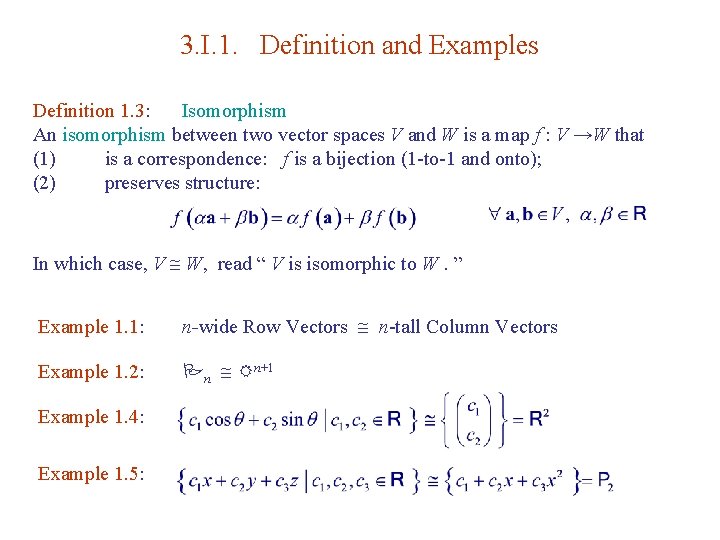
3. I. 1. Definition and Examples Definition 1. 3: Isomorphism An isomorphism between two vector spaces V and W is a map f : V →W that (1) is a correspondence: f is a bijection (1 -to-1 and onto); (2) preserves structure: In which case, V W, read “ V is isomorphic to W. ” Example 1. 1: n-wide Row Vectors n-tall Column Vectors Example 1. 2: Pn Rn+1 Example 1. 4: Example 1. 5:
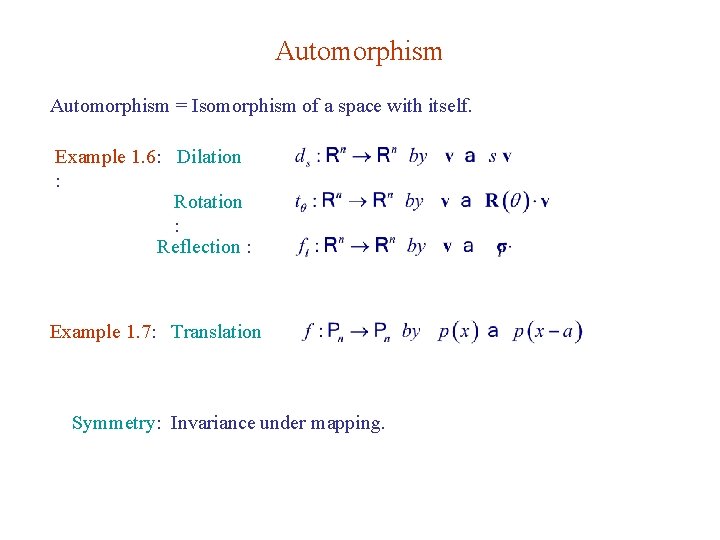
Automorphism = Isomorphism of a space with itself. Example 1. 6: Dilation : Rotation : Reflection : Example 1. 7: Translation Symmetry: Invariance under mapping.
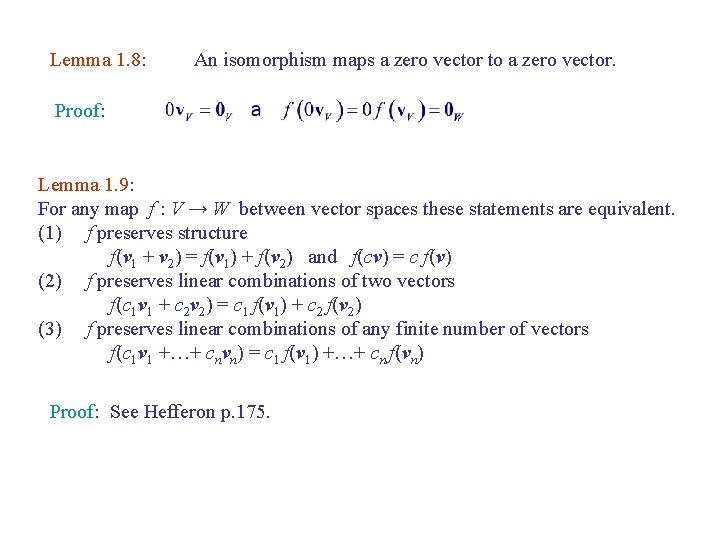
Lemma 1. 8: An isomorphism maps a zero vector to a zero vector. Proof: Lemma 1. 9: For any map f : V → W between vector spaces these statements are equivalent. (1) f preserves structure f(v 1 + v 2) = f(v 1) + f(v 2) and f(cv) = c f(v) (2) f preserves linear combinations of two vectors f(c 1 v 1 + c 2 v 2) = c 1 f(v 1) + c 2 f(v 2) (3) f preserves linear combinations of any finite number of vectors f(c 1 v 1 +…+ cnvn) = c 1 f(v 1) +…+ cn f(vn) Proof: See Hefferon p. 175.
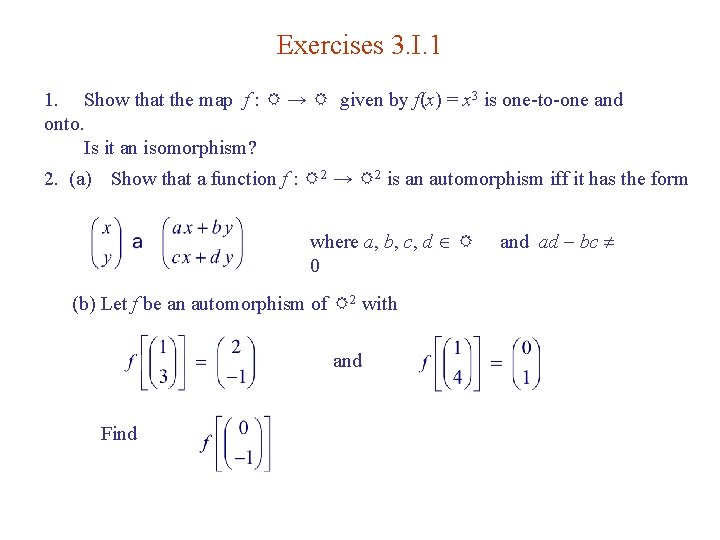
Exercises 3. I. 1 1. Show that the map f : R → R given by f(x) = x 3 is one-to-one and onto. Is it an isomorphism? 2. (a) Show that a function f : R 2 → R 2 is an automorphism iff it has the form where a, b, c, d R 0 (b) Let f be an automorphism of R 2 with and Find ad bc
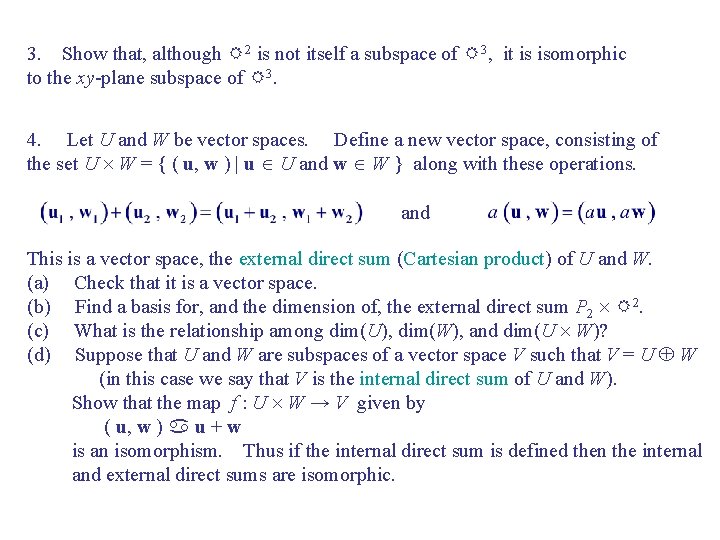
3. Show that, although R 2 is not itself a subspace of R 3, it is isomorphic to the xy-plane subspace of R 3. 4. Let U and W be vector spaces. Define a new vector space, consisting of the set U W = { ( u, w ) | u U and w W } along with these operations. and This is a vector space, the external direct sum (Cartesian product) of U and W. (a) Check that it is a vector space. (b) Find a basis for, and the dimension of, the external direct sum P 2 R 2. (c) What is the relationship among dim(U), dim(W), and dim(U W)? (d) Suppose that U and W are subspaces of a vector space V such that V = U W (in this case we say that V is the internal direct sum of U and W). Show that the map f : U W → V given by ( u, w ) u + w is an isomorphism. Thus if the internal direct sum is defined then the internal and external direct sums are isomorphic.
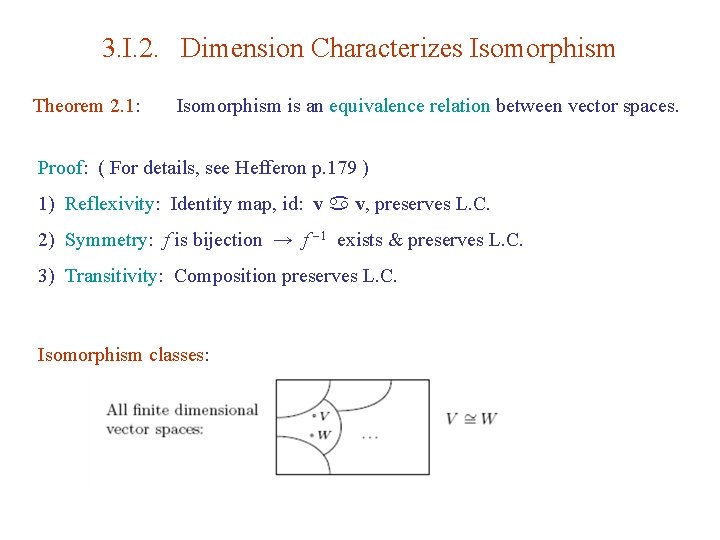
3. I. 2. Dimension Characterizes Isomorphism Theorem 2. 1: Isomorphism is an equivalence relation between vector spaces. Proof: ( For details, see Hefferon p. 179 ) 1) Reflexivity: Identity map, id: v v, preserves L. C. 2) Symmetry: f is bijection → f 1 exists & preserves L. C. 3) Transitivity: Composition preserves L. C. Isomorphism classes:
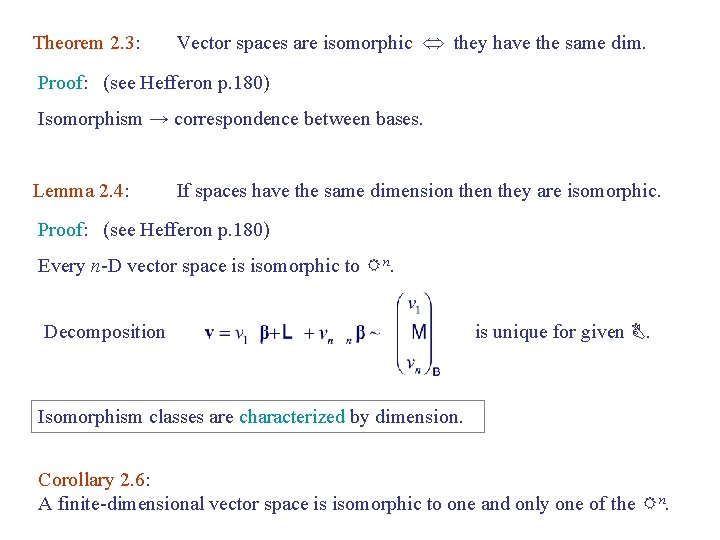
Theorem 2. 3: Vector spaces are isomorphic they have the same dim. Proof: (see Hefferon p. 180) Isomorphism → correspondence between bases. Lemma 2. 4: If spaces have the same dimension they are isomorphic. Proof: (see Hefferon p. 180) Every n-D vector space is isomorphic to Rn. Decomposition is unique for given B. Isomorphism classes are characterized by dimension. Corollary 2. 6: A finite-dimensional vector space is isomorphic to one and only one of the Rn.
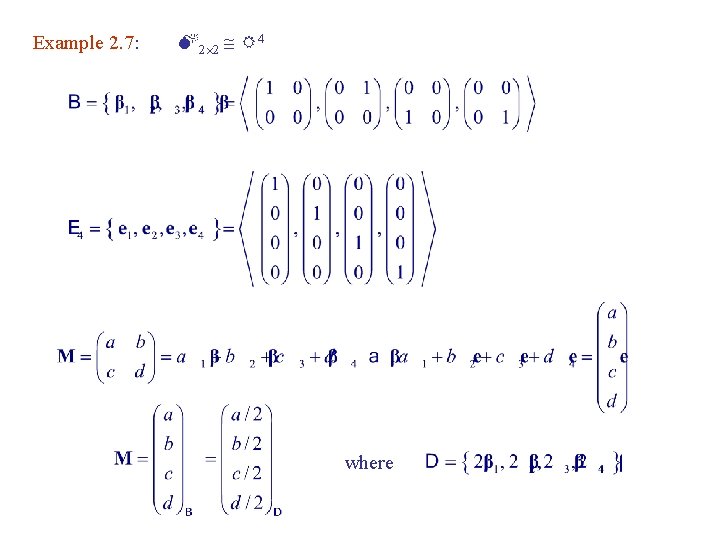
Example 2. 7: M 2 2 R 4 where
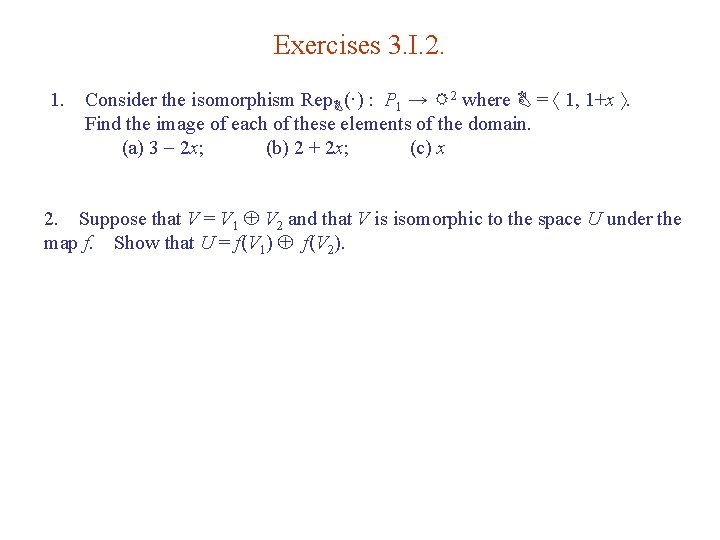
Exercises 3. I. 2. 1. Consider the isomorphism Rep. B(·) : P 1 → R 2 where B = 1, 1+x . Find the image of each of these elements of the domain. (a) 3 2 x; (b) 2 + 2 x; (c) x 2. Suppose that V = V 1 V 2 and that V is isomorphic to the space U under the map f. Show that U = f(V 1) f(V 2).
- Slides: 11