
Chapter Three Main Actors in the Labor Management
Chapter Three Main Actors in the Labor Management Relations Systems in Bangladesh
Trade Unions � "Trade Union" means any combination, whether temporary or permanent, formed primarily for the purpose of regulating the relations between workmen and employers or between workmen and workmen, or between employers and employers, or for imposing restrictive conditions on the conduct of any trade or business. � Trade unions are formed to protect and promote the interests of their members. Their primary function is to protect the interests of workers against discrimination and unfair labor practices.
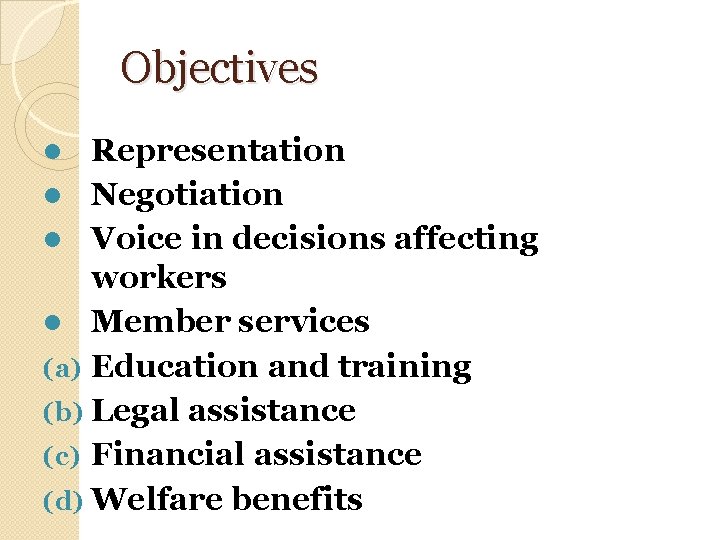
Objectives Representation l Negotiation l Voice in decisions affecting workers l Member services (a) Education and training (b) Legal assistance (c) Financial assistance (d) Welfare benefits l

Functions of Trade unions (i) Militant functions (a) To achieve higher wages and better working conditions (b) To raise the status of workers as a part of industry (c) To protect labors against victimization and injustice
(ii) Fraternal functions l To take up welfare measures for improving the morale of workers l To generate self confidence among workers l To encourage sincerity and discipline among workers l To provide opportunities for promotion and growth l To protect women workers against discrimination
Legal framework of trade union � The Constitution of Bangladesh provides the basic legal foundation formation of organizations by workers and employers. � Section 176 of the Bangladesh Labour Act 2006 provides that every worker has the right to constitute a trade union and to join an association of their choosing. � However, the Act does not cover home workers, EPZs, and agricultural workers. � In order to be registered, a trade union must have a minimum membership of 30 per cent of the total number of workers employed in any establishment or group of establishments in which it is formed. � percentage of workers formation of trade union in civil aviation sector the Act requires that half of the total number of workers should apply for trade union.
Legal framework of trade union The Committee of Experts under the ILO Convention 98 has asked the Government to lower this percentage since it may impede the development of free and voluntary trade unions � As a requirement of formation of trade union, the Act prescribes election of officers by the general body of trade union � The act provides that the term of officer shall not exceed two years upon his election or re-election. � Certificate of registration is issued by the Director of Labour. � Section 176(c) of the Act provides that trade unions shall have the right to establish and join federations � Union or federation shall have the right to affiliate with international organizations and confederations of workers’ organization. �
Cancellation of registration of trade union � Section 194(1), a registered trade union is a statutory body with legal entity and consequently it can own property, enter into contract, sue and be sued by the name in which it is registered. Section 190 of the Act gives powers to the Director of Labour to cancel the certificate of registration under well defined circumstances Where the Director of Labour is satisfied after investigation that the registration of the trade union should be cancelled, he shall submit an application to the Labour Court praying for permission to cancel such registration. The Director of Labour shall cancel the registration of a trade union within thirty days from the date of receipt of permission from the Labour Court. Section 191 of the Act stipulates that any person aggrieved by the order of cancellation of registration may within thirty days from the date of the order, appeal to the Labour Appellate Tribunal. The decision of the Tribunal on this shall be final.

Structure of trade unions Trade unions in Bangladesh may be divided into three categories: Basic trade union • the trade unions at plant level are termed basic unions. Federation of trade unions • any two or more registered trade unions formed in establishment which are engaged in or carrying on the same industry may constitute federation by executing an instrument of federation and the apply for the registration of the federation. • Federation of trade unions can be two types: industrial federation and national federation. National level trade union • National level trade union federations had formed a grand alliance under the auspices of the SKOP (Sromik Kormochari Oikka Parishad), which represents the total workers of the country except the trade unions in the RMG sector.
Trade Unions in the public sector � The Bangladesh Labour Act, 2006 is not applicable to offices of or under the Government � Therefore, the concept of collective bargaining shall not be applicable to officials of public sector. � trade unions are allowed under the framework of the Act for workers of publicly owned corporations, railways, telephone and postal services, public works, public health engineering and government printing press etc. � the Committee of Experts expressed concerns that a vast number of workers in the public sector and state enterprises with the exception of railway, postal and telecommunication services cannot exercise the right to collective bargaining through trade unions. � The terms and conditions of employment of the public sector workers are determined by the government on the recommendation of the National Wages Commission established from time to time. � In reality, no trade unionism is practiced in the public industrial enterprises in Bangladesh
Trade union membership and international affiliation � From 1, 160 trade unions with a membership of 450, 606 in 1971 trade unions had risen to 6, 835 with a membership of 1, 904, 567 in 2004. � The average membership of trade unions has declined significantly. � Trade union density is 1. 12 per cent of the total labour force. � The presence of trade unions in the private export-oriented sectors such as RMG, EPZs, shrimp exporting firms, finished leather and leather goods is very weak. � Although there are more than 40 unions representing garments workers, but workers are less unionized. � Most trade unions in the RMG sector operate outside the factories and therefore lack active participation of the general workers � A combination of factors such as lack of enforcement of labour laws, inhibiting legal provisions, and system of contract labour are responsible for reduced trade union membership in these sectors. � The workers belonging to government sectors, educational institutions, health sector, private security services, confidential staffs, workers in security printing press, ordinance factory, are still deprived from the right to organize and do not have the freedom of collective bargaining.
INDUSTRY BACKGROUND updated till 2011 The major industries of Bangladesh constitutes of 10 sectors. These are- Agriculture, forestry and fisheries � Mining and quarrying � Manufacturing � Electricity gas and water � Construction � Trade, hotel and restaurant � Transport, storage and communication � Finance and business services and real estate � Health, education public administration and defense � Community and personal services Out of these industries Construction and Agriculture Industries do NOT fall under the provisions of Bangladesh labor Law 2006 as the workers in those industries are considered as INFORMAL WORKERS �
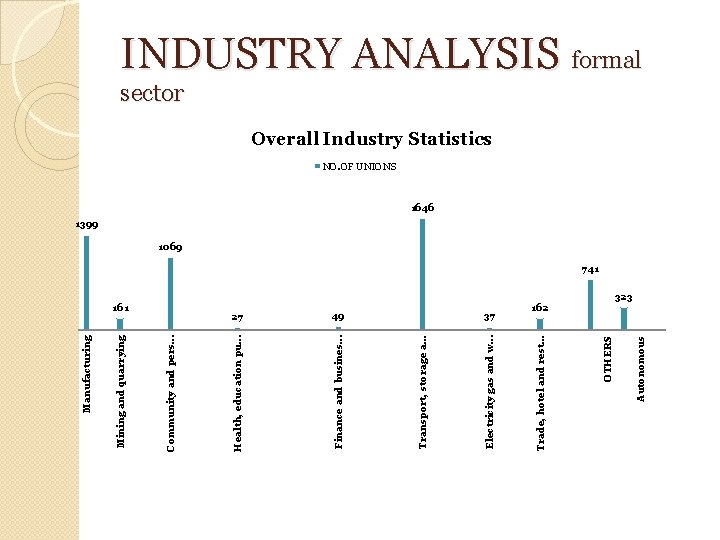
49 162 Autonomous OTHERS 37 Trade, hotel and rest. . . Electricity gas and w. . . Transport, storage a. . . 27 Finance and busines. . . 161 Health, education pu. . . Community and pers. . . Mining and quarrying Manufacturing INDUSTRY ANALYSIS formal sector Overall Industry Statistics NO. OF UNIONS 1646 1399 1069 741 323
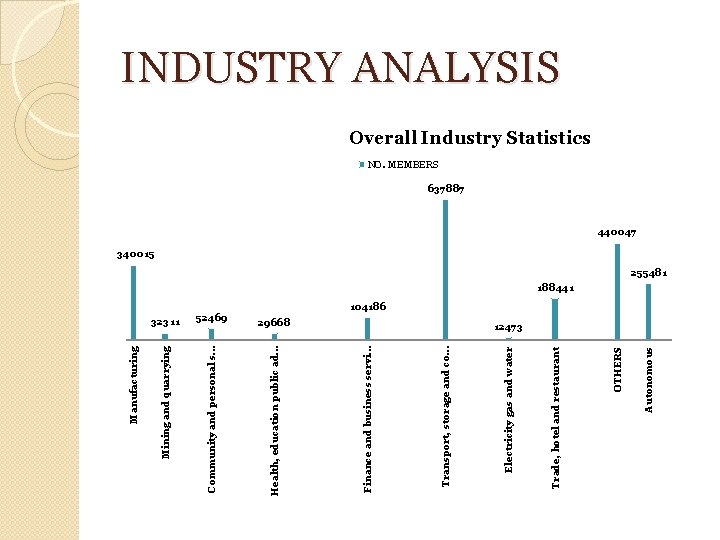
Community and personal s. . . Autonomous OTHERS Trade, hotel and restaurant 29668 Electricity gas and water Transport, storage and co. . . Finance and business servi. . . Health, education public ad. . . 32311 52469 Mining and quarrying Manufacturing INDUSTRY ANALYSIS Overall Industry Statistics NO. MEMBERS 637887 440047 340015 188441 255481 104186 12473
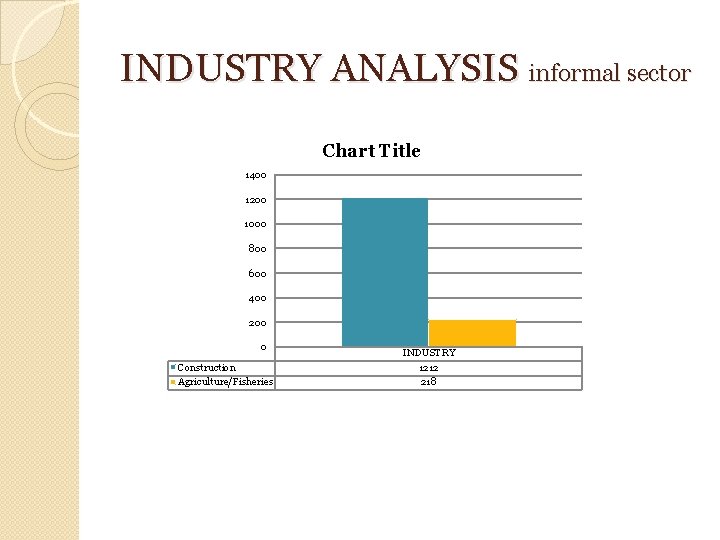
INDUSTRY ANALYSIS informal sector Chart Title 1400 1200 1000 800 600 400 200 0 Construction Agriculture/Fisheries INDUSTRY 1212 218
Trade union effectiveness: RMG sector � At present, this grand alliance claims membership of 21 trade unions out of the 27 unions of garment workers. � Out of 4, 500 garments factories only 120 are affiliated to the unions, less than 5 per cent of the garments workers. � Knitwear garment workers are outside of the operations of the trade unions. � Two national garments federation are registered with the Department of Labour. � From 1994 to 2006 RMG workers’ union signed seven agreement/MOUs with the BGMEA on matters of declaring and implementing minimum wages for garments workers, recognizing trade union activities, leave and holidays etc. � The national tripartite agreement was concluded between the government, BGMEA and the organizations representing garments workers in 2006. � Most of the demands were subsequently incorporated in the Bangladesh Labour Act 2006
Problems of trade unions in Bangladesh � Currently trade unions are faced with problems. The following are some of the reasons - • Politicization: politicization or political affiliation of trade unions prevents them from becoming strong partners in collective bargaining. Politicization of a trade union also causes the loss of its distinct identity; • Influence: the trade unions must be free from influences from political groups, government influence and owners; • Lack of knowledge of labor laws: Workers at the grass root level are not aware of their rights. � Different ideologies: At the national level, trade unions are divided into many federations with diverse ideological and political philosophy. � Accountability of the trade union leaders: accountability of the trade union leaders, which requires a network of checks and balances between labour institutions, and defined performance standards for both common workers and trade union leaders.
Problems of trade unions in Bangladesh • Competence of the trade union leaders: this involves the capacity to formulate appropriate charters of demand, take timely decisions, and implement them effectively. • Ethical Values: trade unions leaders should possess positive ethical values. They must work for to protect the rights of the employees. They shouldn’t be more interested in their personal goals. • Inter-union rivalry: conflict within the trade union for the leadership position may make the situation worse. • Conflict of interest: trade union will fail if the members are more interested in the individual goals rather than the group goals.
Developing leadership skills in trade union leaders � Leadership has been identified as one of the major reasons behind poor trade union outcomes. � It is imperative that trade union leaders possess effective leadership skills. � They must know how to protect the rights of the employees. � The must have skills in the area of negotiation, communication, handling grievance, and management.
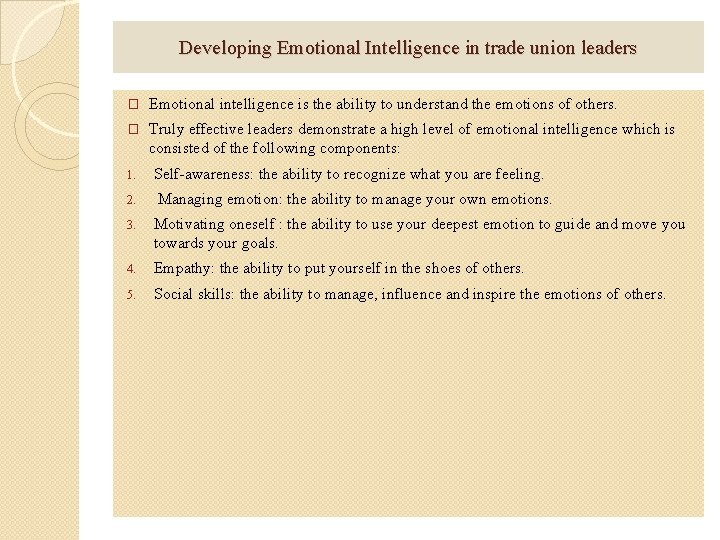
Developing Emotional Intelligence in trade union leaders � Emotional intelligence is the ability to understand the emotions of others. � Truly effective leaders demonstrate a high level of emotional intelligence which is consisted of the following components: 1. 2. Self-awareness: the ability to recognize what you are feeling. Managing emotion: the ability to manage your own emotions. 3. Motivating oneself : the ability to use your deepest emotion to guide and move you towards your goals. 4. Empathy: the ability to put yourself in the shoes of others. 5. Social skills: the ability to manage, influence and inspire the emotions of others.
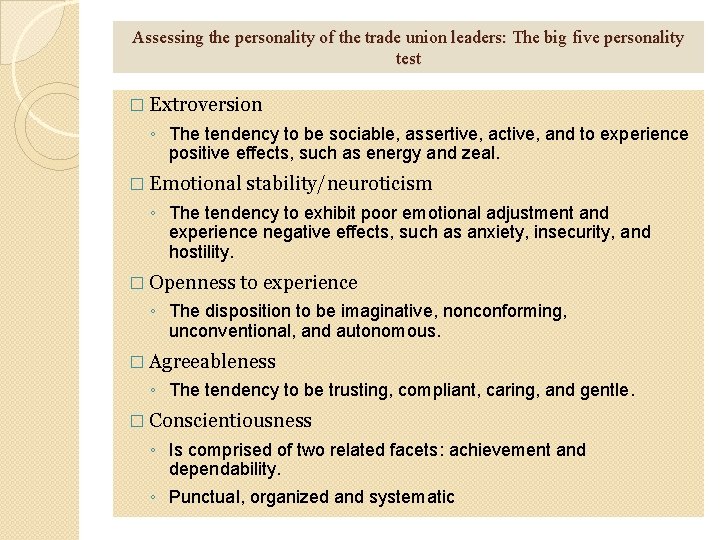
Assessing the personality of the trade union leaders: The big five personality test � Extroversion ◦ The tendency to be sociable, assertive, active, and to experience positive effects, such as energy and zeal. � Emotional stability/neuroticism ◦ The tendency to exhibit poor emotional adjustment and experience negative effects, such as anxiety, insecurity, and hostility. � Openness to experience ◦ The disposition to be imaginative, nonconforming, unconventional, and autonomous. � Agreeableness ◦ The tendency to be trusting, compliant, caring, and gentle. � Conscientiousness ◦ Is comprised of two related facets: achievement and dependability. ◦ Punctual, organized and systematic
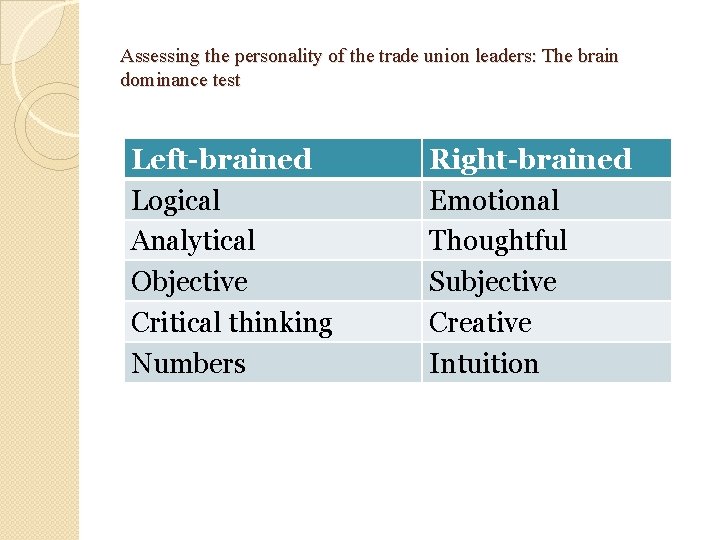
Assessing the personality of the trade union leaders: The brain dominance test Left-brained Logical Analytical Objective Critical thinking Numbers Right-brained Emotional Thoughtful Subjective Creative Intuition
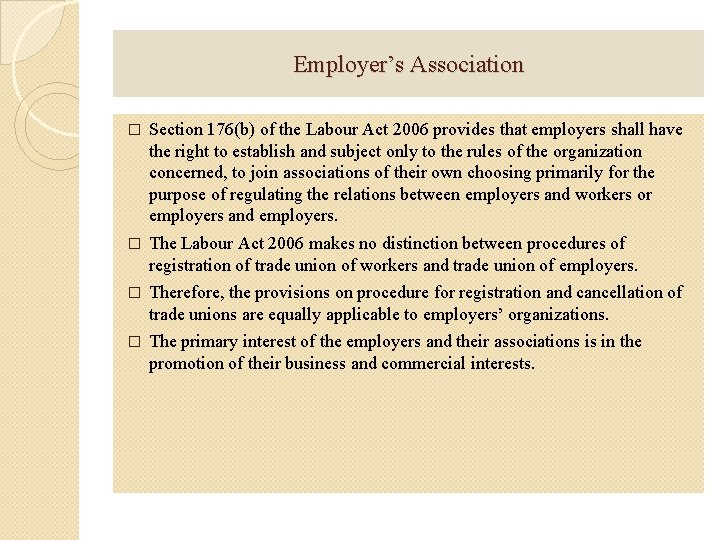
Employer’s Association � Section 176(b) of the Labour Act 2006 provides that employers shall have the right to establish and subject only to the rules of the organization concerned, to join associations of their own choosing primarily for the purpose of regulating the relations between employers and workers or employers and employers. � The Labour Act 2006 makes no distinction between procedures of registration of trade union of workers and trade union of employers. � Therefore, the provisions on procedure for registration and cancellation of trade unions are equally applicable to employers’ organizations. � The primary interest of the employers and their associations is in the promotion of their business and commercial interests.
Employer’s Association � Bangladesh Employers Federation (BEF) is the main federation of employers’ association � The main members of BEF are: - Bangladesh Garments Manufacturing and Exporters Association (BGMEA) - Bangladesh Textile Mills Association (BTMA) - Bangladesh Knitwear Manufacturers and Exporters Association (BKMEA) - Bangladesh Jute Mills Association (BJMA) - Bangladesh Finished Leather, Leather goods and - Footwear Exporters Association. � After its founding in 1998, the BEF took over the activities of the Bangladesh Employers' Association (BEA) which was registered earlier in 1951. � The BEF with a wider membership representation covers approximately 90 per cent of industrial associations in the country as well as prominent individual enterprises.
Role of employers’ organizations � Protect the interest of the employers: The objectives of the Federation are to promote, encourage and protect the interest of the employers in industrial relations, and through such efforts, to establish good relations amongst employers and workers. � Socio- economic policies: It now has a stake in socio-economic policies of the Government, labour legislation and labour relations with kindred national and international bodies. Broadly, its functions include: • Interpretation and clarification of labour laws • Services on wage negotiations by the Wages Consultative Sub-committees in different regions • Legal services to employers in labour courts • Services for improvement in productivity • Training programs (seminars and workshops) • Assistance and advice on national policy issues.
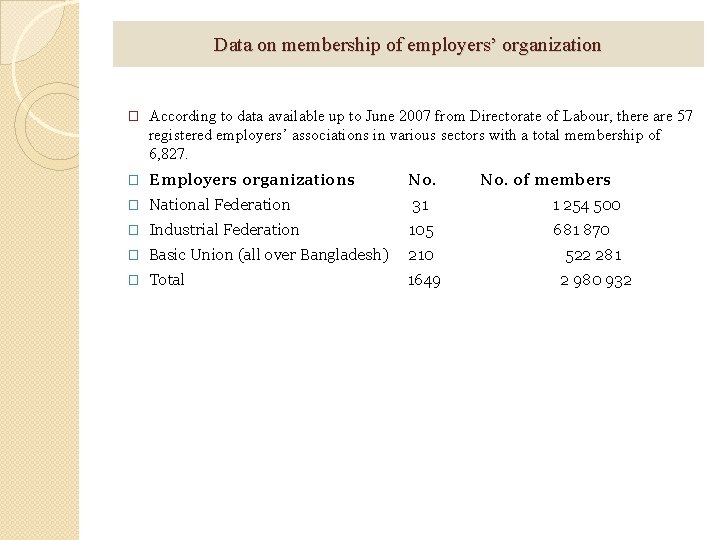
Data on membership of employers’ organization � According to data available up to June 2007 from Directorate of Labour, there are 57 registered employers’ associations in various sectors with a total membership of 6, 827. � Employers organizations No. � National Federation 31 1 254 500 � Industrial Federation 105 681 870 � Basic Union (all over Bangladesh) 210 522 281 � Total 1649 2 980 932 No. of members
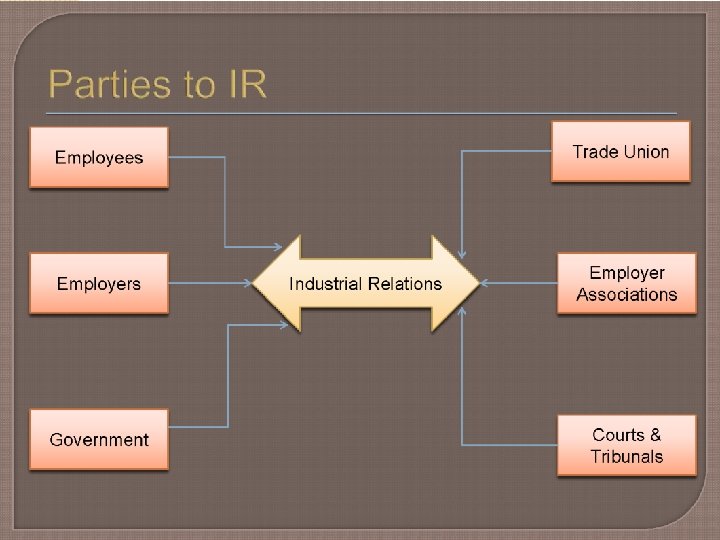
Role of the State in maintaining industrial relations Industrial relations system in Bangladesh is characterized by the predominant role played in it by the government. � Effective laws: It is the duty of the state to formulate labour laws and policies, to administer them and also to uphold justice so that neither the workers nor the employers suffer. � Effective collective bargaining process: The state has to ensure that there is no interference in the bargaining process from any political party, government or the employer. � No state intervention in resolving dispute: Any kind of state intervention in industrial disputes may strain the relationship between the workers and employers. � Inspection: industrial activities should be inspected properly. � But the government intervention in trade union remains a persistent feature of industrial relation system in Bangladesh. � The success or failure of tripartite consultation or negotiations largely depends on the responsiveness of Government to the demands and aspirations of both employers and workers.
Structure and system of labour administration in Bangladesh • The Ministry of Labour and Manpower has under it the following implementing agencies: Ø Department of Labour � DOL was established in 1983. � The department has a Director as its head, an additional director, a joint director and an assistant director of Labour. � There are four Divisional offices under the Department of Labour under which there are 16 regional offices in different industrial areas.
Structure and system of labour administration in Bangladesh Ø Department of Inspection for Factories and Establishments; • Inspection of factories, shops, commercial establishments, tea plantations, ports/docks, railways, inland water transport and road transports under labour laws relating to safety, health, hygiene, labour welfare, payment of wages, regulation, hours of work, conditions and terms of employment, social security etc. of workers � The department of Inspection for Factories and Establishments works under three wings 1. engineering wing, 2. medical wing and 3. general wing. � Chief Inspector is the head of the Department � The Inspection Office has to look after and execute the provisions relating to 40, 000 factories, 30, 00000 shops, 170 tea gardens, 60 ship-breaking industries, two dockyards etc.
Structure and system of labour administration in Bangladesh Ø Bureau of Manpower, Employment and Training (BMET); Ø Minimum Wages Board; Ø Labour Appellate Tribunal and seven labour courts;
“Good management consists in showing average people how to do the work of superior people” – John D. Rockefeller
- Slides: 34