
Chapter Three Formation of Business Organization 3 1
Chapter Three Formation of Business Organization 3. 1. Forms of Business Ownership Ø From point of view of organization or ownership, there are five main forms of organizations. Ø A business may be organized by an individual as sole proprietorship; by mutual agreement of two or more persons as partnership; by an association of persons who form a co operative society or by a number of persons as a joint stock company or corporation or else it may be organized by a government as a public enterprise. For entrepreneurship purposes, however, the chief forms of ownership or organization are: sole proprietorship, partnership, corporation, franchising and co operative society.
3. 1. 1. Sole proprietorship Ø A form of business organization in which an individual introduces his/her own capital, skill and intelligence in the management of its affairs and is solely responsible for the results of its operation known as Sole proprietorship. Ø This form is also known as individual or single proprietorship, sole ownership or individual enterprise. Ø This business is a very common form of ownership carried out in different areas where the capital required is small and the risk is not heavy. In such form of ownership, speed of decision is very important and special regard has to be shown to the needs, tastes and fashions of customers. Ø Examples can be photo studios, bookshops, bakeries, small restaurants, grocery and retail stores, and other elementary business where a personal service is important.
Advantages of Sole Proprietorship Ease and low cost of formation and dissolution • It is easy to form a sole proprietorship; the legal formalities or other complicated procedures required are less. Anyone with limited means can start independent business and gets him/herself employed. Direct motivation and personal care • In this form of organization, all the profits of the business belong to one person who also faces every loss. This gives greater incentive to the owner to take personal interest in the business and manage it efficiently. As only one person is dealing with the business, the proprietor can come into close contact with the customers; and earn goodwill by attending the customers' demands promptly and satisfactorily. Freedom and promptness in action • In matters of business dealing, the sole proprietor can take his/her own decision and there is no question to his/her authority. This type of freedom of action promotes initiative and self reliance. As there is no need to consult other persons, the sole proprietor can take prompt decision. Business secrecy • In this type of business, it is easy to maintain the secrecy of business. Since confidential information is a key to success for a competitive business, it is unlikely that the owner will leak the information. Thus, any change he/she wants to make regarding business methods or policies can be done without the knowledge of others. Social desirability • From the social point of view, the sole proprietorship is desirable as it ensures that too much wealth does not concentrate in the hands of few. It may be one of the ways in which equitable distribution of wealth is ensured.
Disadvantages of Sole Proprietorship Limited resource and size • In this type of concerns, the resources, that is, the capital and skill are very limited. As only one person is responsible for the business, capital is limited to his/her capacity. Lending institutions may hesitate to lend large sum of money, and suppliers may be unwilling to make credit sales in large quantities to such a business because it is neither safe nor dependable, which makes the business to remain limited in size. Unlimited liability • The sole proprietor will be legally liable for all debts of the business. At times of loss and bankruptcy, if the business asset is not sufficient to satisfy the obligations or debts of creditors, her personal and real property may be required to pay off. This concept of unlimited liability is on the one hand a source of courage and real devotion. On the other hand, it makes the owner to be fearful and averse to risk. Limited management skill • While running a business many complex and difficult problems may arise requiring wide array of knowledge in management. This makes the possibility of solving the problems difficult for the sole proprietor in such form of business. Uncertain future • This kind of business suffers from instability or lack of continuity. This business may come to end if the owner cannot continue to run the business due to death, insanity, imprisonment or bankruptcy.
3. 1. 2. Partnership When it will be difficult to find a single person possessing adequate capital, technical skill, knowledge, and managerial experience; there arises a need for a formation of business where two or more persons join together, contribute their capital and skills. This form of association of two or more persons to carry on a business as co owners for profit whereby the relationship is based on agreement is known as partnership. The following are general characteristics of a partnership: Formation This form of business requires the existence of two or more persons entering into a contract. • Capital contribution • In this form of business, every partner shall make a contribution which may be in money, debts, other property or skill. • Management • Every partner has the right to take an active part in the management of the firm's affair. But the partnership agreement may provide the pattern of managing by indicating how the management activity is shared among the different partners according to their experience and knowledge.
Duration The partnership firm legally comes to an end if any of the partners withdraws or is no longer able to be a partner under the law or declared bankrupt. However, if the remaining partners agree to work together under the original firm name and style, the firm will not be dissolved and will continue its business after settling the claims of the outgoing partner. Under some conditions, the business organization can be dissolved if the purpose has been achieved or cannot be achieved and where the partners agree to dissolution prior to the expiry of the term for which the business was formed.
Other legal characters • Unlimited liability: The liability of each partner of the firm is unlimited in respect of the firm's debts. The liability of partners is joint; in a sense that the creditors can recover their dues from the property of any or all partners in case the firm's assets are insufficient. • Implied agency: The partner will be liable for the faults and wrongful acts of a co partner while acting for the business. Since every partner has the right to take part in the management activity, when acting on his/her given a specified area, every partner has an authority to act on behalf of his/her fellow partners and the firm in the ordinary course of business. Thus, he/she is an agent of the firm and that of the other partners. • Utmost good faith: there must be the highest standard of honest among partners. Partnership agreement is based on mutual confidence and trust of partners. • No separate legal entity: the partnership firm has no independent legal existence apart from the persons who constitute it. In the eyes of the law, there is no distinction between the partners and the firm. • Restriction on transfer of interest: A partner cannot transfer his/her share or give his/her ownership to outsiders without the consent of other partners. • Unanimity of consent: No change may be made in the nature of business and no partner can act out of the specified way or make major and special decision without the consent of all the partners.
Types of Partnership • General Partnership: This form of partnership consists of partners who are jointly, severally, partially and fully liable as between themselves and to the partnership undertaking. Under this form, all the parties who are named as the general partners have unlimited liability. the ongoing discussion about partnership basically refers to this type of partnership. • Limited Partnership: This type of partner is limited partners who are only liable to the extent of their contribution in the business. In other words, a limited partnership has at least one general partner and at least one limited partner. The limited partners are basically required to increase the capital of the business. Since their liability is limited, their rights are also restricted and they cannot take part in the management of the business and their act does not bind the firm.
Advantages of Partnership • • Ease of organization: . Large financial and managerial resources: Personal supervision: Reduced risk: The loss incurred by the firm will be shared by all partners and hence the share of lose each partner will be less than the one in the case of sole proprietorship. Disadvantage of partnership • Unlimited liability: if the assets of the partnership are not sufficient to meet the obligation creditors may choose to sue any or all to satisfy the debts. • Risk of implied authority: a dishonest or incompetent partner, by his/her acts, misjudgment or fault, may put the firm in difficulties because his/her acts would bind the firm and the remaining partners. • Lack of harmony: As every partner has equal voice in the management, everyone would try to promote his/her personal interest, which may lead to internal frictions and misunderstandings. • Lack of continuity: partnerships may come to an end, even though not in all cases, due to death, retirement, or withdrawal of a partner for any reasons like dissatisfaction, bankruptcy, or any serious disagreement among partners or by court order.
3. 1. 3. Corporation (Joint Stock Company)- IS Corporation is defined as an artificial person recognized by law, with distinctive name, a common seal comprising transferable shares of fixed values, carrying limited liability, and having a perpetual existence. Features of corporation • Separate legal entity: The rights and privileges are given to the corporation by its charter (charter is an instrument granting the corporation the right to operate and defines the restrictions and procedures under which it may do so), which is granted by the state in which it is incorporated. • Limited liability: • Transferability of shares: . • Perpetual existence: A corporation can be dissolved in only three ways; by court order, by the approval of the majority of the stockholders or by expiration of the corporate charter. Corporation is not affected' or interrupted by the death, insolvency or retirement of any shareholder or director. • Common seal: A company, not being a natural person, cannot sign documents for itself. Therefore, the common seal with the name of the company engraved on it is used as a substitute for its signature. • Separation of ownership from management: Here all owners, large in number, do not have the opportunity of managing the day to day working of the company. The shareholders who own the capital are kind of absentee owners who are engaged in their respective locations or activities while holding shares of the company.
Ø Corporate Structure: There are three groups that comprise the corporate structure: the shareholders, the board of directors and the officers of the corporation Stockholders: The stockholders are owners of the corporation. They are individuals who buy shares of stock that show proof of ownership. Stockholders do not own property in same legal sense that the proprietor or partners do in the other forms of ownership. A corporate charter is written by law of the company and usually contains: • Name and address of the corporation • Names and addresses of the directors • The purposes for which the corporation is formed • Amount and kind of stock to be authorized (common/preferred stock) • Privileges and voting power of each stock • Duration of life of the corporation • On approval, the charter becomes a three way contact between the state and the stockholders, the stockholders and the corporation, and the incorporators and the state. • The board of directors, which consists of three to twelve individuals in Ethiopia, is the chief governing body of the corporation. The board of directors is responsible for the following activities. • Declaration of dividends: • Major decision making: the board decides on major areas including expansion, withdrawal, change of product, and the selection of the corporate officers.
Advantages of Corporation • Financial strength: • Limited liability: • Scope of expansion: • Stability: • Efficient and bolder management: • Voting: Normally, each share of stocks carries with it one vote. . Disadvantages of Corporation • Difficulty of formation: • Lack of owner's personal interest: • Delay in decision-making: • Oligarchic fraudulent management: Though in theory, it is said democratic principles are followed in the management of corporations, in practice the concentration of managing power is in the few hands of the managing directors thus leading to oligarchy of managing or rule by few. Many times dishonest persons at the top succeed in cleverly misleading and cheating the shareholders and as a result leading the companies to be managed by cheating and fraudulent hands. • Double tax: on the average, not less than forty percent of the profit is taxed asfederal income tax. Corporate profit tax and personal income tax on shareholders’ dividends by states are common taxes imposed on corporations. • Lack of secrecy:
3. 1. 4. Franchising is a marketing system that revolves around a two party legal agreement whereby one party is granted the privilege to conduct business as individual owner, but is required to operate according to certain terms and methods specified by the other party. Why Franchising Venture? • There a number of advantages associated with franchising that have potential to convince entrepreneurs to choose franchising over other venues for business: • Training and Guidance: - Perhaps the greatest advantage of buying a franchise, as compared to starting a new business or buying an existing one, is that the franchisor will usually provide both training and guidance to the franchisee. As a result, the likelihood of success is much greater for national franchisees who have received this assistance than for small business owners in general. • Brand-Name Appeal: - An individual who buys a well known national franchise, especially a big name one, has a good chance to succeed. The franchisor’s name is a drawing card for the establishment, and people are often more aware of the product or service offered by a national franchise and prefer it to those offered by lesser known outlets. • .
A Proven Track Record: - Another benefit of buying a franchise is that the franchisor has already proved the operation can be successful. If all of the other units are still in operation and the owners report they are doing well financially, one can be certain that the franchisor has proved that the layout and location of the overall management system are successful Financial Assistance: - Another reason that makes a franchise a good investment is that the franchisor may be able to help the new owner secure the financial assistance needed to run the operation. In fact, some franchisors have personally helped the franchisee get started by lending money and by avoiding requiring any repayment until the operation is running smoothly.
3. 1. 5. Co-operatives Co operatives can be defined in the widest sense as voluntary organization of economic units, based on equity, carrying out an allocated or self given economic objective. Features of co-operatives Open membership: a co operatives society is a voluntary association of persons and not of capital, therefore; any person can join a co operatives society of his/her free will and can leave it at any time after giving due notice to the society. While leaving, he/she can withdraw his/her capital from the society but, cannot transfer his/her share to another person. Equality of voting rights: in a co operatives society, each one of the members has only one vote no matter what proportion the capital he/she has contributed. One man, one vote, is the basic principle. Democratic control: In this form of organization, there is self administration of the society based on the equality of all members. Disposal of profit or surplus: In co operative societies, any excess income is divided between allocations for reserve fund and distribution for members. The amount allocated as a reserve fund is used for covering any contingencies and for expansion of the business. The reserve fund is also used for improving the quality of life of the community. Service motto: A co operative society is organized primarily with the objective of rendering maximum service to its members in a certain field. It does not aim at profit at the cost of its members, for it is formed basically to provide certain essential facilities to its members. This does not mean that a co operative society will never work for profit. It is quite usual to such societies to make profits by extending services to non members. The capital for the enterprise is subscribed only by members.
Types of Co-operatives • Consumers’ Co-operatives: . • Producers' Co-operatives (industrial Co-operatives): • Marketing Co-operatives: • Housing Co-operatives: . • Credit Co-operatives: • Co-operative farming • processing co-operatives • labor and construction co-operatives Advantages of Co-operatives • Democratic management: • Limited liability: . • Continuity: • Tax concessions: The law may give a preferential treatment to co operatives in the form of concessions and exemptions below a specified amount of income. • State assistance: Since a co operation is an instrument of the economic policy of the government, the state offers many types of assistance including cheap loan assistance to co operatives. Disadvantages of Co-operatives • Insufficient motivation to the members: Co operatives lack the profit making incentive common to other forms of business, which appears to be a serious problem. • The tendency to depend on volunteers: Normally, members of the executive committee are not paid for their services. • Excessive state regulation: Excessive state regulation causes lack of flexibility in the co operatives affairs. • Limitation of capital: Often co operatives face shortage of capital as most members come from limited areas and means.
Public enterprises A public enterprise is one that is organized by a federal, state or city government for the purpose of conducting public business. Cities and towns become incorporated to conduct normal business. Public enterprises may arise as a result of nationalization of private enterprises and the establishments of new plants by the state. However, public enterprises will not be discussed further because they are not directly related to entrepreneurship
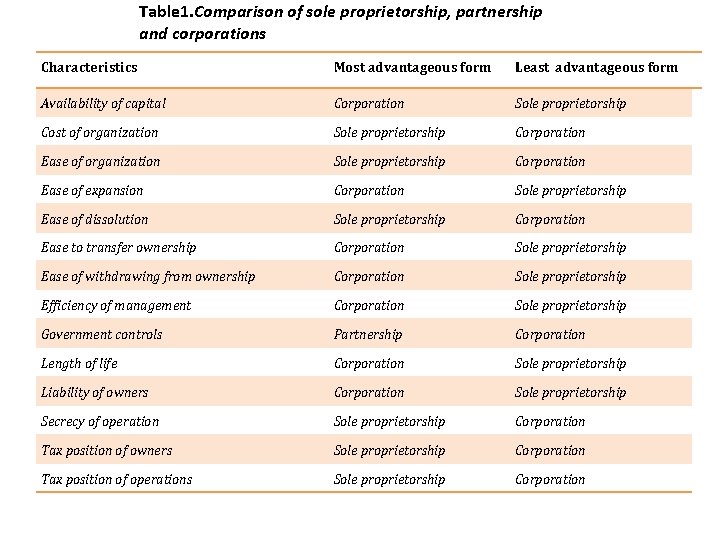
Table 1. Comparison of sole proprietorship, partnership and corporations Characteristics Most advantageous form Least advantageous form Availability of capital Corporation Sole proprietorship Cost of organization Sole proprietorship Corporation Ease of expansion Corporation Sole proprietorship Ease of dissolution Sole proprietorship Corporation Ease to transfer ownership Corporation Sole proprietorship Ease of withdrawing from ownership Corporation Sole proprietorship Efficiency of management Corporation Sole proprietorship Government controls Partnership Corporation Length of life Corporation Sole proprietorship Liability of owners Corporation Sole proprietorship Secrecy of operation Sole proprietorship Corporation Tax position of owners Sole proprietorship Corporation Tax position of operations Sole proprietorship Corporation
3. 2. Criterion for choosing business ownership In choosing a particular form of organization, an entrepreneur will try to find out how far his/her requirements will be met by a particular form of organization. Entrepreneurs will generally consider the following factors while making this type of assessment. Ease of Formation Ease of Raising Capital Limited Liability Direct Relationship between Ownership Control and Management Flexibility of Operation Continuity or Stability Keeping of Business Secrets Freedom from State Regulation Low Tax Liability
3. 3. Legal requirements To operate as a legal businessperson and protect the business from unnecessary suits and liabilities, the entrepreneur needs to understand the various laws that govern his/her business. The following are the key legal issues for the entrepreneur. 3. 3. 1. Patents Ø One of the avenues to the establishment of the new business is invention. An entrepreneur who invents a new thing or improves an existing invention needs to get legal protection for his/her invention through a patent right. Ø A patent is a contract between an inventor and the government in which the government, in exchange for disclosure of the invention, grants the inventor the exclusive right to enjoy the benefits resulting from the possession of the patent. A patent prevents anyone except the inventor from making, using or selling the invention for a specified amount of time.
3. 3. 2. Copyrights A Copyright protects the original works of authorship. However, it does not protect the idea itself, and therefore it allows anyone to use the idea in different manner. Among the things that need to be protected through copyright includes arcs, music, books, software, scripts, articles, poems, sculptures, models, maps and blueprints. 3. 3. 3. Trademarks A trademark is a word, symbol, design or some combination of these, or a slogan or a particular sound that identifies the source or sponsorship of certain goods and services. For instance, the stylish word "Coca Cola" that you see on a coca cola bottle is a trademark. To legally secure the exclusive use of such a mark, the trademark has to be registered with the concerned body.
- Slides: 21