
Chapter Three Developing Global Managers 3 1 a
Chapter Three Developing Global Managers
3 -1 a Chapter Three Outline Developing a Global Mind-Set • A model of Societal and Organizational Cultures • Cultural relativism versus Cultural Imperialism: Balancing Ethical Extremes • Becoming a Global Manager How Well Do U. S. Management Theories Apply in Other Countries? • Becoming Cross-Culturally Competent • Individualism versus Collectivism • High-Context and Low-Context Cultures • A Contingency Model for Cross-Cultural Leadership
3 -1 b Chapter Three Outline (continued) • Preparing for a Foreign Assignment • A Poor Track record for American Expatriate • Some Good News: North American Women on Foreign Assignments • Avoiding OB Trouble Spots in the Foreign Assignment Cycle
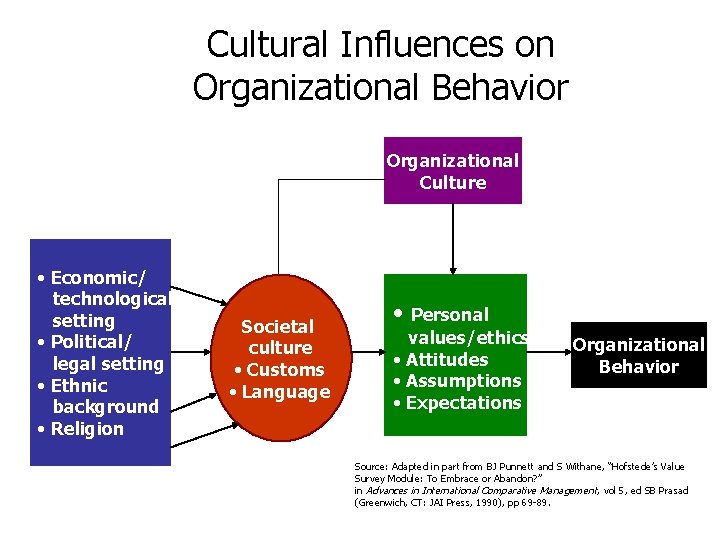
Cultural Influences on Organizational Behavior Organizational Culture • Economic/ technological setting • Political/ legal setting • Ethnic background • Religion Societal culture • Customs • Language • Personal values/ethics • Attitudes • Assumptions • Expectations Organizational Behavior Source: Adapted in part from BJ Punnett and S Withane, “Hofstede’s Value Survey Module: To Embrace or Abandon? ” in Advances in International Comparative Management , vol 5, ed SB Prasad (Greenwich, CT: JAI Press, 1990), pp 69 -89.
Ethnocentrism • The belief that one’s native country, culture, language, and modes of behavior are superior to all others • Worldwide evidence plentiful • Implications on managerial practices
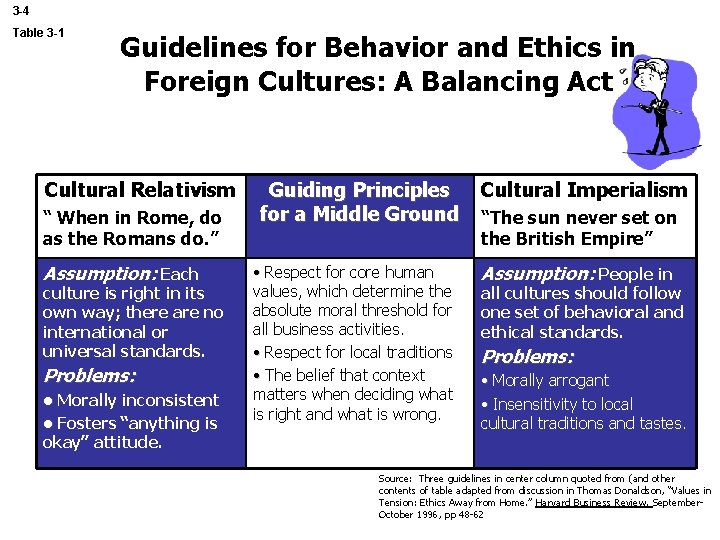
3 -4 Table 3 -1 Guidelines for Behavior and Ethics in Foreign Cultures: A Balancing Act Cultural Relativism “ When in Rome, do as the Romans do. ” Assumption: Each culture is right in its own way; there are no international or universal standards. Problems: • Morally inconsistent • Fosters “anything is okay” attitude. Guiding Principles for a Middle Ground • Respect for core human values, which determine the absolute moral threshold for all business activities. • Respect for local traditions • The belief that context matters when deciding what is right and what is wrong. Cultural Imperialism “The sun never set on the British Empire” Assumption: People in all cultures should follow one set of behavioral and ethical standards. Problems: • Morally arrogant • Insensitivity to local cultural traditions and tastes. Source: Three guidelines in center column quoted from (and other contents of table adapted from discussion in Thomas Donaldson, “Values in Tension: Ethics Away from Home. ” Harvard Business Review, September. October 1996, pp 48 -62
How Strong Is Your Potential for Ethnocentrism? Ethnocentrism is the belief that one’s native country, culture, language, and modes of behavior are superior to all others. ü Are the people from your home country generally more or less ethnocentric than average? Explain. ü How strong a factor is ethnocentrism in war-torn regions of the World, including Northern Ireland, the Middle East, Northern India, Central Africa, and the Balkans? ü Is the trend toward a global economy threatened by ethnocentrism? Explain. ü What can and should managers do to combat ethnocentrism in the workplace? ü What can you do to personally combat ethnocentrism?
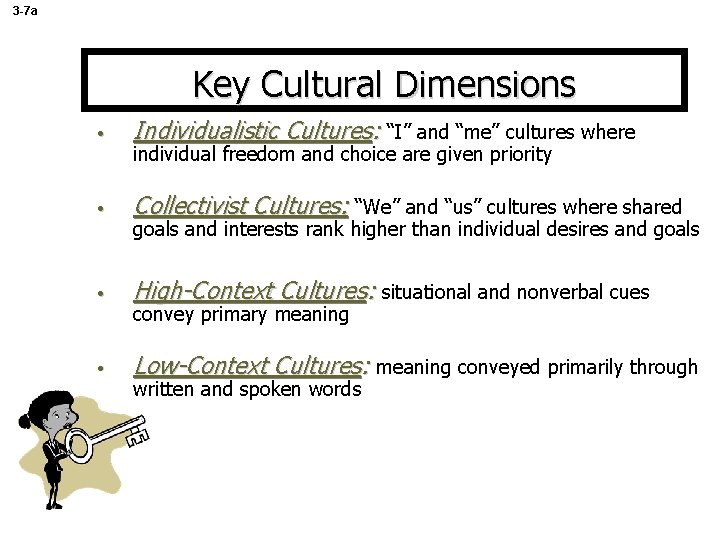
3 -7 a Key Cultural Dimensions • Individualistic Cultures: “I” and “me” cultures where • Collectivist Cultures: “We” and “us” cultures where shared • High-Context Cultures: situational and nonverbal cues • Low-Context Cultures: meaning conveyed primarily through individual freedom and choice are given priority goals and interests rank higher than individual desires and goals convey primary meaning written and spoken words
3 -7 b Key Cultural Dimensions (continued) • Monochronic Time: precise, schedule-driven, and public (do • Polychronic Time: multi-dimensional and personal (engage one thing at a time) in multi-tasking)
GLOBE Project dimensions • Power distance – unequal distribution of power • Uncertainty avoidance – reliance on social norms and rules to reduce uncertainty • Societal collectivism - loyalty to social unit vs individual goals • In-group collectivism – pride and loyalty for their family or organization
GLOBE Project continued • Gender egalitarianism • Assertiveness – confrontational and dominance in social relationship • Future orientation – delay gratification • Performance orientation – reward for individual improvement and excellence • Humane orientation – reward for being kind, fair, friendly, generous
Exercise • DIMENSIONS: – Individualistic/Collectivist – High-Context/Low-Context Cultures – Monochronic Time/Polychronic Time • For class discussion: – Writing: Briefly describe an encounter with or behavior of another person you observed, that illustrates one or a combination of these dimensions. Note the dimension(s). – Discussion: How would you characterize yourself in terms of these key dimensions? How will these cultural tendencies help or hinder you as a manager in your home country?
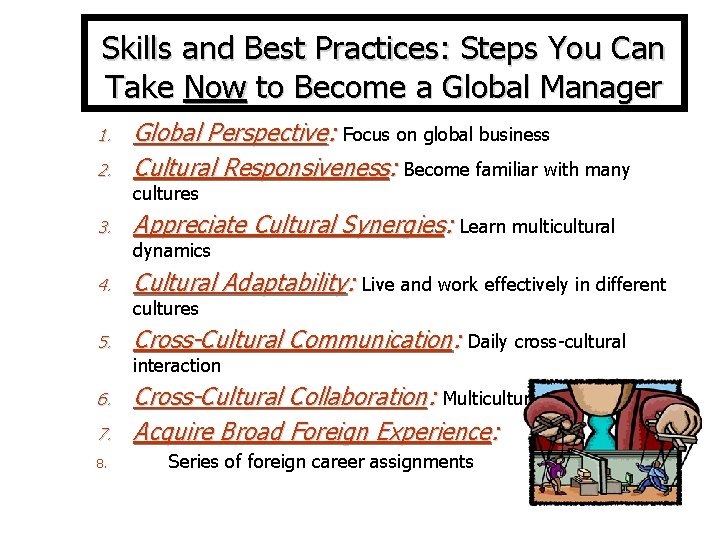
Skills and Best Practices: Steps You Can Take Now to Become a Global Manager 1. 2. Global Perspective: Focus on global business Cultural Responsiveness: Become familiar with many cultures 3. Appreciate Cultural Synergies: Learn multicultural dynamics 4. Cultural Adaptability: Live and work effectively in different cultures 5. Cross-Cultural Communication: Daily cross-cultural interaction 6. 7. 8. Cross-Cultural Collaboration: Multicultural teamwork Acquire Broad Foreign Experience: Series of foreign career assignments
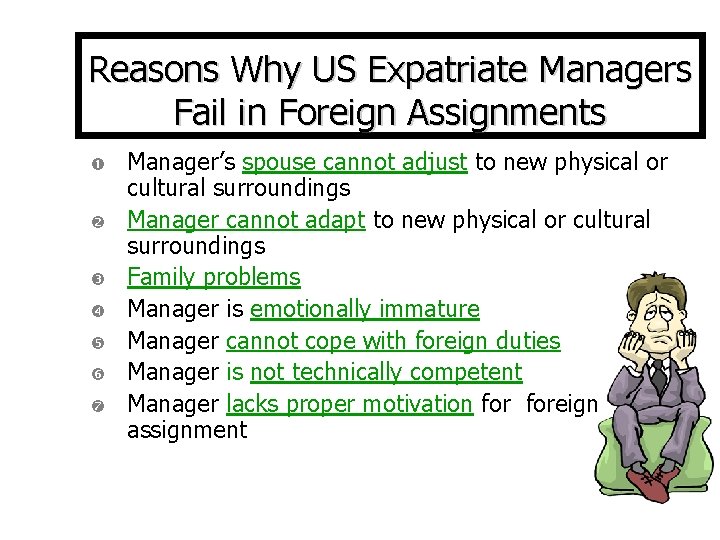
Reasons Why US Expatriate Managers Fail in Foreign Assignments Manager’s spouse cannot adjust to new physical or cultural surroundings Manager cannot adapt to new physical or cultural surroundings Family problems Manager is emotionally immature Manager cannot cope with foreign duties Manager is not technically competent Manager lacks proper motivation foreign assignment
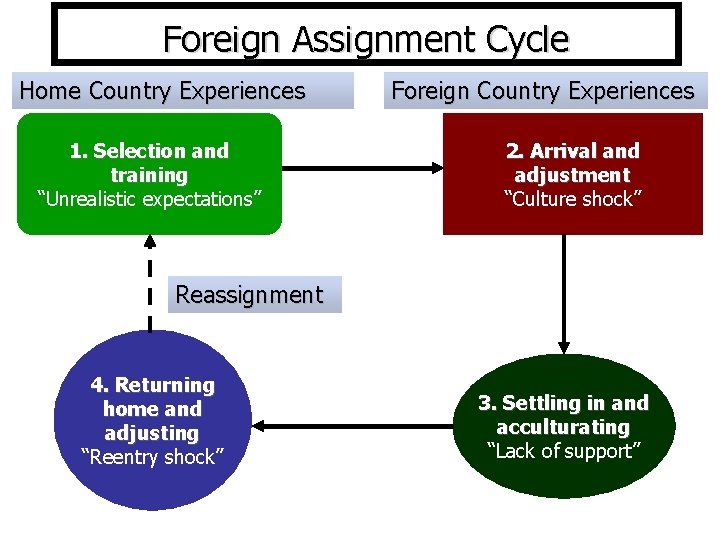
Foreign Assignment Cycle Home Country Experiences 1. Selection and training “Unrealistic expectations” Foreign Country Experiences 2. Arrival and adjustment “Culture shock” Reassignment 4. Returning home and adjusting “Reentry shock” 3. Settling in and acculturating “Lack of support”
- Slides: 15