
CHAPTER TEN VALUATION OF INCOME PROPERTIES APPRAISAL AND


- Slides: 19
CHAPTER TEN VALUATION OF INCOME PROPERTIES: APPRAISAL AND THE MARKET FOR CAPITAL
Market Value • • • Motivated buyer and seller Well informed buyer and seller A reasonable time period Payment in cash or cash equivalent Arms length transaction
Appraisal Process • • • Physical and legal identification Identify property rights Purpose of the appraisal Specify effective date of value estimate Apply techniques to estimate value
Income Approach • • GIM Direct capitalization method Discount present value method Note- the first two methods rely on current market transactions
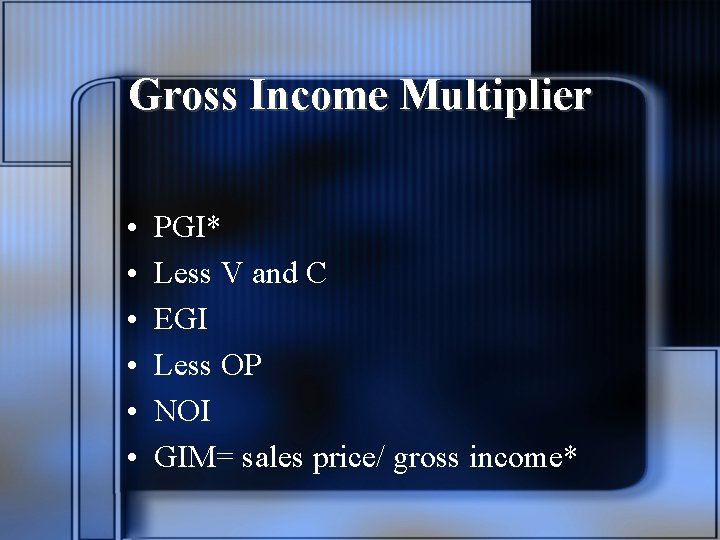
Gross Income Multiplier • • • PGI* Less V and C EGI Less OP NOI GIM= sales price/ gross income*
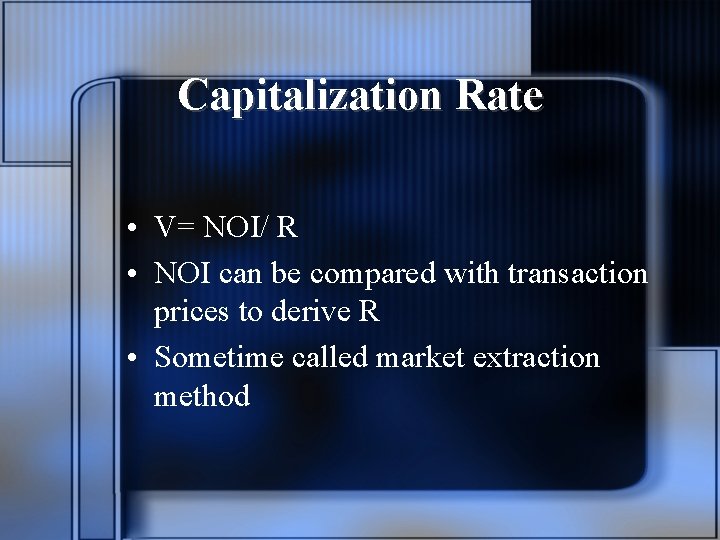
Capitalization Rate • V= NOI/ R • NOI can be compared with transaction prices to derive R • Sometime called market extraction method
Operating Expenses • • • Real estate taxes Insurance Utilities Repair and maintenance Admin. and general Mgnt. and leasing Salaries Reserves other
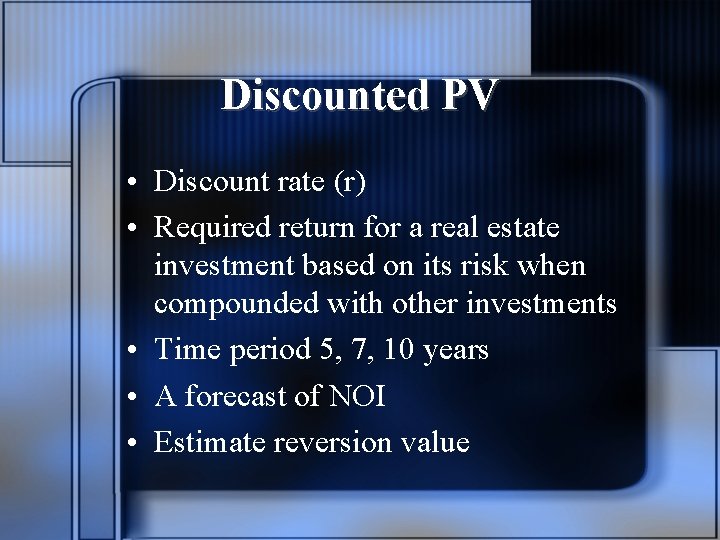
Discounted PV • Discount rate (r) • Required return for a real estate investment based on its risk when compounded with other investments • Time period 5, 7, 10 years • A forecast of NOI • Estimate reversion value
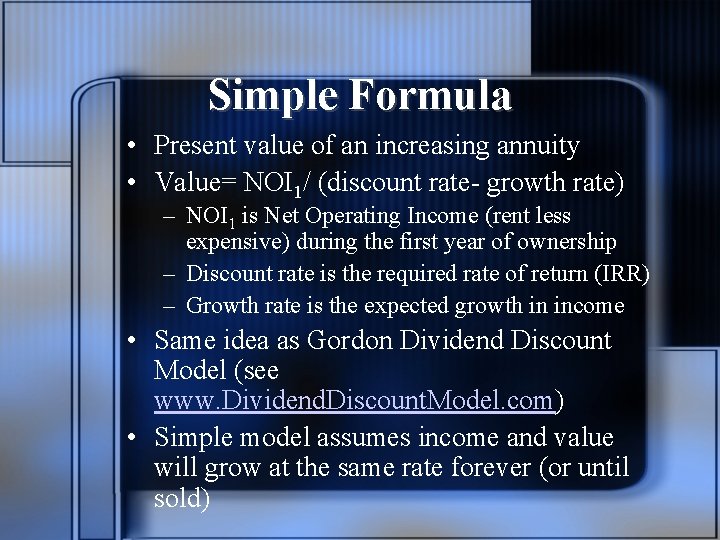
Simple Formula • Present value of an increasing annuity • Value= NOI 1/ (discount rate- growth rate) – NOI 1 is Net Operating Income (rent less expensive) during the first year of ownership – Discount rate is the required rate of return (IRR) – Growth rate is the expected growth in income • Same idea as Gordon Dividend Discount Model (see www. Dividend. Discount. Model. com) • Simple model assumes income and value will grow at the same rate forever (or until sold)
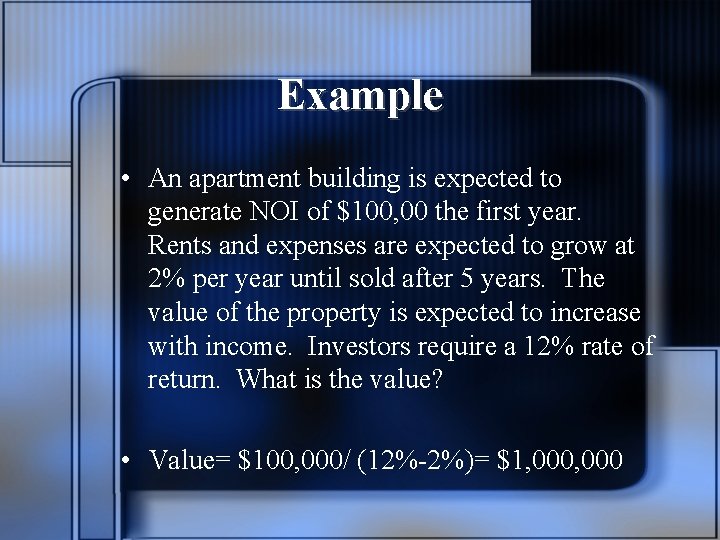
Example • An apartment building is expected to generate NOI of $100, 00 the first year. Rents and expenses are expected to grow at 2% per year until sold after 5 years. The value of the property is expected to increase with income. Investors require a 12% rate of return. What is the value? • Value= $100, 000/ (12%-2%)= $1, 000
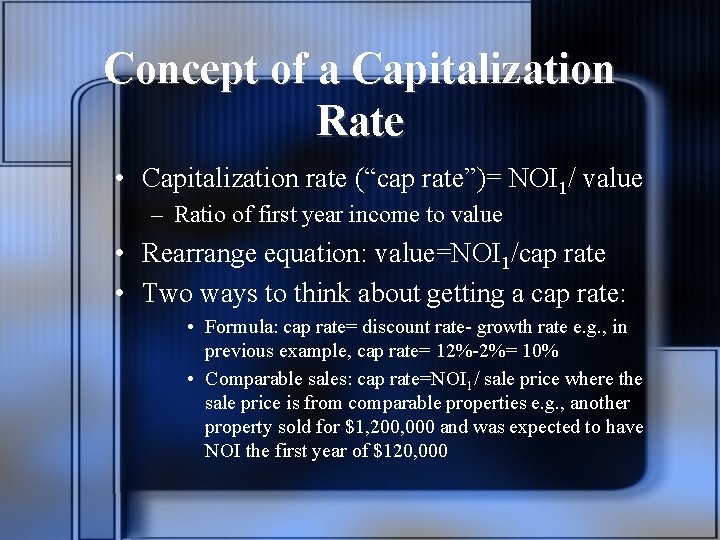
Concept of a Capitalization Rate • Capitalization rate (“cap rate”)= NOI 1/ value – Ratio of first year income to value • Rearrange equation: value=NOI 1/cap rate • Two ways to think about getting a cap rate: • Formula: cap rate= discount rate- growth rate e. g. , in previous example, cap rate= 12%-2%= 10% • Comparable sales: cap rate=NOI 1/ sale price where the sale price is from comparable properties e. g. , another property sold for $1, 200, 000 and was expected to have NOI the first year of $120, 000
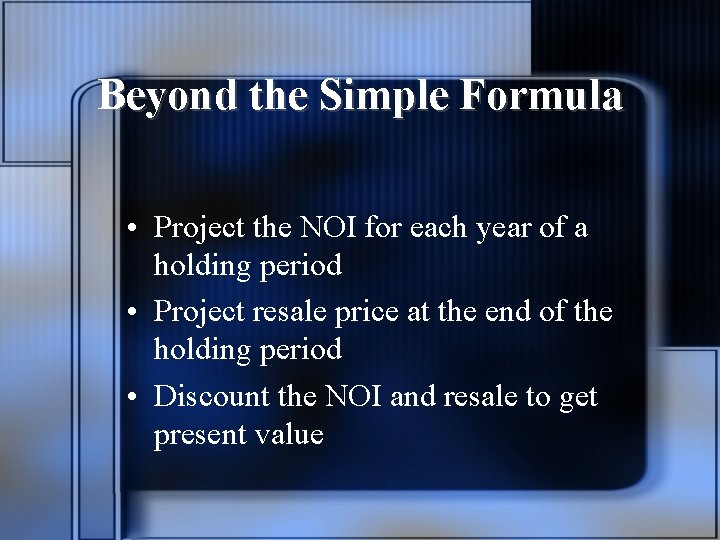
Beyond the Simple Formula • Project the NOI for each year of a holding period • Project resale price at the end of the holding period • Discount the NOI and resale to get present value
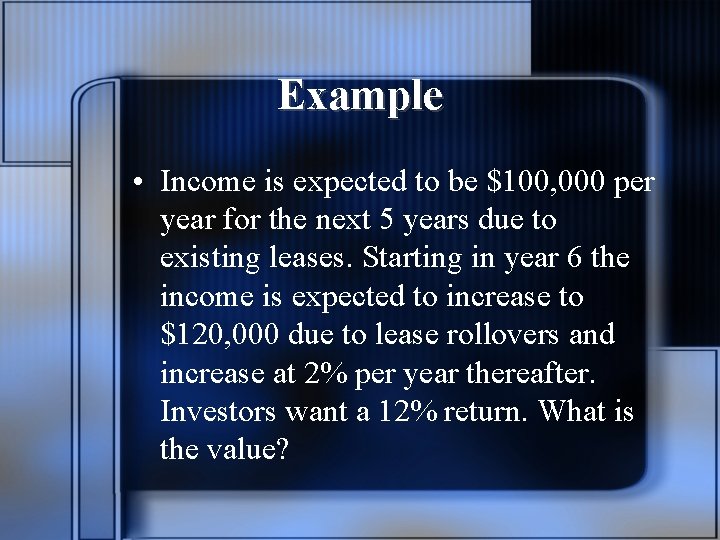
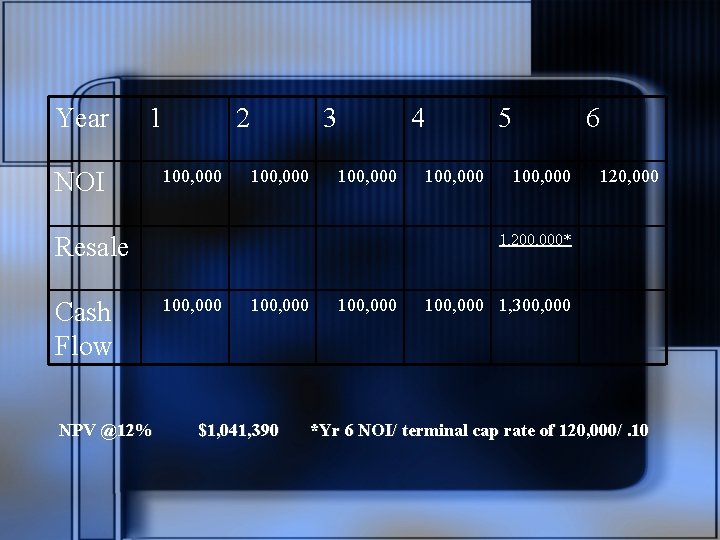
Example • Income is expected to be $100, 000 per year for the next 5 years due to existing leases. Starting in year 6 the income is expected to increase to $120, 000 due to lease rollovers and increase at 2% per year thereafter. Investors want a 12% return. What is the value?
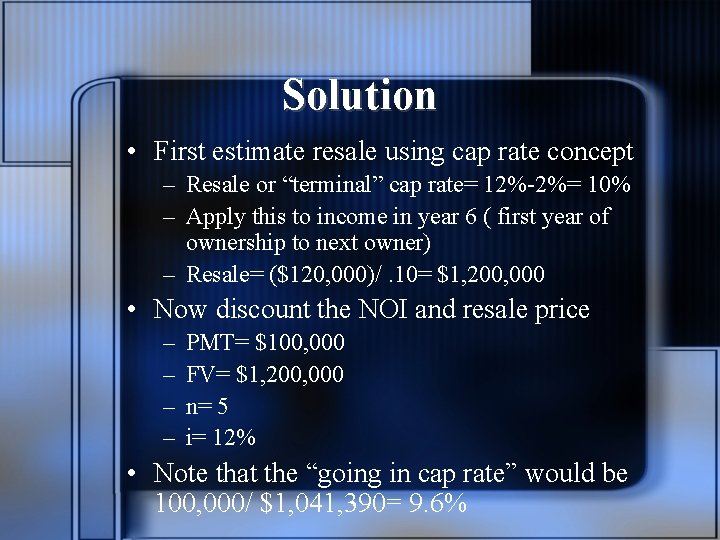
Solution • First estimate resale using cap rate concept – Resale or “terminal” cap rate= 12%-2%= 10% – Apply this to income in year 6 ( first year of ownership to next owner) – Resale= ($120, 000)/. 10= $1, 200, 000 • Now discount the NOI and resale price – – PMT= $100, 000 FV= $1, 200, 000 n= 5 i= 12% • Note that the “going in cap rate” would be 100, 000/ $1, 041, 390= 9. 6%
Year 1 NOI 2 100, 000 3 100, 000 4 100, 000 NPV @12% 100, 000 6 100, 000 120, 000 1, 200, 000* Resale Cash Flow 5 100, 000 $1, 041, 390 100, 000 1, 300, 000 *Yr 6 NOI/ terminal cap rate of 120, 000/. 10
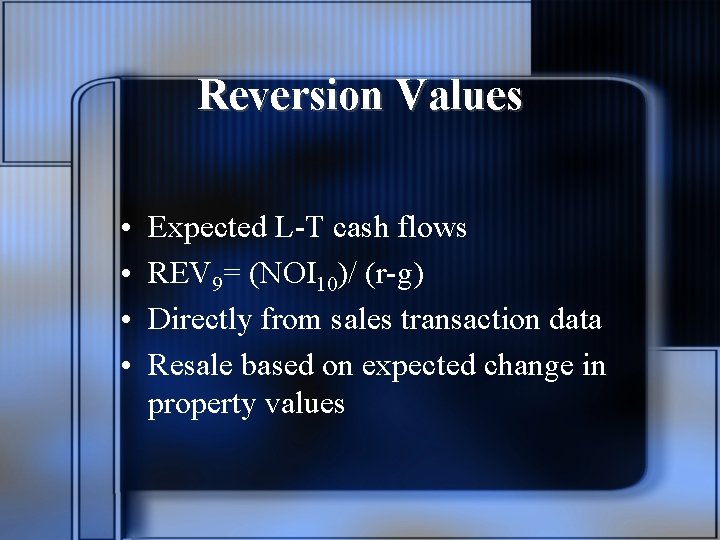
Reversion Values • • Expected L-T cash flows REV 9= (NOI 10)/ (r-g) Directly from sales transaction data Resale based on expected change in property values
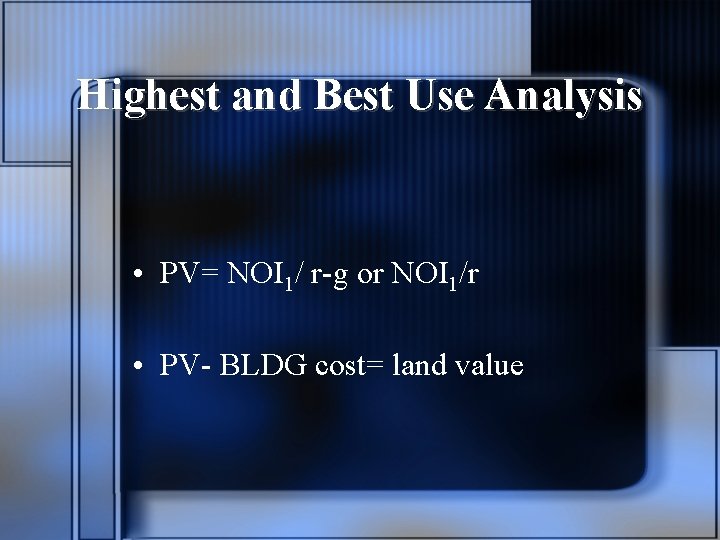
Highest and Best Use Analysis • PV= NOI 1/ r-g or NOI 1/r • PV- BLDG cost= land value
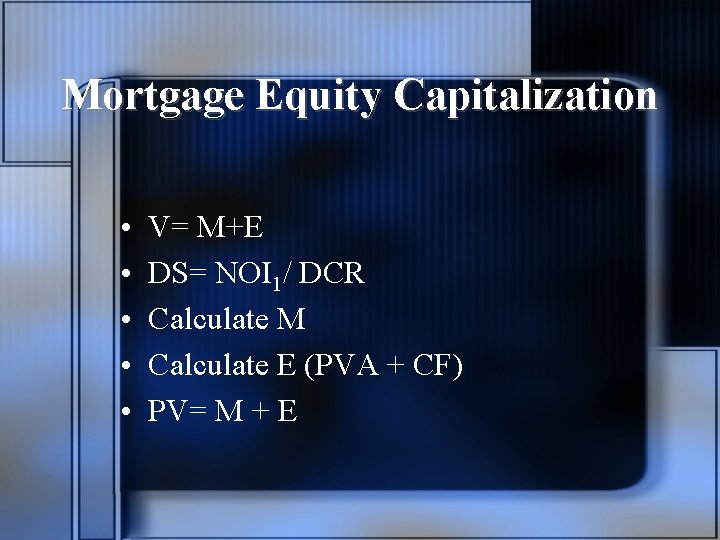
Mortgage Equity Capitalization • • • V= M+E DS= NOI 1/ DCR Calculate M Calculate E (PVA + CF) PV= M + E
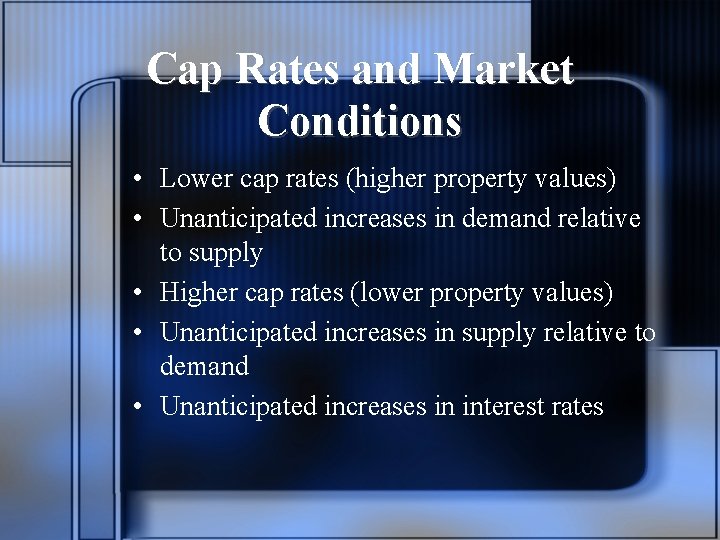
Cap Rates and Market Conditions • Lower cap rates (higher property values) • Unanticipated increases in demand relative to supply • Higher cap rates (lower property values) • Unanticipated increases in supply relative to demand • Unanticipated increases in interest rates