
Chapter Ten Texas Court System Introduction This presentation
- Slides: 18
Chapter Ten Texas Court System
Introduction • This presentation will allow you to follow various types of court cases through the Texas court system. • This is based on Figure 10. 1, so you may refer to the book if you get “lost. ” • Click on the buttons that represent your choices, or on the arrows to move from one slide to the next. Copyright © Houghton Mifflin Company. All rights reserved. 2
Level of Courts • Before you choose the type of case, consider that there are three levels of courts in Texas: • Local • County • State • So as you follow your case, look for each level and see where your case is! Copyright © Houghton Mifflin Company. All rights reserved. 3
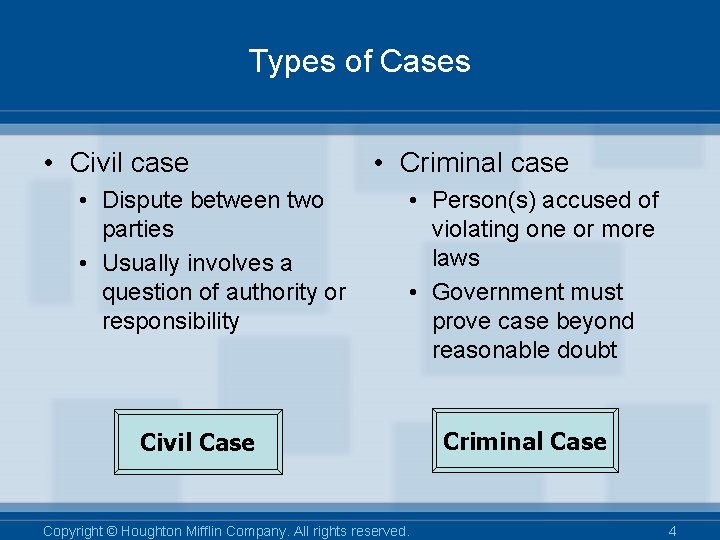
Types of Cases • Civil case • Dispute between two parties • Usually involves a question of authority or responsibility • Criminal case • Person(s) accused of violating one or more laws • Government must prove case beyond reasonable doubt Civil Case Copyright © Houghton Mifflin Company. All rights reserved. Criminal Case 4
Level of Case? Local County State Copyright © Houghton Mifflin Company. All rights reserved. 5
Level of Case? (Cont’d) Local County State Copyright © Houghton Mifflin Company. All rights reserved. 6
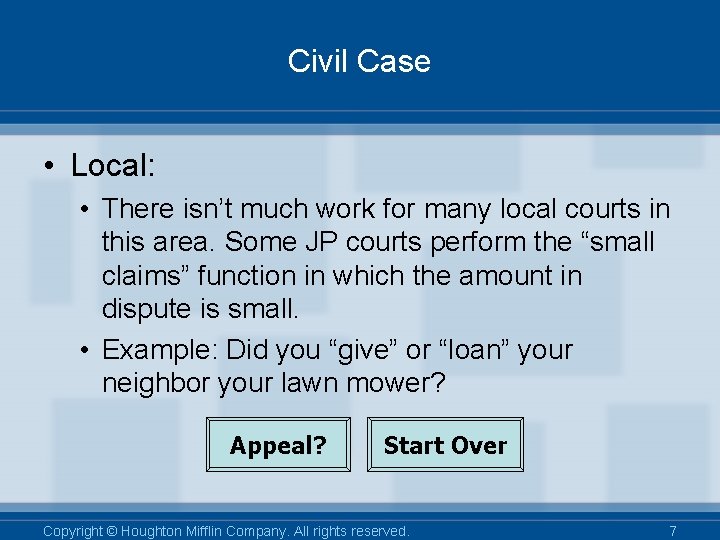
Civil Case • Local: • There isn’t much work for many local courts in this area. Some JP courts perform the “small claims” function in which the amount in dispute is small. • Example: Did you “give” or “loan” your neighbor your lawn mower? Appeal? Start Over Copyright © Houghton Mifflin Company. All rights reserved. 7
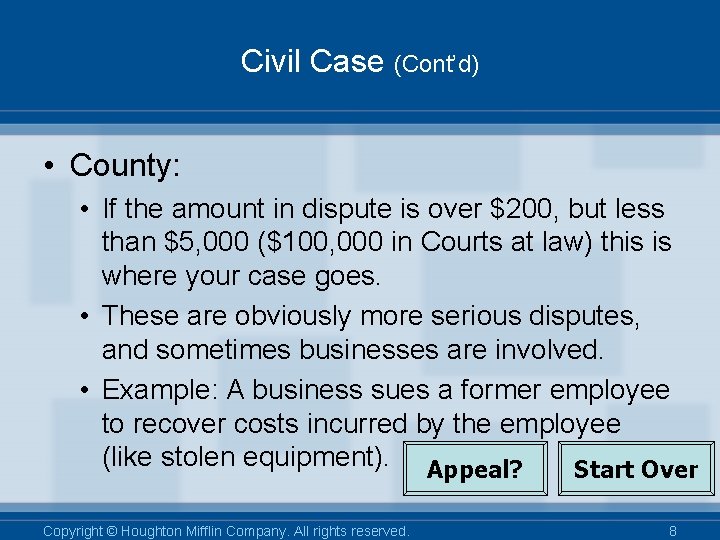
Civil Case (Cont’d) • County: • If the amount in dispute is over $200, but less than $5, 000 ($100, 000 in Courts at law) this is where your case goes. • These are obviously more serious disputes, and sometimes businesses are involved. • Example: A business sues a former employee to recover costs incurred by the employee (like stolen equipment). Appeal? Start Over Copyright © Houghton Mifflin Company. All rights reserved. 8
Civil Case (Cont’d) • State: • These are the most serious cases– divorces, contested elections, etc. • The trial court is the local District Court; some counties have several. • Businesses are often involved in suing each other over contracts. Appeal? Start Over Copyright © Houghton Mifflin Company. All rights reserved. 9
Civil Case (Cont’d) • Appeal: • The Courts of Appeals hears cases from both the county courts and the district courts. • In some cases, like divorces, their decision is final. • In the rest of the cases, you might appeal. Appeal? Start Over Copyright © Houghton Mifflin Company. All rights reserved. 10
Civil Case (Cont’d) • Final Stop: Supreme Court of Texas • This is the final court for the state of Texas. • Their decision is final, and it may take several months for them to reach a decision in your case. Appeal? Start Over Copyright © Houghton Mifflin Company. All rights reserved. 11
Criminal Case • Local: • In municipal courts, cases are violations of city ordinances, like speeding. • In JP courts, cases are Class C misdemeanors. • These courts generally don’t keep records. Appeal? Start Over Copyright © Houghton Mifflin Company. All rights reserved. 12
Criminal Case (Cont’d) • County: • These courts hear Class A & B misdemeanor cases. • There may be an occasional appeal from a local court– but that usually means a new trial. Appeal? Start Over Copyright © Houghton Mifflin Company. All rights reserved. 13
Criminal Case (Cont’d) • State: • This is the place for felonies– the most serious of crimes. • Once again, the trial court is the District Court; some hear only these types of cases. Copyright © Houghton Mifflin Company. All rights reserved. 14
Criminal Case (Cont’d) • State: • One thing to keep in mind about these cases: • There are TWO levels of punishment: • Capital • Non-capital • So there are two paths for possible appeals Non-Capital Appeal? Copyright © Houghton Mifflin Company. All rights reserved. Start Over 15
Criminal Case (Cont’d) • Appeal: • In non-capital punishment cases, these judges will render their decision on the district court. • It is an intermediate step in some cases. Appeal? Start Over Copyright © Houghton Mifflin Company. All rights reserved. 16
Criminal Case (Cont’d) • Final Stop: Court of Criminal Appeals • Death penalty cases automatically come here. • An appeal from a Court of Appeals comes here too. • It can take nearly 3 years (versus 1 year) to decide a death penalty case. Appeal? Start Over Copyright © Houghton Mifflin Company. All rights reserved. 17
Final Stop • This is the end of the line (in most cases) for your case. There are no appeals beyond the court you just left- its decision is final. • You can try your case in federal courts, but that’s for another course. Return to Last Court Start Over Copyright © Houghton Mifflin Company. All rights reserved. END 18