
Chapter Ten Avoiding Irrelevant Premises Copyright 2012 Pearson
- Slides: 18
Chapter Ten Avoiding Irrelevant Premises Copyright © 2012 Pearson Education, Inc. All rights reserved.
Fallacies of Relevance • The fallacies of relevance are committed by arguments whose premises offer irrelevant reasons for their conclusions. • Even if a premise is plainly true, if it is also irrelevant to the conclusion it is supposedly backing up, then it cannot count as a reason for it, and the argument fails. • Arguments that are fallacious by virtue of having irrelevant premises often rely on distractions that draw attention away from what truly matters for the conclusions at hand. Copyright © 2012 Pearson Education, Inc. All rights reserved.
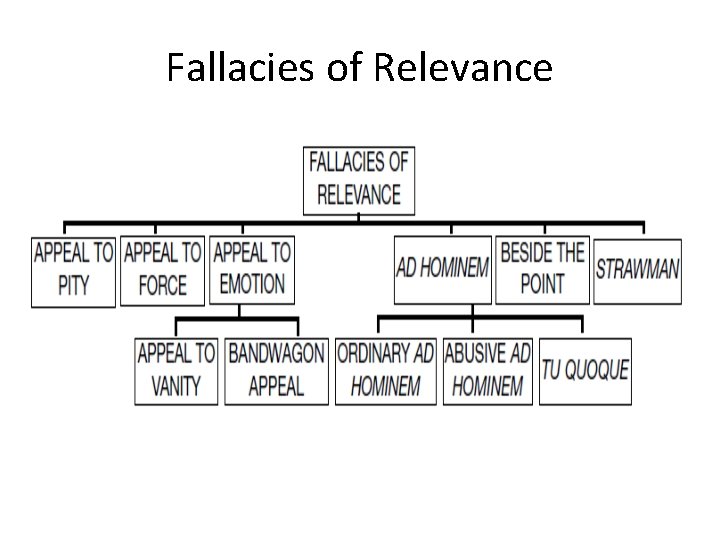
Fallacies of Relevance Copyright © 2012 Pearson Education, Inc. All rights reserved.
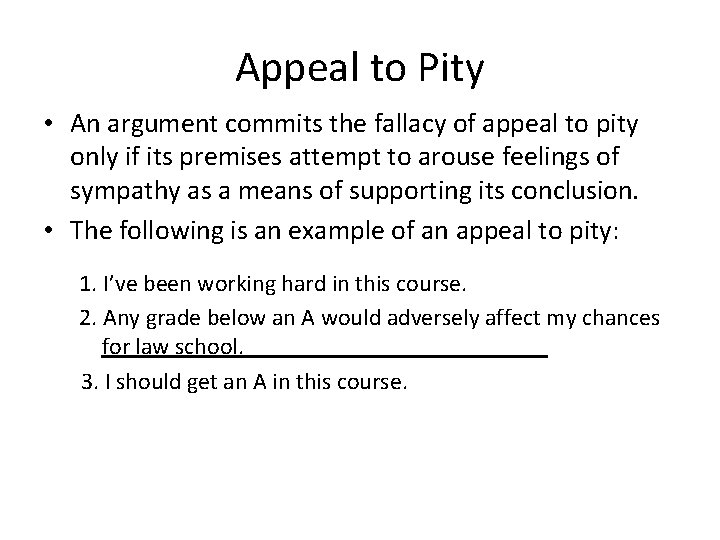
Appeal to Pity • An argument commits the fallacy of appeal to pity only if its premises attempt to arouse feelings of sympathy as a means of supporting its conclusion. • The following is an example of an appeal to pity: 1. I’ve been working hard in this course. 2. Any grade below an A would adversely affect my chances for law school. 3. I should get an A in this course. Copyright © 2012 Pearson Education, Inc. All rights reserved.
How to Avoid Appeal to Pity • An argument whose premises attempt to provoke feelings of sympathy that might move an audience to accept its conclusion commits the fallacy of appeal to pity. • Any such argument should be rejected since it provides no reason relevant to its conclusion —that is, it provides no rational support for it. Copyright © 2012 Pearson Education, Inc. All rights reserved.
Appeal to Force • An argument commits the fallacy of appeal to force only if it resorts to a threat as a means of supporting its conclusion. • The following is an example of appeal to force: – We think it might be a good idea for you to get out and campaign for Mayor Daley in this election because if you don’t, and Mayor Daley wins. . . well. . . you might be out of a job! And. . . you know. . . we’d hate to see you lose your job! So, really, we’re just giving you a little bit of friendly advice here. . . that’s all. We’re looking out for you! Copyright © 2012 Pearson Education, Inc. All rights reserved.
How to Avoid Appeal to Force • An argument whose premises merely express a threat of unpleasant consequences for those who refuse to accept the argument’s conclusion commits the fallacy of appeal to force. • Any such argument should be rejected, since its premises provide only a “reason” that is irrelevant to the argument’s conclusion—thus falling short of rationally supporting it. Copyright © 2012 Pearson Education, Inc. All rights reserved.
Appeal to Emotion • An argument commits the fallacy of appeal to emotion only if it attempts to support its conclusions by appealing to people’s feelings rather than their reason. • Types of appeal to emotion: – The Bandwagon Appeal: intended to take advantage of common feelings that seem to be part of human nature, such as the desire not to miss out on the latest trends; exploits our desire to join in with the common experiences of others and not be left out. – Appeal to Vanity: attempts to exploit people’s unspoken fears about self-esteem. Copyright © 2012 Pearson Education, Inc. All rights reserved.
How to Avoid Appeal to Emotion • Be on guard for arguments that attempt, through the use of emotively charged words or images, to elicit a strong psycho-logical response conducive to the acceptance of its conclusion. • Any such argument commits the fallacy of appeal to emotion and should be rejected. Why? Because its premises offer only “reasons” that are irrelevant, in the way suggested in (1), to the argument’s conclusion. No such argument can provide rational support for its conclusion. Copyright © 2012 Pearson Education, Inc. All rights reserved.
Fallacious Ad Hominem • An argument commits the fallacy of ad hominem if, and only if, it attempts to discredit someone’s (or some group’s) argument, point of view, or achievement by means of personal attack. • The fallacious ad hominem rests on some personal consideration strictly irrelevant to the matter at hand, which is intended to undermine someone’s credibility, as a means of indirectly attacking the person’s position or argument. • The problem with such an ad hominem, of course, is that in this way the question of the real merit of that person’s position is evaded. Copyright © 2012 Pearson Education, Inc. All rights reserved.
Special Forms of Ad Hominem Arguments • Abusive Ad Hominem: – Attacks a person’s character to support an conclusion unrelated to that character trait. • Tu Quoque: – Tries to refute someone’s point of view by calling attention to the person’s hypocrisy regarding that very point of view. – Example: Claiming that Thomas Jefferson’s views on liberty and equality are false because he was a slave owner. Copyright © 2012 Pearson Education, Inc. All rights reserved.
How to Avoid the Fallacious Ad Hominem • Beware of any argument that appeals to some personal facts (or alleged facts) that are irrelevant to its conclusion. • Any such argument commits the fallacy of ad hominem and should be rejected, for its premises are irrelevant to its conclusion—that is, they are offered as a means of attempting to discredit an argument or point of view by discrediting the person who presents it. Copyright © 2012 Pearson Education, Inc. All rights reserved.
Nonfallacious Ad Hominem • Some uses of argument against the person are not fallacious, for there are contexts in which such an argument may be in order. – In public life, for instance, the moral character of a politician may be a highly relevant issue to raise during a campaign, since we expect our elected leaders to be trustworthy. – Attacks on a witness in a courtroom, where credibility is highly relevant. Copyright © 2012 Pearson Education, Inc. All rights reserved.
Beside the Point • An argument commits the fallacy of beside the point if, and only if, its premises fail to support its conclusion by failing to be logically related to its conclusion, though they may support some other conclusion. • For example, consider the following response to a claim that factory farms are cruel to animals: – These farms are not cruel to animals. After all, the farms provide the food that most consumers want, and they do so in a manner that is cost-effective; moreover, these poultry, pork, and beef products are nourishing and contribute to the overall health of American families. Copyright © 2012 Pearson Education, Inc. All rights reserved.
How to Avoid the Beside the Point Fallacy • Logical thinkers should be on guard for: – Arguments whose premises are simply irrelevant to proving the conclusion. – Any such argument is defective, even if nothing else is wrong with it; it commits a beside the point fallacy and should be rejected. Copyright © 2012 Pearson Education, Inc. All rights reserved.
Straw Man • An argument commits the fallacy of straw man if and only if its premises attempt to undermine some view by misrepresenting what that view actually is. – A straw man argument attempts to raise an objection O against a certain view—call it ‘V. ’ – But the argument misrepresents V as being in fact W— where W is vulnerable to the objection O. – The argument concludes by rejecting V on the basis of O. – But does O really undermine V? It seems not. After all, O is an objection only to W, a distorted rendering of V, not to V itself. Copyright © 2012 Pearson Education, Inc. All rights reserved.
How to Avoid a Straw Man Argument • When objecting to a view V, if the argument goes, “View V is wrong because it faces objection O, ” keep in mind that, whether or not O is actually an objection to V depends on whether V has been construed in accordance with faithfulness and charity. • Remember: an obviously false view may be a view nobody holds. Copyright © 2012 Pearson Education, Inc. All rights reserved.
Nonfallacious Appeals to Emotion • The fallacy of appeal to emotion uses emotion to divert attention from the matter at hand by directing attention to a completely irrelevant consideration. • However, appeals to emotion that are relevant to the conclusion being advanced are not fallacious. Copyright © 2012 Pearson Education, Inc. All rights reserved.