
Chapter Ten Arbitrage Pricing Theory and Multifactor Models
Chapter Ten Arbitrage Pricing Theory and Multifactor Models of Risk and Return INVESTMENTS | BODIE, KANE, MARCUS Copyright © 2014 Mc. Graw-Hill Education. All rights reserved. No reproduction or distribution without the prior written consent of Mc. Graw-Hill Education.

Single Factor Model • Returns on a security come from two sources: – Common macro-economic factor – Firm specific events • Possible common macro-economic factors – Gross Domestic Product Growth – Interest Rates 10 -2 INVESTMENTS | BODIE, KANE, MARCUS

Single Factor Model Equation Ri = Excess return on security βi= Factor sensitivity or factor loading or factor beta F = Surprise in macro-economic factor (F could be positive or negative but has expected value of zero) ei = Firm specific events (zero expected value) 10 -3 INVESTMENTS | BODIE, KANE, MARCUS
Multifactor Models • Use more than one factor in addition to market return – Examples include gross domestic product, expected inflation, interest rates, etc. – Estimate a beta or factor loading for each factor using multiple regression. 10 -4 INVESTMENTS | BODIE, KANE, MARCUS
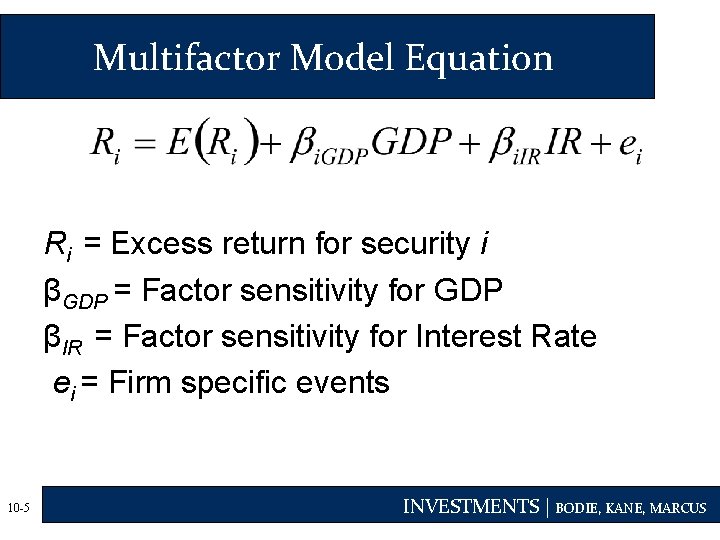
Multifactor Model Equation Ri = Excess return for security i βGDP = Factor sensitivity for GDP βIR = Factor sensitivity for Interest Rate ei = Firm specific events 10 -5 INVESTMENTS | BODIE, KANE, MARCUS
Interpretation The expected return on a security is the sum of: 1. The risk-free rate 2. The sensitivity to GDP times the risk premium for bearing GDP risk 3. The sensitivity to interest rate risk times the risk premium for bearing interest rate risk 10 -6 INVESTMENTS | BODIE, KANE, MARCUS

Arbitrage Pricing Theory • Arbitrage occurs if there is a zero investment portfolio with a sure profit. Since no investment is required, investors can create large positions to obtain large profits. 10 -7 INVESTMENTS | BODIE, KANE, MARCUS
Arbitrage Pricing Theory • Regardless of wealth or risk aversion, investors will want an infinite position in the risk-free arbitrage portfolio. • In efficient markets, profitable arbitrage opportunities will quickly disappear. 10 -8 INVESTMENTS | BODIE, KANE, MARCUS
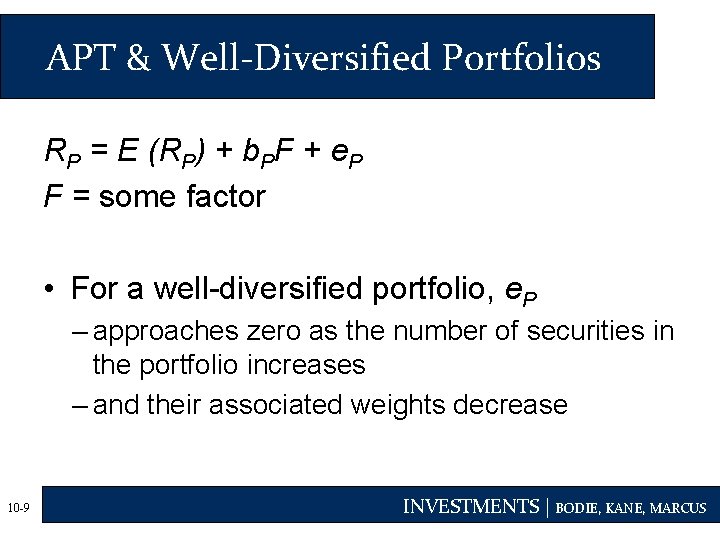
APT & Well-Diversified Portfolios RP = E (RP) + b. PF + e. P F = some factor • For a well-diversified portfolio, e. P – approaches zero as the number of securities in the portfolio increases – and their associated weights decrease 10 -9 INVESTMENTS | BODIE, KANE, MARCUS
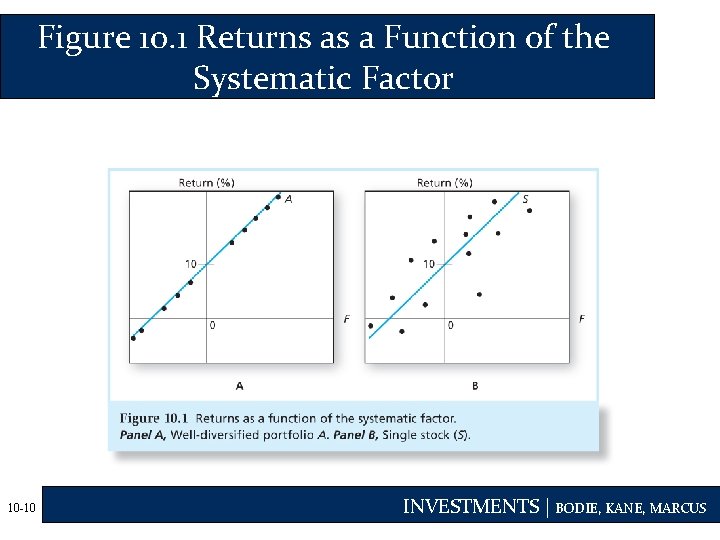
Figure 10. 1 Returns as a Function of the Systematic Factor 10 -10 INVESTMENTS | BODIE, KANE, MARCUS
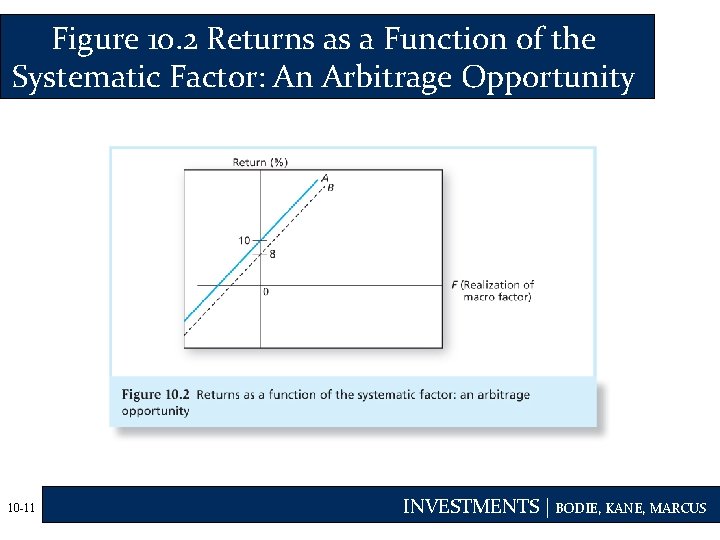
Figure 10. 2 Returns as a Function of the Systematic Factor: An Arbitrage Opportunity 10 -11 INVESTMENTS | BODIE, KANE, MARCUS
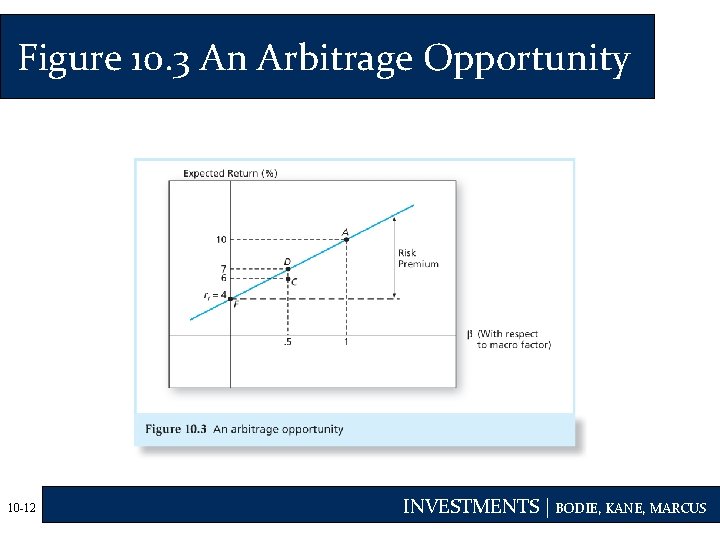
Figure 10. 3 An Arbitrage Opportunity 10 -12 INVESTMENTS | BODIE, KANE, MARCUS

No-Arbitrage Equation of APT • 10 -13 INVESTMENTS | BODIE, KANE, MARCUS
the APT, the CAPM and the Index Model APT • Assumes a welldiversified portfolio, but residual risk is still a factor. • Does not assume investors are meanvariance optimizers. • Uses an observable, market index • Reveals arbitrage opportunities 10 -14 CAPM • Model is based on an inherently unobservable “market” portfolio. • Rests on mean-variance efficiency. The actions of many small investors restore CAPM equilibrium. INVESTMENTS | BODIE, KANE, MARCUS
Multifactor APT • Use of more than a single systematic factor • Requires formation of factor portfolios • What factors? – Factors that are important to performance of the general economy – What about firm characteristics? 10 -15 INVESTMENTS | BODIE, KANE, MARCUS

Two-Factor Model • The multifactor APT is similar to the onefactor case. 10 -16 INVESTMENTS | BODIE, KANE, MARCUS
Two-Factor Model • Track with diversified factor portfolios: – beta=1 for one of the factors and 0 for all other factors. • The factor portfolios track a particular source of macroeconomic risk, but are uncorrelated with other sources of risk. 10 -17 INVESTMENTS | BODIE, KANE, MARCUS
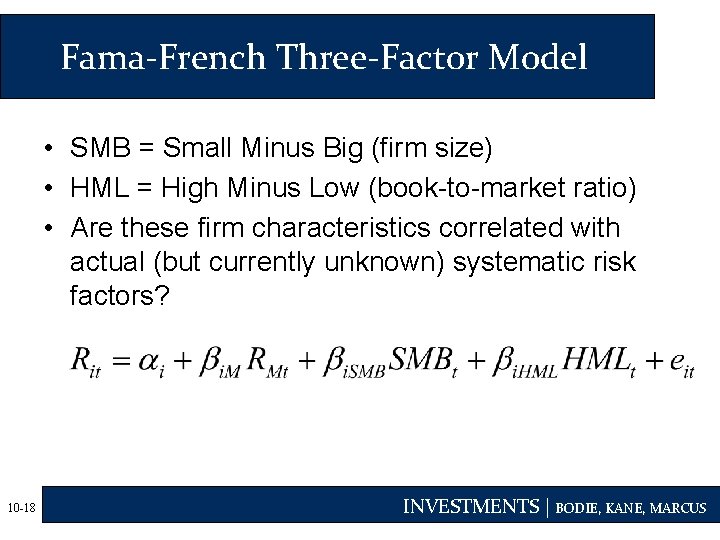
Fama-French Three-Factor Model • SMB = Small Minus Big (firm size) • HML = High Minus Low (book-to-market ratio) • Are these firm characteristics correlated with actual (but currently unknown) systematic risk factors? 10 -18 INVESTMENTS | BODIE, KANE, MARCUS
The Multifactor CAPM and the APT • A multi-index CAPM will inherit its risk factors from sources of risk that a broad group of investors deem important enough to hedge • The APT is largely silent on where to look for priced sources of risk 10 -19 INVESTMENTS | BODIE, KANE, MARCUS
- Slides: 19