
Chapter Sixteen The Structure of Central Banks The
Chapter Sixteen The Structure of Central Banks: The Federal Reserve and the European Central Bank Copyright © 2015 Mc. Graw-Hill Education. All rights reserved. No reproduction or distribution without the prior written consent of Mc. Graw-Hill Education.
Learning Objectives Students will establish an understanding of 1. Structure of the Federal Reserve System. 2. The effectiveness of the Federal Reserve System. 3. The structure of the Eurosystem. 4. The euro-area crisis and the ECB. 16 -2
Introduction • Between 1870 and 1907, the nation experienced 21 financial panics of varying severity. • During the Panic of 1907, an astonishing twothirds of banks founds themselves temporarily unable to redeem deposits. • In the intervening centuries, Europeans had developed a system of central banks. American had not. 16 -3
Introduction • The prevailing philosophy of many 19 thcentury Americans was that centralized government of any form should be kept to a minimum. • But punishing effects of frequent financial panics led people to reconsider the merits of a powerful central banks. • In 1913, Congress passed the Federal Reserve Act. – This created the U. S. Federal Reserve System. 16 -4
Introduction • While central banking had stabilized European financial systems before 1900, the 20 th century was another story. • Europe experienced high inflation rates, low growth, high and volatile interest rates, and unstable exchange rates. • After two world wars, governments’ free spending led to unrelenting fiscal deficits. 16 -5
Introduction • Leaders came to believe that the only way to ensure both political and economic stability was to forge closer ties among the continent’s countries. • The result was the European monetary union (born in 1999), with its common currency, the euro, and its central bank, the European Central Bank (ECB). 16 -6
The Structure of the Federal Reserve System • The Federal Reserve Act established a system that is composed of three branches with overlapping responsibilities: – Twelve regional Federal Reserve Banks, distributed throughout the country; – A central governmental agency, called the Board of Governors of the Federal Reserve System, in Washington, D. C. ; and – The Federal Open Market Committee. 16 -7
The Structure of the Federal Reserve System • In addition, a series of advisory committees make recommendations to the board and the Federal Reserve Banks. • Finally, there are the private banks that are members of the system. • This complex structure diffuses power in a way that is typical of the U. S government. – It creates a system of checks and balances that reduces the tendency for power to concentrate at the center. 16 -8
The Structure of the Federal Reserve System • All national banks are required to belong to the Federal Reserve System. • State banks that receive their charters from individual state banking authorities have the option of joining, but fewer than 20% do. 16 -9
The Federal Reserve Banks • The Federal Reserve Bank of New York has the largest gold vault in the world. – All of this gold belongs to foreign countries and international organizations like the International Monetary Fund. • It is also the largest of the 12 Federal Reserve Banks which together with their branches form the heart of the Federal Reserve System. – All 12 have cash vaults, but only New York has gold. 16 -10
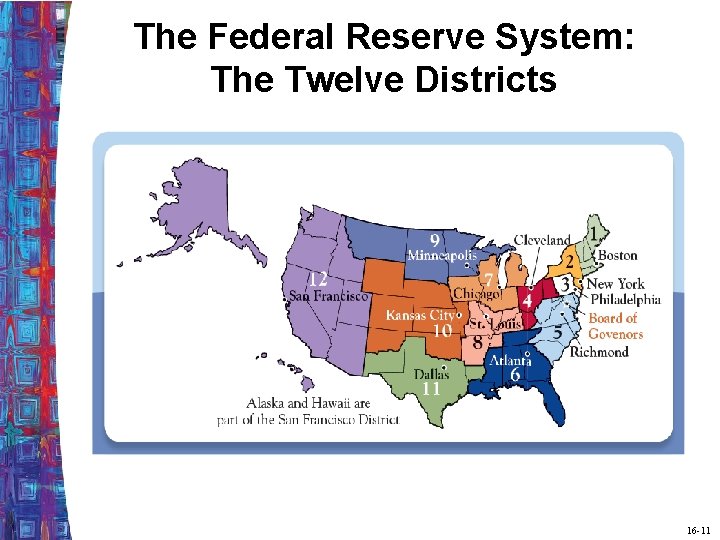
The Federal Reserve System: The Twelve Districts 16 -11
The Federal Reserve Banks • • • The lines separating the regions for the Federal Reserve System were drawn in 1914, so they represent population density at that time. Politicians decided that no district should coincide with a single state. The purpose of this is twofold: 1. To ensure that every district contains as broad a mixture of economic interests as possible, and 2. To ensure that no person or group can obtain preferential treatment from the Reserve Bank. 16 -12
The Federal Reserve Banks • Reserve Banks are part public and part private. • They are federally chartered banks and private, nonprofit organizations, owned by the commercial banks in their districts. • They are overseen by both their own boards of directors and the Board of Governors. • The method for choosing the nine members of each Reserve Bank’s board of directors ensures the inclusion of bankers and other business leaders and people who represent the public interest. 16 -13
The Federal Reserve Banks • Six directors are elected by the commercial bank members of the Reserve Bank – Three directors representing the Reserve Bank and – Three representing the public. • The remaining three directors are appointed by the Boards of Governors. • Each Reserve Bank has a president who is appointed for a five-year term by the bank’s board of directors with the approval of the Board of Governors. 16 -14
The Federal Reserve Banks • The Government’s Bank – Issues currency, – Maintains the Treasury’s account, and – Manages the Treasury debt. • The Bankers’ Bank – Holds Reserve Deposits, – Operates the Payments System, – Makes Discount Loans at the Discount Rate, – Supervises and regulates financial institutions, and – Collects Data. 16 -15
The New York Fed Branch Only the New York Fed Branch: • Auctions Treasury Securities, • Provides Foreign Government Services, • Completes Monetary Policy Operations, and • Runs Fedwire: Large Value Interbank Funds Transfer System. 16 -16
The Federal Reserve Banks • The Federal Reserve’s own portfolio is managed at the Federal Reserve Bank of New York through what we called open market operations. • In the crisis of 2007 -2009, the Federal Reserve Bank of New York also operated a variety of special new liquidity and credit facilities that supplied funds to intermediaries and allowed with Fed to acquire a portfolio of non-Treasury assets. 16 -17
The Federal Reserve Banks • Finally, the Reserve Banks play an important part in formulating monetary policy: – Through their representation on the Federal Open Market Committee (FOMC), and – Through their participation in setting the discount rate. • The interest rate charged on loans to commercial banks. 16 -18
The Federal Reserve Banks • The Federal Reserve Act specifies that the discount rate is to be set by each of the Reserve Bank’s board of directors, with approval of the Board of Governors. • However, it is set automatically at a premium above the overnight interest rate that the FOMC controls. – The directors have virtually no say over the discount rate. 16 -19
The Board of Governors • The seven members of the board, called governors, are appointed by the president and confirmed by the U. S. Senate for 14 -year terms. • The long terms are intended to protect the board from political pressure. • The terms are staggered limiting any individual president's influence over the membership. 16 -20
The Board of Governors • The board’s membership usually includes academic economists, bank regulators, and bankers. • No two governors can come from the same Federal Reserve district. • The Federal Reserve Act explicitly requires “a fair representation of the financial, agricultural, industrial, and commercial interests. ” 16 -21
The Board of Governors • Duties of the governors are to: – Set the reserve requirement, – Approve or disapprove discount rate recommendations, – Rule-writing agency for consumer credit protection laws • (with enforcement by the Consumer Financial Protection Bureau created by the Dodd-Frank Act), 16 -22
The Board of Governors • Duties of the governors (cont. ) – Along with the Reserve Banks, regulate and supervise the banking system, – Invoke the emergency powers to lend to nonbanks (powers were curtailed by the Dodd-Frank Act), – Analyze financial and economic conditions, and – Collect and publish detailed statistics. 16 -23
The Board of Governors • The seven governors do not have their own support staff. • They request help and information from the managers of various departments, who assign individuals to specific tasks. • The managers answer to the chair of the Board of Governors. 16 -24
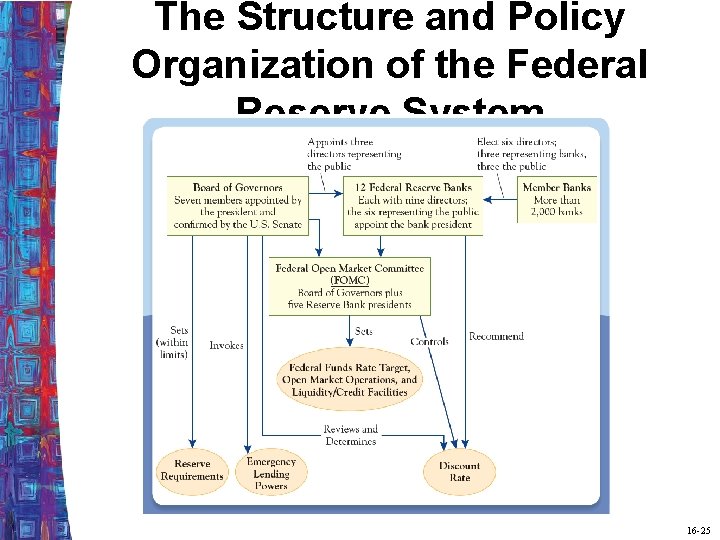
The Structure and Policy Organization of the Federal Reserve System 16 -25
• Treasury Direct allows individuals to purchase U. S. Treasury securities without the use of a broker or dealer. – With as little as $1000 you can start an account and purchase bonds, notes, or bills through the Fed. • You do it at the auction using a noncompetitive bid. – This guarantees you will receive the bond you want at the average auction price. • The Fed will sell your bonds at the highest market price available. 16 -26
The Federal Open Market Committee • When the press discusses the Fed, their focus is generally on the Federal Open Market Committee (FOMC). – This group sets the interest rates and adjusts the Fed’s balance sheet to control the availability of money and credit to the economy. 16 -27
The Federal Open Market Committee • It has existed since 1936 and has 12 voting members: – The seven governors, – The president of the Federal Reserve Bank of New York, and – A rotating selection of 4 of the remaining 11 Reserve Bank presidents. 16 -28
The Federal Open Market Committee • The chair of the Board of Governors chairs the FOMC. • The committee’s vice chair is the president of the Federal Reserve Bank of New York. • While only 5 of the 12 Reserve Bank presidents vote at any one time, all of them participate in the meeting. 16 -29
The Federal Open Market Committee • The FOMC could control any interest rate, but it chooses to control the federal funds rate. – This is the rate banks charge each other for unsecured overnight loans on their excess deposits at the Fed. • By controlling the federal funds rate, the FOMC influences real growth. 16 -30
The Federal Open Market Committee • The FOMC currently meets 8 times a year. • During times of crisis, the committee can confer and change policy over the telephone. – Because these “inter-meeting” policy shifts signal the financial markets that the FOMC believes conditions are dire, they are reserved for extraordinary times. • The financial crisis of 2007 -2009 prompted 12 unscheduled FOMC meetings. 16 -31
The Federal Open Market Committee • The primary purpose of a meeting is to decide on the target interest rate. • The FOMC itself does not engage in the financial market transactions that are required to keep the market federal funds rate near this target or to manage the Fed’s portfolio. • That is the job of the system open market account manager who works for the Federal Reserve Bank of New York. 16 -32
The Federal Open Market Committee • Two important documents are distributed to all attendees prior to each meeting: – The Beigebook and – The Tealbook. • The Beigebook is a compilation of anecdotal information about current business activity. – This is the only FOMC document that is released to the public before the meeting. 16 -33
The Federal Open Market Committee • The Tealbook contains two parts: – The Board staff’s economic forcast for the next few years (until 2010, this was called the Greenbook), and – A discussion of financial markets and current policy options (formerly called the Bluebook) • The Tealbook is not released to the public until 5 years after the meeting 16 -34
The Federal Open Market Committee • An FOMC meeting is a formal proceeding that can be divided into two parts, each beginning with a staff report followed by a round of discussion that includes all the meeting’s participants. – There is a specific order in which people speak at these meetings. • Three weeks after the meeting, detailed minutes summarizing the deliberations are released on the FOMC’s public Web site. 16 -35
The Federal Open Market Committee To see where the committee’s power lies and who controls interest-rate decisions, we can look at a few things. 1. The chair is the voice of the Fed. 2. The governors make up a majority of the committee. 3. Aside from the quarterly projections of FOMC members, the most important information distributed to all committee members is the Tealbook, prepared by the Federal Reserve Board staff, controlled by the chair. 16 -36
The Federal Open Market Committee 4. The chair sets the agenda for FOMC meetings, determines the order in which people speak, and proposes the FOMC policy statement. 5. Although votes are made public immediately after the meeting, committee members observe a blackout period from a week prior to a week after the meeting. • And don’t forget the Board of Governors controls the Reserve Banks’ budgets and salaries of their presidents. 16 -37
The Federal Open Market Committee • The chair of the Fed is the FOMC’s most important member. – Listen to this person to see what the FOMC is going to do. • While the chair is very powerful, the committee structure provides an important check on his/her power. – Even two dissents on an FOMC votes are unusual. – Three dissents would raise doubts about the chair’s leadership. 16 -38
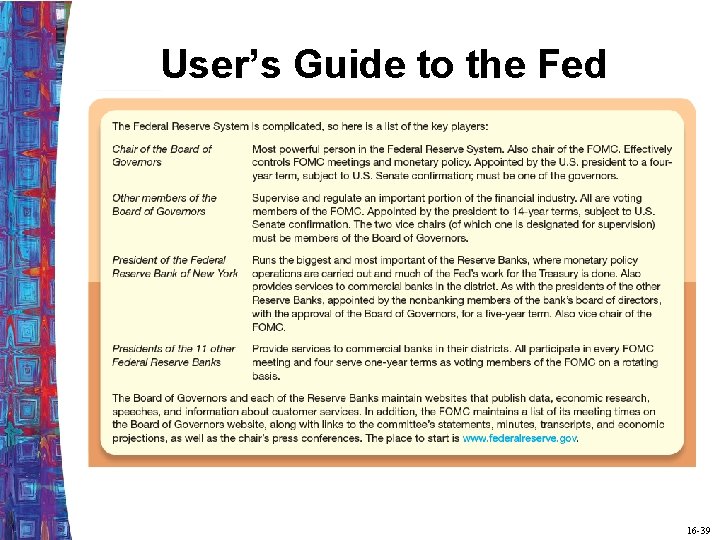
User’s Guide to the Fed 16 -39
• As the financial crisis deepened in 2008, the range of FOMC policy actions broadened. • The form of the FOMC statement released at the end of the FOMC’s regularly scheduled meetings changed markedly. • Interpreting these statement takes some practice, especially as the Fed widens the range of policy tools and provides more complex forward guidance. 16 -40
Assessing the Federal Reserve System’s Structure • In the last chapter we said that an effective central bank is one in which: – Policymakers are independent of political influence, – Make decisions by committee, – Are accountable and transparent, and – State their objective clearly. • Let’s evaluate the Fed using these criteria. 16 -41
Independence from Political Influence • There are three criteria for judging a central bank’s independence: – Budgetary independence, – Irreversible decisions, and – Long terms in office. • The Fed meets each of these. 16 -42
Independence from Political Influence • The Fed controls its own budget. – Their substantial revenue comes from interest on government securities it holds and fees charged to banks for payments system services. – Typically 95% of its income is returned to the U. S. Treasury each year. • Interest rate changes are implemented immediately and can be changed only by the FOMC. • The terms of the governors are 14 years, chair’s term is 4 years, and Reserve Bank presidents serve for 5 years. 16 -43
Decision Making by Committee • The Fed clearly makes decision by committee, because the FOMC is a committee. • While the chair of the Board of Governors may dominate policy decision, the fact that there are 12 voting member provides an important safeguard against arbitrary action. 16 -44
Accountability and Transparency • The FOMC releases huge amount of information to the public: The Beigebook, Announcement of policy decision and reasoning, Detailed minutes of the meeting 3 weeks later, Word-for-word transcript and the Tealbook 5 years later, – Twice-yearly “Monetary Policy Report to the Congress”, – The chair’s appearance before Congress to discuss the state of the nation’s economy, and – Numerous speeches given by the chair, other governors and Reserve Bank presidents. – – 16 -45
Accountability and Transparency A few things are missing from the Fed’s communications: 1. The FOMC does not agree on or publish a consensus economic or interest rate projection, 2. The inputs into the decision-making process and the meeting transcript are not made pubic until five years after the fact. 3. The Fed also delays the dissemination of information about the recipients of its loans. 16 -46
Two events provide the foundation for Fed independence: 1. In 1935, political appointees were removed from the Federal Reserve Board, and the FOMC was created. 2. In 1951, President Truman supported the Fed’s refusal to purchase Treasury securities that the Secretary of the Treasury requested they buy. • The president, the secretary of the Treasury, and the Federal Reserve chair reached an “accord” and issued a joint announcement establishing the FOMC’s independence in setting interest rates and controlling the rate of monetary expansion. 16 -47
Policy Framework The Congress of the U. S. has set the Fed’s objectives: “The Board of Governors of the Federal Reserve System and the Federal Open Market Committee shall maintain long run growth of the monetary and credit aggregates commensurate with the economy’s long run potential to increase production, so as to promote effectively the goals of maximum employment, stable prices, and moderate long-term interest rates. ” 16 -48
Policy Framework • Today, the FOMC’s approach is fairly transparent. • Their strategy is consistent with the inflation targeting framework that Ben Bernanke has advocated. • The FOMC consensus on longer-run strategy is likely to be a legacy of Bernanke’s leadership. 16 -49
• The Fed does its best to stabilize the economy. • The stock market goes up and down regardless of what the Fed does. • The Fed does not control the stock market and will react to movements only in so far as they comprise its inflation and growth objectives. • No one can eliminate the risk that is inherent in an investment - not even the most powerful central bank in the world. 16 -50
The European Central Bank • On January 1, 1999, the majority of Western European countries adopted a common currency. • Purchases are made in euros, and monetary policy is the job of the European Central Bank (ECB). • By 2013, the euro had become the currency of 17 countries. 16 -51
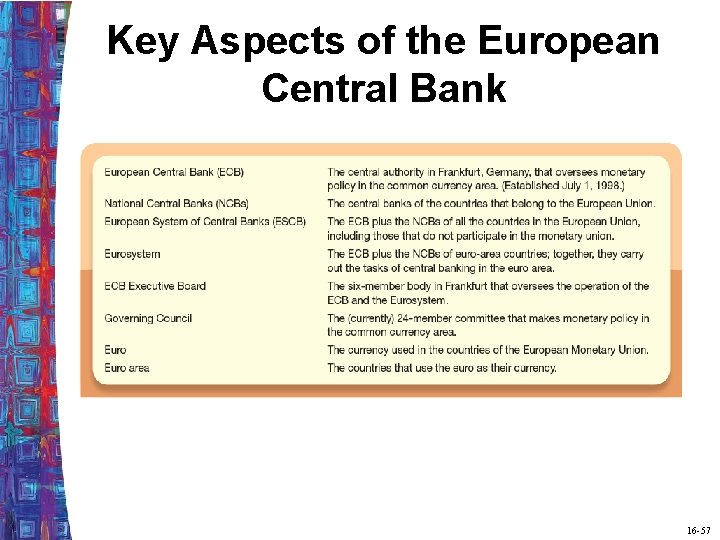
The European Central Bank • The agreement to form a European monetary union was formalized in the Treaty of Maastricht. • It ultimately led to the creation of the European system of Central Banks (ESCB). – The ESCB is composed of the National Central Banks (NCBs) in the 27 countries in the European Union. 16 -52
The European Central Bank • The ECB and the NCBs of the 17 countries that participate in the monetary union make up what is known as the Eurosystem. – They share a common currency and common monetary policy. • We will refer to the institution that is responsible for monetary policy in the euro area as the European Central Bank (ECB). 16 -53
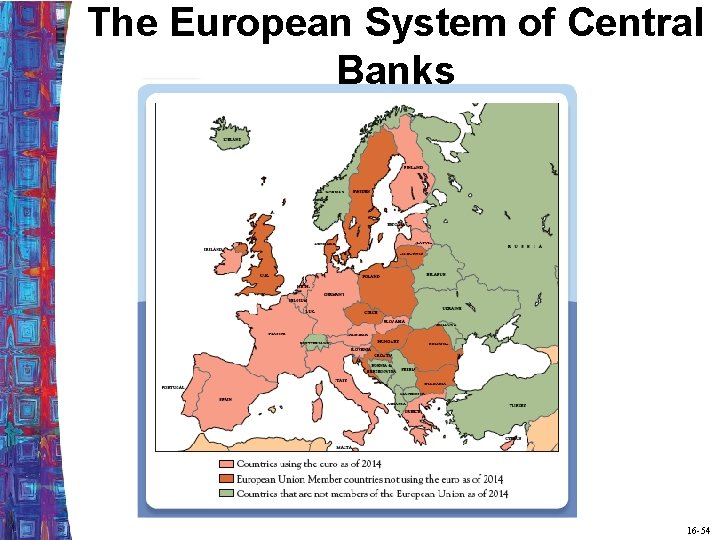
The European System of Central Banks 16 -54
Organizational Structure • The eurosystem mirrors the structure of the Federal Reserve System in several ways. – There is a six-member Executive Board of the ECB, similar to the Board of Governors; – The National Central Banks play many of the same roles as the Federal Reserve Banks; and – The Governing Council formulates monetary policy as the FOMC does. 16 -55
Organizational Structure • The Executive Board has a president and a vice president who play the same role as the Fed’s Board of Governors. • ECB executive board members are appointed by a committee composed of the heads of state of the countries that participate in the monetary union. 16 -56
Key Aspects of the European Central Bank 16 -57
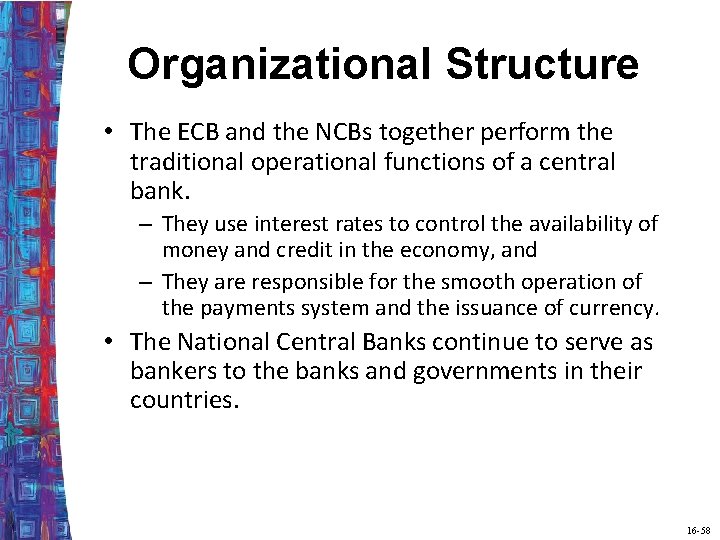
Organizational Structure • The ECB and the NCBs together perform the traditional operational functions of a central bank. – They use interest rates to control the availability of money and credit in the economy, and – They are responsible for the smooth operation of the payments system and the issuance of currency. • The National Central Banks continue to serve as bankers to the banks and governments in their countries. 16 -58
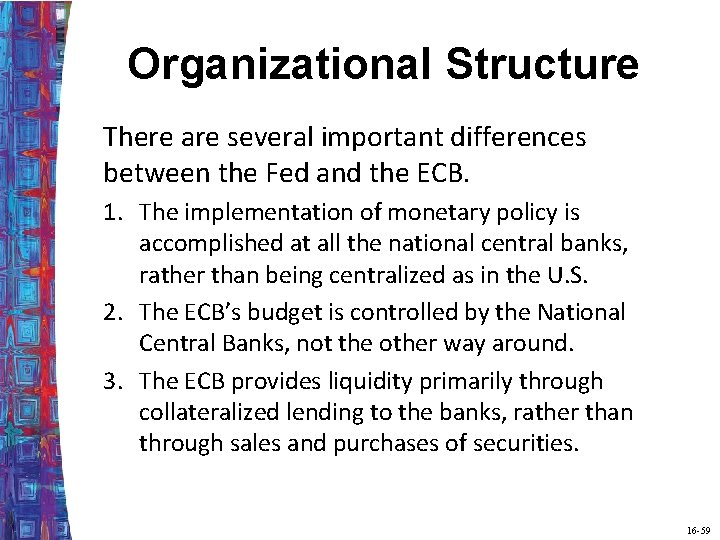
Organizational Structure There are several important differences between the Fed and the ECB. 1. The implementation of monetary policy is accomplished at all the national central banks, rather than being centralized as in the U. S. 2. The ECB’s budget is controlled by the National Central Banks, not the other way around. 3. The ECB provides liquidity primarily through collateralized lending to the banks, rather than through sales and purchases of securities. 16 -59
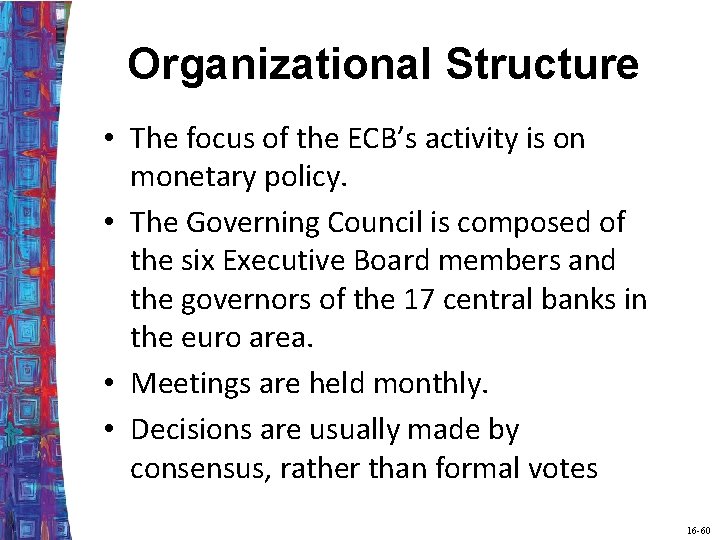
Organizational Structure • The focus of the ECB’s activity is on monetary policy. • The Governing Council is composed of the six Executive Board members and the governors of the 17 central banks in the euro area. • Meetings are held monthly. • Decisions are usually made by consensus, rather than formal votes 16 -60
Organizational Structure • The Governing Council members are charged with setting policy for the euro area as a whole, regardless of economic conditions in the individual countries. – The decisions are made for the benefit of the euro area, not for individual countries. 16 -61
Organizational Structure A number of important safeguards were included in the Treaty of Maastricht to ensure the central bank’s independence. 1. There are terms of office. 2. The ECB’s financial interests must remain separate from any political organization. 3. The treaty states explicitly that the Governing Council cannot take instructions from any government, so its policy decisions are irreversible. 16 -62
Organizational Structure • There will be more countries who want to enter the monetary union and some difficult decisions must be made. – ECB’s membership would be 6 executive board members and one representative from each of the member countries - a possible total of 33 members. • The Governing Council of the ECB has planned a complex system of rotation to be implemented when country membership reaches 19 states. – It bears a passing resemblance to the system used by the FOMC. 16 -63
Accountability and Transparency • Like the Fed, the ECB distributes large volumes of information in all of the ECB’s official languages. • Included are: – A weekly balance sheet; – A monthly statistical bulletin; – An analysis of current economic conditions; – Biannual forecasts of inflation and growth; – Research reports relevant to current policy; and – An annual report. 16 -64
Accountability and Transparency • The most important aspect of the ECB’s communication strategy concerns statements about the Governing Council’s policy deliberations. • Following each of the Governing Council’s monthly meetings, the president and vice president of the ECB hold a news conference. – This contrasts the statement and refusing to answer questions after its meeting by the FOMC. • However, the ECB does not make minutes public for 20 years. 16 -65
Accountability and Transparency In assessing whether the ECB’s communications strategy is sufficient, we need to ask two questions: 1. Does the information that is released minimize the extent to which people will be surprised by future policy actions? 2. Does it hold policymakers accountable for their decisions? • The answer is yes to both questions. 16 -66
• Interview with Michael Woodruff, an economist at Columbia University. – Regarded as one of the world’s foremost experts on monetary policy. • He states that the Fed should change their focus from primarily an inflation target to a target level for economic output, in nominal dollar terms. 16 -67
The Price Stability Objective and Monetary Policy Strategy The Treaty of Maastricht states: “The primary objective of the European System of Central Banks shall be to maintain price stability. Without prejudice to the objective of price stability, the ESCB shall support the general economic policies in the Community. ” • This includes the objective of sustainable and non-inflationary growth. 16 -68
The Price Stability Objective and Monetary Policy Strategy • The Treaty is widely understood to place priority on price stability as the top objective for the ECB. • The Governing Council’s response has been to explain its interpretation of the statement and describe the factors that guide its policy decisions. 16 -69
The Price Stability Objective and Monetary Policy Strategy The strategy has two parts: 1. There is a numerical definition of price stability, and 2. The Governing Council announces its intention to focus on a broad-based assessment of the outlook for future prices, with money playing a prominent role. 16 -70
The Price Stability Objective and Monetary Policy Strategy • The ECB’s Governing Council defines price stability as an inflation rate of close to, but less than, 2 percent, based on a euro-areawide measure of consumer prices. – This is the harmonized index of consumer prices (HICP) and is similar to the CPI. – It is the average of retail price inflation in all the countries of the monetary union, weighted by the size of their gross domestic products. 16 -71
The Price Stability Objective and Monetary Policy Strategy • This arrangement has important implications for monetary policy operations, because there will surely be times when the proper policy for Ireland is to raise interest rates but the proper policy for Germany is to lower them. – Given Ireland’s relative size, a change in inflation or growth there has little impact on the euro area as whole. • The same is true for other small countries in the union. 16 -72
The Price Stability Objective and Monetary Policy Strategy • The fact that the economically large countries matter much more than the small ones can affect the dynamics of the governing council’s interest rate decisions. • While the governing Council’s job is to stabilize prices in the euro area as a whole, one wonders whether activities in the smaller countries might have undue influence on its policy decisions. 16 -73
The Price Stability Objective and Monetary Policy Strategy • Evidence strongly suggests that the ECB is doing the job it is supposed to do. • The Governing council’s policy has been appropriate to the euro area. – It has not been skewed toward smaller countries’ concerns. • The specificity of the price stability objective holds policymakers accountable. – It limits discretion in their decision making. 16 -74
• The Maastricht Treaty provided the ECB with a legal foundation that makes it highly independent, but – They cannot secure price stability over the long term if fiscal policymakers do not control the rise of public debt nor – Ensure economic stability in the face of bank runs. • When the euro-area crisis began in 2010, the policymakers had to fight to keep the monetary union together. 16 -75
• The financial crisis of 2007 -2009 severely damaged the eruo-area banks leading to a deep recession. – Where deficits were large, as in Greece, they widened further. – Where deficits were contained, but the banking sector had over-extended itself with risky lending (Spain), the government had to borrow heavily. • Investors and depositors ran to safer banks. 16 -76
• When in a monetary union, a country might believe that other countries will bail it (or its banks) out in a crisis. – This creates a moral hazard for some banks to take on more risk. • Like the Fed, the ECB offered banks liquidity through new and inventive means. – But the ECB cannot solve the euro areas structural problems. 16 -77
- Slides: 77