
Chapter Sixteen Managing Change and Organizational Learning Mc


- Slides: 42
Chapter Sixteen Managing Change and Organizational Learning Mc. Graw-Hill/Irwin Copyright © 2010 The Mc. Graw-Hill Companies, Inc. All rights reserved.
After reading the material in this chapter, you should be able to: • Discuss the external and internal forces that can create the need for organizational change. • Describe Lewin’s change model and the systems model of change. • Explain Kotter’s eight steps for leading organizational change. 16 -2
After reading the material in this chapter, you should be able to: • Review the 11 reasons employees resist change. • Identify alternative strategies for overcoming resistance to change. • Discuss the process organizations use to build their learning capabilities. 16 -3
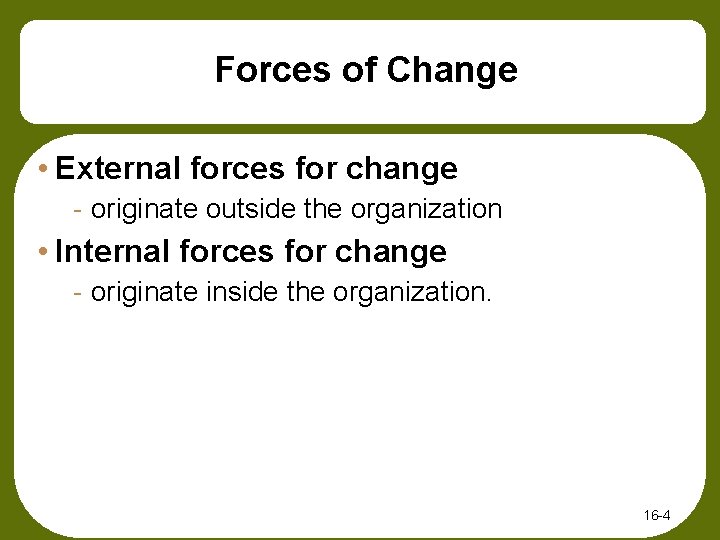
Forces of Change • External forces for change - originate outside the organization • Internal forces for change - originate inside the organization. 16 -4
External Forces • Demographic characteristics • Technological advancements • Customer and market changes • Social and political pressures 16 -5
Internal Forces • Low job satisfaction • High turnover • Conflict • Management pressure • Organizational culture 16 -6
Question? ABC Trucking, conducted an analysis of employee job satisfaction and turnover, and concluded that its turnover rate was 48%. This was primarily attributed to job dissatisfaction by employees. This represents a(n) ______ for ABC. A. B. C. D. External force for change Social and political pressure Technological advancements Internal force for change 16 -7
Lewin’s Change Model • Unfreezing - Focus is to create the motivation to change - Begin by disconfirming the usefulness or appropriateness of employees’ present behaviors or attitudes 16 -8
Lewin’s Change Model • Benchmarking - process by which a company compares its performance with that of high-performing companies 16 -9
Question? Fredfirst, a securities trading company, regularly compares its performance with that of high performing organizations in the industry, such as Merrill Lynch. This process is described as A. B. C. D. Change. Refreezing. Benchmarking. A strategic plan 16 -10
Lewin’s Change Model • Changing - Organizational change can be aimed at improvement or growth, or it can focus on solving a problem such as poor customer service or low productivity - Can be targeted at different levels in an organization 16 -11
Lewin’s Change Model • Refreezing - Change is stabilized by helping employees integrate the changed behavior or attitude into their normal way of doing things - Giving employees the chance to exhibit new behaviors, which are then reinforced 16 -12
A Systems Model of Change • Systems Approach - Based on the premise that any change, no matter how large or small, has a cascading effect throughout an organization - Takes a “big picture” perspective of organizational change 16 -13
A Systems Model of Change • Mission statement - summarizes why an organization exists • Strategic plan - long-term plan outlining actions needed to achieve desired results • Target elements of change - components of an organization that may be changed 16 -14
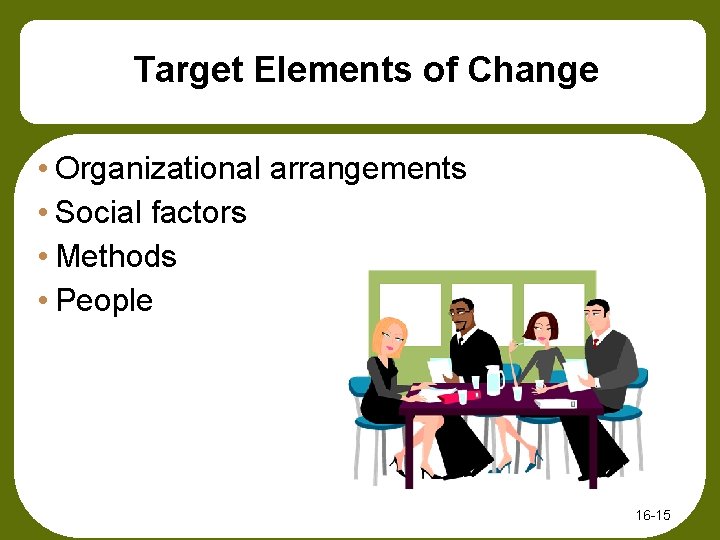
Target Elements of Change • Organizational arrangements • Social factors • Methods • People 16 -15
A Systems Model of Change Figure 16 -16
Applying the Systems Model of Change • Aid during the strategic planning process • Using the model as a diagnostic framework to determine the causes of an organizational problem and to propose solutions 16 -17
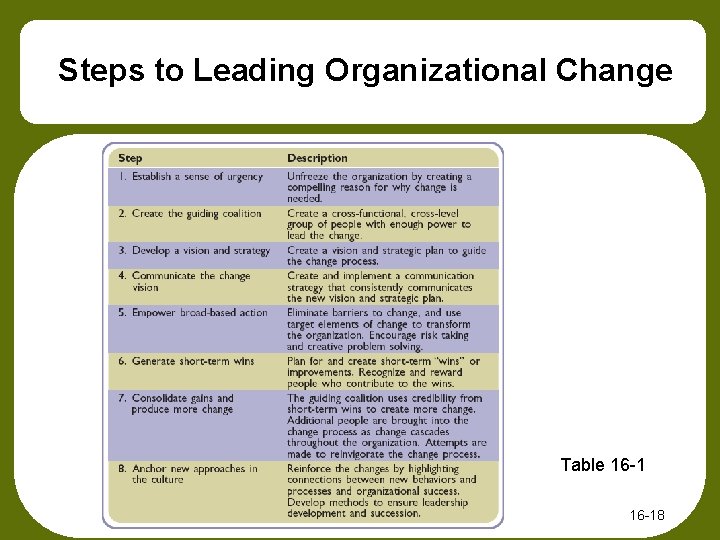
Steps to Leading Organizational Change Table 16 -18
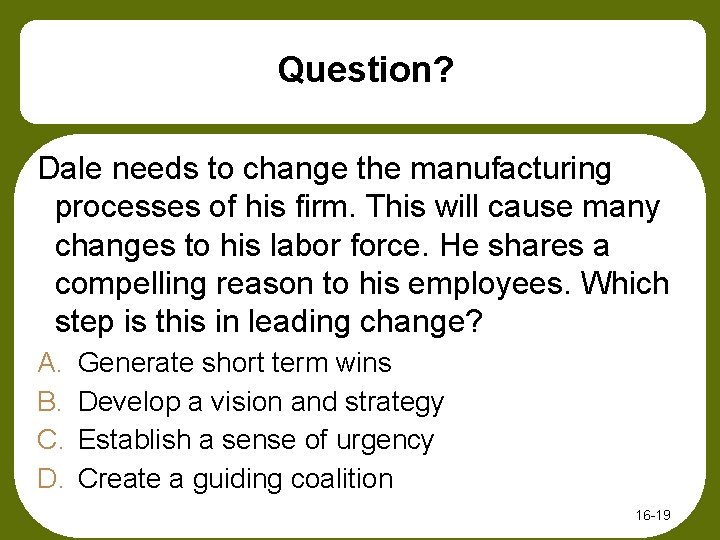
Question? Dale needs to change the manufacturing processes of his firm. This will cause many changes to his labor force. He shares a compelling reason to his employees. Which step is this in leading change? A. B. C. D. Generate short term wins Develop a vision and strategy Establish a sense of urgency Create a guiding coalition 16 -19
Creating Change Through Organization Development • Organization Development - a set of techniques or tools that are used to implement organizational change - Involves profound change - Value loaded - Diagnostic/prescription cycle - Process oriented 16 -20
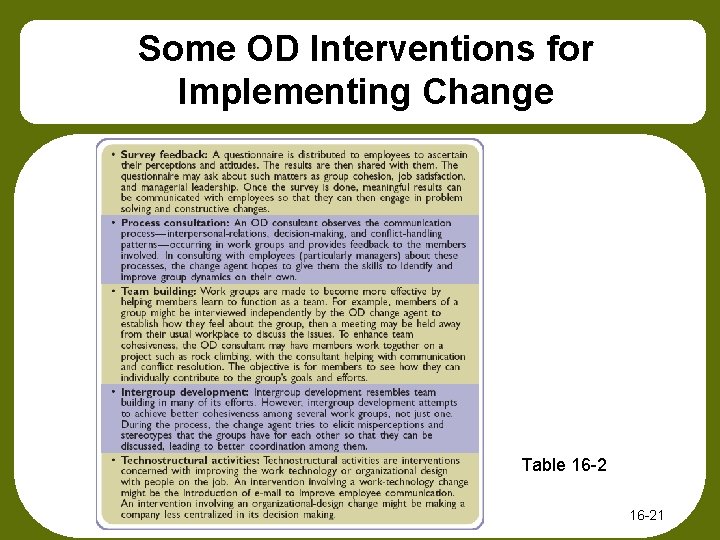
Some OD Interventions for Implementing Change Table 16 -21
OD Research and Practical Implications 1. Planned organizational change works 2. Change programs are more successful when they are geared toward meeting both short-term and long-term results 3. Organizational change is more likely to succeed when top management is truly committed to the change program 4. Effectiveness of OD interventions is affected by cross-cultural considerations 16 -22
Why People Resist Change in the Workplace • Resistance to change - emotional or behavioral response to real or imagined work changes 16 -23
Why People Resist Change in the Workplace 1. An individual’s predisposition toward change 2. Surprise and fear of the unknown 3. Climate of mistrust 4. Fear of failure 5. Loss of status and/or job security 6. Peer pressure 16 -24
Question? Jamie is not directly affected by the change introduced in her company, but she is actively resisting it to protect the interests of her friends. This describes which reason for resistance to change? A. Surprise and fear of the unknown B. Personality conflicts C. Peer pressure D. Lack of tact 16 -25
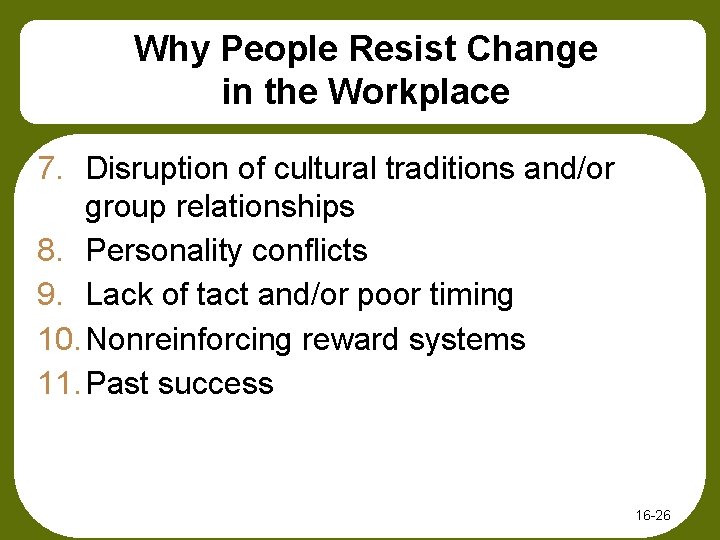
Why People Resist Change in the Workplace 7. Disruption of cultural traditions and/or group relationships 8. Personality conflicts 9. Lack of tact and/or poor timing 10. Nonreinforcing reward systems 11. Past success 16 -26
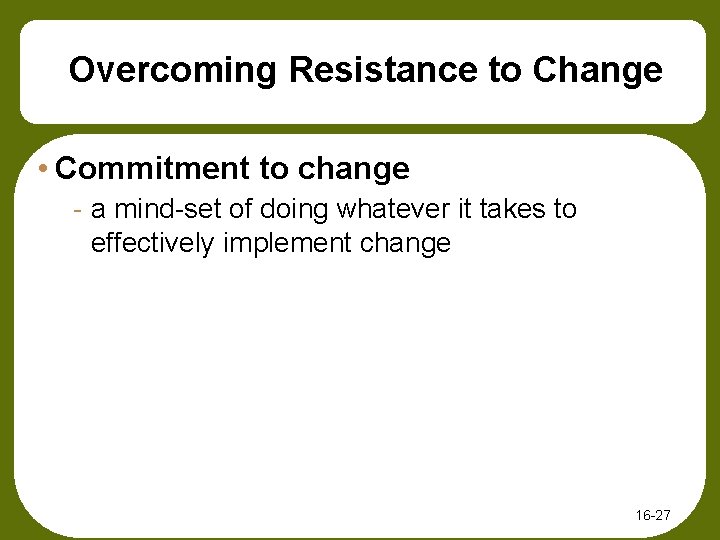
Overcoming Resistance to Change • Commitment to change - a mind-set of doing whatever it takes to effectively implement change 16 -27
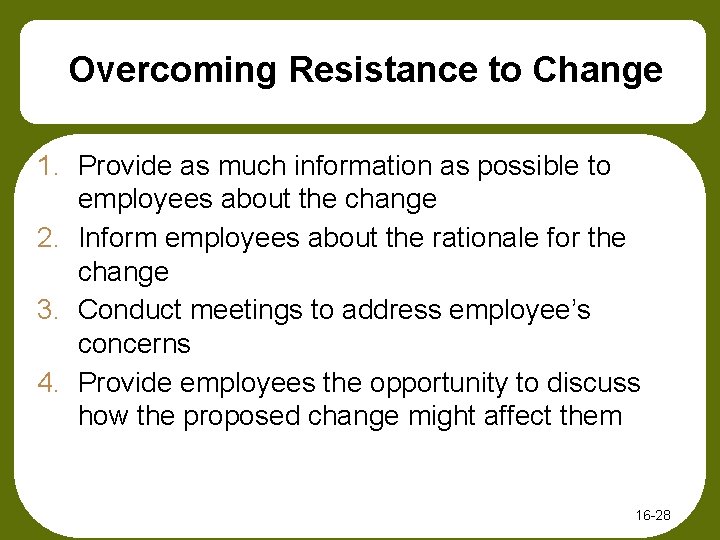
Overcoming Resistance to Change 1. Provide as much information as possible to employees about the change 2. Inform employees about the rationale for the change 3. Conduct meetings to address employee’s concerns 4. Provide employees the opportunity to discuss how the proposed change might affect them 16 -28
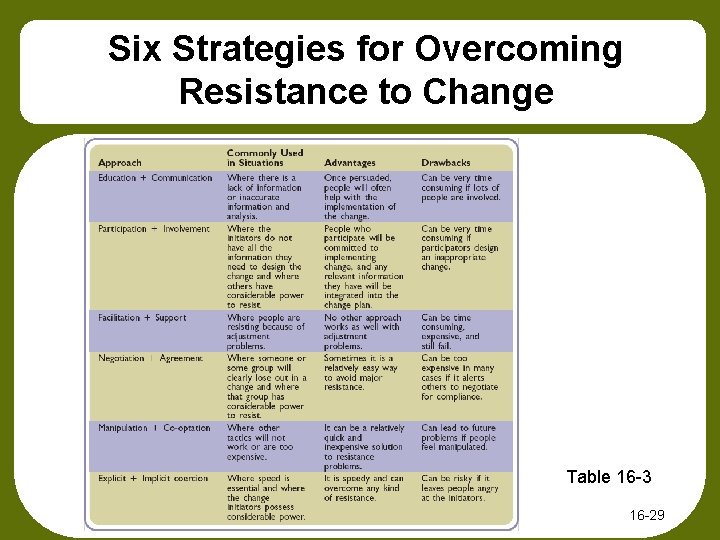
Six Strategies for Overcoming Resistance to Change Table 16 -3 16 -29
Creating a Learning Organization • Learning organization - proactively creates, acquires, and transfers knowledge throughout the organization 16 -30
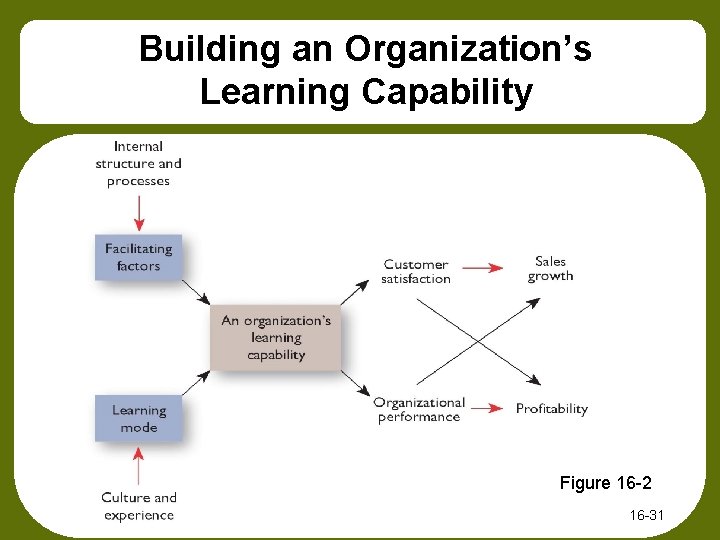
Building an Organization’s Learning Capability Figure 16 -2 16 -31
Building an Organization’s Learning Capability • Learning capabilities - set of core competencies and internal processes that enable an organization to adapt to its environment 16 -32
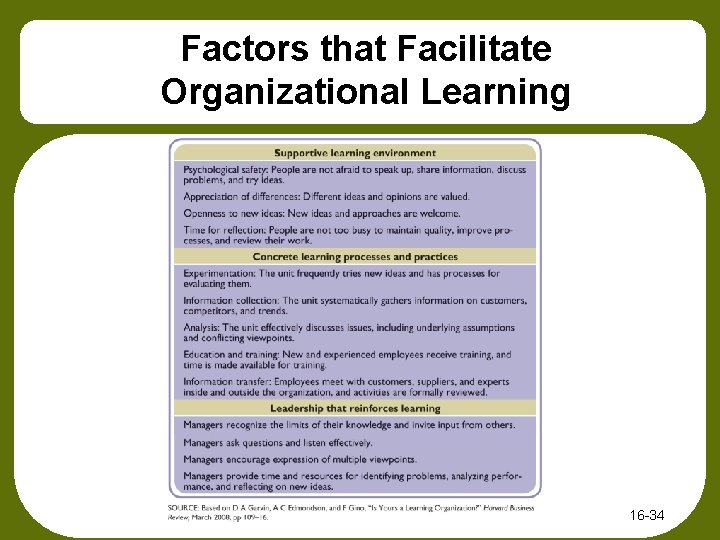
Building an Organization’s Learning Capability • Facilitating factors - represent the internal structure and processes that affect how easy or hard it is for learning to occur and the amount of effective learning that takes place 16 -33
Factors that Facilitate Organizational Learning Insert new Table 16 -4 16 -34
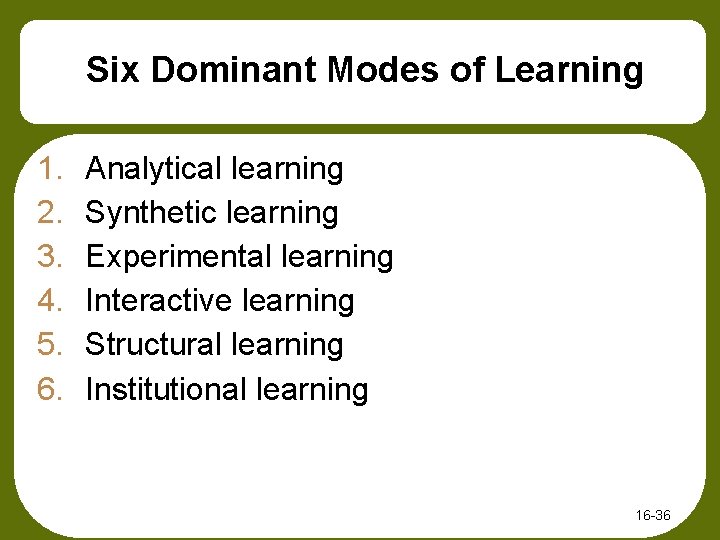
Learning Modes • Learning modes - various ways in which organizations attempt to create and maximize their learning 16 -35
Six Dominant Modes of Learning 1. 2. 3. 4. 5. 6. Analytical learning Synthetic learning Experimental learning Interactive learning Structural learning Institutional learning 16 -36
Question? Grant learns through systematic gathering of information. He is a(n) _____ learner. A. Analytic B. Synthetic C. Experimental D. Interactive 16 -37
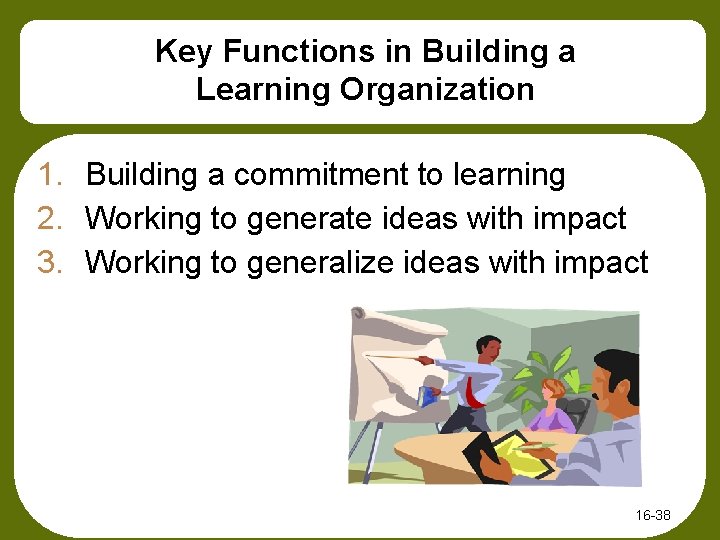
Key Functions in Building a Learning Organization 1. Building a commitment to learning 2. Working to generate ideas with impact 3. Working to generalize ideas with impact 16 -38
Supplemental Slides • Slides 40 -44 contain extra non-text examples to integrate and enhance instructor lectures - Slide 40: Change Approaches Slides 41: Rational Approach to Change Slide 42: Emotional Approach to Change Slide 43: Change Management Slide 44: Video discussion slide 16 -39
Change Approaches • Economic focus: Firms value financial return to stockholders using downsizing, layoffs, restructuring. - Al “Chainsaw” Dunlap - Scott Paper, Sunbeam • Focus on organizational capabilities: Firms value corporate culture, human capabilities, information feedback, measurements. - Denny’s approach to achieving court-ordered change 16 -40
Change Management • Read an article on “An Improvisational Model of Change Management” 16 -41
Video Case: Louisville Slugger – Hillerich & Bradsby • What role do information systems play at H&B? What were the internal and external trade-offs between reconfiguring the old information system and designing a new one? • Why was the transition to the new system difficult? How could Kotter’s eight steps be used to facilitate such a transition? • Why did some people resist change and experience stress? What strategies could H&B have used to overcome resistance to change? 16 -42