
Chapter Six Sun SPARC Architecture SPARC Processor The

- Slides: 31
Chapter Six Sun SPARC Architecture
SPARC Processor • The name SPARC stands for Scalable Processor Architecture • SPARC architecture follows the RISC design philosophy by stressing importance of – Large CPU register file – Similar register window features
RISC Vs CISC • The historical background: – In first 25 years (1945 -70) performance came from both technology and design. – Design considerations: o small and slow memories: compact programs are fast. o small no. of registers: memory operands are used instead o attempts to bridge the semantic gap: model high level language features in instructions. o no need for portability: same vendor application, OS and hardware. o backward compatibility: every new ISA must carry the good and bad of all past ones. • Result: powerful and complex instructions that are rarely used. • Such type of processors were classified as CISC.
CISC • CISC is an acronym for Complex Instruction Set Computer. • These chips are easy to program and make efficient use of memory. • CISC philosophy made sense as the earliest machines were programmed in assembly language and memory was slow and expensive • Most common microprocessor designs such as Intel 80 x 86 and Motorola 68 K series followed the CISC philosophy.
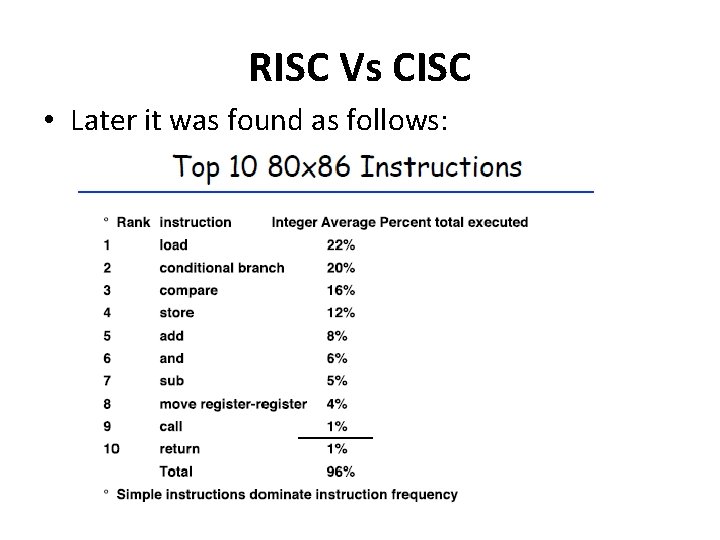
RISC Vs CISC • Later it was found as follows:
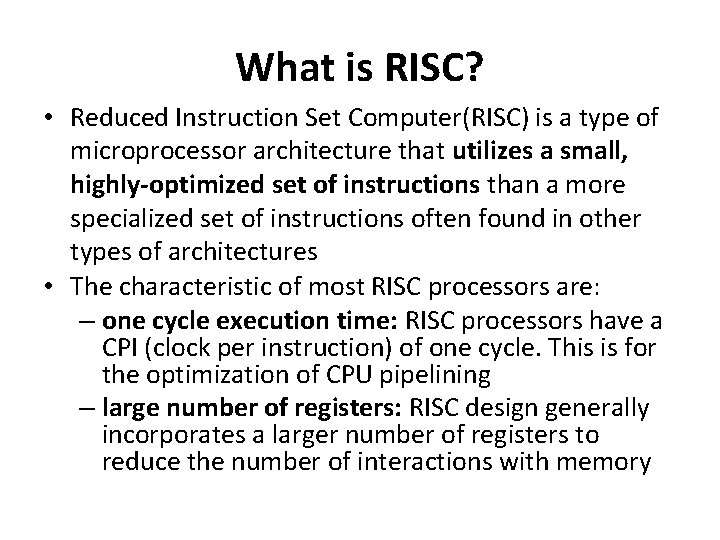
What is RISC? • Reduced Instruction Set Computer(RISC) is a type of microprocessor architecture that utilizes a small, highly-optimized set of instructions than a more specialized set of instructions often found in other types of architectures • The characteristic of most RISC processors are: – one cycle execution time: RISC processors have a CPI (clock per instruction) of one cycle. This is for the optimization of CPU pipelining – large number of registers: RISC design generally incorporates a larger number of registers to reduce the number of interactions with memory
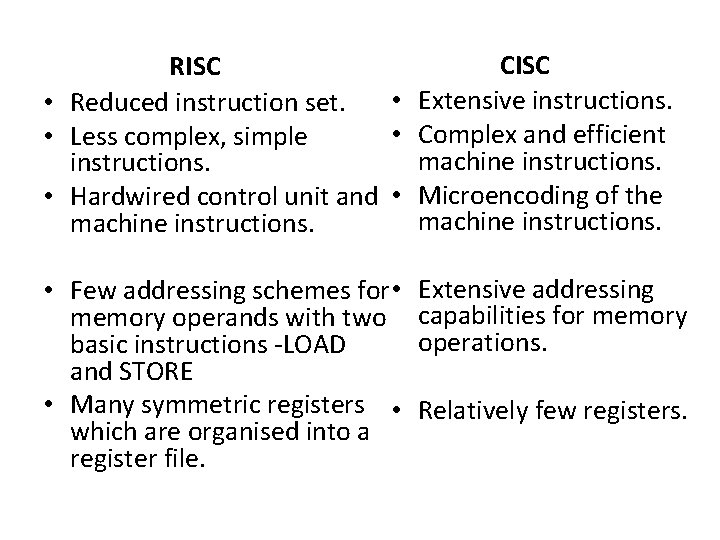
CISC RISC • Extensive instructions. • Reduced instruction set. • Complex and efficient • Less complex, simple machine instructions. • Hardwired control unit and • Microencoding of the machine instructions. • Few addressing schemes for • memory operands with two basic instructions -LOAD and STORE • Many symmetric registers • which are organised into a register file. Extensive addressing capabilities for memory operations. Relatively few registers.
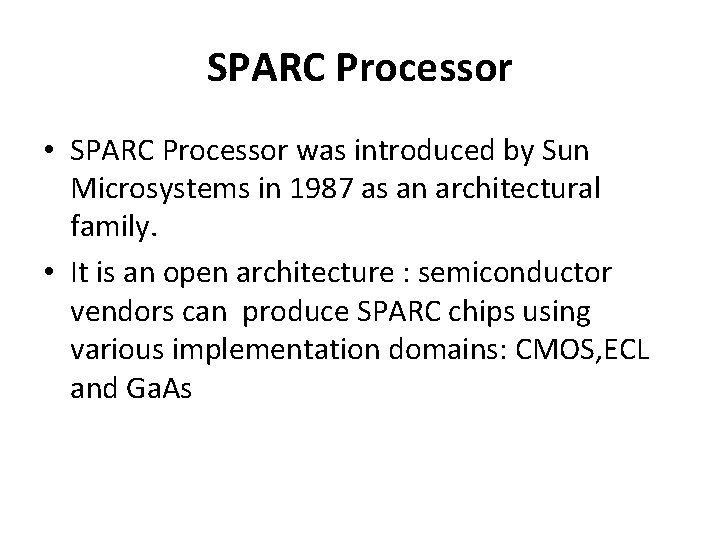
SPARC Processor • SPARC Processor was introduced by Sun Microsystems in 1987 as an architectural family. • It is an open architecture : semiconductor vendors can produce SPARC chips using various implementation domains: CMOS, ECL and Ga. As
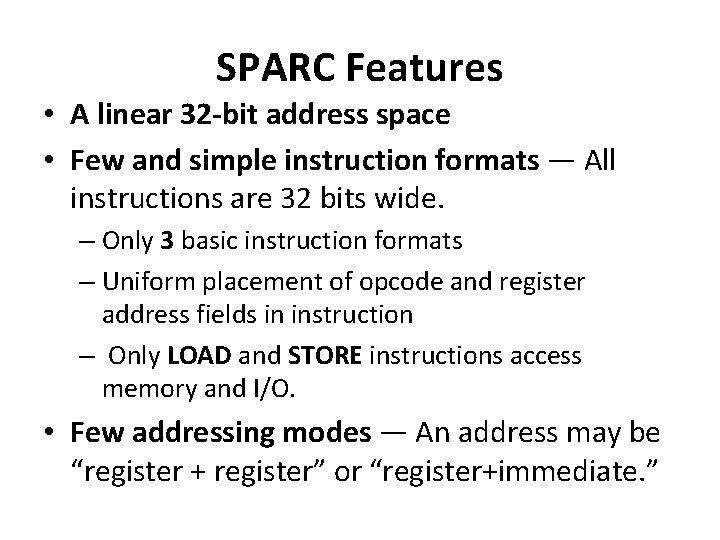
SPARC Features • A linear 32 -bit address space • Few and simple instruction formats — All instructions are 32 bits wide. – Only 3 basic instruction formats – Uniform placement of opcode and register address fields in instruction – Only LOAD and STORE instructions access memory and I/O. • Few addressing modes — An address may be “register + register” or “register+immediate. ”
SPARC Features • Triadic register addresses— Most instructions operate on two register operands (or one register and a constant) and place the result in a third register. • A large “windowed” register file — At any one instant, a program sees 8 global integer registers plus a 24 -register window into a larger register file. • A separate floating-point register file
SPARC Features • Delayed control transfer— The processor always fetches the next instruction after a delayed control-transfer instruction. • Fast trap handler • Tagged instructions • Multiprocessor synchronization instructions • Coprocessor— The architecture defines a straightforward coprocessor instruction set, in addition to the floating-point instruction set.
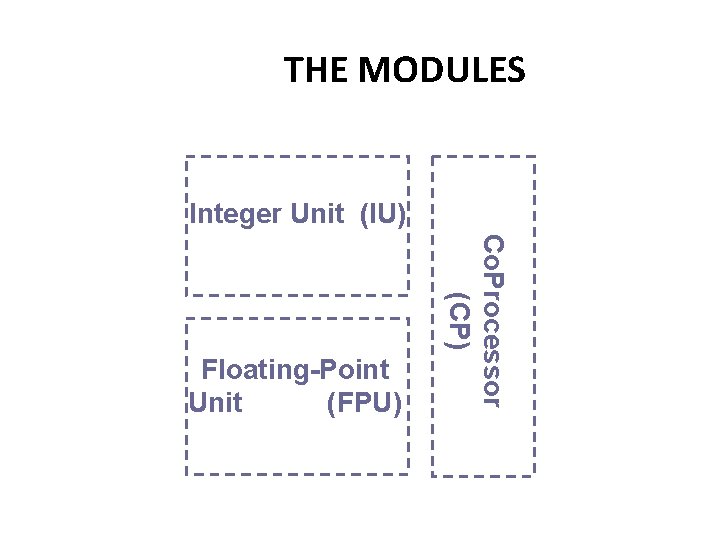
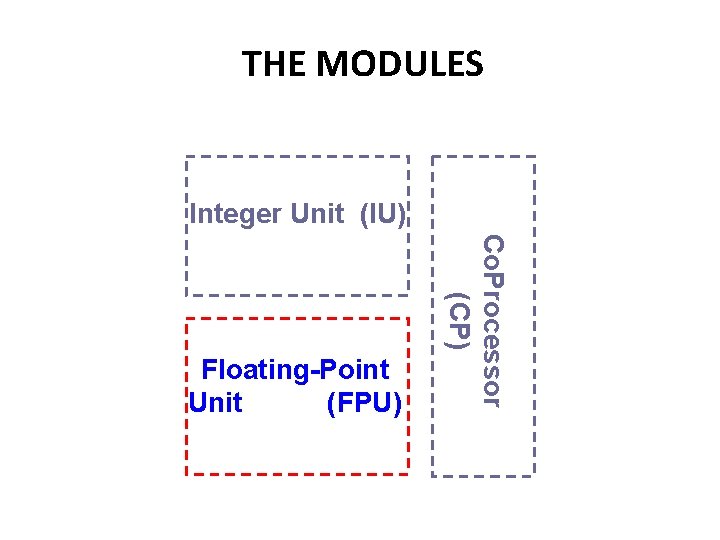
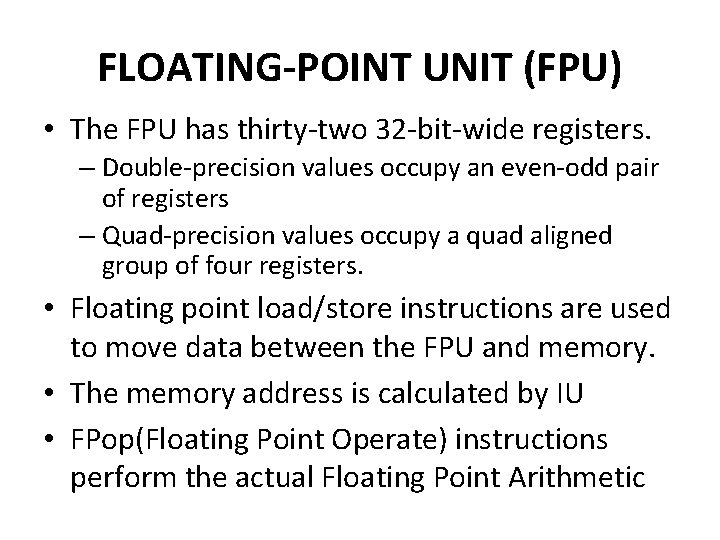
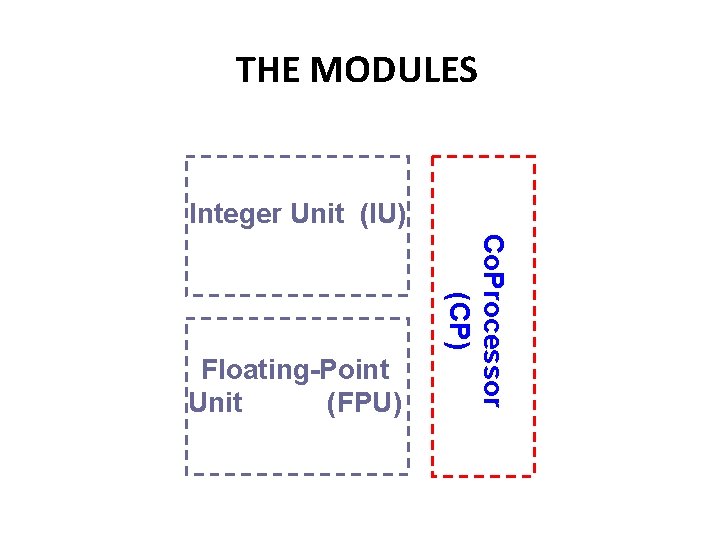
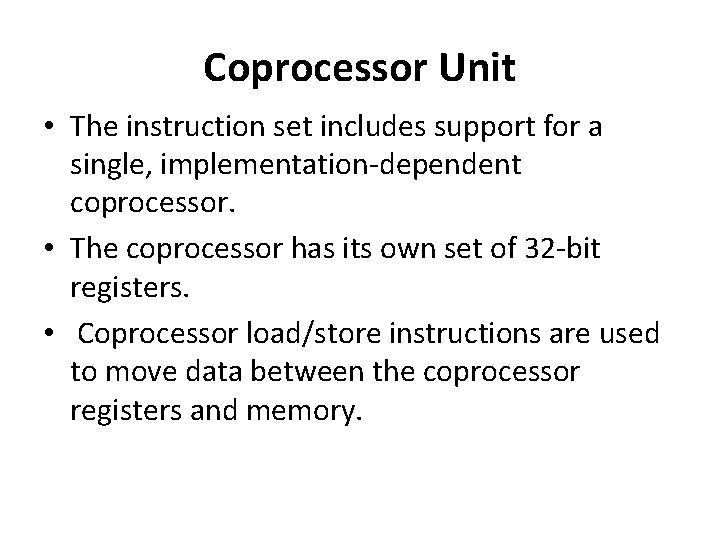
SPARC Architecture • SPARC is an instruction set architecture (ISA) with 32 -bit integer and 32 -, 64 -, and 128 -bit floating point as its principal data types. • SPARC processor logically comprises 3 units: – an Integer Unit (IU) – a Floating-Point Unit (FPU) – an optional Coprocessor (CP), each with its own registers. (32 -bits wide).
SPARC Processor • SPARC processor can be in either of 2 modes: – Supervisor mode: The processor can execute any instruction including the privileged instructions. – User mode: “User Application” programs will be executed in user mode. An attempt to execute a privileged instruction will cause a trap to supervisor software.
THE MODULES Integer Unit (IU) Co. Processor (CP) Floating-Point Unit (FPU)
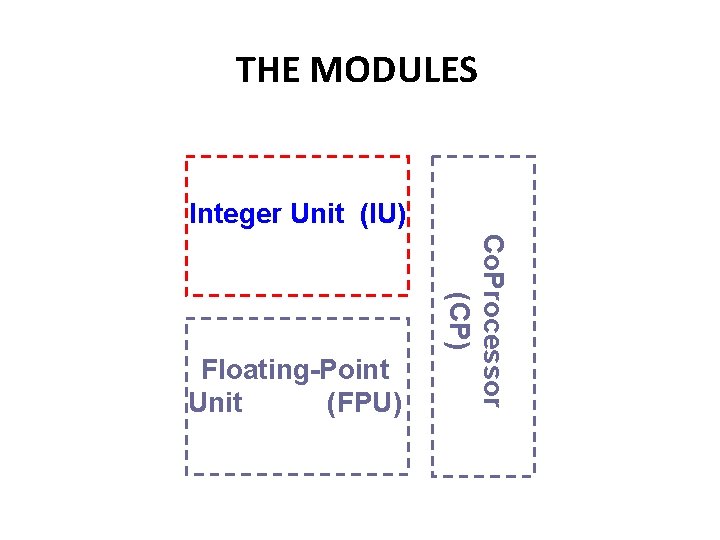
THE MODULES Integer Unit (IU) Co. Processor (CP) Floating-Point Unit (FPU)
INTEGER UNIT (IU) • Contains the general purpose registers and controls the overall operation of the processor. • Executes the integer arithmetic instructions and computes memory addresses for loads and stores. • Maintains the program counters and controls instruction execution for the FPU and the CP. • May contain from 40 to 520 general-purpose 32 -bit registers • It corresponds to – 8 global registers and – a circular stack of from 2 to 32 sets of 16 registers known as register windows. – Thus (2*16=32+8=40) to (32*16+8 =520) Integer Unit (IU)
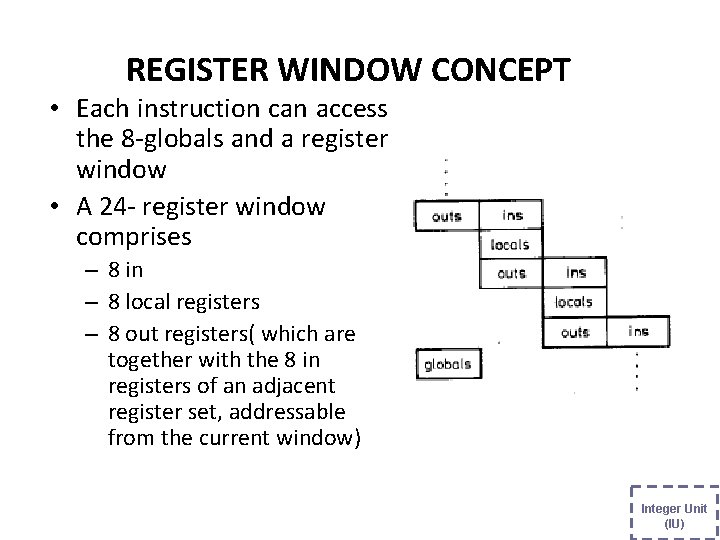
REGISTER WINDOW CONCEPT • Each instruction can access the 8 -globals and a register window • A 24 - register window comprises – 8 in – 8 local registers – 8 out registers( which are together with the 8 in registers of an adjacent register set, addressable from the current window) Integer Unit (IU)
THE MODULES Integer Unit (IU) Co. Processor (CP) Floating-Point Unit (FPU)
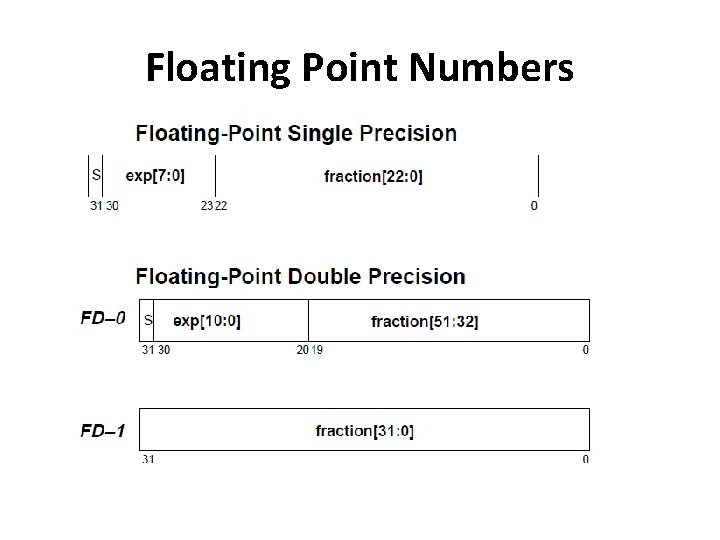
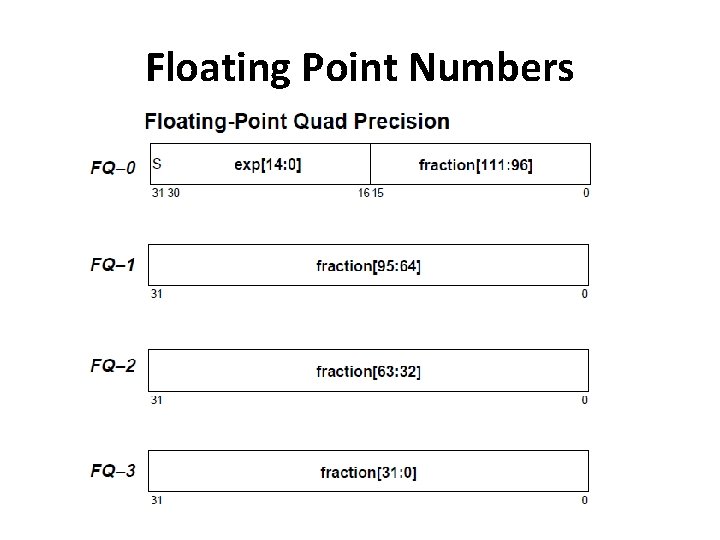
FLOATING-POINT UNIT (FPU) • The FPU has thirty-two 32 -bit-wide registers. – Double-precision values occupy an even-odd pair of registers – Quad-precision values occupy a quad aligned group of four registers. • Floating point load/store instructions are used to move data between the FPU and memory. • The memory address is calculated by IU • FPop(Floating Point Operate) instructions perform the actual Floating Point Arithmetic
THE MODULES Integer Unit (IU) Co. Processor (CP) Floating-Point Unit (FPU)
Coprocessor Unit • The instruction set includes support for a single, implementation-dependent coprocessor. • The coprocessor has its own set of 32 -bit registers. • Coprocessor load/store instructions are used to move data between the coprocessor registers and memory.
Data Formats
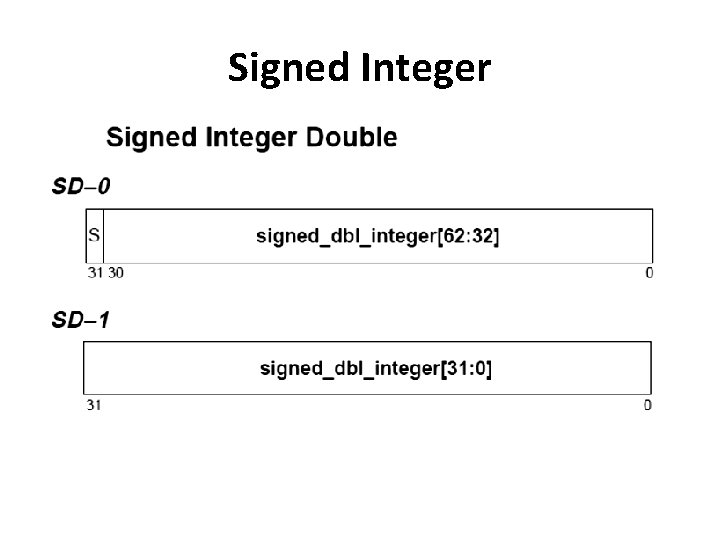
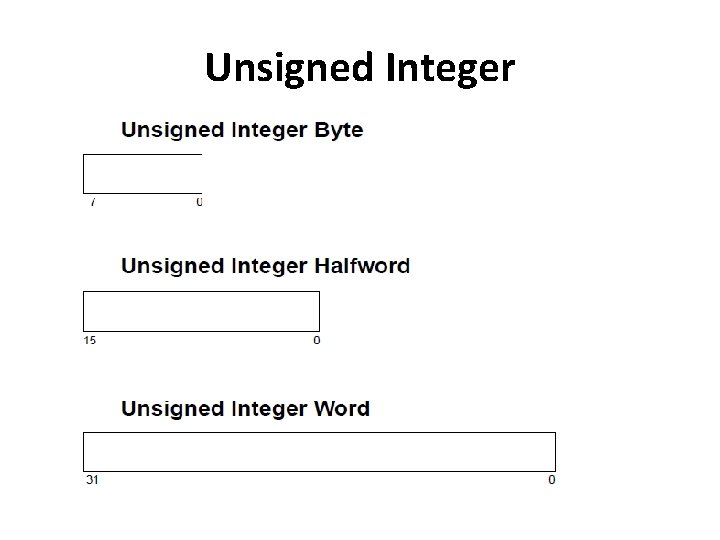
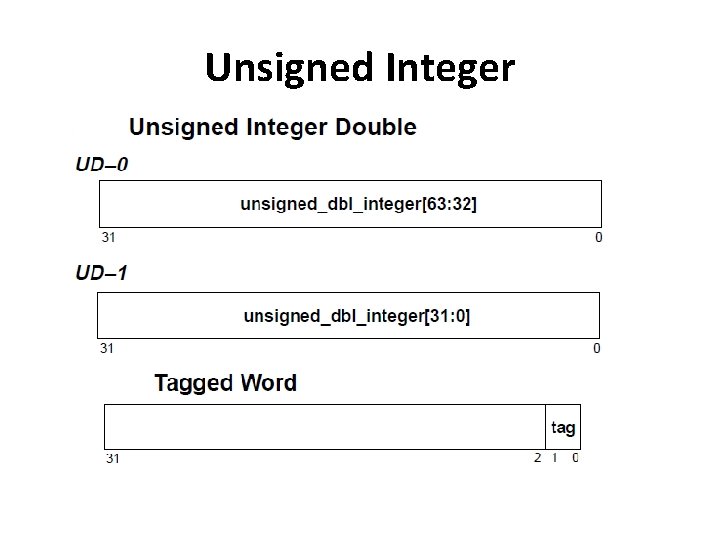
SPARC Data Formats • The SPARC architecture recognizes three fundamental data formats (or types): – Signed Integer— 8, 16, 32, and 64 bits – Unsigned Integer— 8, 16, 32, and 64 bits – Floating-Point — 32, 64, and 128 bits • The format widths are defined as – Byte — 8 bits – Halfword— 16 bits – Word/Singleword — 32 bits
SPARC Data Formats – Tagged Word— 32 bits (30 -bit value plus 2 tag bits) – Doubleword— 64 bits – Quadword— 128 bits
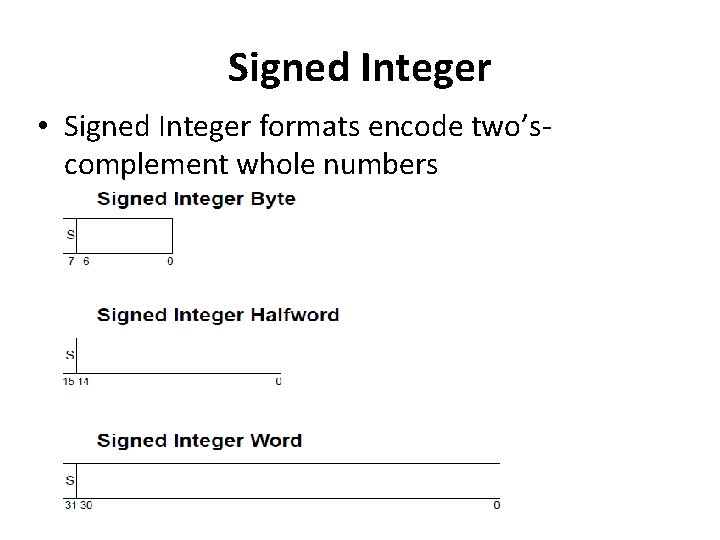
Signed Integer • Signed Integer formats encode two’scomplement whole numbers
Signed Integer
Unsigned Integer • Unsigned Integer formats are general-purpose and hence they do not encode any particular data type. • They can represent a whole number, string, fraction, boolean value, etc.
Unsigned Integer
Unsigned Integer
Floating Point Numbers
Floating Point Numbers