
Chapter Six Pragmatics Language in Use 1 Sense
- Slides: 92
Chapter Six Pragmatics (Language in Use)
1. Sense relations between sentences Sense relationships also exist between sentences n Entailment n (含义, 蕴含) n Presupposition n (前提) n Implicature n (言外之意) n (p 146) n 2
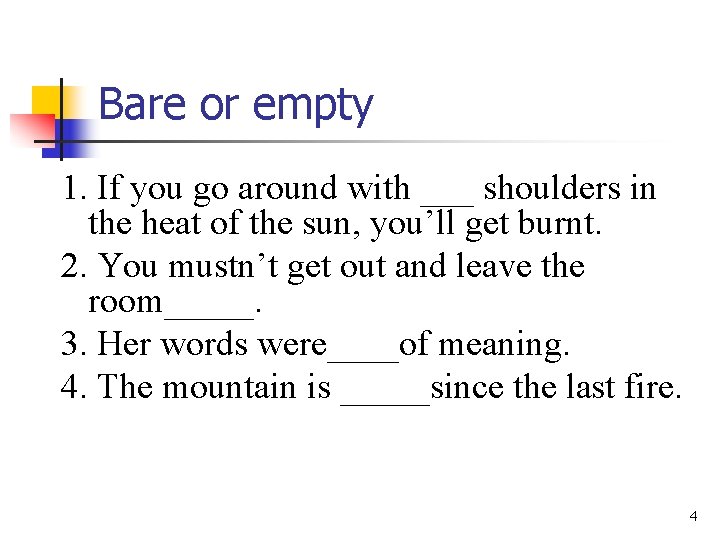
Bare or empty 1. If you go around with ___ shoulders in the heat of the sun, you’ll get burnt. 2. You mustn’t get out and leave the room_____. 3. Her words were____of meaning. 4. The mountain is _____since the last fire. 4
n n n n Sense complex relationships also exist between sentences Entailment (含义, 蕴含) Presupposition (预设) Implicature (言外之意) 5
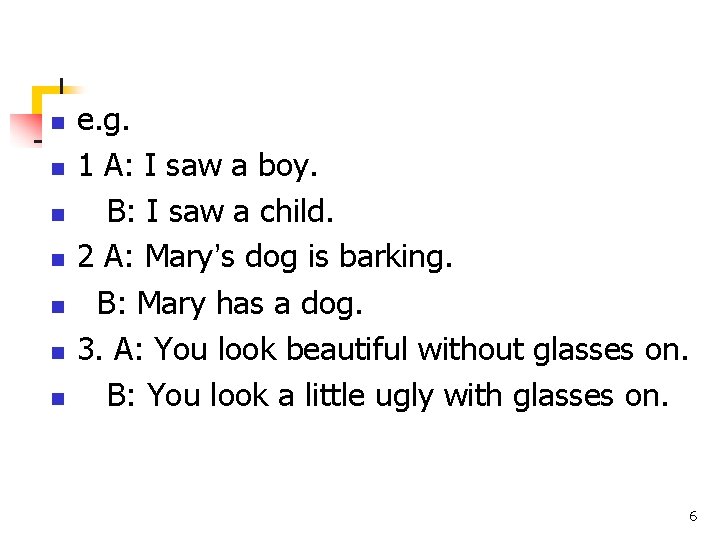
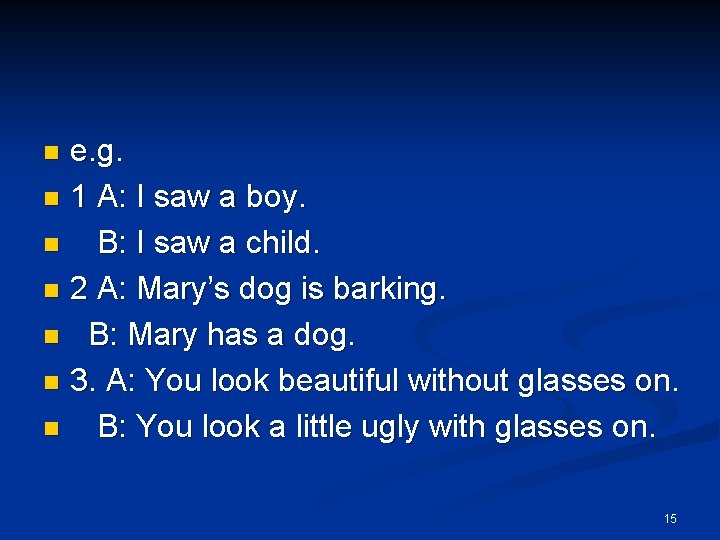
n n n n e. g. 1 A: I saw a boy. B: I saw a child. 2 A: Mary’s dog is barking. B: Mary has a dog. 3. A: You look beautiful without glasses on. B: You look a little ugly with glasses on. 6
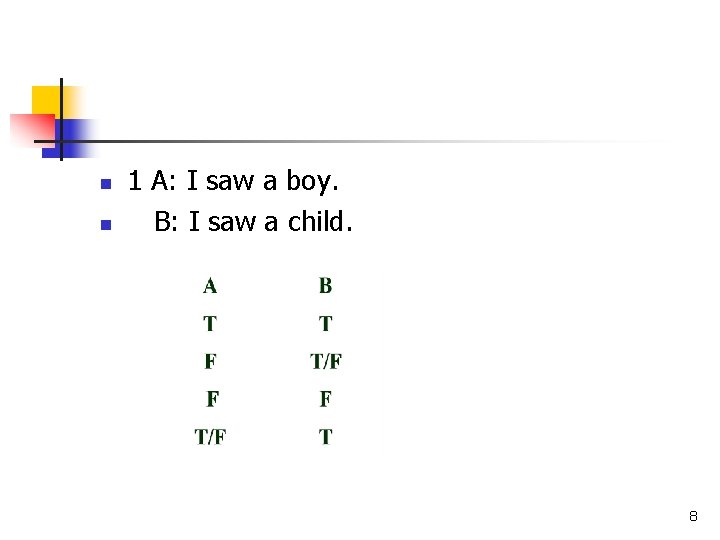
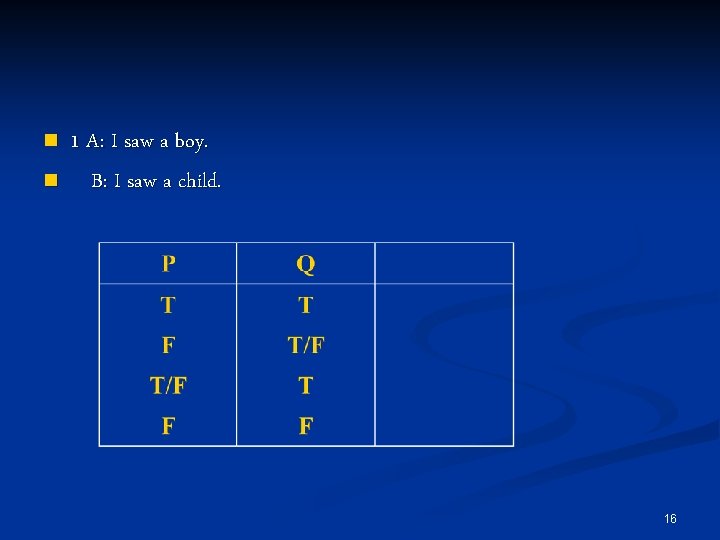
n Entailment is a relation of inclusion. 7
n n 1 A: I saw a boy. B: I saw a child. 8
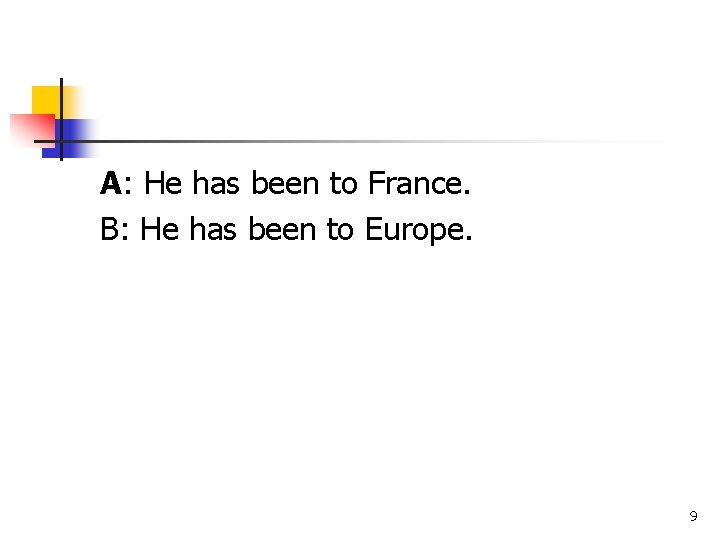
A: He has been to France. B: He has been to Europe. 9
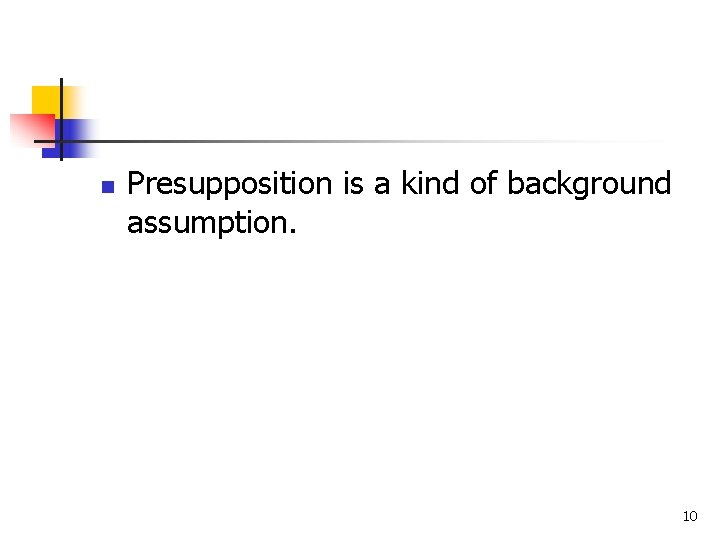
n Presupposition is a kind of background assumption. 10
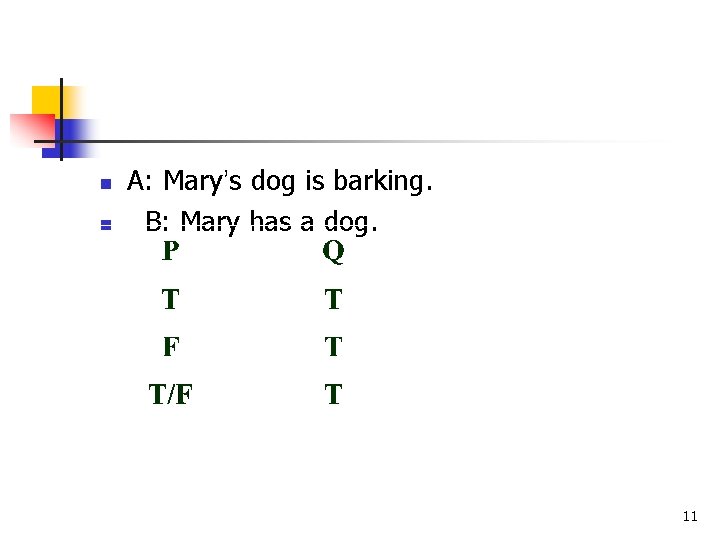
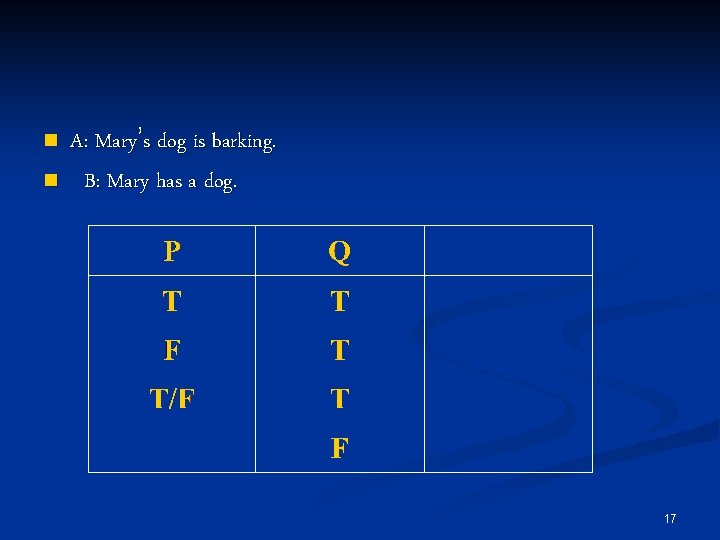
n n A: Mary’s dog is barking. B: Mary has a dog. 11
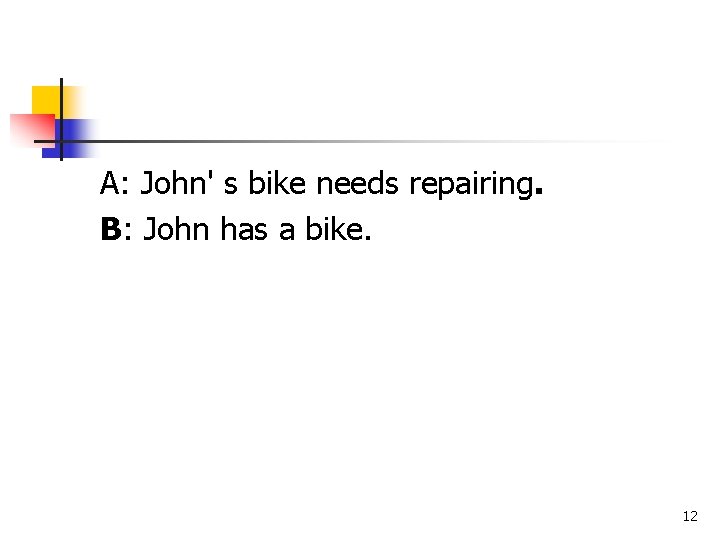
A: John' s bike needs repairing. B: John has a bike. 12
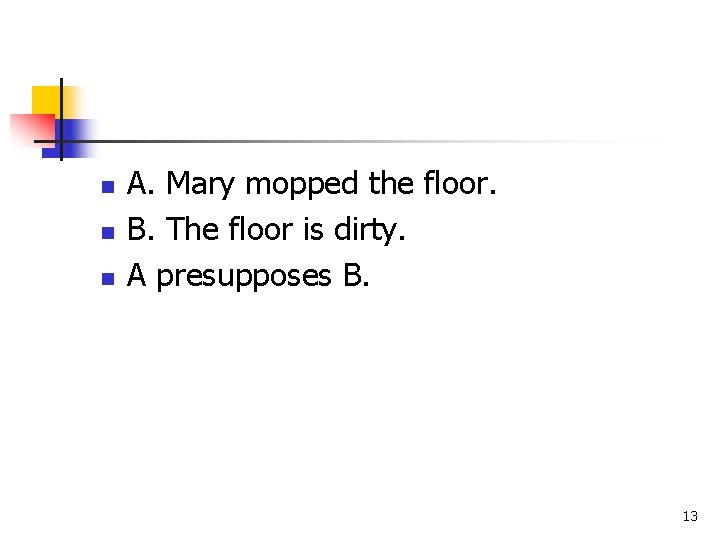
n n n A. Mary mopped the floor. B. The floor is dirty. A presupposes B. 13
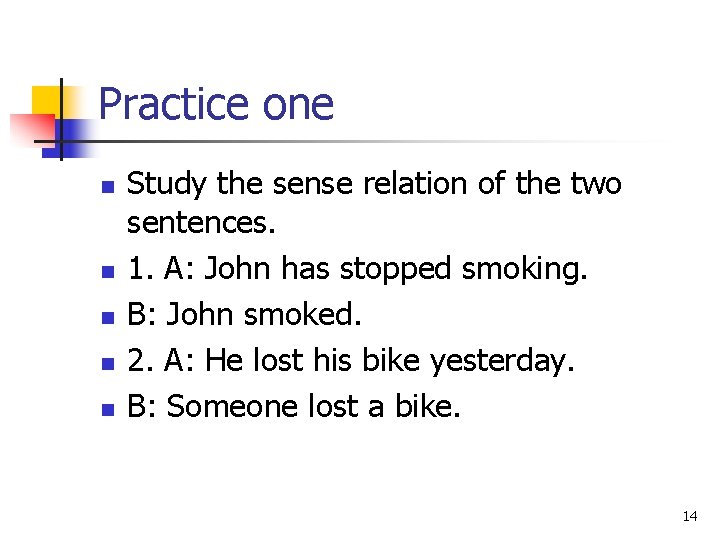
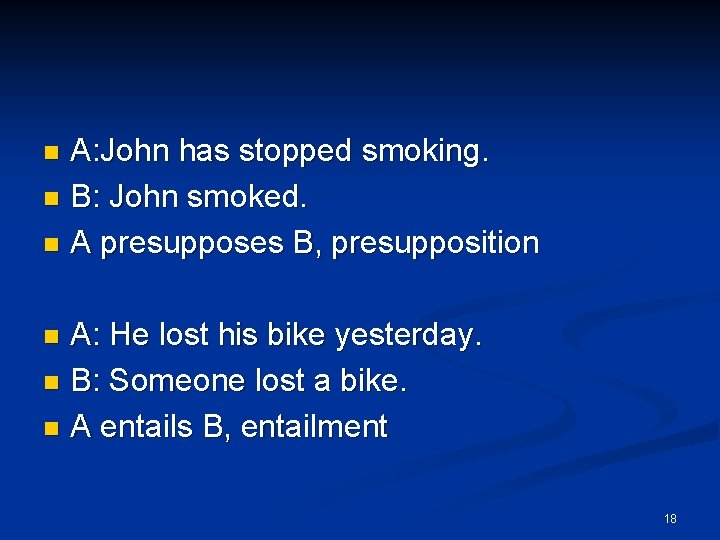
Practice one n n n Study the sense relation of the two sentences. 1. A: John has stopped smoking. B: John smoked. 2. A: He lost his bike yesterday. B: Someone lost a bike. 14
e. g. n 1 A: I saw a boy. n B: I saw a child. n 2 A: Mary’s dog is barking. n B: Mary has a dog. n 3. A: You look beautiful without glasses on. n B: You look a little ugly with glasses on. n 15
n n 1 A: I saw a boy. B: I saw a child. 16
n n A: Mary’s dog is barking. B: Mary has a dog. 17
A: John has stopped smoking. n B: John smoked. n A presupposes B, presupposition n A: He lost his bike yesterday. n B: Someone lost a bike. n A entails B, entailment n 18
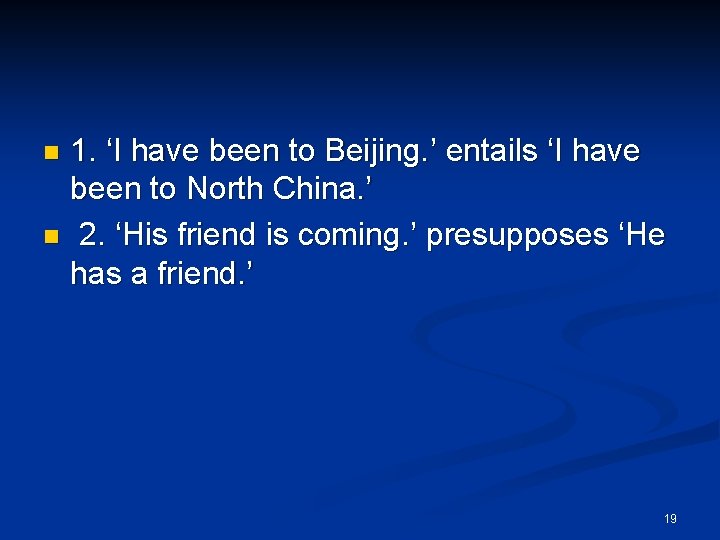
1. ‘I have been to Beijing. ’ entails ‘I have been to North China. ’ n 2. ‘His friend is coming. ’ presupposes ‘He has a friend. ’ n 19
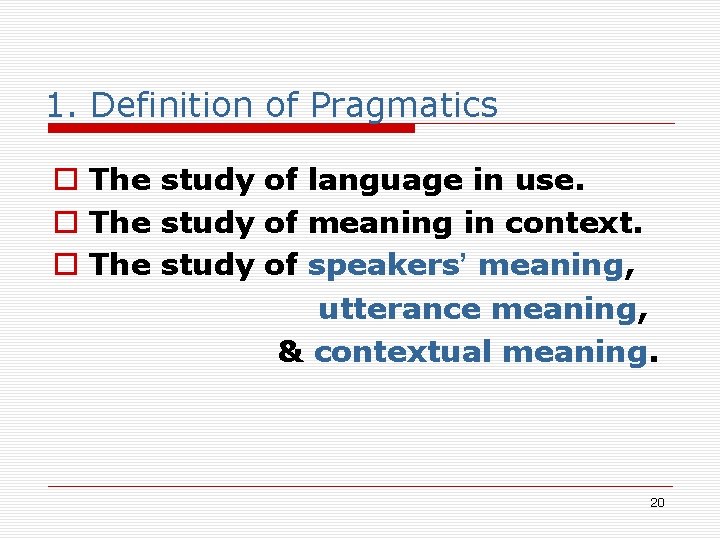
1. Definition of Pragmatics o The study of language in use. o The study of meaning in context. o The study of speakers’ meaning, utterance meaning, & contextual meaning. 20
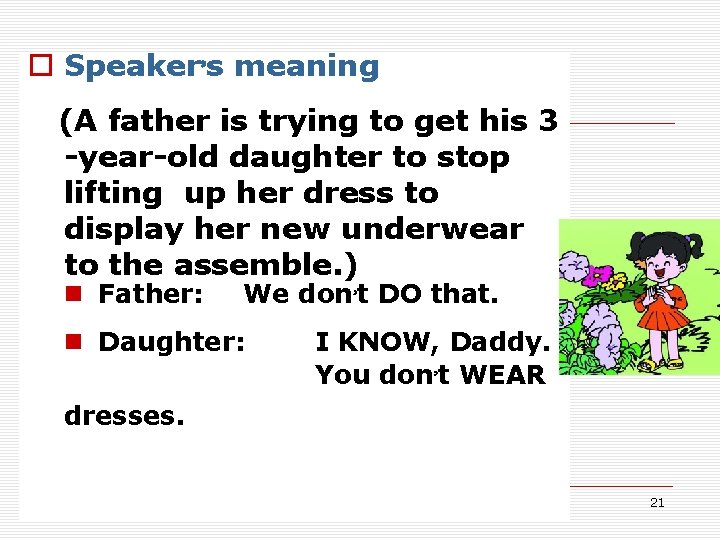
o Speaker’s meaning (A father is trying to get his 3 -year-old daughter to stop lifting up her dress to display her new underwear to the assemble. ) n Father: We don’t DO that. n Daughter: I KNOW, Daddy. You don’t WEAR dresses. 21
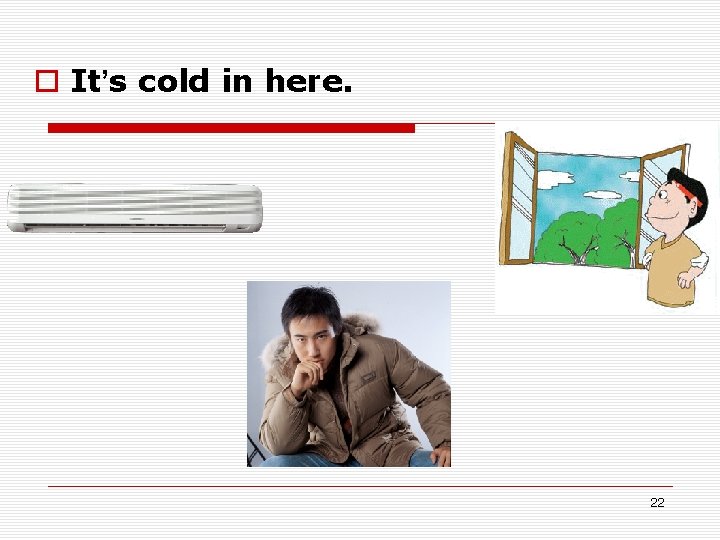
o It’s cold in here. 22
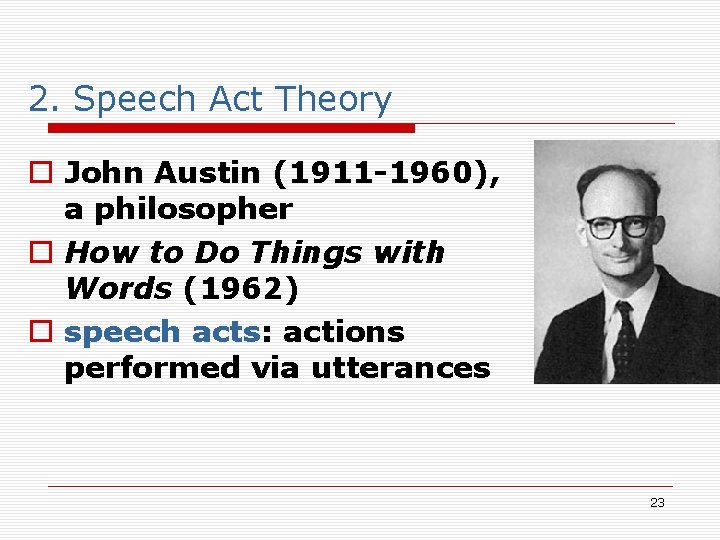
2. Speech Act Theory o John Austin (1911 -1960), a philosopher o How to Do Things with Words (1962) o speech acts: actions performed via utterances 23
o Pragmatics can be defined as the study of how speakers use the sentences of a language to effect successful communication. o Pragmatics is different from traditional semantics in that it studies meaning not in isolation but in context. 24
Context o 1. background knowledge o 2. mutual knowledge o 3. context of utterance 25
o Please read p 172 -173 and try to give an explanation to constatives and performatives. 26
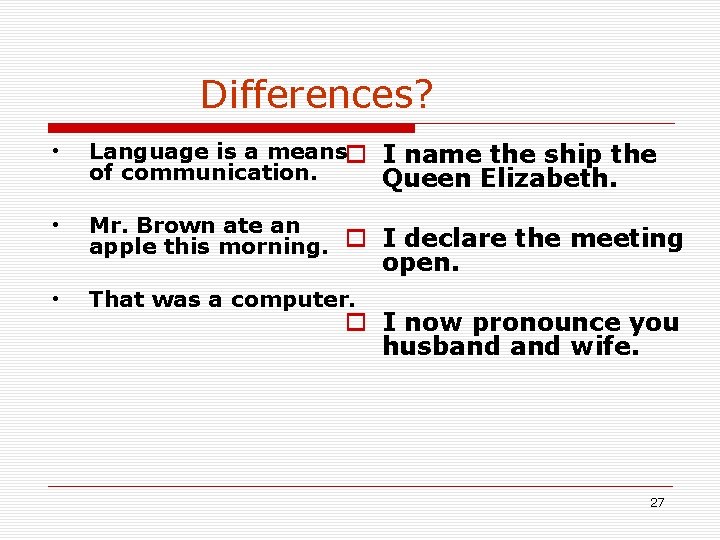
Differences? • Language is a meanso I name the ship the of communication. Queen Elizabeth. • Mr. Brown ate an apple this morning. o I declare the meeting open. • That was a computer. o I now pronounce you husband wife. 27
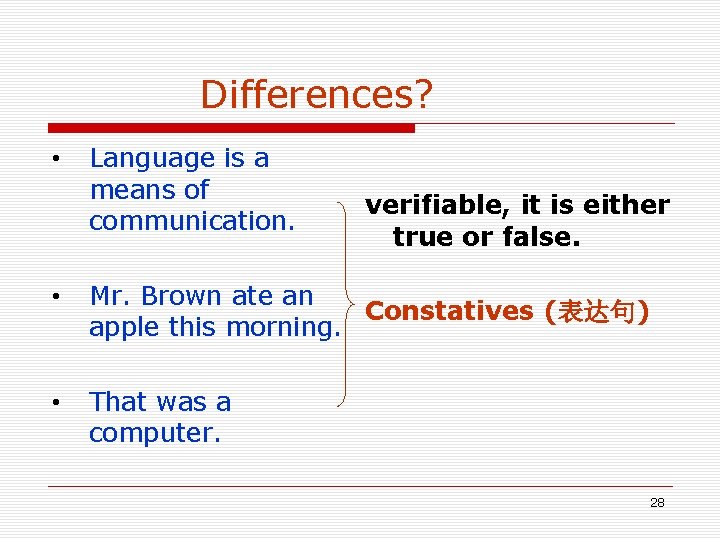
Differences? • Language is a means of communication. verifiable, it is either true or false. • Mr. Brown ate an Constatives (表达句) apple this morning. • That was a computer. 28
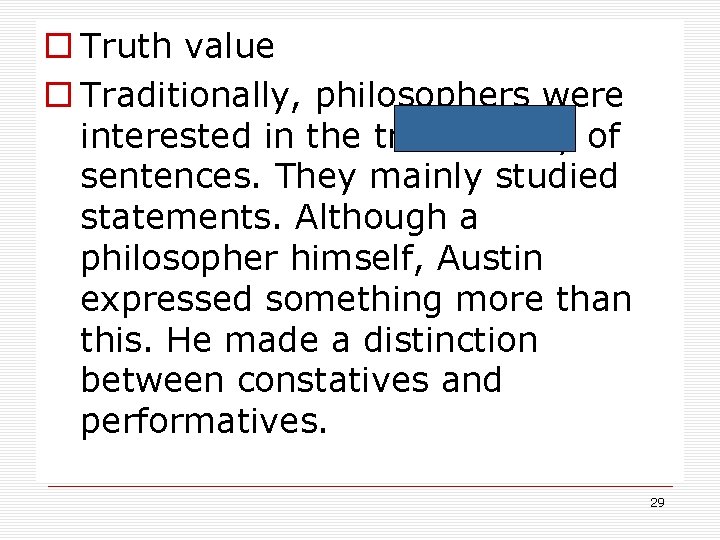
o Truth value o Traditionally, philosophers were interested in the truth-falsity of sentences. They mainly studied statements. Although a philosopher himself, Austin expressed something more than this. He made a distinction between constatives and performatives. 29
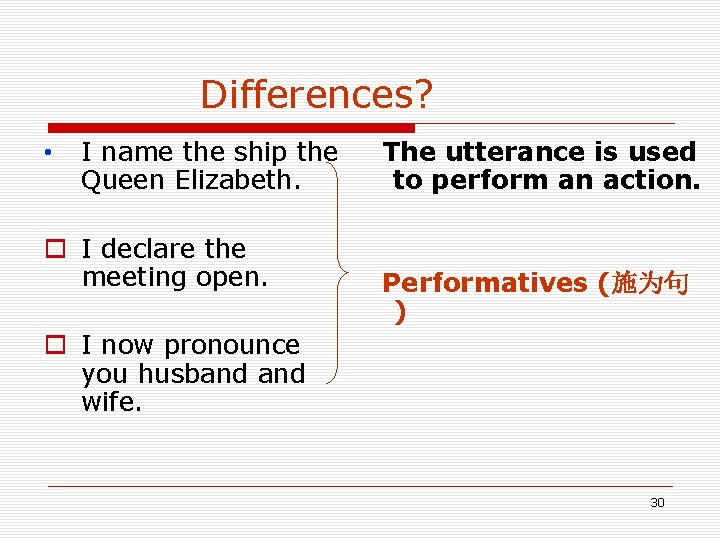
Differences? • I name the ship the Queen Elizabeth. o I declare the meeting open. The utterance is used to perform an action. Performatives (施为句 ) o I now pronounce you husband wife. 30
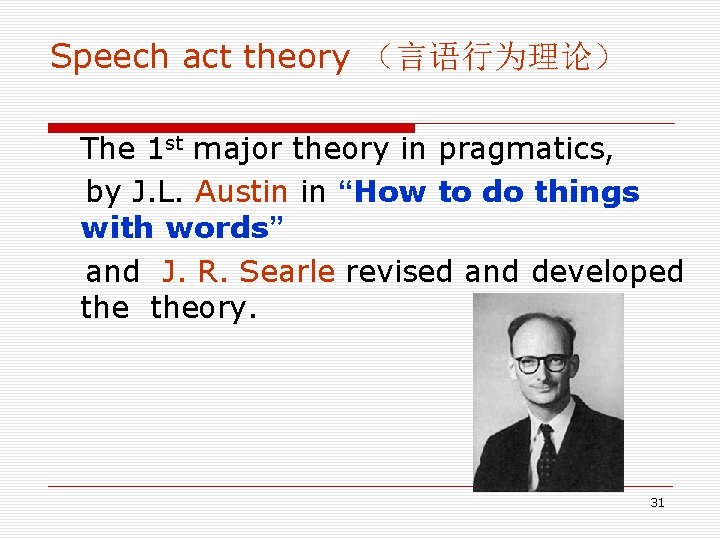
Speech act theory (言语行为理论) The 1 st major theory in pragmatics, by J. L. Austin in “How to do things with words” and J. R. Searle revised and developed theory. 31
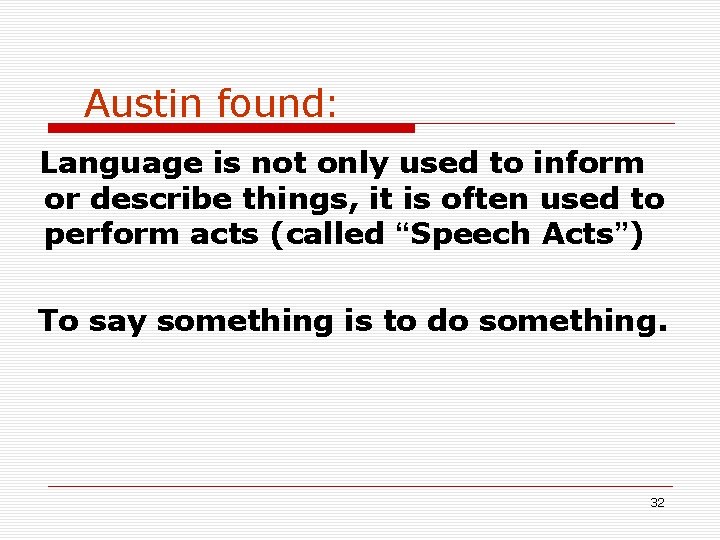
Austin found: Language is not only used to inform or describe things, it is often used to perform acts (called “Speech Acts”) To say something is to do something. 32
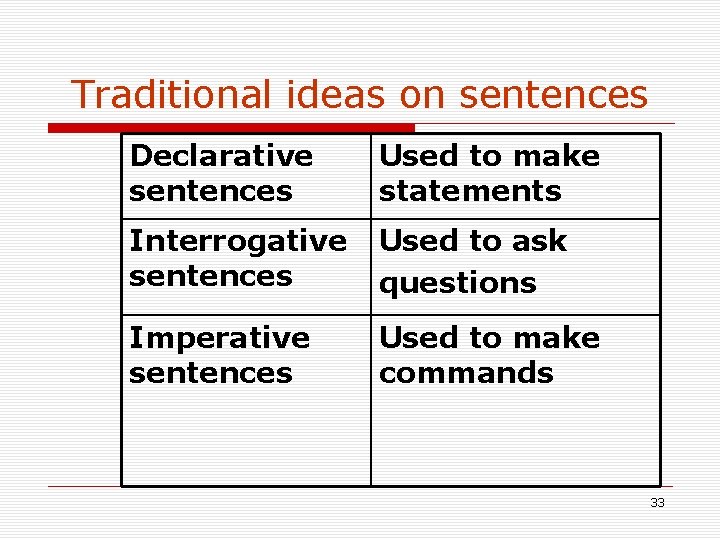
Traditional ideas on sentences Declarative sentences Used to make statements Interrogative sentences Used to ask questions Imperative sentences Used to make commands 33
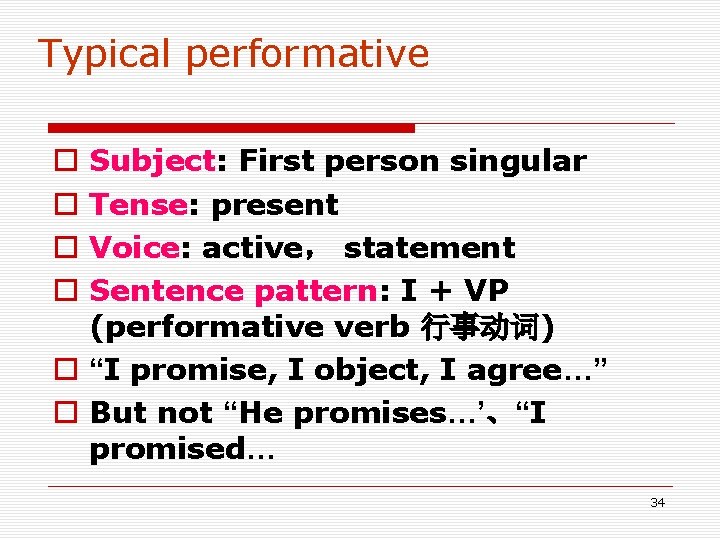
Typical performative Subject: First person singular Tense: present Voice: active, statement Sentence pattern: I + VP (performative verb 行事动词) o “I promise, I object, I agree…” o But not “He promises…’、“I promised… o o 34
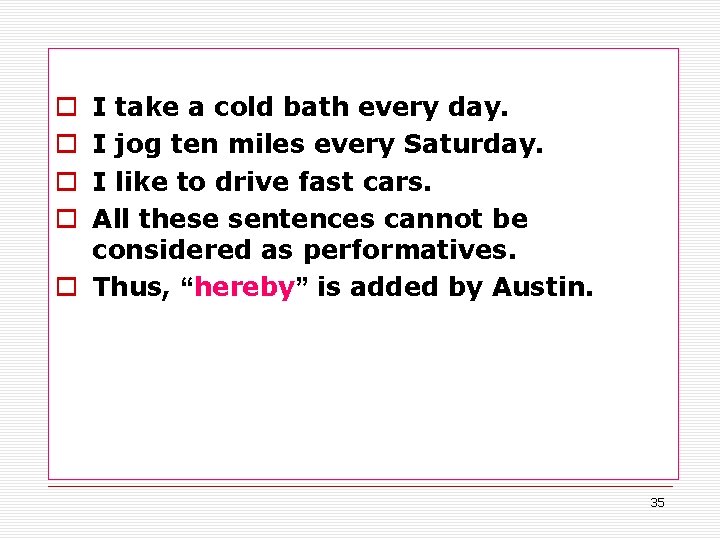
I take a cold bath every day. I jog ten miles every Saturday. I like to drive fast cars. All these sentences cannot be considered as performatives. o Thus, “hereby” is added by Austin. o o 35
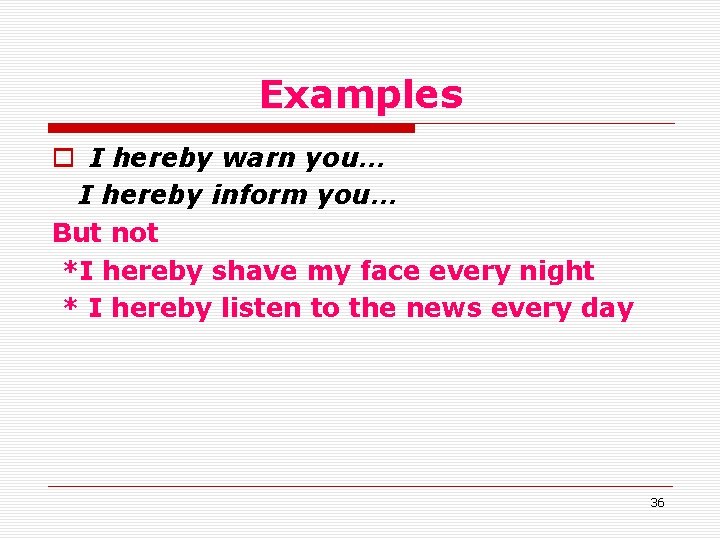
Examples o I hereby warn you… I hereby inform you… But not *I hereby shave my face every night * I hereby listen to the news every day 36
Typical performative Subject: First person singular Tense: present Voice: statement Mood: active Sentence pattern: I + VP (performative verb 行事动词) o “I promise, I object, I agree…” o hereby o o o 37
o However o Later, Austin realized that such distinction cannot be definite, because all sentences can be used to do things. saying is performing. o E. g. 38
o I promise to be there. n I’ll be there. o I admit I was wrong. n I was foolish. o I warn you, this gun is loaded. n This gun is loaded. 39
o I thank you. n I’m very grateful. o o I apologize. I’m sorry. I order you to sit down. You must sit down. 40
o Conclusion: o The distinction between constatives & performatives cannot be maintained. o All sentences can be used to do things. 41
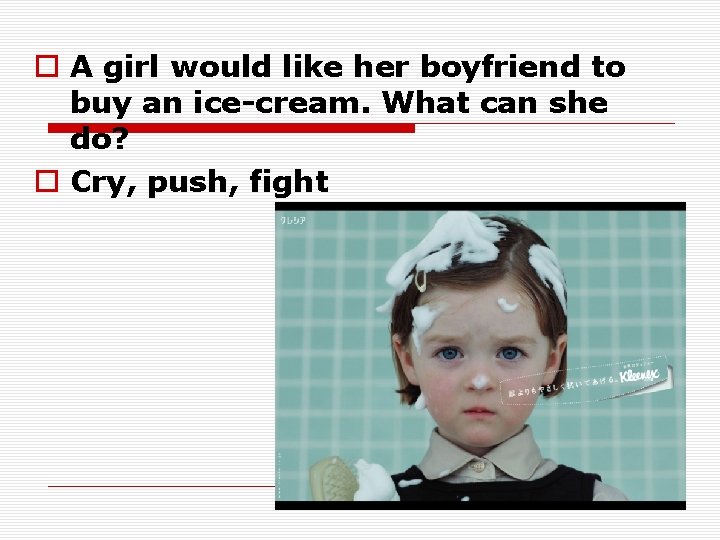
o A girl would like her boyfriend to buy an ice-cream. What can she do? o Cry, push, fight 42
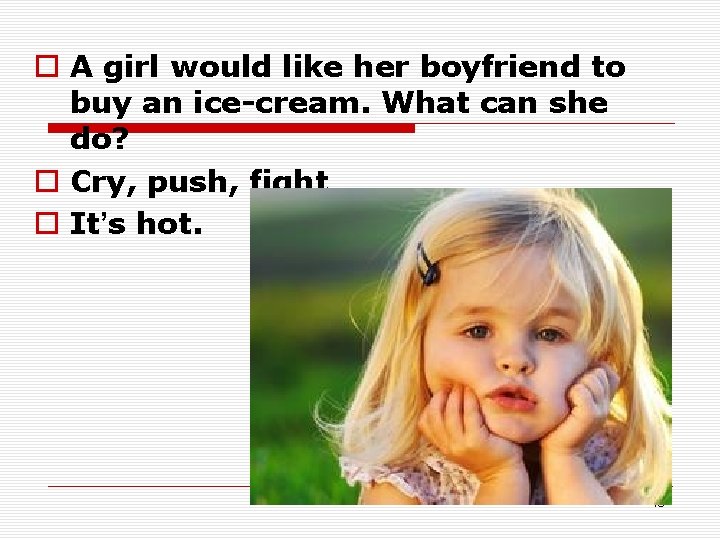
o A girl would like her boyfriend to buy an ice-cream. What can she do? o Cry, push, fight o It’s hot. 43
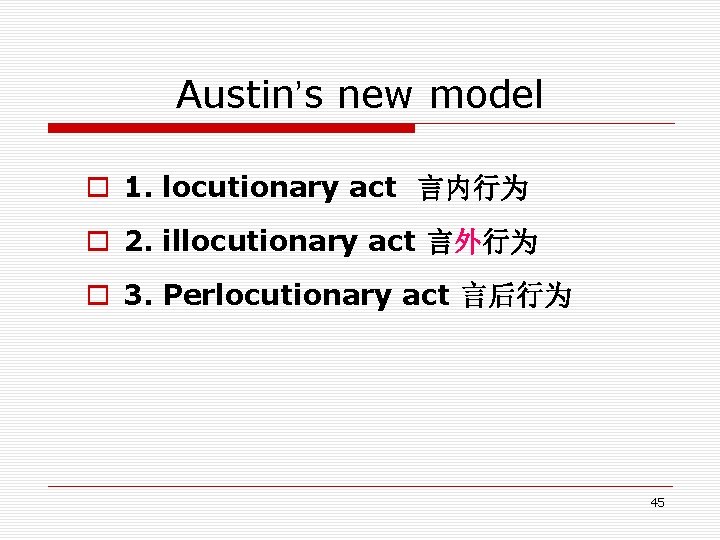
3. Illocutionary Act Theory o Speech acts can be analyzed on 3 levels: 44
Austin’s new model o 1. locutionary act 言内行为 o 2. illocutionary act 言外行为 o 3. Perlocutionary act 言后行为 45
o A speaker is in most cases performing 3 acts simultaneously while making an utterance. 46
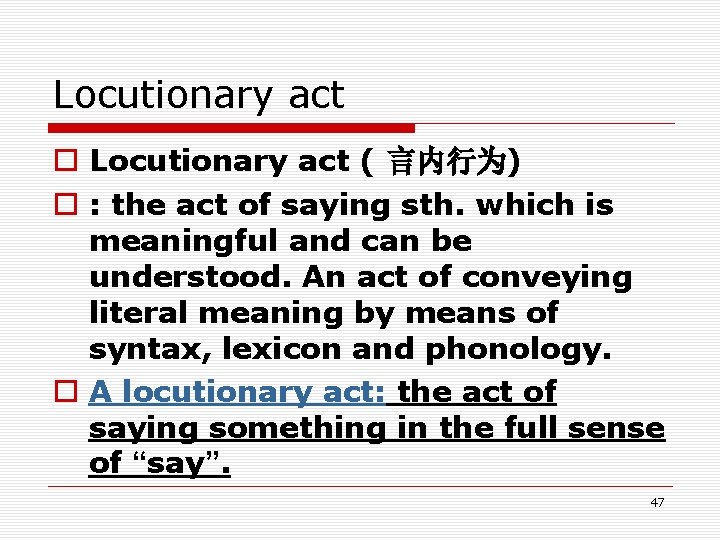
Locutionary act o Locutionary act ( 言内行为) o : the act of saying sth. which is meaningful and can be understood. An act of conveying literal meaning by means of syntax, lexicon and phonology. o A locutionary act: the act of saying something in the full sense of “say”. 47
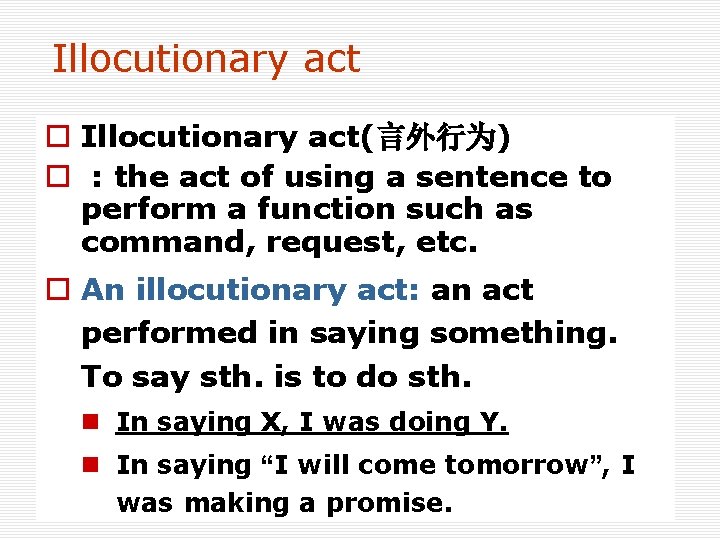
Illocutionary act o Illocutionary act(言外行为) o : the act of using a sentence to perform a function such as command, request, etc. o An illocutionary act: an act performed in saying something. To say sth. is to do sth. n In saying X, I was doing Y. n In saying “I will come tomorrow”, I was making a promise. 48
Perlocutionary act o Perlocutionary act (言后行为) o : the results or effects that are produced by means of saying sth. 49
o A perlocutionary act: the act preformed by or as a result of saying, the effects on the hearer. n By saying X and doing Y, someone did Z. 50
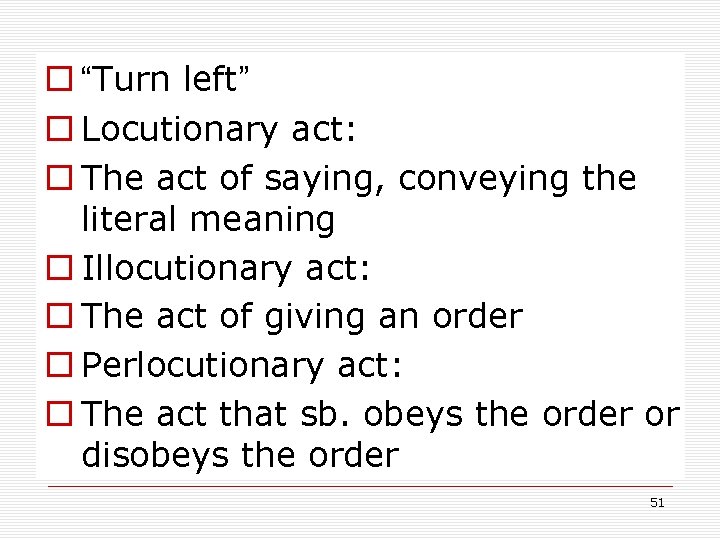
o “Turn left” o Locutionary act: o The act of saying, conveying the literal meaning o Illocutionary act: o The act of giving an order o Perlocutionary act: o The act that sb. obeys the order or disobeys the order 51
o “Morning” o Locutionary act: o Illocutionary act: o Perlocutionary act: 52
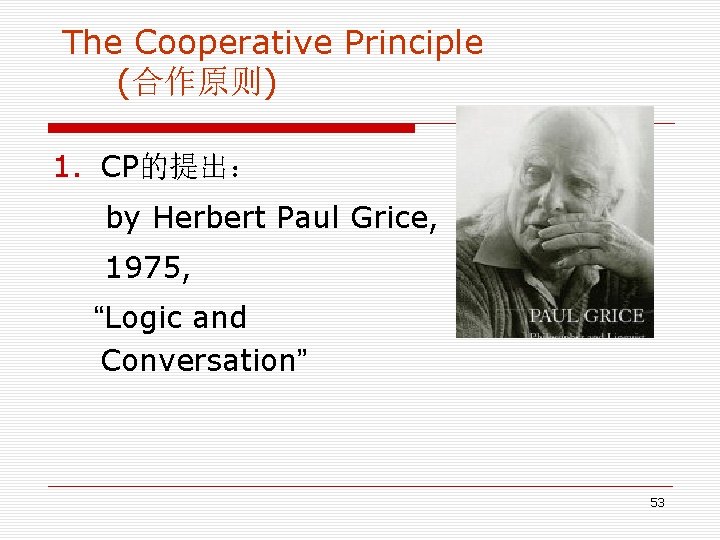
The Cooperative Principle (合作原则) 1. CP的提出: by Herbert Paul Grice, 1975, “Logic and Conversation” 53
o P 177 o CP 54
That is: Human beings try to speak sincerely, relevantly and clearly, while providing sufficient information. 说话者试图真诚地、贴切地、清楚地表达足够的信息,交流 才得以顺利进行。 55
But: The view may describe a philosopher’s paradise, but no one actually speaks like that the whole time. 但是,现实中人们并非总按照规则说话。 甚至,有时候人们在故意违反规则。 56
o However, CP is often violated. n Since CP is regulative, CP can be violated. o Violation of CP and its maxims leads to conversational implicature. 57
1. 3 Violation of the maxims (Quantity) 1. Make your contribution as informative as is required. A: 昨天上街买了些什么? B: 就买了些东西。 > I don’t want to tell you what I bought. 58
Dear Sir, Mr. X’s command of English is excellent, and his attendance at tutorials has been regular. Y ours > Mr. X is not suitable for the job. 59
Violation of CP Violation of Quantity (量的违反) 1. A: Would you mind telling me your address? (您介意告诉我您的住址吗?) B: Somewhere In the south of Handan. (我住在邯郸的南边。) 60
2. Do not make your contribution more informative than is required. Aunt: How did Jimmy do history exam? Mother: Oh, not at all well. Teachers asked him things that happened before the poor boy was born. > Her son should not be blamed. 61
Violation of Quantity (量的违反) 2. A: Where is John? (约翰在哪呢?) B: He’s gone to the library. He said so when he left. ( 他去图书馆了。他走时是这么说的。) 62
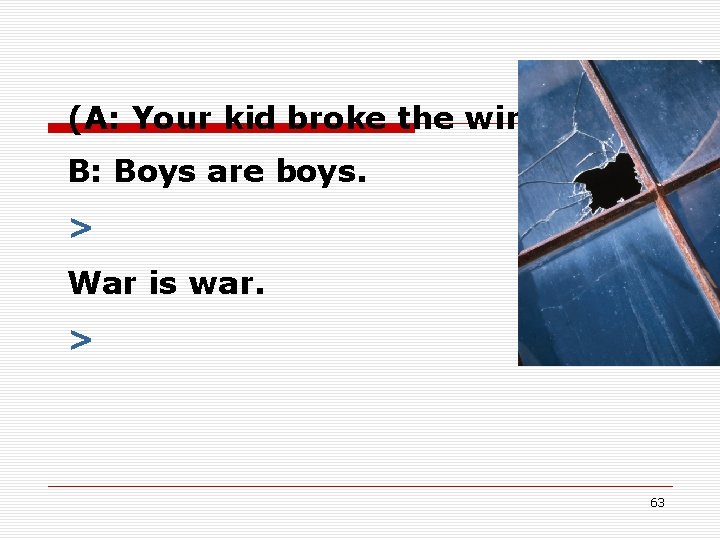
(A: Your kid broke the window. ) B: Boys are boys. > War is war. > 63
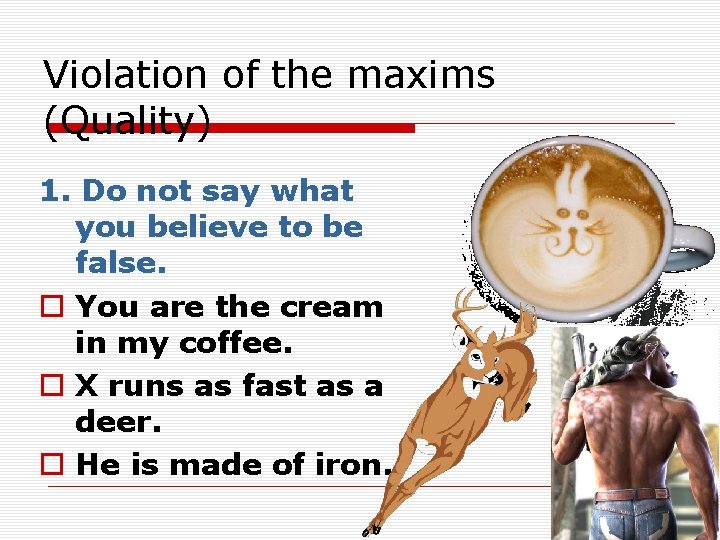
Violation of the maxims (Quality) 1. Do not say what you believe to be false. o You are the cream in my coffee. o X runs as fast as a deer. o He is made of iron. 64
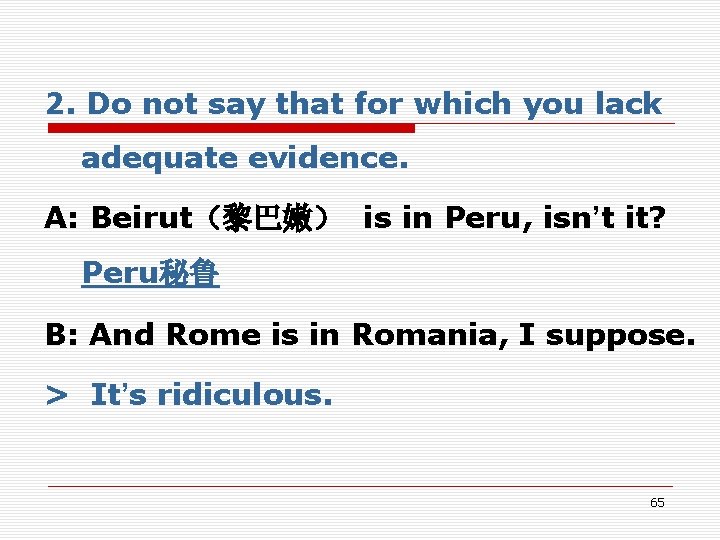
2. Do not say that for which you lack adequate evidence. A: Beirut(黎巴嫩) is in Peru, isn’t it? Peru秘鲁 B: And Rome is in Romania, I suppose. > It’s ridiculous. 65
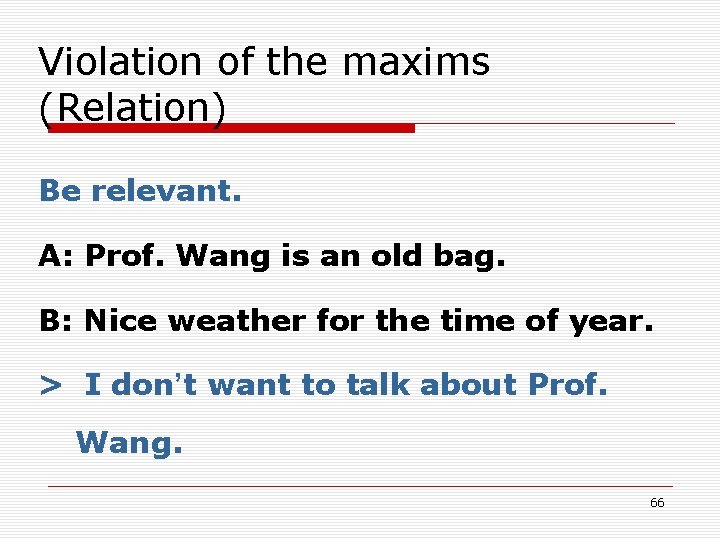
Violation of the maxims (Relation) Be relevant. A: Prof. Wang is an old bag. B: Nice weather for the time of year. > I don’t want to talk about Prof. Wang. 66
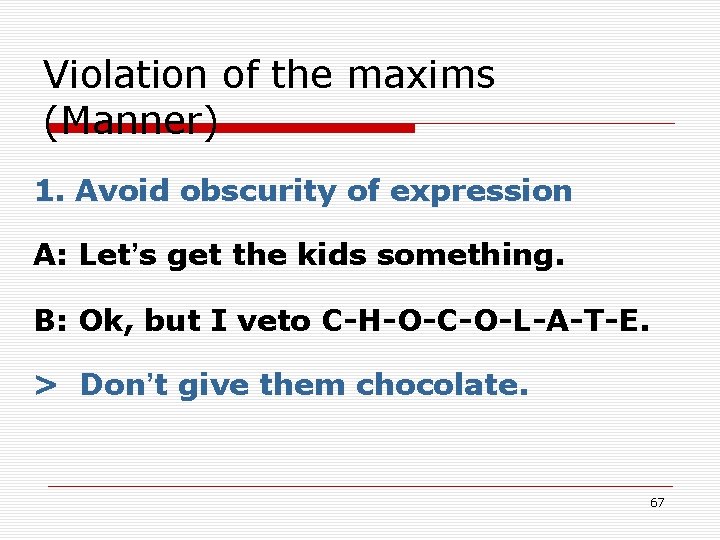
Violation of the maxims (Manner) 1. Avoid obscurity of expression A: Let’s get the kids something. B: Ok, but I veto C-H-O-C-O-L-A-T-E. > Don’t give them chocolate. 67
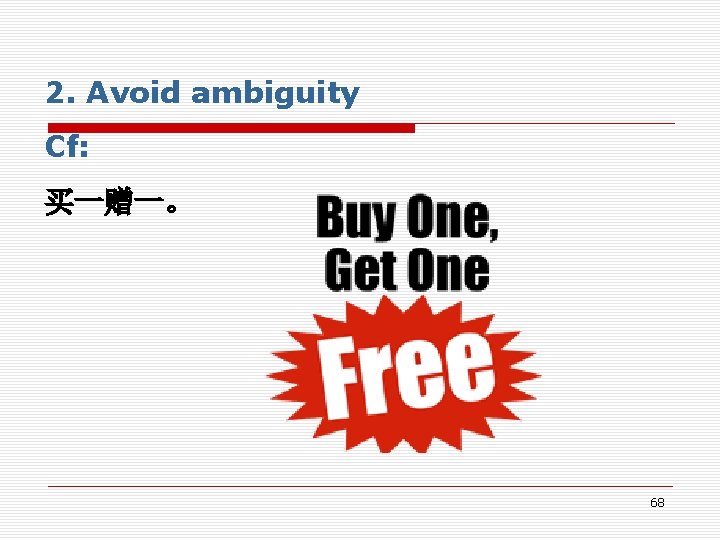
2. Avoid ambiguity Cf: 买一赠一。 68
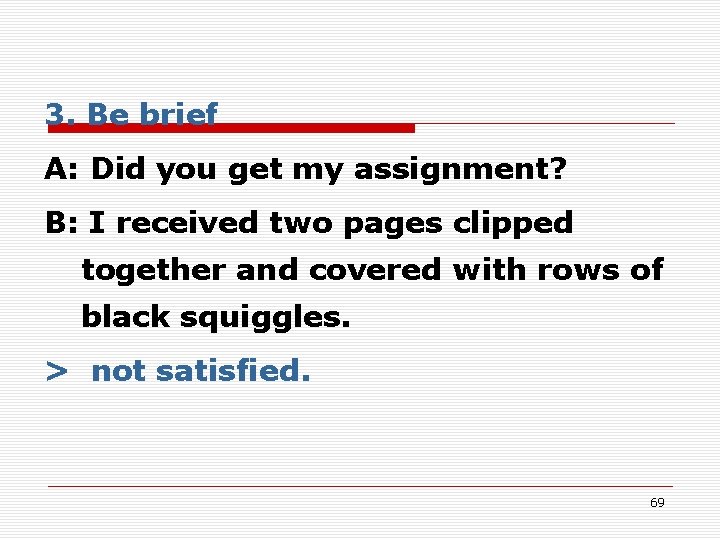
3. Be brief A: Did you get my assignment? B: I received two pages clipped together and covered with rows of black squiggles. > not satisfied. 69
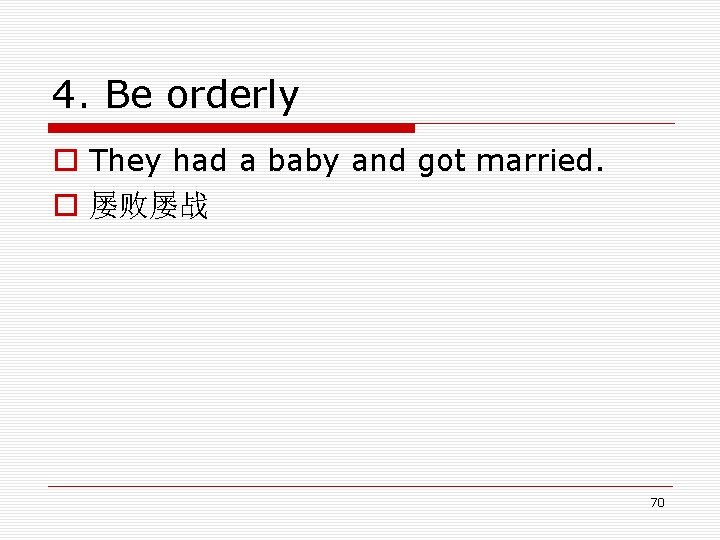
4. Be orderly o They had a baby and got married. o 屡败屡战 70
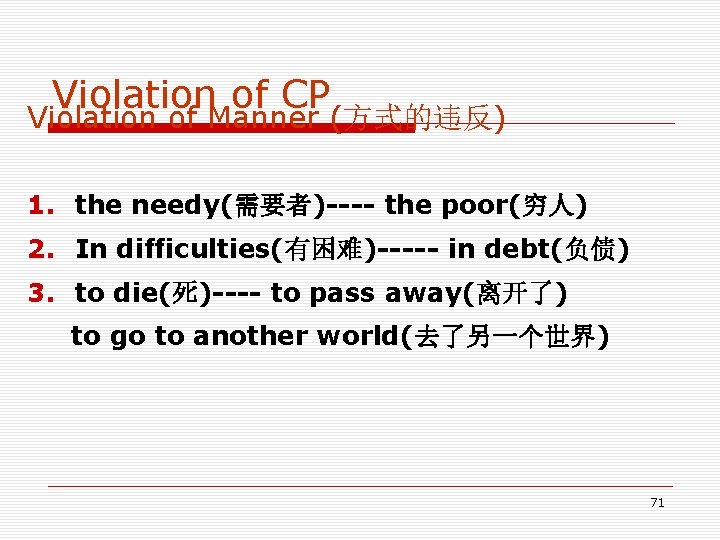
Violation of CP Violation of Manner (方式的违反) 1. the needy(需要者)---- the poor(穷人) 2. In difficulties(有困难)----- in debt(负债) 3. to die(死)---- to pass away(离开了) to go to another world(去了另一个世界) 71
Violation of CP occurs, what follows? 72
Violation of CP occurs, what follows? Implicature (会话含义,言外之意) 73
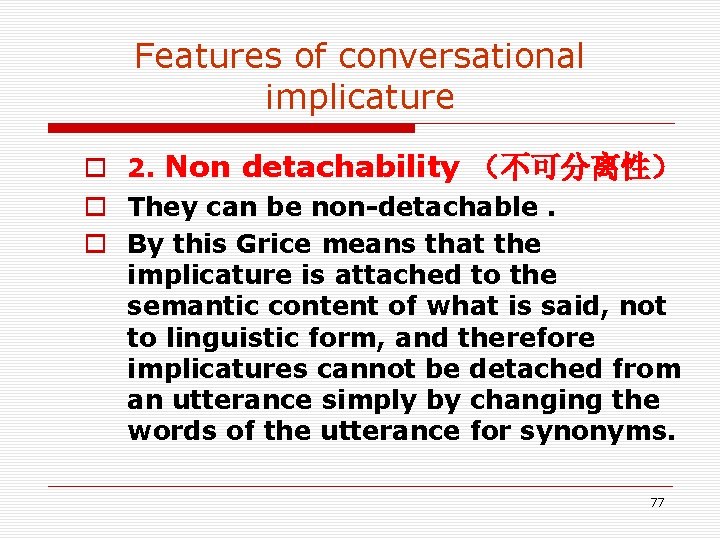
The definition of conversational implicature o Conversational implicature means the additional, unstated meaning, that is, what a speaker can imply, suggest, or mean more than what is said, as distinct from what the speaker literally says. o The word “implicature”is created by Grice, an American philosopher. 74
Features of conversational implicature o 1. cancellability or defeasibility (可被撤消, 可被废弃) o Conversational implicature can be cancellable or more exactly defeasible o An inference is defeasible if it is possible to cancel it by adding some additional premises to the original ones. 75
An example o A: Dear Sir, o Mr. X’s command of English is excellent and his attendance at tutorials has been regular, yours, etc. (violation of quantity) o Dear Sir, o Mr. X’s command of English is excellent and his attendance at tutorials has been regular. However, his ability at and enthusiasm for philosophy are quite adequate for the job. 76
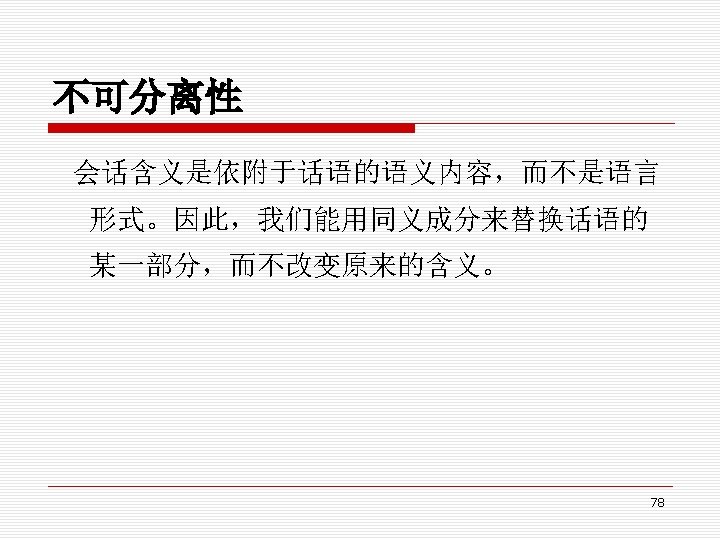
Features of conversational implicature o 2. Non detachability (不可分离性) o They can be non-detachable. o By this Grice means that the implicature is attached to the semantic content of what is said, not to linguistic form, and therefore implicatures cannot be detached from an utterance simply by changing the words of the utterance for synonyms. 77
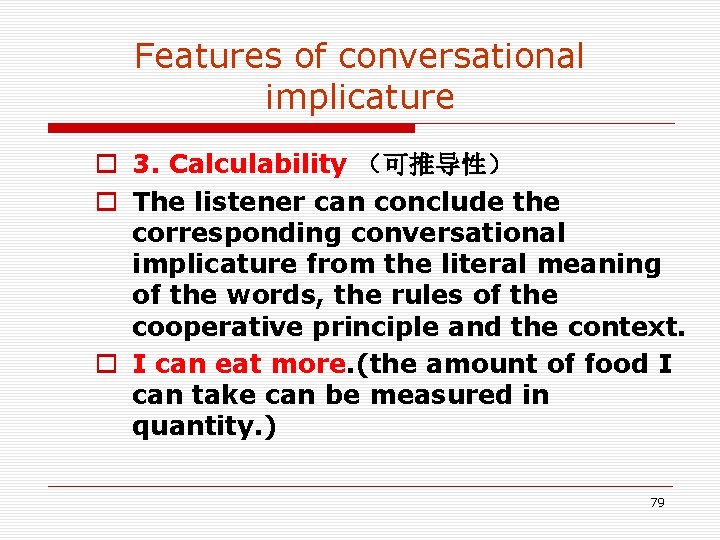
Features of conversational implicature o 3. Calculability (可推导性) o The listener can conclude the corresponding conversational implicature from the literal meaning of the words, the rules of the cooperative principle and the context. o I can eat more. (the amount of food I can take can be measured in quantity. ) 79
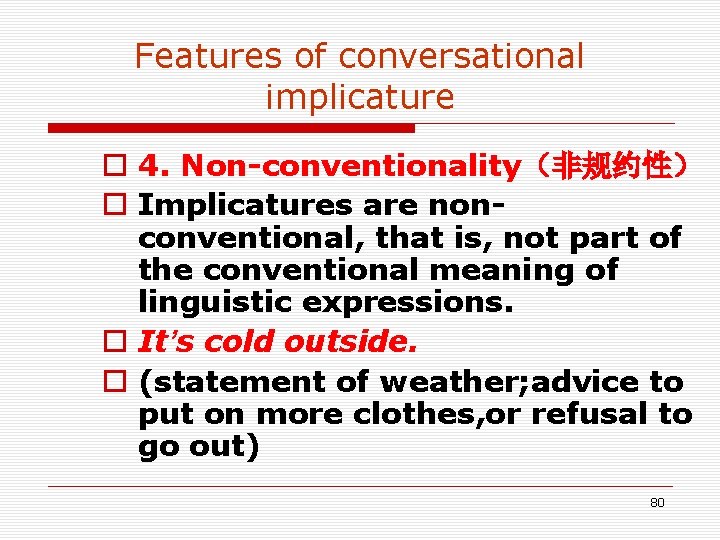
Features of conversational implicature o 4. Non-conventionality(非规约性) o Implicatures are nonconventional, that is, not part of the conventional meaning of linguistic expressions. o It’s cold outside. o (statement of weather; advice to put on more clothes, or refusal to go out) 80
Homework (作业) Try to analyze the euphemism from CP perspective. 试用语用学中合作原则的理论分析委婉语的 使用 81
o Why? 82
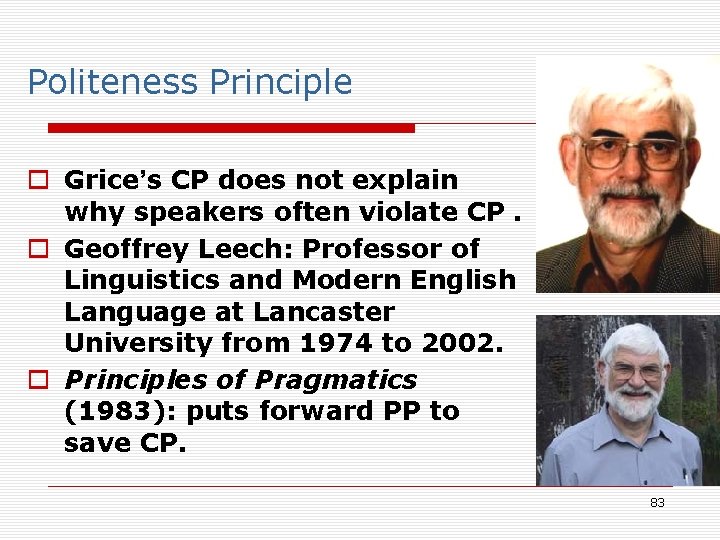
Politeness Principle o Grice’s CP does not explain why speakers often violate CP. o Geoffrey Leech: Professor of Linguistics and Modern English Language at Lancaster University from 1974 to 2002. o Principles of Pragmatics (1983): puts forward PP to save CP. 83
A: We’ll miss Bill and Mary, won’t we? B: Well, we’ll all miss Bill. (violation of quantity maxim) 84
Homework (作业) Try to analyze the euphemism from CP perspective. 试用语用学中合作原则的理论分析委婉语的 使用 87
分析现状 Analysis of the present case o Euphemism o A euphemism is a polite word or expression that is used to refer to things that people may find upsetting or embarrassing to talk about, for example sex, the human body, or death. o Studies on euphemism o Features, structures, reasons, social factors 88
2. Put forward the research question 提出问题 o The study of euphemism from the perspective of CP 89
3. Analyzing CP o (Cooperative Principle,简称CP) and its maxims o 1. (maxim of Quantity) o 2. (maxim of Quality) o 3. (maxim of Relation) o 4. (maxim of Manner) 90
1. Violation of the maxim of quantity o o o TB, tuberculosis, BS, bullshit Vamp, vampire 91
Violation of the maxim of quality o o o Ministry of Defense Ministry of War life insurance when you are dead freedom fighters terrorists 92