
CHAPTER SIX Nature and principles of land evaluation
- Slides: 52
CHAPTER SIX Nature and principles of land evaluation 1 12/19/2021
Aim and principles of land evaluation Ø The rationale of a land evaluation and its product may be viewed in two ways. Ø The first, or proximate, intention is to provide the users with information about the land form conditions at any site of interest. Ø The 2 second or ultimate purpose is to supply information which will assist in decision making about the land use and land development planning. Such decisions range from allocation to a particular type of use, e. g. for agriculture or forestry, to details of crop management practices. 12/19/2021
Con’d Ø Land evaluation may be concerned with present land performance. Frequently, however, it involves change and its effects. Ø change in the use of land in some cases change in the land itself. Evaluation takes into consideration the economics of the proposed enterprises, the social consequences for the people of the area and the country concerned, and the consequences, beneficial or adverse, for the environment. 3 12/19/2021
v Fundamental principles and procedures of land evaluation Ø Land evaluation involves execution and interpretation of soil, vegetation, climate etc in terms of requirements of specified land use. 4 12/19/2021
Ø The evaluation process does not in itself determine the land use changes that are to be carried out, but provides data on the basis of which such decisions can be taken. The concept of land suitability is only meaningful in terms of specific kinds of land use, each with their own requirements, e. g. for soil moisture, rooting depth etc. Ø The qualities of each type of land, such as moisture availability or liability to flooding, are compared with the requirements of each use. Thus the land itself and the land use are equally fundamental to land suitability evaluation. Hence, evaluation should be carried out based on basic principles listed hereunder. 5 12/19/2021
q These basic principles are as follows: Ø Land suitability is assessed and classified with respect to specified kinds of use. Ø Evaluation requires a comparison of the benefits obtained and the inputs needed on different types of land. Ø A multidisciplinary approach is required. Ø Evaluation is made in terms relevant to the physical, economic and social context of the area concerned. Ø Suitability refers to use on a sustained basis. Ø Evaluation involves comparison of more than a single kind of use. 6 12/19/2021
Purpose of land evaluation Ø General purpose of land evaluation represents standardized approach for all lands to evaluate their capability to support a generally defined land use. Stable and near optimum mechanized management system is assumed. Ø The term general land evaluation as used by Beek (1978) is equivalent to the major kinds of land use and the land capability classes of the USDA land evaluation systems. Ø Agriculture is given precedence over pastoral, forestry and 7 recreational or wildlife uses, respectively. On the other hand, all lands can be compared, once they have been classified according to the universal land capability classes. Land evaluation for potential rainfed agriculture, grazing, irrigation or forestry comprises a general- purpose of land evaluations. 12/19/2021
Specific purpose land evaluation Ø Suitability of land is evaluated for specific land use practices. E. g. carried out to predict potentials of land for rainfed traditional maize production, growing of a specific forest tree, or for grazing of sheep, etc. Ø The levels of technology and economy are taken into account. The inputs required and expected outputs are expressed. Ø Land utilization type is not standardized but has to be 8 selected in view of the prevailing physical and socioeconomic conditions of the area where the land evaluation takes place. 12/19/2021
Con’d Ø Using all relevant and available physical, technological, social and economic data, each land area is evaluated on its fitness to support the most pertinent land utilization types. Ø This fitness, or land suitability, is expressed in terms of the effects to be expected and the inputs required. Ø Separate land suitability classifications are made for each relevant land utilization types. 9 12/19/2021
Con’d Ø In purely physical terms, the effects or outputs are expressed in physical terms (erosion losses, yields) and the inputs are also expressed in physical terms (amounts of fertilizer, water application, duration of field operations, labor requirements. . . ) quantified either on an ordinal or a ratio scale. Ø Specific purpose land evaluation is complex and requires the services of different disciplines (soils, hydrology, water management, agronomy, agricultural economics, sociology, agricultural engineering): 10 12/19/2021
Con’d ØTo select the relevant land utilization types. ØTo interpret the LUTs in terms of specific land requirements. ØTo study the land conditions, determining the constraining land qualities and the possibilities of their improvement. ØTo predict the performance of land use within defined levels of reliability, taking into account their land requirements and tolerance. ØTo translate these predictions from multi-dimensional physical effects into common (mostly economic) terms. 11 12/19/2021
Con’d q Thus land evaluation should answer the following questions: Ø How is the land currently managed, and what will happen if present practices remain unchanged? Ø What improvements in management practices, within the present use, are possible? Ø What other uses of land are physically possible and economically and socially relevant? Ø Which of these uses offer possibilities of sustained production or other benefits? Ø What adverse effects, physical, economic or social, are associated with each use? Ø What recurrent inputs are necessary to bring about the desired production and minimize the adverse effects? Ø What are the benefits of each form of use? 12 12/19/2021
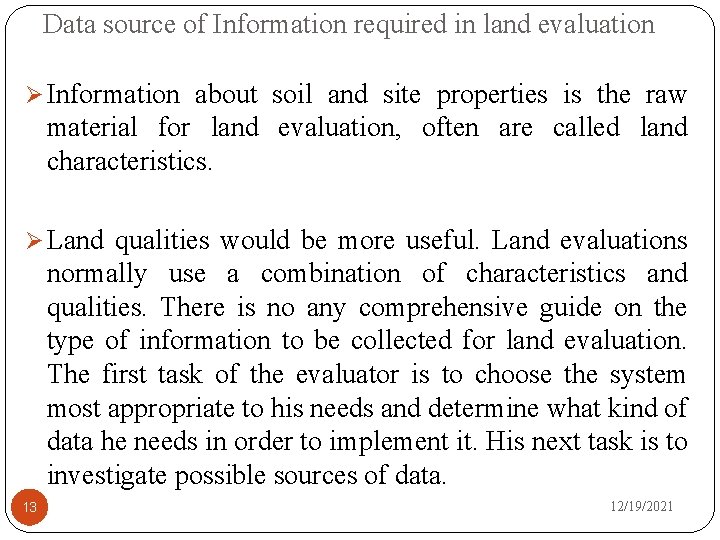
Data source of Information required in land evaluation Ø Information about soil and site properties is the raw material for land evaluation, often are called land characteristics. Ø Land qualities would be more useful. Land evaluations normally use a combination of characteristics and qualities. There is no any comprehensive guide on the type of information to be collected for land evaluation. The first task of the evaluator is to choose the system most appropriate to his needs and determine what kind of data he needs in order to implement it. His next task is to investigate possible sources of data. 13 12/19/2021
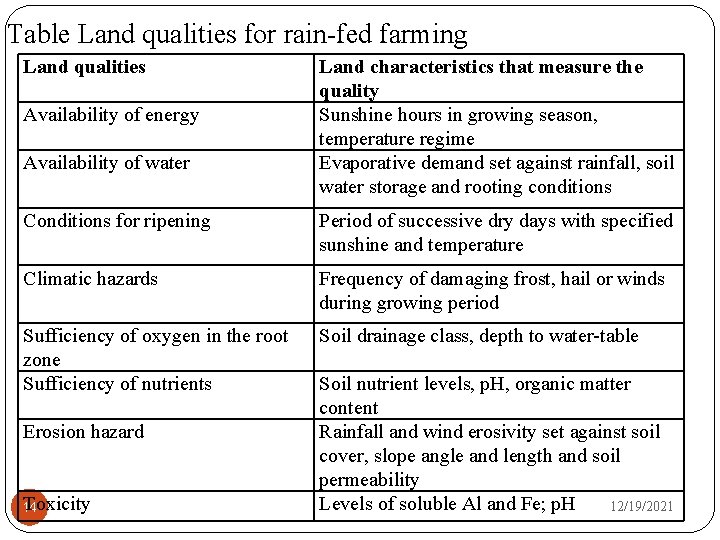
Table Land qualities for rain-fed farming Land qualities Availability of energy Availability of water Land characteristics that measure the quality Sunshine hours in growing season, temperature regime Evaporative demand set against rainfall, soil water storage and rooting conditions Conditions for ripening Period of successive dry days with specified sunshine and temperature Climatic hazards Frequency of damaging frost, hail or winds during growing period Sufficiency of oxygen in the root zone Sufficiency of nutrients Soil drainage class, depth to water-table Erosion hazard Toxicity 14 Soil nutrient levels, p. H, organic matter content Rainfall and wind erosivity set against soil cover, slope angle and length and soil permeability Levels of soluble Al and Fe; p. H 12/19/2021
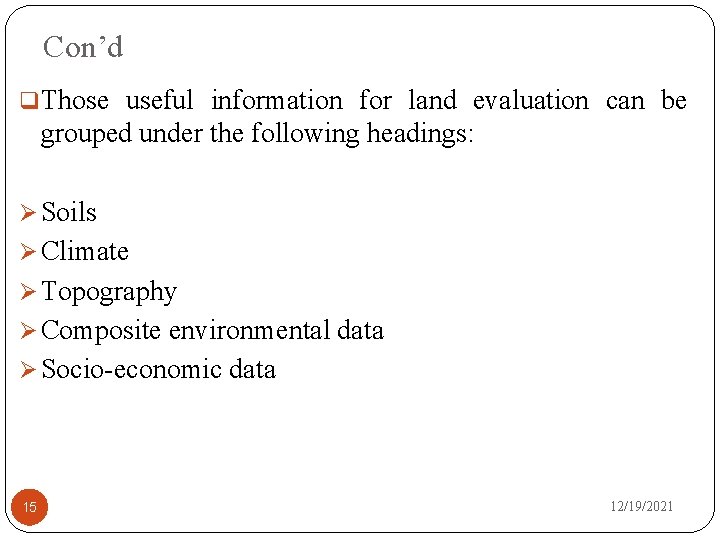
Con’d q. Those useful information for land evaluation can be grouped under the following headings: Ø Soils Ø Climate Ø Topography Ø Composite environmental data Ø Socio-economic data 15 12/19/2021
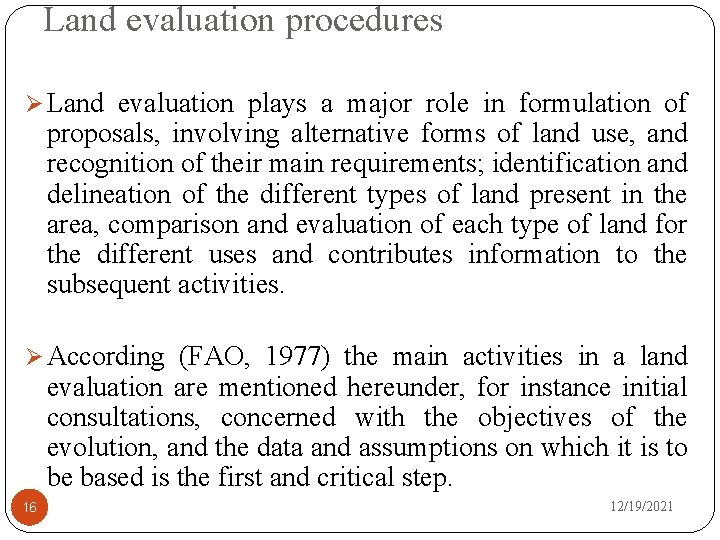
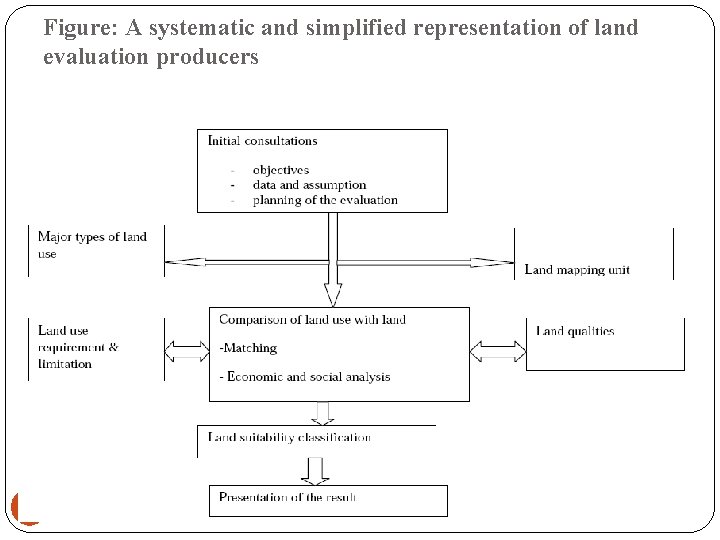
Land evaluation procedures Ø Land evaluation plays a major role in formulation of proposals, involving alternative forms of land use, and recognition of their main requirements; identification and delineation of the different types of land present in the area, comparison and evaluation of each type of land for the different uses and contributes information to the subsequent activities. Ø According (FAO, 1977) the main activities in a land evaluation are mentioned hereunder, for instance initial consultations, concerned with the objectives of the evolution, and the data and assumptions on which it is to be based is the first and critical step. 16 12/19/2021
Figure: A systematic and simplified representation of land evaluation producers 17 12/19/2021
Con’d Ø As a principle any land evaluation process should precede or encompass all the above components accordingly. Ø Everyone has understood, it is important to note that there is an element of iteration, or a cyclic element, in the procedures. 18 12/19/2021
Scales and approaches of land Evaluation Ø Certain groups of activities are common to all types of land evaluation. In all cases evaluation commences with initial consultations, concerned with the objectives of the evaluation, assumptions and constraints, and the methods to be followed. Ø Details of subsequent activities and the sequence, in which they are carried out, vary with circumstances. These circumstances include the level of intensity of the survey and which of two overall approaches is followed. 19 12/19/2021
Scales and intensity of land use survey q Three levels of intensity may be distinguished: 1. Reconnaissance level: carried out for the purpose of inventory, identification physical aspects. Ø 1: 250, 000 map scales is very important. Ø Reconnaissance surveys are concerned with broad inventory of resources and development possibilities at regional and national scales. Ø Economic analysis is only in very general terms, and land evaluation is qualitative. Ø The results contribute to national plans, permitting the selection of development areas and priorities. 20 12/19/2021
Con’d 2. Semi-detailed level: Ø Semi-detailed level is made for project feasibility and map scale of 1: 50, 000 to 1: 250, 000 are recommended. Ø Surveys at the semi-detailed, or intermediate level are concerned with more specific aims such as feasibility studies of development projects. Ø The work may include farm surveys; economic analysis is considerably more important, and land evaluation is usually quantitative. Ø This level provides information for decisions on the selection of projects, or whether a particular development or other change is to go ahead. 21 12/19/2021
Con’d 3. Detailed level Ø The detailed level covers surveys for actual planning and design, or farm planning and advice, often carried out after the decision to implement has been made. Ø It is made for project implementation purpose and detailed layout is assessed. Ø Large-scale >1: 50, 000 22 12/19/2021
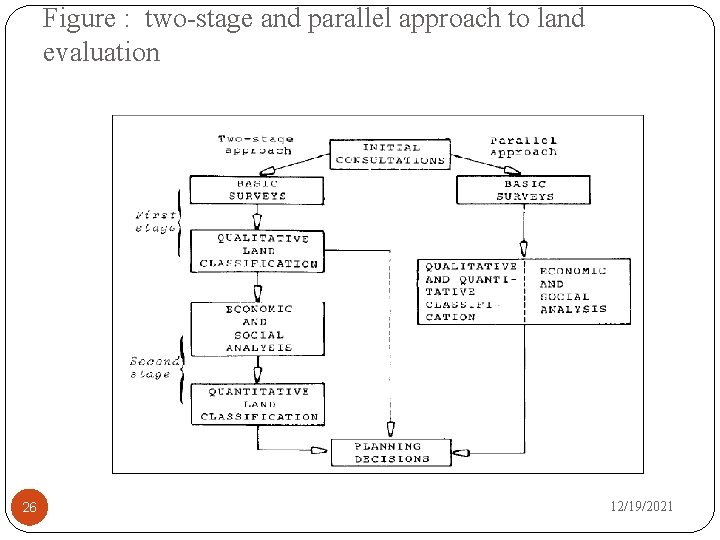
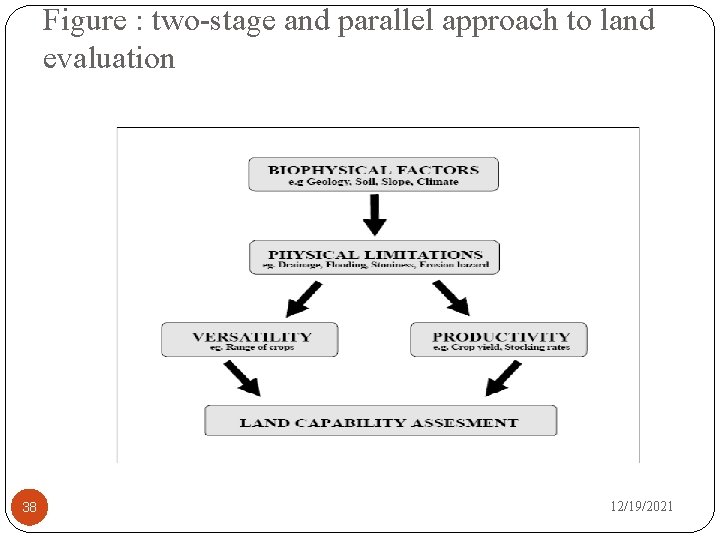
Two-Stage and Parallel Approaches to Land Evaluation Ø The relationships of resource surveys and economic and social analysis, and the manner in which the kinds of land use are formulated, depend on which of the following approaches to land evaluation is adopted. Ø A two-stage approach in which the first stage is mainly concerned with qualitative land evaluation, later (although not necessarily) followed by a second stage consisting of economic and social analysis; a parallel approach in which analysis of the relationships between land use proceeds concurrently with economic and social analysis. 23 12/19/2021
Con’d Ø The two-stage approach is often used in resource inventories for broad planning purposes and in studies for the assessment of biological productive potential. Ø The land suitability classifications in the first stage are based on the suitability of the land for kinds of land use which are selected at the beginning of the survey, e. g. arable cropping, dairy farming, maize, tomatoes. Ø The contribution of economic and social analysis to the first stage is limited to a check on the relevance of the kinds of land use. After the first stage has been completed and its results presented in map and report form, these results may then be subject to the second stage, that of economic and social analysis, either immediately or after an interval of time. 24 12/19/2021
Con’d Ø In the parallel approach the economic and social analysis of the kinds of land use proceeds simultaneously with the survey and assessment of physical factors. Ø The kinds of use to which the evaluation refers are usually modified in the course of the study. In the case of arable farming, for example, this modification may include selection of crops and rotations, estimates of the inputs of capital and labour, and determination of optimum farm size. Ø The parallel approach is expected to give more precise results in a shorter period of time. It offers a better chance of concentrating survey and data collection activities on producing information needed for the evaluation. 25 12/19/2021
Figure : two-stage and parallel approach to land evaluation 26 12/19/2021
Con’d Ø However, the two-stage approach appears more straightforward, possessing a clear-cut sequence of activities. Ø The physical resource surveys precede economic and social analysis, without overlap, hence permitting a more flexible timing of activities and of staff recruitment. The two stage approach is used as a background in the subsequent text except where otherwise stated. 27 12/19/2021
Types of land evaluation q There are different types or called approaches to land evaluation, the choice of which depends on the objectives of the evaluation and available information. In general, the following few sections deal with major types of land evaluation. 1. Physical land evaluation Ø Involves the evaluation of land based on physical parameters. It assumes that permanent physical land resources determine land use and considers that physically limited land is also economically unprofitable and ecologically unsustainable. Ø Land evaluation classes are separated from each other in term of physical attributes, such as erosion sensitivity, inputs required, fertility and climatic conditions. It identifies and analyzes land conditions that can and that connote be improved and gives the evaluation results for both improved and unimproved land resources. 28 12/19/2021
Con’d Ø For this reason, it usually starts with information on soil, hydrology, topography, climate and vegetation characteristics of the area to be evaluated. Ø As soil resources are a highly variable natural resource of an area, much of the information for physical evaluations is based mainly on soil survey results. The data are synthesized to classify land according to biophysical conditions. Ø It groups land according to its potential and management requirements as land mapping units. Since it is based on permanent natural limiting conditions, the results of evaluation can be used for longer periods of time. However, it excludes economic evaluation. 29 12/19/2021
Con’d 2. Economic land evaluation Ø Economic land evaluation involves evaluation on the basis of profitability. Evaluation results are expressed in economic or more specifically in financial terms. The values of attributes for outputs (e. g. yield) and agricultural inputs (e. g. fertilizer, labor, etc) are expressed in common financial terms. Ø The boundaries between evaluation classes are identified by 30 this economic significance. However, unlike physical evaluation, economic evaluation is temporal. The economic values of the produce, outputs and marketing outlets have short-term influences, as they are subject to changes depending on the existing local economic and/or marketing situations. The system requires regular re-evaluation of the land for other alternative land use practices. 12/19/2021
Con’d 3. Actual land evaluation Ø Actual or current land suitability evaluation refers to evaluation for a particular use at its present conditions with on or minor involvement of land improvements. In this type of land evaluation, activities that can be achieved by individual farmer (and his family), such as the use of fertilizers are considered as minor land improvements. Ø They are conceived as minor as individuals can carry them out and/ or are not permanent limiting conditions. This idea, however, may not always be valid because what is minor in some areas could be major problem in the other parts (e. g. mechanized versus subsistence farming or developing versus developed countries). 31 12/19/2021
Con’d 4. Potential land evaluation Ø A potential land evaluation implies evaluation for a specific use for some in the future after major improvements are made to the land. Ø A major land improvement implies the modifying or changing of permanent limiting natural resource attributes/qualities e. g. leveling of land, drainage works, or the reclamation of salt and alkali affected soils to adapt them for irrigation agriculture. They are also considered to be type of activity that cannot be implemented by individual land owners and that are economic and/ or technology specific. 32 12/19/2021
Con’d Ø Thus land evaluation is related to available technology and economy in relation to local conditions. Ø Evaluation results of the land classes are assigned after major changes are brought to eliminate and/ or reduce permanent physical limiting conditions, or at least assume that such changes can be taken before implementing the specified land use. Ø If the level of technology and capital do not match with the 33 required improvements that are to be made, the system of evaluation may result in inappropriate land evaluation classes. Thus, in established land use system, potential land suitability will be strongly influenced by limiting socio-economic oriented factors inherited from the past. 12/19/2021
Qualitative land suitability classification Ø A qualitative land evaluation involves expressions of evaluation results in qualitative terms without calculations of costs and returns. Ø The land suitability condition for a land use is expressed qualitatively by employing terms such as highly, moderately and marginally suitable or unsuitable. Ø The variables being considered in evaluation could have quantified value (e. g. soil depth, organic matter, temperature, etc. ) although results are expressed in qualitative terms. Ø It is used to assess alternative development projects and the potential of an area for certain land uses. Ø A quantitative land evaluation expresses its results in numerical terms. Numerical expressions of attributes of land are used to arrive at numerical expression of the values of land suitability. 34 12/19/2021
Con’d Ø Quantitative land evaluation needs detailed and quantified data from qualitative land evaluation. Ø It is equated as the use of computer models (van Diepen et al. , 1919; Resister, 1996), dynamic simulation models (van Lanen et al. , 1992) or economic criteria in the evaluation procedures (FAO, 1983). Ø Characteristics considered in physical land evaluation, such as rates of soil erosion, required labor, amounts of fertilizer or amount of water needed to irrigate unit area of land can be expressed quantitatively, either in physical or economic terms. Ø Economic considerations of profit and loss as well as other physical attributes used in the evaluation criteria can be given numerical economic values. Land suitability classes can be identified by quantified values derived from quantitative physical or economic land evaluation. 35 12/19/2021
Land capability classification Ø It has been said that land is the basic natural resource. Over the span of human history, man has drawn most of his sustenance and much of his fuel, clothing, and shelter from the land. Ø Land has been mans habitat and living space. Land has been a matter of life and death, of survival or starvation. That is the use of should have been of major importance to man is, therefore, not surprising (Mather, 1986). 36 12/19/2021
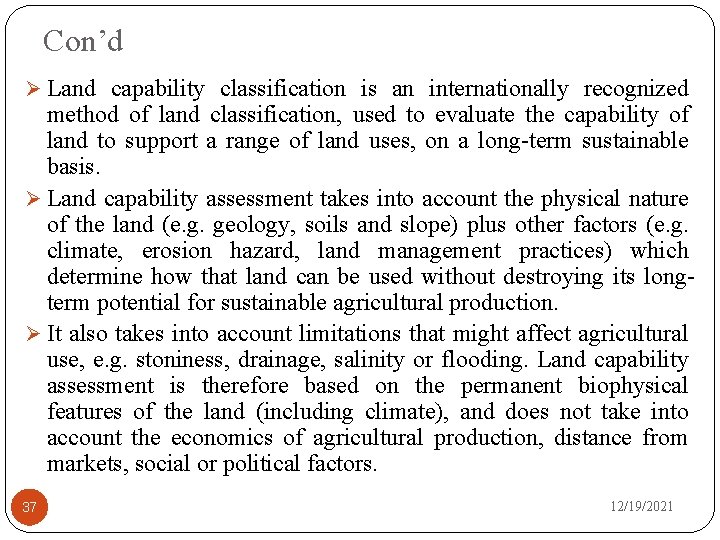
Con’d Ø Land capability classification is an internationally recognized method of land classification, used to evaluate the capability of land to support a range of land uses, on a long-term sustainable basis. Ø Land capability assessment takes into account the physical nature of the land (e. g. geology, soils and slope) plus other factors (e. g. climate, erosion hazard, land management practices) which determine how that land can be used without destroying its longterm potential for sustainable agricultural production. Ø It also takes into account limitations that might affect agricultural use, e. g. stoniness, drainage, salinity or flooding. Land capability assessment is therefore based on the permanent biophysical features of the land (including climate), and does not take into account the economics of agricultural production, distance from markets, social or political factors. 37 12/19/2021
Figure : two-stage and parallel approach to land evaluation 38 12/19/2021
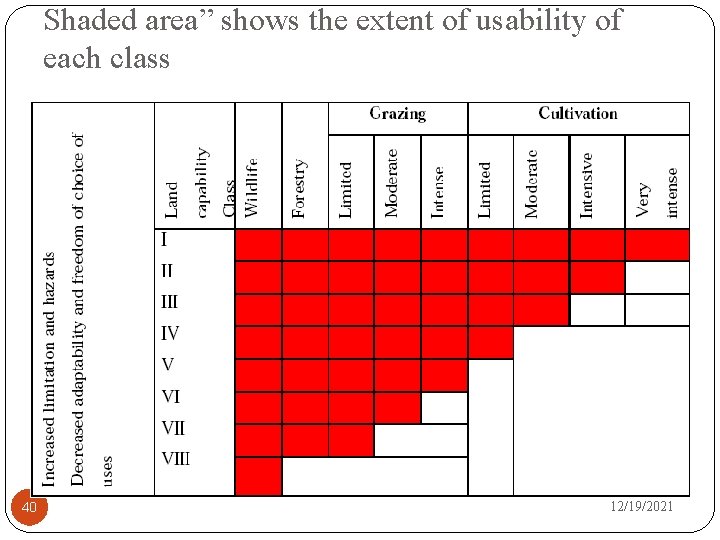
Con’d Ø The land capability class is the broadest grouping of the land capability classification and gives an indication of the general degree of limitation to use and the versatility of the land. 39 12/19/2021
Shaded area” shows the extent of usability of each class 40 12/19/2021
Con’d Class I Ø Soils with few limitations that restrict their uses. Ø Class 1 land is highly productive and capable of being cropped eight to nine years out of ten in a rotation with pasture or equivalent without risk of damage to the soil resource. Class II Ø Soil with some limitations that reduce the choice of plants or require moderate conservation practices. Ø Land suitable for a wide range of intensive cropping and grazing activities. 41 12/19/2021
Con’d Class III Ø Soil with severe limitations that reduce the choice of plants or require special conservation practices or both. Ø Land suitable for cropping and intensive grazing. Class IV Ø Soil with very severe limitations that restrict the choice of plants or require very careful management or both. Ø Land primarily suitable for grazing but which may be used for occasional cropping. Class V Ø This land is unsuitable for cropping, although some areas on easier slopes may be cultivated for pasture establishment or renewal and occasional fodder crops may be possible. Ø The land may have slight to moderate limitations for pastoral use. 42 12/19/2021
Con’d Class VI Ø Land marginally suitable for grazing because of severe limitations. Ø This land has low productivity, high risk of erosion, low natural fertility or other limitations that severely restrict agricultural use. Ø This land should be retained under its natural vegetation cover. Class VII Ø Land with very severe to extreme limitations which make it unsuitable for agricultural use. Ø Their uses restricted to grazing, woodland wildlife. Ø Soils and landforms with limitations that preclude their use for commercial plant production and restrict it to recreation, wildlife, water supply or aesthetic purpose. 43 12/19/2021
Land Suitability Classification q Evaluating land suitability should answer the following questions: 1. For any specified kind of land use, which areas of land are best suited? 2. For any given area of land, for which kind of use is it best suited? Ø Land suitability is the fitness of a given type of land for a defined use. Ø The land may be considered in its present condition or after improvements. Ø The process of land suitability classification is the appraisal and grouping of specific areas of land in terms of their suitability for defined uses. Ø In accordance with the principles, separate classifications are made with respect to each kind of land use that appears to be relevant for the area. Ø Thus, for example, in a region where arable land use, animal production and forestry are all believed to be possible on certain areas, a separate suitability classification is made for each of these three kinds of use. 44 12/19/2021
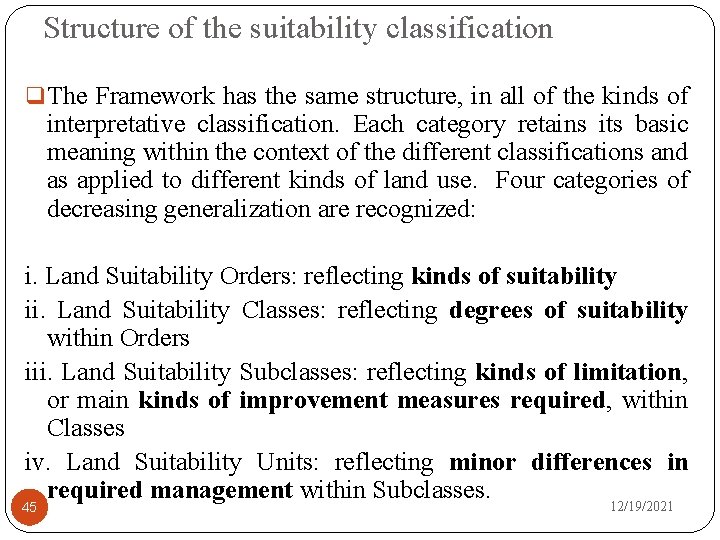
Structure of the suitability classification q The Framework has the same structure, in all of the kinds of interpretative classification. Each category retains its basic meaning within the context of the different classifications and as applied to different kinds of land use. Four categories of decreasing generalization are recognized: i. Land Suitability Orders: reflecting kinds of suitability ii. Land Suitability Classes: reflecting degrees of suitability within Orders iii. Land Suitability Subclasses: reflecting kinds of limitation, or main kinds of improvement measures required, within Classes iv. Land Suitability Units: reflecting minor differences in required management within Subclasses. 45 12/19/2021
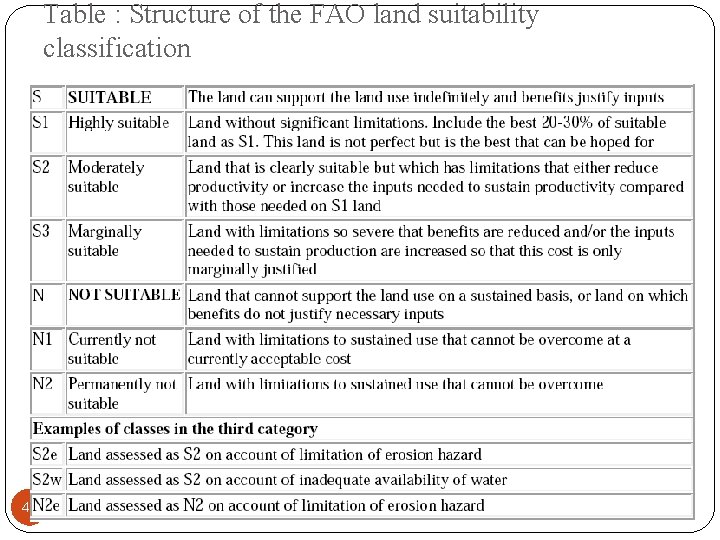
Table : Structure of the FAO land suitability classification 46 12/19/2021
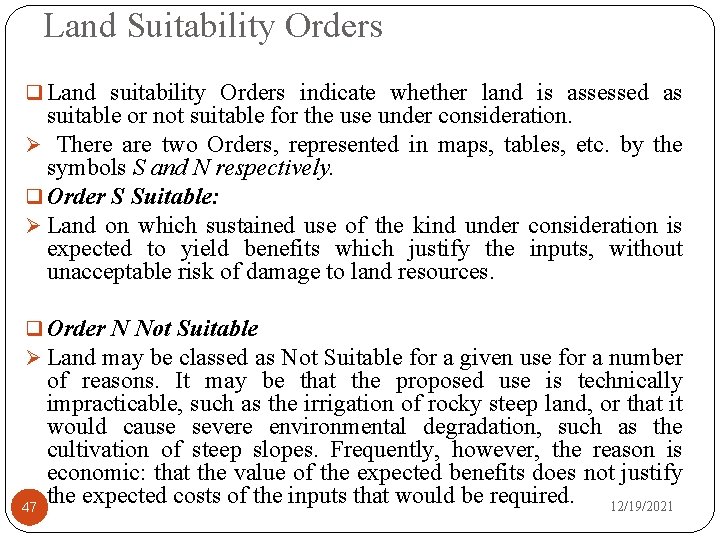
Land Suitability Orders q Land suitability Orders indicate whether land is assessed as suitable or not suitable for the use under consideration. Ø There are two Orders, represented in maps, tables, etc. by the symbols S and N respectively. q Order S Suitable: Ø Land on which sustained use of the kind under consideration is expected to yield benefits which justify the inputs, without unacceptable risk of damage to land resources. q Order N Not Suitable Ø Land may be classed as Not Suitable for a given use for a number 47 of reasons. It may be that the proposed use is technically impracticable, such as the irrigation of rocky steep land, or that it would cause severe environmental degradation, such as the cultivation of steep slopes. Frequently, however, the reason is economic: that the value of the expected benefits does not justify the expected costs of the inputs that would be required. 12/19/2021
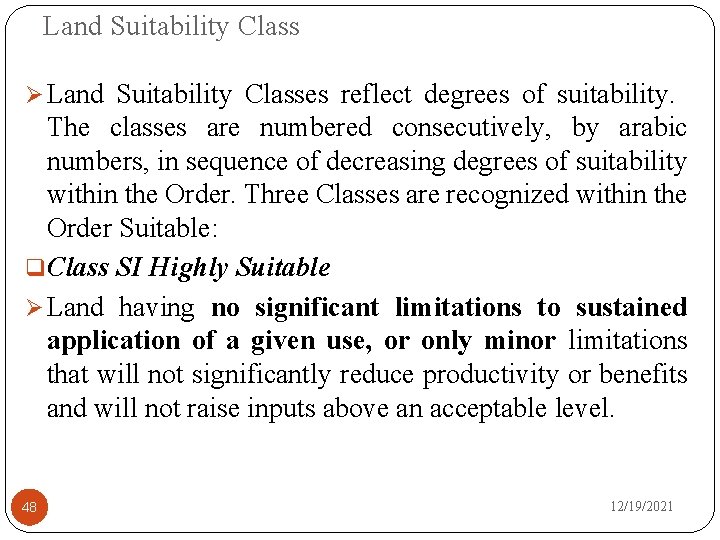
Land Suitability Class Ø Land Suitability Classes reflect degrees of suitability. The classes are numbered consecutively, by arabic numbers, in sequence of decreasing degrees of suitability within the Order. Three Classes are recognized within the Order Suitable: q. Class SI Highly Suitable Ø Land having no significant limitations to sustained application of a given use, or only minor limitations that will not significantly reduce productivity or benefits and will not raise inputs above an acceptable level. 48 12/19/2021
Con’d q Class S 2 Moderately Suitable: Ø Land having limitations which in aggregate are moderately severe for sustained application of a given use. Ø The limitations will reduce productivity or benefits and increase required inputs to the extent that the overall advantage to be gained from the use, although still attractive, will be appreciably inferior to that expected on Class SI land. q Class S 3 Marginally Suitable: Ø Land having limitations which in aggregate are severe for sustained 49 application of a given use and will so reduce productivity or benefits, or increase required inputs, that this expenditure will be only marginally justified. In a quantitative classification, both inputs and benefits must be expressed in common measurable terms, normally economic 12/19/2021
Con’d Ø In different circumstances different variables may express most clearly the degree of suitability, e. g. the range of expected net income per unit area or per standard management unit, or the net return per unit of irrigation water applied to different types of land for a given use. Ø Within the Order Not Suitable, there are normally two Classes: Class N 1 Currently Not Suitable Land having limitations which may be surmountable in time but which cannot be corrected with existing knowledge at currently acceptable cost; the limitations are so severe as to preclude successful sustained use of the land in the given manner. Class N 2 Permanently Not Suitable Land having limitations which appear so severe as to preclude any possibilities of successful sustained use of the land in the given manner. 50 12/19/2021
Con’d q Land Suitability Subclasses Ø Land Suitability Subclasses reflect kinds of limitations, e. g. moisture deficiency, erosion hazard. Subclasses are indicated by lower-case letters with mnemonic significance, e. g. S 2 m (m implies moisture deficiency), S 2 e, S 3 me. q Land Suitability Units Ø Land Suitability Units are subdivisions of a subclass. All the units within a subclass have the same degree of suitability at the class level and similar kinds of limitations at the subclass level. Ø The units differ from each other in their production characteristics (their management requirements). Ø Their recognition permits detailed interpretation at the farm planning level. Ø Suitability units are distinguished by Arabic numbers following a hyphen, e. g. S 2 e-I, S 2 e-2. 12/19/2021 51
Con’d q Conditional Suitability Ø The designation Conditionally Suitable may be added in certain instances to Ø Ø 52 condense and simplify presentation. This is necessary to cater for circumstances where small areas of land, within the survey area, may be unsuitable or poorly suitable for a particular use under the management specified for that use, but suitable given that certain conditions are fulfilled. The possible nature of the conditions is varied and might relate to modifications to the management practices or the inputs of the defined land use (occasioned, e. g. by localized phenomena of poor soil drainage, soil salinity); or to restrictions in the choice of crops (limited, for example, to crops with an especially high market value, or resistant to frost). In such instances, the indication "conditional" can avoid the need for additional classifications to account for local modifications of land use or local major improvements. Conditionally suitable is a phase of the Order Suitable. It is indicated by a lower case letter “c “between the order symbol and the class number, e. g. Sc 2. 12/19/2021