
Chapter Six Interpersonal Communication and Conversation This multimedia









- Slides: 22
Chapter Six: Interpersonal Communication and Conversation This multimedia product and its contents are protected under copyright law. The following are prohibited by law: - any public performance or display, including transmission of any image over a network; - preparation of any derivative work, including the extraction, in whole or in part, of any images; - any rental, lease, or lending of the program. Copyright © 2014, 2011, 2008 Pearson Education, Inc. All rights reserved.
Chapter Six Goals l l Maintain conversations more effectively Have more politeness, flexibility, and immediacy in conversations Have more satisfying conversations Communicate more effectively in making small talk, apologies, and giving compliments Copyright © 2014, 2011, 2008 Pearson Education, Inc. All rights reserved.
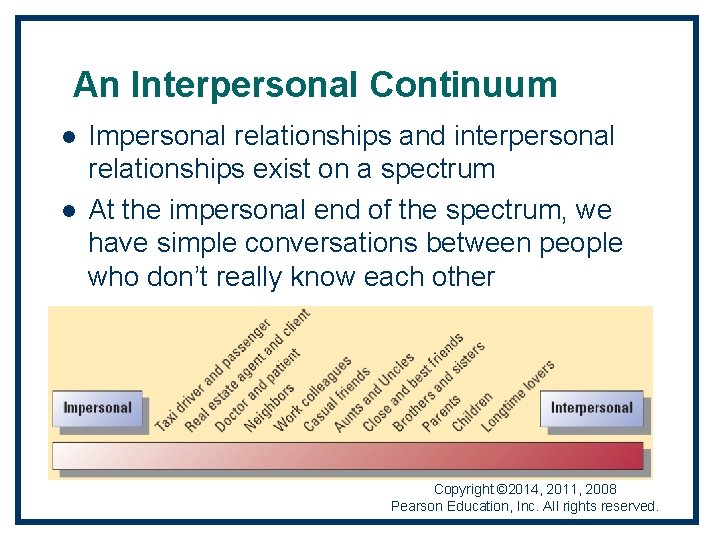
An Interpersonal Continuum l l Impersonal relationships and interpersonal relationships exist on a spectrum At the impersonal end of the spectrum, we have simple conversations between people who don’t really know each other Copyright © 2014, 2011, 2008 Pearson Education, Inc. All rights reserved.
Impersonal Relationships l l l Contains simple conversations Little self-disclosure or emotional content Interact according to the rules of society Copyright © 2014, 2011, 2008 Pearson Education, Inc. All rights reserved.
Interpersonal Relationships l l Communication that takes place between people who are intimately interconnected Communicate as unique individuals Follow personally established rules Contains more self-disclosure and emotional content Copyright © 2014, 2011, 2008 Pearson Education, Inc. All rights reserved.
The Principle of Conversations l l l The Principle of Process The Principle of Turn-Taking The Principle of Dialogue The Principle of Immediacy The Principle of Flexibility The Principle of Politeness Copyright © 2014, 2011, 2008 Pearson Education, Inc. All rights reserved.
The Principle of Process Copyright © 2014, 2011, 2008 Pearson Education, Inc. All rights reserved.
Opening l l l Greeting another person Verbal (“Hello”) Nonverbal (handshake, wave) Feedforward l l Opens channels of communication Previews future messages Copyright © 2014, 2011, 2008 Pearson Education, Inc. All rights reserved.
Business l l l The substance and focus of the conversation Fulfills one of the basic components of interpersonal communication: learn, relate, influence, play, or help Exchanges roles of speaker and listener frequently Copyright © 2014, 2011, 2008 Pearson Education, Inc. All rights reserved.
Feedback l l The act of reflecting on a conversation How to make feedback more effective: – – – If the feedback is mostly negative, start with something positive Give feedback in the appropriate time and place Get feedback about your feedback Copyright © 2014, 2011, 2008 Pearson Education, Inc. All rights reserved.
Closing l l The “good bye” of the conversation Combination of verbal and nonverbal Usually signals some degree of supportiveness May summarize the interaction as a conclusion Copyright © 2014, 2011, 2008 Pearson Education, Inc. All rights reserved.
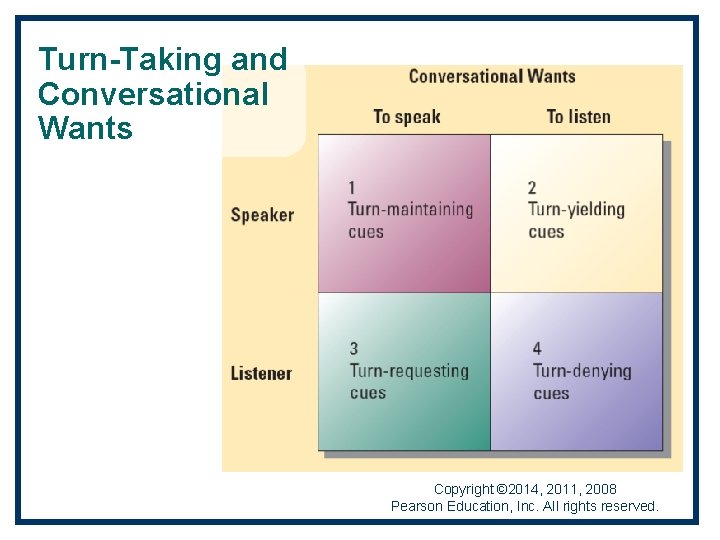
The Principle of Turn-Taking Speaker Cues l Turn-Maintaining cues l Turn-Yielding cues Listener Cues l Turn-Requesting cues l Turn-Denying cues l Back-channeling cues and interruptions Copyright © 2014, 2011, 2008 Pearson Education, Inc. All rights reserved.
Turn-Taking and Conversational Wants Copyright © 2014, 2011, 2008 Pearson Education, Inc. All rights reserved.
The Principle of Dialogue l l Dialogue = Conversation Each person is a speaker and listener The objective is mutual understanding and empathy There is respect for each other Copyright © 2014, 2011, 2008 Pearson Education, Inc. All rights reserved.
The Principle of Immediacy l l l The creation of closeness, a sense of togetherness, of oneness between speaker and listener Can make people more attractive to others Can be verbal or nonverbal Copyright © 2014, 2011, 2008 Pearson Education, Inc. All rights reserved.
The Principle of Flexibility The effective communicator needs to be flexible: l l Analyze the specific conversational situation Mindfully consider your available choices Estimate the potential advantages and disadvantages Competently communicate Copyright © 2014, 2011, 2008 Pearson Education, Inc. All rights reserved.
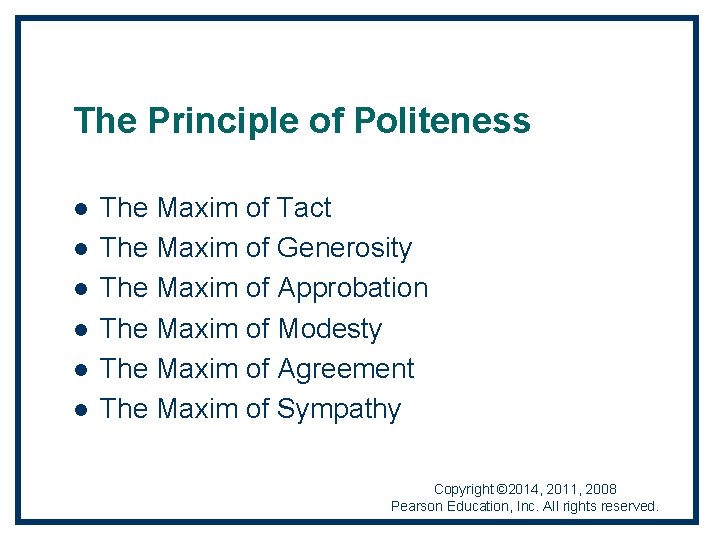
The Principle of Politeness l l l The Maxim of Tact The Maxim of Generosity The Maxim of Approbation The Maxim of Modesty The Maxim of Agreement The Maxim of Sympathy Copyright © 2014, 2011, 2008 Pearson Education, Inc. All rights reserved.
Everyday Conversations l l l Small talk Apologies Compliments Copyright © 2014, 2011, 2008 Pearson Education, Inc. All rights reserved.
Small Talk l l l Preliminary talk Helps ease into a major topic (“big talk”) Can be a politeness strategy Stress similarities rather than differences Some relationships are based entirely on small talk Copyright © 2014, 2011, 2008 Pearson Education, Inc. All rights reserved.
Apologies An expression of wrong-doing or regret for having done something or for something that has happened. l l l Admit wrong-doing Be apologetic Empathize Avoid excuses Give assurances it will not happen again Copyright © 2014, 2011, 2008 Pearson Education, Inc. All rights reserved.
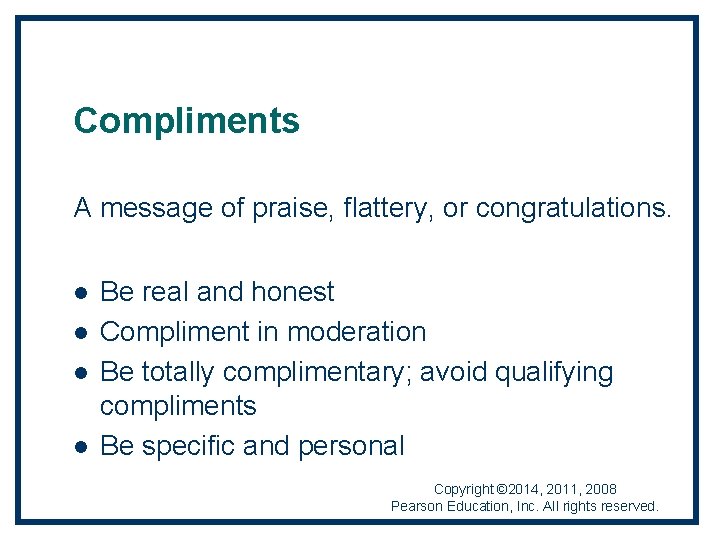
Compliments A message of praise, flattery, or congratulations. l l Be real and honest Compliment in moderation Be totally complimentary; avoid qualifying compliments Be specific and personal Copyright © 2014, 2011, 2008 Pearson Education, Inc. All rights reserved.
End Show Copyright © 2014, 2011, 2008 Pearson Education, Inc. All rights reserved.