
Chapter Six Accommodating Student Variability Overview Ability grouping
Chapter Six Accommodating Student Variability
Overview • Ability grouping • The Individuals with Disabilities Education Act (IDEA) • Students with mental retardation • Students with learning disabilities • Students with emotional disturbance • Gifted and talented students • Using technology to assist exceptional students Copyright © Houghton Mifflin Company. All rights reserved. 2
What is ability grouping? • Ability grouping is … – Grouping students of similar ability for the purposes of instruction. Copyright © Houghton Mifflin Company. All rights reserved. 3
Types of Ability Groups • Between-class ability grouping – Each class is made up of students of similar ability. • Regrouping – Students of the same age, ability, and grade but from different classes come together for instruction in a specific subject. • Joplin plan – Regrouping that takes place across grade levels. • Within-class ability grouping – Division of a single class into two or three groups for instruction in specific subjects. Copyright © Houghton Mifflin Company. All rights reserved. 4
Evaluations of Ability Grouping • There is little to no support for between-class ability grouping. • Research on the effect of regrouping for reading or math is inconclusive. • The Joplin plan yields moderately positive effects compared with instruction in heterogeneous classes. • Within-class grouping in math and science produced modestly positive results compared to other instructional approaches. Copyright © Houghton Mifflin Company. All rights reserved. 5
Evaluations of Ability Grouping • Students in homogeneously and heterogeneously grouped classes scored similarly on measures of self-esteem. • Students in high-ability classes had more positive attitudes about school and higher educational aspirations than did students in low-ability classrooms. • Between-class grouping affected the quality of instruction received by students. Copyright © Houghton Mifflin Company. All rights reserved. 6
Major Provisions of the Individuals with Disabilities Education Act (IDEA) • A free and appropriate public education • A preplacement evaluation prior to being placed in a special education program • An individualized education program (IEP) if one receives special education services • Educational services must be provided in the least restrictive environment • Procedural safeguards to protect the legal rights of parents and their children Copyright © Houghton Mifflin Company. All rights reserved. 7
Preplacement Evaluation (“Individuals with Disabilities, ” 1997) • Tests must be administered in the child’s native language. • A test must be valid for the specific purpose for which it is used. • Tests must be administered by trained professionals. • Tests administered to students who have impaired sensory, manual, or speaking skills must reflect aptitude or achievement rather than the impairment. Copyright © Houghton Mifflin Company. All rights reserved. 8
Preplacement Evaluation (“Individuals with Disabilities, ” 1997) • No single procedure can be the sole basis for determining an appropriate educational program. • Evaluations must be made by a multidisciplinary team. • The child must be assessed in all areas related to the suspected disability. Copyright © Houghton Mifflin Company. All rights reserved. 9
Individualized Education Plan (“Individuals with Disabilities, ” 1997) • A statement of the child’s present levels of educational performance • A statement of annual goals, including short -term instructional objectives • A statement of the specific special education and related services to be provided to the child, and the extent to which the child will be able to participate in regular educational programs Copyright © Houghton Mifflin Company. All rights reserved. 10
Individualized Education Plan (“Individuals with Disabilities, ” 1997) • The projected dates for initiation of services and the anticipated duration of the services • Appropriate objective criteria and evaluation procedures and schedules for determining, on at least an annual basis, whether short-term objectives are being achieved Copyright © Houghton Mifflin Company. All rights reserved. 11
Least Restrictive Environment • Special classroom – Students with disabilities spend their entire day in a separate classroom. • Mainstreaming – Students with disabilities spend part of their day in a separate classroom and part of their day in the regular education classroom. • Inclusion – Students with disabilities spend their entire day in the regular education classroom. Copyright © Houghton Mifflin Company. All rights reserved. 12
Conclusions Regarding Inclusion • Inclusion may not be an appropriate course of action for every child with a disability. • Inclusion will likely work best where the presence of a disabled student stimulates the teacher to improve the general quality of classroom instruction and where well-trained staff are available. • For students who are mainstreamed, IEPs should be written so as to better reflect what a given student probably can and cannot accomplish. Copyright © Houghton Mifflin Company. All rights reserved. 13
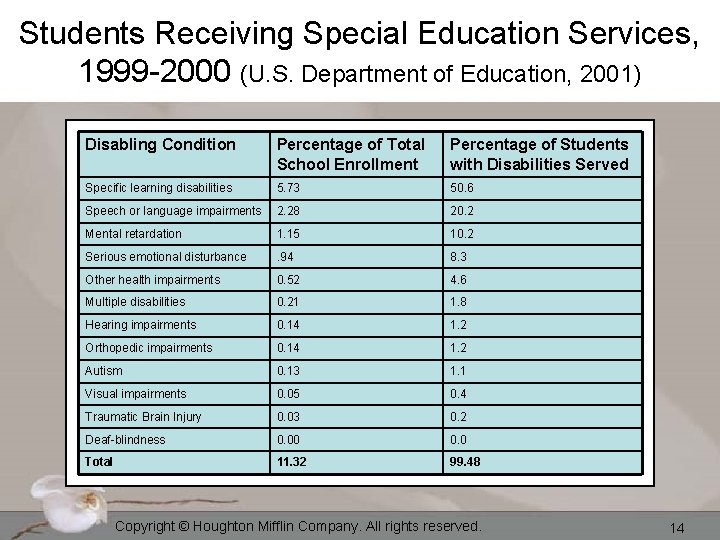
Students Receiving Special Education Services, 1999 -2000 (U. S. Department of Education, 2001) Disabling Condition Percentage of Total School Enrollment Percentage of Students with Disabilities Served Specific learning disabilities 5. 73 50. 6 Speech or language impairments 2. 28 20. 2 Mental retardation 1. 15 10. 2 Serious emotional disturbance . 94 8. 3 Other health impairments 0. 52 4. 6 Multiple disabilities 0. 21 1. 8 Hearing impairments 0. 14 1. 2 Orthopedic impairments 0. 14 1. 2 Autism 0. 13 1. 1 Visual impairments 0. 05 0. 4 Traumatic Brain Injury 0. 03 0. 2 Deaf-blindness 0. 00 0. 0 Total 11. 32 99. 48 Copyright © Houghton Mifflin Company. All rights reserved. 14
Regular Education Teacher’s Responsibilities Under IDEA • • Referral Assessment Preparation of the IEP Implementation and evaluation of the IEP Copyright © Houghton Mifflin Company. All rights reserved. 15
Definition of Specific Learning Disabilities • The individual has a disorder in one or more of the basic psychological processes. • The individual has difficulty in learning. • The problem is not due primarily to other causes. Copyright © Houghton Mifflin Company. All rights reserved. 16
Attention-Deficit/Hyperactivity Disorder (American Psychiatric Association, 2000) • Symptoms – Inattention, hyperactivity, and impulsivity • To be labeled, the symptoms must – First appear before the age of seven – Be displayed in several settings (home, school, play) – Persist over time Copyright © Houghton Mifflin Company. All rights reserved. 17
Characteristics of Students with a Severe Emotional Disturbance • Externalizing students – Aggressive, uncooperative, restless, and negativistic • Internalizing students – Shy, timid, anxious, fearful, and lack selfconfidence Copyright © Houghton Mifflin Company. All rights reserved. 18
Congressional Definition of Gifted and Talented • “The term gifted and talented children and youth means children and youth who give evidence of high performance capability in areas such as intellectual, creative, artistic, or leadership capability, or in specific academic fields, and who require services or activities not ordinarily provided by the school in order to fully develop such capabilities. ” (Title IV-H. R. A, 1988, pp. 227 -228) Copyright © Houghton Mifflin Company. All rights reserved. 19
Instructional Options for the Gifted and Talented • Accelerated instruction • Gifted and talented classes and schools • Enrichment and differentiated instruction Copyright © Houghton Mifflin Company. All rights reserved. 20
Types of Accelerated Instruction • Allowing students to complete the work for more than one grade during the regular school year • Extending the school year by using summer sessions • Allowing students to take college classes while still in high school Copyright © Houghton Mifflin Company. All rights reserved. 21
Curriculum Enrichment Techniques • Type I enrichment – Involves exploratory activities that are designed to expose students to topics not ordinarily covered in the regular curriculum • Type II enrichment – Involves instructional methods and materials aimed at the development of thinking and feeling processes • Type III enrichment – Consists of activities in which students investigate and collect data about a real topic or problem Copyright © Houghton Mifflin Company. All rights reserved. 22
- Slides: 22