
Chapter Seventeen Global Marketing and R D 17

Chapter Seventeen • Global Marketing and • R & D
17 - 3 Opening Case • Kodak entered Russia in the early 1990’s - Country was deep in the middle of a turbulent transition from a communist economy to a new democracy - Russian consumers had little knowledge of Kodak’s products - The consumer market for photography was underdeveloped - Apart from state-run stores, there was little or no infrastructure in place for distributing photographic equipment, film, and processing - Consumers were poor and lacked the ability to afford all but the most inexpensive cameras Mc. Graw-Hill/Irwin International Business, 6/e © 2007 The Mc. Graw-Hill Companies, Inc. , All Rights Reserved.
17 - 4 Opening Case • Kodak’s entry into Russia is widely regarded as a major success because it accounts for a significant portion of $2. 59 billion in international sales and growth rate of 26% • Reasons for Kodak’s success include - A clear and consistent marketing message communicated through a number of media - They invested in promoting a corporate image as a firm that takes a stand against corruption and black-market practices - The product strategy has been to sell lower-end film and cameras in Russia - Encouraged major enterprises to give cameras to valued employees - Built a distribution channel through franchising Mc. Graw-Hill/Irwin International Business, 6/e © 2007 The Mc. Graw-Hill Companies, Inc. , All Rights Reserved.
17 - 5 The Globalization of Markets and Brands • Important to determine when product standardization is appropriate in an international market • Firms may need to vary marketing mix in each different country • Globalization may be the exception rather than the rule in many consumer goods markets and industrial markets Mc. Graw-Hill/Irwin International Business, 6/e © 2007 The Mc. Graw-Hill Companies, Inc. , All Rights Reserved.
17 - 6 Market Segmentation • Refers to identifying distinct groups of consumers whose purchasing behavior differs from others in important ways • Segments can based on: - Geography Demography Socio-cultural factors Psychological factors Mc. Graw-Hill/Irwin International Business, 6/e © 2007 The Mc. Graw-Hill Companies, Inc. , All Rights Reserved.
17 - 7 Market Segmentation • Two main issues relating to segmentation: - Extent of differences between countries in the structure of market segments - Existence of segments that transcend national borders Mc. Graw-Hill/Irwin International Business, 6/e © 2007 The Mc. Graw-Hill Companies, Inc. , All Rights Reserved.
17 - 8 Product Attributes • Cultural differences • Economic development • Product and technical standards Mc. Graw-Hill/Irwin International Business, 6/e © 2007 The Mc. Graw-Hill Companies, Inc. , All Rights Reserved.
17 - 9 Cultural Differences • Differ along dimensions such as social structure, language, religion, and education • Impact of tradition • Some tastes and preferences becoming cosmopolitan Mc. Graw-Hill/Irwin International Business, 6/e © 2007 The Mc. Graw-Hill Companies, Inc. , All Rights Reserved.
17 - 10 Economic Development • Consumer behavior is influenced by economic development - Consumers in highly developed countries tend to demand extra performance attributes in their products • Price not a factor due to high income level - Consumers in less developed countries value basic features as more important • Price a factor due to lower income level - Cars: no air-conditioning, power steering, power windows, radios, and cassette players • Product reliability is more important Mc. Graw-Hill/Irwin International Business, 6/e © 2007 The Mc. Graw-Hill Companies, Inc. , All Rights Reserved.
17 - 11 Product and Technical Standards - Government standards can rule out mass production and marketing of a standardized product - Differing technical standards constrain globalization of markets • Different television signal frequencies Mc. Graw-Hill/Irwin International Business, 6/e © 2007 The Mc. Graw-Hill Companies, Inc. , All Rights Reserved.
17 - 12 Distribution Strategy • Choice of the optimal channel for delivering a product to the consumer - Optimal strategy is determined by the relative costs and benefits of each alternative - Depends on differences between countries • Retail concentration • Channel length • Channel exclusivity Mc. Graw-Hill/Irwin International Business, 6/e © 2007 The Mc. Graw-Hill Companies, Inc. , All Rights Reserved.
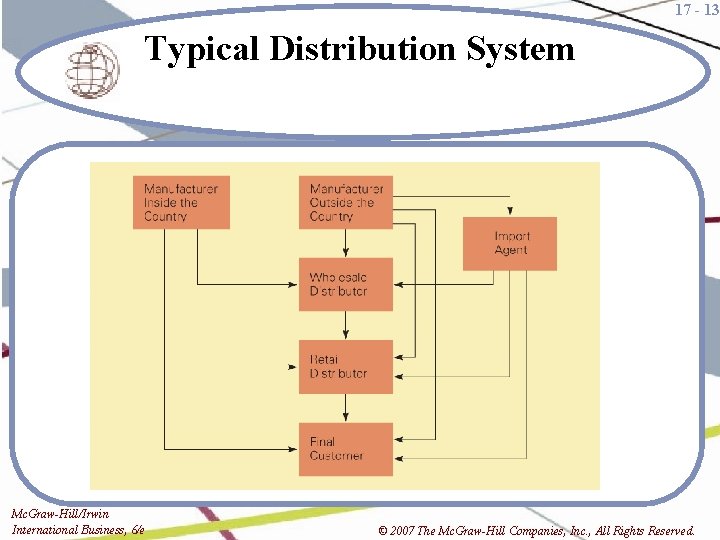
17 - 13 Typical Distribution System Mc. Graw-Hill/Irwin International Business, 6/e © 2007 The Mc. Graw-Hill Companies, Inc. , All Rights Reserved.
17 - 14 Retail Concentration • Concentrated system - Common in developed countries - Contributing factors: increase in car ownership, number of households with refrigerators and freezers, and two-income households • Fragmented system - Common in developing countries - Contributing factors: great population density with large number of urban centers, e. g. Japan - Uneven or mountainous terrain, e. g. Nepal Mc. Graw-Hill/Irwin International Business, 6/e © 2007 The Mc. Graw-Hill Companies, Inc. , All Rights Reserved.
17 - 15 Channel Length • Refers to number of intermediaries between the producer and the consumer • Determined by degree to which the retail system is fragmented - Long distribution channel - Short distribution channel Mc. Graw-Hill/Irwin International Business, 6/e © 2007 The Mc. Graw-Hill Companies, Inc. , All Rights Reserved.
17 - 16 Channel Length • Long distribution channel - Fragmented retail system promotes growth of wholesalers and retailers - Firms go through intermediaries such as wholesalers to cut selling costs • Short distribution channel - Concentrated retail system - Firms deal directly with retailers Mc. Graw-Hill/Irwin International Business, 6/e © 2007 The Mc. Graw-Hill Companies, Inc. , All Rights Reserved.
17 - 17 Channel Exclusivity • Degree to which it is difficult for outsiders to access distribution channels • Varies between countries - Japan - exclusive systems because personal relations, often decades old, play an important role in stocking products - Difficult for new firm to get shelf space as compared to an old firm Mc. Graw-Hill/Irwin International Business, 6/e © 2007 The Mc. Graw-Hill Companies, Inc. , All Rights Reserved.
17 - 18 Choosing a Distribution Strategy • The optimal strategy is determined by the relative costs and benefits of each alternative - Varies from country to country • Benefits of a shorter distribution channel - The longer the channel, the greater the aggregate markup and the higher the price that consumers are charged for the final product - If price is an important competitive weapon the firm might choose a shorter channel Mc. Graw-Hill/Irwin International Business, 6/e © 2007 The Mc. Graw-Hill Companies, Inc. , All Rights Reserved.
17 - 19 Choosing a Distribution Strategy • Benefits of a longer distribution channel - Cuts selling costs when the retail sector is fragmented - Longer channels can provide increased market access • If channel quality is poor, a firm should consider what steps it could take to upgrade the quality of the channel - This may include establishing its own distribution channel Mc. Graw-Hill/Irwin International Business, 6/e © 2007 The Mc. Graw-Hill Companies, Inc. , All Rights Reserved.
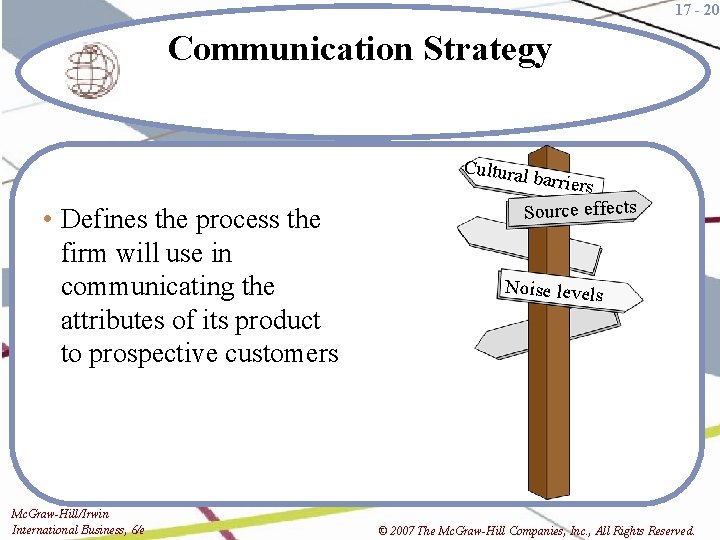
17 - 20 Communication Strategy Cultural • Defines the process the firm will use in communicating the attributes of its product to prospective customers Mc. Graw-Hill/Irwin International Business, 6/e barriers Source effects Noise levels © 2007 The Mc. Graw-Hill Companies, Inc. , All Rights Reserved.
17 - 21 Barriers to International Communication • Cultural Barriers - Develop cross-cultural literacy - Firm should use local input such as local advertising agency and sales force • Source and country of origin effects - Receiver of the message evaluates the message based on status or image of the sender • Anti-Japan wave in US in 1990’s - Place of manufacturing influences product evaluations • Often used when consumer lacks more detailed knowledge of the product - Examples: French wines, Italian clothes, and German luxury cars Mc. Graw-Hill/Irwin International Business, 6/e © 2007 The Mc. Graw-Hill Companies, Inc. , All Rights Reserved.
17 - 22 Barriers to International Communication • Noise levels - Amount of other messages competing for a potential customer’s attention • Developed countries - high • Less developed countries - low • Standardized advertising strategy execution more difficult (culture, laws) Mc. Graw-Hill/Irwin International Business, 6/e © 2007 The Mc. Graw-Hill Companies, Inc. , All Rights Reserved.
17 - 23 Push Versus Pull Strategy • Push strategy emphasizes personal selling - Requires intense use of a sales force - Relatively costly • Pull strategy depends on mass media advertising - Can be cheaper for a large market segment • Determining factors of type of strategy - Product type and consumer sophistication - Channel length - Media availability Mc. Graw-Hill/Irwin International Business, 6/e © 2007 The Mc. Graw-Hill Companies, Inc. , All Rights Reserved.
17 - 24 Product Type and Consumer Sophistication • Pull strategy - Consumer goods - Large market segment - Long distribution channels - Mass communication has cost advantages Mc. Graw-Hill/Irwin International Business, 6/e • Push strategy - Industrial products or complex new products - Direct selling allows firms to educate users - Short distribution channels - Used in poorer nations for consumer goods where direct selling only way to reach consumers © 2007 The Mc. Graw-Hill Companies, Inc. , All Rights Reserved.
17 - 25 Channel Length • Pull strategy - Long or exclusive distribution channels • e. g. Japan - Mass advertising to generate demand to pull product through various layers • Push Strategy - In countries with low literacy levels to educate consumers Mc. Graw-Hill/Irwin International Business, 6/e © 2007 The Mc. Graw-Hill Companies, Inc. , All Rights Reserved.
17 - 26 Media Availability • Pull strategy - Relies on access to advertising media - Common in developed nations • Push strategy - Media availability limited by law - All electronic media state owned with no commercial policy Mc. Graw-Hill/Irwin International Business, 6/e © 2007 The Mc. Graw-Hill Companies, Inc. , All Rights Reserved.
17 - 27 Global Advertising • Standardized: - Significant economic advantages - Scarce creative talent - Many global brand names • Non-standardized: - Cultural differences - Advertising regulations can be a restriction Mc. Graw-Hill/Irwin International Business, 6/e © 2007 The Mc. Graw-Hill Companies, Inc. , All Rights Reserved.
17 - 28 Pricing Strategy • Three aspects of international pricing strategy - Price discrimination - Strategic pricing - Regulatory influence on prices Mc. Graw-Hill/Irwin International Business, 6/e © 2007 The Mc. Graw-Hill Companies, Inc. , All Rights Reserved.
17 - 29 Price Discrimination • Said to occur when consumers in different countries are charged different prices for the same product • Two conditions necessary - National markets kept separate to prevent arbitrage • Capitalization of price differentials by purchasing product in countries where prices are lower and reselling where prices are higher - Different price elasticities of demand in different countries • Greater in countries with low income levels and highly competitive conditions Mc. Graw-Hill/Irwin International Business, 6/e © 2007 The Mc. Graw-Hill Companies, Inc. , All Rights Reserved.
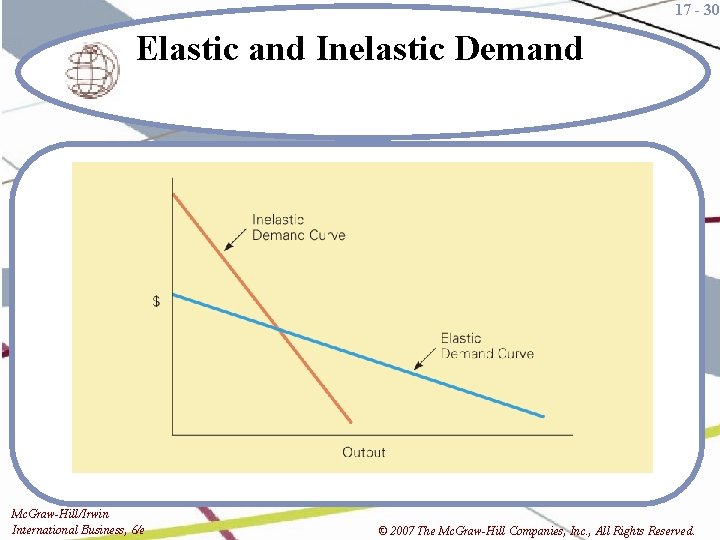
17 - 30 Elastic and Inelastic Demand Mc. Graw-Hill/Irwin International Business, 6/e © 2007 The Mc. Graw-Hill Companies, Inc. , All Rights Reserved.
17 - 31 Strategic Pricing • Predatory pricing - Using price as a competitive weapon to drive weaker competition out of a national market - Firms then raise prices to enjoy high profits - Firms normally have profitable position in another national market Mc. Graw-Hill/Irwin International Business, 6/e © 2007 The Mc. Graw-Hill Companies, Inc. , All Rights Reserved.
17 - 32 Strategic Pricing • Multipoint pricing strategy - Two or more international firms compete against each other in two or more national markets - A firm’s pricing strategy in one market may impact a rival in another market • Kodak and Fuji Mc. Graw-Hill/Irwin International Business, 6/e © 2007 The Mc. Graw-Hill Companies, Inc. , All Rights Reserved.
17 - 33 Strategic Pricing • Experience curve pricing - Firms price low worldwide to build market share - Incurred losses are made up as company moves down experience curve, making substantial profits - Cost advantage over its less-aggressive competitors Mc. Graw-Hill/Irwin International Business, 6/e © 2007 The Mc. Graw-Hill Companies, Inc. , All Rights Reserved.
17 - 34 Regulatory Influences on Prices • Antidumping regulations - Selling a product for a price that is less than the cost of producing it - Antidumping rules vague, but place a floor under export prices and limit a firm’s ability to pursue strategic pricing • Article 6 of GATT allows action against an importer if the product is sold at ‘less than fair value’ and causes ‘material injury to a domestic industry’ • Competition policy - Regulations designed to promote competition and restrict monopoly practices Mc. Graw-Hill/Irwin International Business, 6/e © 2007 The Mc. Graw-Hill Companies, Inc. , All Rights Reserved.
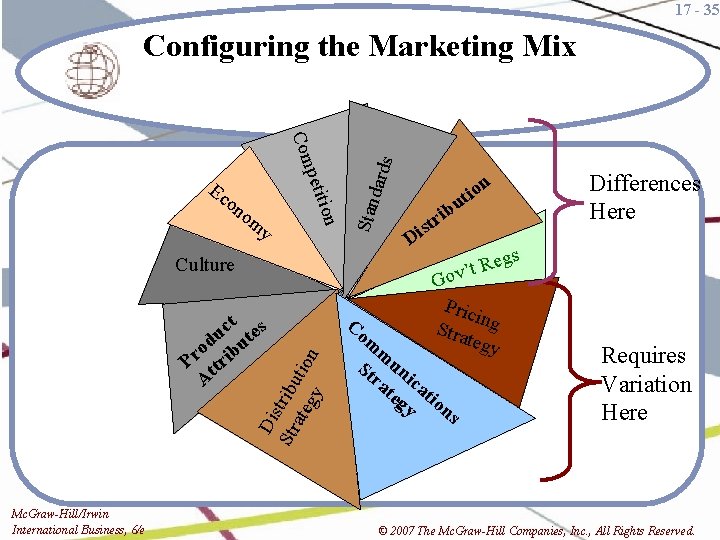
17 - 35 y tion om dard peti on Stan Com Ec s Configuring the Marketing Mix Culture Di Str stribu ate tio gy n t s c u te d o ibu r P ttr A Mc. Graw-Hill/Irwin International Business, 6/e Co io ut Differences Here n D ib r t is gs e R t ’ Gov Pric i Stra ng tegy m m St un ra ica te ti gy on s Requires Variation Here © 2007 The Mc. Graw-Hill Companies, Inc. , All Rights Reserved.
17 - 36 New Product Development • The location of R & D - Rate of new product development greater in countries where • • More money spent on R&D Underlying demand is strong Consumers are affluent Competition is intense Mc. Graw-Hill/Irwin International Business, 6/e © 2007 The Mc. Graw-Hill Companies, Inc. , All Rights Reserved.
17 - 37 Integrating R&D, Marketing and Production • Integrating R&D, production and marketing ensures - Project development driven by customer needs New products are designed for ease of manufacture Development costs are kept in check Time to market is minimized Mc. Graw-Hill/Irwin International Business, 6/e © 2007 The Mc. Graw-Hill Companies, Inc. , All Rights Reserved.
17 - 38 Integrating R&D, Marketing and Production • High failure ratio - Between 33 % and 60% of new products fail to earn adequate profits • Reasons for failure: - Limited product demand - Failure to adequately commercialize product - Inability to manufacture product cost-effectively Mc. Graw-Hill/Irwin International Business, 6/e © 2007 The Mc. Graw-Hill Companies, Inc. , All Rights Reserved.
17 - 39 Cross-Functional Product Development Teams • Objective of team to take a product development project from the initial concept development to market introduction • Effective teams must have - “Heavyweight “ project manager One member from each key function Physically co-located to facilitate communication Clear plan and goals Own process for communication and conflict resolution Mc. Graw-Hill/Irwin International Business, 6/e © 2007 The Mc. Graw-Hill Companies, Inc. , All Rights Reserved.

17 - 40 Looking Ahead to Chapter 18 • Global Human Resource Management - The Strategic Role of International HRM Staffing Policy Training and Management Development Performance Appraisal Compensation International Labor Relations Mc. Graw-Hill/Irwin International Business, 6/e © 2007 The Mc. Graw-Hill Companies, Inc. , All Rights Reserved.
- Slides: 40