
CHAPTER SEVEN PARTICIPATIVE MANAGEMENT AND LEADING TEAMS Learning


- Slides: 71
CHAPTER SEVEN PARTICIPATIVE MANAGEMENT AND LEADING TEAMS
Learning Objectives 1. 2. 3. 4. 5. Understand when and why participation should be used to improve leadership effectiveness. Explain the role of culture in the use and success of participative leadership. Specify the elements of effective delegation. Clarify the role of leadership in self-managed teams. Explain the principles of super- and self -leadership.
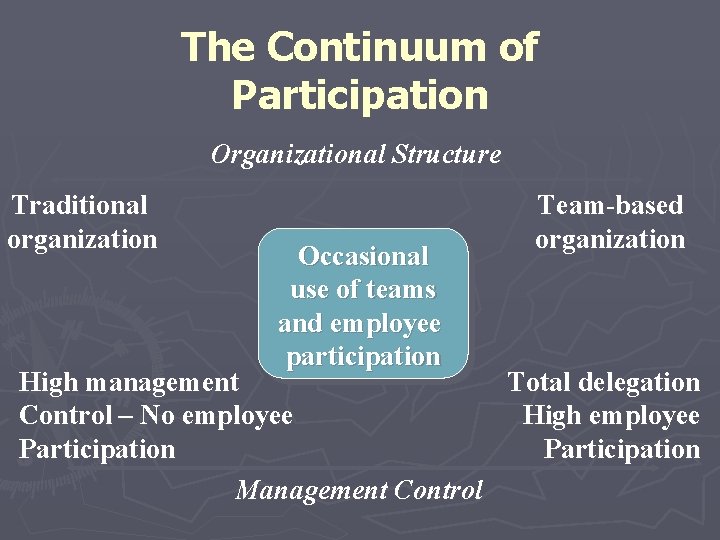
The Continuum of Participation Organizational Structure Traditional organization Occasional use of teams and employee participation Team-based organization High management Total delegation Control – No employee High employee Participation Management Control
Criteria for Use of Participation z z z When the task is complex and quality is important When follower commitment is needed When there is time When the leader and follower are ready When the leader and followers can easily interact
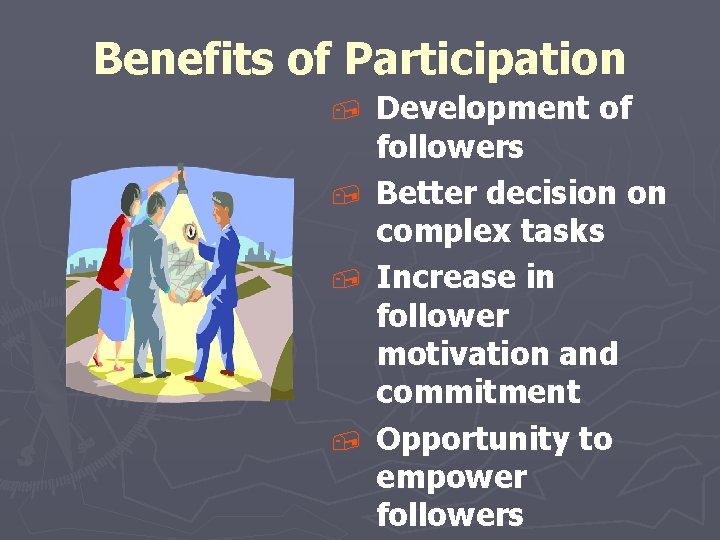
Benefits of Participation , , , , Development of followers Better decision on complex tasks Increase in follower motivation and commitment Opportunity to empower followers
Guidelines For Good Delegation Delegate pleasant and unpleasant tasks Ö Ö Clarify goals and expectations Delegate authority along with responsibility Ö Ö Provide support Ö Monitor and provide feedback Ö Delegate to different followers
Excuses For Not Delegating “My followers are not ready. ” “They do not have the skills. ” “I am uncomfortable delegating my tasks. ” ü “I can do the job quicker myself. ” ü “My followers are too busy. ” ü “I am responsible for my followers mistakes. ” ü “My own manager may think I am not working hard enough. ” ü ü ü
TEAMS
Characteristics Of Teams h h h Members are fully committed to common goals they develop Members are mutually accountable to one another Members trust one another Collaborative culture Shared leadership based on facilitation Synergy
Self-Managed Teams Ø Ø Ø Power to manage their own work Members with different expertise and experience No outside manager and power to implement team decisions Coordination with other teams Internal leadership based on facilitation
Elements of Super Leadership b Developing positive and motivating thought patterns Personal goal setting b Observation and selfevaluation b Self-reinforcement control and monitoring b
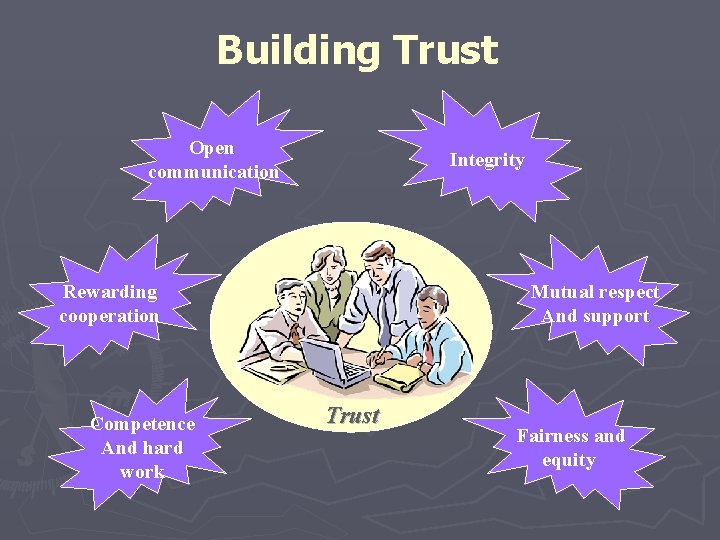
Building Trust Open communication Integrity Rewarding cooperation Competence And hard work Mutual respect And support Trust Fairness and equity
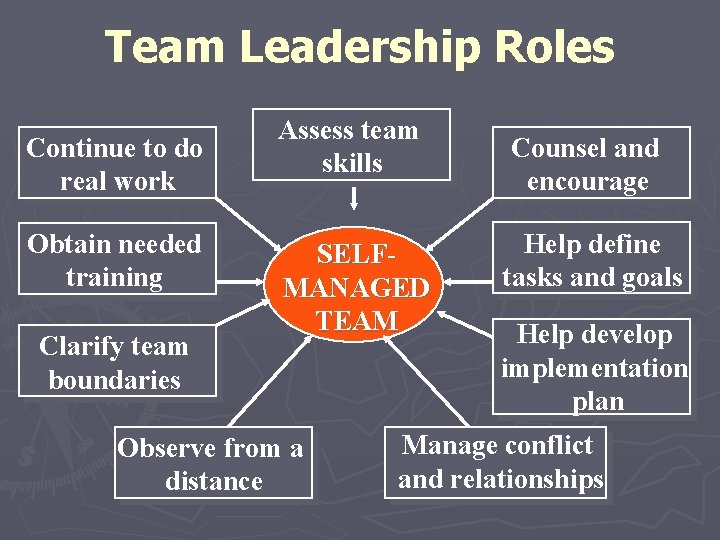
Team Leadership Roles Continue to do real work Obtain needed training Clarify team boundaries Assess team skills SELFMANAGED TEAM Observe from a distance Counsel and encourage Help define tasks and goals Help develop implementation plan Manage conflict and relationships
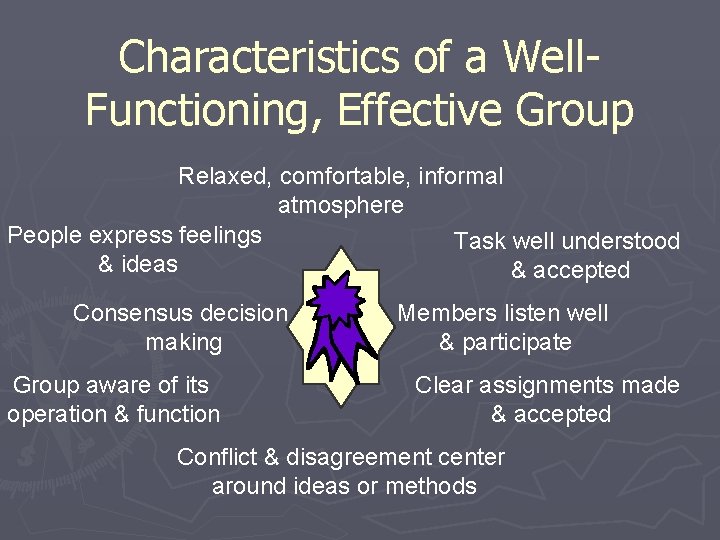
Characteristics of a Well. Functioning, Effective Group Relaxed, comfortable, informal atmosphere People express feelings Task well understood & ideas & accepted Consensus decision making Group aware of its operation & function Members listen well & participate Clear assignments made & accepted Conflict & disagreement center around ideas or methods
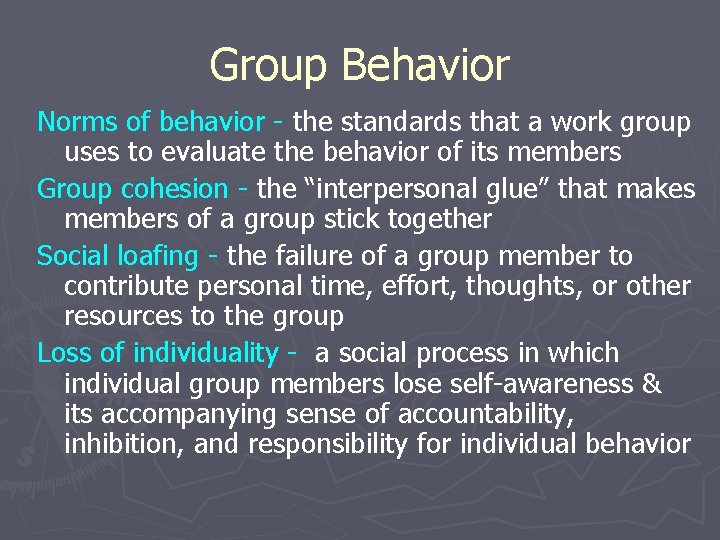
Group Behavior Norms of behavior - the standards that a work group uses to evaluate the behavior of its members Group cohesion - the “interpersonal glue” that makes members of a group stick together Social loafing - the failure of a group member to contribute personal time, effort, thoughts, or other resources to the group Loss of individuality - a social process in which individual group members lose self-awareness & its accompanying sense of accountability, inhibition, and responsibility for individual behavior
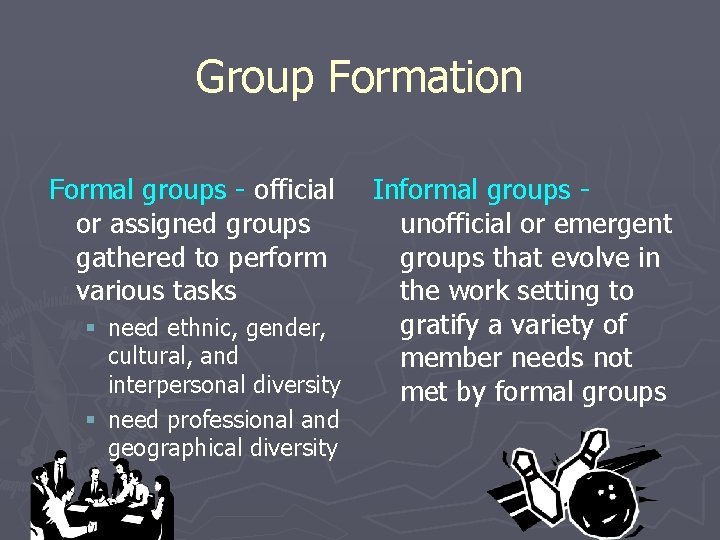
Group Formation Formal groups - official or assigned groups gathered to perform various tasks § need ethnic, gender, cultural, and interpersonal diversity § need professional and geographical diversity Informal groups unofficial or emergent groups that evolve in the work setting to gratify a variety of member needs not met by formal groups
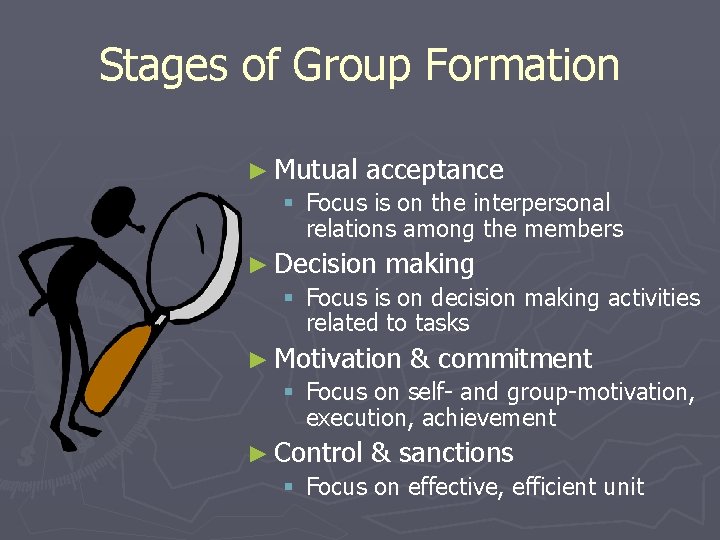
Stages of Group Formation ► Mutual acceptance § Focus is on the interpersonal relations among the members ► Decision making § Focus is on decision making activities related to tasks ► Motivation & commitment § Focus on self- and group-motivation, execution, achievement ► Control & sanctions § Focus on effective, efficient unit
Joining Groups ► Security ► Status ► Self-Esteem ► Affiliation ► Power ► Goal Achievement
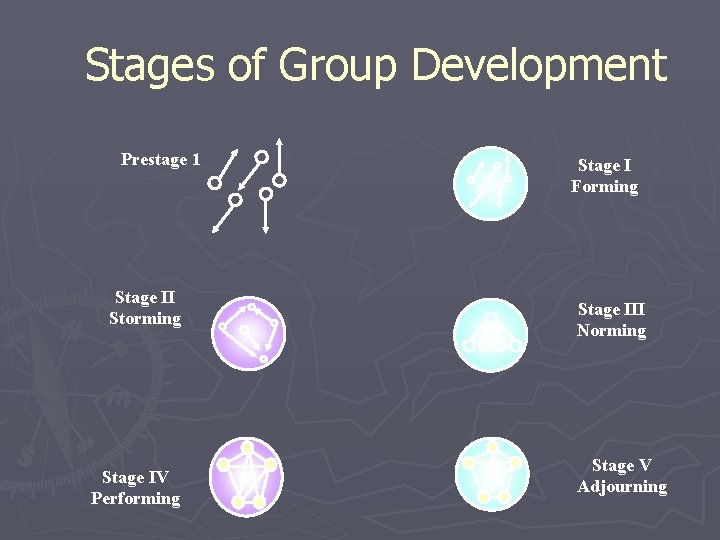
Stages of Group Development Prestage 1 Stage II Storming Stage IV Performing Stage I Forming Stage III Norming Stage V Adjourning
Group Behavior Model ► External Conditions Imposed on the Group § Group Member Resources § Group Structure ► Group Process § Group Task ► Performance and Satisfaction
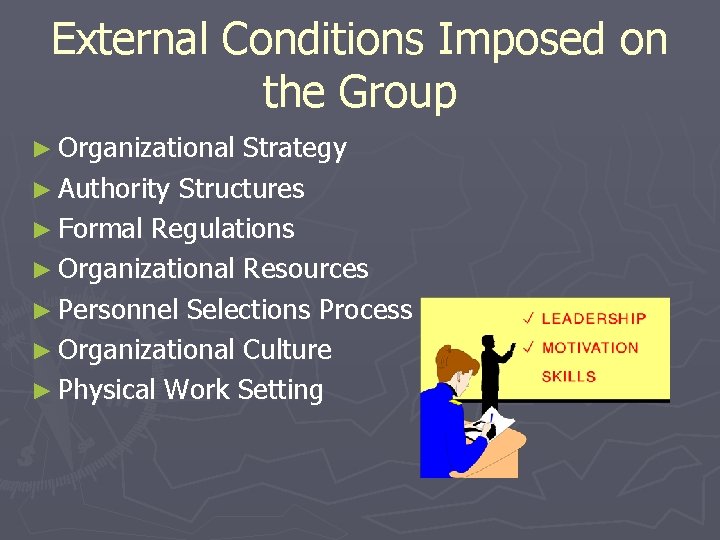
External Conditions Imposed on the Group ► Organizational Strategy ► Authority Structures ► Formal Regulations ► Organizational Resources ► Personnel Selections Process ► Organizational Culture ► Physical Work Setting
Group Leaders ► Department Manager ► Supervisors ► Foreman ► Project Leaders ► Task Force Head ► Chairperson ► Chief Executive Officer (CEO)
Group Roles ► Definition: § Set of expected behavior pattern, attributed to someone occupying a given position in a social unit ► Role Identity ► Role Perception ► Role Expectations ► Role Conflict
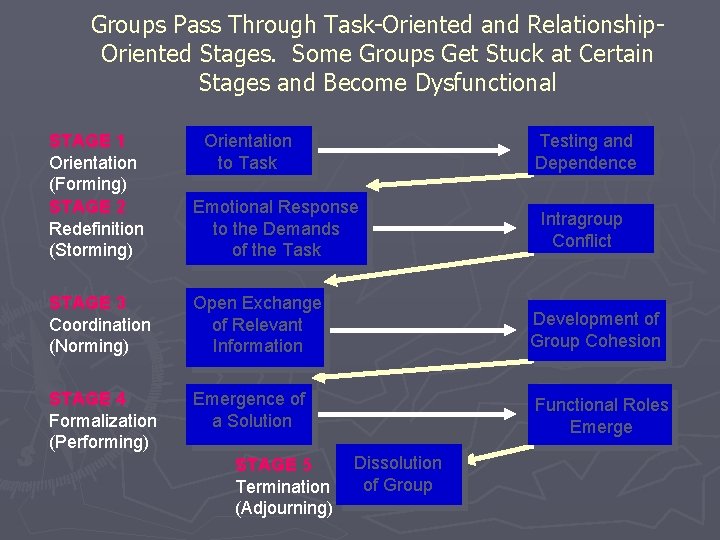
Groups Pass Through Task-Oriented and Relationship. Oriented Stages. Some Groups Get Stuck at Certain Stages and Become Dysfunctional STAGE 1 Orientation (Forming) STAGE 2 Redefinition (Storming) Orientation to Task Emotional Response to the Demands of the Task STAGE 3 Coordination (Norming) Open Exchange of Relevant Information Development of Group Cohesion STAGE 4 Formalization (Performing) Emergence of a Solution Functional Roles Emerge STAGE 5 Termination (Adjourning) Testing and Dependence Dissolution of Group Intragroup Conflict
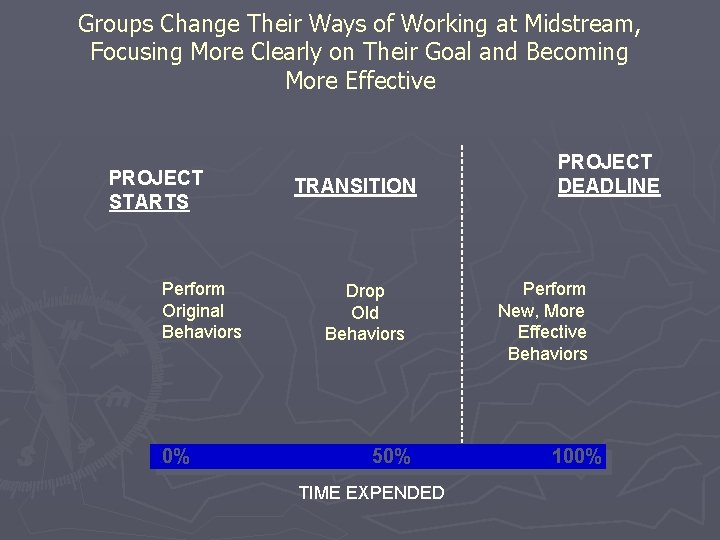
Groups Change Their Ways of Working at Midstream, Focusing More Clearly on Their Goal and Becoming More Effective PROJECT STARTS Perform Original Behaviors 0% TRANSITION Drop Old Behaviors 50% TIME EXPENDED PROJECT DEADLINE Perform New, More Effective Behaviors 100%
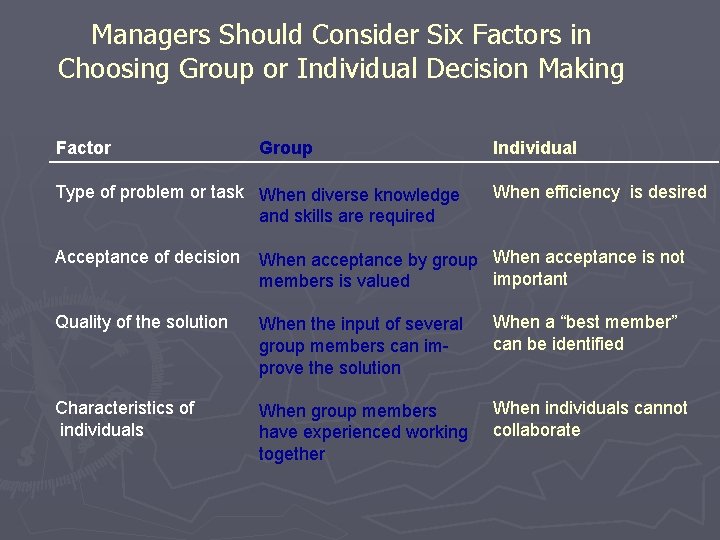
Managers Should Consider Six Factors in Choosing Group or Individual Decision Making Factor Group Type of problem or task When diverse knowledge and skills are required Individual When efficiency is desired Acceptance of decision When acceptance by group When acceptance is not important members is valued Quality of the solution When the input of several group members can improve the solution When a “best member” can be identified Characteristics of individuals When group members have experienced working together When individuals cannot collaborate
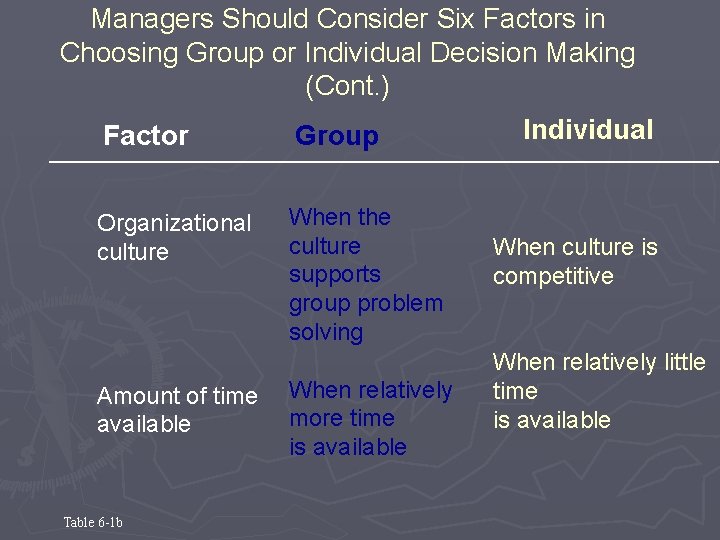
Managers Should Consider Six Factors in Choosing Group or Individual Decision Making (Cont. ) Factor Group Organizational culture When the culture supports group problem solving Amount of time available Table 6 -1 b When relatively more time is available Individual When culture is competitive When relatively little time is available
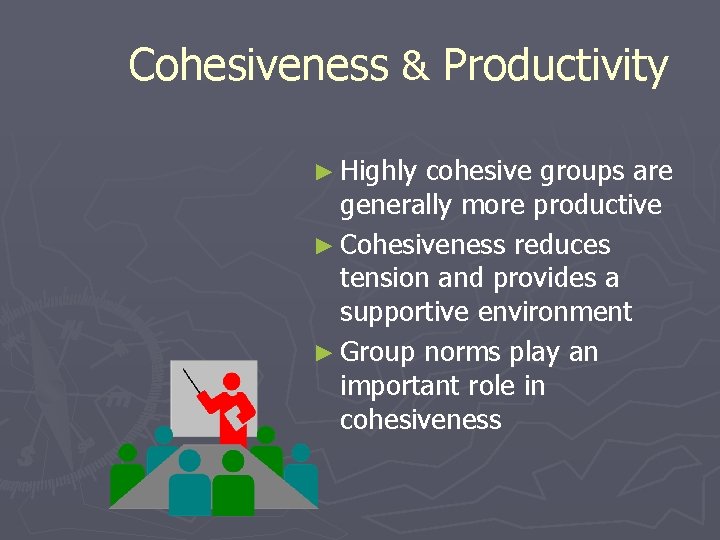
Cohesiveness & Productivity ► Highly cohesive groups are generally more productive ► Cohesiveness reduces tension and provides a supportive environment ► Group norms play an important role in cohesiveness
Setting Standards Group members help to develop, follow, and enforce the rules, policies, and procedures of the group. Such rules may range from simple ones, like beginning on time, to more complex policies, such as procedures to arrive at consensus. Mission Values Logistical Arrangements Decision Making Conflict
Group Cohesiveness ► Time Spent Together ► Severity of Initiation ► Group Size ► External Threats ► Previous Successes
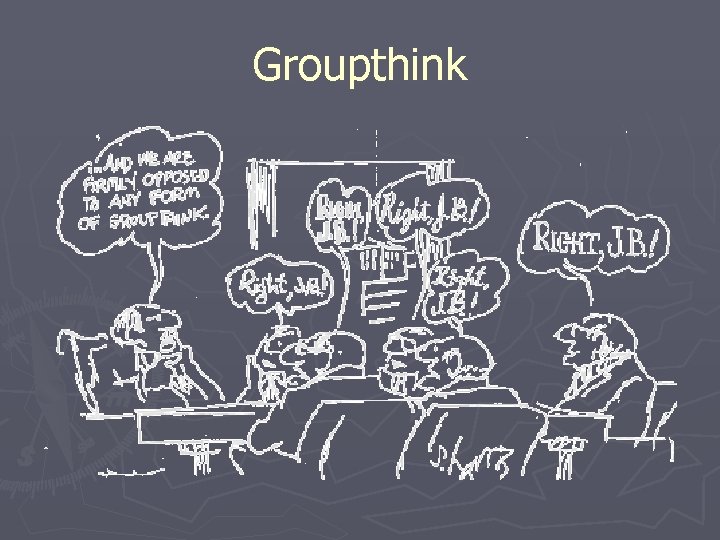
Groupthink
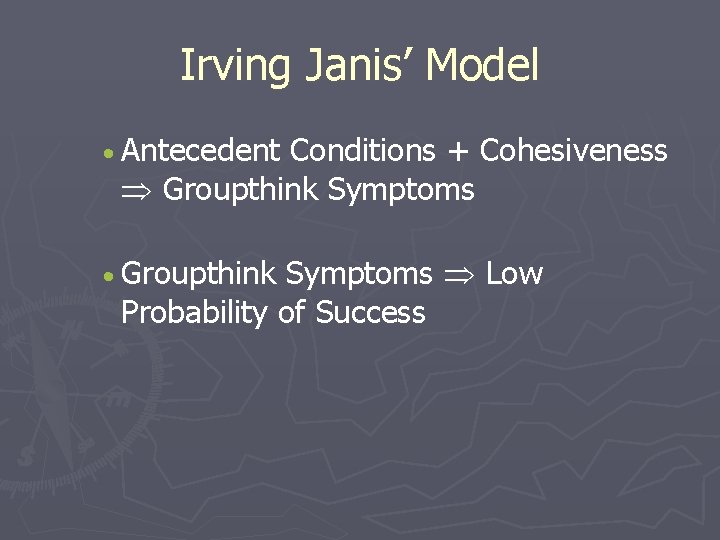
Irving Janis’ Model · Antecedent Conditions + Cohesiveness Groupthink Symptoms Low Probability of Success · Groupthink
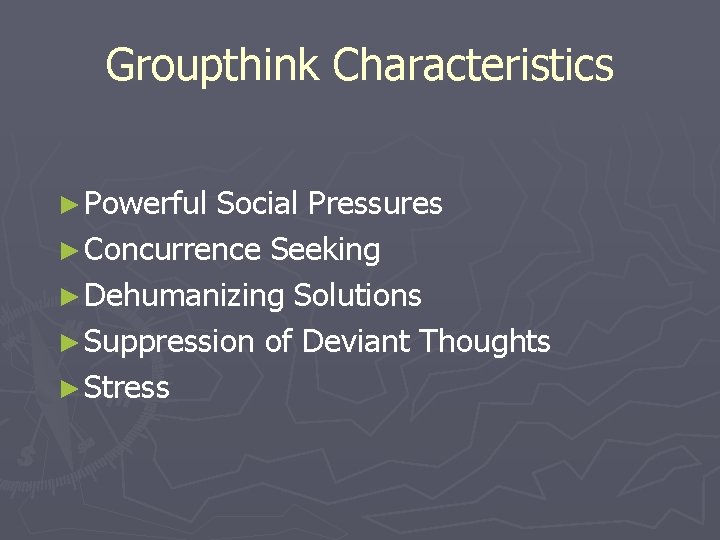
Groupthink Characteristics ► Powerful Social Pressures ► Concurrence Seeking ► Dehumanizing Solutions ► Suppression of Deviant Thoughts ► Stress
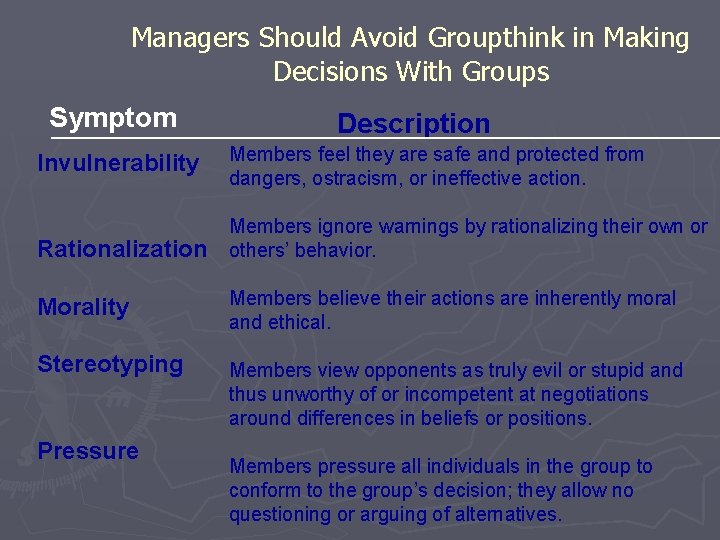
Managers Should Avoid Groupthink in Making Decisions With Groups Symptom Invulnerability Rationalization Description Members feel they are safe and protected from dangers, ostracism, or ineffective action. Members ignore warnings by rationalizing their own or others’ behavior. Morality Members believe their actions are inherently moral and ethical. Stereotyping Members view opponents as truly evil or stupid and thus unworthy of or incompetent at negotiations around differences in beliefs or positions. Pressure Members pressure all individuals in the group to conform to the group’s decision; they allow no questioning or arguing of alternatives.
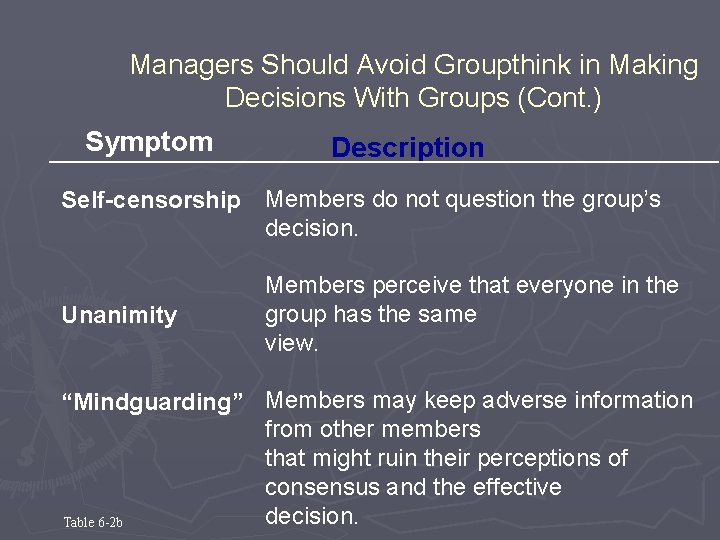
Managers Should Avoid Groupthink in Making Decisions With Groups (Cont. ) Symptom Description Self-censorship Members do not question the group’s decision. Unanimity Members perceive that everyone in the group has the same view. “Mindguarding” Members may keep adverse information from other members that might ruin their perceptions of consensus and the effective decision. Table 6 -2 b
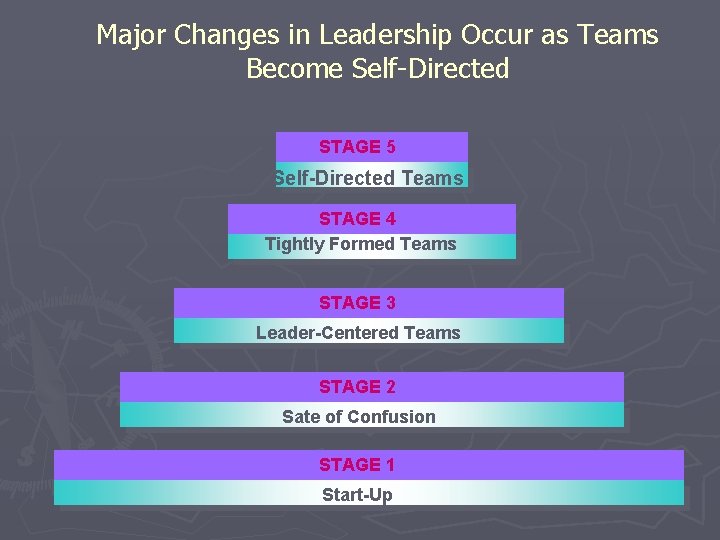
Major Changes in Leadership Occur as Teams Become Self-Directed STAGE 5 Self-Directed Teams STAGE 4 Tightly Formed Teams STAGE 3 Leader-Centered Teams STAGE 2 Sate of Confusion STAGE 1 Start-Up
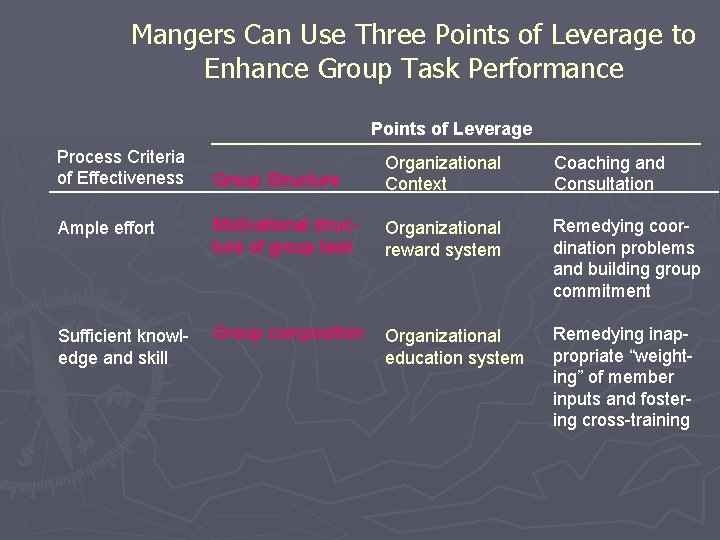
Mangers Can Use Three Points of Leverage to Enhance Group Task Performance Points of Leverage Process Criteria of Effectiveness Group Structure Organizational Context Coaching and Consultation Ample effort Motivational structure of group task Organizational reward system Remedying coordination problems and building group commitment Sufficient knowledge and skill Group composition Organizational education system Remedying inappropriate “weighting” of member inputs and fostering cross-training
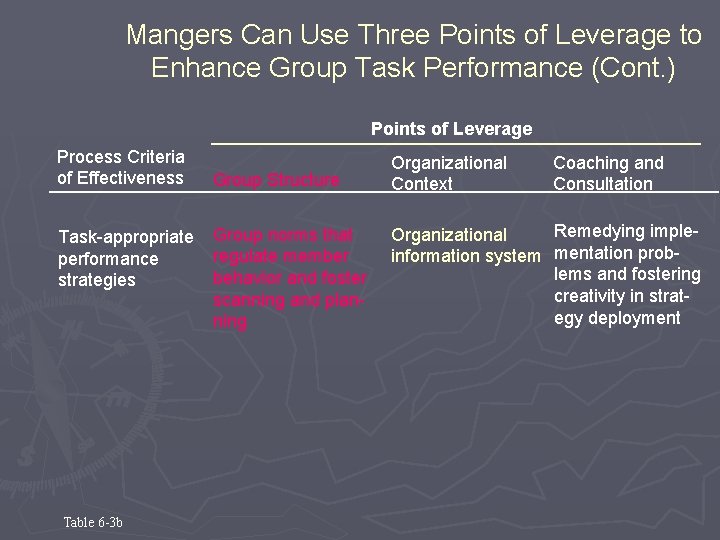
Mangers Can Use Three Points of Leverage to Enhance Group Task Performance (Cont. ) Points of Leverage Process Criteria of Effectiveness Task-appropriate performance strategies Table 6 -3 b Group Structure Organizational Context Coaching and Consultation Group norms that regulate member behavior and foster scanning and planning Remedying imple. Organizational information system mentation problems and fostering creativity in strategy deployment
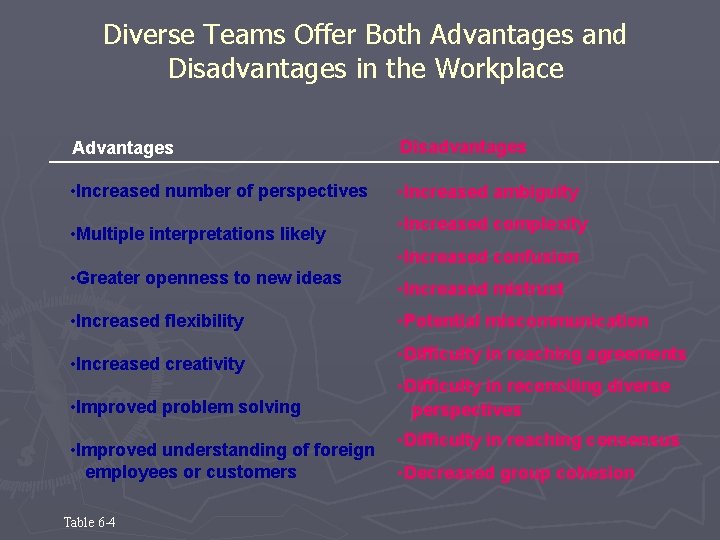
Diverse Teams Offer Both Advantages and Disadvantages in the Workplace Advantages Disadvantages • Increased number of perspectives • Increased ambiguity • Multiple interpretations likely • Increased complexity • Increased confusion • Greater openness to new ideas • Increased flexibility • Increased creativity • Improved problem solving • Improved understanding of foreign employees or customers Table 6 -4 • Increased mistrust • Potential miscommunication • Difficulty in reaching agreements • Difficulty in reconciling diverse perspectives • Difficulty in reaching consensus • Decreased group cohesion
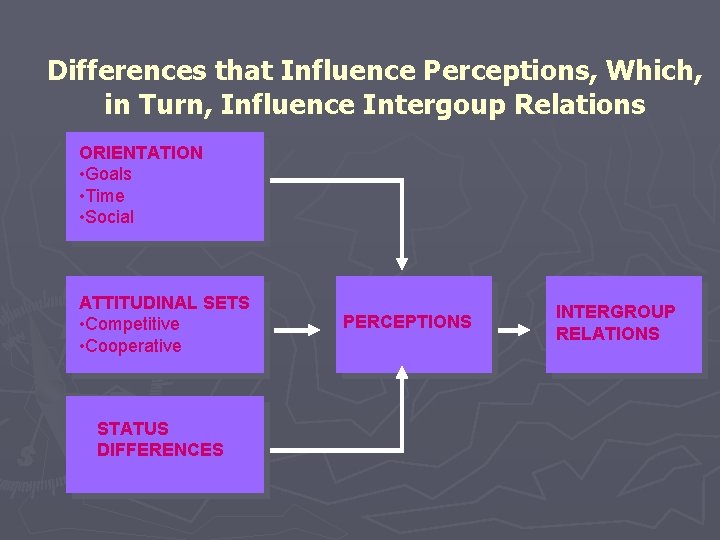
Differences that Influence Perceptions, Which, in Turn, Influence Intergoup Relations ORIENTATION • Goals • Time • Social ATTITUDINAL SETS • Competitive • Cooperative STATUS DIFFERENCES PERCEPTIONS INTERGROUP RELATIONS
Four Categories of Roles ► Group Task Roles: roles which facilitate the selection and definition of a common problem and solution. ► Group Building and Maintenance: roles which increase the functioning of the group as a group. ► Individual Roles: roles which are oriented toward the satisfaction of individual’s needs. ► Creative Roles: roles which involve using creativity to identify possible solutions.
Group Task Roles
The Initiator- Contributor ► Suggests or proposes new ideas § may include the suggestion: ►for a new group ►a new way to view a problem ►a new way to address a problem within the group ►a new procedure for the group ►a new way to organize the group
The Information Seeker ► Seeks clarification of suggestions made in terms of their factual adequacy, for authoritative information and facets pertinent to the problem being discussed.
The Opinion Seeker ► Asks not primarily for the facts of the case but for a clarification of the values pertinent to what the group is undertaking or of values involved in a suggestion made or in alternative suggestions.
The Information Giver ► Offers facts or generalizations which are “authoritative” or relates his own experience pertinently to the group problem.
The Opinion Giver ► States his/her belief or opinion pertinently to a suggestion made or to alternative suggestions. The emphasis is on his/her proposal of what should become the group’s view of pertinent values, not primarily upon relevant facts or information.
The Coordinator ► Shows or clarifies the relationships among various ideas and suggestions ► Tries to pull ideas and suggestions together ► Tries to coordinate the activities of various members
The Evaluator- Critic ► Subjects the accomplishments of the group to some standard or set of standards of group functioning in the context of the group task. ► My evaluate the “practicality”, “logic”, “Facts”, or “procedures”
The Energizer ► Prods ► the group to action or decision. Attempts to stimulate or arouse the group to greater or higher quality work.
The Recorder ► Writes ► down suggestions. Makes a record of group decisions (may be down via memory). ► The recorder role is the “group memory. ”
Group Building and Maintenance Roles
The Encourager ► Praises, agrees with and accepts the contributions of others. ► Indicates warmth, solidarity in attitude toward others. ► Offers commendation and praise in various ways and indicates acceptance of others,
The Harmonizer ► Mediates the differences between members ► Attempts to reconcile disagreements. ► Relieves tension in conflict situations.
The Compromiser ► Operates from within a conflict in which his/her ideas or position is involved. ► May offer compromise by yielding status, admitting error, or by coming “halfway” in meeting another.
The Gate-Keeper & Expediter ► Attempts to keep communication open by facilitating participation of others. ► Proposes regulation of the flow of communication.
The Follower ► Goes along with the movement of the group. ► Passively ► Serves accepts the ideas of others. as an audience for others in the group as well as for group discussion and decision.
Individual Roles ► Attempts by individuals to satisfy personal needs. ► Numerous types - from Sociology and Psychology.
The Monopolist ► Def: One who chatters on incessantly due to anxiety when silent. ► Effect: Group gets concerned, then frustrated angry. May be afraid to confront because then they must fill the void.
Help-Rejecting Complainer ► Def. : requests help than rejects; takes problem in insolvability of problems; blames authority, conflicted about dependency feeling helpless and distrusting. ► Effects: seen as greedy and user of group energy; members become bored, confused, irritated and frustrated.
Self-Righteous Moralist ► Def. : strong need to be right. Demonstrates superiority via poise and unconcerned about being liked. Deep underlying shame. ► Effect: mobilizes so much resentment that may be forced out of the group.
Creative Group Roles
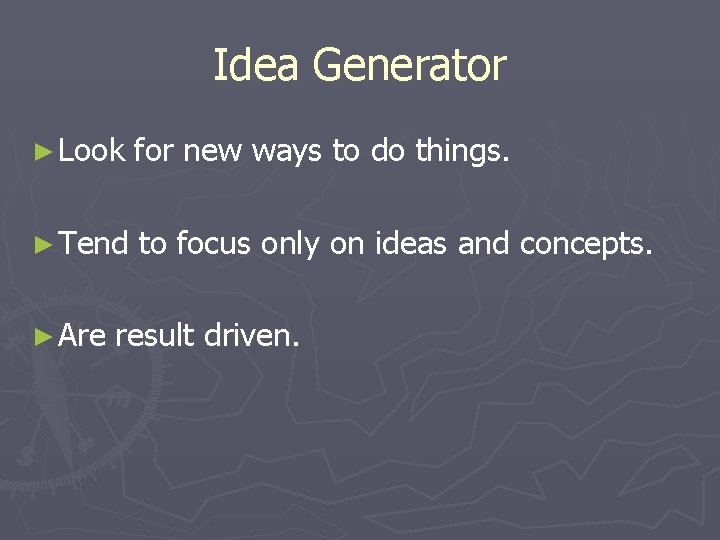
Idea Generator ► Look for new ways to do things. ► Tend to focus only on ideas and concepts. ► Are result driven.
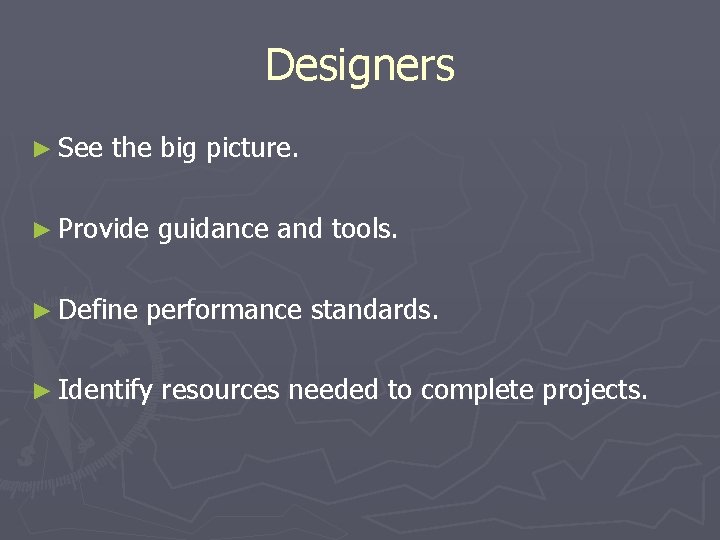
Designers ► See the big picture. ► Provide ► Define guidance and tools. performance standards. ► Identify resources needed to complete projects.
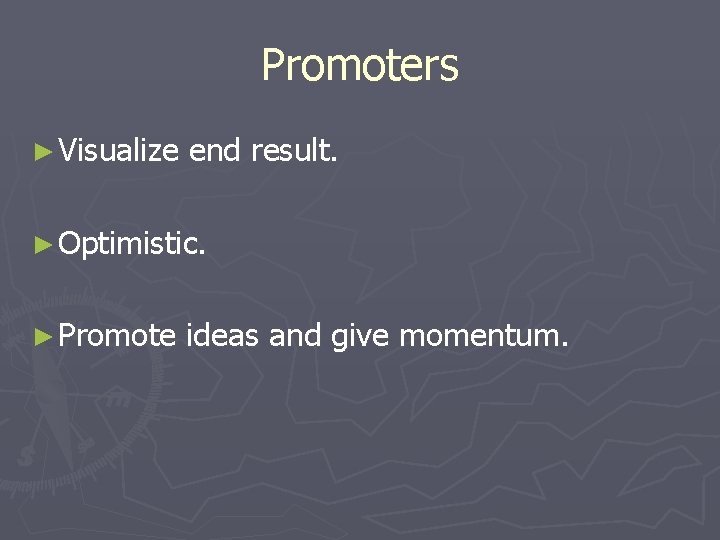
Promoters ► Visualize end result. ► Optimistic. ► Promote ideas and give momentum.
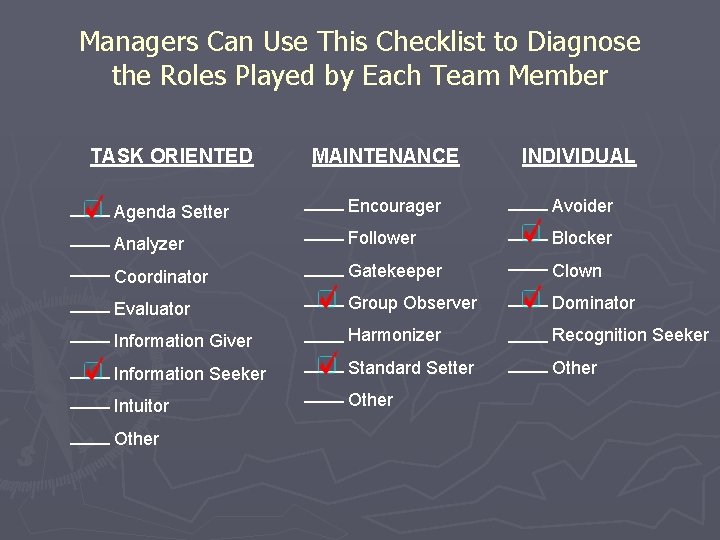
Managers Can Use This Checklist to Diagnose the Roles Played by Each Team Member TASK ORIENTED MAINTENANCE INDIVIDUAL Agenda Setter Encourager Avoider Analyzer Follower Blocker Coordinator Gatekeeper Clown Evaluator Group Observer Dominator Information Giver Harmonizer Recognition Seeker Information Seeker Standard Setter Other Intuitor Other
Mature Group Characteristics Purpose and Mission ► May be assigned or may emerge from the group ► Group often questions, reexamines, & modifies mission & purpose ► Mission converted into specific agenda, clear goals, & a set of critical success factors
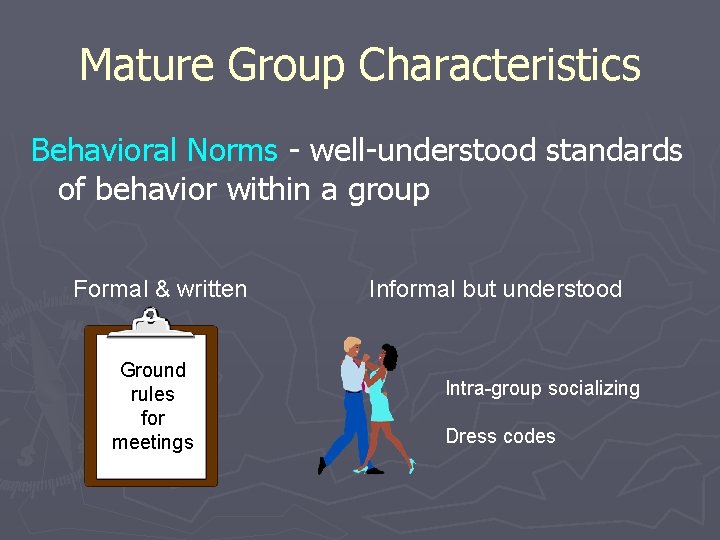
Mature Group Characteristics Behavioral Norms - well-understood standards of behavior within a group Formal & written Ground rules for meetings Informal but understood Intra-group socializing Dress codes
► Demand Leading Change: Delphi Automotive Systems for customization and independence from GM ► Reinvented itself by changes in physical plant and worker behavior ► Encouraged pride and ownership of work; people at the center of the workflow ► Work stations and tools are completely modular ► Each “cell” is independent and empowered to do its own work as needed
Leadership In Action: Dian Graves Owen ► People thrive on responsibility ► Encourage autonomy and empower employees ► Self-managed teams that are flexible and use their expertise ► Employee participation and stock ownership
The Leadership Challenge ► Focus on guidelines for delegation ► Listen to feedback, even if unpleasant ► Tasks should be spread among followers ► Delegation to different people provides opportunity to develop followers and observe performance ► Volunteers are highly valuable; they have the motivation to do the task