
CHAPTER S E V E N An Introduction
- Slides: 44
CHAPTER S E V E N An Introduction to International Economics Third Edition Economic Integration Dominick Salvatore John Wiley & Sons, Inc. 1
Economic integration n Economic integration refers to the commercial policy of discriminately reducing or eliminating barriers to trade between a selected group of countries. 2
Forms of economic integration n Preferential trade arrangements n Provides lower barriers to trade among participating nations than on trade with nonparticipating nations. n The loosest form of economic integration. 3
Forms of economic integration n Preferential trade arrangements n Free trade areas n Removes all barriers to trade among members, but each nation retains its own barriers on trade with non-members. n The North American Free Trade Agreement (NAFTA) is a free trade area. 4
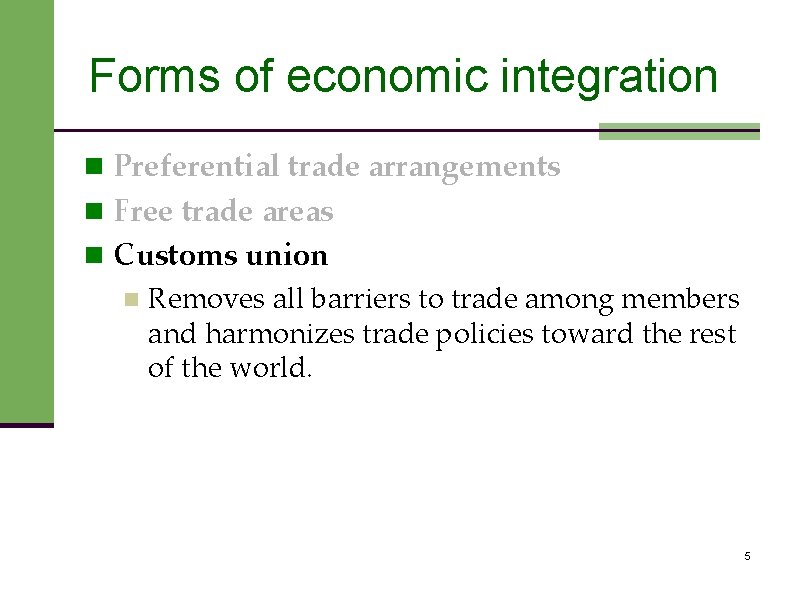
Forms of economic integration n Preferential trade arrangements n Free trade areas n Customs union n Removes all barriers to trade among members and harmonizes trade policies toward the rest of the world. 5
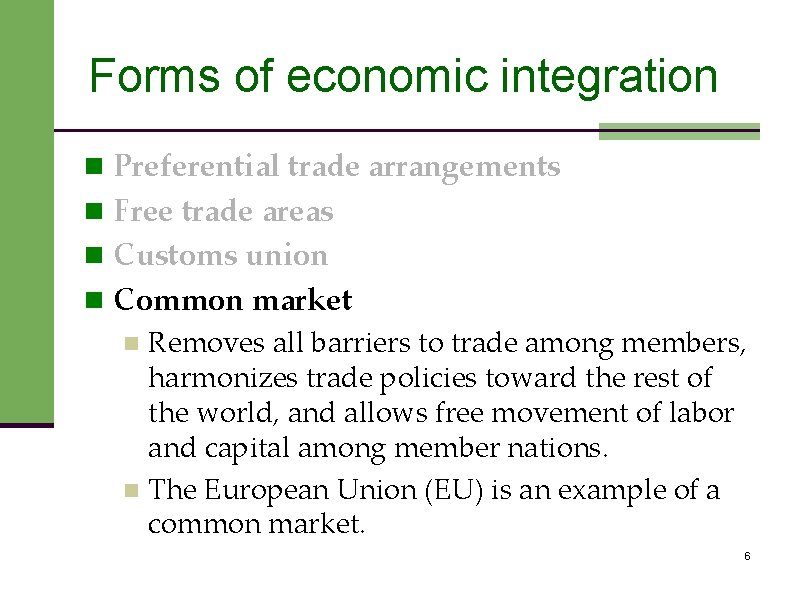
Forms of economic integration n Preferential trade arrangements n Free trade areas n Customs union n Common market n Removes all barriers to trade among members, harmonizes trade policies toward the rest of the world, and allows free movement of labor and capital among member nations. n The European Union (EU) is an example of a common market. 6
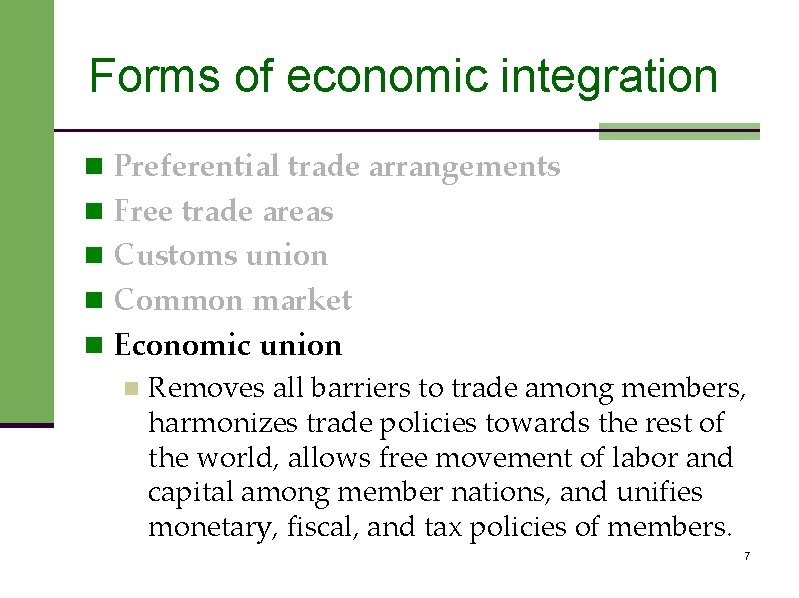
Forms of economic integration n Preferential trade arrangements n Free trade areas n Customs union n Common market n Economic union n Removes all barriers to trade among members, harmonizes trade policies towards the rest of the world, allows free movement of labor and capital among member nations, and unifies monetary, fiscal, and tax policies of members. 7
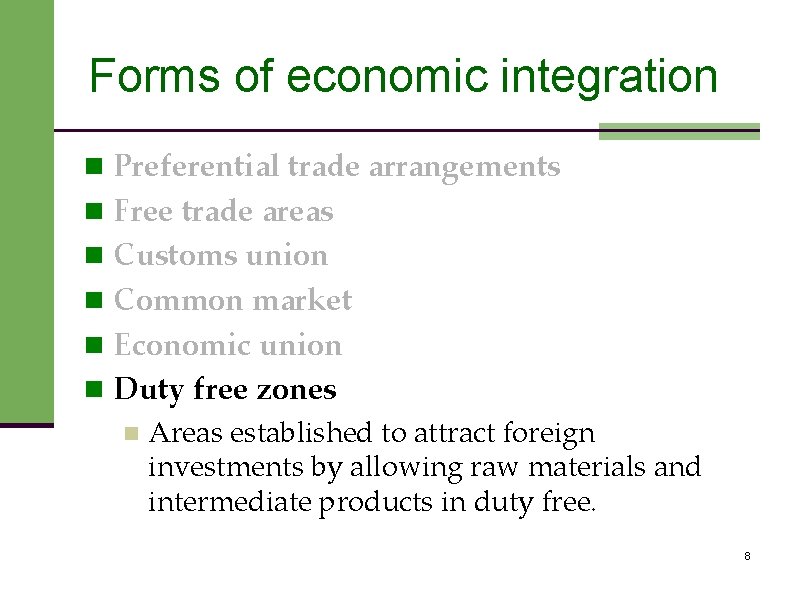
Forms of economic integration n Preferential trade arrangements n Free trade areas n Customs union n Common market n Economic union n Duty free zones n Areas established to attract foreign investments by allowing raw materials and intermediate products in duty free. 8
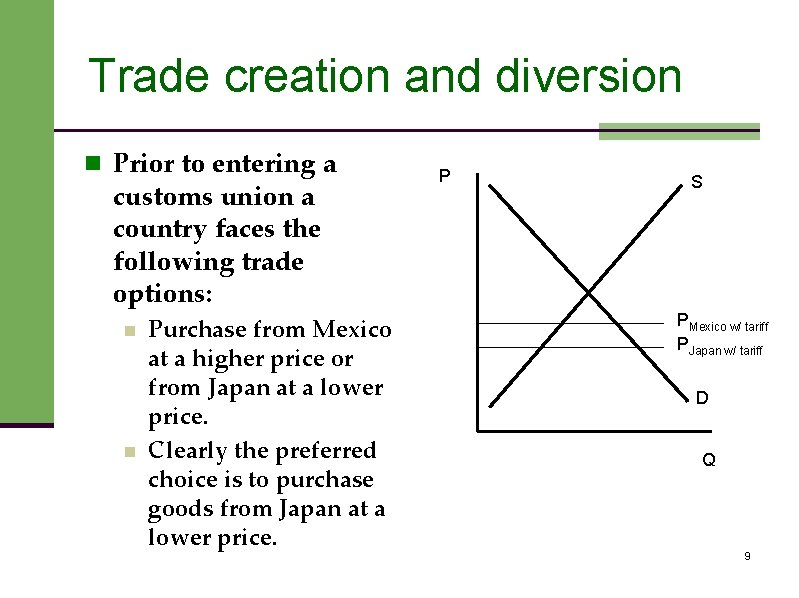
Trade creation and diversion n Prior to entering a customs union a country faces the following trade options: n n Purchase from Mexico at a higher price or from Japan at a lower price. Clearly the preferred choice is to purchase goods from Japan at a lower price. P S PMexico w/ tariff PJapan w/ tariff D Q 9
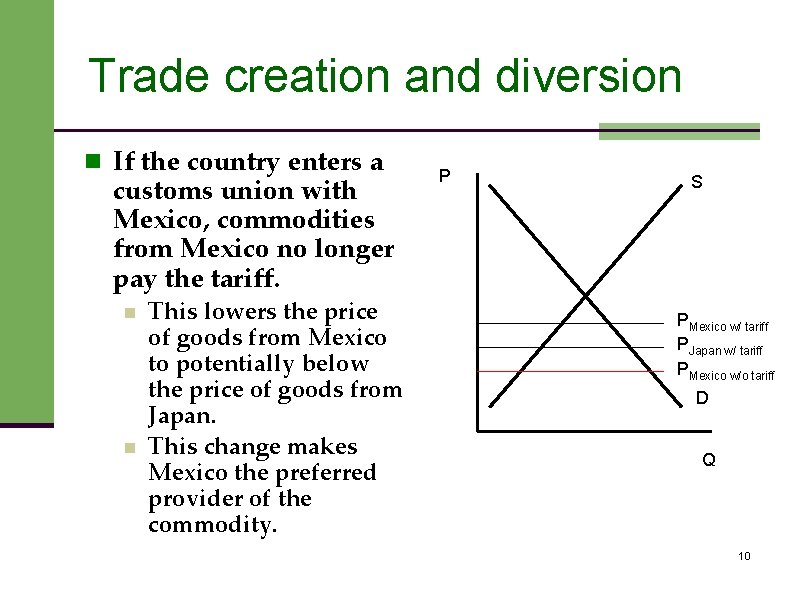
Trade creation and diversion n If the country enters a customs union with Mexico, commodities from Mexico no longer pay the tariff. n n This lowers the price of goods from Mexico to potentially below the price of goods from Japan. This change makes Mexico the preferred provider of the commodity. P S PMexico w/ tariff PJapan w/ tariff PMexico w/o tariff D Q 10
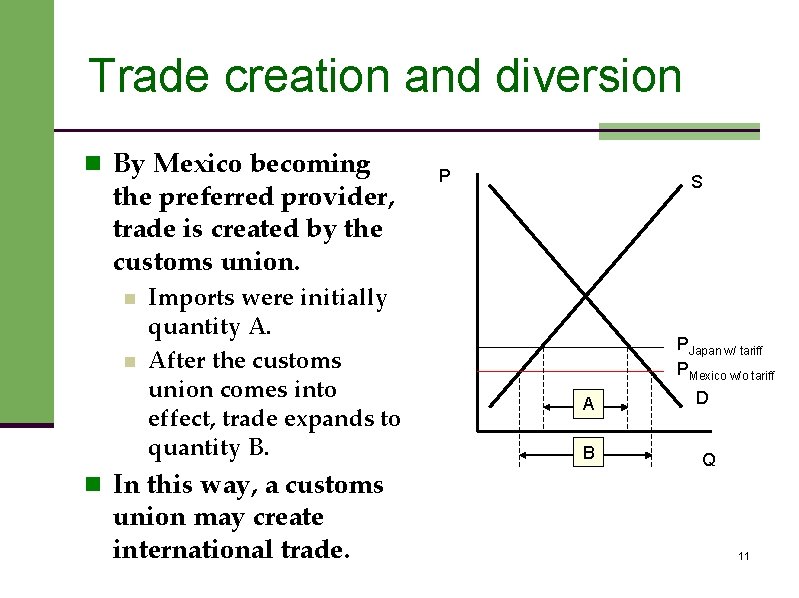
Trade creation and diversion n By Mexico becoming the preferred provider, trade is created by the customs union. n n Imports were initially quantity A. After the customs union comes into effect, trade expands to quantity B. n In this way, a customs union may create international trade. P S PJapan w/ tariff PMexico w/o tariff A B D Q 11
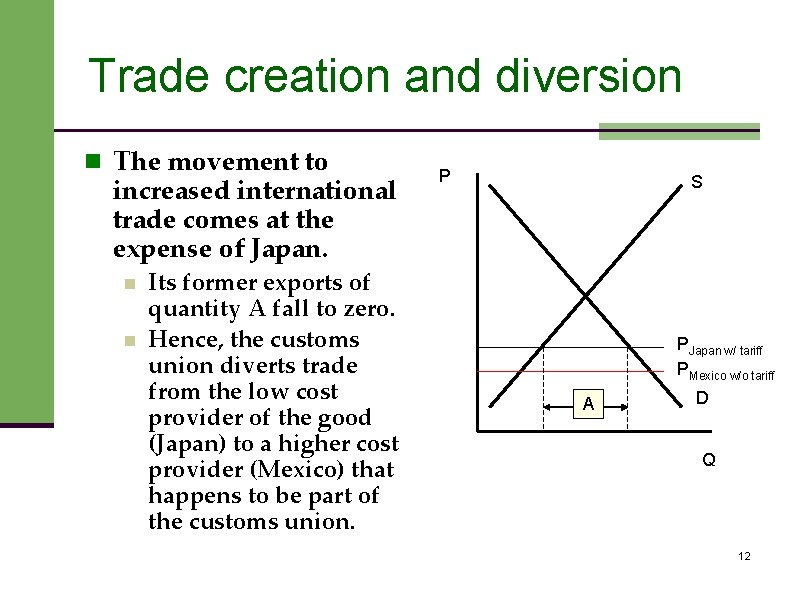
Trade creation and diversion n The movement to increased international trade comes at the expense of Japan. n n Its former exports of quantity A fall to zero. Hence, the customs union diverts trade from the low cost provider of the good (Japan) to a higher cost provider (Mexico) that happens to be part of the customs union. P S PJapan w/ tariff PMexico w/o tariff A D Q 12
Trade-Creating Customs Unions- Example Trade Creation n Trade creation occurs when some domestic production in a member nation is replaced by lower-cost imports from another member nation. n A trade-creating customs union therefore raises the welfare of member nations. n A trade-creating customs union may also raise the welfare of nonmembers because some of the increase in its real income spills over into increased imports from the rest of the world
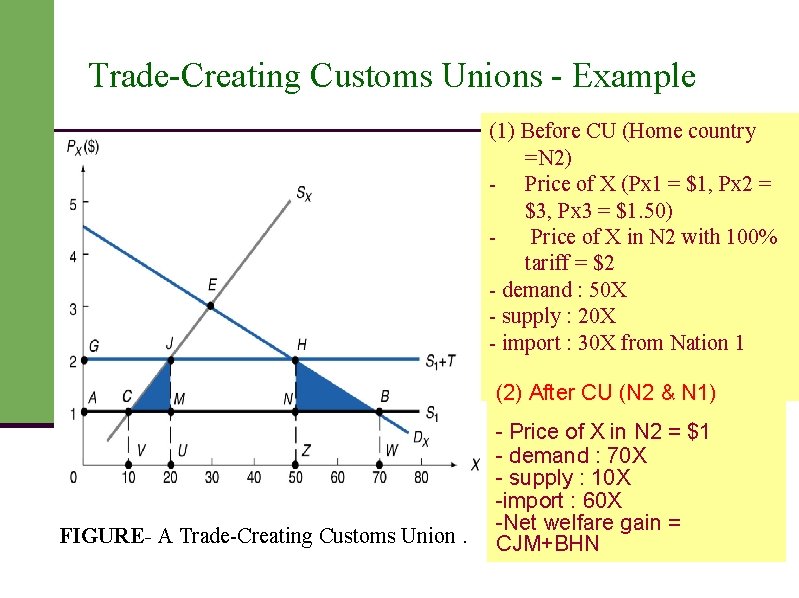
Trade-Creating Customs Unions - Example (1) Before CU (Home country =N 2) - Price of X (Px 1 = $1, Px 2 = $3, Px 3 = $1. 50) Price of X in N 2 with 100% tariff = $2 - demand : 50 X - supply : 20 X - import : 30 X from Nation 1 (2) After CU (N 2 & N 1) FIGURE- A Trade-Creating Customs Union. - Price of X in N 2 = $1 - demand : 70 X - supply : 10 X -import : 60 X -Net welfare gain = CJM+BHN
Trade-Diverting Customs Unions - Example Trade Diversion n Trade diversion occurs when lower-cost imports from outside the customs union are replaced by higher-cost imports from a member nation. n A trade-diverting customs union results in both trade creation and trade diversion, and therefore can increase or reduce the welfare of union members.
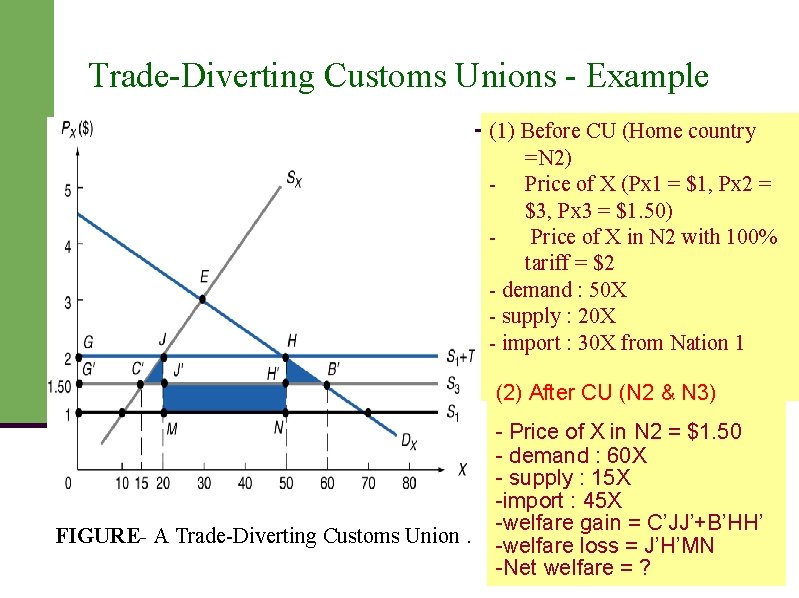
Trade-Diverting Customs Unions - Example (1) Before CU (Home country =N 2) - Price of X (Px 1 = $1, Px 2 = $3, Px 3 = $1. 50) Price of X in N 2 with 100% tariff = $2 - demand : 50 X - supply : 20 X - import : 30 X from Nation 1 (2) After CU (N 2 & N 3) FIGURE- A Trade-Diverting Customs Union. - Price of X in N 2 = $1. 50 - demand : 60 X - supply : 15 X -import : 45 X -welfare gain = C’JJ’+B’HH’ -welfare loss = J’H’MN -Net welfare = ?
Dynamic benefits from customs unions n Increased competition n Competitive pressures tend to spur more rapid innovation and growth n External competition limits the ability of a domestic producer to exercise its monopoly power 17
Dynamic benefits from customs unions n Increased competition n Economies of scale in production n By being a member of a customs union, producers have access to larger markets that allow them produce on a larger scale and exploit any available economies of scale. 18
Dynamic benefits from customs unions n Increased competition n Economies of scale in production n Stimulus to investment n Production within a customs union may be sold within the customs union without tariffs. n This advantage may induce investors outside the customs union to invest in production facilities within the customs union. 19
The European Union (EU) n The EU developed from the European Economic Community that was initially established in 1958. 20
The European Union (EU) n The EU developed from the European Economic Community that was initially established in 1958. n The EU formally came into existence with passage of the Treaty of Maastricht in 1992. n The Treaty of Maastricht also laid the foundation for the introduction of a unified European currency: the euro. 21
The European Union (EU) n The EU developed from the European Economic Community that was initially established in 1958. n The EU formally can into existence with passage of the Treaty of Maastricht in 1992. n Currently the EU has 27 member nations with an aggregate population of nearly half a billion. 22
The European Union (EU) n Institutions of the EU n European Parliament n EU legislative body 23
The European Union (EU) n Institutions of the EU n European Parliament n Council of the European Union n Represents the governments of the member states to the EU government 24
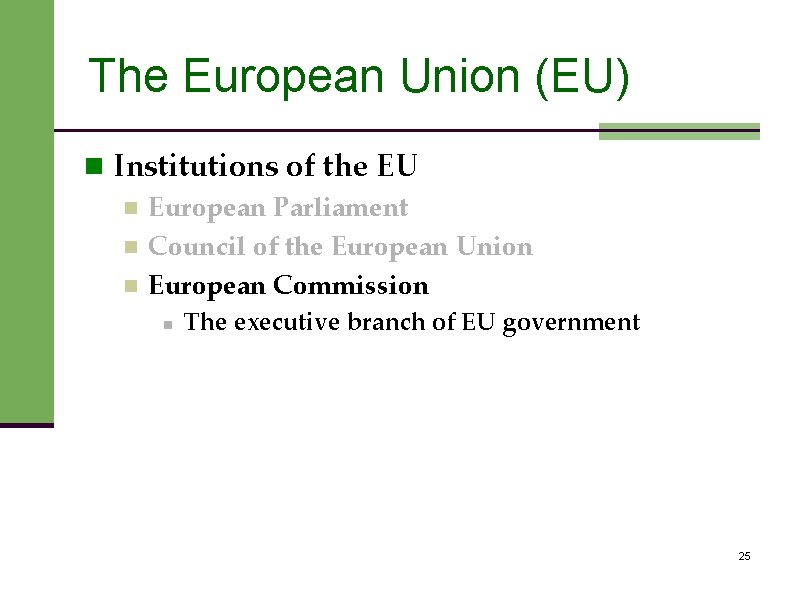
The European Union (EU) n Institutions of the EU n European Parliament n Council of the European Union n European Commission n The executive branch of EU government 25
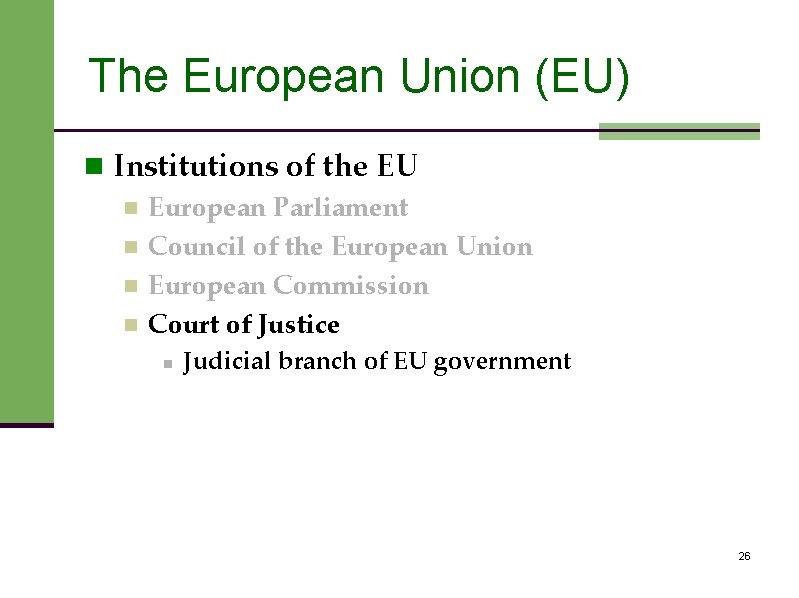
The European Union (EU) n Institutions of the EU n European Parliament n Council of the European Union n European Commission n Court of Justice n Judicial branch of EU government 26
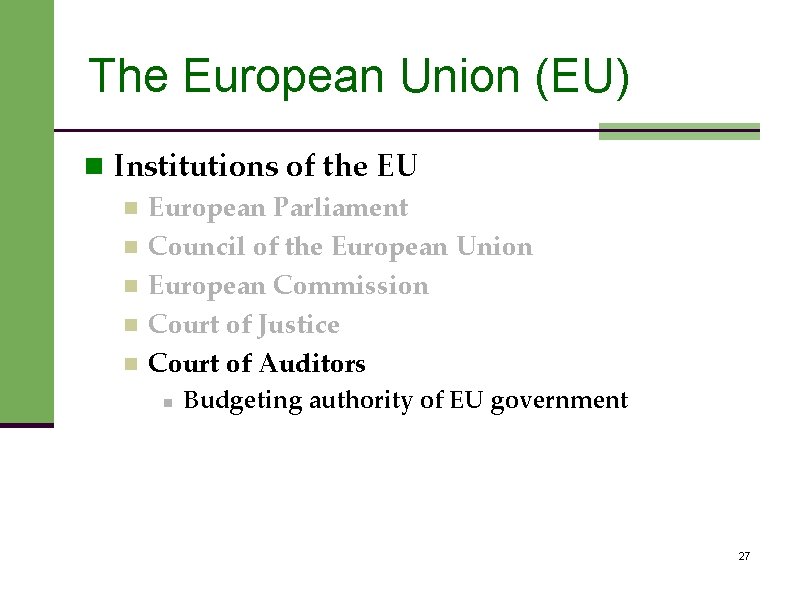
The European Union (EU) n Institutions of the EU n European Parliament n Council of the European Union n European Commission n Court of Justice n Court of Auditors n Budgeting authority of EU government 27
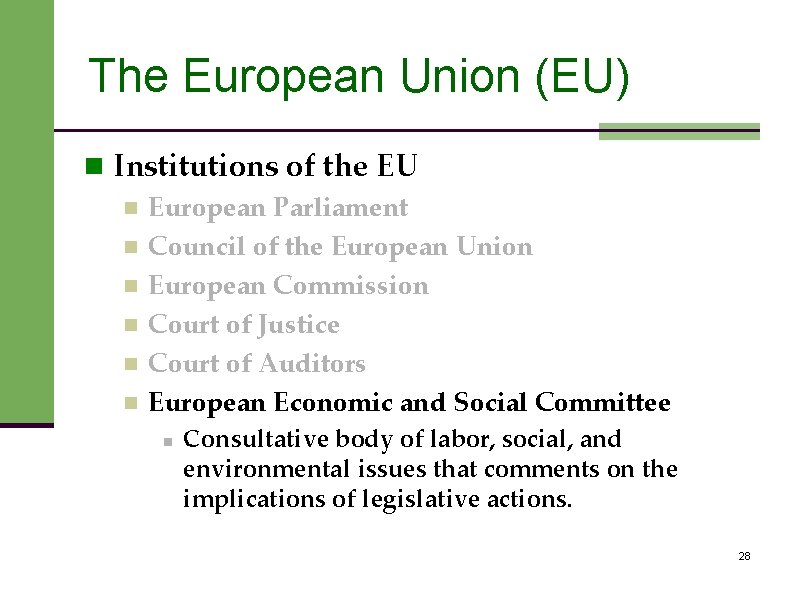
The European Union (EU) n Institutions of the EU n European Parliament n Council of the European Union n European Commission n Court of Justice n Court of Auditors n European Economic and Social Committee n Consultative body of labor, social, and environmental issues that comments on the implications of legislative actions. 28
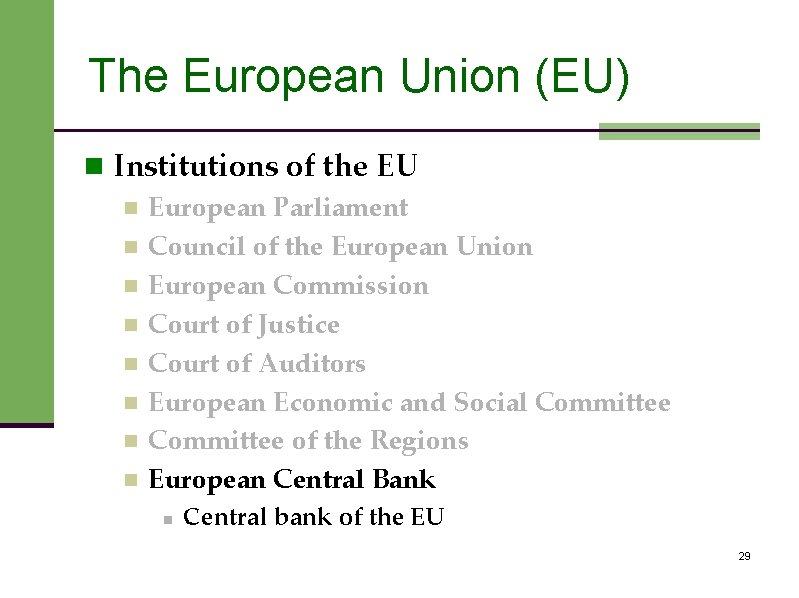
The European Union (EU) n Institutions of the EU n European Parliament n Council of the European Union n European Commission n Court of Justice n Court of Auditors n European Economic and Social Committee n Committee of the Regions n European Central Bank n Central bank of the EU 29
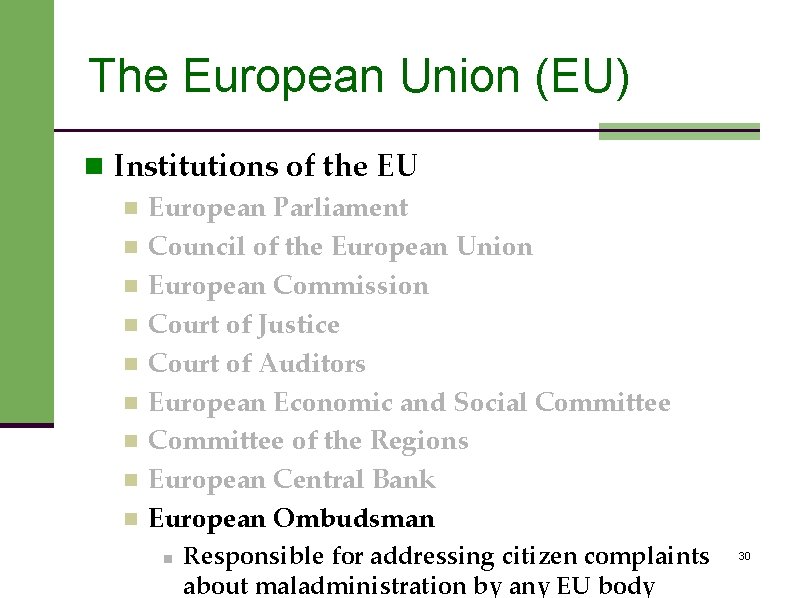
The European Union (EU) n Institutions of the EU n European Parliament n Council of the European Union n European Commission n Court of Justice n Court of Auditors n European Economic and Social Committee n Committee of the Regions n European Central Bank n European Ombudsman n Responsible for addressing citizen complaints about maladministration by any EU body 30
The European Union (EU) n Institutions of the EU n Steps towards economic unification n Internal tariffs and duties have been removed. 31
The European Union (EU) n Institutions of the EU n Steps towards economic unification n Internal tariffs and duties have been removed. n Impediments to the free movement of labor and capital have been removed. 32
The European Union (EU) n Institutions of the EU n Steps towards economic unification n Internal tariffs and duties have been removed n Impediments to the free movement of labor and capital have been removed. n Corporate law practices have been harmonized. 33
The European Union (EU) n Institutions of the EU n Steps towards economic unification n Internal tariffs and duties have been removed n Impediments to the free movement of labor and capital have been removed. n Corporate law practices have been harmonized. n Environmental regulations have been harmonized. 34
The European Union (EU) n Institutions of the EU n Steps towards economic unification n Internal tariffs and duties have been removed n Impediments to the free movement of labor and capital have been removed. n Corporate law practices have been harmonized. n Environmental regulations have been harmonized. n Labor standards have been harmonized. 35
The European Union (EU) n Institutions of the EU n Steps towards economic unification n Further information on the EU n EUROPA is in the Internet portal for the EU government n http: //europa. eu/index_en. htm 36
NAFTA n The North American Free Trade Agreement (NAFTA) came into force in 1994. 37
NAFTA n The North American Free Trade Agreement (NAFTA) came into force in 1994. n Objectives of NAFTA n Eliminate barriers to trade between the US, Mexico, and Canada. 38
NAFTA n The North American Free Trade Agreement (NAFTA) came into force in 1994. n Objectives of NAFTA Eliminate barriers to trade between the US, Mexico, and Canada. n Improve intellectual property rights protections between the member nations. n 39
NAFTA n The North American Free Trade Agreement (NAFTA) came into force in 1994. n Objectives of the NAFTA Eliminate barriers to trade between the US, Mexico, and Canada. n Improve intellectual property rights protections between the member nations. n Provide a dispute resolution mechanism for trade disputes under this agreement. n 40
NAFTA n The North American Free Trade Agreement (NAFTA) came into force in 1994. n Objectives of the NAFTA n An extension of NAFTA? The proposed Free Trade Area of the Americas (FTAA) is broadly modeled on NAFTA. n The FTAA is designed to generate a free trade area throughout the western hemisphere (excluding Cuba). n 41
NAFTA n The North American Free Trade Agreement (NAFTA) came into force in 1994. n Objectives of the NAFTA n An extension of the NAFTA? n Further information n NAFTA Secretariat 42
NAFTA n The North American Free Trade Agreement (NAFTA) came into force in 1994. n Objectives of NAFTA n An extension of NAFTA? n Further information NAFTA Secretariat n Official Site of the Free Trade Area of the Americas n https: //www. nafta-sec-us. org/Default. aspx n 43
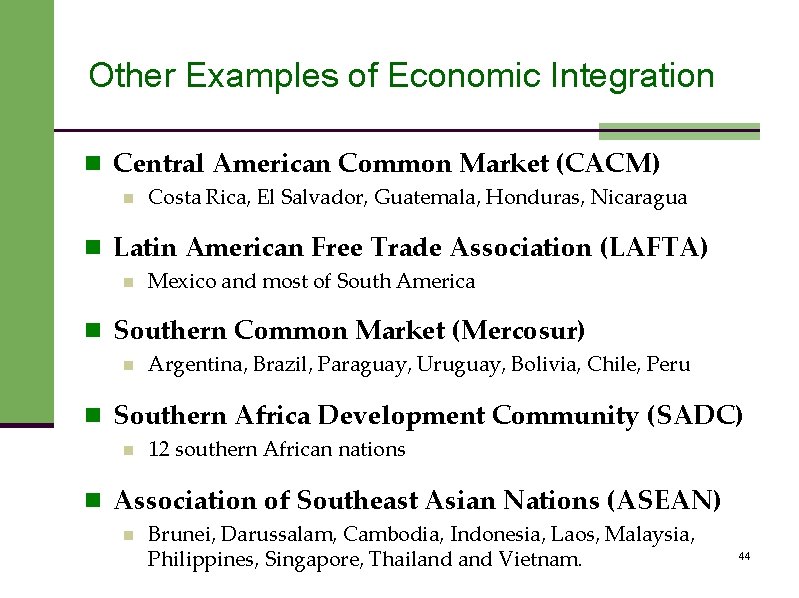
Other Examples of Economic Integration n Central American Common Market (CACM) n Costa Rica, El Salvador, Guatemala, Honduras, Nicaragua n Latin American Free Trade Association (LAFTA) n Mexico and most of South America n Southern Common Market (Mercosur) n Argentina, Brazil, Paraguay, Uruguay, Bolivia, Chile, Peru n Southern Africa Development Community (SADC) n 12 southern African nations n Association of Southeast Asian Nations (ASEAN) n Brunei, Darussalam, Cambodia, Indonesia, Laos, Malaysia, Philippines, Singapore, Thailand Vietnam. 44