
CHAPTER Probability II Solutions Practice Questions 19 3
CHAPTER Probability II Solutions: Practice Questions 19. 3 19
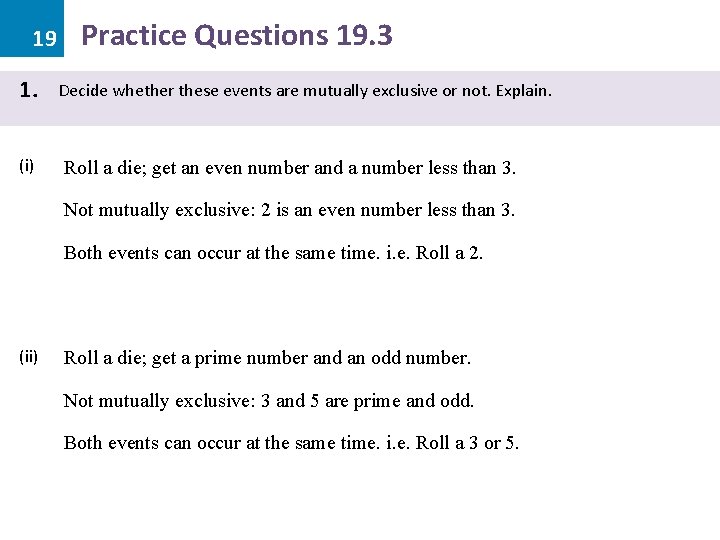
19 1. (i) Practice Questions 19. 3 Decide whether these events are mutually exclusive or not. Explain. Roll a die; get an even number and a number less than 3. Not mutually exclusive: 2 is an even number less than 3. Both events can occur at the same time. i. e. Roll a 2. (ii) Roll a die; get a prime number and an odd number. Not mutually exclusive: 3 and 5 are prime and odd. Both events can occur at the same time. i. e. Roll a 3 or 5.
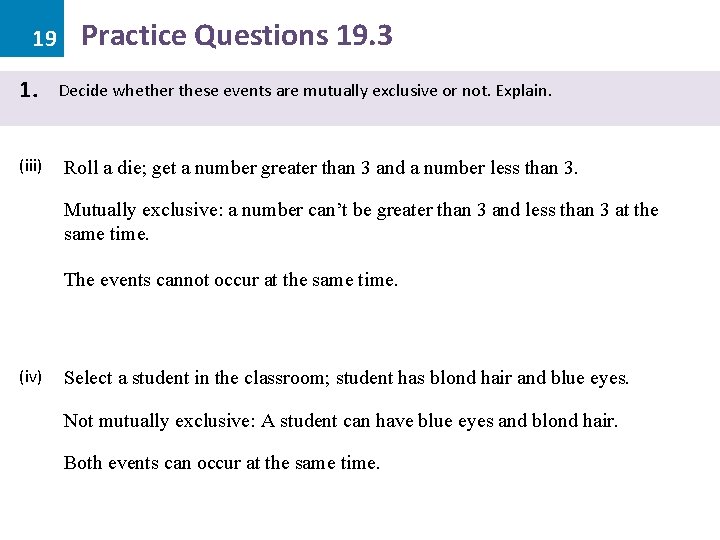
19 1. (iii) Practice Questions 19. 3 Decide whether these events are mutually exclusive or not. Explain. Roll a die; get a number greater than 3 and a number less than 3. Mutually exclusive: a number can’t be greater than 3 and less than 3 at the same time. The events cannot occur at the same time. (iv) Select a student in the classroom; student has blond hair and blue eyes. Not mutually exclusive: A student can have blue eyes and blond hair. Both events can occur at the same time.
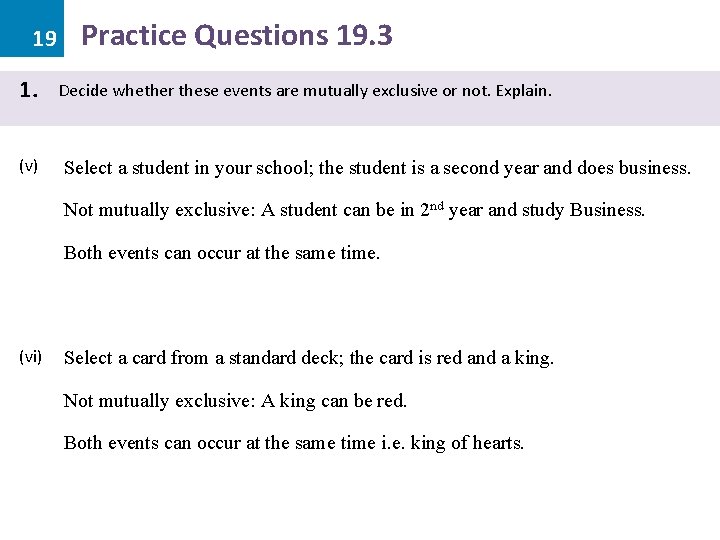
19 1. (v) Practice Questions 19. 3 Decide whether these events are mutually exclusive or not. Explain. Select a student in your school; the student is a second year and does business. Not mutually exclusive: A student can be in 2 nd year and study Business. Both events can occur at the same time. (vi) Select a card from a standard deck; the card is red and a king. Not mutually exclusive: A king can be red. Both events can occur at the same time i. e. king of hearts.
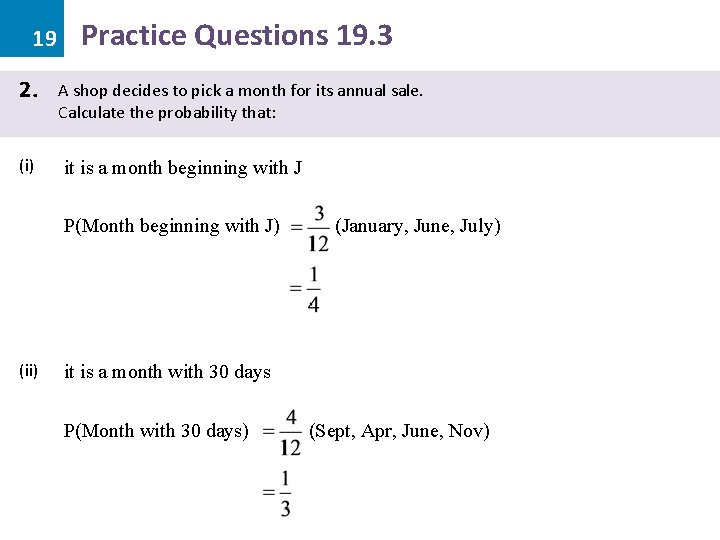
19 2. (i) Practice Questions 19. 3 A shop decides to pick a month for its annual sale. Calculate the probability that: it is a month beginning with J P(Month beginning with J) (ii) (January, June, July) it is a month with 30 days P(Month with 30 days) (Sept, Apr, June, Nov)
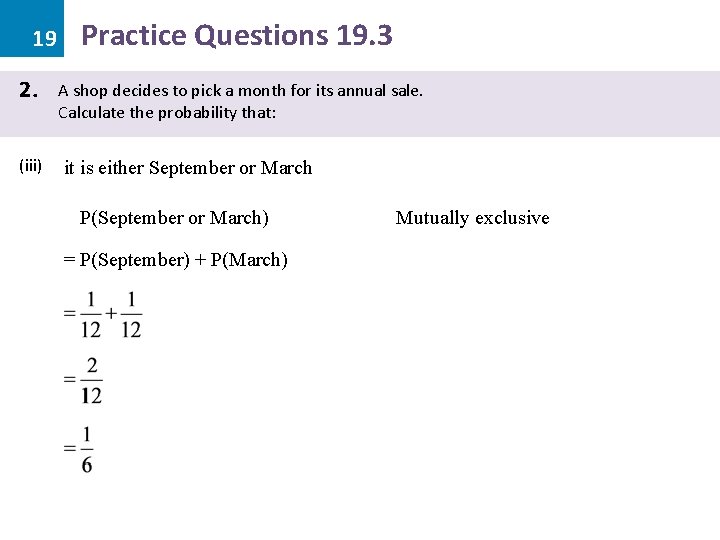
19 2. (iii) Practice Questions 19. 3 A shop decides to pick a month for its annual sale. Calculate the probability that: it is either September or March P(September or March) = P(September) + P(March) Mutually exclusive
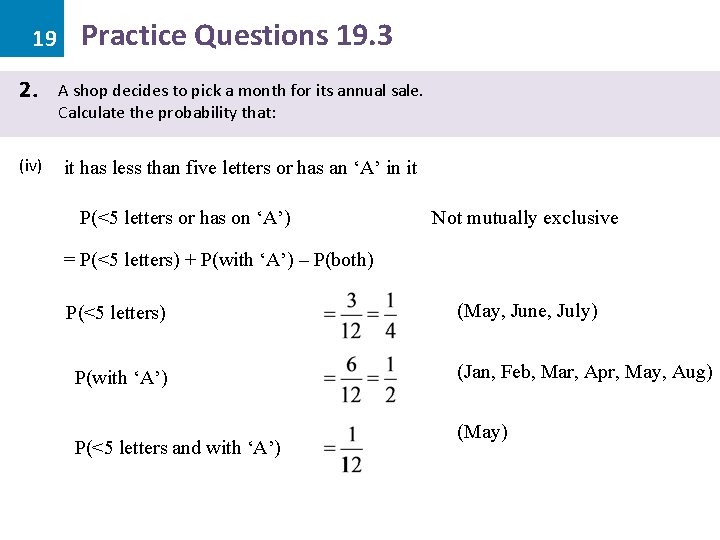
19 Practice Questions 19. 3 2. A shop decides to pick a month for its annual sale. Calculate the probability that: (iv) it has less than five letters or has an ‘A’ in it P(<5 letters or has on ‘A’) Not mutually exclusive = P(<5 letters) + P(with ‘A’) – P(both) P(<5 letters) P(with ‘A’) P(<5 letters and with ‘A’) (May, June, July) (Jan, Feb, Mar, Apr, May, Aug) (May)
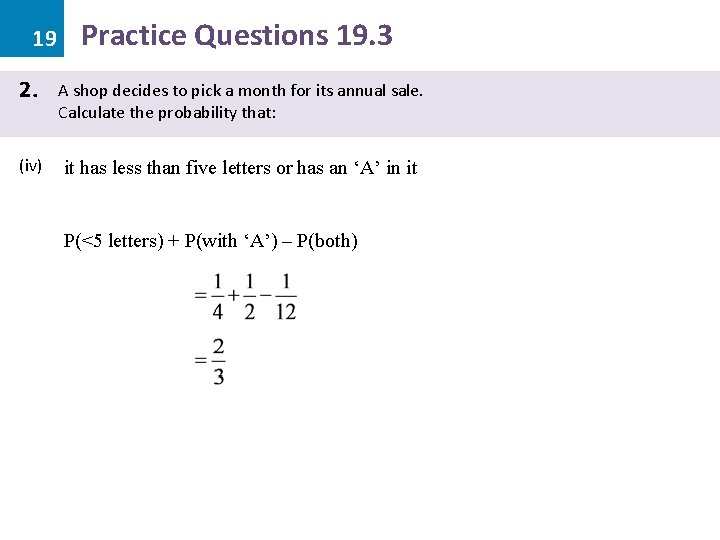
19 Practice Questions 19. 3 2. A shop decides to pick a month for its annual sale. Calculate the probability that: (iv) it has less than five letters or has an ‘A’ in it P(<5 letters) + P(with ‘A’) – P(both)
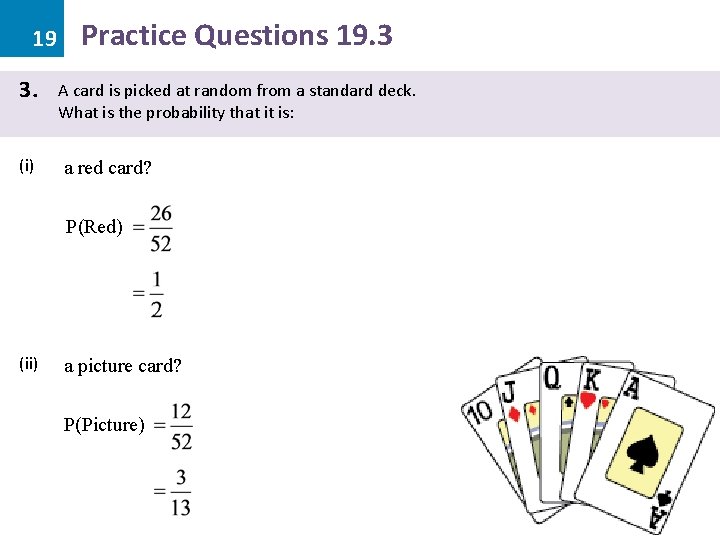
19 3. (i) Practice Questions 19. 3 A card is picked at random from a standard deck. What is the probability that it is: a red card? P(Red) (ii) a picture card? P(Picture)
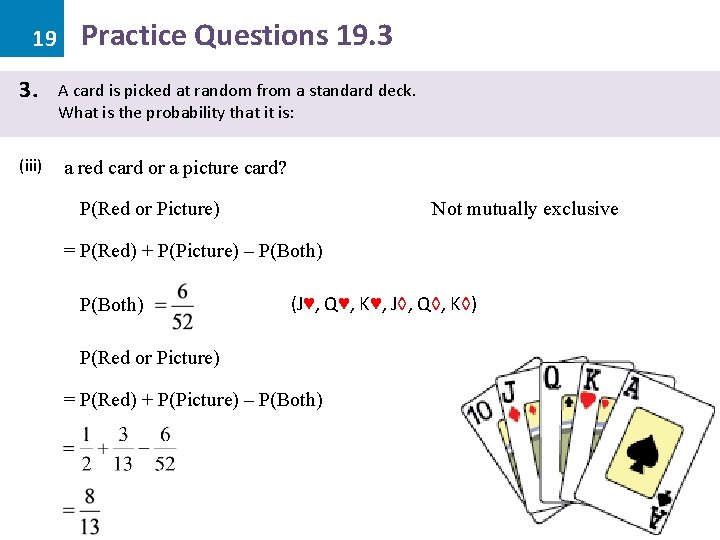
19 3. (iii) Practice Questions 19. 3 A card is picked at random from a standard deck. What is the probability that it is: a red card or a picture card? P(Red or Picture) Not mutually exclusive = P(Red) + P(Picture) – P(Both) (J♥, Q♥, K♥, J◊, Q◊, K◊) P(Red or Picture) = P(Red) + P(Picture) – P(Both)
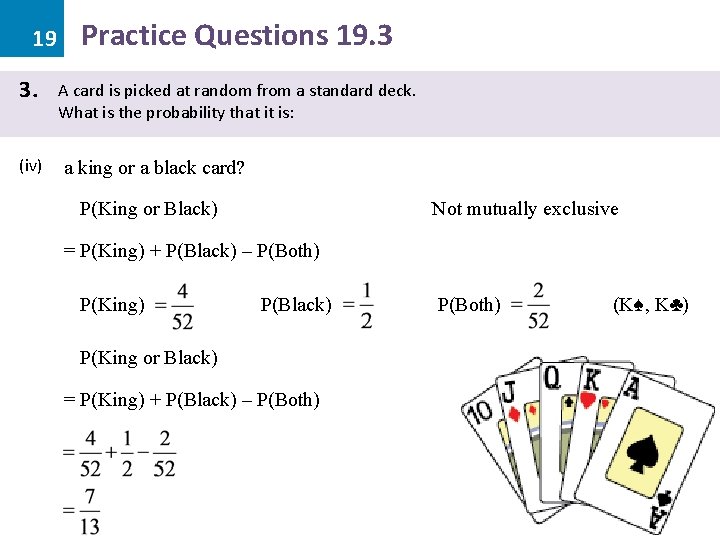
19 3. (iv) Practice Questions 19. 3 A card is picked at random from a standard deck. What is the probability that it is: a king or a black card? P(King or Black) Not mutually exclusive = P(King) + P(Black) – P(Both) P(King) P(Black) P(King or Black) = P(King) + P(Black) – P(Both) (K♠, K♣)
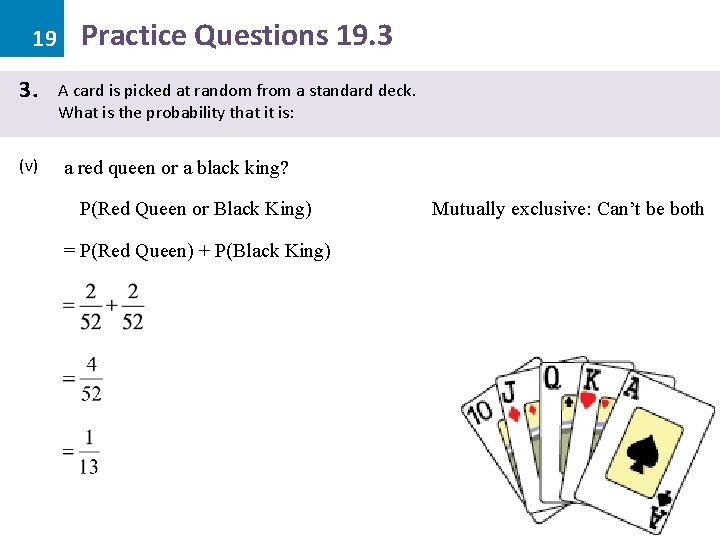
19 3. (v) Practice Questions 19. 3 A card is picked at random from a standard deck. What is the probability that it is: a red queen or a black king? P(Red Queen or Black King) = P(Red Queen) + P(Black King) Mutually exclusive: Can’t be both
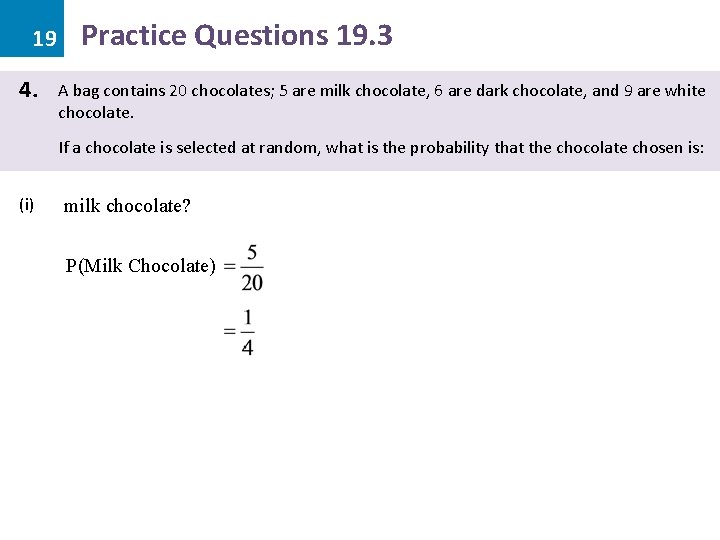
19 4. Practice Questions 19. 3 A bag contains 20 chocolates; 5 are milk chocolate, 6 are dark chocolate, and 9 are white chocolate. If a chocolate is selected at random, what is the probability that the chocolate chosen is: (i) milk chocolate? P(Milk Chocolate)
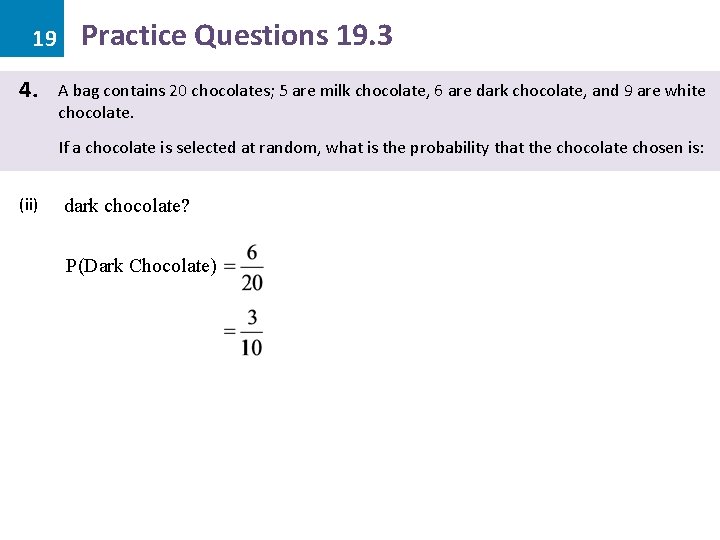
19 4. Practice Questions 19. 3 A bag contains 20 chocolates; 5 are milk chocolate, 6 are dark chocolate, and 9 are white chocolate. If a chocolate is selected at random, what is the probability that the chocolate chosen is: (ii) dark chocolate? P(Dark Chocolate)
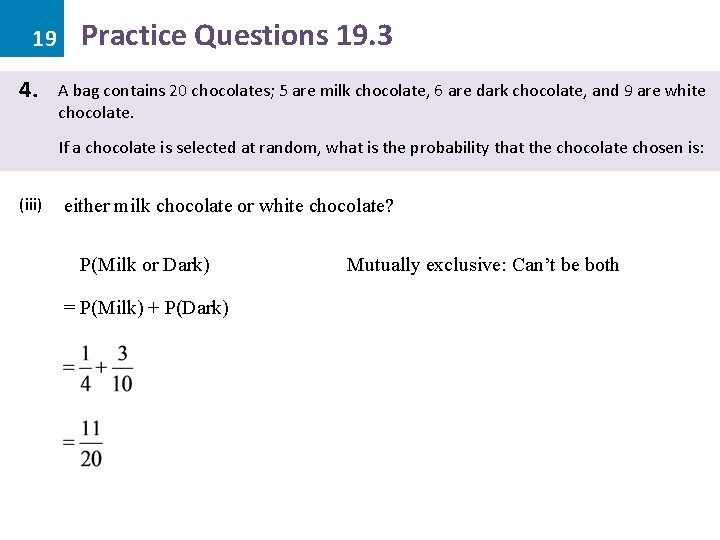
19 4. Practice Questions 19. 3 A bag contains 20 chocolates; 5 are milk chocolate, 6 are dark chocolate, and 9 are white chocolate. If a chocolate is selected at random, what is the probability that the chocolate chosen is: (iii) either milk chocolate or white chocolate? P(Milk or Dark) = P(Milk) + P(Dark) Mutually exclusive: Can’t be both
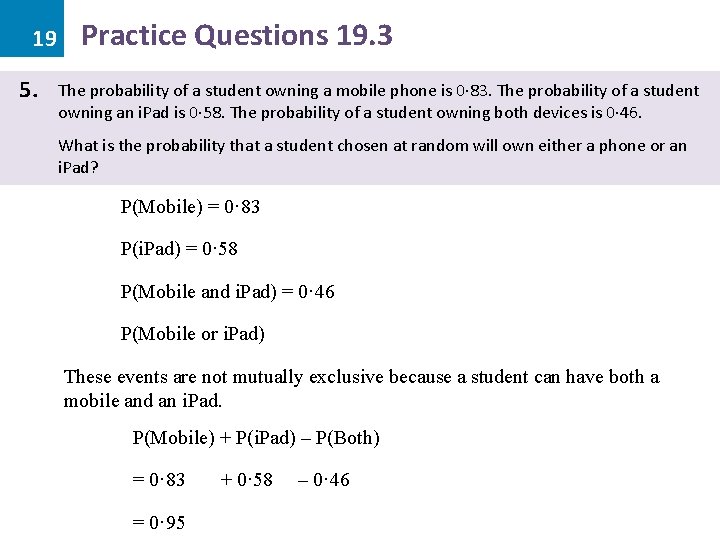
19 5. Practice Questions 19. 3 The probability of a student owning a mobile phone is 0· 83. The probability of a student owning an i. Pad is 0· 58. The probability of a student owning both devices is 0· 46. What is the probability that a student chosen at random will own either a phone or an i. Pad? P(Mobile) = 0· 83 P(i. Pad) = 0· 58 P(Mobile and i. Pad) = 0· 46 P(Mobile or i. Pad) These events are not mutually exclusive because a student can have both a mobile and an i. Pad. P(Mobile) + P(i. Pad) – P(Both) = 0· 83 = 0· 95 + 0· 58 – 0· 46
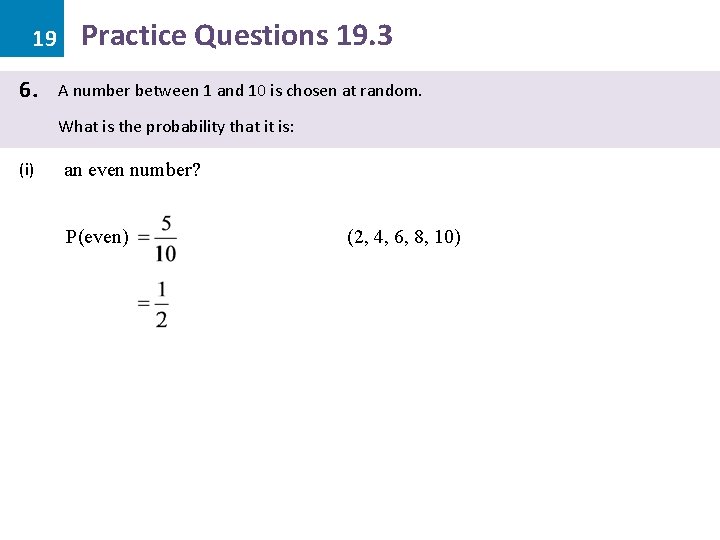
19 6. Practice Questions 19. 3 A number between 1 and 10 is chosen at random. What is the probability that it is: (i) an even number? P(even) (2, 4, 6, 8, 10)
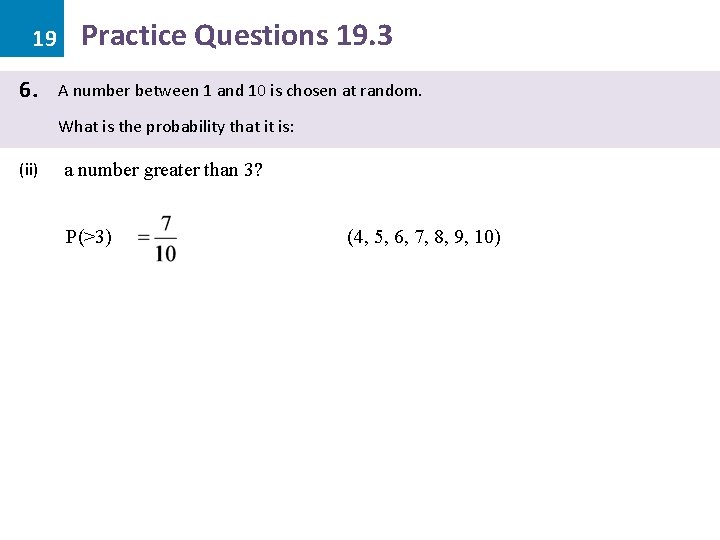
19 6. Practice Questions 19. 3 A number between 1 and 10 is chosen at random. What is the probability that it is: (ii) a number greater than 3? P(>3) (4, 5, 6, 7, 8, 9, 10)
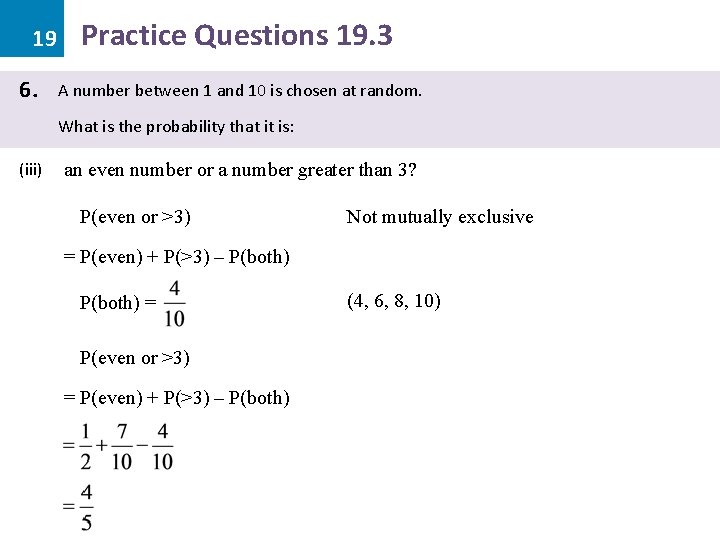
19 6. Practice Questions 19. 3 A number between 1 and 10 is chosen at random. What is the probability that it is: (iii) an even number or a number greater than 3? P(even or >3) Not mutually exclusive = P(even) + P(>3) – P(both) = P(even or >3) = P(even) + P(>3) – P(both) (4, 6, 8, 10)
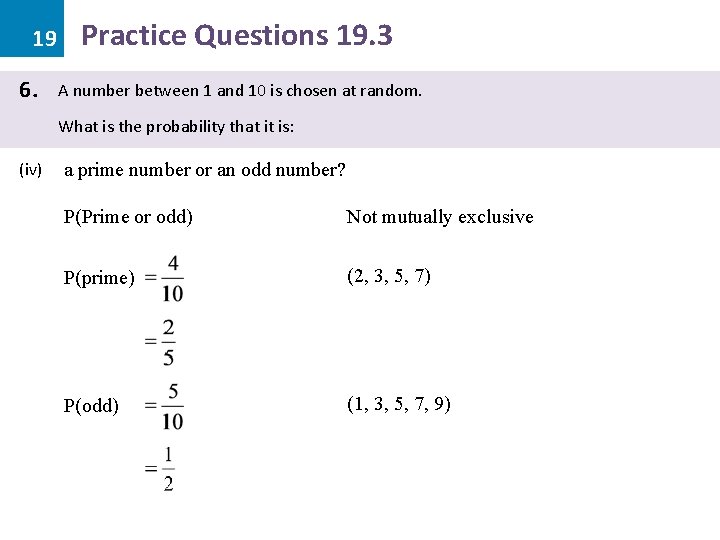
19 6. Practice Questions 19. 3 A number between 1 and 10 is chosen at random. What is the probability that it is: (iv) a prime number or an odd number? P(Prime or odd) Not mutually exclusive P(prime) (2, 3, 5, 7) P(odd) (1, 3, 5, 7, 9)
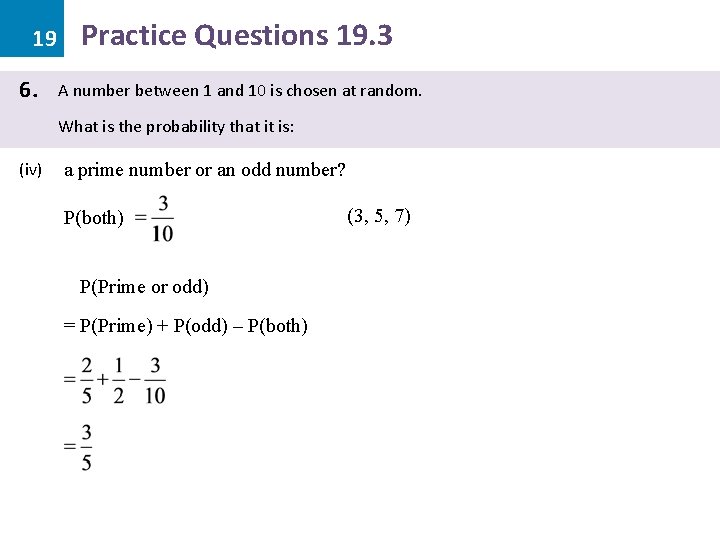
19 6. Practice Questions 19. 3 A number between 1 and 10 is chosen at random. What is the probability that it is: (iv) a prime number or an odd number? P(both) P(Prime or odd) = P(Prime) + P(odd) – P(both) (3, 5, 7)
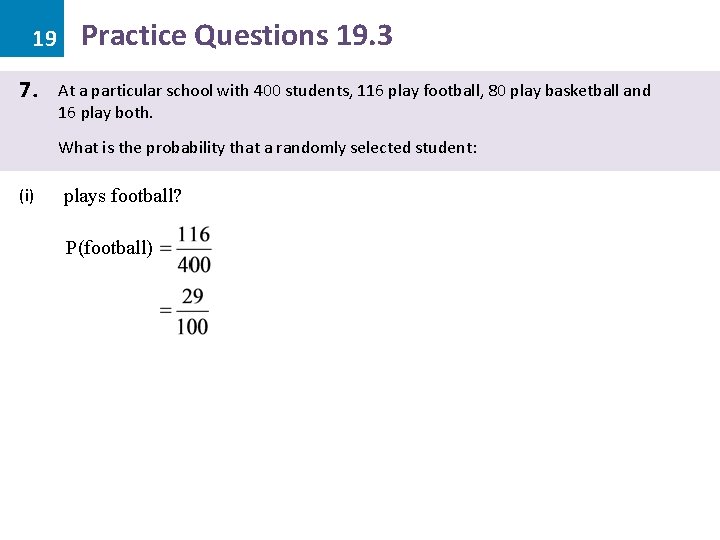
19 7. Practice Questions 19. 3 At a particular school with 400 students, 116 play football, 80 play basketball and 16 play both. What is the probability that a randomly selected student: (i) plays football? P(football)
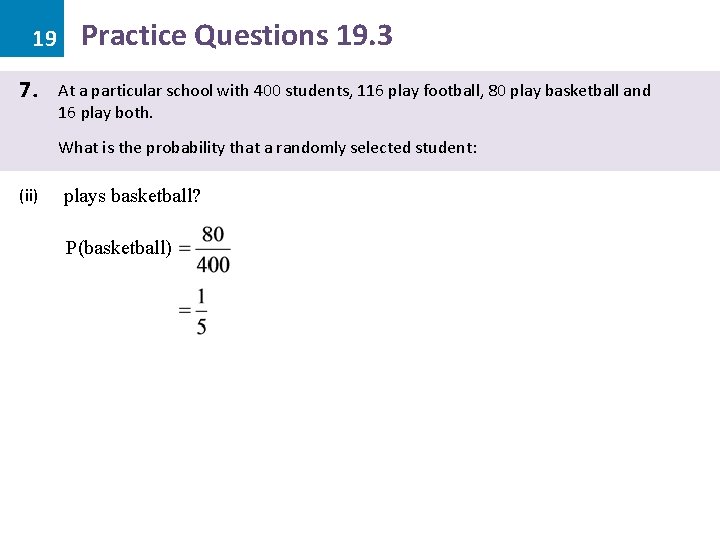
19 7. Practice Questions 19. 3 At a particular school with 400 students, 116 play football, 80 play basketball and 16 play both. What is the probability that a randomly selected student: (ii) plays basketball? P(basketball)
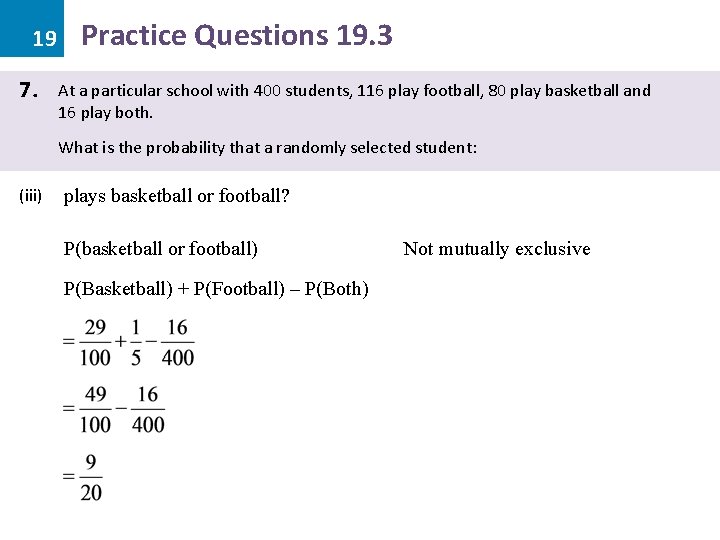
19 7. Practice Questions 19. 3 At a particular school with 400 students, 116 play football, 80 play basketball and 16 play both. What is the probability that a randomly selected student: (iii) plays basketball or football? P(basketball or football) P(Basketball) + P(Football) – P(Both) Not mutually exclusive
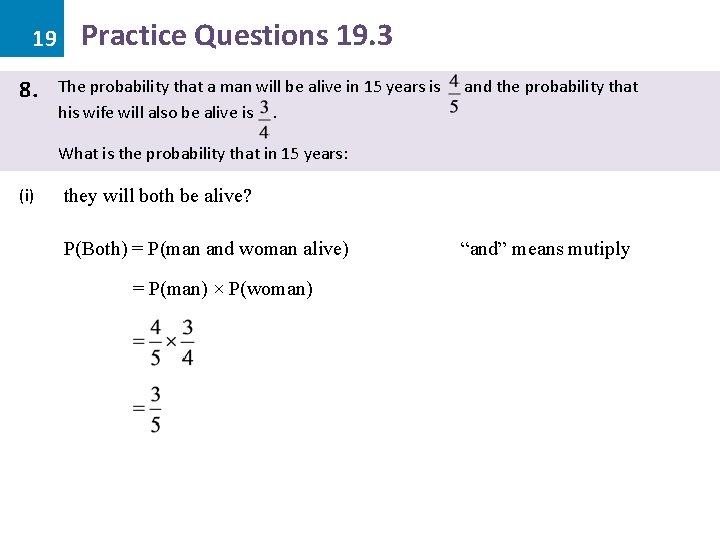
19 8. Practice Questions 19. 3 The probability that a man will be alive in 15 years is and the probability that his wife will also be alive is . What is the probability that in 15 years: (i) they will both be alive? P(Both) = P(man and woman alive) = P(man) × P(woman) “and” means mutiply
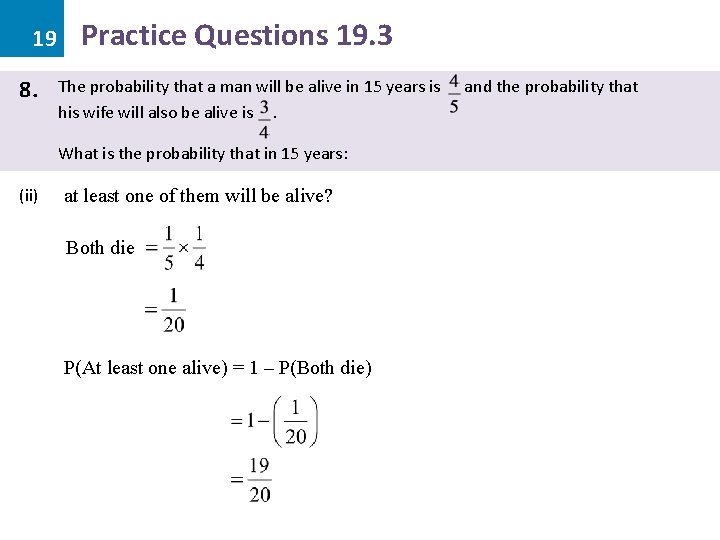
19 8. Practice Questions 19. 3 The probability that a man will be alive in 15 years is and the probability that his wife will also be alive is . What is the probability that in 15 years: (ii) at least one of them will be alive? Both die P(At least one alive) = 1 – P(Both die)
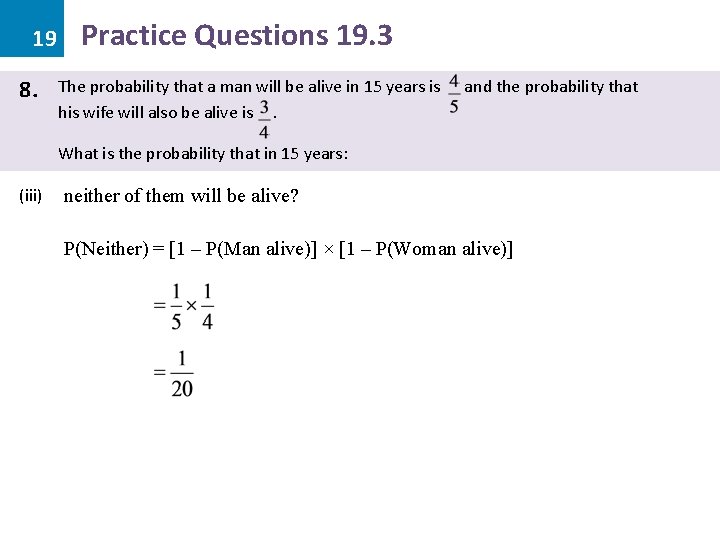
19 8. Practice Questions 19. 3 The probability that a man will be alive in 15 years is and the probability that his wife will also be alive is . What is the probability that in 15 years: (iii) neither of them will be alive? P(Neither) = [1 – P(Man alive)] × [1 – P(Woman alive)]
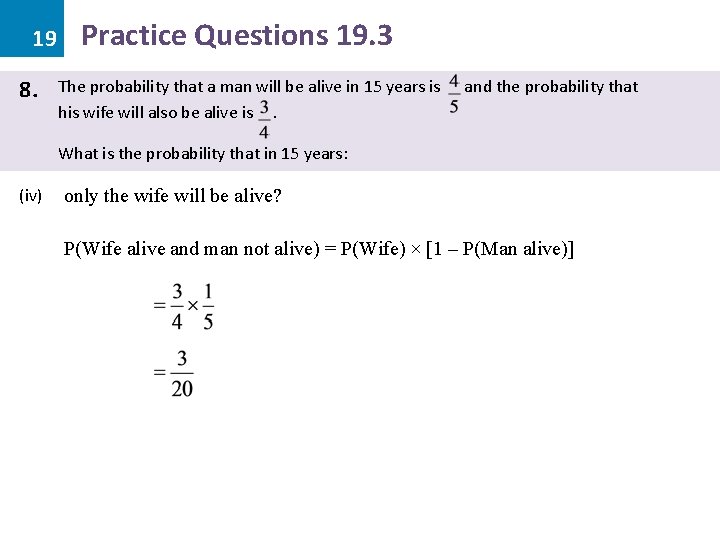
19 8. Practice Questions 19. 3 The probability that a man will be alive in 15 years is and the probability that his wife will also be alive is . What is the probability that in 15 years: (iv) only the wife will be alive? P(Wife alive and man not alive) = P(Wife) × [1 – P(Man alive)]
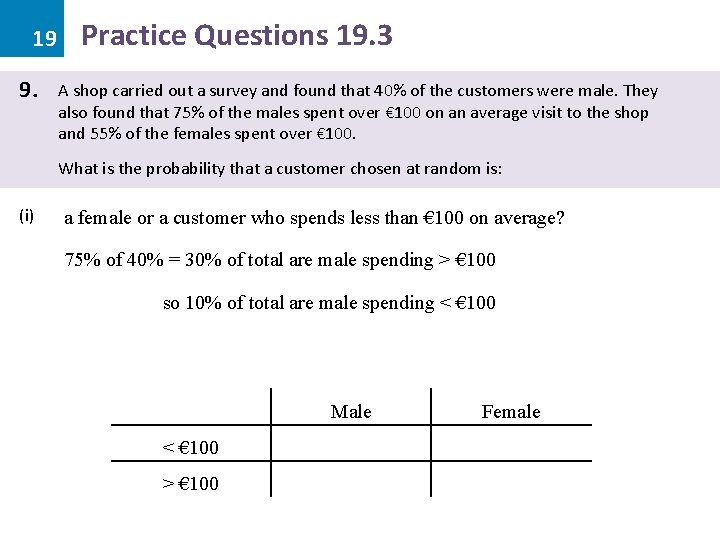
19 9. Practice Questions 19. 3 A shop carried out a survey and found that 40% of the customers were male. They also found that 75% of the males spent over € 100 on an average visit to the shop and 55% of the females spent over € 100. What is the probability that a customer chosen at random is: (i) a female or a customer who spends less than € 100 on average? 75% of 40% = 30% of total are male spending > € 100 so 10% of total are male spending < € 100 Male Female < € 100 10% 27% > € 100 30% 33%
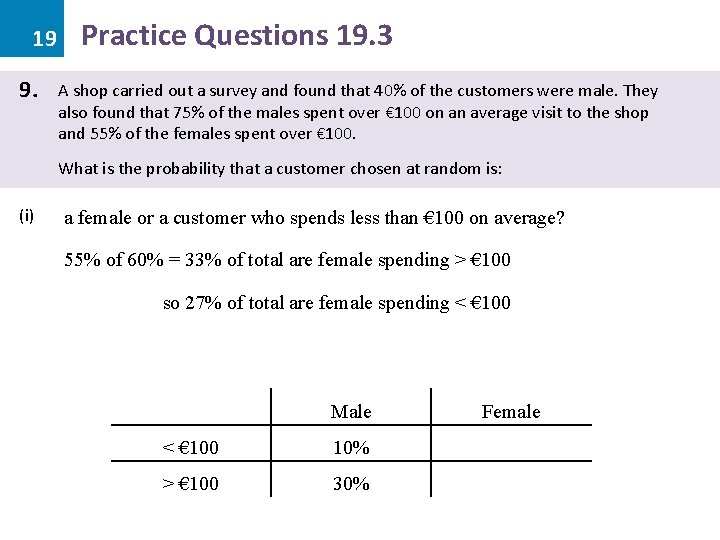
19 9. Practice Questions 19. 3 A shop carried out a survey and found that 40% of the customers were male. They also found that 75% of the males spent over € 100 on an average visit to the shop and 55% of the females spent over € 100. What is the probability that a customer chosen at random is: (i) a female or a customer who spends less than € 100 on average? 55% of 60% = 33% of total are female spending > € 100 so 27% of total are female spending < € 100 Male Female < € 100 10% 27% > € 100 30% 33%
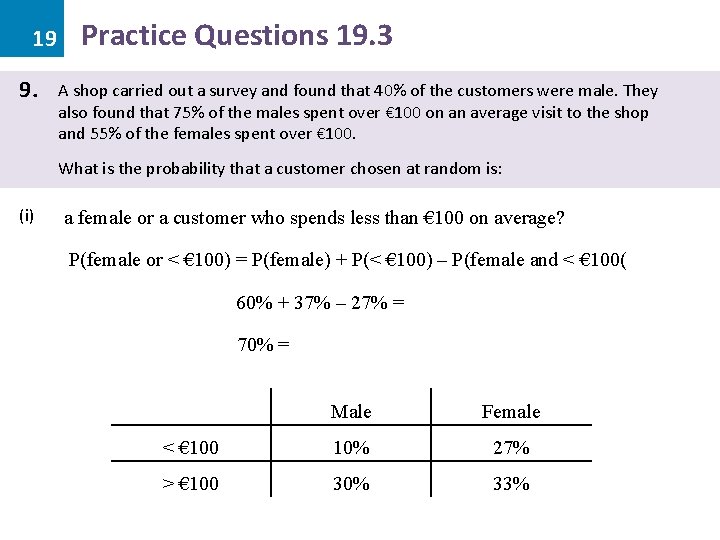
19 9. Practice Questions 19. 3 A shop carried out a survey and found that 40% of the customers were male. They also found that 75% of the males spent over € 100 on an average visit to the shop and 55% of the females spent over € 100. What is the probability that a customer chosen at random is: (i) a female or a customer who spends less than € 100 on average? P(female or < € 100) = P(female) + P(< € 100) – P(female and < € 100( 60% + 37% – 27% = 70% = Male Female < € 100 10% 27% > € 100 30% 33%
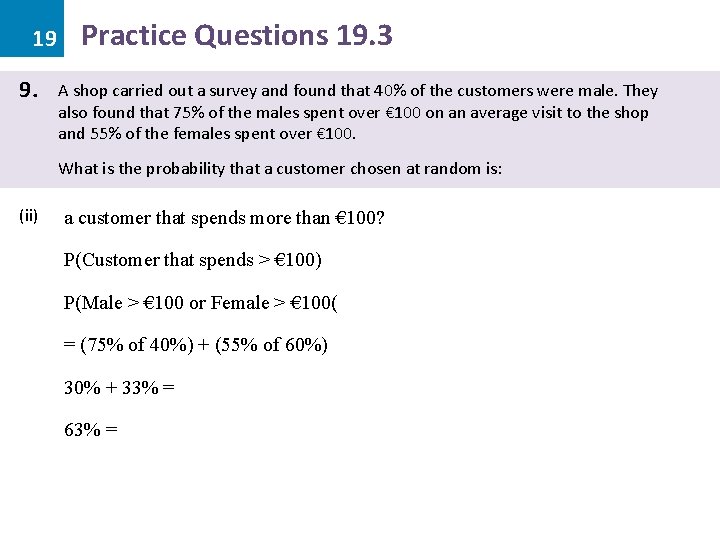
19 9. Practice Questions 19. 3 A shop carried out a survey and found that 40% of the customers were male. They also found that 75% of the males spent over € 100 on an average visit to the shop and 55% of the females spent over € 100. What is the probability that a customer chosen at random is: (ii) a customer that spends more than € 100? P(Customer that spends > € 100) P(Male > € 100 or Female > € 100( = (75% of 40%) + (55% of 60%) 30% + 33% = 63% =
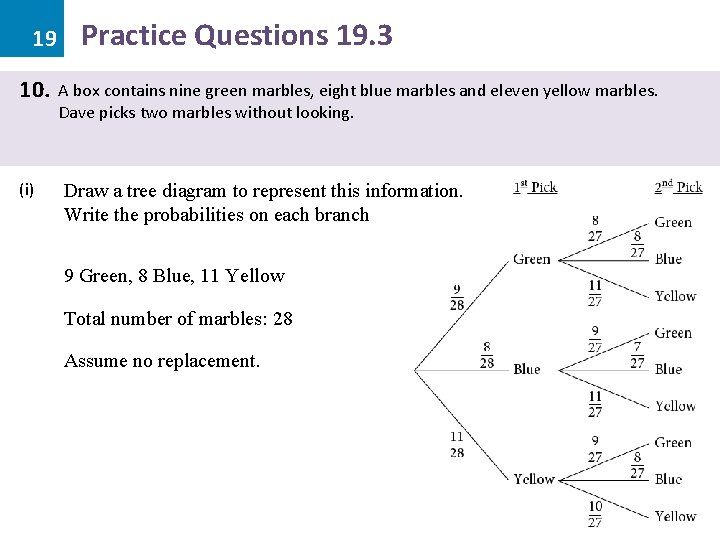
19 10. (i) Practice Questions 19. 3 A box contains nine green marbles, eight blue marbles and eleven yellow marbles. Dave picks two marbles without looking. Draw a tree diagram to represent this information. Write the probabilities on each branch 9 Green, 8 Blue, 11 Yellow Total number of marbles: 28 Assume no replacement.
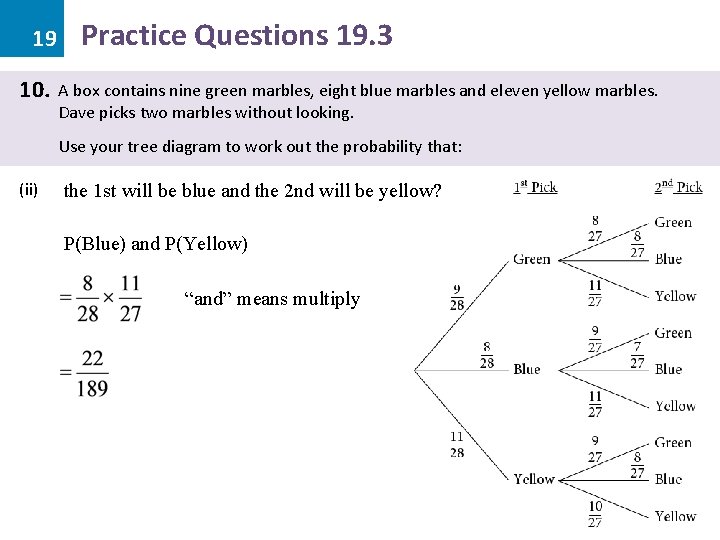
19 10. Practice Questions 19. 3 A box contains nine green marbles, eight blue marbles and eleven yellow marbles. Dave picks two marbles without looking. Use your tree diagram to work out the probability that: (ii) the 1 st will be blue and the 2 nd will be yellow? P(Blue) and P(Yellow) “and” means multiply
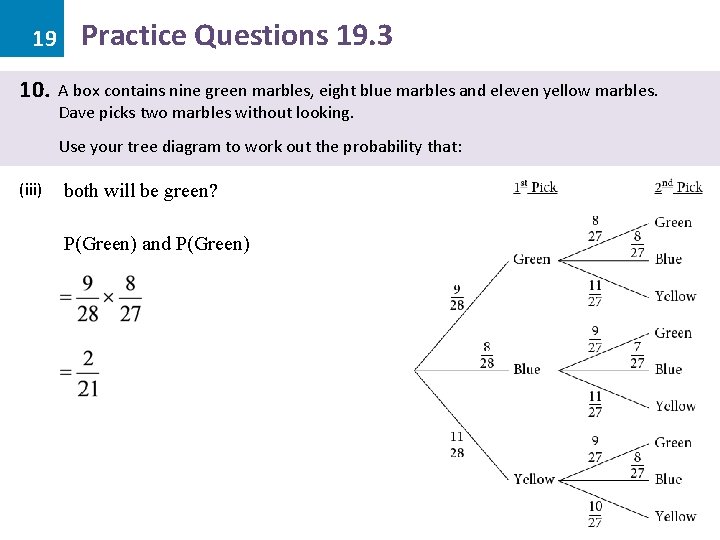
19 10. Practice Questions 19. 3 A box contains nine green marbles, eight blue marbles and eleven yellow marbles. Dave picks two marbles without looking. Use your tree diagram to work out the probability that: (iii) both will be green? P(Green) and P(Green)
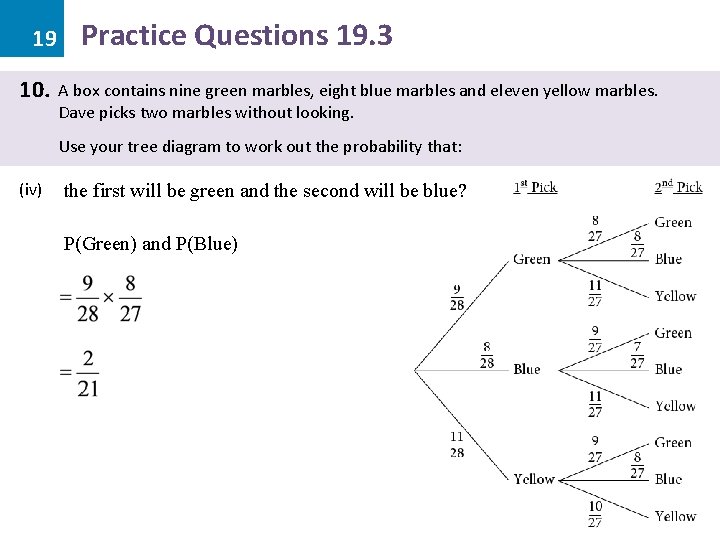
19 10. Practice Questions 19. 3 A box contains nine green marbles, eight blue marbles and eleven yellow marbles. Dave picks two marbles without looking. Use your tree diagram to work out the probability that: (iv) the first will be green and the second will be blue? P(Green) and P(Blue)
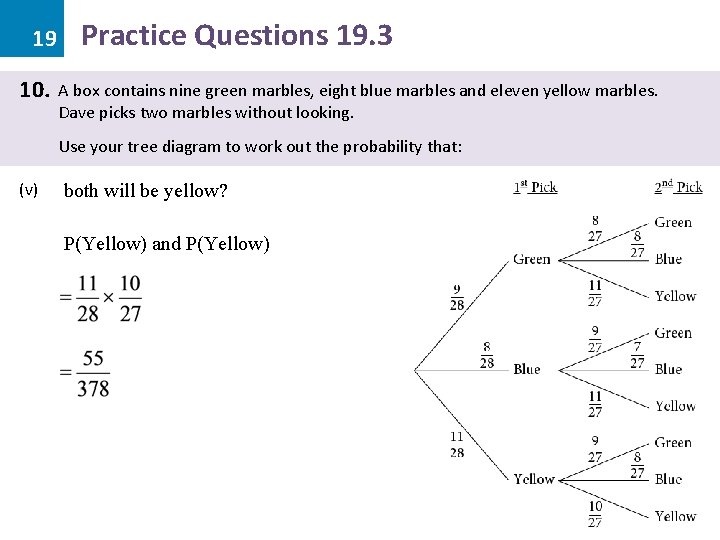
19 10. Practice Questions 19. 3 A box contains nine green marbles, eight blue marbles and eleven yellow marbles. Dave picks two marbles without looking. Use your tree diagram to work out the probability that: (v) both will be yellow? P(Yellow) and P(Yellow)
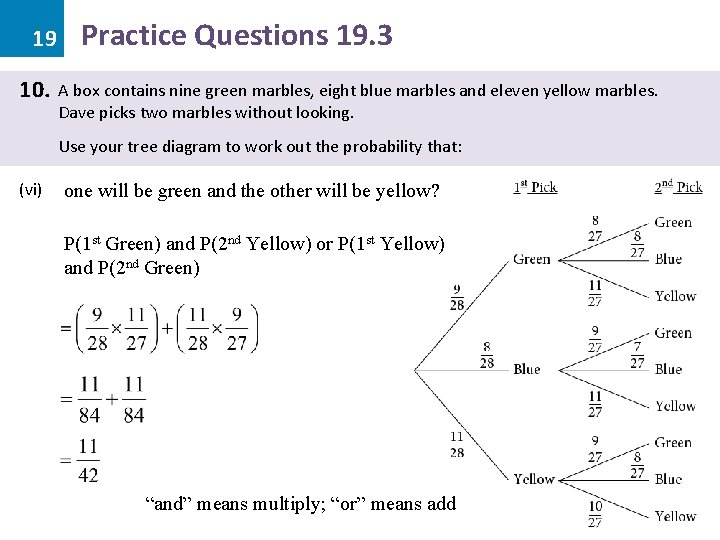
19 10. Practice Questions 19. 3 A box contains nine green marbles, eight blue marbles and eleven yellow marbles. Dave picks two marbles without looking. Use your tree diagram to work out the probability that: (vi) one will be green and the other will be yellow? P(1 st Green) and P(2 nd Yellow) or P(1 st Yellow) and P(2 nd Green) “and” means multiply; “or” means add
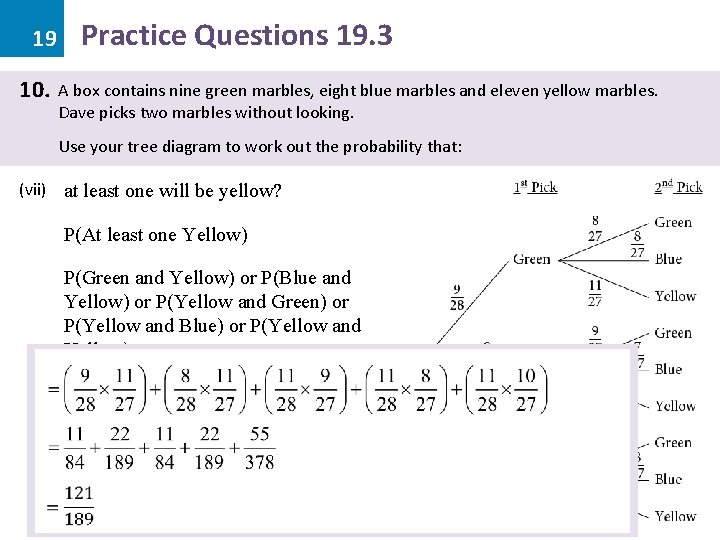
19 10. Practice Questions 19. 3 A box contains nine green marbles, eight blue marbles and eleven yellow marbles. Dave picks two marbles without looking. Use your tree diagram to work out the probability that: (vii) at least one will be yellow? P(At least one Yellow) P(Green and Yellow) or P(Blue and Yellow) or P(Yellow and Green) or P(Yellow and Blue) or P(Yellow and Yellow)
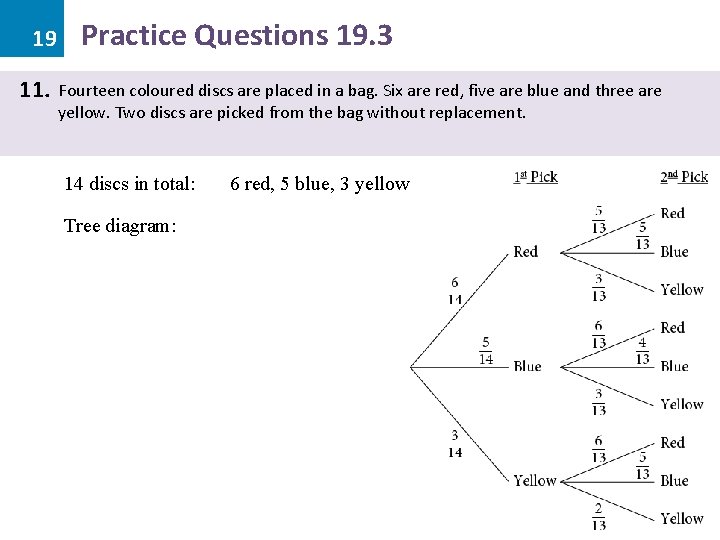
19 11. Practice Questions 19. 3 Fourteen coloured discs are placed in a bag. Six are red, five are blue and three are yellow. Two discs are picked from the bag without replacement. 14 discs in total: Tree diagram: 6 red, 5 blue, 3 yellow
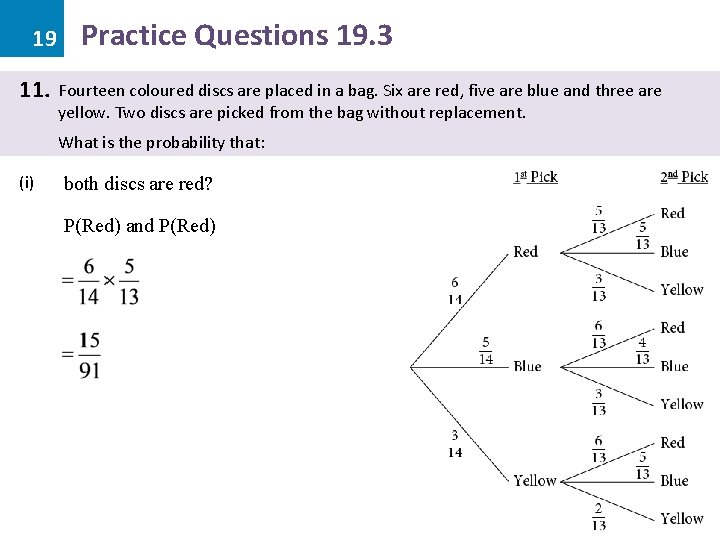
19 11. Practice Questions 19. 3 Fourteen coloured discs are placed in a bag. Six are red, five are blue and three are yellow. Two discs are picked from the bag without replacement. What is the probability that: (i) both discs are red? P(Red) and P(Red)
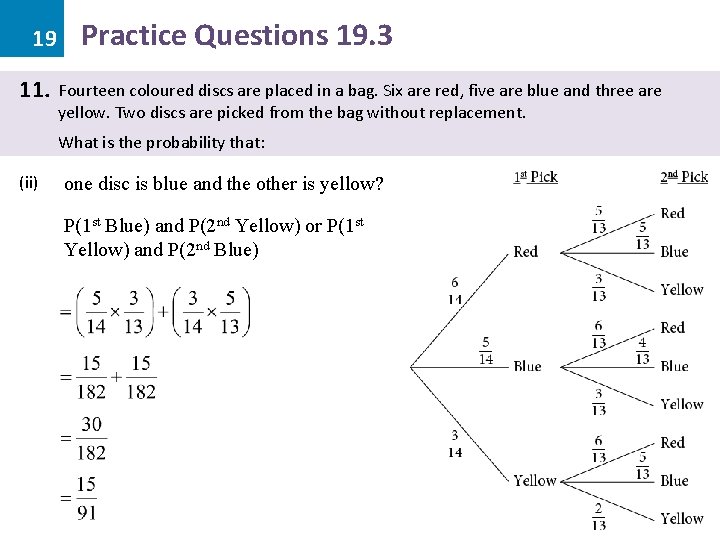
19 11. Practice Questions 19. 3 Fourteen coloured discs are placed in a bag. Six are red, five are blue and three are yellow. Two discs are picked from the bag without replacement. What is the probability that: (ii) one disc is blue and the other is yellow? P(1 st Blue) and P(2 nd Yellow) or P(1 st Yellow) and P(2 nd Blue)
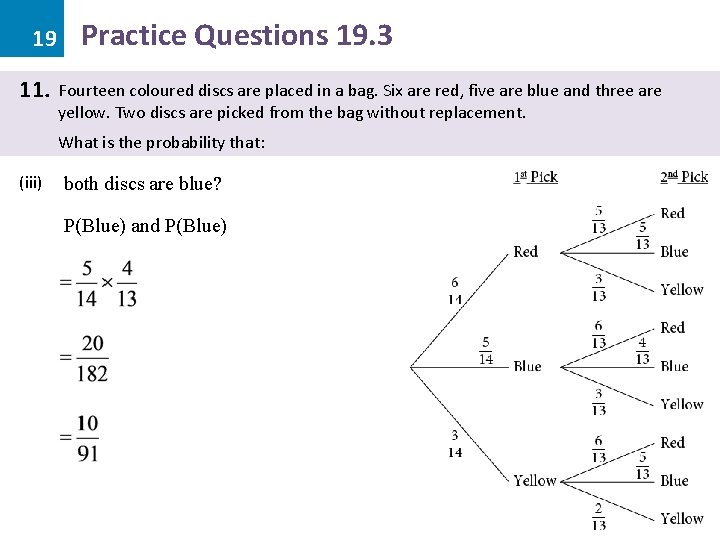
19 11. Practice Questions 19. 3 Fourteen coloured discs are placed in a bag. Six are red, five are blue and three are yellow. Two discs are picked from the bag without replacement. What is the probability that: (iii) both discs are blue? P(Blue) and P(Blue)
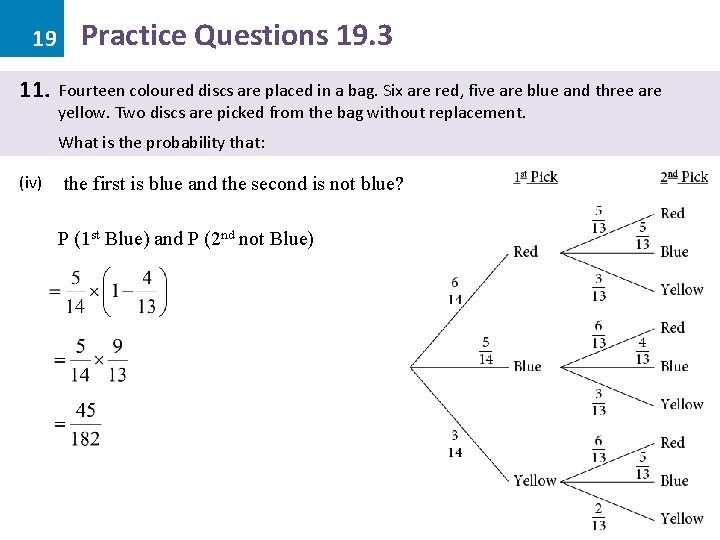
19 11. Practice Questions 19. 3 Fourteen coloured discs are placed in a bag. Six are red, five are blue and three are yellow. Two discs are picked from the bag without replacement. What is the probability that: (iv) the first is blue and the second is not blue? P (1 st Blue) and P (2 nd not Blue)
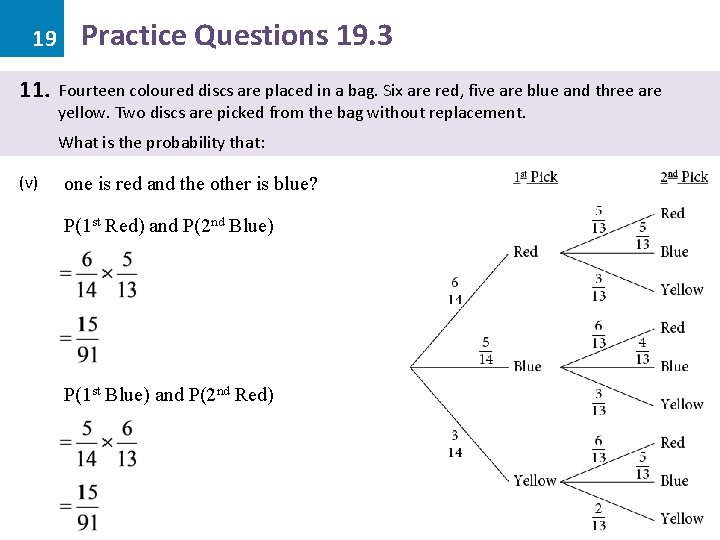
19 11. Practice Questions 19. 3 Fourteen coloured discs are placed in a bag. Six are red, five are blue and three are yellow. Two discs are picked from the bag without replacement. What is the probability that: (v) one is red and the other is blue? P(1 st Red) and P(2 nd Blue) P(1 st Blue) and P(2 nd Red)
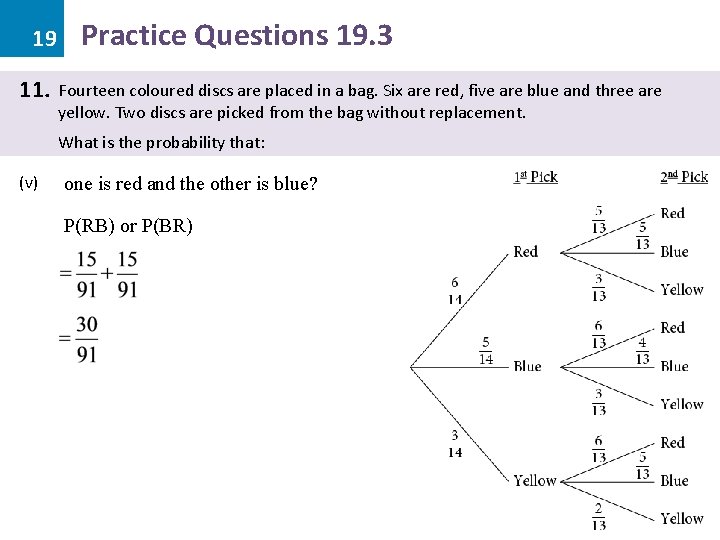
19 11. Practice Questions 19. 3 Fourteen coloured discs are placed in a bag. Six are red, five are blue and three are yellow. Two discs are picked from the bag without replacement. What is the probability that: (v) one is red and the other is blue? P(RB) or P(BR)
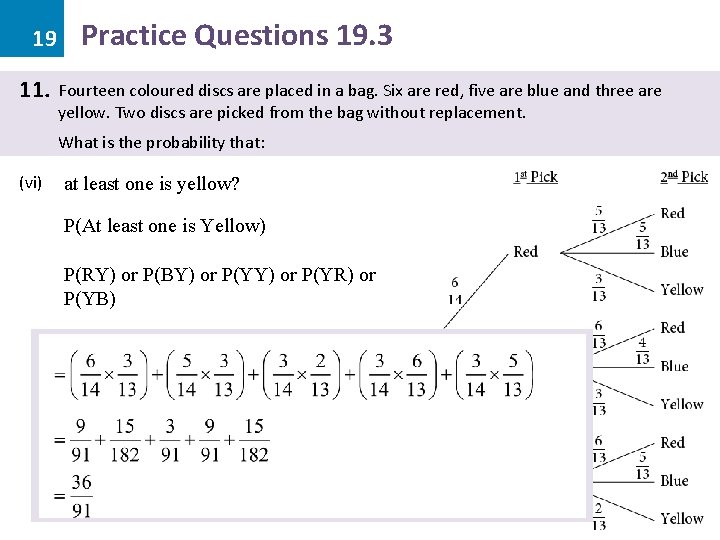
19 11. Practice Questions 19. 3 Fourteen coloured discs are placed in a bag. Six are red, five are blue and three are yellow. Two discs are picked from the bag without replacement. What is the probability that: (vi) at least one is yellow? P(At least one is Yellow) P(RY) or P(BY) or P(YR) or P(YB)
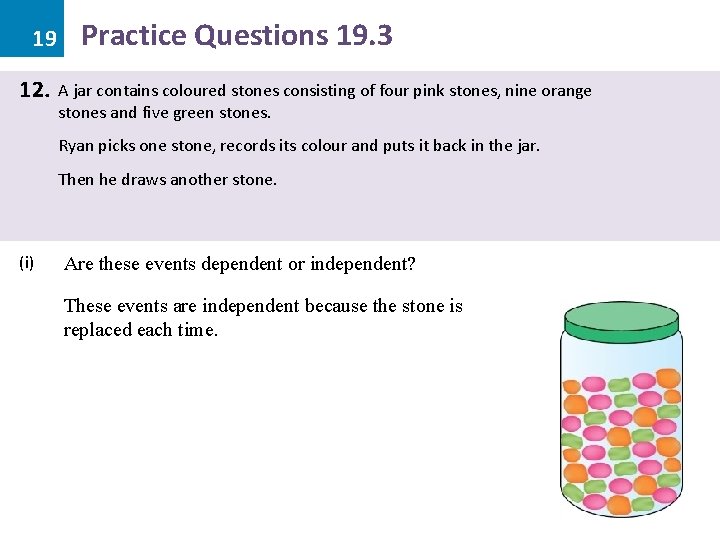
19 12. Practice Questions 19. 3 A jar contains coloured stones consisting of four pink stones, nine orange stones and five green stones. Ryan picks one stone, records its colour and puts it back in the jar. Then he draws another stone. (i) Are these events dependent or independent? These events are independent because the stone is replaced each time.
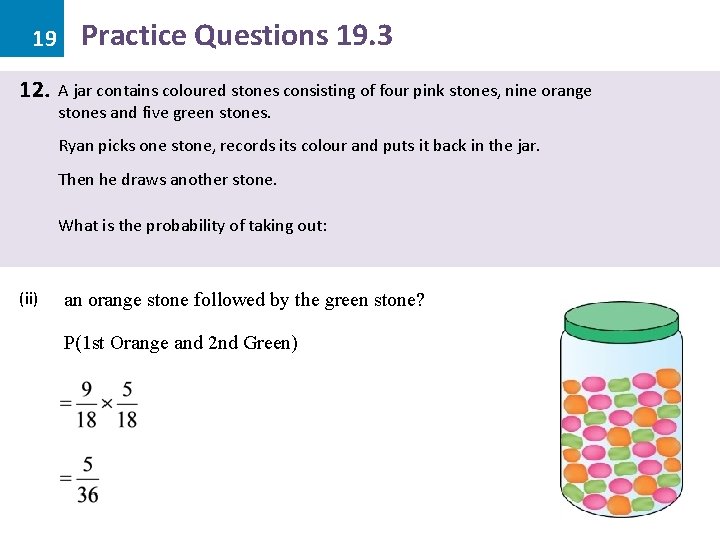
19 12. Practice Questions 19. 3 A jar contains coloured stones consisting of four pink stones, nine orange stones and five green stones. Ryan picks one stone, records its colour and puts it back in the jar. Then he draws another stone. What is the probability of taking out: (ii) an orange stone followed by the green stone? P(1 st Orange and 2 nd Green)
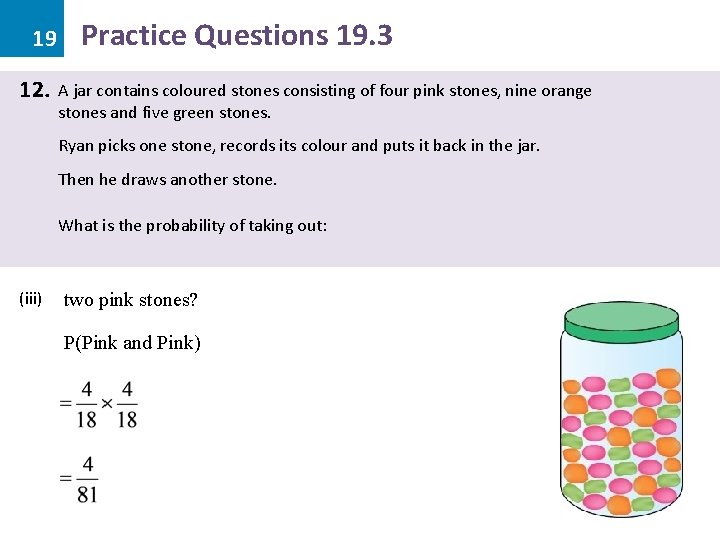
19 12. Practice Questions 19. 3 A jar contains coloured stones consisting of four pink stones, nine orange stones and five green stones. Ryan picks one stone, records its colour and puts it back in the jar. Then he draws another stone. What is the probability of taking out: (iii) two pink stones? P(Pink and Pink)
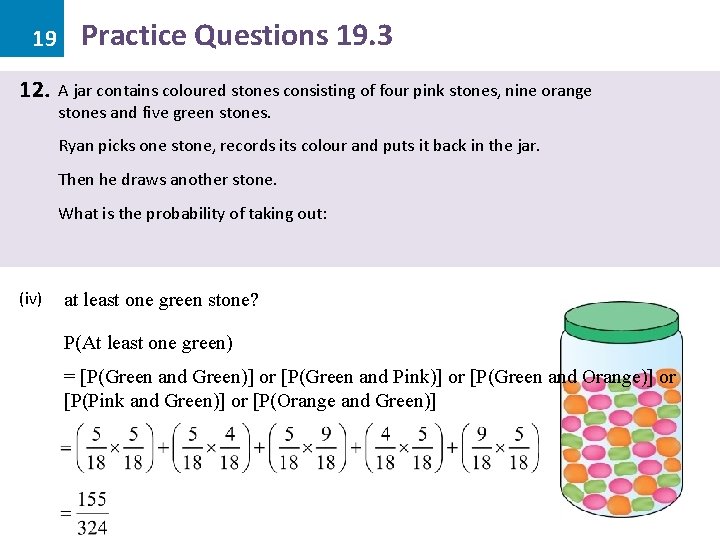
19 12. Practice Questions 19. 3 A jar contains coloured stones consisting of four pink stones, nine orange stones and five green stones. Ryan picks one stone, records its colour and puts it back in the jar. Then he draws another stone. What is the probability of taking out: (iv) at least one green stone? P(At least one green) = [P(Green and Green)] or [P(Green and Pink)] or [P(Green and Orange)] or [P(Pink and Green)] or [P(Orange and Green)]
- Slides: 51