
Chapter P Section 2 Linear Models and Rates
- Slides: 11
Chapter P Section 2 Linear Models and Rates of Change
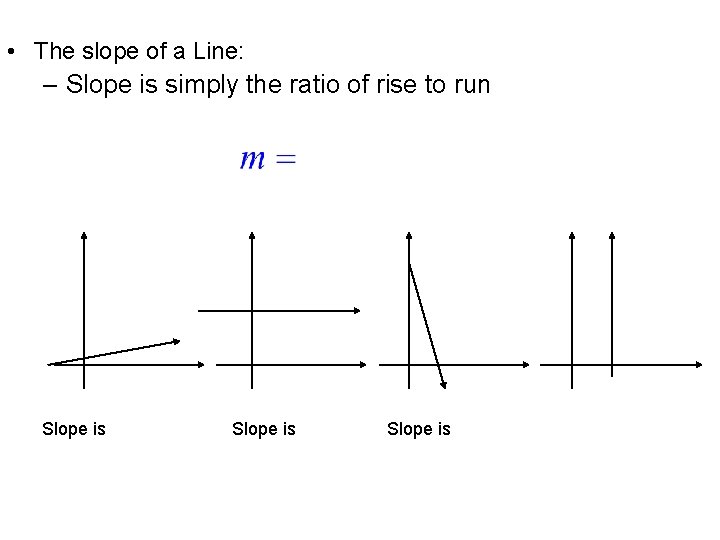
• The slope of a Line: – Slope is simply the ratio of rise to run Slope is positive Slope is zero Slope is negative No Slope
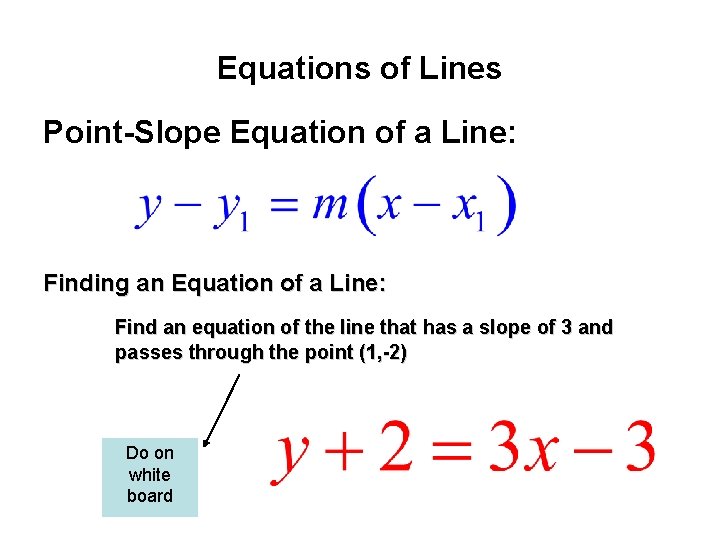
Equations of Lines Point-Slope Equation of a Line: Finding an Equation of a Line: Find an equation of the line that has a slope of 3 and passes through the point (1, -2) Do on white board
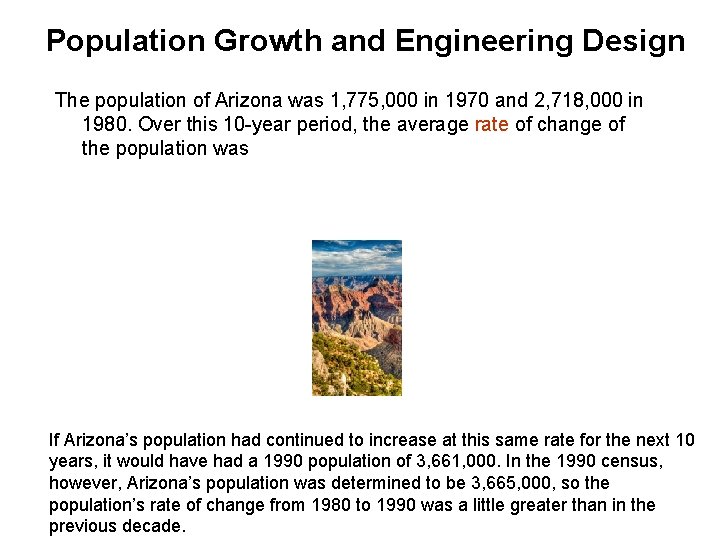
Population Growth and Engineering Design Population (in millions) The population of Arizona was 1, 775, 000 in 1970 and 2, 718, 000 in 1980. Over this 10 -year period, the average rate of change of the population was 4 Rate of change = Change in years 3 943, 000 2 1 Change in population = 2, 718, 000 – 1, 775, 000 1980 - 1970 10 = 94, 300 people per year 1970 1980 1990 year If Arizona’s population had continued to increase at this same rate for the next 10 years, it would have had a 1990 population of 3, 661, 000. In the 1990 census, however, Arizona’s population was determined to be 3, 665, 000, so the population’s rate of change from 1980 to 1990 was a little greater than in the previous decade.
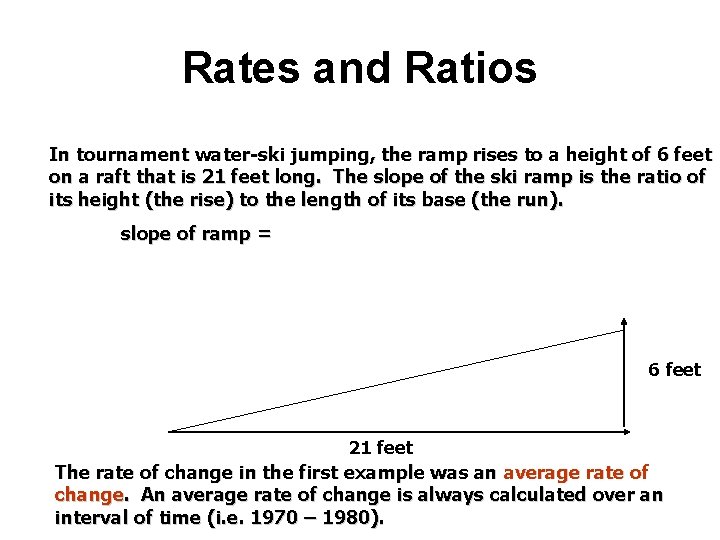
Rates and Ratios In tournament water-ski jumping, the ramp rises to a height of 6 feet on a raft that is 21 feet long. The slope of the ski ramp is the ratio of its height (the rise) to the length of its base (the run). slope of ramp = rise/run = 6 feet / 21 feet = 2/7 In this case the slope is a ratio and has no units. 6 feet 21 feet The rate of change in the first example was an average rate of change. An average rate of change is always calculated over an interval of time (i. e. 1970 – 1980).
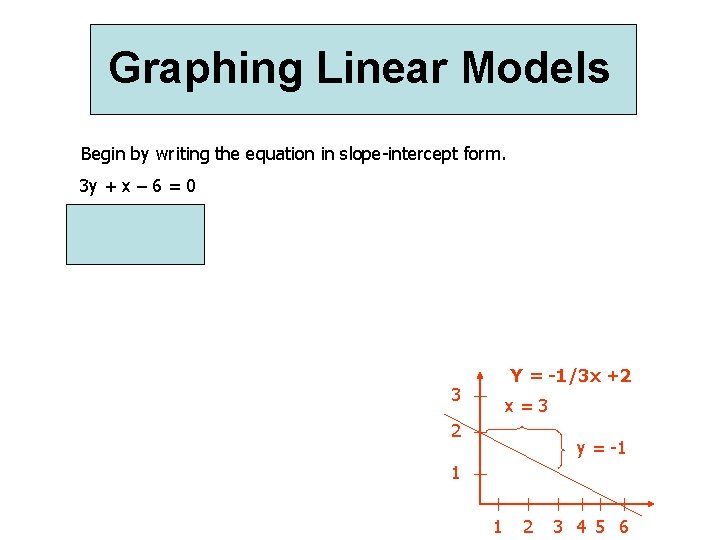
Graphing Linear Models Begin by writing the equation in slope-intercept form. 3 y + x – 6 = 0 3 y = -x +6 y = -1/3 x + 2 In this form you can see that the y-intercept is (0, 2) and that the slope is -1/3. This means that the line falls one unit for every three units it moves to the right. Y = 2 x +1 3 y=2 2 1 x=1 1 2 3 Y=2 3 3 2 2 1 1 1 2 3 Y = -1/3 x +2 x=3 y = -1 1 2 3 4 5 6
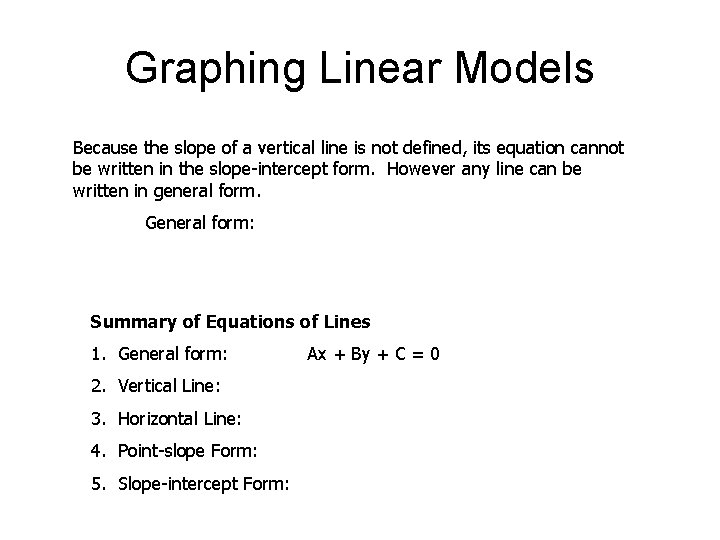
Graphing Linear Models Because the slope of a vertical line is not defined, its equation cannot be written in the slope-intercept form. However any line can be written in general form. General form: Ax + By + C = 0 Summary of Equations of Lines 1. General form: Ax + By + C = 0 2. Vertical Line: x=a 3. Horizontal Line: y=b 4. Point-slope Form: y – y 1 = m( x – x 1) 5. Slope-intercept Form: y = mx + b
Parallel and Perpendicular Lines: 1. Two distinct non-vertical lines are parallel if and only if their slopes are equal, that is if and only if m 1 = m 2 2. Two non-vertical lines are perpendicular if and only if their slopes are negative reciprocals of each other, that is, if and only if m 1 = -1/m 2 m 1 = -1/m 2 m 1 = m 2
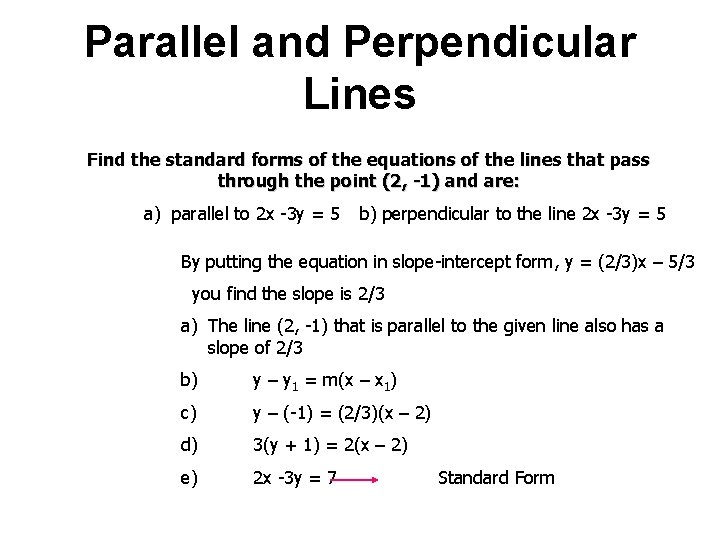
Parallel and Perpendicular Lines Find the standard forms of the equations of the lines that pass through the point (2, -1) and are: a) parallel to 2 x -3 y = 5 b) perpendicular to the line 2 x -3 y = 5 By putting the equation in slope-intercept form, y = (2/3)x – 5/3 you find the slope is 2/3 a) The line (2, -1) that is parallel to the given line also has a slope of 2/3 b) y – y 1 = m(x – x 1) c) y – (-1) = (2/3)(x – 2) d) 3(y + 1) = 2(x – 2) e) 2 x -3 y = 7 Standard Form
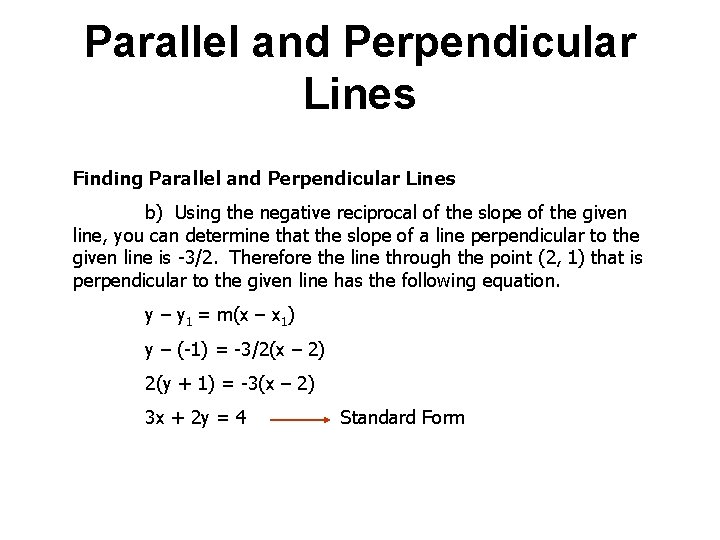
Parallel and Perpendicular Lines Finding Parallel and Perpendicular Lines b) Using the negative reciprocal of the slope of the given line, you can determine that the slope of a line perpendicular to the given line is -3/2. Therefore the line through the point (2, 1) that is perpendicular to the given line has the following equation. y – y 1 = m(x – x 1) y – (-1) = -3/2(x – 2) 2(y + 1) = -3(x – 2) 3 x + 2 y = 4 Standard Form
P. 2/16, 7, 13, 15, 17, 18, 20, 23, 30, 32, 36, 38, 40, 45, 59, 61, 63, 65, 70, 71, 73, 74, 76, 87, 88