
Chapter One Welcome to the World of Marketing
- Slides: 40
Chapter One Welcome to the World of Marketing: Create and Deliver Value Marketing: Real People, Real Choices, 9 e Solomon, Marshall, and Stuart Copyright © 2018 Pearson Education, Inc. 1 1
Chapter Objectives • Explain what marketing is, the marketing mix, what can be marketed, and the value of marketing. • Explain the evolution of the marketing concept. • Understand value from the perspectives of customers, producers, and society. • Explain the basics of market planning. Copyright © 2018 Pearson Education, Inc. 1 2
Real People, Real Choices: A Decision Maker at Twitter • Which option should be pursued? – Option 1: Hold weekly meetings to discuss ideas and innovations within Twitter – Option 2: Build an internal online tool to allow employees to share, build, and measure ideas – Option 3: Get feedback from the external Twitter community to shape Twitter’s product vision Copyright © 2018 Pearson Education, Inc. 1 3
Marketing: What Is It? • As consumers, you all know a lot about it! • Marketing is first and foremost about satisfying customer needs in a profitable manner. Copyright © 2018 Pearson Education, Inc. 1 4
AMA Definition of Marketing • Marketing is the activity, set of institutions, and processes for creating, communicating, delivering, and exchanging offerings that have value for customers, clients, partners, and society at large. Copyright © 2018 Pearson Education, Inc. 1 5
Marketing Defined: Activity, Institutions, Processes • Marketing includes many different activities: – More than just sales and advertising – Involves interactions with non marketers: Finance, HR, MIS, Operations, Accounting, etc. • Marketing is also a decision process. Copyright © 2018 Pearson Education, Inc. 1 6
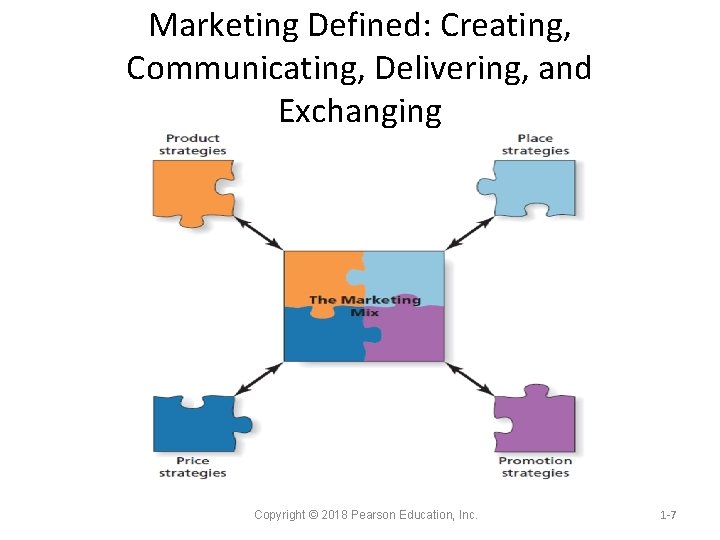
Marketing Defined: Creating, Communicating, Delivering, and Exchanging Copyright © 2018 Pearson Education, Inc. 1 7
Marketing Facilitates Exchange • Exchange occurs when one party gives up something and in return for receiving something else. • Conditions for Exchange – At least two people or organizations must be willing to make a trade. – Have something the other party wants – Agree on value of exchange and terms – Each party free to accept or reject exchange Copyright © 2018 Pearson Education, Inc. 1 8
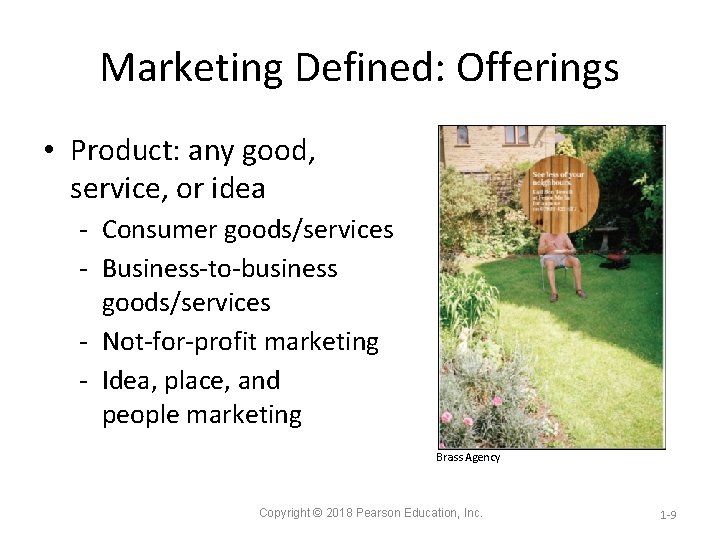
Marketing Defined: Offerings • Product: any good, service, or idea Consumer goods/services Business to business goods/services Not for profit marketing Idea, place, and people marketing Brass Agency Copyright © 2018 Pearson Education, Inc. 1 9
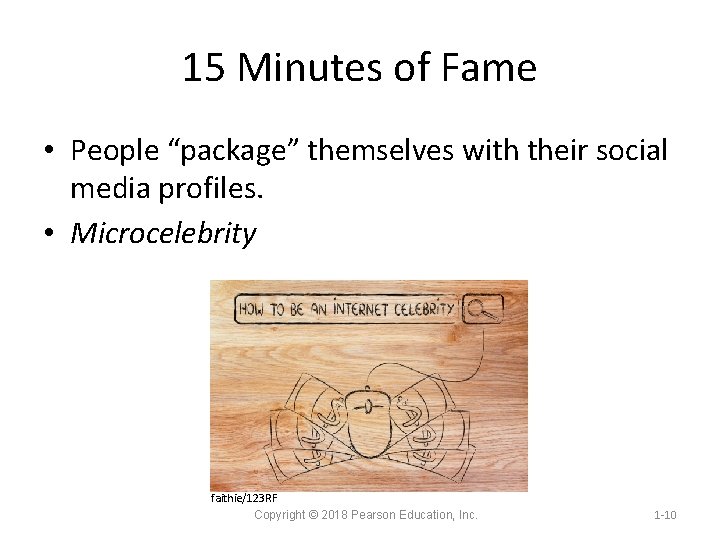
15 Minutes of Fame • People “package” themselves with their social media profiles. • Microcelebrity faithie/123 RF Copyright © 2018 Pearson Education, Inc. 1 10
Marketing Defined: Value for Customers • Marketing concept – Modern marketers practice the marketing concept: identifying and satisfying the needs of consumers to ensure profitability. • Practicing the marketing concept is complex. Copyright © 2018 Pearson Education, Inc. 1 11
Needs, Wants, and Benefits • Needs – Difference between actual and desired state – Can be physiological or psychological • Wants – Desire to satisfy a need in a particular way – Influenced by history, past experience, and culture • Benefits – Consumer received benefit when need satisfied • Demand – Customers’ desires for products coupled with the resources needed to obtain them Copyright © 2018 Pearson Education, Inc. 1 12
Markets and Marketplaces • A market consists of all consumers who share a common need that can be satisfied by a specific product, and who have resources, willingness and authority to purchase. • A marketplace is any location or medium used to facilitate an exchange. Copyright © 2018 Pearson Education, Inc. 1 13
Collaborative Consumption • Consumers increasingly would rather rent than purchase the products they use. – Examples? • Traditional marketers are also looking to take advantage of this trend. Copyright © 2018 Pearson Education, Inc. 1 14
Marketing Creates Utility • Utility represents the sum of benefits a consumer receives from use of a product. – Form utility – Place utility – Time utility – Possession utility Copyright © 2018 Pearson Education, Inc. 1 15
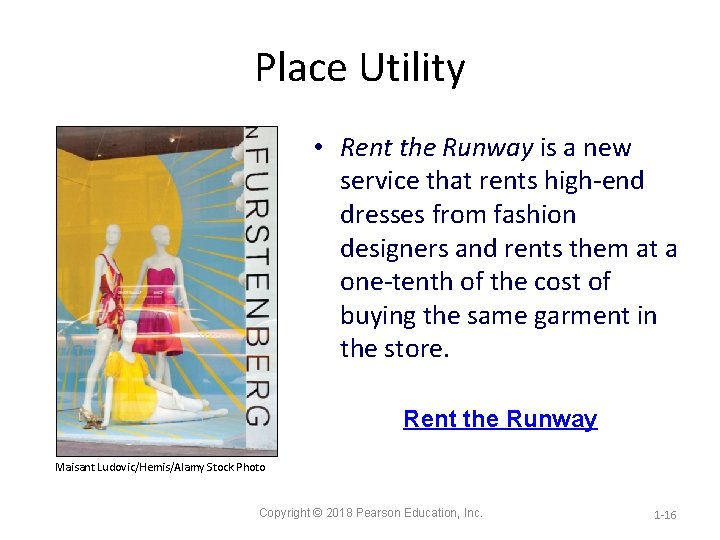
Place Utility • Rent the Runway is a new service that rents high end dresses from fashion designers and rents them at a one tenth of the cost of buying the same garment in the store. Rent the Runway Maisant Ludovic/Hemis/Alamy Stock Photo Copyright © 2018 Pearson Education, Inc. 1 16
Marketing Defined: Value for Society • Is it possible to make profits and contribute to society and the planet in a positive way? • Corporate responsibility at Target – In 2012, Target set goals for all seafood sold in stores to be sustainable and traceable. – Reusable bag program saves consumers $7 million – 50+% of apparel is labeled “machine wash cold” to help reduce energy consumption. Copyright © 2018 Pearson Education, Inc. 1 17
Summary: Marketing Defined • Marketing encompasses activities and process that create, communicate, deliver value based exchanges. – Benefits to stakeholders beyond just businesses and consumers How does the definition of marketing relate to you as a consumer? To your future career? Copyright © 2018 Pearson Education, Inc. 1 18
Evolution of the Marketing Concept • • Production era Selling era Relationship era Triple bottom line era Copyright © 2018 Pearson Education, Inc. 1 19
Production Era • Marketing dominated by a production orientation – A management philosophy that emphasizes the most efficient ways to produce and distribute products • Marketing promotions played a minor role • Henry Ford’s Model T and Ivory soap are examples of products that were created under a production orientation. Copyright © 2018 Pearson Education, Inc. 1 20
Sales Era • Dominated by selling orientation – A managerial view of marketing as a sales function, or a way to move products out of warehouses to reduce inventory – Emphasis on aggressive promotional activities • Post–World War II, production capacity exceeded demand. – Led businesses to focus on one time sales of goods rather than repeat business Copyright © 2018 Pearson Education, Inc. 1 21
Relationship Era • Focused upon a consumer orientation – A management philosophy that emphasizes satisfying customers’ needs and wants • Marketing plays a more central role – Emergence of the marketing concept – Total Quality Management (TQM) and other quality initiatives gains wide acceptance Copyright © 2018 Pearson Education, Inc. 1 22
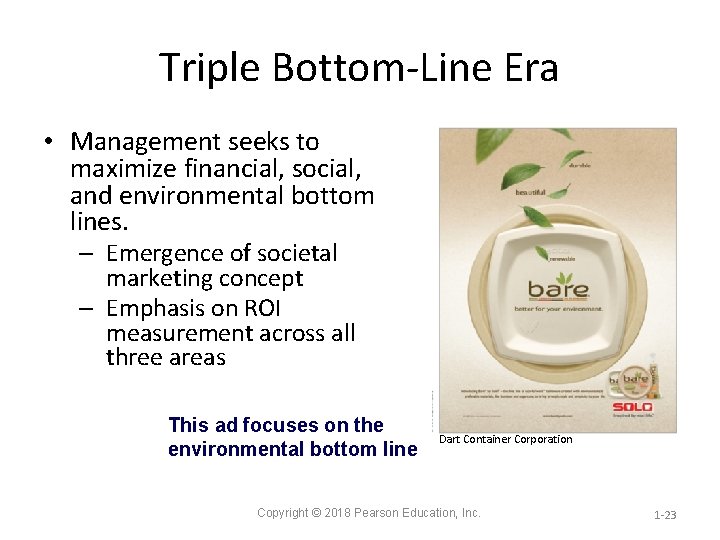
Triple Bottom Line Era • Management seeks to maximize financial, social, and environmental bottom lines. – Emergence of societal marketing concept – Emphasis on ROI measurement across all three areas This ad focuses on the environmental bottom line Dart Container Corporation Copyright © 2018 Pearson Education, Inc. 1 23
Sustainability • Sustainability is about creating products that meet present needs while ensuring future generations can have their needs met. – Green marketing is one type of sustainable business practice. Copyright © 2018 Pearson Education, Inc. 1 24
What’s Next in the Evolution of Marketing? • • Mobile marketing User generated content Corporate citizenship Big data Copyright © 2018 Pearson Education, Inc. 1 25
The Changing World of Marketing • Marketing has experienced many changes – Production → Selling → Relationship → Triple Bottom Line • Marketing in the midst of an exciting period of rapid change right now! What skills will marketers need to succeed in a “Big Data” era? Copyright © 2018 Pearson Education, Inc. 1 26
Ethical/Sustainable Decisions in the Real World • Many people are literally addicted to their phones and tablets. • Nearly three quarters of Americans sleep with their smart phones. Should companies try to increase the amount of time consumers spend with their small screens? Copyright © 2018 Pearson Education, Inc. 1 27
The Value of Marketing and the Marketing of Value • Value is benefits received by the consumer from a product relative to total costs. • Marketing activities lead to value creation through innovations that enhance customer benefits and reduce costs. • Marketing promotional activities communicate the value proposition. Copyright © 2018 Pearson Education, Inc. 1 28
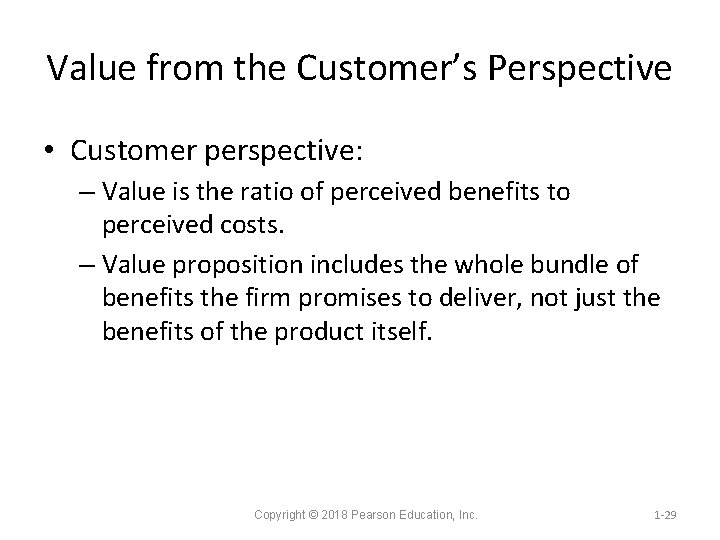
Value from the Customer’s Perspective • Customer perspective: – Value is the ratio of perceived benefits to perceived costs. – Value proposition includes the whole bundle of benefits the firm promises to deliver, not just the benefits of the product itself. Copyright © 2018 Pearson Education, Inc. 1 29
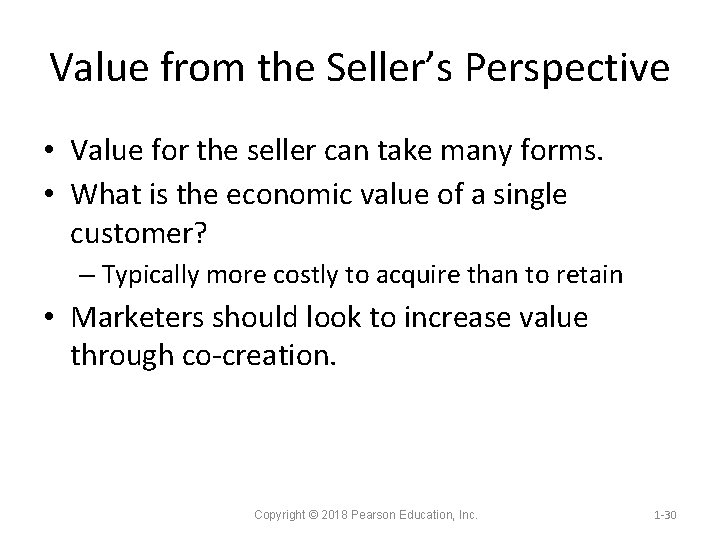
Value from the Seller’s Perspective • Value for the seller can take many forms. • What is the economic value of a single customer? – Typically more costly to acquire than to retain • Marketers should look to increase value through co creation. Copyright © 2018 Pearson Education, Inc. 1 30
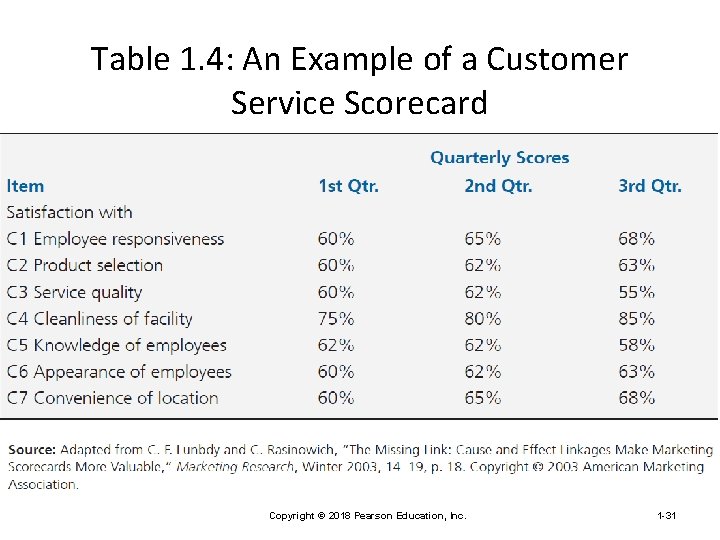
Table 1. 4: An Example of a Customer Service Scorecard Copyright © 2018 Pearson Education, Inc. 1 -31
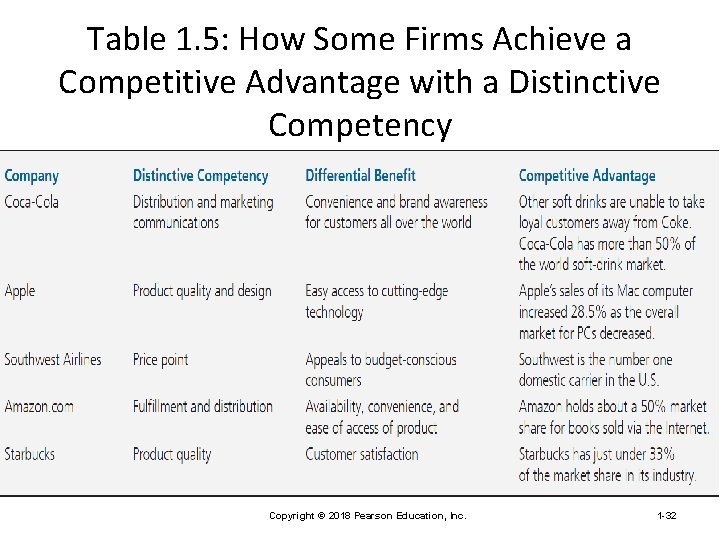
Table 1. 5: How Some Firms Achieve a Competitive Advantage with a Distinctive Competency Copyright © 2018 Pearson Education, Inc. 1 -32
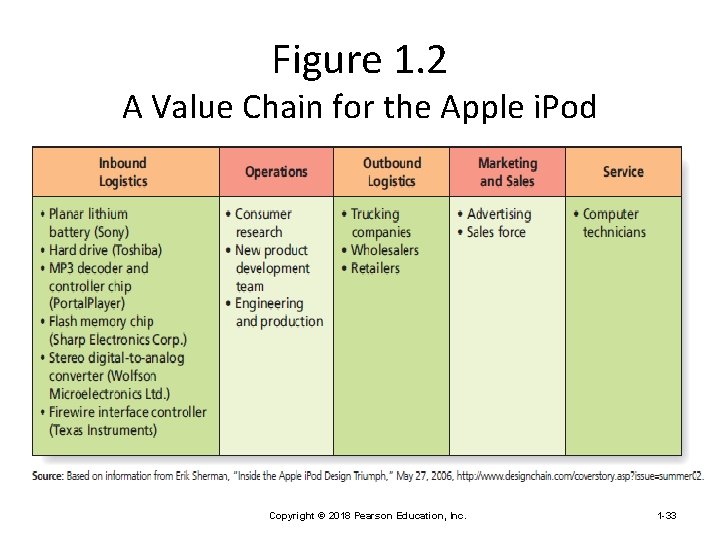
Figure 1. 2 A Value Chain for the Apple i. Pod Copyright © 2018 Pearson Education, Inc. 1 -33
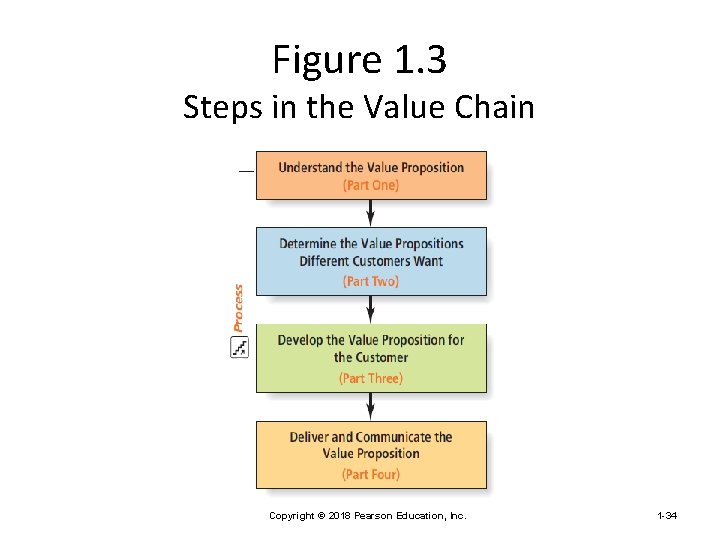
Figure 1. 3 Steps in the Value Chain Copyright © 2018 Pearson Education, Inc. 1 -34
Consumer Generated Value: From Audience to Community • Everyday people are generating value instead of just buying it. http: //www. crashthesuperbowl. com • Web 4. 0 puts the internet on smart phones. • Social networking platforms provide numerous opportunities for marketers. Copyright © 2018 Pearson Education, Inc. 1 35
Value from Society’s Perspective • Marketing transactions may add or subtract value from society. – Stressing socially responsible and ethical decisions is good for business. • Marketing often faces criticisms. – “Dark side” marketing and consumption issues Copyright © 2018 Pearson Education, Inc. 1 36
Value of Marketing • Marketing activities facilitate exchanges that create, communicate, and deliver value to customers. • Sellers and society at large also derive value from these exchanges. But marketing is sometimes misused Are criticisms of marketing justified? Copyright © 2018 Pearson Education, Inc. 1 37
Marketing as a Process Marketers ask questions related to: • Product benefits • Capabilities • Additional customer groups • Changes in technology • Changes in social and cultural values • Environmental issues • Legal and regulatory issues Copyright © 2018 Pearson Education, Inc. 1 38
Marketing as a Process • • • Marketing plan Mass market Market segment Target market Positioning Copyright © 2018 Pearson Education, Inc. 1 39
All rights reserved. No part of this publication may be reproduced, stored in a retrieval system, or transmitted, in any form or by any means, electronic, mechanical, photocopying, recording, or otherwise, without the prior written permission of the publisher. Printed in the United States of America. Copyright © 2018 Pearson Education, Inc. 1 40