
CHAPTER ONE The Master Reader by D J
CHAPTER ONE The Master Reader by D. J. Henry PART ONE Becoming a Master Reader Power. Point by Mary Dubbé Thomas Nelson Community College A Reading System for Master Readers Copyright © 2012 Pearson Education Inc. 1
CHAPTER ONE Chapter Outline and Learning Objectives In this chapter, you will learn to: 1 Define prior knowledge. 2 Discuss the three phases of the reading process. 3 Describe SQ 3 R. 4 Describe your reading process. Copyright © 2012 Pearson Education Inc.
CHAPTER ONE Assess your comprehension of prior knowledge and the reading process. 5 6 Evaluate the importance of prior knowledge and SQ 3 R. 7 Activate prior knowledge and apply SQ 3 R 8 to your reading process. Develop textbook skills. Use SQ 3 R to Copyright © 2012 Pearson Education Inc.
CHAPTER ONE 1 Define prior knowledge. Comprehension − an understanding of what has been read Connecting to prior knowledge increases comprehension. Prior Knowledge − the large body of information learned throughout a lifetime of experience Copyright © 2012 Pearson Education Inc.
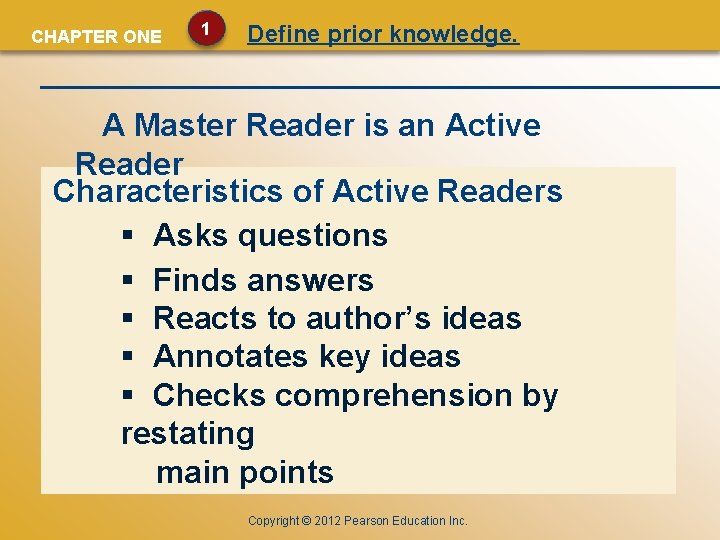
CHAPTER ONE 1 Define prior knowledge. A Master Reader is an Active Reader Characteristics of Active Readers § Asks questions § Finds answers § Reacts to author’s ideas § Annotates key ideas § Checks comprehension by restating main points Copyright © 2012 Pearson Education Inc.
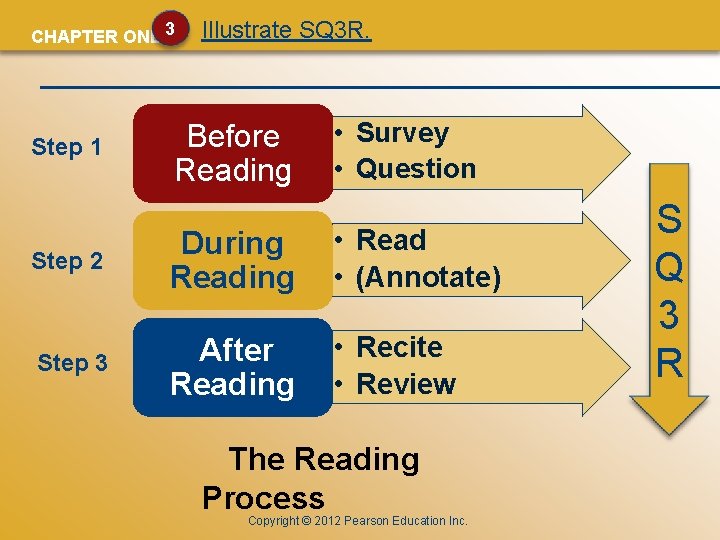
CHAPTER ONE 3 Step 1 Illustrate SQ 3 R. Before Reading • Survey • Question Step 2 During Reading • Read • (Annotate) Step 3 After Reading • Recite • Review The Reading Process Copyright © 2012 Pearson Education Inc. S Q 3 R
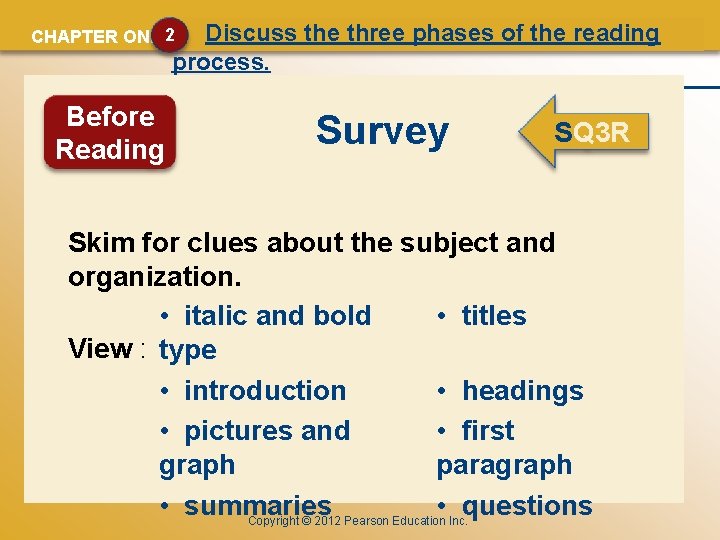
Discuss the three phases of the reading process. CHAPTER ONE 2 Before Reading Survey SQ 3 R Skim for clues about the subject and organization. • italic and bold • titles View : type • introduction • headings • pictures and • first graph paragraph • summaries • questions Copyright © 2012 Pearson Education Inc.
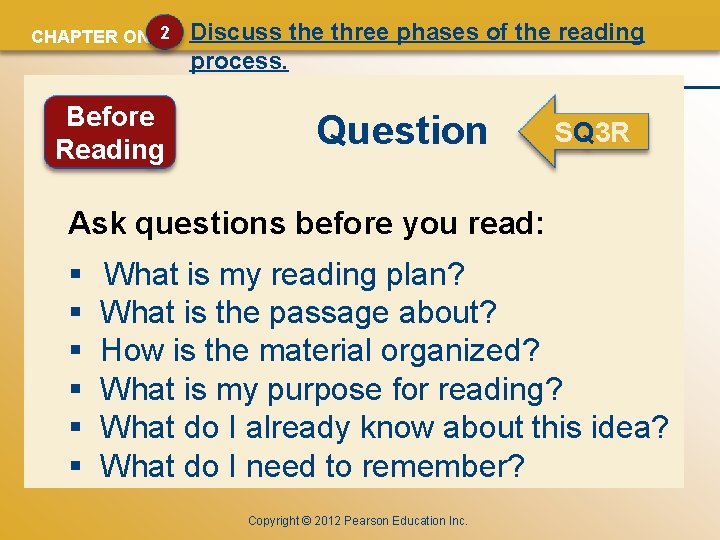
CHAPTER ONE 2 Before Reading Discuss the three phases of the reading process. Question SQ 3 R Ask questions before you read: § § § What is my reading plan? What is the passage about? How is the material organized? What is my purpose for reading? What do I already know about this idea? What do I need to remember? Copyright © 2012 Pearson Education Inc.
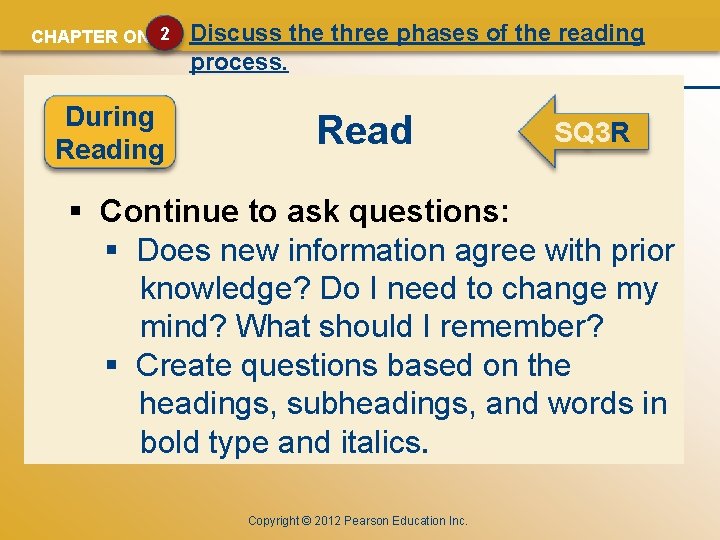
CHAPTER ONE 2 During Reading Discuss the three phases of the reading process. Read SQ 3 R § Continue to ask questions: § Does new information agree with prior knowledge? Do I need to change my mind? What should I remember? § Create questions based on the headings, subheadings, and words in bold type and italics. Copyright © 2012 Pearson Education Inc.
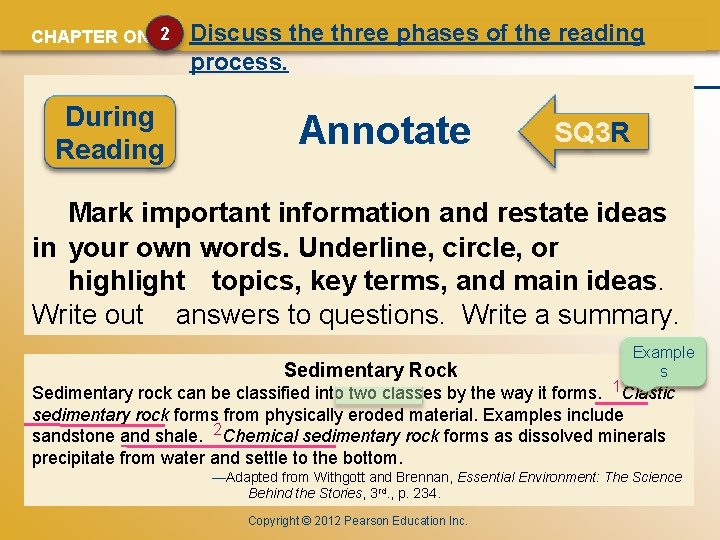
CHAPTER ONE 2 During Reading Discuss the three phases of the reading process. Annotate SQ 3 R Mark important information and restate ideas in your own words. Underline, circle, or highlight topics, key terms, and main ideas. Write out answers to questions. Write a summary. Sedimentary Rock Example s Sedimentary rock can be classified into two classes by the way it forms. 1 Clastic sedimentary rock forms from physically eroded material. Examples include sandstone and shale. 2 Chemical sedimentary rock forms as dissolved minerals precipitate from water and settle to the bottom. —Adapted from Withgott and Brennan, Essential Environment: The Science Behind the Stories, 3 rd. , p. 234. Copyright © 2012 Pearson Education Inc.
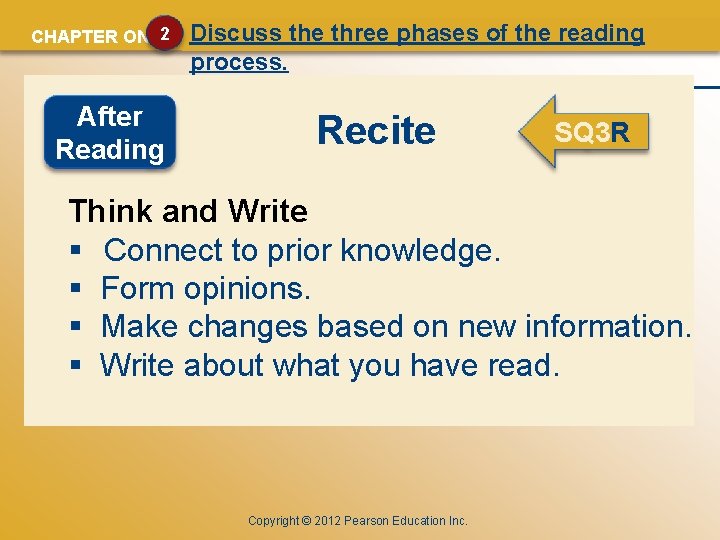
CHAPTER ONE 2 After Reading Discuss the three phases of the reading process. Recite SQ 3 R Think and Write § Connect to prior knowledge. § Form opinions. § Make changes based on new information. § Write about what you have read. Copyright © 2012 Pearson Education Inc.
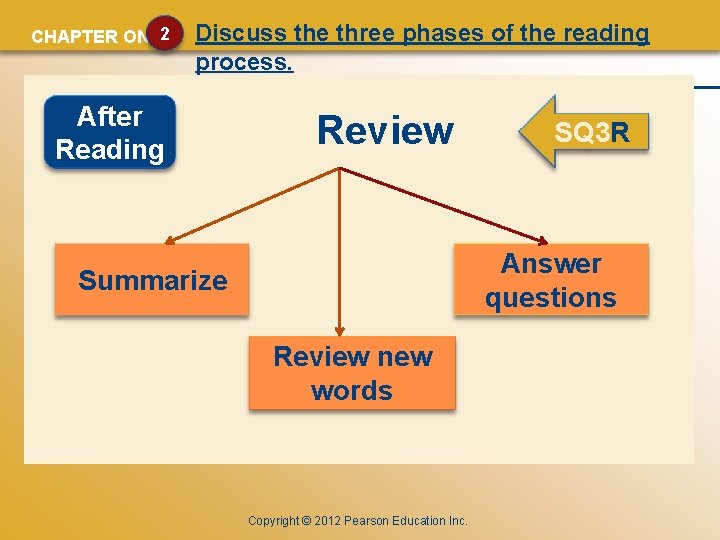
CHAPTER ONE 2 Discuss the three phases of the reading process. After Reading Review SQ 3 R Answer questions Summarize Review new words Copyright © 2012 Pearson Education Inc.
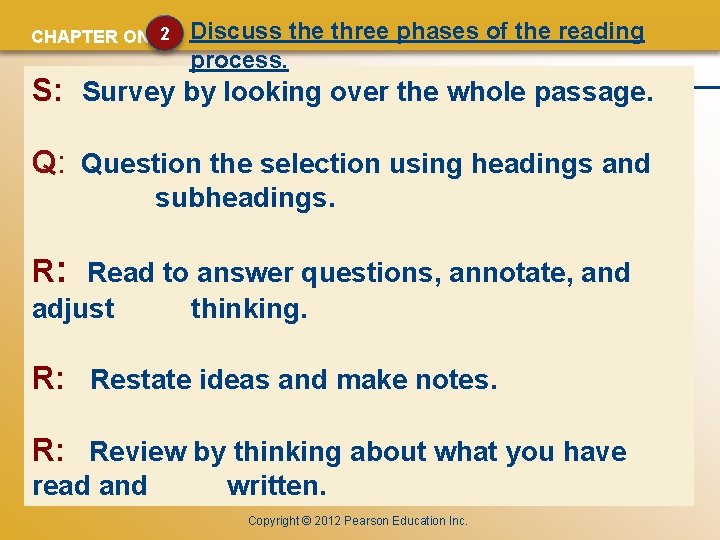
CHAPTER ONE 2 Discuss the three phases of the reading process. S: Survey by looking over the whole passage. Q: Question the selection using headings and subheadings. R: Read to answer questions, annotate, and adjust thinking. R: Restate ideas and make notes. R: Review by thinking about what you have read and written. Copyright © 2012 Pearson Education Inc.
CHAPTER ONE 5 Let’s Review! Assess your comprehension of the terms and concepts included in this chapter. Copyright © 2012 Pearson Education Inc.
CHAPTER ONE 1. The understanding of information is called _______. A. comprehension B. passive learning C. prior knowledge D. the reading process Copyright © 2012 Pearson Education Inc.
CHAPTER ONE 1. The understanding of information is called _______. A. comprehension B. passive learning C. prior knowledge D. the reading process 1 Define prior knowledge. Copyright © 2012 Pearson Education Inc.
CHAPTER ONE 2. The large body of information that is learned throughout a lifetime of experiences is called _______. A. experiential learning B. passive learning C. prior knowledge D. the reading process Copyright © 2012 Pearson Education Inc.
CHAPTER ONE 2. The large body of information that is learned throughout a lifetime of experiences is called _______. A. experiential learning B. passive learning C. prior knowledge D. the reading process 5 Assess your comprehension of prior knowledge and the reading process. Copyright © 2012 Pearson Education Inc.
CHAPTER ONE 3. SQ 3 R is a reading process that _______. A. helps the reader define difficult vocabulary words B. involves memorizing content word for word C. contains three steps D. activates prior knowledge and offers reading strategies Copyright © 2012 Pearson Education Inc.
CHAPTER ONE 3. SQ 3 R is a reading process that _______. A. helps the reader define difficult vocabulary words B. involves memorizing content word for word C. contains three steps D. activates prior knowledge and offers reading strategies 5 Assess your comprehension of prior knowledge and the reading process. Copyright © 2012 Pearson Education Inc.
CHAPTER ONE 4. In SQ 3 R, the first step stands for _______, which requires the reader to quickly skim the reading passage. A. skim B. summarize C. simulate D. survey Copyright © 2012 Pearson Education Inc.
CHAPTER ONE 4. In SQ 3 R, the first step stands for _______, which requires the reader to quickly skim the reading passage. A. skim B. summarize C. simulate D. survey 2 Discuss the three phases of the reading process. Copyright © 2012 Pearson Education Inc.
CHAPTER ONE 5. While surveying, the effective reader should look for clues about the _______. A. summary or conclusion B. hidden meanings C. subject and organization D. author’s biases Copyright © 2012 Pearson Education Inc.
CHAPTER ONE 5. While surveying, the effective reader should look for clues about the _______. A. summary or conclusion B. hidden meanings C. subject and organization D. author’s biases 2 Discuss the three phases of the reading process. Copyright © 2012 Pearson Education Inc.
CHAPTER ONE 6. Questions should be created from the _______. A. supporting details B. examples C. index D. concluding paragraph Copyright © 2012 Pearson Education Inc.
CHAPTER ONE 6. Questions should be created from the _______. A. supporting details B. examples C. index D. concluding paragraph 2 Discuss the three phases of the reading process. Copyright © 2012 Pearson Education Inc.
CHAPTER ONE 7. While reading, the effective reader should _______. A. summarize the important details B. annotate key words and ideas C. skim for surface information D. ignore headings and subheadings Copyright © 2012 Pearson Education Inc.
CHAPTER ONE 7. While reading, the effective reader should _______. A. summarize the important details B. annotate key words and ideas C. skim for surface information D. ignore headings and subheadings 2 Discuss the three phases of the reading process. Copyright © 2012 Pearson Education Inc.
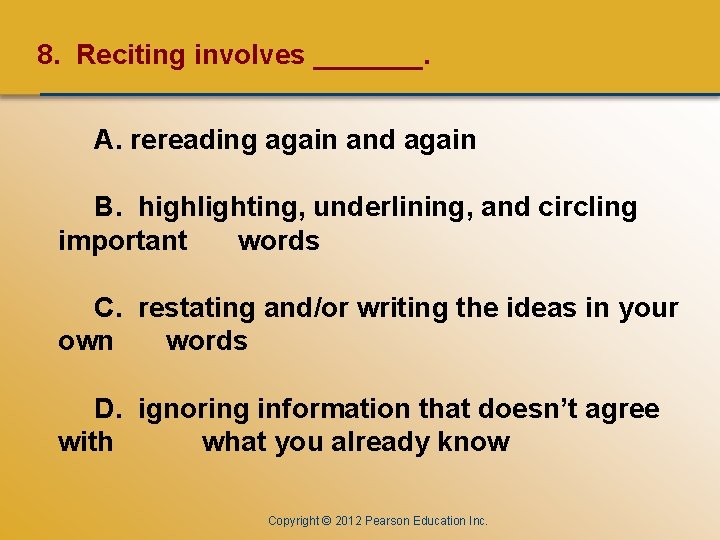
CHAPTER ONE 8. Reciting involves _______. A. rereading again and again B. highlighting, underlining, and circling important words C. restating and/or writing the ideas in your own words D. ignoring information that doesn’t agree with what you already know Copyright © 2012 Pearson Education Inc.
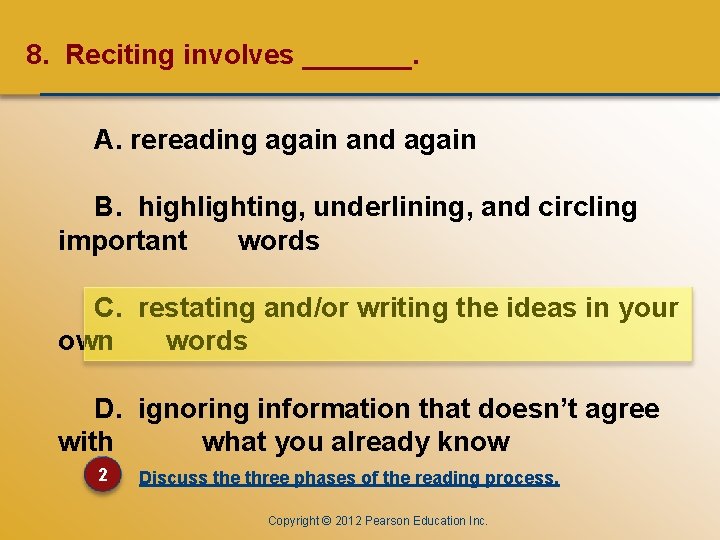
CHAPTER ONE 8. Reciting involves _______. A. rereading again and again B. highlighting, underlining, and circling important words C. restating and/or writing the ideas in your own words D. ignoring information that doesn’t agree with what you already know 2 Discuss the three phases of the reading process. Copyright © 2012 Pearson Education Inc.
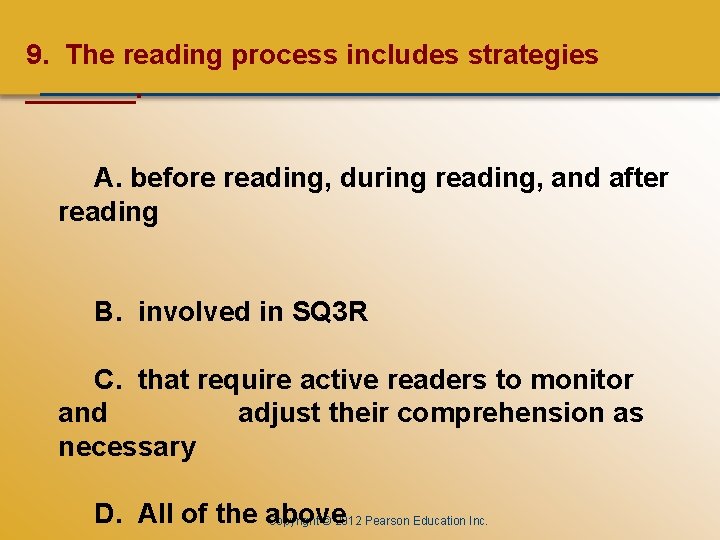
CHAPTER ONE 9. The reading process includes strategies _______. A. before reading, during reading, and after reading B. involved in SQ 3 R C. that require active readers to monitor and adjust their comprehension as necessary D. All of the above Copyright © 2012 Pearson Education Inc.
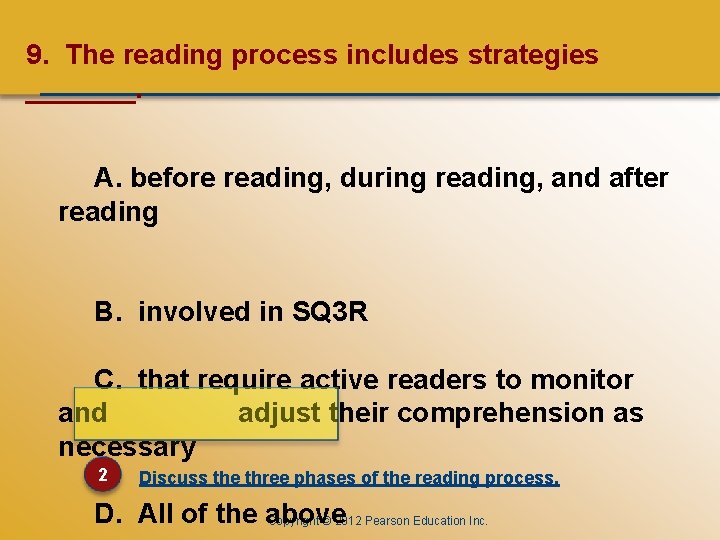
CHAPTER ONE 9. The reading process includes strategies _______. A. before reading, during reading, and after reading B. involved in SQ 3 R C. that require active readers to monitor and adjust their comprehension as necessary 2 Discuss the three phases of the reading process. D. All of the above Copyright © 2012 Pearson Education Inc.
CHAPTER ONE 10. Understanding the relationship of prior knowledge and SQ 3 R is important because_______. A. this helps a reader to skim instead of reading tedious textbooks B. reading then becomes an active process that enables the reader to achieve comprehension C. most students find textbook reading impossible D. the student won’t need to purchase textbooks Copyright © 2012 Pearson Education Inc.
CHAPTER ONE 10. Understanding the relationship of prior knowledge and SQ 3 R is important because_______. A. this helps a reader to skim instead of reading tedious textbooks B. reading then becomes an active process that enables the reader to achieve comprehension C. most students find textbook reading impossible Evaluate the importance prior knowledge and SQ 3 R. D. 6 the student won’tofneed to purchase textbooks Copyright © 2012 Pearson Education Inc.
CHAPTER ONE For more practice, connect to www. myreadinglab. com. See page 37 of The Master Reader, 3 rd edition, for specific activities related to Chapter 2. Copyright © 2012 Pearson Education Inc. 35
- Slides: 35