
Chapter One The History of Law Enforcement Police
- Slides: 44
Chapter One The History of Law Enforcement
• • • Police Activities Patrol Traffic Enforcement K-9 SWAT Gang Unit Undercover • • • Crime Prevention Corrections Dispatch School Resource Detectives Forensics
Define “Justice” • What is right and fair. • A standard of fairness where it is judged whether each person is rewarded what he/she is due. • Who determines what is right and fair?
Which comes first, Laws or Morality? • As people grow, they develop feelings that certain actions are right or wrong. These feelings are created by parents, school, religion, country, friends, and others. These ideas about duties and ethics we will refer to as morality, although many refer to these feelings as a conscience.
Which comes first Morality or Laws? • When enough people with political power within the government agree that an action should be labeled right or wrong and that everyone should be made to follow their decision, a law is then created
Are all laws enforced? ? • Is it feasible to enforce all laws all the time?
Discretion • Who gets to decide whether or not to enforce a law? – Judges – Prosecutors – Police
Laws not widely enforced • Polygamy • Jay Walking • Curfew • Some traffic laws • Speeding, Improper turns, Vehicle condition • Truancy
Why aren’t they Enforced • Lack of public consensus that the law should be enforced. • Widespread violation • Limited manpower • Low priorities.
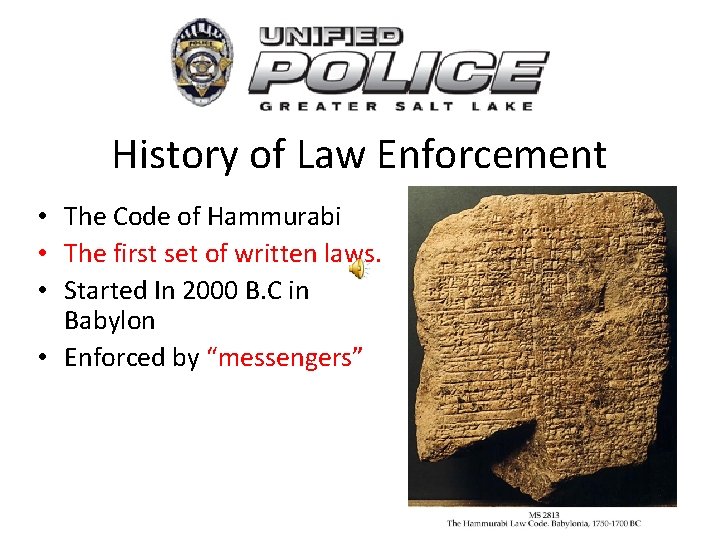
History of Law Enforcement • The Code of Hammurabi • The first set of written laws. • Started In 2000 B. C in Babylon • Enforced by “messengers”
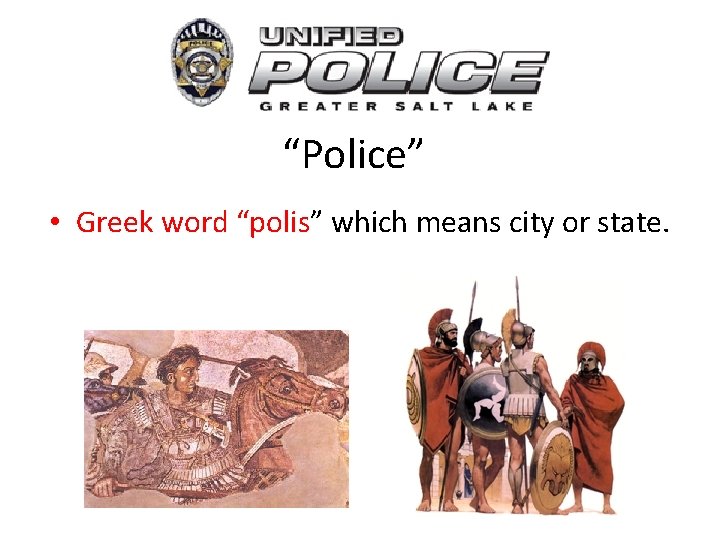
“Police” • Greek word “polis” which means city or state.
History of Law Enforcement • 1200 B. C. Assyrian Empire: court system • 700 B. C. Egypt: marine or customs police • 400 B. C. Persian Empire: police to protect roads and postal system
Roman Empire • The Roman Empire was the first non-military police force established in the city. They were known as vigils. • Weapons were wooden clubs and short swords
Tithing System • • 9 th century, King Alfred of England Villages organized into groups of ten families. Ten families a tithing, the leader Tithingman raised the “hue and cry”
Norman Philosophy of Law Enforcement • Normans invaded England in 1066 • Crimes were now viewed as being committed against the state and not the individual victim. • Villages located in Shires. • The king appointed a Reeve to control the Shire • The Reeve was able to enlist the aid of all able bodied men in the shire in order to form a posse comitatus to respond to violations of law.
England started many traditions • The watch and ward system. Law enforcement by citizens. • Sir Robert Peel • Judge Henry Fielding started the bow street runners • The Magna Charta • The Statute of Winchester was the first attempt to organize a systematic police system
The word “Sheriff” • “Shires” = Counties • “Reeve” = Chief law enforcement officer • Shire-reeve evolved into “Sheriff”
England in 1215 • The Magna Carter signed reducing the king’s power. • Law enforcement again became community based. • Watch and Ward system
Watch and Ward System • • • The patrol function within a community Any male between 15 and 60 Watch = night patrol Ward = day patrol Sir Robert Peel called it shiver and shake. Shiver from cold shake from fear
The Statute of Winchester • • • Created in 1285 First English attempt at systematic police Created Bailiffs Created Sergeants Continues until the sixteenth century when the industrial revolution ends unpaid civilian police.
Henry Fielding • • 1737, the king allows cities to tax for police. Magistrate of Bow Street Court Didn’t like the watchmen and constables. Created the Bow Street Runners – Officer working directly for the judge.
Sir Robert Peel • An Aristocrat in 1829 – Served as member of Parliament, Undersecretary of war, Chief Secretary of Ireland, Home Secretary of England, Prime Minister • Introduced the Metropolitan Police Improvement Bill. • English police officers are still nicknamed “Bobbies” after Peel’s first name. (5, 2)
Sir Robert Peel Felt the primary responsibility of a police officer was to serve the public. He truly believed, “The police are the public and the public are the police. ”
Peel’s Tenants and Beliefs • • • Police organized along military lines Police under government control Absence of crime best proves police efficiency. Must distribute crime news Deploy police strength by time and area Policemen should have a controlled tempter, quiet and determined manner
Peel’s Tenants and Beliefs Cont. Good appearance commands respect Proper selection and training of police is root of efficiency Officer’s must have identifying numbers Police headquarters should be centrally located and easily accessible to public • Probation for new hires • Police crime records are necessary to best distribute police • Peel’s principles are still valid today. (7&8) • •
Policing in America Citizens distrust central authority Elect law enforcement officials Use a watch and ward system Around 1658 initiated a paid patrol, these watchmen wore the first American police uniforms, continued until 1830’s • In 1700 watchmen became civilian rather that military police • •
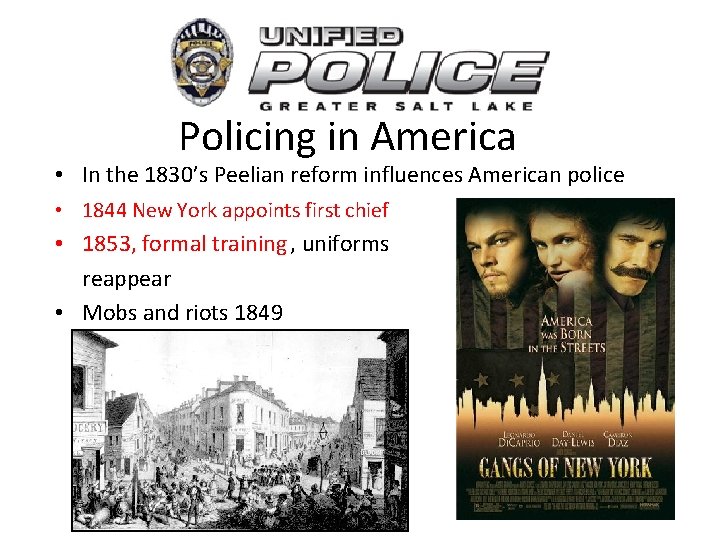
Policing in America • In the 1830’s Peelian reform influences American police • 1844 New York appoints first chief • 1853, formal training , uniforms reappear • Mobs and riots 1849
Policing in America • Philadelphia first merit system for advancement • 1835, Texas Rangers first State Police Agency. Now all states have State Police or Highway Patrol. • Massachusetts State Police to investigate local police • Pennsylvania State Police to deal with striking coal miners • 1789, U. S. Marshals first federal agency • 1870, Bureau of Investigation created for transportation of women across state lines for immoral purposes, 1935 name changes to the FBI.
Policing in America Continued • Three basic functions of Law Enforcement – Combating Criminal Violations. – Enforcing Laws – Provide miscellaneous services (jails, ambulance, etc. )
Policing in America continued • As of January 1, 2008 Utah has approximately 4, 706 Sworn police officers. • Of all Police Departments nationally in 2008, 11. 9% were female. • Of all Sheriff’s Departments nationally in 2007, 13. 6% were female • Nationally 2. 5 Officers per 1, 000 citizens. • In Utah, 1. 8 Officers per 1, 000 citizens. (10, 3)
The Bill of Rights • March 1, 1781 Articles of Confederation ratified. • May 14, 1787 Constitutional Convention • Connecticut Compromise, The Great Compromise. – Deals with representation in House & Senate – Completes the writing of the Constitution
The Bill of Rights • James Madsen pushes the 1 st congress to discuss a bill of rights • 124 proposed amendments • 90 introduced amendments • 12 submitted for ratification • 10 become The Bill of Rights
AMENDMENT I • Congress shall make no law respecting an establishment of religion, or prohibiting the free exercise thereof; or abridging the freedom of speech, or of the press; or the right of the people peaceably to assemble, and to petition the Government for a redress of grievances.
AMENDMENT II • A well regulated Militia, being necessary to the security of free State, the right of the people to keep and bear Arms, shall not be infringed. (12, 2)
AMENDMENT III • No Soldier shall, in time of peace be quartered in any house, without the consent of the owner, nor in time of War, but in a manner to be prescribed by law.
AMENDMENT IV • The right of the people to be secure in their persons, houses, papers, and effects, against unreasonable searches and seizures, shall not be violated, and no Warrants shall issue, but on probable cause, supported by Oath or affirmation, and particularly describing the place to be searched, and the persons or things to be seized.
AMENDMENT V • No person shall be held to answer for a capital, or otherwise infamous crime, unless on a presentment or indictment of a Grand Jury, except in cases arising in the land or naval forces, or in the Militia, when in actual service in time of War or public danger; nor shall any person be subject for the same offense to be twice put in jeopardy of life or limb, nor shall be compelled in any criminal case to be a witness against himself, nor be deprived of life, liberty, or property, without due process of law; nor shall private property be taken for public use, without just compensation.
AMENDMENT VI • In all criminal prosecutions, the accused shall enjoy the right to a speedy and public trial, by an impartial jury of the state and district wherein the crime shall have been committed, which district shall have been previously ascertained by law, and to be informed of the nature and cause of the accusation; to be confronted with the witness against him; to have compulsory process for obtaining Witnesses in his favor and to have the Assistance of Counsel for his defense.
AMENDMENT VII • In suits at common law, where the value in controversy shall exceed twenty dollars, the right of trial by jury shall be preserved, and no fact tried by a jury, shall be otherwise re-examined in any court of the United States, then according to the rules of the common law.
AMENDMENT VIII • Excessive bail shall not be required, nor excessive fines imposed, nor cruel and unusual punishments imposed.
AMENDMENT IX • The enumeration in the constitution of certain rights, shall not be construed to deny or disparage others retained by the people.
AMENDMENT X • The powers not delegated to the United States by the Constitution, nor prohibited by it to the States, are reserved to the States, respectively, or to the people.
AMENDMENT XIV • Section 1. All persons born or naturalized in the United States, and subject to the jurisdiction thereof, are citizens of the United States and of the state wherein they reside. No State shall make or enforce any law which shall abridge the privileges or immunities of the citizens of the United States; nor shall the State deprive any person of life, liberty, or property, without due process of law; nor deny to any person within its jurisdiction the equal protection of the laws. . .