
CHAPTER ONE The Foundations of Chemistry Red pigment

- Slides: 69
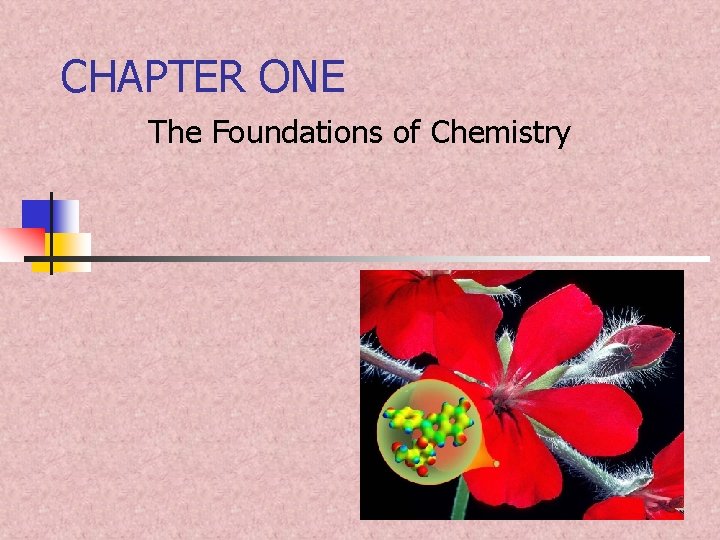
CHAPTER ONE The Foundations of Chemistry
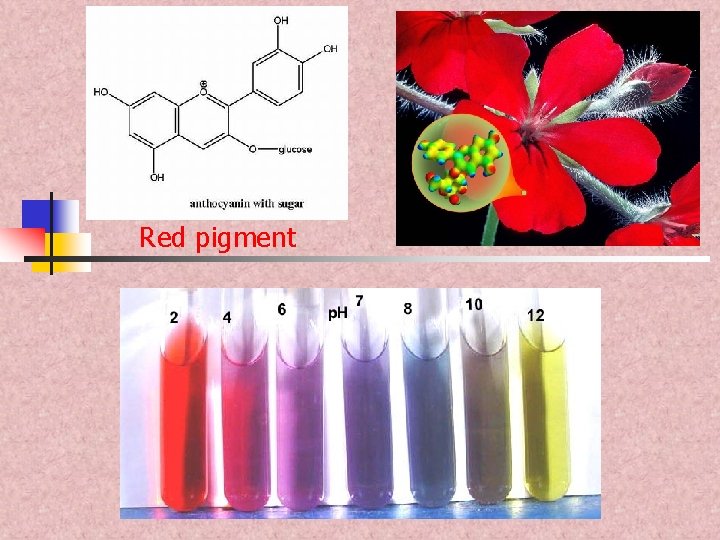
Red pigment
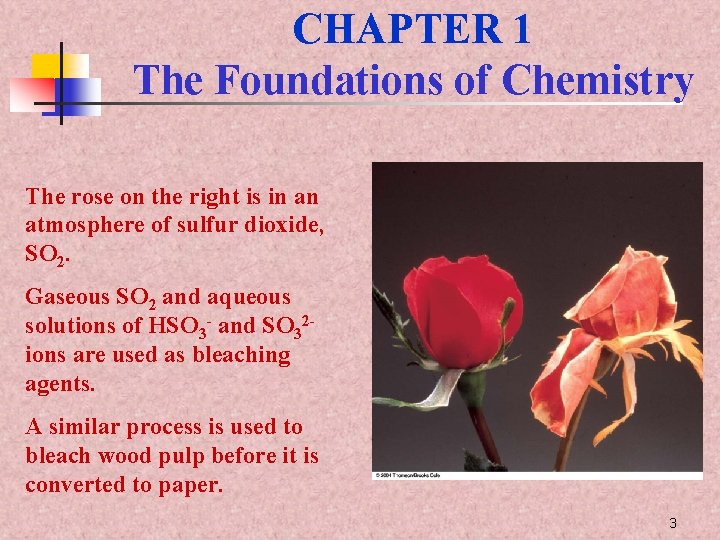
CHAPTER 1 The Foundations of Chemistry The rose on the right is in an atmosphere of sulfur dioxide, SO 2. Gaseous SO 2 and aqueous solutions of HSO 3 - and SO 32 ions are used as bleaching agents. A similar process is used to bleach wood pulp before it is converted to paper. 3
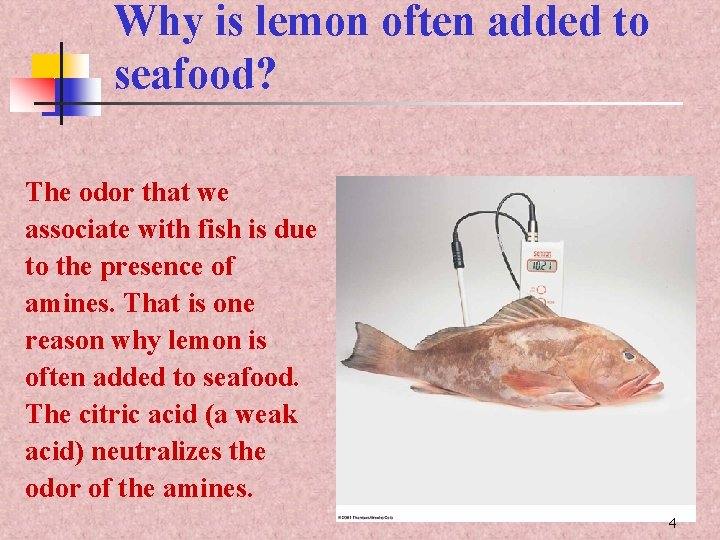
Why is lemon often added to seafood? The odor that we associate with fish is due to the presence of amines. That is one reason why lemon is often added to seafood. The citric acid (a weak acid) neutralizes the odor of the amines. 4
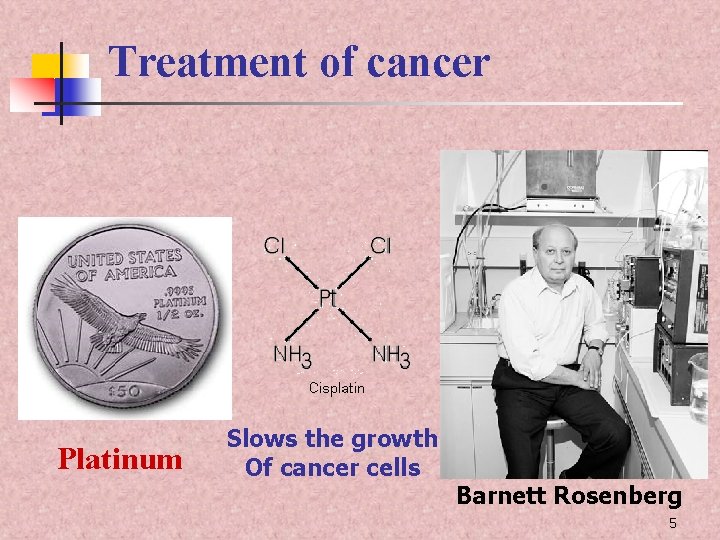
Treatment of cancer Platinum Slows the growth Of cancer cells Barnett Rosenberg 5
Matter and Energy - Vocabulary n Chemistry n n Matter n n Science that describes matter – its properties, the changes it undergoes, and the energy changes that accompany those processes Anything that has mass and occupies space. Energy n The capacity to do work or transfer heat. 6
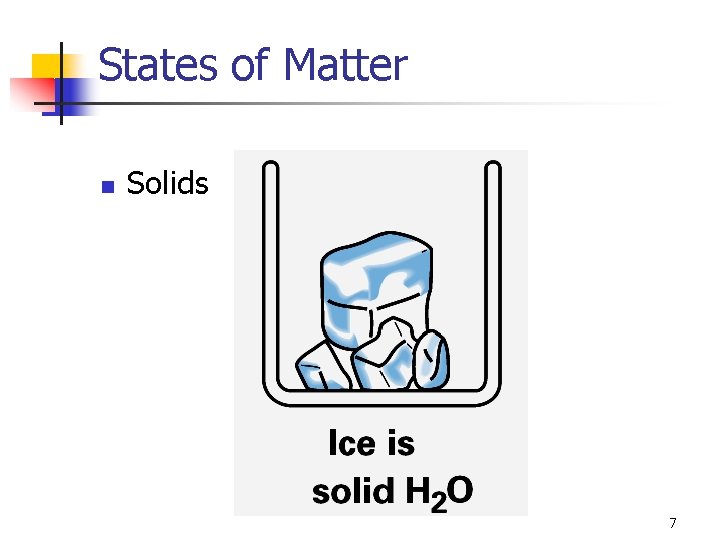
States of Matter n Solids 7
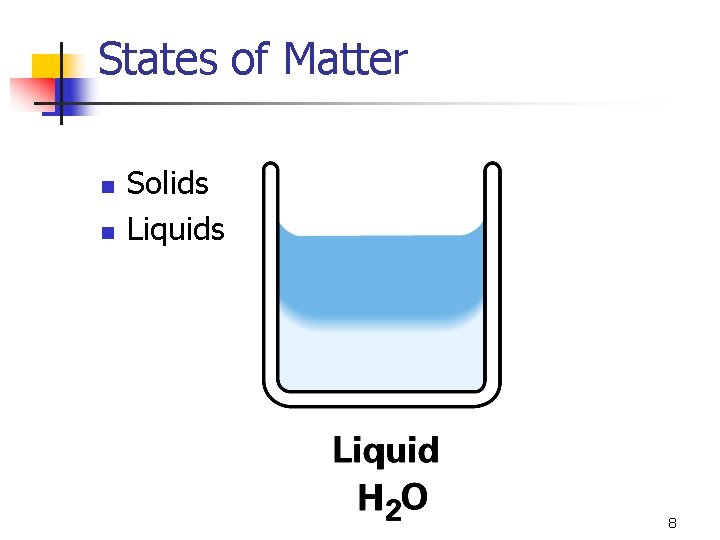
States of Matter n n Solids Liquids 8
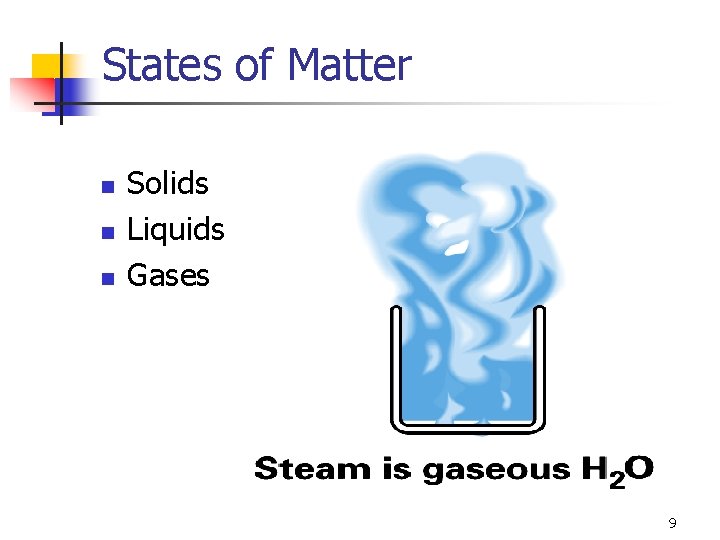
States of Matter n n n Solids Liquids Gases 9
States of Matter n n Solids Liquids Gases Plasma (another form of the gaseous state) 10
Chemical and Physical Properties n n Chemical Properties - chemical changes n rusting or oxidation n chemical reactions Physical Properties - physical changes n changes of state n density, color, solubility Extensive Properties - depend on quantity (mass, volume) Intensive Properties - do not depend on quantity (color, temperature, density, melting point, etc. ) 11
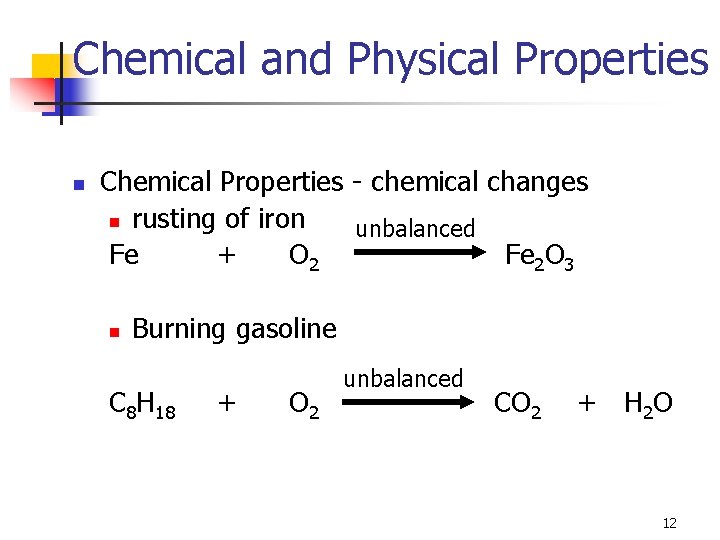
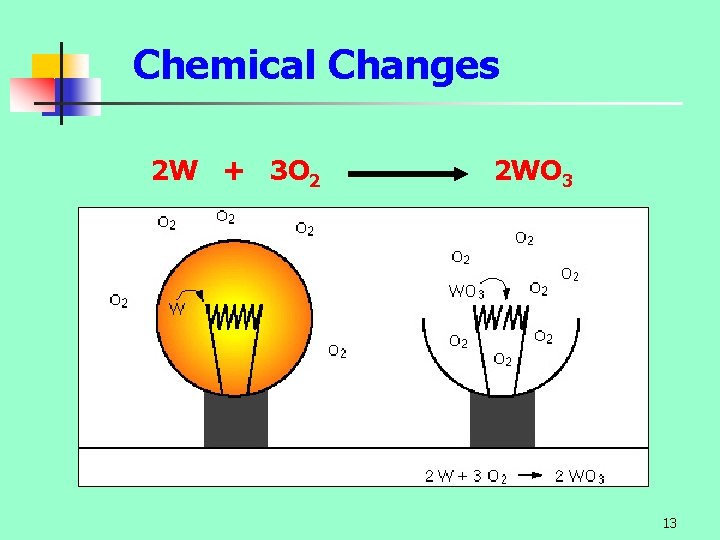
Chemical and Physical Properties n Chemical Properties - chemical changes n rusting of iron unbalanced Fe + O 2 Fe 2 O 3 n Burning gasoline C 8 H 18 + O 2 unbalanced CO 2 + H 2 O 12
Chemical Changes 2 W + 3 O 2 2 WO 3 13
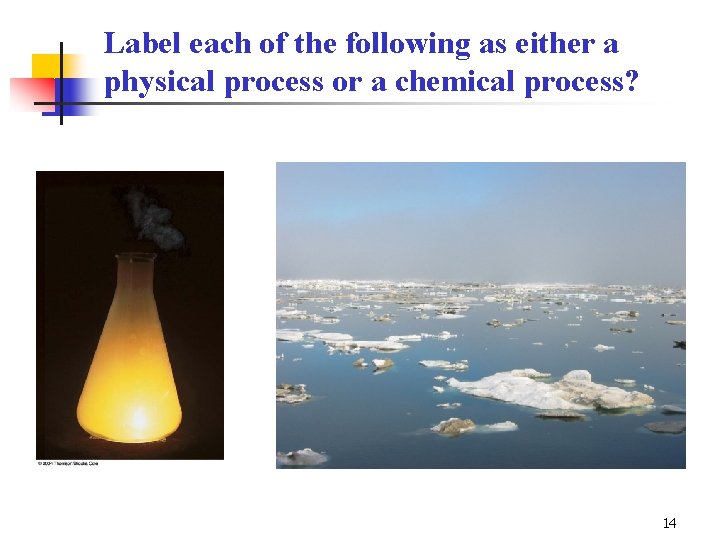
Label each of the following as either a physical process or a chemical process? 14
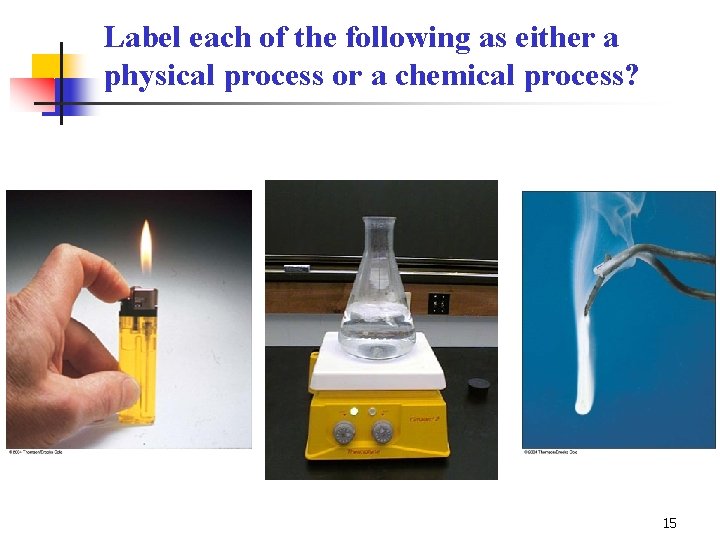
Label each of the following as either a physical process or a chemical process? 15
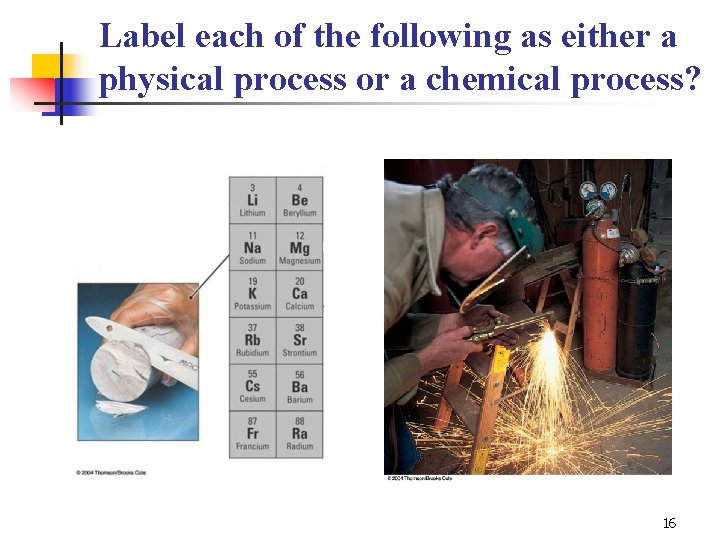
Label each of the following as either a physical process or a chemical process? 16
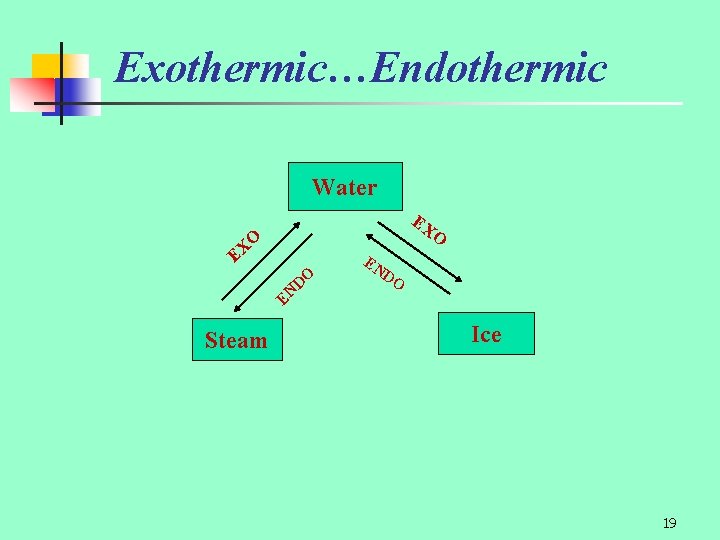
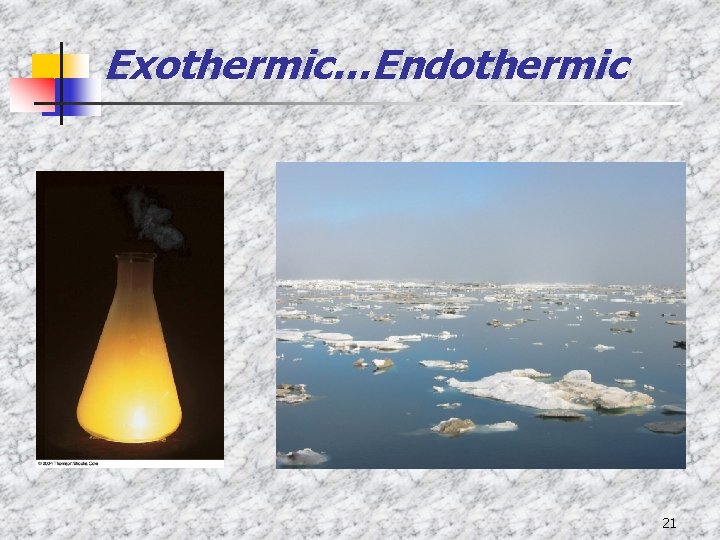
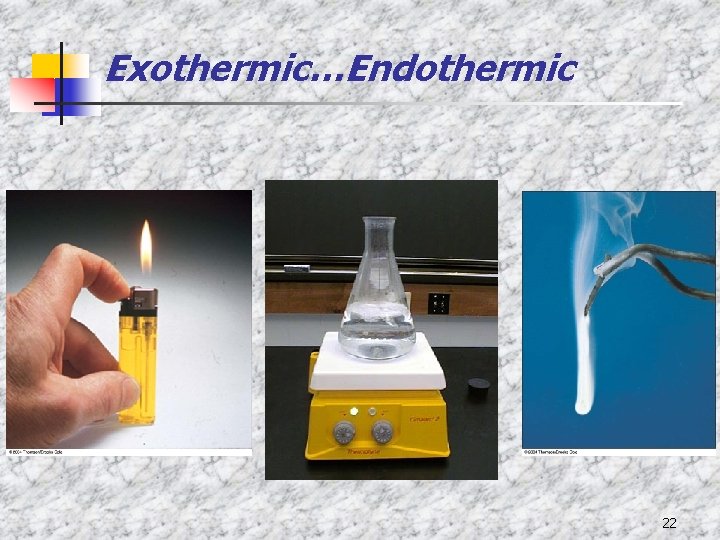
Exothermic…Endothermic n n n (a) Combustion is an exothermic process in which a chemical reaction releases heat. (b) The freezing of water is an exothermic process. Heat must be removed from the molecules in the liquid state to cause solidification. (c) The melting of ice is an endothermic process. The system requires heat to break the attractive forces that hold solid water together. 17
Exothermic…Endothermic n n (d) The boiling of water is an endothermic process. Molecules of liquid water must absorb energy to break away from the attractive forces that hold liquid water together in order to form gaseous molecules. (e) The condensing of steam is an exothermic process. The heat stored in water vapor must be removed for the vapor to liquefy. The condensation process is the opposite of boiling which requires heat. 18
Exothermic…Endothermic Water EX O EN D O O X E Steam Ice 19
Take-Home Vocabulary n n n Endothermic: Describes processes that absorb heat energy. Exothermic: Describes processes that release heat energy. Energy: The capacity to do work or transfer heat. 20
Exothermic…Endothermic 21
Exothermic…Endothermic 22
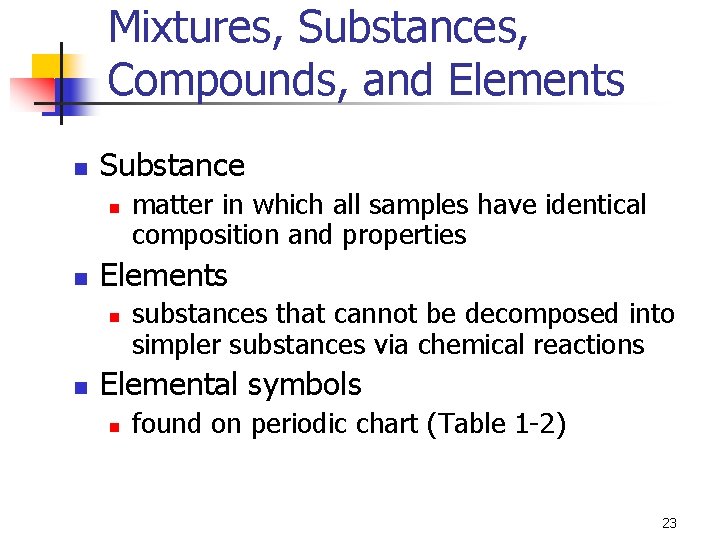
Mixtures, Substances, Compounds, and Elements n Substance n n Elements n n matter in which all samples have identical composition and properties substances that cannot be decomposed into simpler substances via chemical reactions Elemental symbols n found on periodic chart (Table 1 -2) 23
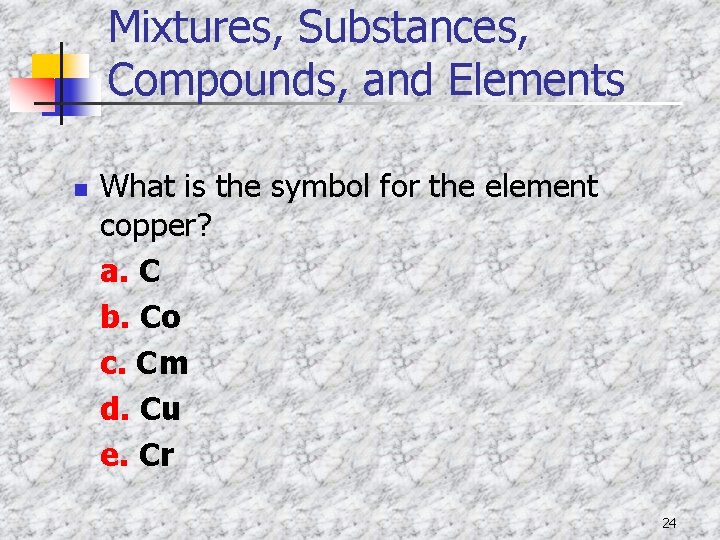
Mixtures, Substances, Compounds, and Elements n What is the symbol for the element copper? a. C b. Co c. Cm d. Cu e. Cr 24
Mixtures, Substances, Compounds, and Elements Which name - symbol combination is wrong? a. silver – Au b. krypton – Kr c. zinc – Zn d. platinum – Pt e. tungsten - W 25
Mixtures, Substances, Compounds, and Elements n Compounds n n substances composed of two or more elements in a definite ratio by mass can be decomposed into the constituent elements n Water is a compound that can be decomposed into simpler substances – hydrogen and oxygen 26
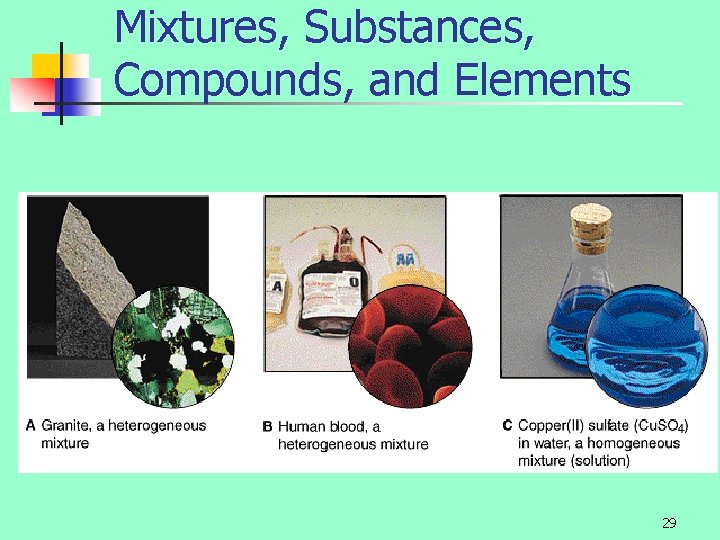
Mixtures, Substances, Compounds, and Elements n Mixtures n n n composed of two or more substances homogeneous mixtures: e. g. solution (dissolved salt + water, brass, etc. ) heterogeneous mixtures: e. g. soil (rocks, clay, organic matter, etc. ) 27
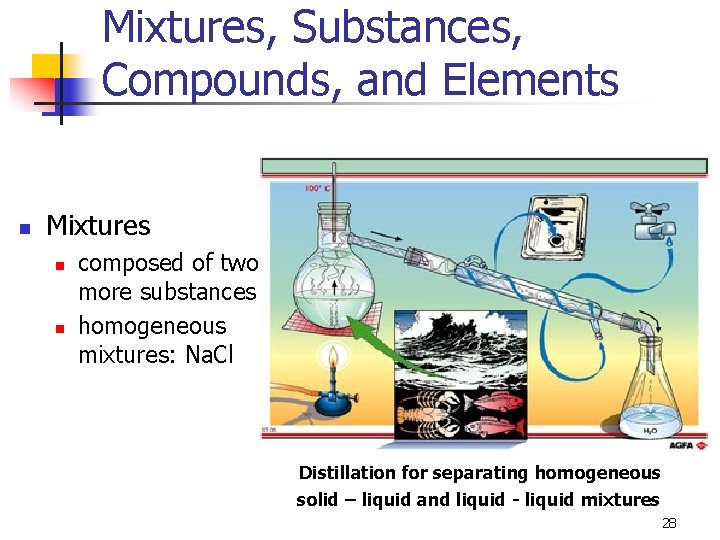
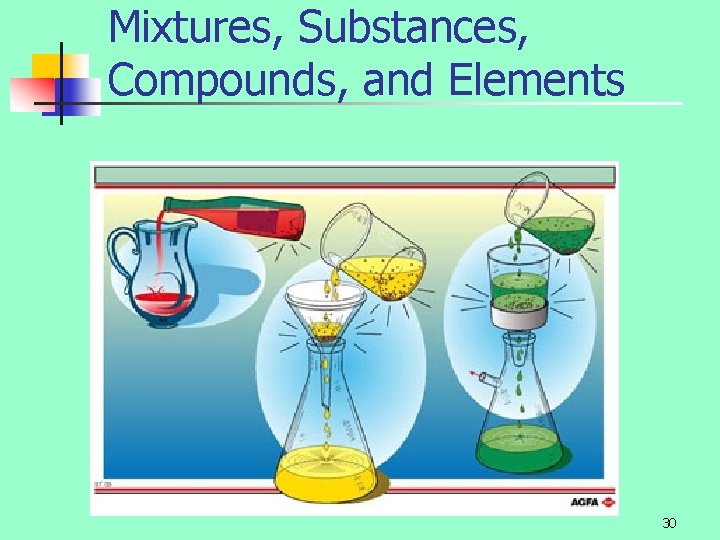
Mixtures, Substances, Compounds, and Elements n Mixtures n n composed of two or more substances homogeneous mixtures: Na. Cl Distillation for separating homogeneous solid – liquid and liquid - liquid mixtures 28
Mixtures, Substances, Compounds, and Elements 29
Mixtures, Substances, Compounds, and Elements 30
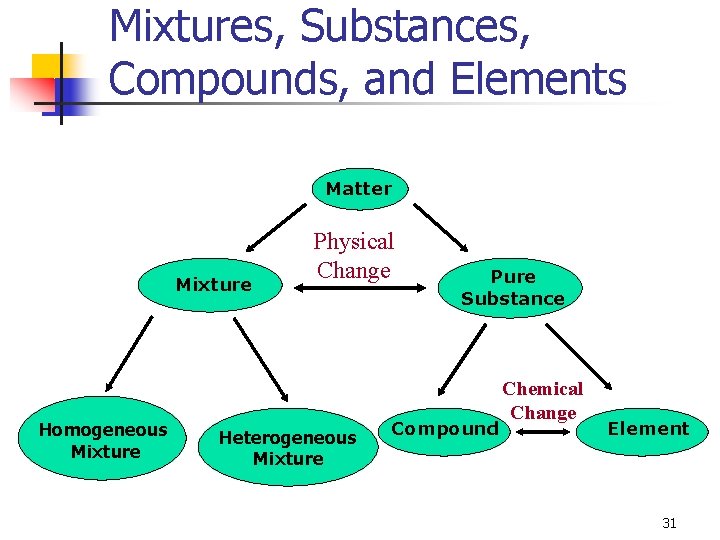
Mixtures, Substances, Compounds, and Elements Matter Mixture Homogeneous Mixture Physical Change Heterogeneous Mixture Pure Substance Compound Chemical Change Element 31
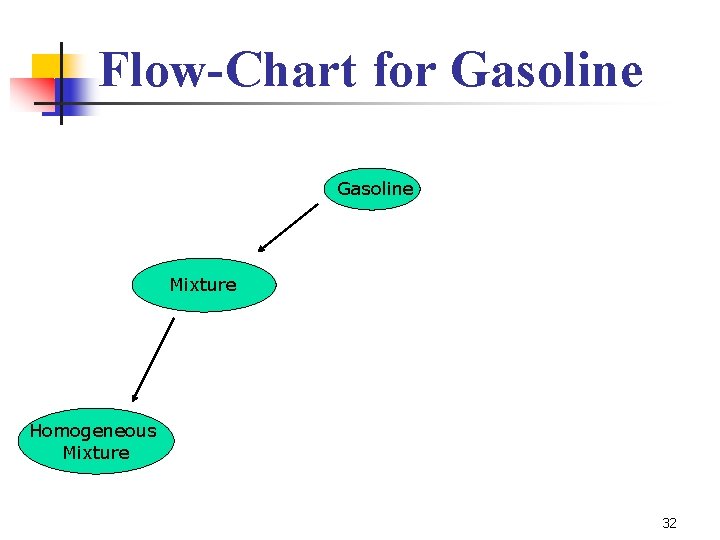
Flow-Chart for Gasoline Mixture Homogeneous Mixture 32
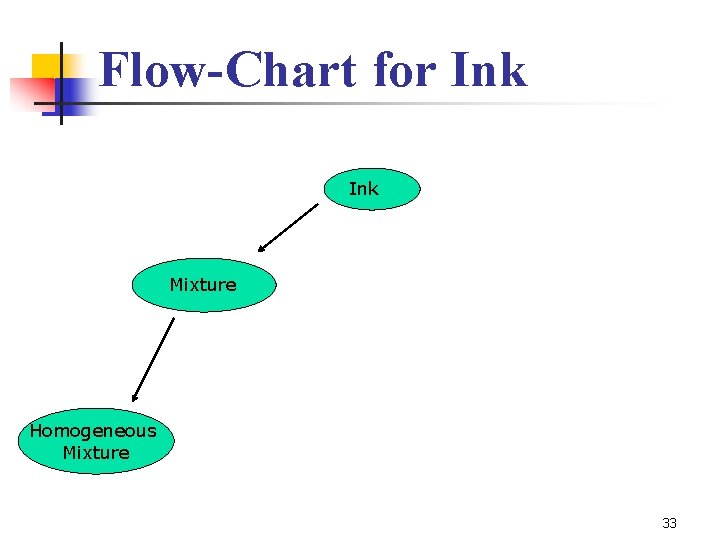
Flow-Chart for Ink Mixture Homogeneous Mixture 33
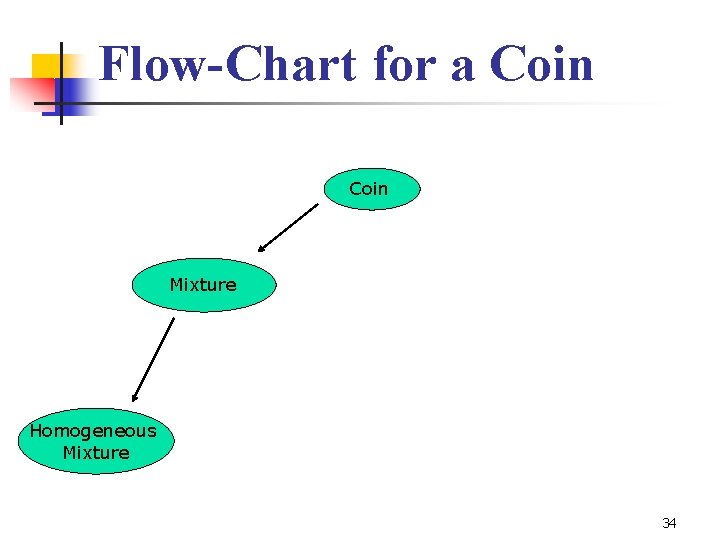
Flow-Chart for a Coin Mixture Homogeneous Mixture 34
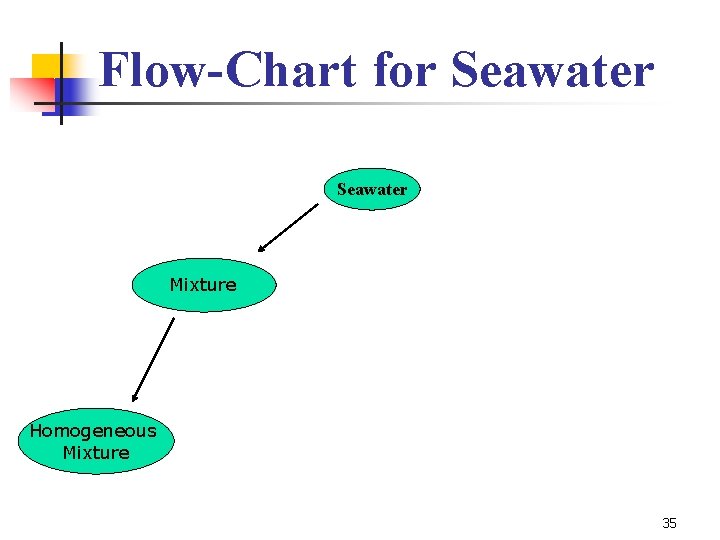
Flow-Chart for Seawater Mixture Homogeneous Mixture 35
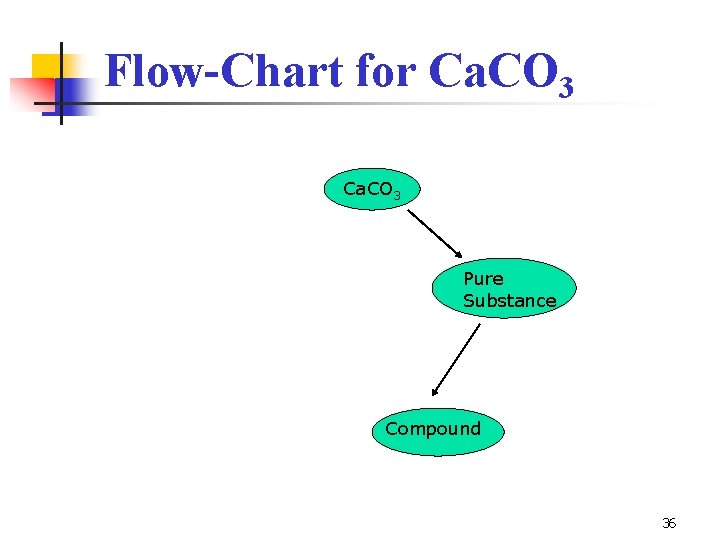
Flow-Chart for Ca. CO 3 Pure Substance Compound 36
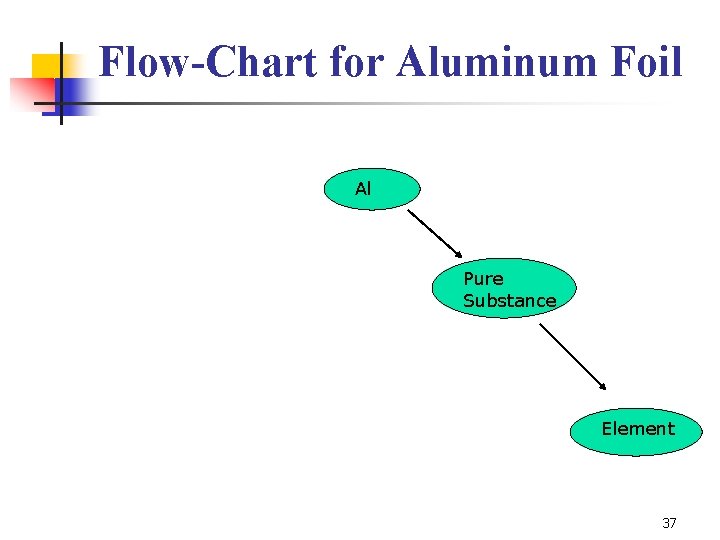
Flow-Chart for Aluminum Foil Al Pure Substance Element 37
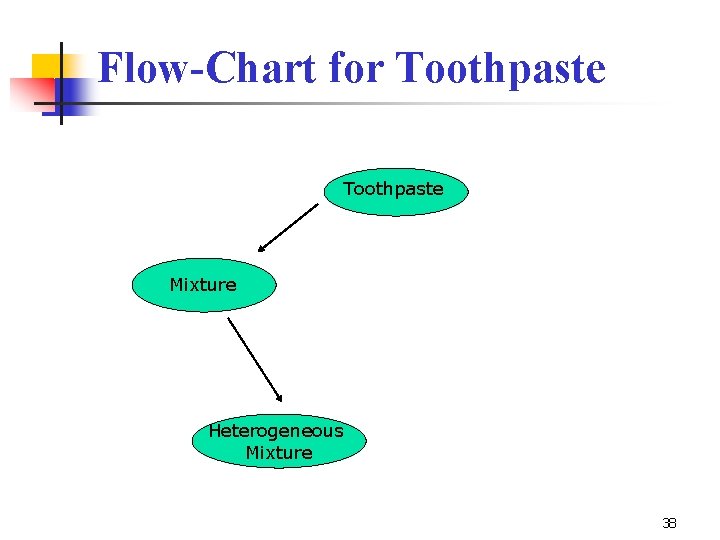
Flow-Chart for Toothpaste Mixture Heterogeneous Mixture 38
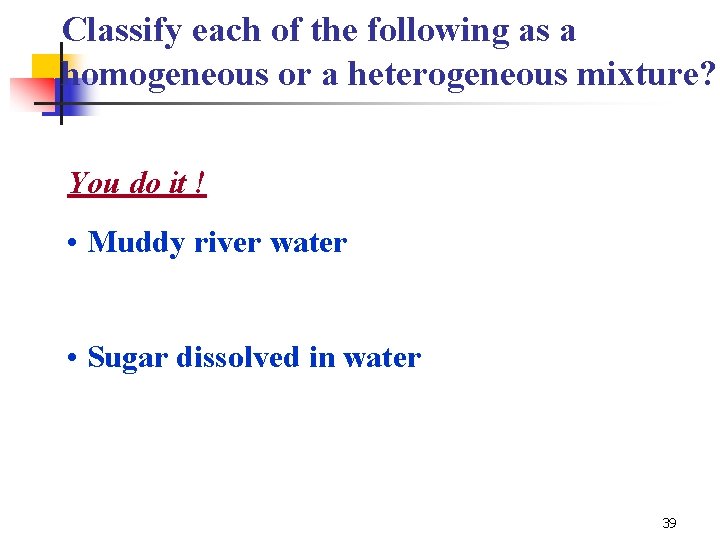
Classify each of the following as a homogeneous or a heterogeneous mixture? You do it ! • Muddy river water • Sugar dissolved in water 39
Take-Home Vocabulary n n Chemical change: A change in which one or more new substances are formed. Physical change: A change in which a substance changes from one physical state to another, but no substances with different compositions are formed. 40
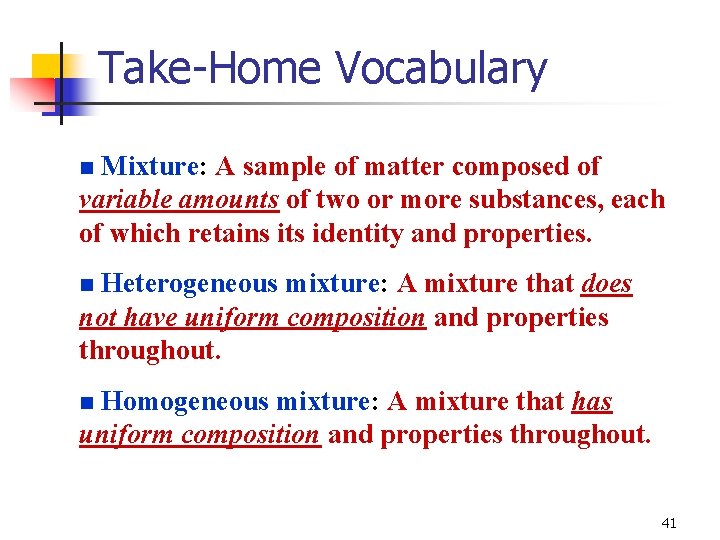
Take-Home Vocabulary Mixture: A sample of matter composed of variable amounts of two or more substances, each of which retains its identity and properties. n Heterogeneous mixture: A mixture that does not have uniform composition and properties throughout. n Homogeneous mixture: A mixture that has uniform composition and properties throughout. n 41
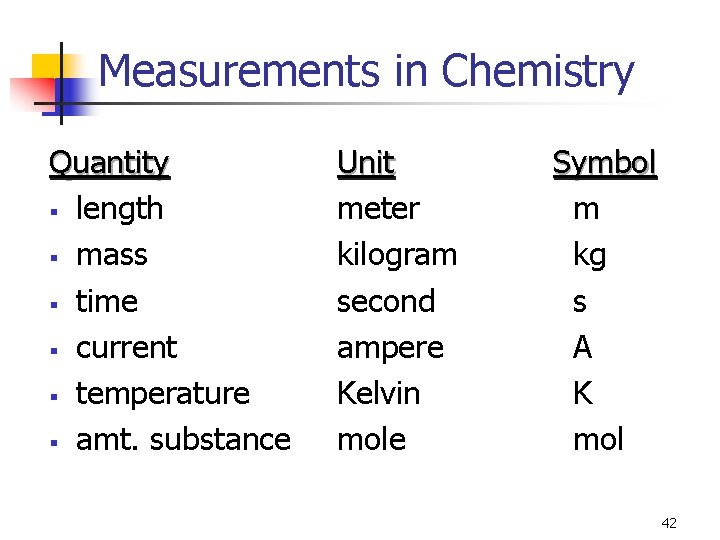
Measurements in Chemistry Quantity § length § mass § time § current § temperature § amt. substance Unit meter kilogram second ampere Kelvin mole Symbol m kg s A K mol 42
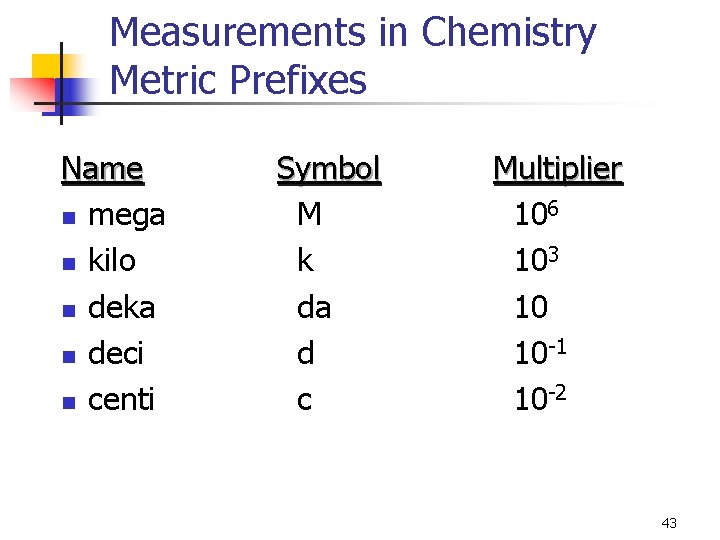
Measurements in Chemistry Metric Prefixes Name n mega n kilo n deka n deci n centi Symbol M k da d c Multiplier 106 103 10 -1 10 -2 43
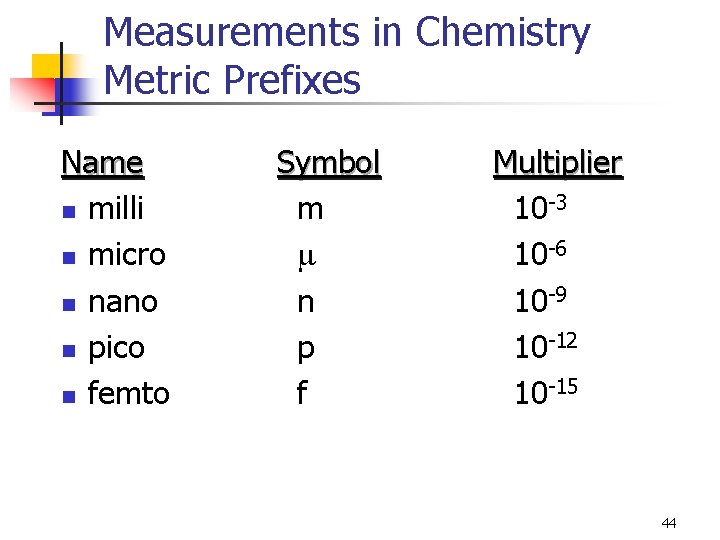
Measurements in Chemistry Metric Prefixes Name n milli n micro n nano n pico n femto Symbol m n p f Multiplier 10 -3 10 -6 10 -9 10 -12 10 -15 44
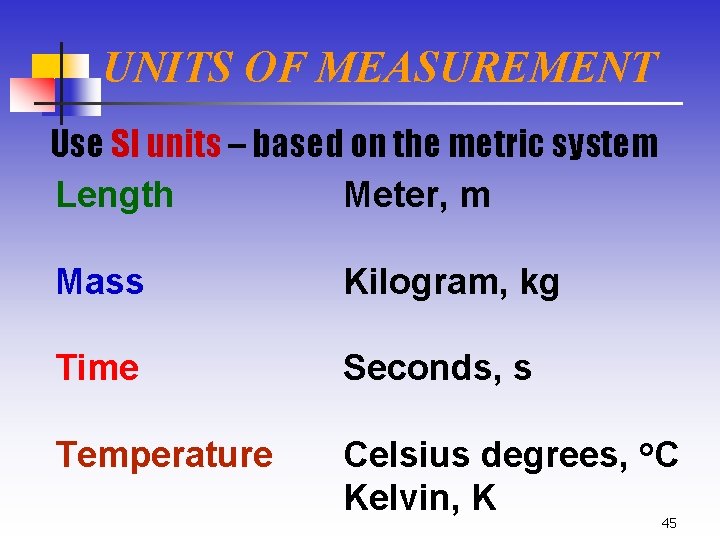
UNITS OF MEASUREMENT Use SI units – based on the metric system Length Meter, m Mass Kilogram, kg Time Seconds, s Temperature Celsius degrees, o. C Kelvin, K 45
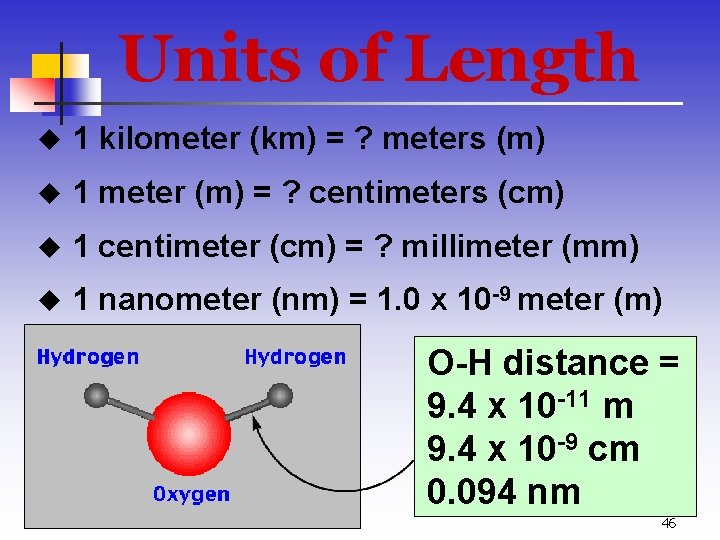
Units of Length u 1 kilometer (km) = ? meters (m) u 1 meter (m) = ? centimeters (cm) u 1 centimeter (cm) = ? millimeter (mm) u 1 nanometer (nm) = 1. 0 x 10 -9 meter (m) O-H distance = 9. 4 x 10 -11 m 9. 4 x 10 -9 cm 0. 094 nm 46
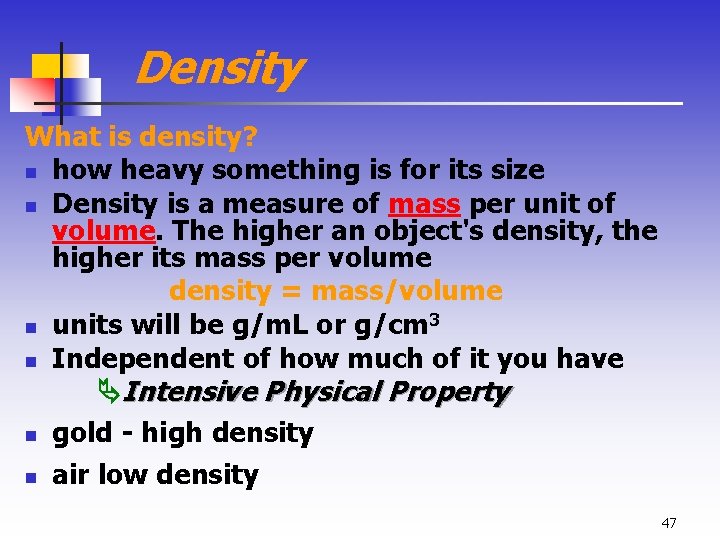
Density What is density? n how heavy something is for its size n Density is a measure of mass per unit of volume. The higher an object's density, the higher its mass per volume density = mass/volume n units will be g/m. L or g/cm 3 n Independent of how much of it you have Intensive Physical Property n gold - high density n air low density 47
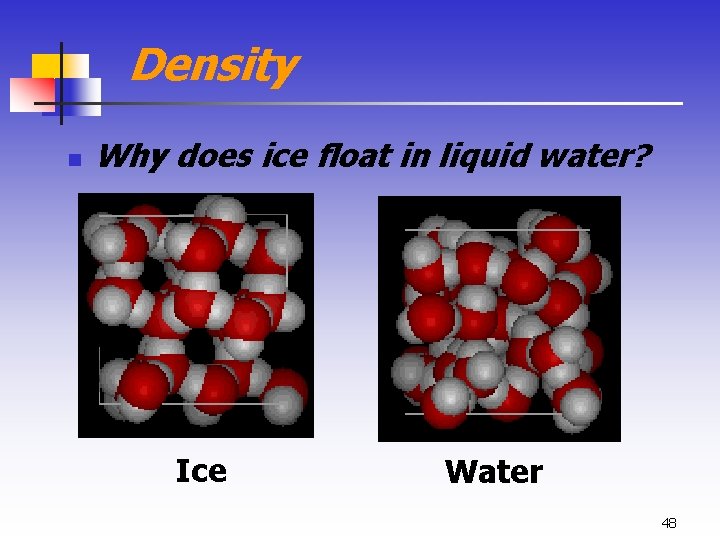
Density n Why does ice float in liquid water? Ice Water 48
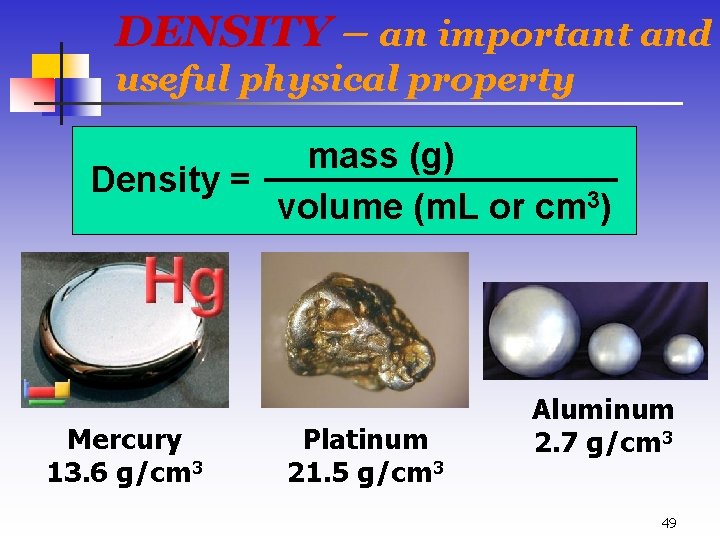
DENSITY – an important and useful physical property mass (g) Density = volume (m. L or cm 3) Mercury 13. 6 g/cm 3 Platinum 21. 5 g/cm 3 Aluminum 2. 7 g/cm 3 49
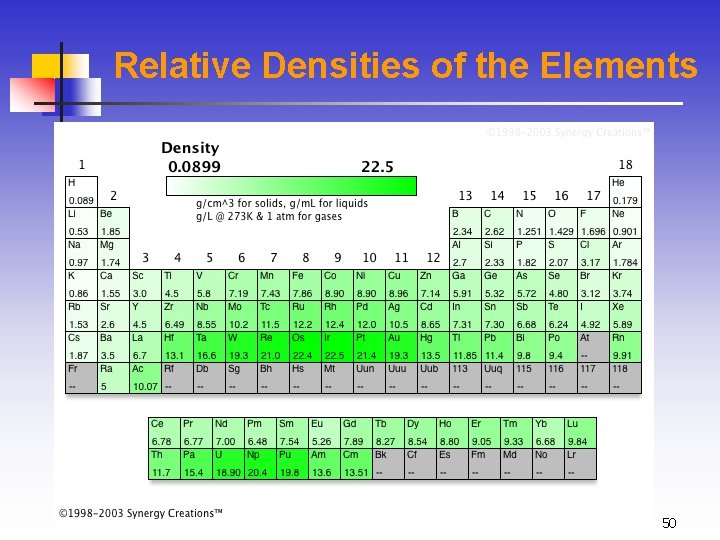
Relative Densities of the Elements 50
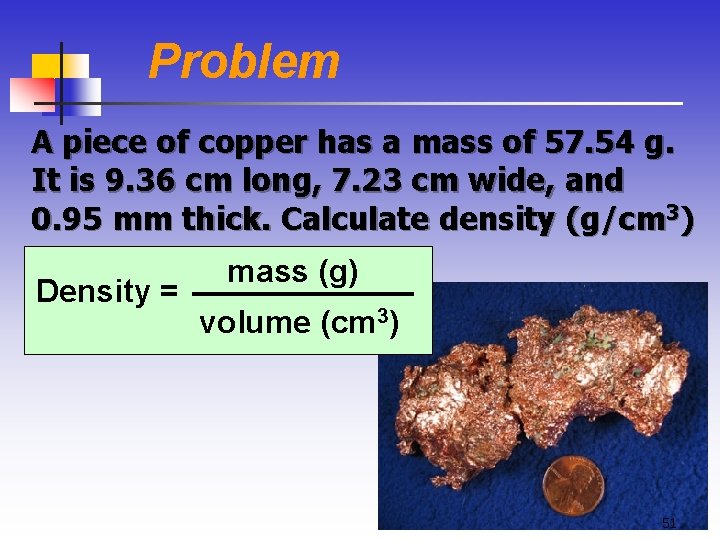
Problem A piece of copper has a mass of 57. 54 g. It is 9. 36 cm long, 7. 23 cm wide, and 0. 95 mm thick. Calculate density (g/cm 3) Density = mass (g) volume (cm 3) 51
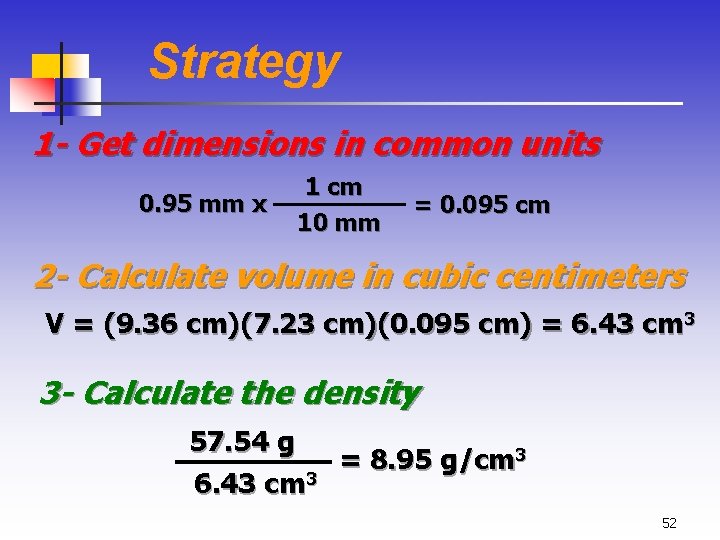
Strategy 1 - Get dimensions in common units 0. 95 mm x 1 cm 10 mm = 0. 095 cm 2 - Calculate volume in cubic centimeters V = (9. 36 cm)(7. 23 cm)(0. 095 cm) = 6. 43 cm 3 3 - Calculate the density 57. 54 g = 8. 95 g/cm 3 6. 43 cm 3 52
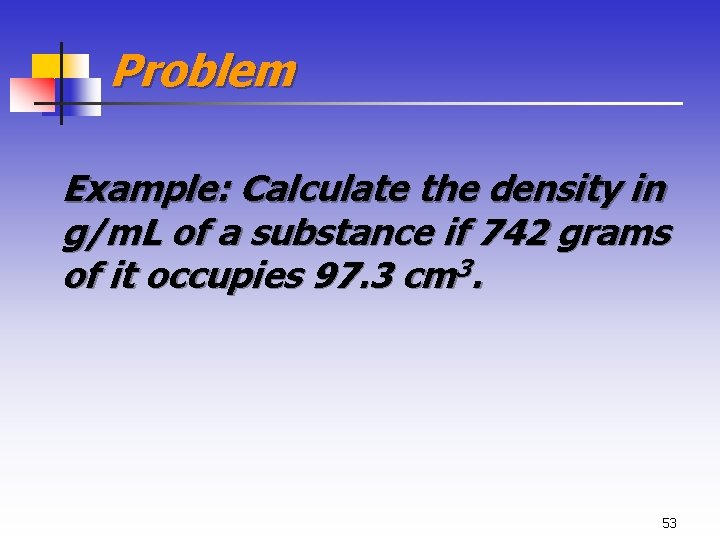
Problem Example: Calculate the density in g/m. L of a substance if 742 grams of it occupies 97. 3 cm 3. 53
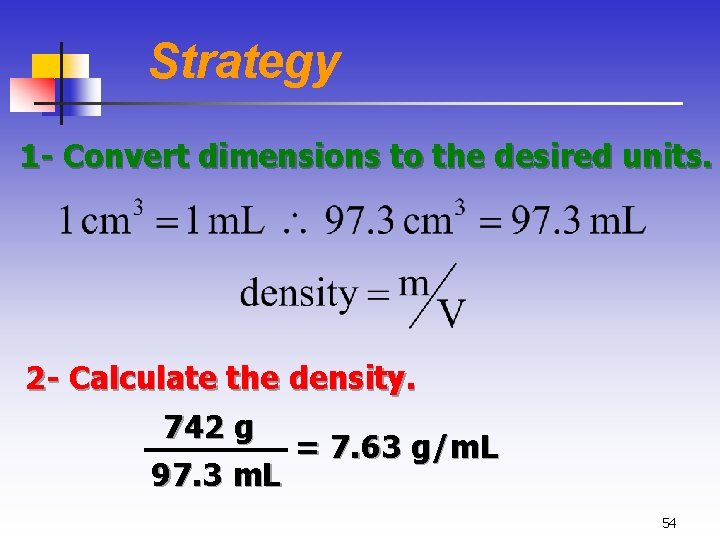
Strategy 1 - Convert dimensions to the desired units. 2 - Calculate the density. 742 g = 7. 63 g/m. L 97. 3 m. L 54
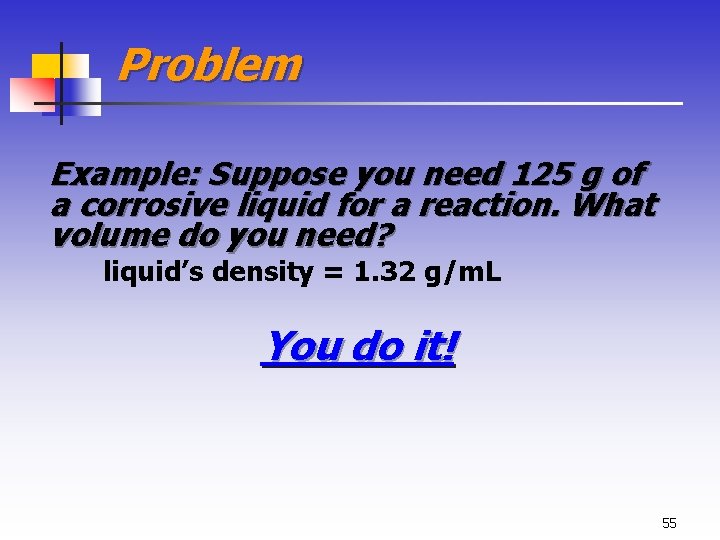
Problem Example: Suppose you need 125 g of a corrosive liquid for a reaction. What volume do you need? liquid’s density = 1. 32 g/m. L You do it! 55
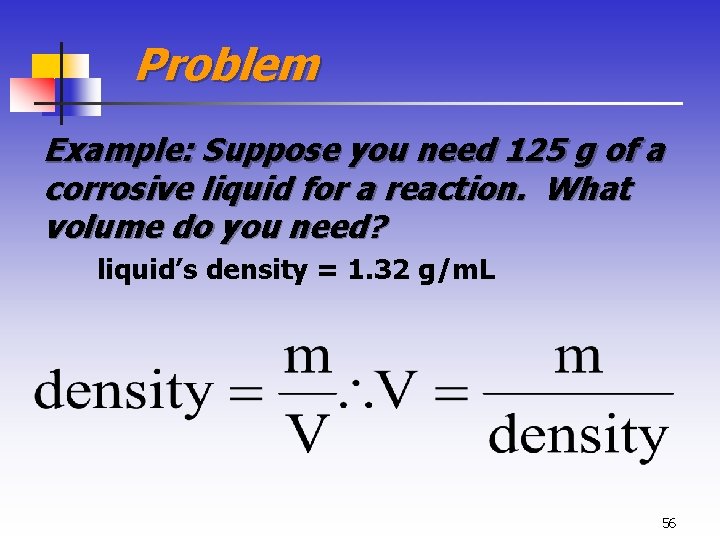
Problem Example: Suppose you need 125 g of a corrosive liquid for a reaction. What volume do you need? liquid’s density = 1. 32 g/m. L 56
Problem 57
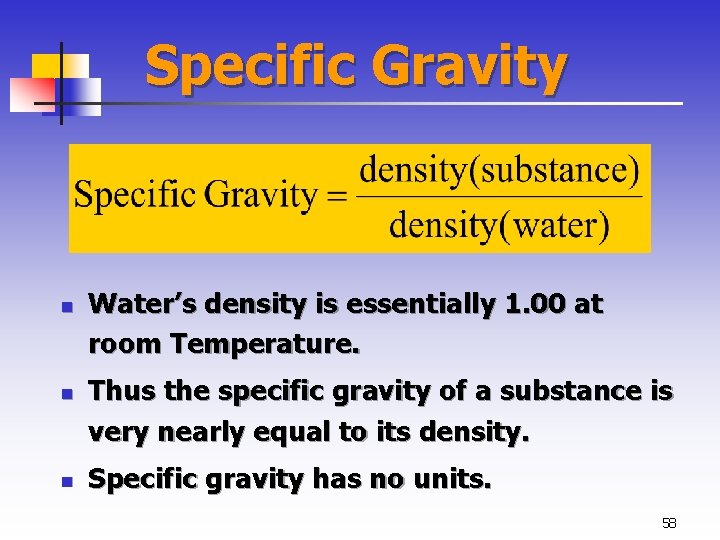
Specific Gravity n n n Water’s density is essentially 1. 00 at room Temperature. Thus the specific gravity of a substance is very nearly equal to its density. Specific gravity has no units. 58
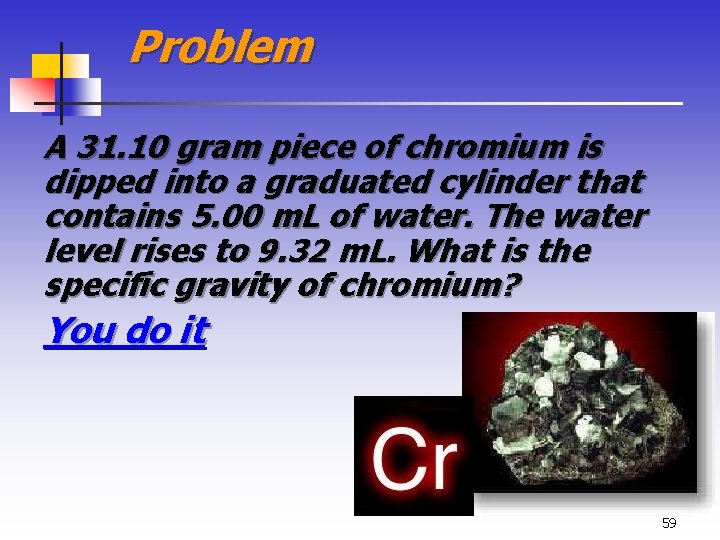
Problem A 31. 10 gram piece of chromium is dipped into a graduated cylinder that contains 5. 00 m. L of water. The water level rises to 9. 32 m. L. What is the specific gravity of chromium? You do it 59
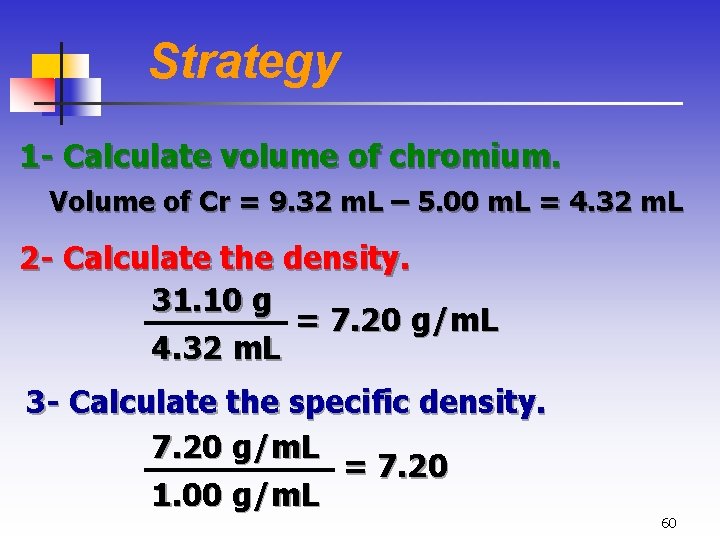
Strategy 1 - Calculate volume of chromium. Volume of Cr = 9. 32 m. L – 5. 00 m. L = 4. 32 m. L 2 - Calculate the density. 31. 10 g = 7. 20 g/m. L 4. 32 m. L 3 - Calculate the specific density. 7. 20 g/m. L = 7. 20 1. 00 g/m. L 60
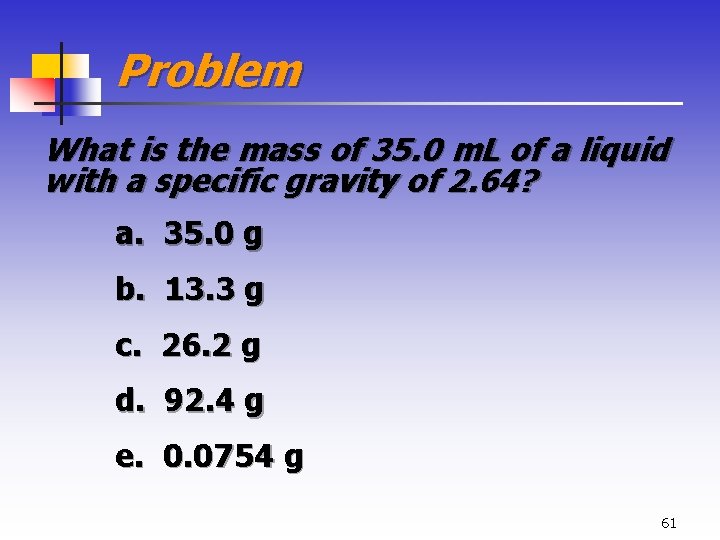
Problem What is the mass of 35. 0 m. L of a liquid with a specific gravity of 2. 64? a. 35. 0 g b. 13. 3 g c. 26. 2 g d. 92. 4 g e. 0. 0754 g 61
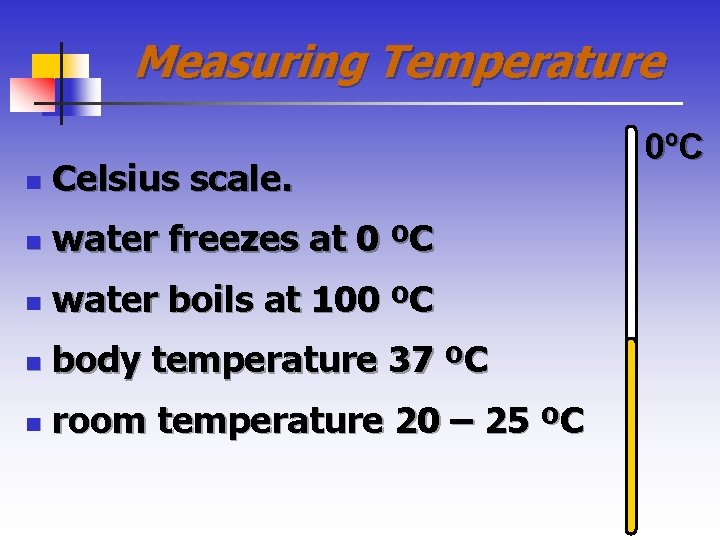
Measuring Temperature n Celsius scale. n water freezes at 0 ºC n water boils at 100 ºC n body temperature 37 ºC n room temperature 20 – 25 ºC 0ºC
Measuring Temperature Kelvin starts at absolute zero (-273 º C) n degrees are the same size n C = K -273 n K = C + 273 n Kelvin is always bigger. n Kelvin can never be negative. n 273 K
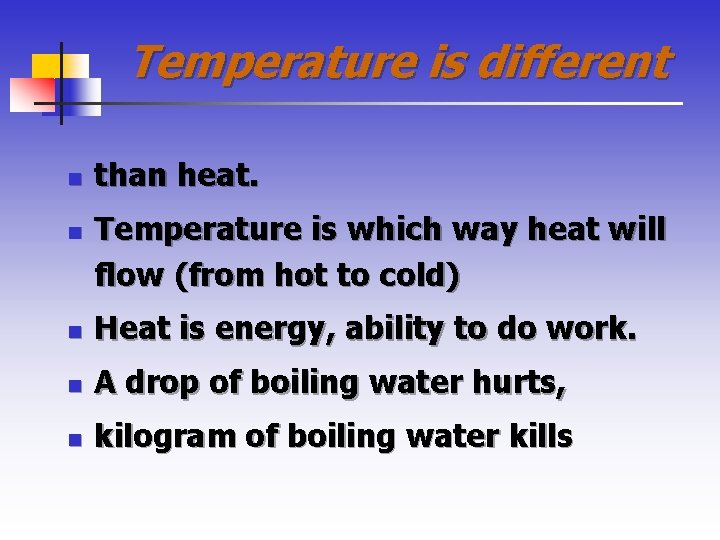
Temperature is different n n than heat. Temperature is which way heat will flow (from hot to cold) n Heat is energy, ability to do work. n A drop of boiling water hurts, n kilogram of boiling water kills
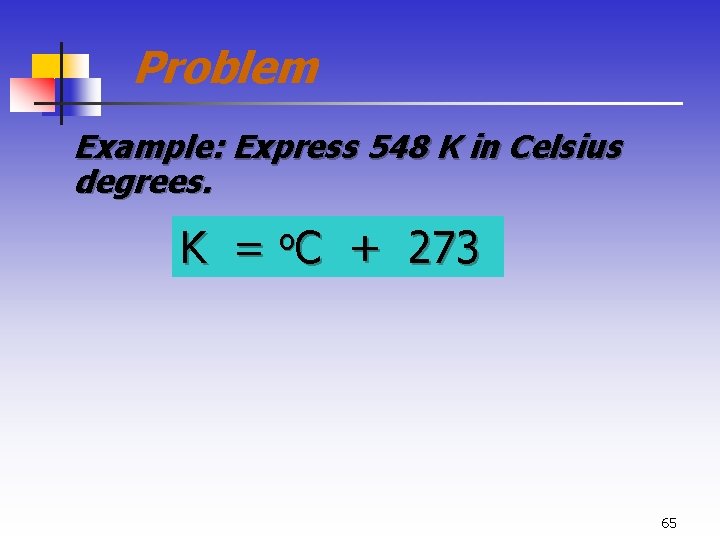
Problem Example: Express 548 K in Celsius degrees. K = o. C + 273 65
Reading…. Please read section 1 -12 for more examples: HEAT AND TEMPERATURE 66
Homework Assignment Textbook Problems (optional, Chapter 1): 11, 13, 15, 18, 19, 23, 27, 35, 40, 41, 43, 46, 48, 49, 53, 74 One-line Web Learning (OWL): Chapter 1 Exercises and Tutors – Optional Introductory math problems and Chapter 1 Homework problems – Optional 67
End of Chapter 1 68
Reading…. Chapter 2: Chemical Formulas and Composition Stoichiometry Page: 46 - 87 69