
Chapter One Lecture Notes Introduction to Financial Management

- Slides: 18
Chapter One Lecture Notes Introduction to Financial Management 1 Finkler: Financial Management For Public, Health, And Not-For-Profit Organizations, 3 rd Ed. © Pearson Education 2010
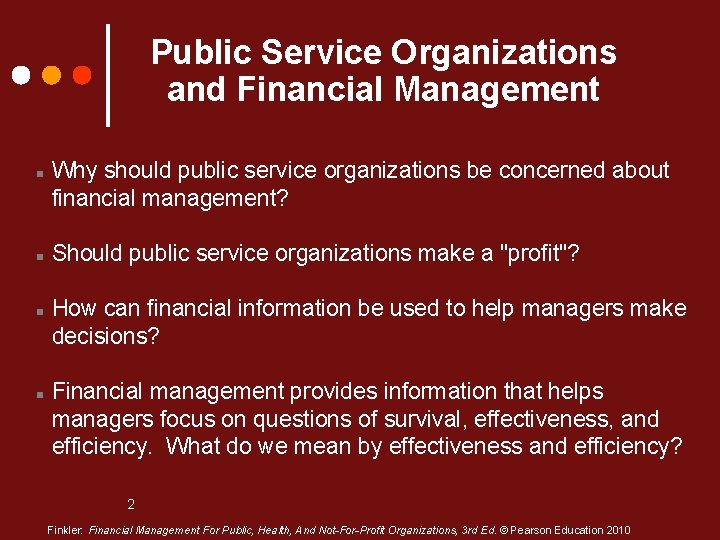
Public Service Organizations and Financial Management n n Why should public service organizations be concerned about financial management? Should public service organizations make a "profit"? How can financial information be used to help managers make decisions? Financial management provides information that helps managers focus on questions of survival, effectiveness, and efficiency. What do we mean by effectiveness and efficiency? 2 Finkler: Financial Management For Public, Health, And Not-For-Profit Organizations, 3 rd Ed. © Pearson Education 2010
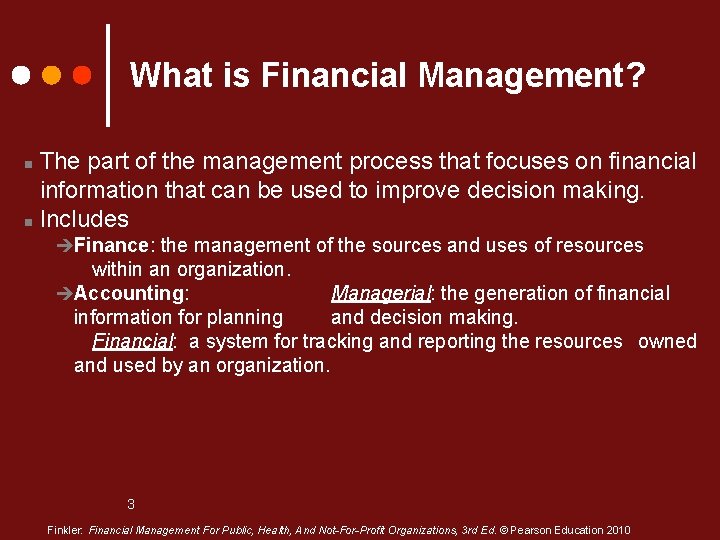
What is Financial Management? The part of the management process that focuses on financial information that can be used to improve decision making. n Includes n èFinance: the management of the sources and uses of resources within an organization. èAccounting: Managerial: the generation of financial information for planning and decision making. Financial: a system for tracking and reporting the resources owned and used by an organization. 3 Finkler: Financial Management For Public, Health, And Not-For-Profit Organizations, 3 rd Ed. © Pearson Education 2010
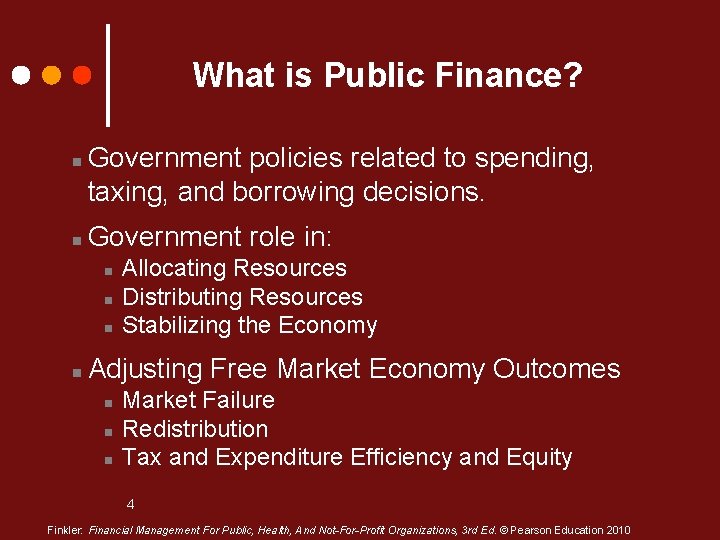
What is Public Finance? n n Government policies related to spending, taxing, and borrowing decisions. Government role in: n n Allocating Resources Distributing Resources Stabilizing the Economy Adjusting Free Market Economy Outcomes n n n Market Failure Redistribution Tax and Expenditure Efficiency and Equity 4 Finkler: Financial Management For Public, Health, And Not-For-Profit Organizations, 3 rd Ed. © Pearson Education 2010
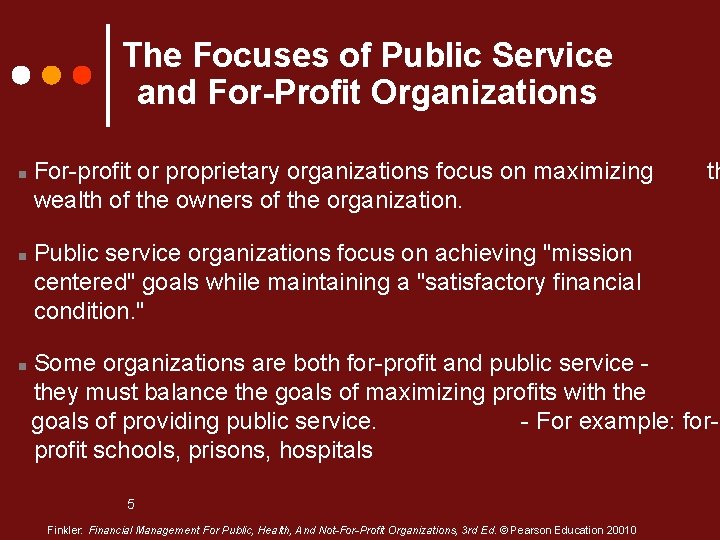
The Focuses of Public Service and For-Profit Organizations n n n For-profit or proprietary organizations focus on maximizing wealth of the owners of the organization. th Public service organizations focus on achieving "mission centered" goals while maintaining a "satisfactory financial condition. " Some organizations are both for-profit and public service they must balance the goals of maximizing profits with the goals of providing public service. - For example: forprofit schools, prisons, hospitals 5 Finkler: Financial Management For Public, Health, And Not-For-Profit Organizations, 3 rd Ed. © Pearson Education 20010
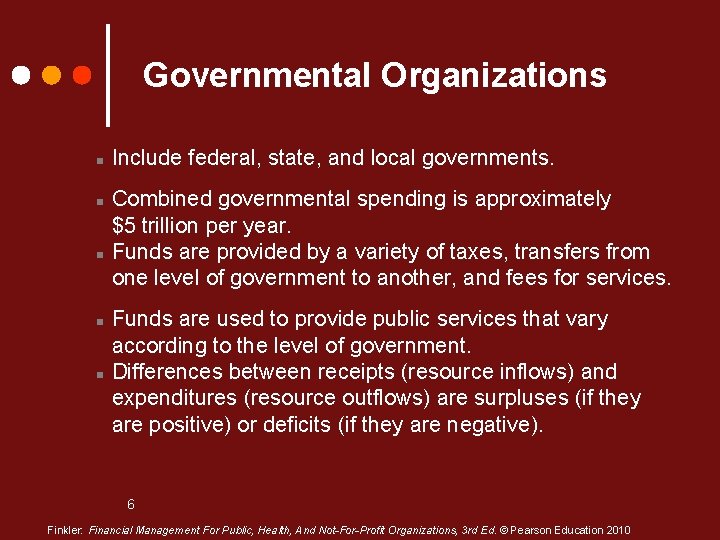
Governmental Organizations n n n Include federal, state, and local governments. Combined governmental spending is approximately $5 trillion per year. Funds are provided by a variety of taxes, transfers from one level of government to another, and fees for services. Funds are used to provide public services that vary according to the level of government. Differences between receipts (resource inflows) and expenditures (resource outflows) are surpluses (if they are positive) or deficits (if they are negative). 6 Finkler: Financial Management For Public, Health, And Not-For-Profit Organizations, 3 rd Ed. © Pearson Education 2010
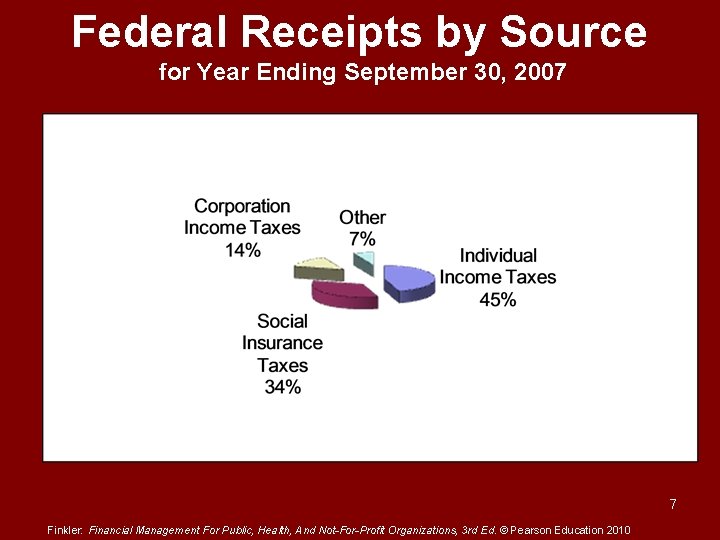
Federal Receipts by Source for Year Ending September 30, 2007 7 Finkler: Financial Management For Public, Health, And Not-For-Profit Organizations, 3 rd Ed. © Pearson Education 2010
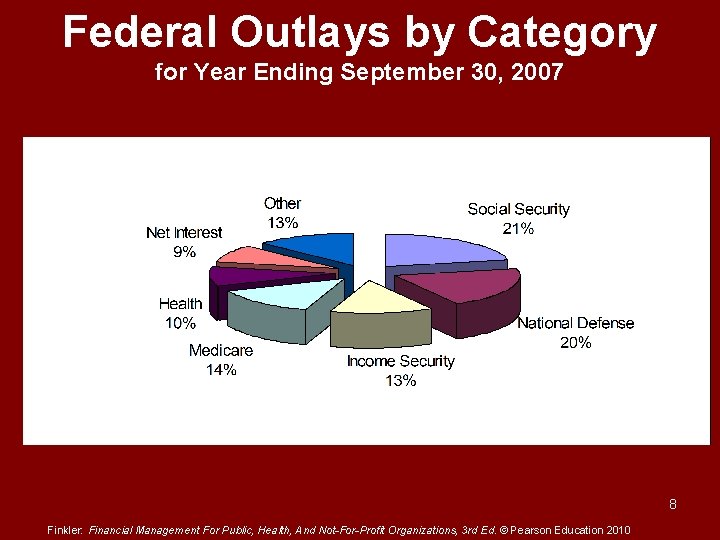
Federal Outlays by Category for Year Ending September 30, 2007 8 Finkler: Financial Management For Public, Health, And Not-For-Profit Organizations, 3 rd Ed. © Pearson Education 2010
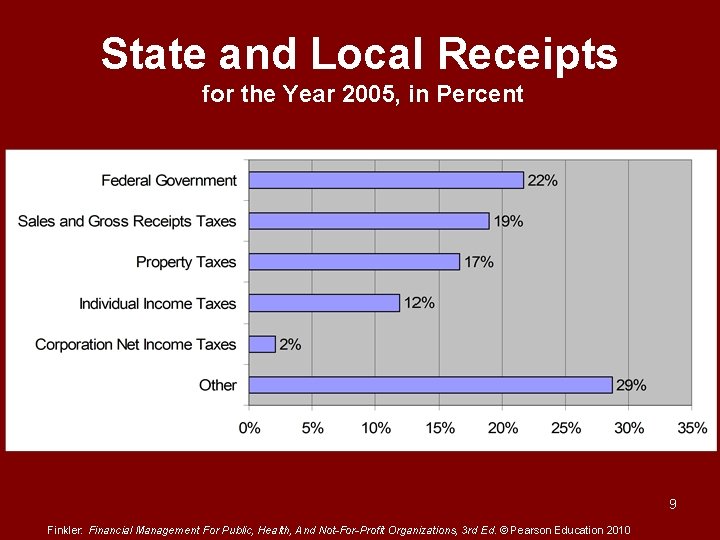
State and Local Receipts for the Year 2005, in Percent 9 Finkler: Financial Management For Public, Health, And Not-For-Profit Organizations, 3 rd Ed. © Pearson Education 2010
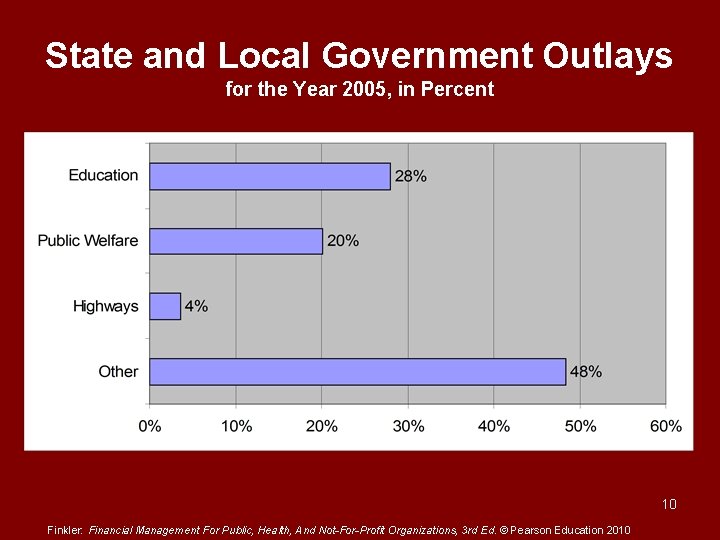
State and Local Government Outlays for the Year 2005, in Percent 10 Finkler: Financial Management For Public, Health, And Not-For-Profit Organizations, 3 rd Ed. © Pearson Education 2010
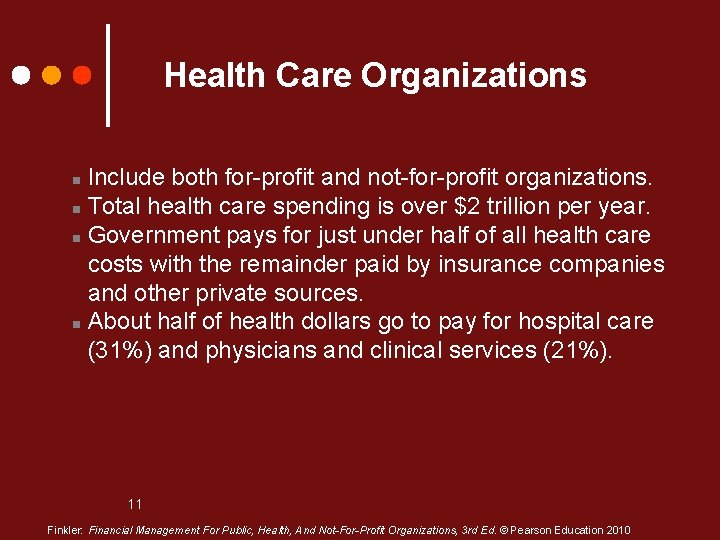
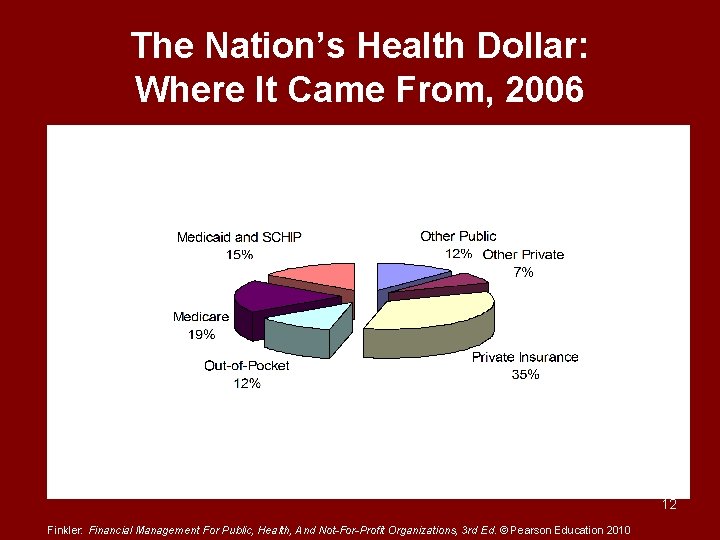
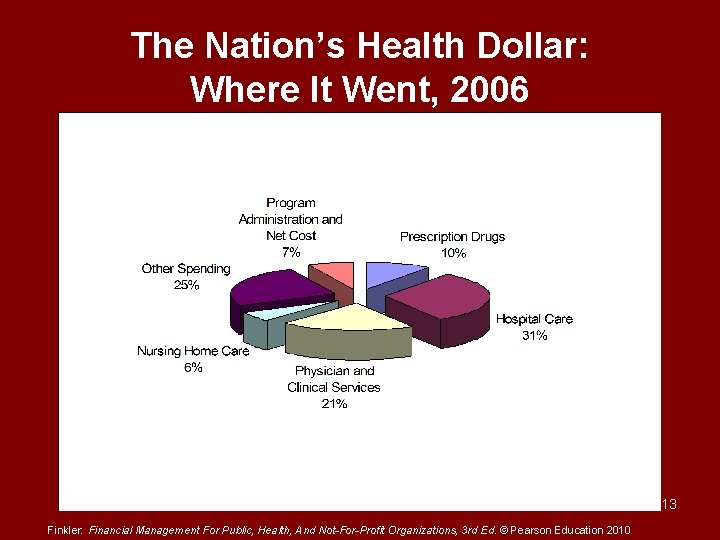
Health Care Organizations Include both for-profit and not-for-profit organizations. n Total health care spending is over $2 trillion per year. n Government pays for just under half of all health care costs with the remainder paid by insurance companies and other private sources. n About half of health dollars go to pay for hospital care (31%) and physicians and clinical services (21%). n 11 Finkler: Financial Management For Public, Health, And Not-For-Profit Organizations, 3 rd Ed. © Pearson Education 2010
The Nation’s Health Dollar: Where It Came From, 2006 12 Finkler: Financial Management For Public, Health, And Not-For-Profit Organizations, 3 rd Ed. © Pearson Education 2010
The Nation’s Health Dollar: Where It Went, 2006 13 Finkler: Financial Management For Public, Health, And Not-For-Profit Organizations, 3 rd Ed. © Pearson Education 2010
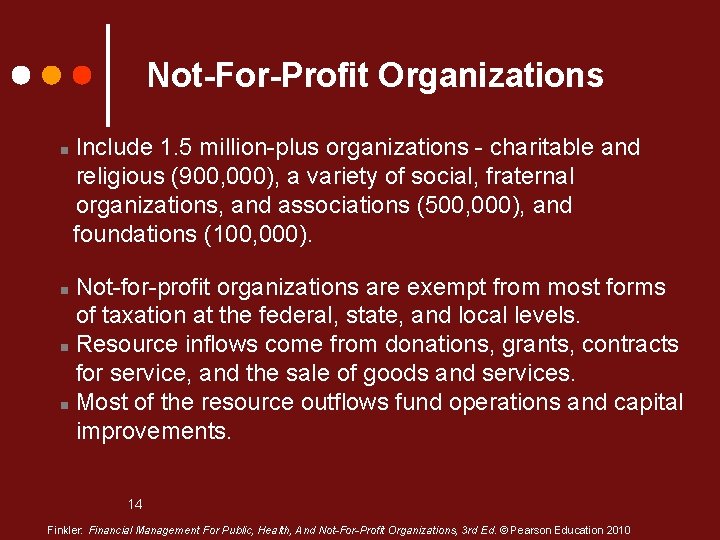
Not-For-Profit Organizations n Include 1. 5 million-plus organizations - charitable and religious (900, 000), a variety of social, fraternal organizations, and associations (500, 000), and foundations (100, 000). Not-for-profit organizations are exempt from most forms of taxation at the federal, state, and local levels. n Resource inflows come from donations, grants, contracts for service, and the sale of goods and services. n Most of the resource outflows fund operations and capital improvements. n 14 Finkler: Financial Management For Public, Health, And Not-For-Profit Organizations, 3 rd Ed. © Pearson Education 2010
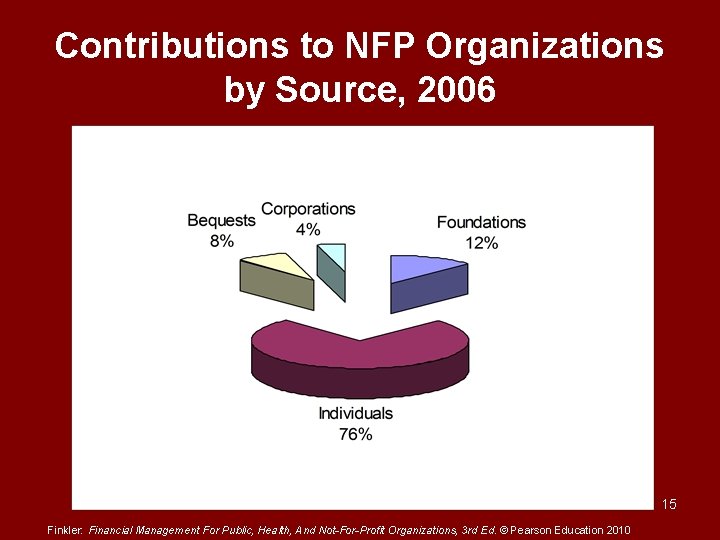
Contributions to NFP Organizations by Source, 2006 15 Finkler: Financial Management For Public, Health, And Not-For-Profit Organizations, 3 rd Ed. © Pearson Education 2010
Contributions to NFP Organizations by Type of Recipient Organization, 2006 16 Finkler: Financial Management For Public, Health, And Not-For-Profit Organizations, 3 rd Ed. © Pearson Education 2010
The International NGO Sector NGO (Non-Governmental Organization): “Private organizations that pursue activities to relieve suffering, promote the interests of the poor, protect the environment, provide basic social services, or undertake community development” (World Bank Operational Directive 14. 70) n Community Based (CBOs) n n National n International 17 Finkler: Financial Management For Public, Health, And Not-For-Profit Organizations, 3 rd Ed. © Pearson Education 2010
Fund Raising n n Statistics show people are more likely to donate, and donate more, if they are solicited for a donation. Contributions – come from individuals, foundations, corporations, government. May be: n Unrestricted n Restricted – temporarily or permanently n Operating versus Capital Contributions n Planned Giving n Contracts and Grants 18 Finkler: Financial Management For Public, Health, And Not-For-Profit Organizations, 3 rd Ed. © Pearson Education 2010