
CHAPTER ONE INTRODUCTION TO SERVICES MARKETING Objectives of
CHAPTER ONE INTRODUCTION TO SERVICES MARKETING Objectives of the Chapter: After Completing this chapter, students should be able to: • Define what service marketing is. • Explain the reasons for growth in the service sector • List and define the inherent characteristics of services • Specify the major problems created by the characteristics of services and the appropriate marketing strategies need to recue these problems • List six classification levels of the classification scheme for services • Identify issues that service firms must address at each level of the classifications scheme 1
1. 1 Service Definition • Customer service is a task, other than common operations that involves interactions with customers in person, by telecommunication mail, of automated process. The meaning of customer service varies from one organization to another. Within the service sector, it can be described as the total quality of the service process as perceived by the customer. 2
To be cont’d…… • To define service, there is no standard or commonly accepted definition, with the contexts of business or retailing operations. Nevertheless, Philip Kotler defines “A service is any act or performance that one partly can offer to another that is essentially intangible and does not result in the ownership of anything. Its production may or may not be tied to a physical production. (Kotler, 2006). • According to Stephone, service is any activity or benefit that one partly can offer to another that is essentially intangible and does not result in the ownership of anything. (Ross Stephone A. 2001) • Louis definition, service is intangible tasks that satisfy consumer and industrial user’s need when efficiently developed and distributed to chosen market segment. (Boon, Louis E. 1990) • The American Marketing Association also defines services in the following way, “Services are activities, benefits or satisfactions which are offered for sale are provided on connection with the sale of goods. ” 3
To be cont’d…. • All the above definitions make clear that services are activities benefits or satisfaction and we find their uses for selling products which may be tangible or intangible. 4
1. 2. Reasons for Growth of the Service Sector • The movement to an information age spurred/drive by the invention of the computer and advancements in telecommunications. • Shift from an agricultural to industrialized economic base. • An aging population longer life expectancies • Increased leisure time • Higher per capita • Increased time pressure • More female work force participation, • Changing social and cultural values • Advances in technology. 5
1. 3 Characteristics of Services • Services posses four inherent characteristics not found in goods: intangibility, perishability, inseparability, and variability. These characteristics create unique challenges for services. To attract new customers and to keep current customers coming back, services firms must find ways to meet these challenges. 6
1. 3. 1 Intangibility: refers to the lack of tangible assets that can be seen, touched, smelled, heard, or tasted prior to purchase. Strategies to reduce negative impact of intangibility: • • • Stressing tangible cues; Using personal sources of information; Stimulating word-of mouth communication Creating a strong corporation image; and Encouraging employees to communicate with customers. 7
1. 3. 2 Pershability • The second characteristic of services is perishability, meaning the service cannot be inventoried or store Strategies to reduce the negative impact of perishability: The service firm has to develop strategies to deal with demand, supply, and capacity. 8
1. 3. 3 Inseparability • Inseparability is the simultaneous production and consumption of services. Strategies to reduce negative impact of inseparability: • hire competent employees and then train them to perform the service. • managing customers so customers will have positive feelings about the interaction between employees and themselves. • having additional locations and by offering carrying-out home delivery services. 9
1. 3. 4 Variability • Variability refers to the sporadic/irregular or random levels of service quality customers receive when they patronize/shop a service. • Strategies to reduce negative impact of variability: Standardization and quality control measures can be used to reduce the variability of services. 10
1. 4. Challenges and Questions for Service Marketers • How can service quality be defined and improved when the product is intangible and non-standardize? • How can new services be designed and tested effectively when the service is essentially intangible process? • How can the firm be certain in communicating a consistent and relevant image when so many elements of the marketing mix communicate to customers and some of these elements are the service providers themselves? • How does the firm accommodate fluctuating demand when capacity is fixed and the service itself is perishable? • How can the firm best motivate and select service employees, because the services is delivered in real time, become a critical part of the product itself? 11
To be cont’d…. • How should prices be set when it is difficult to determine actual costs of production and price may be inextricably intertwined wit perceptions of quality? • How should the firm be organized so that good strategic and tactical decisions are made when a decision in any of the functional areas of marketing, operations, and human resources? • How can the balance between standardization and personalization be determined to maximize both the efficiency of the organization and the satisfaction of its customers? • How can the organization protect new service concepts form competitors when service processes cannot be legally patented? • How does the firm communicate quality and balance to consumers when the offering is intangible and cannot be readily tried or displayed? • How can the organization ensure the delivery of consistent quality service when both the organization’s employees and the customers themselves can affect the service outcome? 12
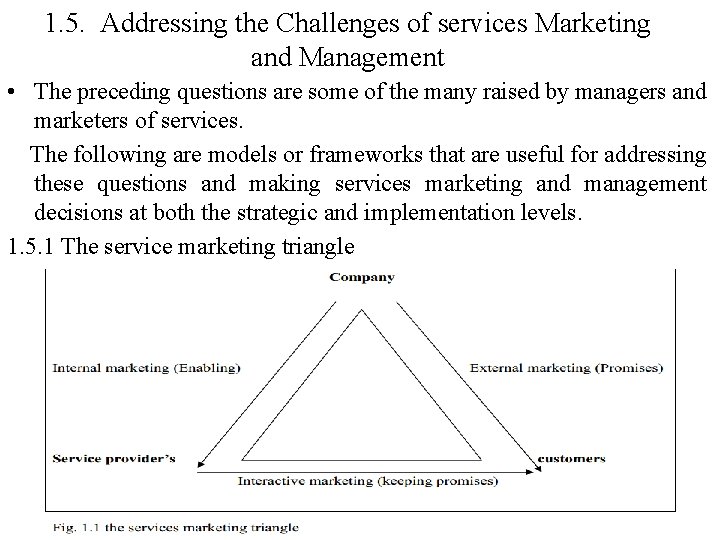
1. 5. Addressing the Challenges of services Marketing and Management • The preceding questions are some of the many raised by managers and marketers of services. The following are models or frameworks that are useful for addressing these questions and making services marketing and management decisions at both the strategic and implementation levels. 1. 5. 1 The service marketing triangle 13
1. 5. 2. The services marketing Mix • Another way to begin addressing the challenges of services marketing is to think creatively about the marketing mix through an expanded marketing mix for services which is going to be discussed next. 1. 5. 3. The Gap Model of Service Quality • The third model for addressing services challenges is the gaps model of service quality. This model focuses on strategies and processes the firms can employ to drive service excellence. The gaps model will be discussed in chapter four. 14
1. 6 Traditional Marketing Mix �The traditional marketing mix is composed of the four P’s: ü Product ü price ü place (distribution) ü promotion �However, the strategies for the four P’s require some modifications when applied to service. 15
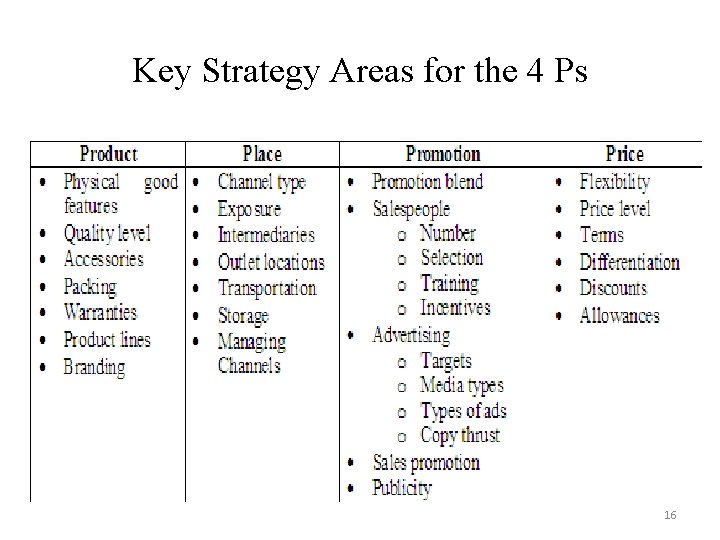
Key Strategy Areas for the 4 Ps 16
a) Service Outcome �The product component of the marketing mix is the outcome of the service. It consists of two components: the technical and the functional. �The technical outcome is the end result of the service or the “what” of the service �The functional outcome is the process of receiving the service or “how” the service was provided. 17
b) Price �The second component of the marketing mix is the price of the service. �Because services are intangible and experiential in nature, price becomes more important to consumers as a cue of what to expect. �Higher prices tend to convey higher quality. However, an extremely high price may be viewed by consumers as a rip-off. �The converse is also true; lower prices tend to convey lower quality but for some services and for some consumers, this is acceptable. 18
C) Distribution �Because of the inherent characteristics of services, distribution becomes more challenging. �Distribution is the availability and accessibility of a service to consumers. 19
d) Promotion �Since services are experiential in nature, promoting a service is more complex than promoting a good v. When developing an effective promotion program as part of its marketing mix, a service marketer should take certain factors into consideration: üEmployees üWord-Of-Mouth Advertising üTangible Symbols üContinuity üKept Promises 20
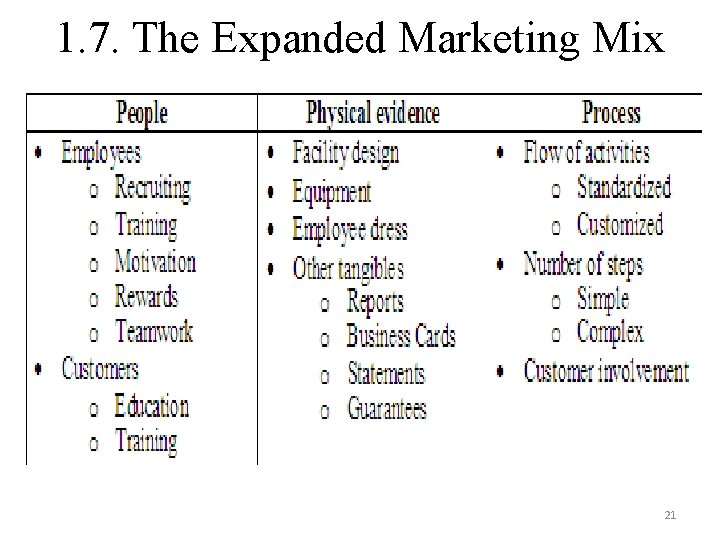
1. 7. The Expanded Marketing Mix 21
a) People • Refer to all human actors who play a part in service delivery and, thus, influence the buyer’s perceptions: namely, the firm’s personnel, the customer and other customers in the service environment. 22
People…Cont’d �The service provider or contact person can be very important. �In fact, for some services (such as consulting, counseling, teaching, and other professional relationship-based services), the provider is the service. �In other cases the contact person may play a relatively small part in service delivery; for instance, a telephone installer, an airline baggage handler, or an equipment delivery dispatcher. 23
People…Cont’d • In many service situations, customers themselves can also influence service delivery, thus affecting service quality and their own satisfaction. • For example, a client of a consulting company can influence the quality of service received by providing needed and timely information and by implementing recommendations provided by the consultant. • Similarly, heath care patients greatly affect the quality if service they receive when they either comply or do not comply with health regimens prescribed by the provider. 24
People…Cont’d �Customers not only influence their own service outcomes, but they can influence other customers as well. �In a theater, at a ball game, or in a class room, customers can influence the quality of service received by others – either enhancing or detracting from other customers’ experiences. �Given the strong influence they can have on service quality and service delivery, employees, the customer him/herself, and other customers are included within the people element of the service marketing mix. 25
b) Physical Evidence • Physical evidence is the environment in which the service is delivered and where the firm and customer interact, and any tangible components that facilitate performance or communication of the service. 26
c) Process �Process is the actual procedures, mechanisms and flow of activities by which the service is delivered – the service delivery and operating systems. 27
To be cont’d…… • The three new marketing mix elements (People, physical evidence, and process) are included in the marketing mix as separate elements because they are within the control of the firm and any or all of them may influence the customer’s initial decision to purchase a service, as well as the customer’s level of satisfaction and repurchase decisions. 28
CHAPTER TWO CONSUMER BEHAVIOR IN SERVICE SETTING Objectives of the chapter: At the end students should be able to: ü Understand nature of service consumption and user costs for services ü Explain the generic difference in consumer behavior in service and good ü Understand in the four categories of consumer behavior 29
2. 1 An overview of customer Behavior Understanding customer behavior lies at the heart of marketing. • Why do customers buy one product and not another? • Who or what influences their decisions and their brand preferences? • Against what criteria do they evaluate possible alternatives? • Why do they buy one type of service when a different type might have provided a better solution to their needs? • what drives these needs in the first planed? • How does the buying patterns of the household and corporate purchasers tend to be different? Ø Once a customer has actually purchased a service, marketers need to examine how and when they use it. • How does the customer interact with service facilities, service personnel, and other customers, especially in the case of high-contact services? 30
2. 2 The nature of service consumption • The distinction between goods consumption and service consumption is the former is output consumption and the later is process consumption. 31
2. 2. 1. Understanding user costs for services • To obtain the benefits of a service performance, customers must be prepared to offer something in exchange. • From a customer’s standpoint, the monetary price changed by the supplier may be just the first of many costs associated with purchase and delivery of a service. Let’s take a look at what’s involved. 32
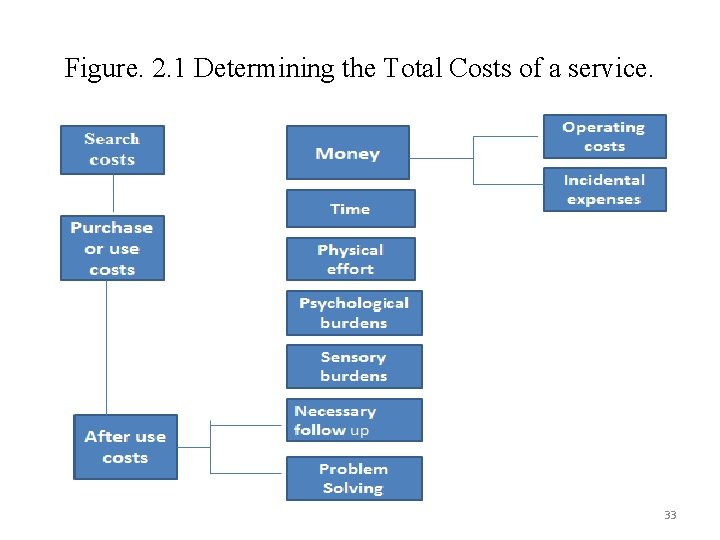
Figure. 2. 1 Determining the Total Costs of a service. 33
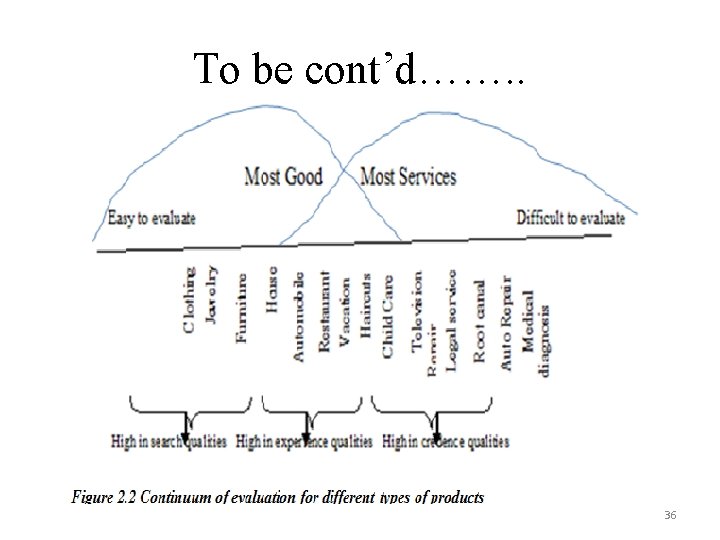
2. 3 A Continuum of Product Attributes One of the basic differences between goods and services is that services are harder for customers to evaluate. All products can be placed on a continuum ranging from “easy to evaluate” to difficult to evaluate” depending on whether they are high in search attributes, experience attributes, or credent attributes. These three attribute categories provide a useful framework for understanding how consumers evaluate different types of market offerings. As shown in Figure 2. 2, most physical goods are located toward the left of the spectrum, with services to the middle or right. 34
To be cont’d…. . • Search Attributes. Physical goods tend to emphasize those attributes that allow customers to evaluate a product before purchasing it. • Experience Attributes. These are properties that can’t be evaluated prior to purchase. Customers must experience these features to know what they are getting. • Credence Attributes. Product characteristics that customers find impossible to evaluate confidently even after purchase and consumption are known as credence attributes. 35
To be cont’d……. . 36
2. 3. 1 Strategic Responses to the Intangibility of service Performances. • Marketers whose products are high in experience characteristics often try to provide more search attributes for their customers. One approach is to offer a free trial. • Advertising is another way to help customers visualize service benefits when there are few inherent search attributes i. e. by showing physical evidence of the benefits of the service. 37
To be cont’d…… • Providers of service that are high in credence characteristics have to try to provide tangible cues to customers about their service. 38
2. 4. The purchase Process for services • The Pre-purchase stage, • The service encounter stage, and • The post purchase stage, 39
2. 4. 1 Pre-purchase Stage • The decision to buy and use a service is made in the pre-purchase stage. Individual needs and expectations are very important here because they influence what alternative customers will consider. 40
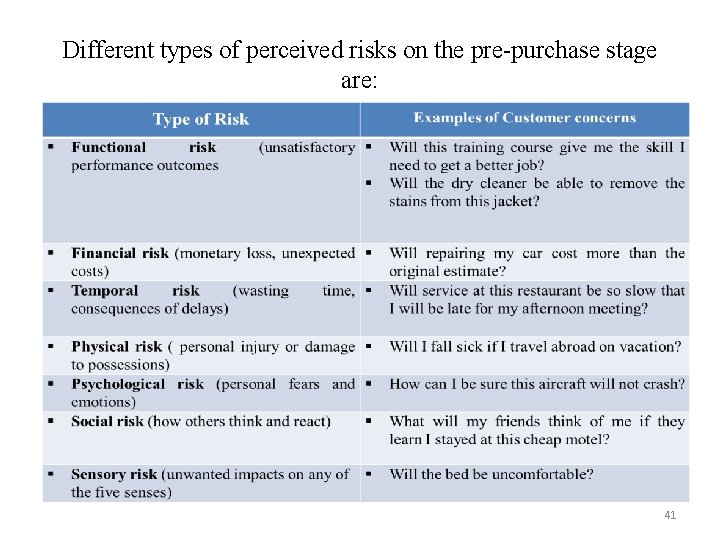
Different types of perceived risks on the pre-purchase stage are: 41
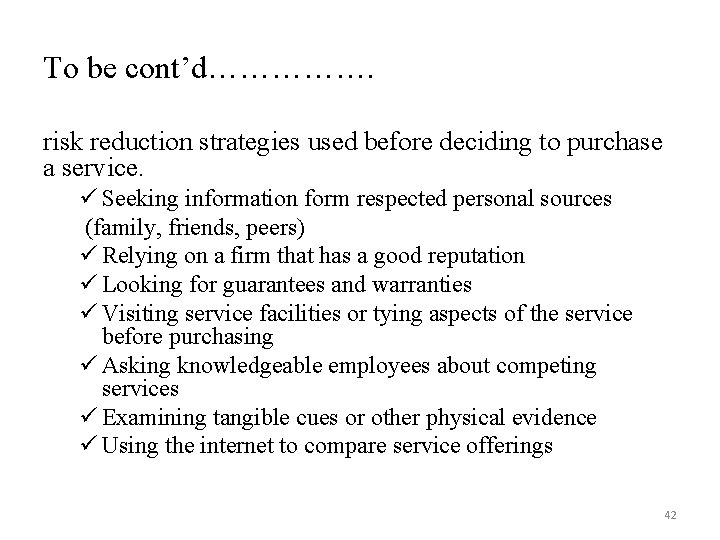
To be cont’d……………. risk reduction strategies used before deciding to purchase a service. ü Seeking information form respected personal sources (family, friends, peers) ü Relying on a firm that has a good reputation ü Looking for guarantees and warranties ü Visiting service facilities or tying aspects of the service before purchasing ü Asking knowledgeable employees about competing services ü Examining tangible cues or other physical evidence ü Using the internet to compare service offerings 42
2. 4. 2 Service Encounter Stage • After deciding to purchase a specific service, customers experience one or more contacts with their chosen service provider. These moments of truth in the service encounter often begin with submitting an application, requesting a reservation, or placing an order. Contacts may take the form of personal exchanges between customers and service employees or impersonal interactions with machines or computers. 43
2. 4. 3 Post purchase Stage • During the post purchase stage, customers continue a process they began in the service encounter stageevaluating service quality and their satisfaction or dissatisfaction with the service experience. The outcome of this process will affect their future intentions, such as whether to remain loyal to the provider that delivered service and whether to pass on positive or negative recommendations to family members and other associates. 44
2. 5 Evaluating the Service Offering • Because the consumer evaluation and purchase processes are more complex for services, it’s especially important that service managers understand how customers view the totality of the service offering (sometimes referred to as the service package). 45
2. 5. 1. Increasing Customers’ Perceptions of Value • Whatever the business companies have to think in terms of performing well on all actions and reactions that customers perceive they are purchasing. And they need to be clear about which of these various interactions constitutes the core product and which represent supplementary service elements. § The core product provides the central benefit that addresses specific customer needs. § Supplementary service elements supply additional benefits to enhance the core product and differentiate it from competitors’ offerings. 46
2. 5. 2 Competing on supplementary Service Elements • Every business that aspires to market leadership should be working to enhance existing products and to develop new ones. But achieving significant innovation in the core product is nearly always time-consuming and expensive, sometimes requiring enormous research and investments. In mature product categories, such innovation only occurs infrequency. • Because significant innovation in core products seems to be an infrequent event in many industries, much of the action asks place among supplementary service elements. That is where most companies mature industries should focus their strategic thinking for the short and medium term because supplementary services offer the best opportunity of increasing customers; perceptions of value. This idea is not a new one by any means. 47
CHAPTER THREE Customer Expectation of Service Objectives of the chapter: At the end students should be able to: • • Identify and define the levels of consumer expectations List the antecedents of consumer expectations of services Identify the internal and external factors that impact consumers’ expectations Explain how service firms can manage consumer expectations of the purchase process 48
3. 1. Meaning and types of Service expectations What are Customer expectations? These are beliefs about service delivery that function as standards or reference points against which performance is judged. Customers compare their perceptions with the reference points when evaluating service quality. Knowledge about customer expectation is critical to services marketers. Knowing what the customer expects is the first step in delivering quality service. Being wrong about what customers want can mean losing a customer’s business 49
Levels of customer expectations Desired Service Level: Desired service is the type of service customers hope to receive. It is a wished for level of service. adequate service level: is defined as the minimum level of service customers will accept without being dissatisfied. Predicted Service: The level of service customers actually anticipate receiving Zone of tolerance: The extent to which customers are willing to accept the variations in a service delivery. 50
3. 2. Antecedents of Consumer Expectations 3. 2. 1 Internal Factors i. Individual Needs – – – Physiological Safety Social belongingness Self Esteem Self actualization ii. Level of involvement iii. Past Experience iv. Service Philosophy 51
3. 2. 2. External Factors i. Competitive Options ii. Social Context iii. Word-of-Mouth Communications 3. 2. 3 Situational Factors i. iii. iv. Reason for purchase Consumer mood Time constraints Emergencies and catastrophes 52
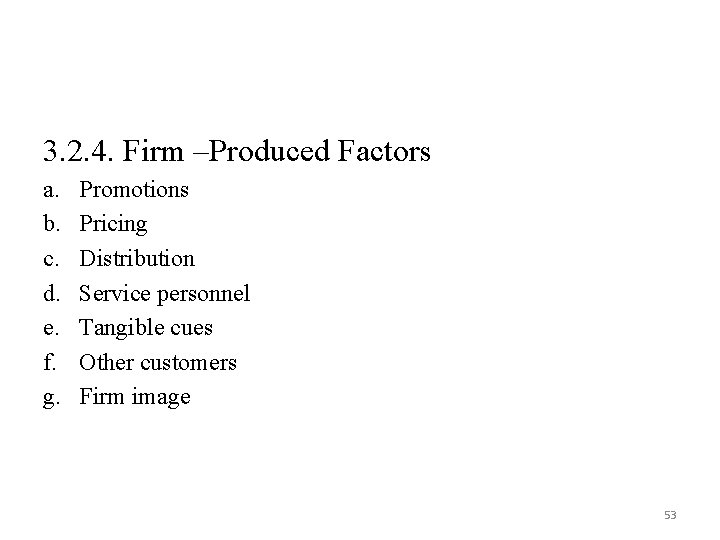
3. 2. 4. Firm –Produced Factors a. b. c. d. e. f. g. Promotions Pricing Distribution Service personnel Tangible cues Other customers Firm image 53
3. 3. Role of Consumer Expectation • During the pre-purchase phase, consumer expectations will influence which firm is patronized. • During the service encounter, customer will compare the service they are receiving to what they expected. • In the post-purchase phase, after patronage decisions will be based on how closely the service experience met the expectations of customer. 54
3. 4. Managing Consumer Expectations purchase decisions are based on consumer expectations. The higher the expectations are the greater the probability of purchase. The lower the expectations are the lower the probability of purchase. Also, remember that the higher the expectations, the greater the chances that the service firm will not be able to meet consumer expectations and that the customer will be dissatisfied. The reverse is true for lower expectations. 55
Consumer expectations must be managed during the pre -purchase phase, the service encounter, and the postpurchase phase. During the pre-purchase phase Managing customer expectations during the pre-purchase phase consists of three steps. ü Learn what customers expect ü Tell customers what they can expect ü Consistently provide the service that customers expect 56
During the service encounters Three strategies can be used during the service encounter to manage customer expectations: ü Service personnel must communicate with the customer during the service encounter ü If possible, service providers should modify the service to meet the customers’ expectations ü If the service cannot be modified the service personnel should explain why the customer expectations cannot be met. The goal of this phase is to ensure the service being provided matches the customer’s expectations. 57
During the post-purchase phase Managing consumer expectations does not stop after the service is performed. Service firms have three strategies they can see after the service has been completed. ü Companies should communicate with customers immediately after the service is completed to see if expectations were met. ü Firms can use a follow-up programs (evaluation survey) ü Companies should have a procedure for dealing with dissatisfied customer that will assist in managing future expectations. The goal during this phase is twofold. ü To communicate with costumers to see if expectations were met ü To modify the service to increase the chances of repeat purchases 58
Chapter Four Customer perception The objectives of this chapter are as follows: ü Provide students with definitions and understanding of customer satisfaction and service quality and of how these two types of customers’ perceptions are related. ü Show that service encounters or the moments of truth are the building blocks of customer perception. ü Highlight strategies for managing customer perceptions of service 59
4. 1 Over view of Customer Perceptions and its definition Customers perceive service in terms of quality of the service and how satisfied they are overall with their experiences. Companies today recognize that they can compete more effectively by distinguishing themselves with respect to service quality and improved customer satisfaction. A consumer perception is defined as the process by which an individual selects, organizes, and interprets stimuli into a meaningful and Coherent picture of the world. A stimulus is any unit of input to any of the sense. Examples of stimuli (i. e sensory input) include products, packages, brand names, advertisements, and commercials (Leon and Leslie, 1997). 60
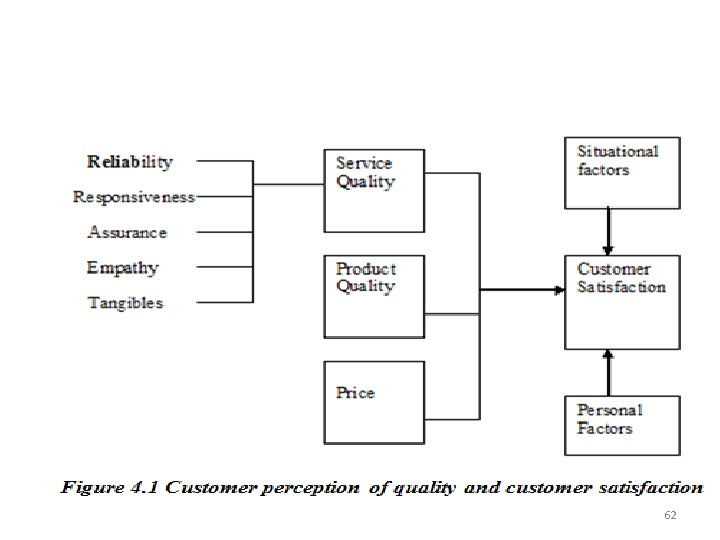
4. 1. 1 Satisfaction versus Service Quality satisfaction is generally viewed as broader concept while service quality assessment focuses specifically on dimensions of service. Based on this view, perceived service quality is a component of customer satisfaction. As shown in the following figure 4. 1, Service quality is a focused evaluation that reflects the customer’s perception of specific dimensions of service reliability, responsiveness, assurance, empathy, tangibles. Satisfaction, on the other hand, is more inclusive: it is influenced by perceptions of service quality, product quality and price as well as situational factors and personal factors. 61
62
4. 1. 2. Internal and External Perceptions • By external customer, we mean those individuals and businesses that buy goods and services from the organization. These are the people we usually think of when we use the word “customer”. • Internal customers are employees within the firm who, in their jobs, depend on others in the organization for internally provided goods and services. 63
4. 2 Customers Satisfaction is the consumer’s fulfillment response. It is a judgment that a producer or service feature or the product or service itself provides a pleasurable level of consumption-related fulfillment. According to Kottler and Keller (2006), customer satisfaction is a person’s feeling of pleasure or disappointment resulting from comparing a product’s perceived performance (or outcome) in relation to his or her expectations. 64
If the performance falls short of expectations, the customer is dissatisfied. If the performance matches the expectations, the customer is satisfied. If the performance exceeds expectations, the customer is highly satisfied or delighted. Customer satisfaction will be influenced by specific product or service features and by perceptions of quality as suggested by figure above. Satisfaction will also be influenced by customers’ emotional responses, their attributions, and their perceptions of equity. 65
Outcomes of Customer Satisfaction • customer satisfaction is an important indicator of national economic health. • increasing Level of customer satisfaction can be linked to customer loyalty and profits. 66
4. 3. Service Quality Next is service quality, a critical component of customer perceptions. In the case of pure services, service quality will be the dominant element in customer’s evaluations. In cases where customers’ services or services are offered in combination with a physical product, service quality may also be very critical in determining customer satisfaction. First, we discuss the distinctions between process and technical outcome quality; then we examine the five dimensions of service quality. Ultimately, consumers judge the quality of services on their perception of the technical outcome provided and on how that outcome was delivered. For example, a legal services client will judge the quality of the outcome or how the court case was resolved and also the quality of the process. Process quality would include such things as the lawyer’s timeliness, his responsiveness in returning phone calls, his empathy for the client, his courtesy and listening skills. 67
Service Quality Dimensions Five principal dimensions that customers use to evaluate service quality. These are: Reliability, Responsive, Assurance, Empathy, and Tangibles as shown earlier and defined here: • Reliability: Ability to perform the promised service dependably and accurately. • Responsiveness: Willingness to help customers and provide prompt service. • Assurance: Employees’ knowledge and courtesy and their ability to inspire trust and confidence. • Empathy: Caring, individualized attention given to customers. • Tangibles: Appearance of physical facilities, equipment, personnel and written materials. 68
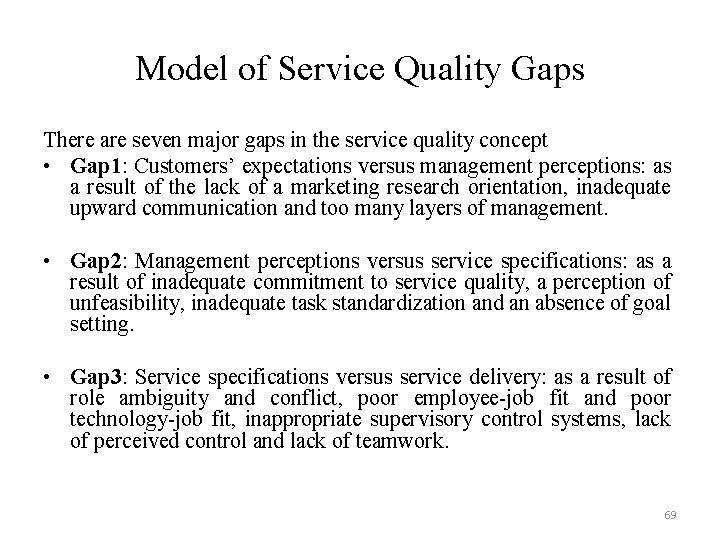
Model of Service Quality Gaps There are seven major gaps in the service quality concept • Gap 1: Customers’ expectations versus management perceptions: as a result of the lack of a marketing research orientation, inadequate upward communication and too many layers of management. • Gap 2: Management perceptions versus service specifications: as a result of inadequate commitment to service quality, a perception of unfeasibility, inadequate task standardization and an absence of goal setting. • Gap 3: Service specifications versus service delivery: as a result of role ambiguity and conflict, poor employee-job fit and poor technology-job fit, inappropriate supervisory control systems, lack of perceived control and lack of teamwork. 69
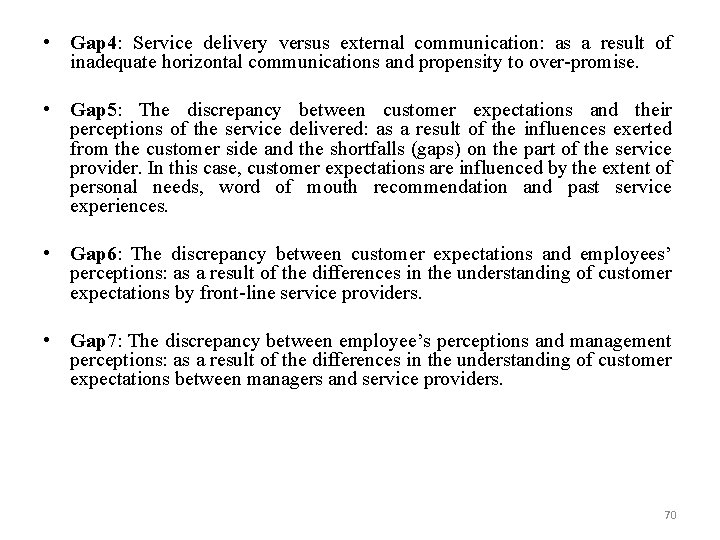
• Gap 4: Service delivery versus external communication: as a result of inadequate horizontal communications and propensity to over-promise. • Gap 5: The discrepancy between customer expectations and their perceptions of the service delivered: as a result of the influences exerted from the customer side and the shortfalls (gaps) on the part of the service provider. In this case, customer expectations are influenced by the extent of personal needs, word of mouth recommendation and past service experiences. • Gap 6: The discrepancy between customer expectations and employees’ perceptions: as a result of the differences in the understanding of customer expectations by front-line service providers. • Gap 7: The discrepancy between employee’s perceptions and management perceptions: as a result of the differences in the understanding of customer expectations between managers and service providers. 70
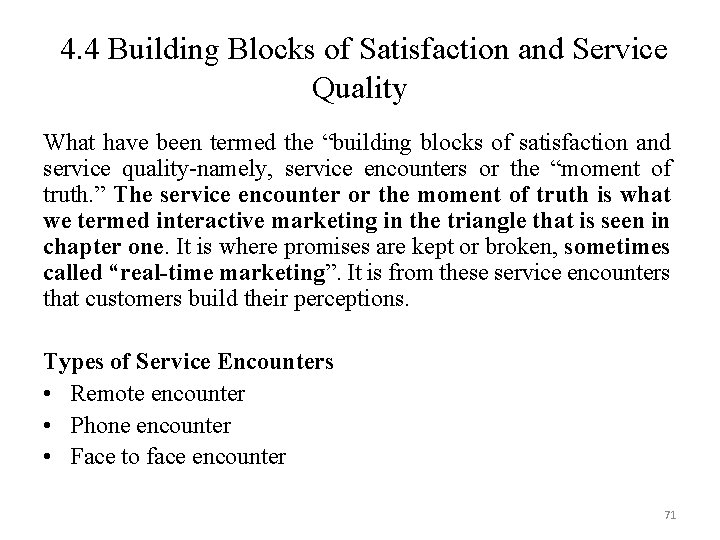
4. 4 Building Blocks of Satisfaction and Service Quality What have been termed the “building blocks of satisfaction and service quality-namely, service encounters or the “moment of truth. ” The service encounter or the moment of truth is what we termed interactive marketing in the triangle that is seen in chapter one. It is where promises are kept or broken, sometimes called “real-time marketing”. It is from these service encounters that customers build their perceptions. Types of Service Encounters • Remote encounter • Phone encounter • Face to face encounter 71
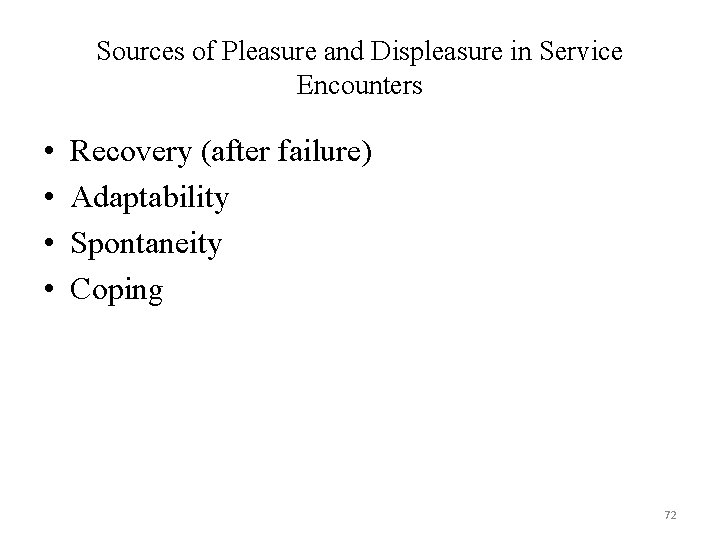
Sources of Pleasure and Displeasure in Service Encounters • • Recovery (after failure) Adaptability Spontaneity Coping 72
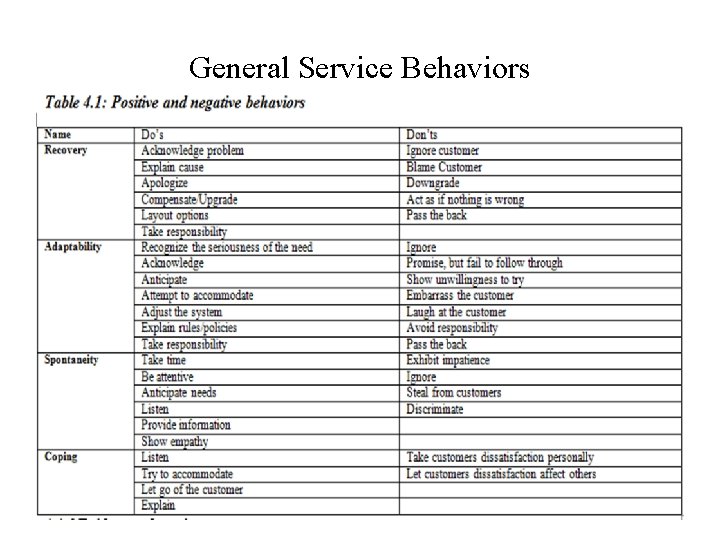
General Service Behaviors 73
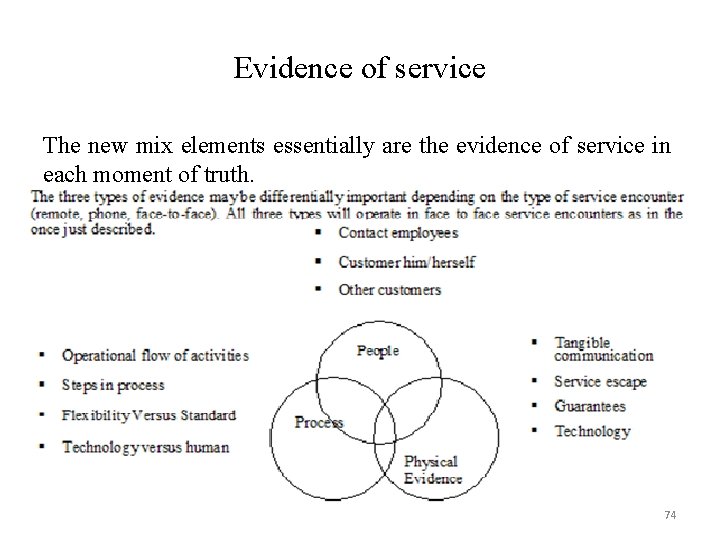
Evidence of service The new mix elements essentially are the evidence of service in each moment of truth. 74
Strategies for Influencing Customer Perceptions Management strategies used to influence perceptions of service delivery are: • Measure and manage customer satisfaction and service quality • Aim for Service Quality and Customer Satisfaction in Every Service Encounter ü ü ü Plan for Effective Recovery Facilitate Adaptability and Flexibility Encourage Spontaneity Help Employees Cope with Problem Customers Manage the Dimensions of Quality at the Encounter Level • Manage the Evidence of service to reinforce perceptions 75
Chapter five Customer Relationships The objective of this chapter: At the end of this chapter students will be able to: • Explain relationship marketing, its goals and the benefits of long-term relationships for firms and customers. • Explain why and how to estimate customer lifetime value. • Specify the foundations for successful relationship marketing, namely quality core service and careful market segmentation Understand successful customer retention strategies 76
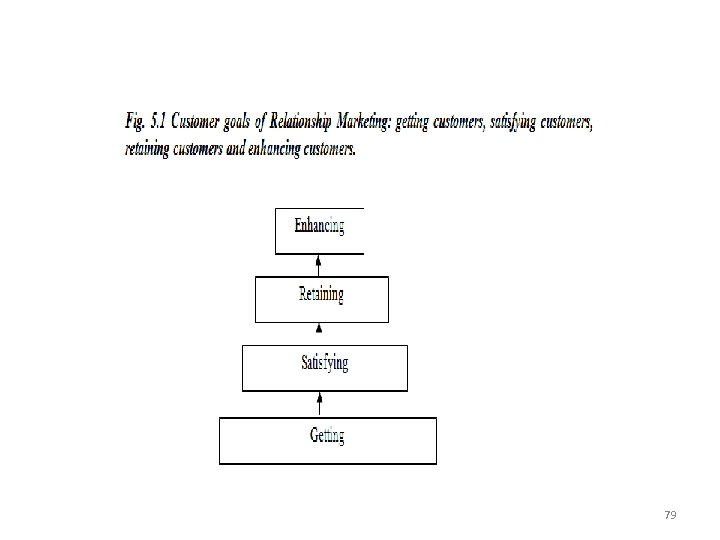
5. 1 Relationships Marketing There has been a shift from a transaction to a relationship focus in marketing. Customers become partners and the firm must make long-term commitments to maintaining those relationships with quality, service and innovation. Goals of Relationship Marketing The primary goal of relationship marketing is to build and maintain a base of committed customers who are profitable for the organization. To achieve this goal, the firm will focus on the attraction, retention and enhancement of customer relationship. First, the firm will seek to attract customers who are likely to become long-term relationship customers. 77
As the number of these relationships grow, the loyal customers themselves will frequently help to attract (through word of mouth) new customers with similar relationship potential. Once they are attracted to begin a relationship with the company, customers will be more likely to stay in the relationship when they are consistently provided with quality products and services and good value over time. They are less likely to be pulled away by competitors if they feel the company understands their changing needs and seems willing to invest in the relationship constantly improving and evolving is product and service mix. Finally, the goal of customer enhancement suggests that loyal customers can be even better customers if they buy more products and services from the company over time. Loyal customers not only provide a solid base for the organization, they may represent growth potential. 78
79
5. 1. 1. Benefits of Customer/ firm Relations A. Benefits for customers: ü Confidence Benefits ü Social Benefits ü Special Treatment Benefits B. Benefits for the Organization: ü Increasing Purchases ü Lower Costs ü Free Advertising through word of mouth ü Employee Retention 80
5. 2. Life time Value of a Customer Lifetime value of a customer is a concept or calculation that looks at customers from the point of view of their lifetime revenue and profitability contributions to a company. This type of calculations obviously needed when companies start thinking of building long -term relationships with their customer. Factors that influence lifetime value: • The lifetime value of a customer is influenced by the length of an average “lifetime”, the average revenues generated per relevant time period over the lifetime, Sales of additional products and service over time and referrers generated by the customer over time. • Lifetime value sometimes refers to lifetime revenue stream only; other times, when costs are considered, lifetime value may truly mean ‘lifetime profitability. ” 81
5. 3. Foundation for Relationship Strategies a. Quality in the core Service • Retention strategies will have little long-term success unless there is a solid base of service quality and customer satisfaction to build on. • It must be competitive, however, and frequently better than that. • It’s not good to attempt retention strategies of inferior services. 82
b. Careful Market Segmentation and Targeting Process for Market Segmentation and Targeting in Services Many aspects of segmentation and targeting for services are the same as those for manufactured goods. These are: • • • Identifying bases for segment the market, developing profiles of resulting segment, develop measures of segment attractiveness, select the target segment, and Ensure that segments are compatible. 83
c. Monitoring Relationships A thorough means of monitoring and evaluating relationship quality over time is another foundation for relationship marketing. 84
5. 4. Retention Strategies Retention marketing can occur at different levels and that each successive level of strategy results in ties that bind the customer a little closer to the firm. ü Level one-Financial Bonds ü Level two- Social Bonds ü Level Three- customization bonds ü Level Four- Structural bonds ü Customer Appreciation 85
CHAPTER SIX Complaint Handing and Service Recovery Objectives of the chapter: At the end of this chapter students will be able: • Understand the courses of action that are opened to dissatisfied consumer • Explain the factors that influence complaining behavior • Understand how managers design a service recovery system • Know the techniques for identifying the root cause for specific problems • Know the offers of service guarantees 86
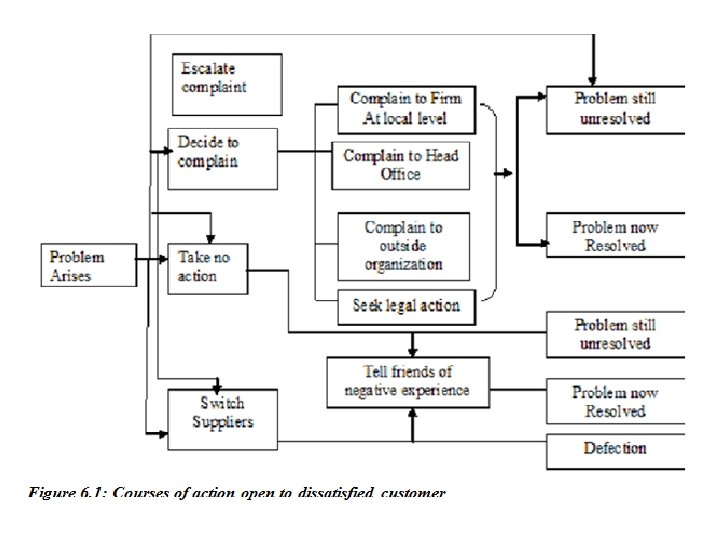
6. 1 Consumer Complaining Behavior 6. 1. 1 Customer Response to Service Failures What options are open to customers when they experience a service failure? Figure 6. 1 depicts the courses of action available. This model suggests at least four major courses of action: • Do nothing. • Complain in some form to the service firm. • Take action through a third party (consumer advocacy group, consumer affairs or regulatory agencies, and civil or criminal courts). • Abandon this supplier and discourage other people from using the service (negative word of mouth). 87
6. 1. 2. The TARP Study of Consumer Complaint Handling Why Don’t Customers Complain? TARP found three primary reasons why dissatisfied customers do not complain. • They didn’t think it was worth the time or effort. • They decided no one would be concerned about their problem or resolving it • They did not know where to go or what to do • Another reason why people don’t complain reflects culture or context.
Impact on Repurchase Intentions: When complaints are satisfactorily resolved, there’s a much better chance that the customers involved will remain brand loyal and continue to repurchase the items in question.
6. 1. 3 Factors Influencing Complaining Behavior studies of consumer complaining behavior have identified two main purposes for complaining. • First, consumers will complain to recover some economic loss, seeking either to get a refund or to have the service performed again (e. g. , car repairs and dry cleaning services). • A second reason for complaining is to rebuild self-esteem.
There are perceived costs to complaining. These may include: • The monetary cost of a stamp or phone call, • Time and effort in writing a detailed letter or making a verbal complaint, and • The psychological cost of risking an unpleasant personal confrontation with a service provider especially if this involves someone whom the customer knows and may have to deal with again such costs may well deter a dissatisfied customer from complaining
6. 1. 4 Complaints as Market Research Data Responsive service organizations look at complaints as a stream of information that can be used to help monitor productivity and quality and highlight improvements needed to improve service design and execution. The most useful roles for centralized complaint logs/record are: • To provide a basis for follow-up and tracking all complaints to see that they have in fact been resolved, • To serve as an early warning indicator of perceived deterioration in one or more aspects of service, and • To indicate topics and issues that may require more detailed research.
6. 1. 5 Making it easier for customers to complain How can managers make it easier for unhappy customers to complain about service failures? Many companies have improved their complaint collection procedures: • By adding special toll/fee free phone lines, • Prominently displayed customer comment cards and video or computer terminals for recording complaints. Some go even further, • Training their staff to ask customers if everything is satisfactory and to intervene if a customer is obviously discontented of course just collecting complaints doesn’t necessarily help resolve them.
6. 2. Impact of Service Recovery Efforts on Customer Loyalty • TARP argues that complaint handling should be seen as a profit center, not a center and has even created a formula to help companies relate the value of retaining a profitable customer to the overall costs of running an effective complaint handling unit. • Efforts to design service recovery procedures must take into account a firm’s specific environment and the types of problems that customers are likely to encounter.
6. 2. 1 Service Recovery Following Customer Complaints Service recovery is an umbrella term for systematic efforts by a firm to correct a problem following a service failure and to retain a customer’s goodwill. Service recovery efforts play a crucial role in achieving (or restoring) customer satisfaction. In every organization, things may occur that have a negative impact on its relationships with customers. Effective service recovery requires thoughtful procedures for resolving problems and handling disgruntled customers. It is critical for firms to have effective recovery strategies, because even a single service problem can destroy a customer’s confidence in a firm under the following conditions: ü The failure is totally outrageous/offensive (for instance, blatant dishonesty on the part of the supplier). ü The problem fits a pattern of failure rather than being an isolated incident. ü The recovery efforts are weak, serving to compound the original problem rather than correct it
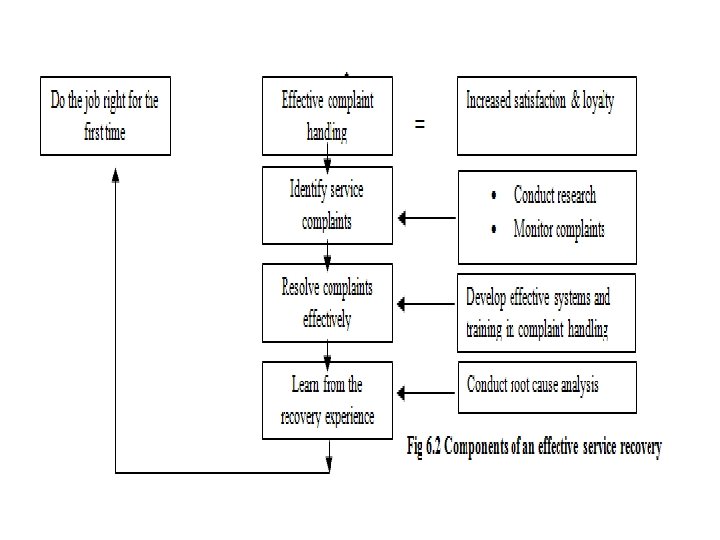
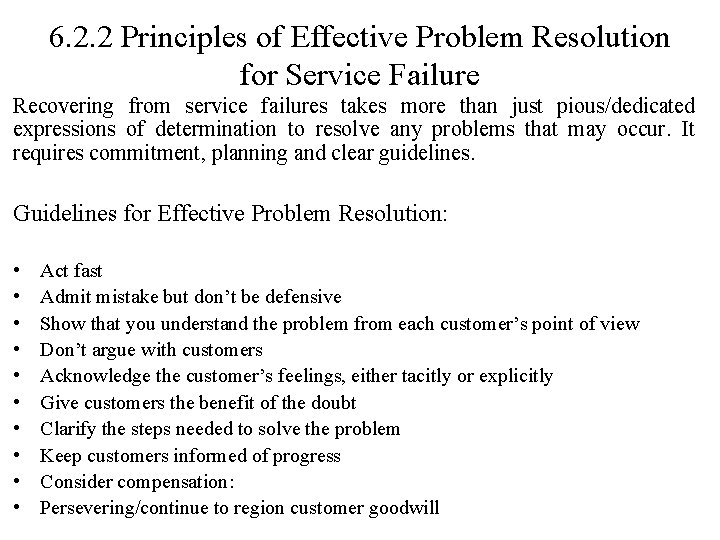
6. 2. 2 Principles of Effective Problem Resolution for Service Failure Recovering from service failures takes more than just pious/dedicated expressions of determination to resolve any problems that may occur. It requires commitment, planning and clear guidelines. Guidelines for Effective Problem Resolution: • • • Act fast Admit mistake but don’t be defensive Show that you understand the problem from each customer’s point of view Don’t argue with customers Acknowledge the customer’s feelings, either tacitly or explicitly Give customers the benefit of the doubt Clarify the steps needed to solve the problem Keep customers informed of progress Consider compensation: Persevering/continue to region customer goodwill
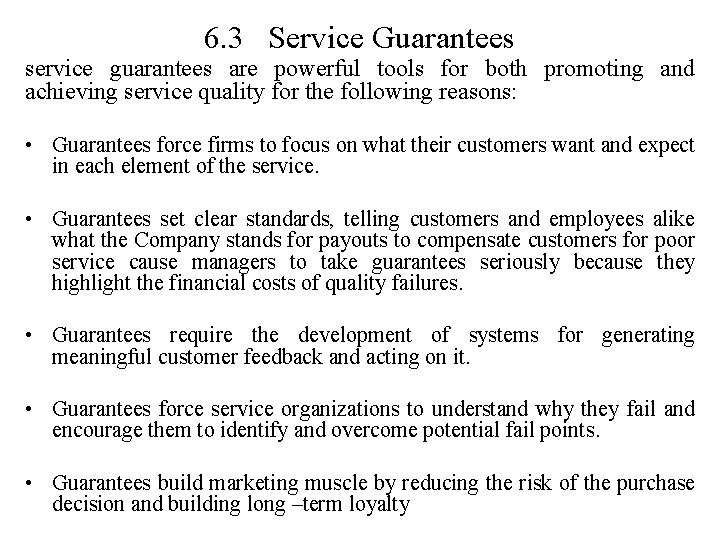
6. 3 Service Guarantees service guarantees are powerful tools for both promoting and achieving service quality for the following reasons: • Guarantees force firms to focus on what their customers want and expect in each element of the service. • Guarantees set clear standards, telling customers and employees alike what the Company stands for payouts to compensate customers for poor service cause managers to take guarantees seriously because they highlight the financial costs of quality failures. • Guarantees require the development of systems for generating meaningful customer feedback and acting on it. • Guarantees force service organizations to understand why they fail and encourage them to identify and overcome potential fail points. • Guarantees build marketing muscle by reducing the risk of the purchase decision and building long –term loyalty
Chapter Seven Service Development and Design Objectives of the chapter: At the end of the chapter students will be able: • understand the challenges inherent in service design • know steps in the new-service development process • Show the value of service blueprinting and quality function development in new-service design and service improvement
7. 1 Challenges of Service Designing Because services are intangible, they are difficult to describe and communicate. When services are delivered over a long period their complexity increases and they become even more difficult to define and describe. Further, because services are delivered by employees to customers, they are heterogeneous. These characteristics of services, which we explored in the first chapter of this course, are the heart of the challenge involved in designing services.
Because services cannot be touched or tried out, people frequently resort to words in their efforts to describe them. Lynn shostack, a pioneer in developing design concepts for services, has pointed out four risks of attempting to describe service in words alone. These are: • • Simplification Incompleteness Subjectivity Biased interpretation
7. 2 New Service Development The fact that services are intangible makes it even more imperative for a new service development system to have four basic characteristics: • • It must be objective, no subjective It must be precise, not vague It must be fact driven, not opinion driven It must be methodological not philosophical
7. 3 Types of new services Not all new services are “new” to the same degree. The type of new service options can run the range from major innovations to minor style changes, as described in the following. • Major innovations • Start up business • New Services • Service line extension • Service improvements • Style changes
7. 4. Stages in New-Service Development The steps can be applied to any of the types of new services just described. Much of what is presented in this section has direct parallels in the new-product development process for manufactured goods. Because of the inherent characteristics of services, however, the development process for new services require unique and complex adaptations. An underlying assumption of new product development process model is that new product ideas can be dropped at any stage of the process if they do not satisfy the criteria for success at that particular stage. Figure 7 -1 shows the checkpoints (represented by stop signs) that precede critical stages of the development process. The process shown in Figure 7 -1 is divided into two sections: front-end planning and implementation.
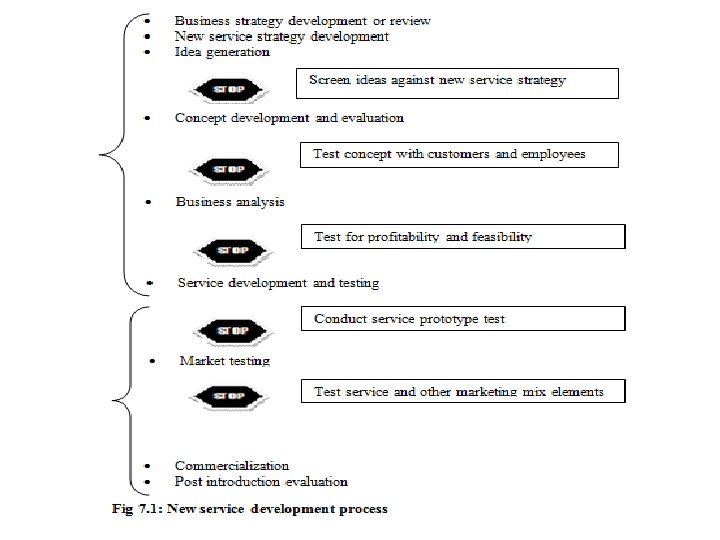
7. 4. 1 Front-End Planning Business Strategy Development It is usually assumed that an organization will have an overall strategic vision and mission. – Clearly a first step in new service development is to review that vision and mission. – The new service strategy and specific new service ideas must fit within the larger strategic picture of the organization.
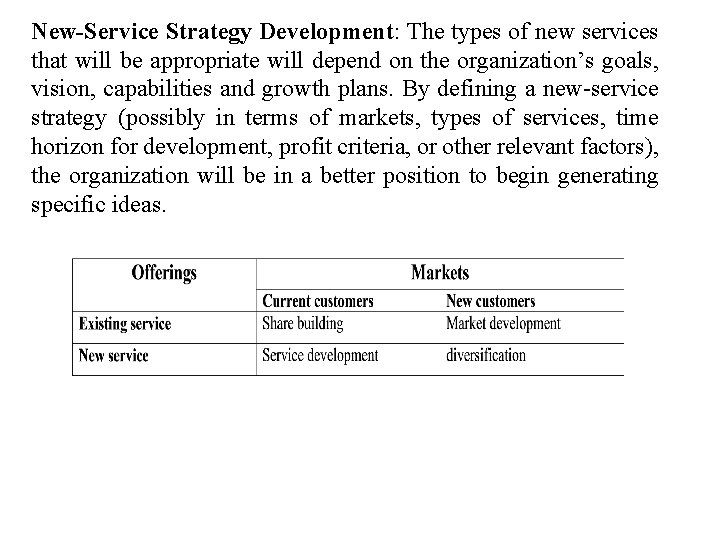
New-Service Strategy Development: The types of new services that will be appropriate will depend on the organization’s goals, vision, capabilities and growth plans. By defining a new-service strategy (possibly in terms of markets, types of services, time horizon for development, profit criteria, or other relevant factors), the organization will be in a better position to begin generating specific ideas.
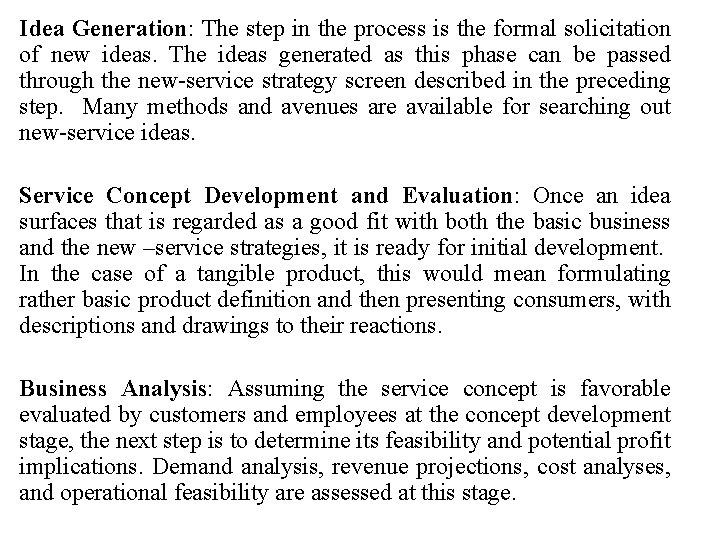
Idea Generation: The step in the process is the formal solicitation of new ideas. The ideas generated as this phase can be passed through the new-service strategy screen described in the preceding step. Many methods and avenues are available for searching out new-service ideas. Service Concept Development and Evaluation: Once an idea surfaces that is regarded as a good fit with both the basic business and the new –service strategies, it is ready for initial development. In the case of a tangible product, this would mean formulating rather basic product definition and then presenting consumers, with descriptions and drawings to their reactions. Business Analysis: Assuming the service concept is favorable evaluated by customers and employees at the concept development stage, the next step is to determine its feasibility and potential profit implications. Demand analysis, revenue projections, cost analyses, and operational feasibility are assessed at this stage.
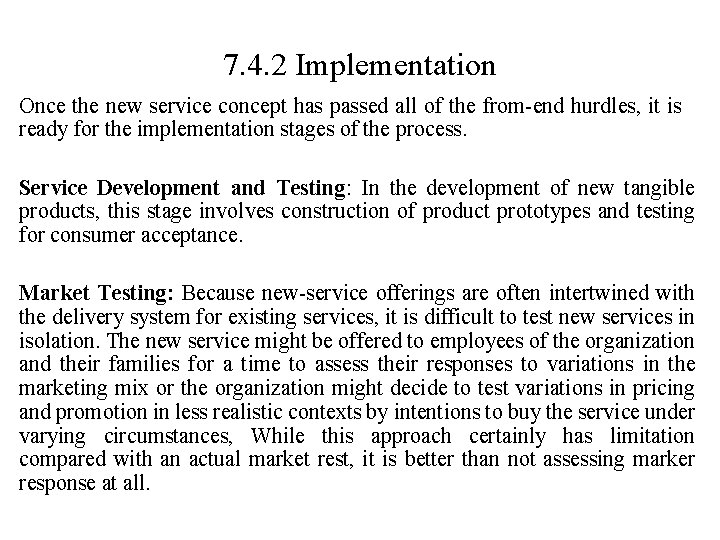
7. 4. 2 Implementation Once the new service concept has passed all of the from-end hurdles, it is ready for the implementation stages of the process. Service Development and Testing: In the development of new tangible products, this stage involves construction of product prototypes and testing for consumer acceptance. Market Testing: Because new-service offerings are often intertwined with the delivery system for existing services, it is difficult to test new services in isolation. The new service might be offered to employees of the organization and their families for a time to assess their responses to variations in the marketing mix or the organization might decide to test variations in pricing and promotion in less realistic contexts by intentions to buy the service under varying circumstances, While this approach certainly has limitation compared with an actual market rest, it is better than not assessing marker response at all.
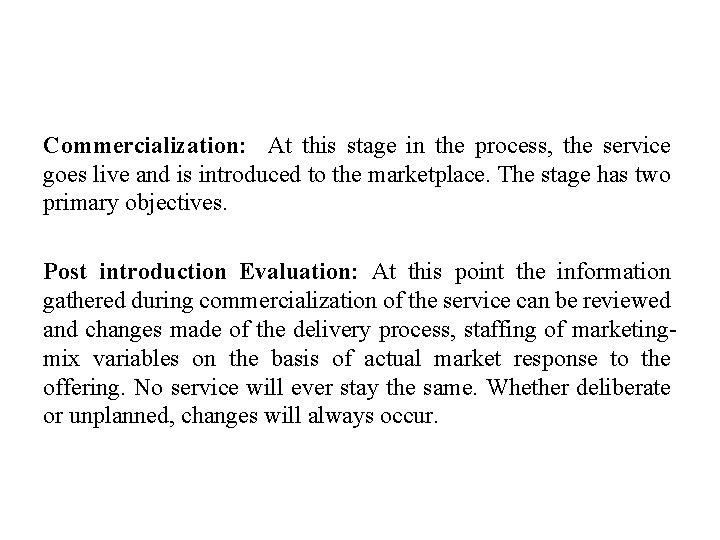
Commercialization: At this stage in the process, the service goes live and is introduced to the marketplace. The stage has two primary objectives. Post introduction Evaluation: At this point the information gathered during commercialization of the service can be reviewed and changes made of the delivery process, staffing of marketingmix variables on the basis of actual market response to the offering. No service will ever stay the same. Whether deliberate or unplanned, changes will always occur.
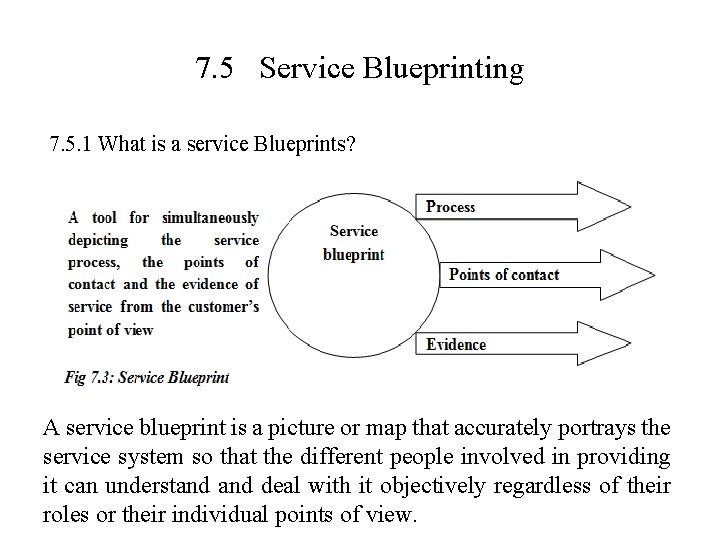
7. 5 Service Blueprinting 7. 5. 1 What is a service Blueprints? A service blueprint is a picture or map that accurately portrays the service system so that the different people involved in providing it can understand deal with it objectively regardless of their roles or their individual points of view.
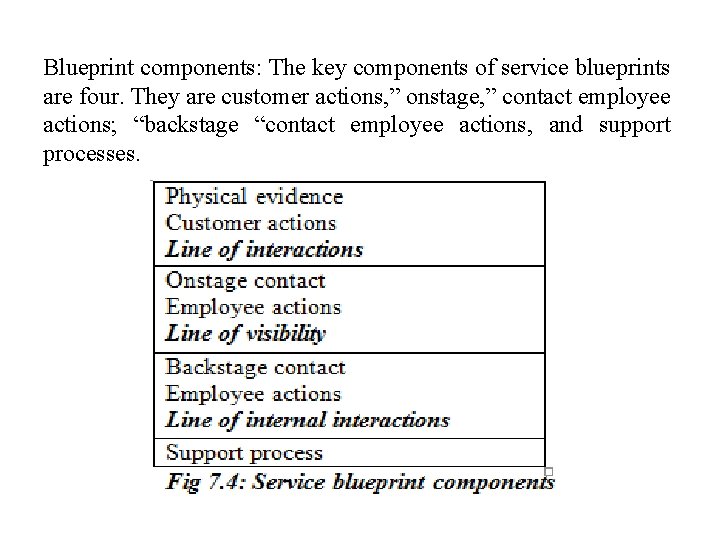
Blueprint components: The key components of service blueprints are four. They are customer actions, ” onstage, ” contact employee actions; “backstage “contact employee actions, and support processes.
The support processes section of the blueprint covers the internal services, steps, and interactions that take place to support the contact employees in delivering the service. Again in the legal example, any service support activities such as legal research by staff, preparation of documents, and secretarial support to set up meetings will be shown in the support processes area of the blueprint.
The four key action areas are separated by three horizontal lines. • First in the line of interaction, representing direct interactions between the customer and the organization. Any line a vertical line crosses the horizontal line of interaction, a direct contact between the customer and the organization, or a service encounter, has occurred. • The next horizontal line is the critically important line of visibility. This line separates all service activities that are visible to the customer from those that are not visible. • In reading blueprints it is immediately obvious whether the consumer in provided with much visible evidence of the service simply by analyzing how much of the service occurs above the line of visibility versus the activities carried out below the line. This line also separates what the contact employees do onstage from what they do backstage.
CHAPTER EIGHT: DELIVERING AND PERFORMING SERVICES The objectives of this chapter are to: • Illustrator the critical importance of service employees in creating customer satisfaction and service quality • Demonstrate the challenges inherent in boundary spanning roles. • Provide examples of strategies for creating customer oriented service delivery • Show the strategies can support a service culture
A. EMPLOYEES’ ROLES IN SERVICE DELIVERY 8. 1 The critical importance of service employees Ø They are the service Ø They are the organization in the customer’s eyes Ø They are marketers
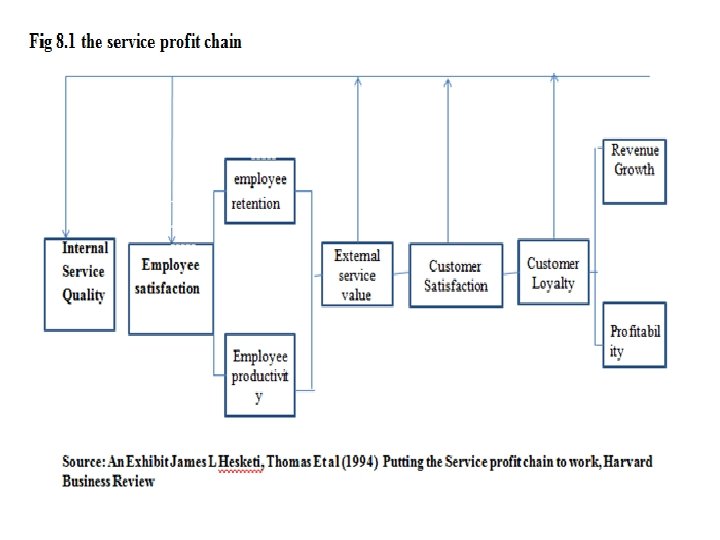
8. 1. 1 Employee satisfaction, customer satisfaction and profits • There is concrete evidence that satisfied employees make for satisfied customers and satisfied customers can in turn reinforce employees’ sense of satisfaction in their jobs. • What the service profit chain suggests is that there are critical linkages among internal service quality, employee satisfaction/productivity, the value of services provided to the customer and ultimately customer satisfaction, retention and profits.
8. 1. 2 Service Quality Dimension are Driven by employee Behavior All of the five dimensions of service quality (reliability, responsiveness, assurance, empathy and tangibles) can be influenced directly by service employees. Delivering the service as promised (reliability) is often totally within the control of front -line employees.
8. 2 Boundary spanning roles The front-line service employees are referred to as boundary spanners because they operate at the organization's boundary. They serve a critical function in understanding, filtering and interpreting information and resources to and from the organization and its external constituencies. Boundary spanning positions are often high stress jobs. In addition to mental and physical skills, these positions require extra ordinary levels of emotional labor, frequently demand an ability to handle interpersonal and inter-organizational conflict and call on the employee to make re-time trade-offs between quality and productivity of the job.
8. 2. 1 Emotional labor The term emotional labor refers to the labor that goes beyond the physical or mental skills needed to deliver quality services. 8. 2. 2 Sources of conflict Front-line employees often face interpersonal and inter-organizational conflicts on the job. Their frustration and confusion can, if left unattended, lead to stress, job dissatisfaction, a diminished ability to service customers, and burnout. The conflicts are: • Person/role conflicts • Organization versus client • Client versus client • Quality versus productivity
8. 3. Strategies for closing the Gap between the actual performance of a service and the standards set by management The four strategies that build customer-oriented service minded workforce: • Hire the right people ü Compete for the best people ü Hire for service competencies and service inclination ü Be the preferred employer • Develop people to deliver service quality ü Train from technical and interactive skills ü Empower employees ü Promote teamwork • Provide the needed support system ü ü Measure internal service quality A cautionary note Provide supportive technology and equipment Develop service-oriented internal processes • Retain the best people • Include employees in the company vision • Treat employees as customers • Measure and reward strong service performers
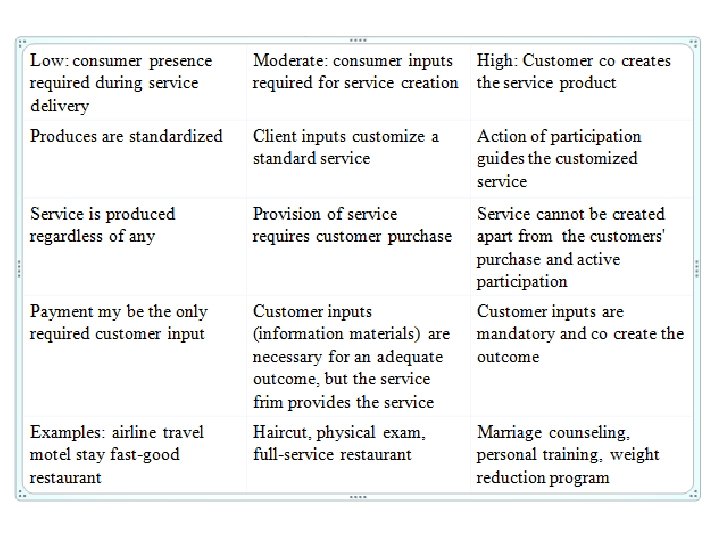
B. CUSTOMERS’ ROLES IN SERVICE DELIVERY 8. 4. The importance of customers in service delivery A. Customer receiving the service Because the customer receiving the service participates in the delivery process, she/he can contribute to gap 3 (the gap between service specification and service delivery) through their own appropriate or inappropriate, effective or ineffective, productive or unproductive behavior.
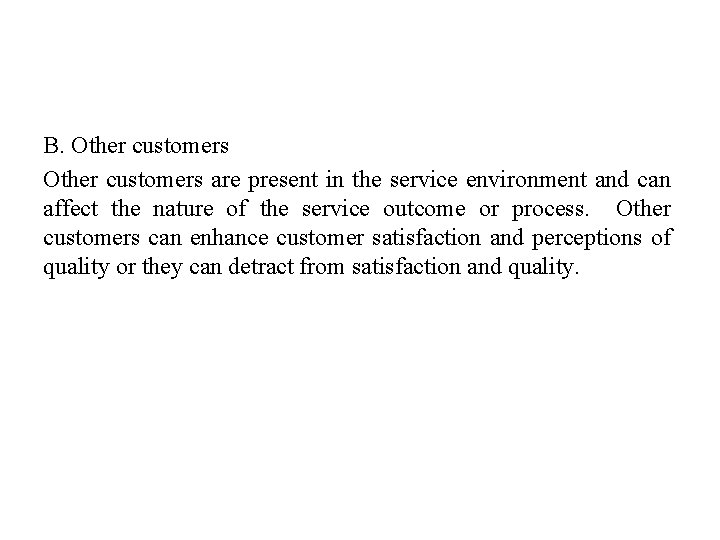
B. Other customers are present in the service environment and can affect the nature of the service outcome or process. Other customers can enhance customer satisfaction and perceptions of quality or they can detract from satisfaction and quality.
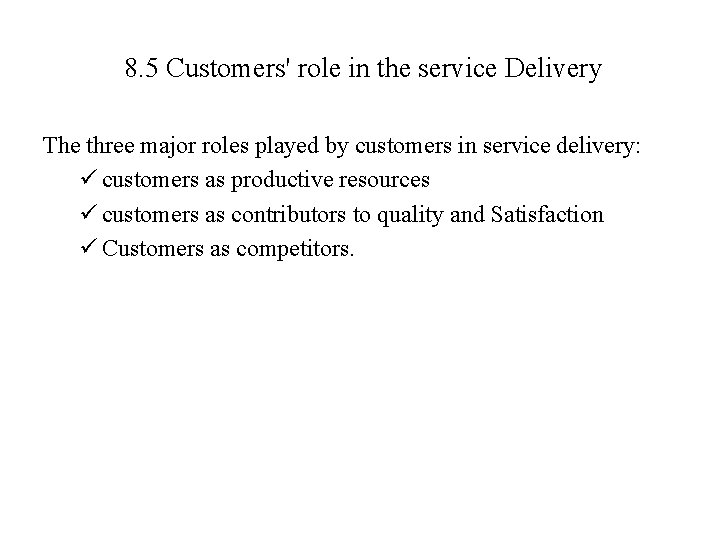
8. 5 Customers' role in the service Delivery The three major roles played by customers in service delivery: ü customers as productive resources ü customers as contributors to quality and Satisfaction ü Customers as competitors.
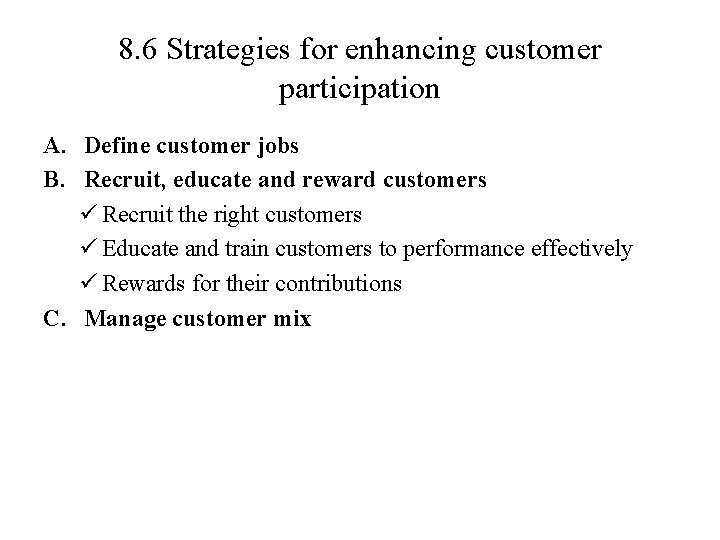
8. 6 Strategies for enhancing customer participation A. Define customer jobs B. Recruit, educate and reward customers ü Recruit the right customers ü Educate and train customers to performance effectively ü Rewards for their contributions C. Manage customer mix
Whether a household or a firm chooses to produce a particular service for itself or contract externally for the service depends on a variety of factors: • Expertise capacity: possesses the specific skills and knowledge needed to produce it. • Resource capacity: Having resources including people, space, money, and materials. • Time capacity: with adequate time capacity • Economic rewards: the economic advantage or disadvantage of a particular exchange decision • Psychic rewards: include degree of satisfaction enjoyment, gratification, or happiness • Trust: means the degree of confidence or certainty • Control: desire for control over the process and outcome of the exchange will also influence the choice.
CHAPTER NINE INTEGRATED SERVICES MARKETING Objectives of the chapter: After Completing these chapter students should be able to understand: • • • Concept of integrated service marketing communication Reasons for service communication problems Strategies to match service promises with service delivery Concept of customer expectation Managing internal marketing communication
9. 1 Concept of integrated services marketing communications Integrated marketing communications build a strong brand identity in the marketplace by tying together and reinforcing all your images and messages. IMC means that all your corporate messages, positioning and images, and identity are coordinated across all venues. It means that your PR materials say the same things as your direct mail campaign, and your advertising has the same ‘look and feel’ as your website. More complex type of integrated marketing communication is needed for services than for goods. External communications channels must be coordinated, as with physical goods, but both external communications and internal communication channels must be integrated to create consistent service promises. To do that, internal marketing communications channels must be managed so that employees and the company are in agreement about what is communicated to the customer. We call this more complicated version of IMC integrated services marketing communications (ISMC).
9. 2 Key Service Communication Challenges Discrepancies between what is communicated about a service and what a customer receives or perceives that they receive can powerfully affect consumer evaluations of service quality. The factors that contribute to these communication challenges include: • • • Service intangibility Management of service promises, Management of customer expectations, Customer education, and Internal marketing communications.
9. 2. 1 Service intangibility Because services are performances rather than objects, their essence and benefits are difficult to communicate to customers. Intangibility involves incorporeal existence, abstractness, generality, non-searchability and mental impalpability. • Incorporeal existence: The service product does not occupy physical space. • Abstractness: Service benefits such as financial security, fun, or health do not correspond directly with objects, making them difficult to visualize and understand. • Generality: refers to a class of things, persons, events, or properties • Non-searchability: Because service is a performance, it often cannot be previewed or inspected in advance of purchase. • Mental impalpability: Services are often complex, multidimensional, and difficult to grasp mentally.
9. 2. 2 Management of Service Promises A serious problem occurs when companies fail to manage service marketing communications. 9. 2. 3 Management of Customer Expectations Appropriate and accurate communication about services is the responsibility of both marketing and operations. Marketing must accurately (if compellingly) reflect what happens in actual service encounters; operations must deliver what is promised in communications.
9. 2. 4 Customer Education Service companies must educate their customers. If customers are unclear about how the service will be provided, what their role in delivery involves, and how to evaluate services they have never used before, they will be disappointed. 9. 2. 5 Internal Marketing Communications Multiple functions in the organization, such as marketing and operations, must be coordinated to achieve the goal of service provision. Because service advertising and personal selling promise what people do frequent and effective communication across functions horizontal communication is critical.
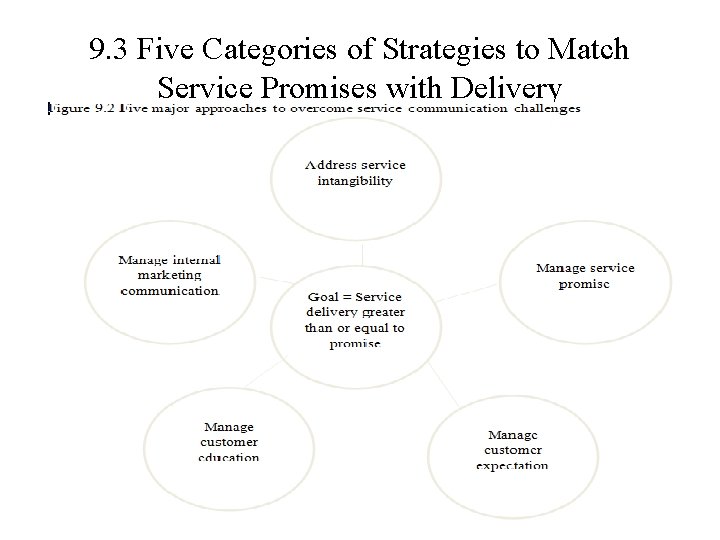
9. 3 Five Categories of Strategies to Match Service Promises with Delivery
9. 3. 1 Address Service Intangibility If service companies recognize the challenges they face due to intangibility, they can use selected strategies to compensate. • • • Use narratives to demonstrate the service experience. Present vivid information Use interactive imagery Focus on the tangibles Use brand icons to make the service tangible Use association, physical representation, documentation and visualization Feature service employees in communication. Feature satisfied customers in the communication Encourage word-of-mouth communication Leverage social media Make use of video-sharing networks
9. 3. 2 Manage Service Promises In manufacturing physical goods, the departments that make promises and those that deliver them can operate independently. Goods can be fully designed and produced, and then turned over to marketing for promotion and sale. In services, however, the sales and marketing departments make promises about what other employees in the organization will fulfill.
9. 3. 3 Manage Customer Expectations Accurately promising when and how service will be delivered is one of the most important ways to close the communication gap. Among the most effective strategies to manage customer expectations are: • Make realistic promises • Offer service guarantees, options and tiered-value offerings • Communicate criteria customers can use to assess service
9. 3. 4 Manage Customer Education Customers must perform their roles properly for many services to be effective. If customers forget to perform their roles, or perform them improperly, disappointment may result. For this reason, communication to customers can take the form of customer education. 9. 3. 5 Manage Internal Marketing Communication The fifth major category of strategies necessary to match service delivery with promises involves managing internal marketing communications. Internal marketing communications can be both vertical and horizontal. Vertical communications are either downward, from management to employees, or upward, from employees to management. Horizontal communications are those across functional boundaries in an organization.
CHAPTER TEN PRICING OF SERVICES Objectives of the chapter: After completing these chapter students should be able to understand: • • The Concept of value to Customers The role of price as an indicator of service quality Approaches to pricing service Strategies Used by companies to price services
10. 1 Concept of value to customers When consumers discuss value, they use the term in many different ways and talk about myriad attributes or components. What constitutes value, even in a single service category, appears to be highly personal and idiosyncratic. Customers define value in four ways: • Value is low price. • Value is whatever I want in a product or service. • Value is the quality I get for the price I pay. • Value is what I get for what I give.
10. 1. 1 Value Is Low Price Some consumers equate value with low price, indicating that what they have to give up in terms of money is most salient in their perceptions of value, as typified in these representative comments from customers: 10. 1. 2 Value Is Whatever I Want in a Product or Service Rather than focusing on the money given up, some consumers emphasize the benefits they receive from a service or product as the most important component of value. In this value definition, price is far less important than the quality or features that match what the consumer wants.
10. 1. 3 Value Is the Quality I Get for the Price I Pay Other consumers see value as a tradeoff between the money they give up and the quality they receive. 10. 1. 4 Value Is What I Get for What I Give Finally, some consumers consider all the benefits they receive as well as all sacrifice components (money, time, effort) when describing value.
10. 2 Price as an Indicator of Service Quality One of the intriguing aspects of pricing is that buyers are likely to use price as an indicator of both service costs and service quality. price is at once an attraction variable and a repellent. Customers’ use of price as an indicator of quality depends on several factors, one of which is the other information available to them.
10. 3 Approaches to Pricing Services • Cost-Based Pricing • Competition-Based Pricing • Demand-Based Pricing
10. 4 Pricing Strategies That Link to the Four Value Definitions 10. 4. 1 Pricing Strategies When the Customer Means ‘Value Is Low Price’ ü ü ü Discount Odd pricing Synchro-pricing Dynamic pricing Penetration pricing
10. 4. 2 Pricing Strategies When The Customer Means ‘Value Is Everything I Want In A Service. ’ ü Prestige pricing ü Skimming pricing 10. 4. 3 Pricing Strategies When the Customer Means “Value Is the Quality I Get for the Price I Pay” ü Value pricing ü Market segmentation pricing
10. 4. 4 Pricing Strategies When the Customer Means “Value Is All That I Get for All That I Give” ü ü Price framing Price bundling Complementary pricing Result-based pricing
- Slides: 149