
Chapter One Introduction to Heat Transfer Examples and




- Slides: 8
Chapter One – Introduction to Heat Transfer Examples and Exercises By Dawit M.
Analysis of Heat Transfer - Methodology Known: § After carefully reading the problem, state briefly and concisely what is known about the problem. Do not repeat the problem statement. Find: § State briefly and concisely what must be found. Schematic: § Draw a schematic of the physical system. If application of the conservation laws is anticipated, represent the required control volumes or surfaces by dashed lines on the schematic. Identify relevant heat transfer processes by appropriately labeled arrows on the schematic. Assumptions: § List all pertinent simplifying assumptions. Properties: § Compile property values needed for subsequent calculations and identify the source from which they are obtained. Analysis: § Begin your analysis by applying appropriate conservation laws, and introduce rate equations as needed. Develop the analysis as completely as possible before substituting numerical values. Perform the calculations needed to obtain the desired results. Comments: § Discuss your results. Such a discussion may include a summary of key conclusions, a critique of the original assumptions, and an inference of Analysis of Heat Transfer Problems: Methodology trends obtained by performing additional what-if and parameter sensitivity calculations.
Example 1: Conduction across a Plane Wall 1) The wall of a house, 7 m wide and 6 m high is made from 0. 3 m thick brick K = 0. 6 W/m. K. The surface temperature on the inside of the wall is 160 C and that on the outside is 60 C. Find the heat flux through the wall and the total heat loss through it.
Example 2: Convection Heat Dissipation from Transistor 2) The case of a power transistor, which is of length L = 10 mm and diameter D = 12 mm, is cooled by an air stream of temperature T = 250 C. § Under conditions for which the air maintains an average convection coefficient of h = 100 W/m 2 K on the surface of the case, what is the maximum allowable power dissipation if the surface temperature is not to exceed 850 C?
Example 3: Surface to Surface Heat Exchange 3) An un-insulated steam pipe passes through a room in which the air and walls are at 25°C. The outside diameter of the pipe is 70 mm, and its surface temperature and emissivity are 200°C and 0. 8, respectively. If the coefficient associated with free convection heat transfer from the surface to the air is 15 W/m 2 K, what is the rate of heat loss from the surface per unit length of pipe? (Assume gray sruface, ε = α )
Example 4: Closed System Energy Balance 4) A long conducting rod of diameter D and electrical resistance per unit length Re’ is initially in thermal equilibrium with the ambient air and its surroundings. This equilibrium is disturbed when an electrical current I is passed through the rod. Develop an equation that could be used to compute the variation of the rod temperature with time during the passage of the current.
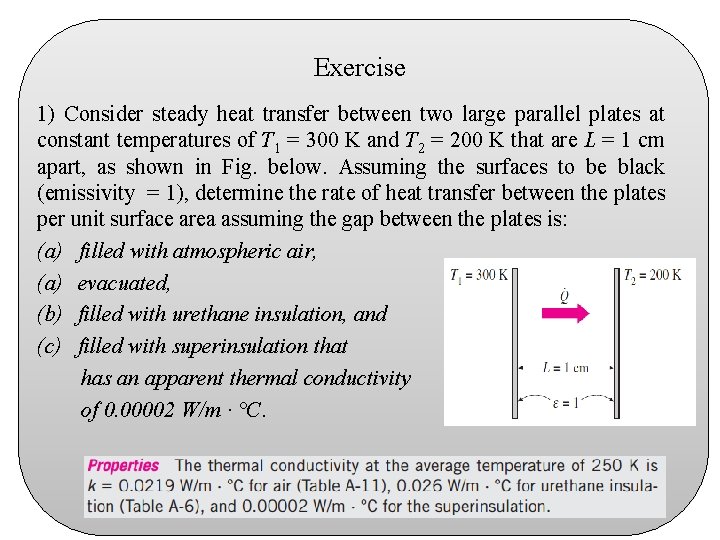
Exercise 1) Consider steady heat transfer between two large parallel plates at constant temperatures of T 1 = 300 K and T 2 = 200 K that are L = 1 cm apart, as shown in Fig. below. Assuming the surfaces to be black (emissivity = 1), determine the rate of heat transfer between the plates per unit surface area assuming the gap between the plates is: (a) filled with atmospheric air, (a) evacuated, (b) filled with urethane insulation, and (c) filled with superinsulation that has an apparent thermal conductivity of 0. 00002 W/m · °C.
Thank You Any Question?