
Chapter one Human Development The scientific study of

- Slides: 24
Chapter one Human Development The scientific study of the processes of development
Four Goals of Developmental Psychology ● Describe Example: When do children say their first words? ● Explain Example: How do children learn to use language? • Predict Example: Will delayed language development affect speech? ● Modify Example: Can therapy help speech delays?
Life Span Developmental processes: change and stability Two kinds of change: • Quantitative: change in number/amount (growth, height) • Qualitative: change in kind, structure, organization
Two Types of Developmental Change • Qualitative Structure or Organization Often difficult to Example: anticipate Changing from nonverbal to verbal communication • Quantitative Number or Amount Examples: Height Weight Size of Vocabulary
Life Span Development Physical development: change and stability in growth of the body and brain, sensory capacities, motor skills, and health Cognitive development: change and stability in mental abilities, learning, attention, memory, language, reasoning, creativity Psychosocial development: change and stability in emotions, personality, social relationships
Life Span Development Influences on development: normative: most people, similarities individual differences: specific differences Heredity & Environment Heredity: inborn traits or characteristics inherited from the parents Environment: inner and outer environment
Life Span Development Maturation: Unfolding of a natural sequence of physical changes and behavior patterns, mastery of skills, ability to learn. Culture & Ethnicity Culture is the society or group’s total way of life Ethnic: people united by a distinct culture, ancestry, religion, language, or national origin
Timing of Influences: Critical or Sensitive Periods Lorenz: hatched ducklings Imprinting: automatic and irreversible; instinctive bonding with mother; a predisposition to learning
Critical Period: specific time when a given event (or absence) has specific impact on development. Not absolutely fixed. Plasticity: ability to modify Sensitive Periods: especially responsive to specific type of experience
The Effects of Early Experience Questions to consider: 1. How important are early experiences and how much of an effect do they have on a person’s later life? 2. Are there critical periods during which a child must be exposed to certain stimulations or experiences (or forever be disadvantaged)? 3. How “plastic” is the child? That is, how can a child take and still bounce back? How much can a child endure before his/her later development will be permanently impaired?
Without feedback from the environment (that is, without experience) how can further development occur? A child raised in a deprived environment with inadequate stimulation and feedback might fail to learn. The damage to a child is significant when love and attention are absent.
Critical & Sensitive Periods Critical and sensitive periods are both times when the organism is biologically primed to most benefit from a particular experience. Sensitive Periods: adverse effects caused by missing a sensitive period may be overcome at a later time, although with great difficulty.
Critical Periods: adverse effects caused by missing a critical period are permanent. The only clearly demonstrated critical period in human beings involves early stimulation of certain neural and body cells. Without such stimulation, these cells atrophy and die (e. g. , visual neurons must have light during their early development or they will die. Depth perception may occur as well.
The first 5 to 6 years of childhood may be a critical period for the development of the brain. Even when a part of the brain is damaged, if damage occurs before age 5/6, the brain may compensate and take over the functions. After age six, highly unlikely.
Other ways a child may suffer permanent disability by early childhood: 1. occurrence of irreparable physical damage upon which later development will depend 2. a critical period that passes without the child’s obtaining the necessary experience or stimulation 3. a situation where the child is kept by their culture or environment from ever obtaining the learning necessary for proper development.
Learning and Early Experience Sometimes a child misses an important learning experience because the environment fails to provide it. If the child eventually receives the necessary experiences they may be able to recover.
Baltes’s Life Span Approach: 6 Key Principles 1. Development is lifelong Change & adaptation occur throughout life 2. Development involves both gain & loss Ex: Gaining vocabulary, but losing ability to acquire language 3. Biological & cultural influences shift over time 4. Development involves changing allocation of resources Resources used for growth, maintenance, & recovery 5. Development shows plasticity Ex: Memory can be improved with practice 6. Development is influenced by historical and cultural context.
Theory & Reseach Two models: Mechanistic: locke Organismic: Rousseau
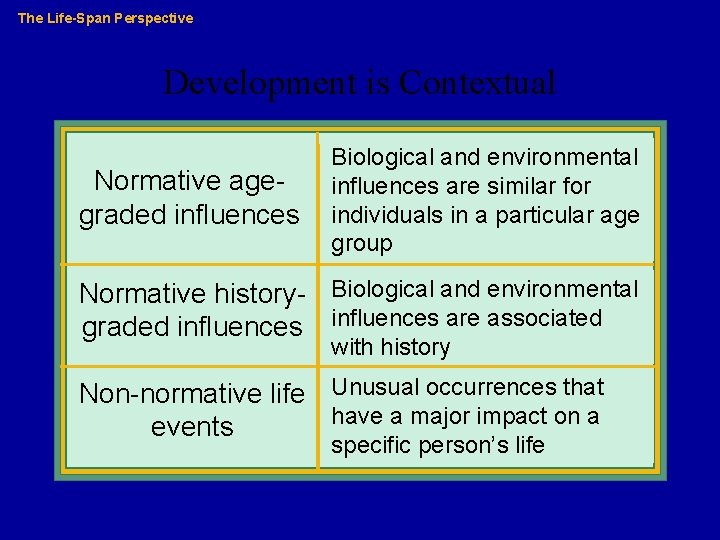
The Life-Span Perspective Development is Contextual Normative agegraded influences Biological and environmental influences are similar for individuals in a particular age group Normative history- Biological and environmental graded influences are associated with history Non-normative life Unusual occurrences that have a major impact on a events specific person’s life
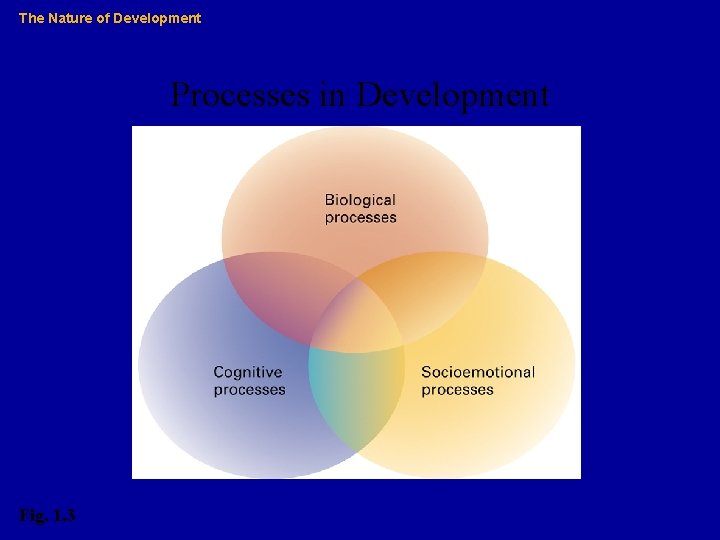
The Nature of Development Processes in Development Fig. 1. 3
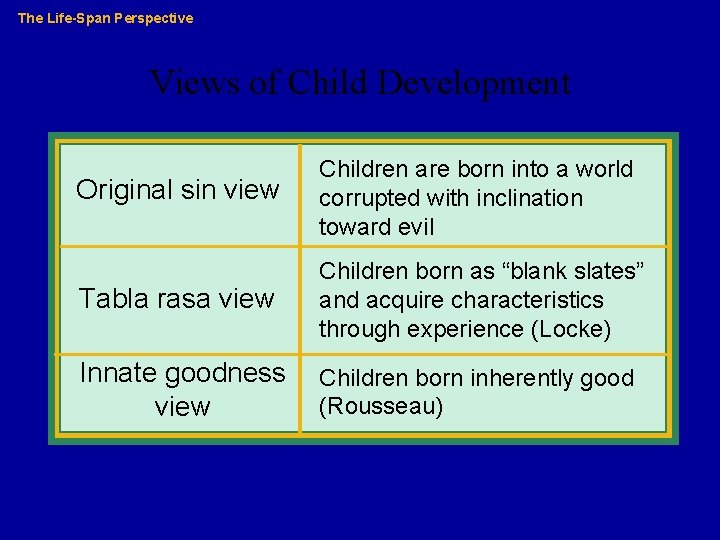
The Life-Span Perspective Views of Child Development Original sin view Children are born into a world corrupted with inclination toward evil Tabla rasa view Children born as “blank slates” and acquire characteristics through experience (Locke) Innate goodness view Children born inherently good (Rousseau)
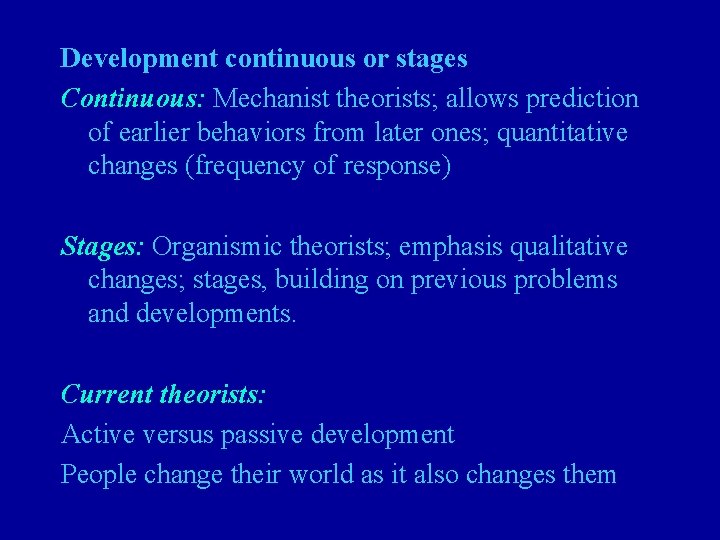
Development continuous or stages Continuous: Mechanist theorists; allows prediction of earlier behaviors from later ones; quantitative changes (frequency of response) Stages: Organismic theorists; emphasis qualitative changes; stages, building on previous problems and developments. Current theorists: Active versus passive development People change their world as it also changes them
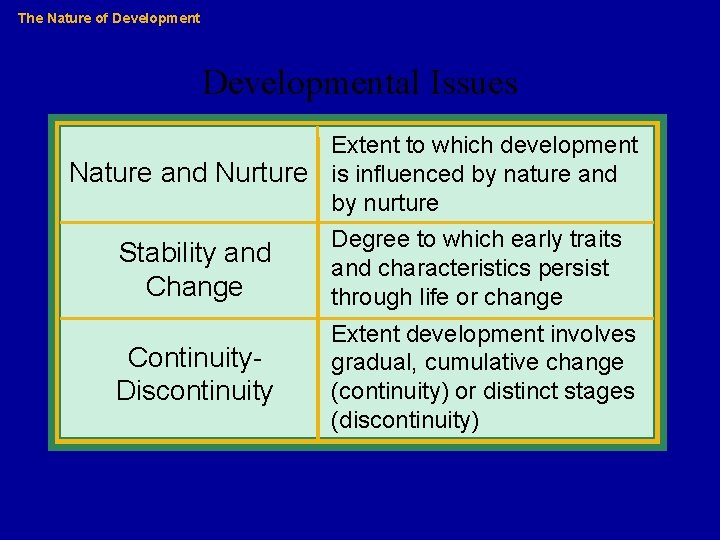
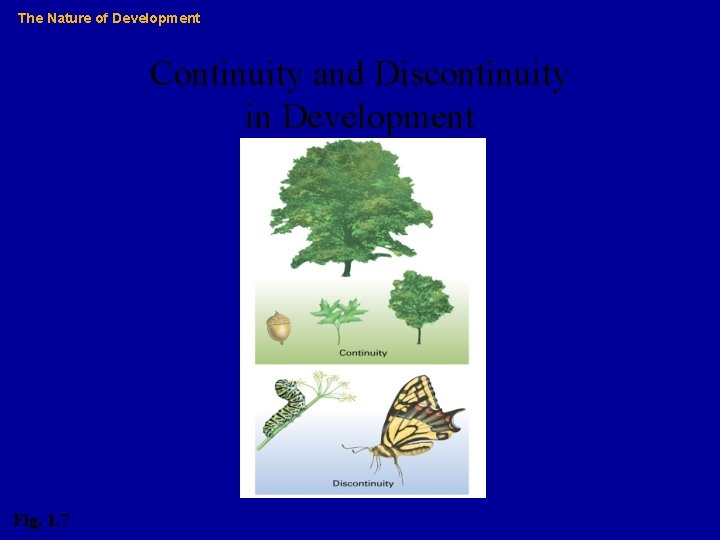
The Nature of Developmental Issues Extent to which development Nature and Nurture is influenced by nature and by nurture Stability and Change Degree to which early traits and characteristics persist through life or change Continuity. Discontinuity Extent development involves gradual, cumulative change (continuity) or distinct stages (discontinuity)
The Nature of Development Continuity and Discontinuity in Development Fig. 1. 7