
Chapter Objectives Determine the deflection and slope at
Chapter Objectives ü ü Determine the deflection and slope at specific points on beams and shafts, using various analytical methods including: Ø The integration method Ø The use of discontinuity functions Ø The method of superposition Determine the same, using a semi-graphical technique, called the moment-area method. Copyright © 2014 Pearson Education, All Rights Reserved
In-class Activities 1. 2. 3. 4. 5. 6. 7. 8. Reading Quiz Applications Elastic Curve Integration Method Use of discontinuity functions Method of superposition Moment area method Concept Quiz Copyright © 2014 Pearson Education, All Rights Reserved
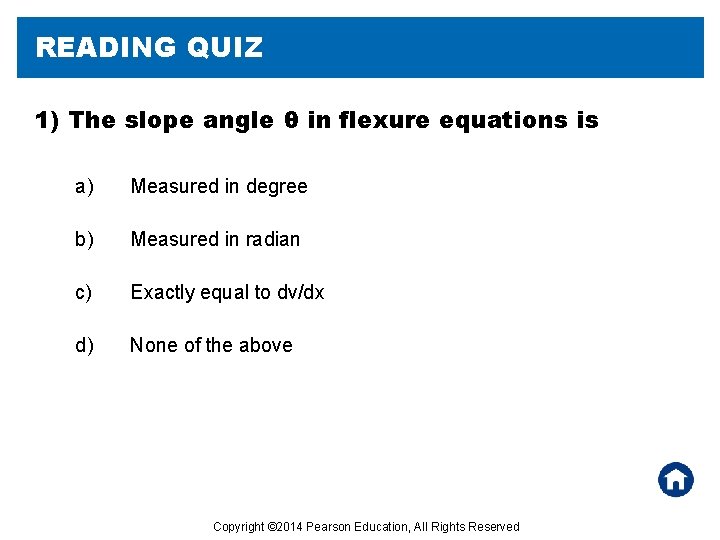
READING QUIZ 1) The slope angle θ in flexure equations is a) Measured in degree b) Measured in radian c) Exactly equal to dv/dx d) None of the above Copyright © 2014 Pearson Education, All Rights Reserved
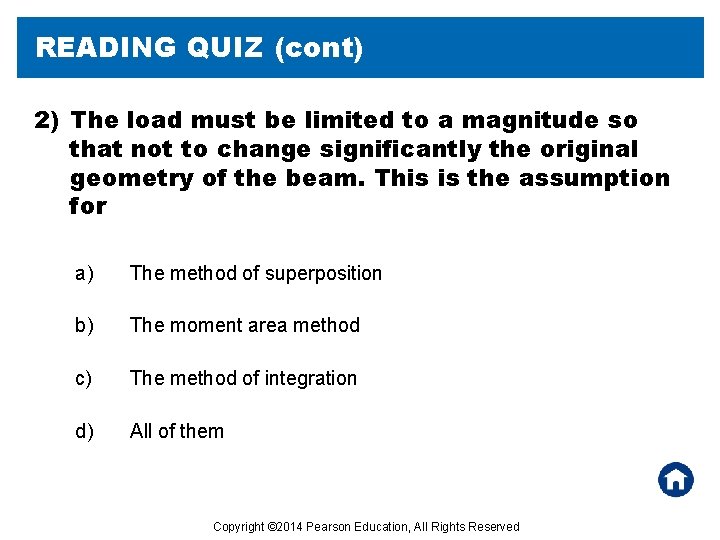
READING QUIZ (cont) 2) The load must be limited to a magnitude so that not to change significantly the original geometry of the beam. This is the assumption for a) The method of superposition b) The moment area method c) The method of integration d) All of them Copyright © 2014 Pearson Education, All Rights Reserved
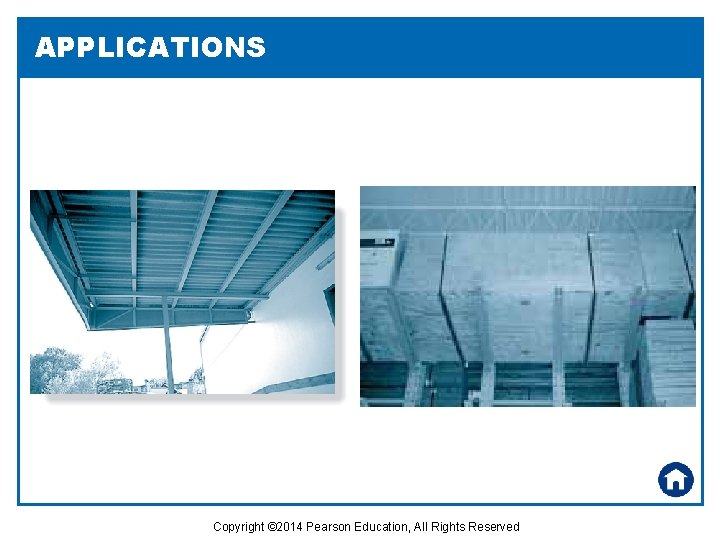
APPLICATIONS Copyright © 2014 Pearson Education, All Rights Reserved
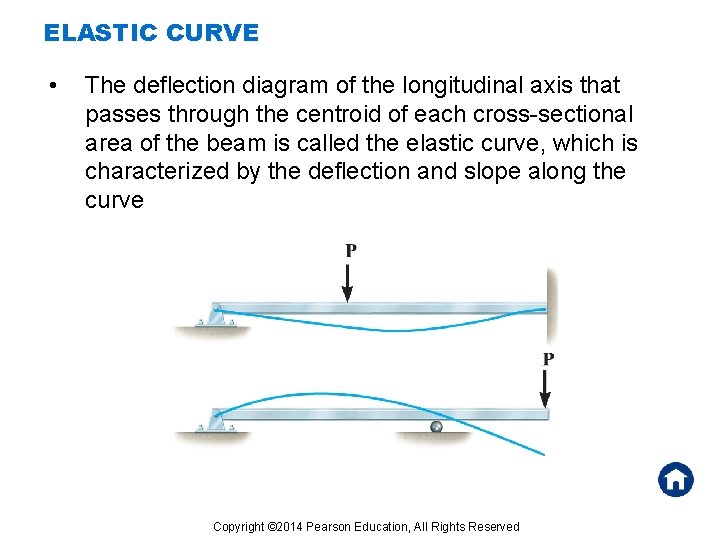
ELASTIC CURVE • The deflection diagram of the longitudinal axis that passes through the centroid of each cross-sectional area of the beam is called the elastic curve, which is characterized by the deflection and slope along the curve Copyright © 2014 Pearson Education, All Rights Reserved
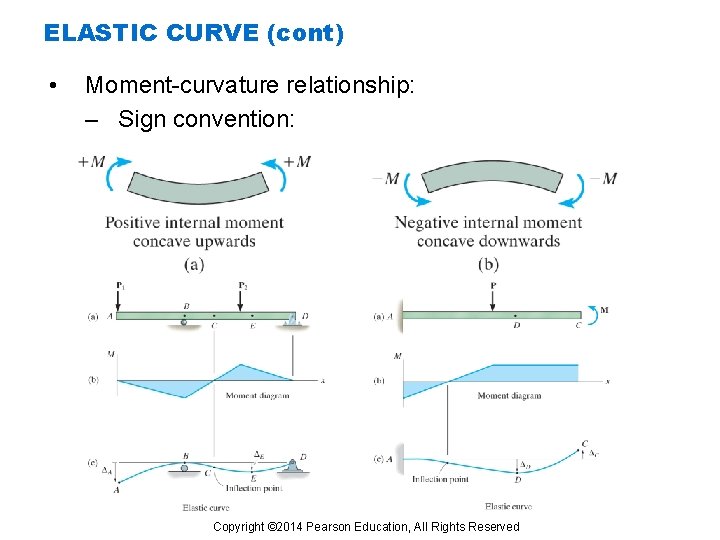
ELASTIC CURVE (cont) • Moment-curvature relationship: – Sign convention: Copyright © 2014 Pearson Education, All Rights Reserved
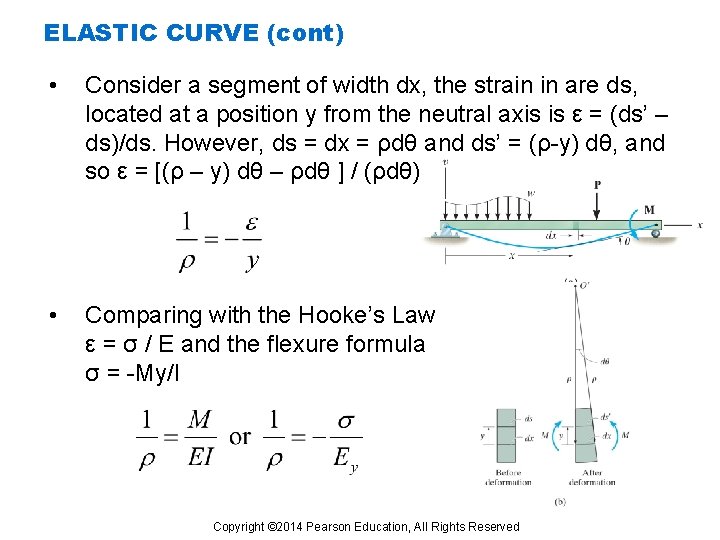
ELASTIC CURVE (cont) • Consider a segment of width dx, the strain in are ds, located at a position y from the neutral axis is ε = (ds’ – ds)/ds. However, ds = dx = ρdθ and ds’ = (ρ-y) dθ, and so ε = [(ρ – y) dθ – ρdθ ] / (ρdθ), or • Comparing with the Hooke’s Law ε = σ / E and the flexure formula σ = -My/I Copyright © 2014 Pearson Education, All Rights Reserved
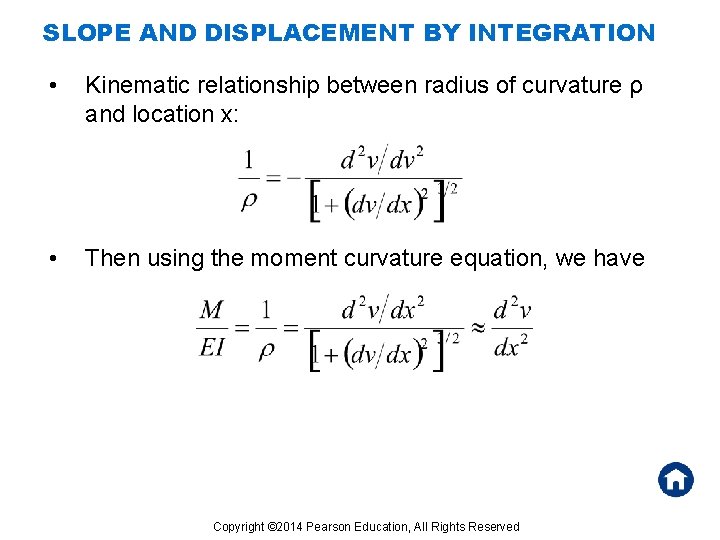
SLOPE AND DISPLACEMENT BY INTEGRATION • Kinematic relationship between radius of curvature ρ and location x: • Then using the moment curvature equation, we have Copyright © 2014 Pearson Education, All Rights Reserved
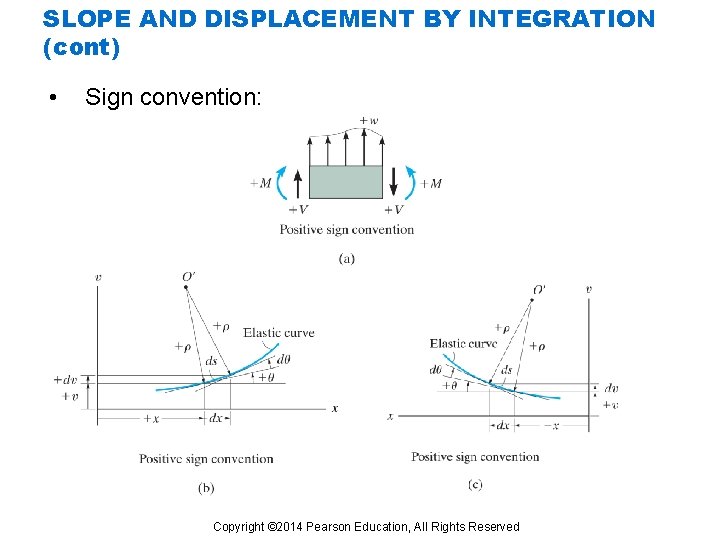
SLOPE AND DISPLACEMENT BY INTEGRATION (cont) • Sign convention: Copyright © 2014 Pearson Education, All Rights Reserved
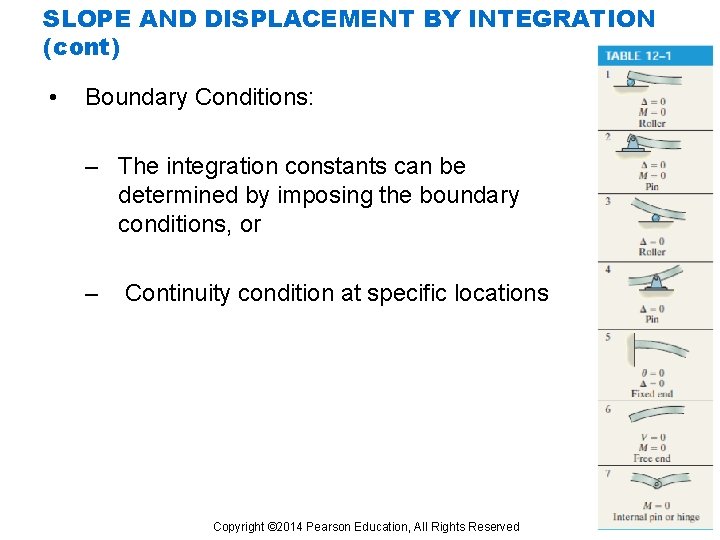
SLOPE AND DISPLACEMENT BY INTEGRATION (cont) • Boundary Conditions: – The integration constants can be determined by imposing the boundary conditions, or – Continuity condition at specific locations Copyright © 2014 Pearson Education, All Rights Reserved
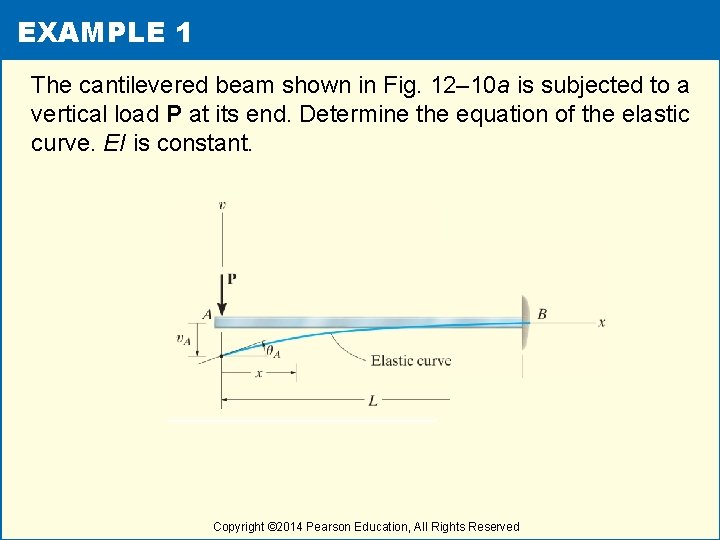
EXAMPLE 1 The cantilevered beam shown in Fig. 12– 10 a is subjected to a vertical load P at its end. Determine the equation of the elastic curve. EI is constant. Copyright © 2014 Pearson Education, All Rights Reserved
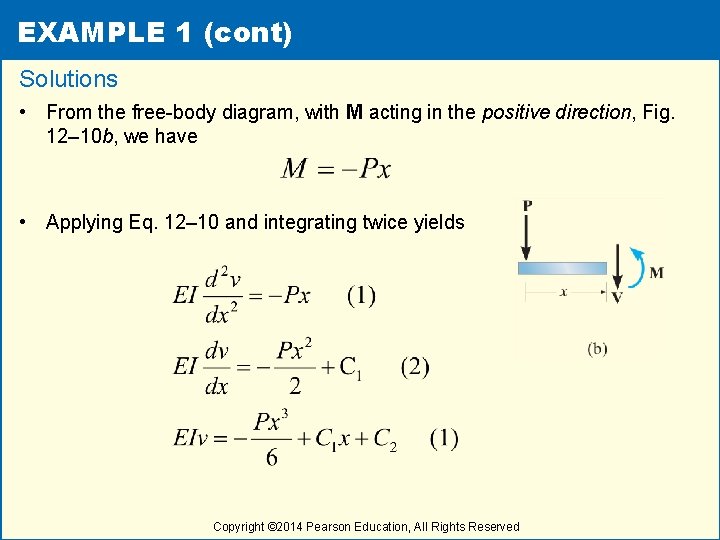
EXAMPLE 1 (cont) Solutions • From the free-body diagram, with M acting in the positive direction, Fig. 12– 10 b, we have • Applying Eq. 12– 10 and integrating twice yields Copyright © 2014 Pearson Education, All Rights Reserved
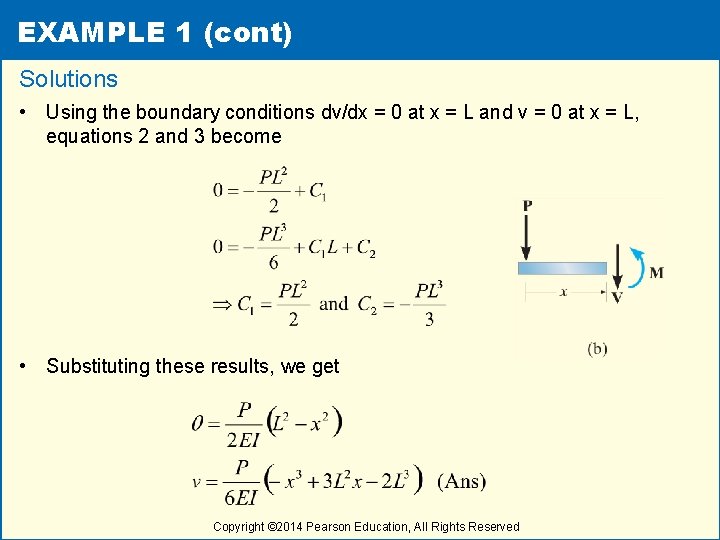
EXAMPLE 1 (cont) Solutions • Using the boundary conditions dv/dx = 0 at x = L and v = 0 at x = L, equations 2 and 3 become • Substituting these results, we get Copyright © 2014 Pearson Education, All Rights Reserved
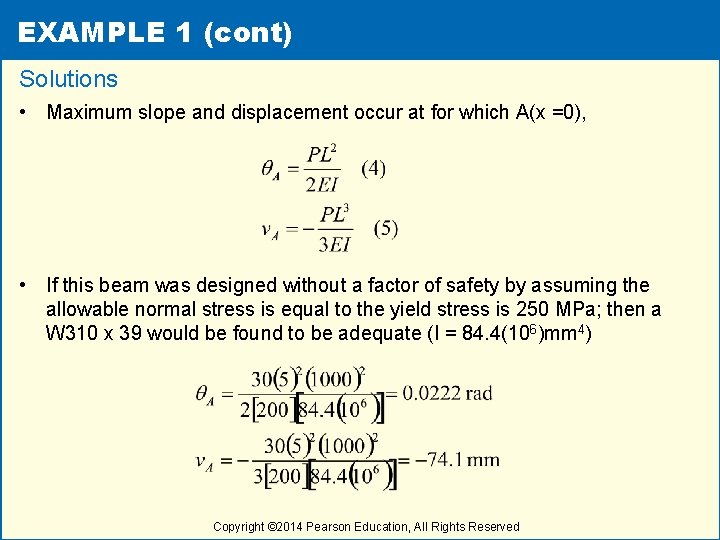
EXAMPLE 1 (cont) Solutions • Maximum slope and displacement occur at for which A(x =0), • If this beam was designed without a factor of safety by assuming the allowable normal stress is equal to the yield stress is 250 MPa; then a W 310 x 39 would be found to be adequate (I = 84. 4(106)mm 4) Copyright © 2014 Pearson Education, All Rights Reserved
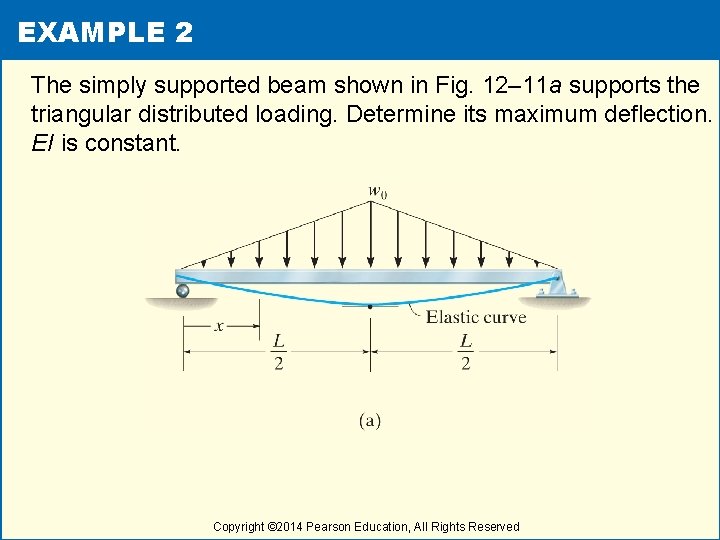
EXAMPLE 2 The simply supported beam shown in Fig. 12– 11 a supports the triangular distributed loading. Determine its maximum deflection. EI is constant. Copyright © 2014 Pearson Education, All Rights Reserved
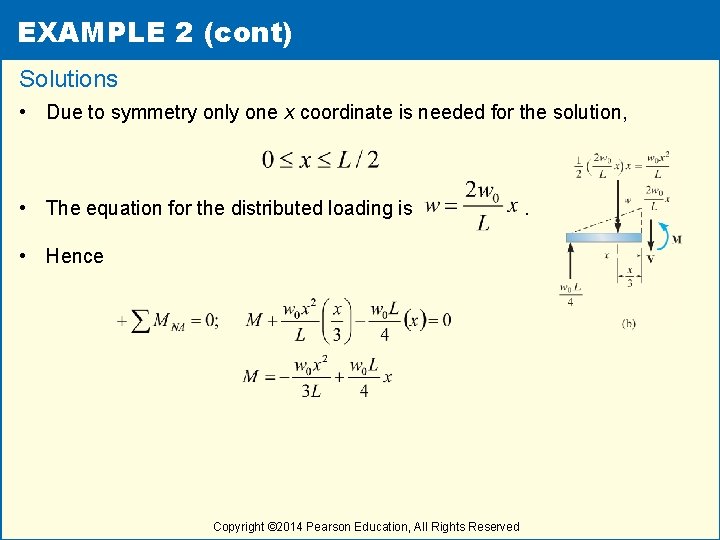
EXAMPLE 2 (cont) Solutions • Due to symmetry only one x coordinate is needed for the solution, • The equation for the distributed loading is • Hence Copyright © 2014 Pearson Education, All Rights Reserved .
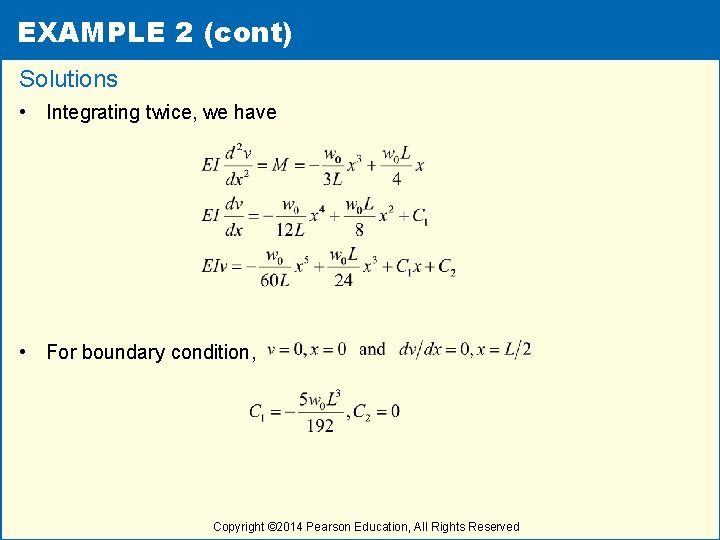
EXAMPLE 2 (cont) Solutions • Integrating twice, we have • For boundary condition, Copyright © 2014 Pearson Education, All Rights Reserved
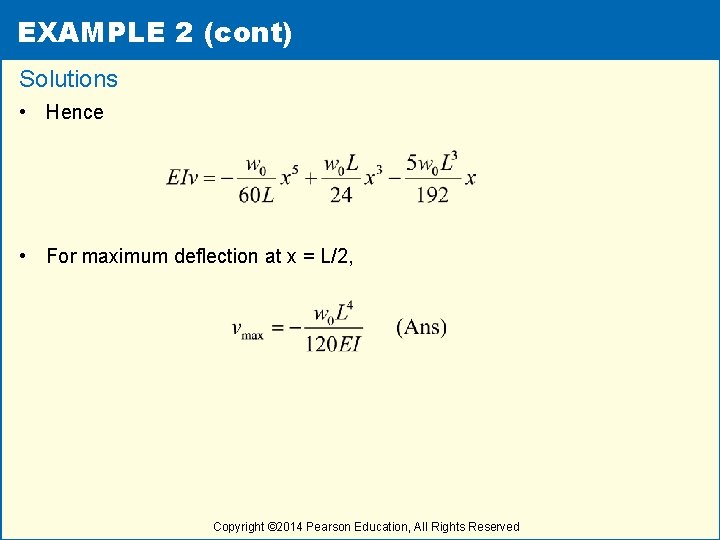
EXAMPLE 2 (cont) Solutions • Hence • For maximum deflection at x = L/2, Copyright © 2014 Pearson Education, All Rights Reserved
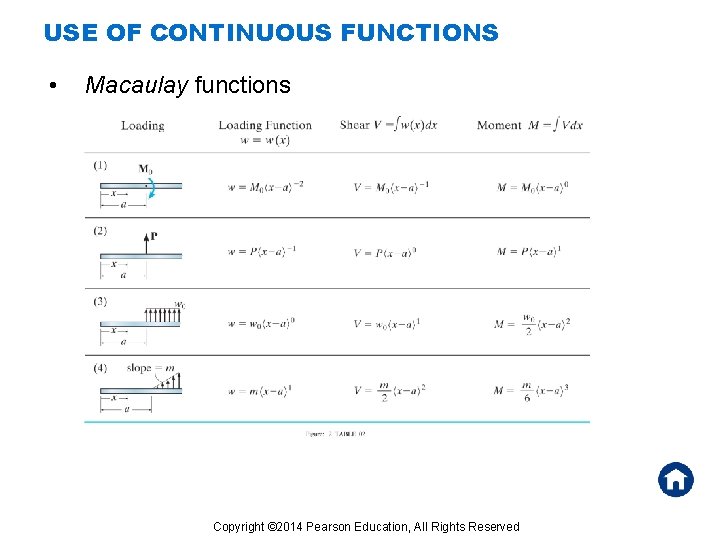
USE OF CONTINUOUS FUNCTIONS • Macaulay functions Copyright © 2014 Pearson Education, All Rights Reserved
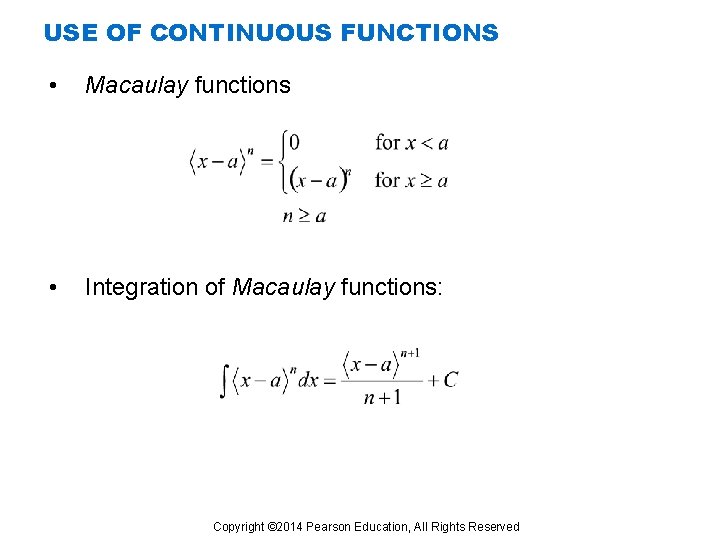
USE OF CONTINUOUS FUNCTIONS • Macaulay functions • Integration of Macaulay functions: Copyright © 2014 Pearson Education, All Rights Reserved
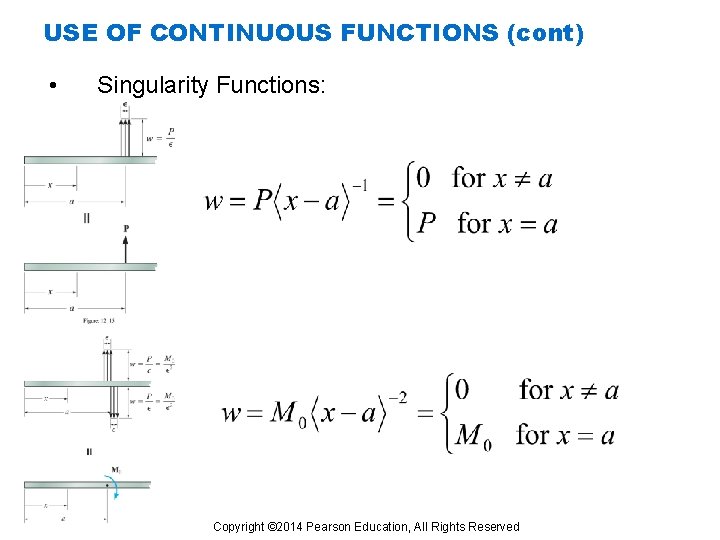
USE OF CONTINUOUS FUNCTIONS (cont) • Singularity Functions: Copyright © 2014 Pearson Education, All Rights Reserved
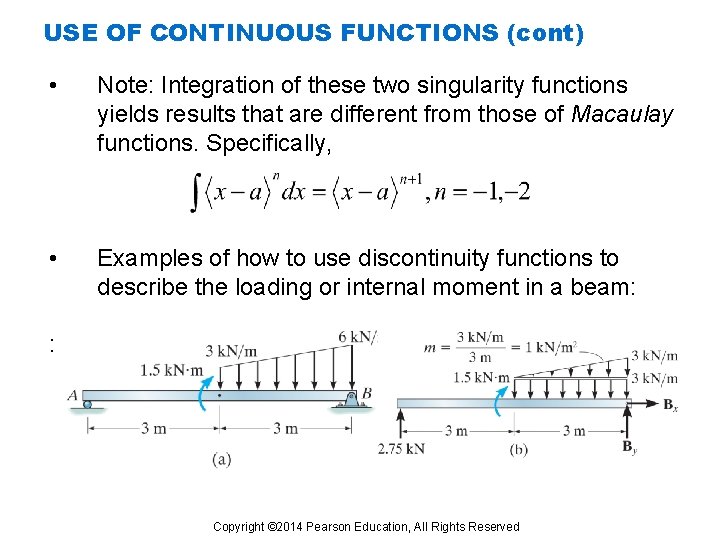
USE OF CONTINUOUS FUNCTIONS (cont) • Note: Integration of these two singularity functions yields results that are different from those of Macaulay functions. Specifically, • Examples of how to use discontinuity functions to describe the loading or internal moment in a beam: : Copyright © 2014 Pearson Education, All Rights Reserved
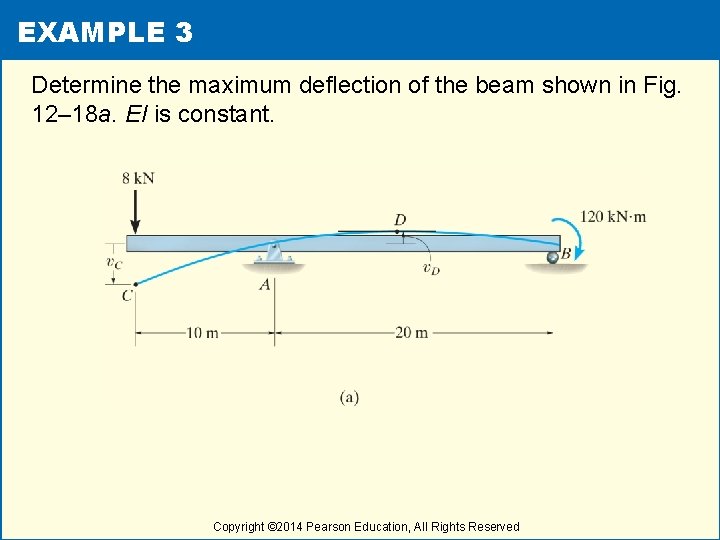
EXAMPLE 3 Determine the maximum deflection of the beam shown in Fig. 12– 18 a. EI is constant. Copyright © 2014 Pearson Education, All Rights Reserved
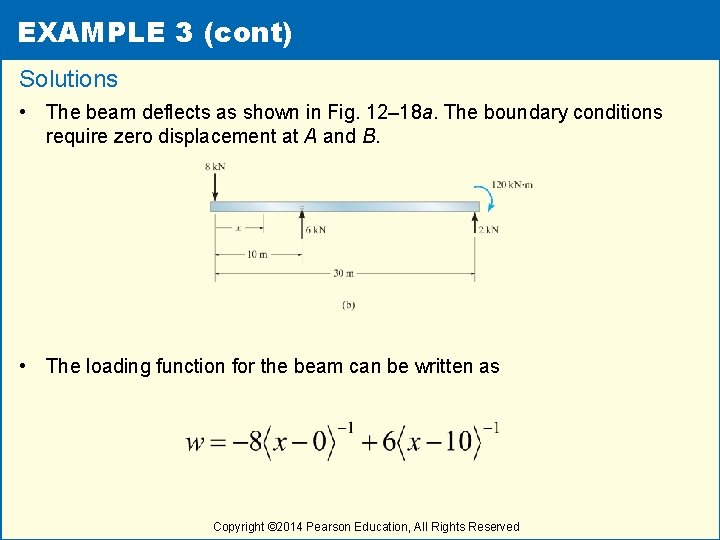
EXAMPLE 3 (cont) Solutions • The beam deflects as shown in Fig. 12– 18 a. The boundary conditions require zero displacement at A and B. • The loading function for the beam can be written as Copyright © 2014 Pearson Education, All Rights Reserved
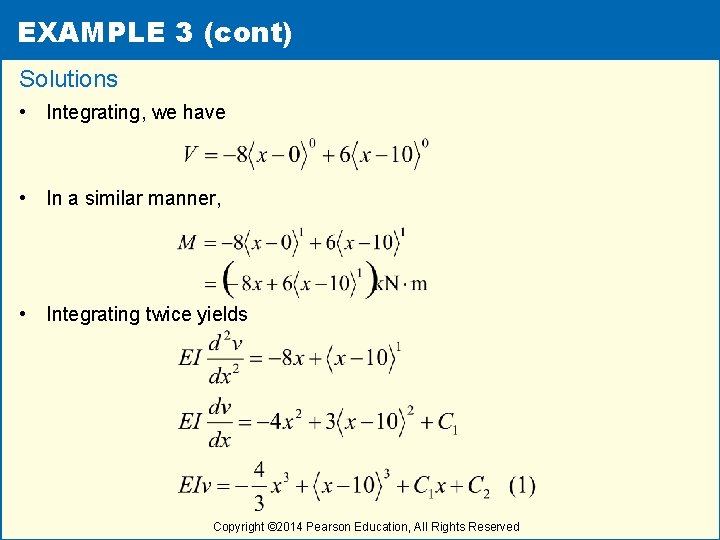
EXAMPLE 3 (cont) Solutions • Integrating, we have • In a similar manner, • Integrating twice yields Copyright © 2014 Pearson Education, All Rights Reserved
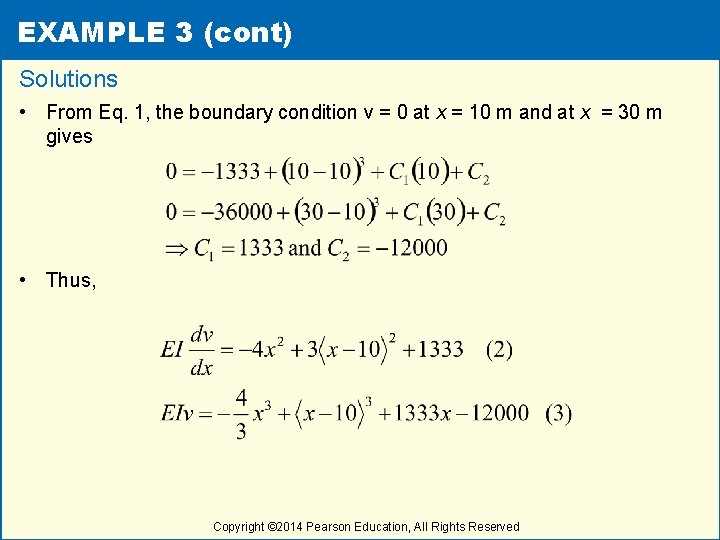
EXAMPLE 3 (cont) Solutions • From Eq. 1, the boundary condition v = 0 at x = 10 m and at x = 30 m gives • Thus, Copyright © 2014 Pearson Education, All Rights Reserved
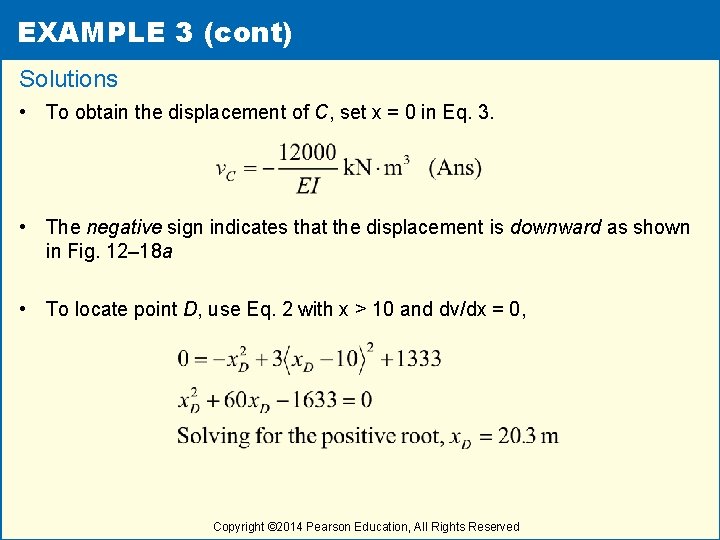
EXAMPLE 3 (cont) Solutions • To obtain the displacement of C, set x = 0 in Eq. 3. • The negative sign indicates that the displacement is downward as shown in Fig. 12– 18 a • To locate point D, use Eq. 2 with x > 10 and dv/dx = 0, Copyright © 2014 Pearson Education, All Rights Reserved
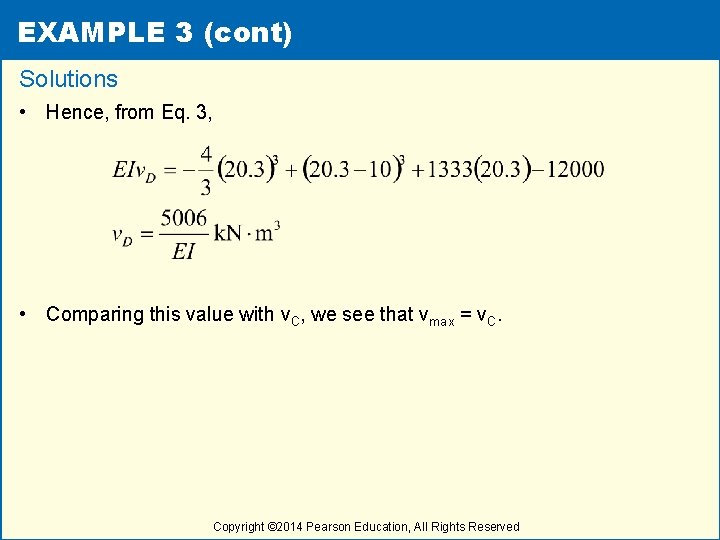
EXAMPLE 3 (cont) Solutions • Hence, from Eq. 3, • Comparing this value with v. C, we see that vmax = v. C. Copyright © 2014 Pearson Education, All Rights Reserved
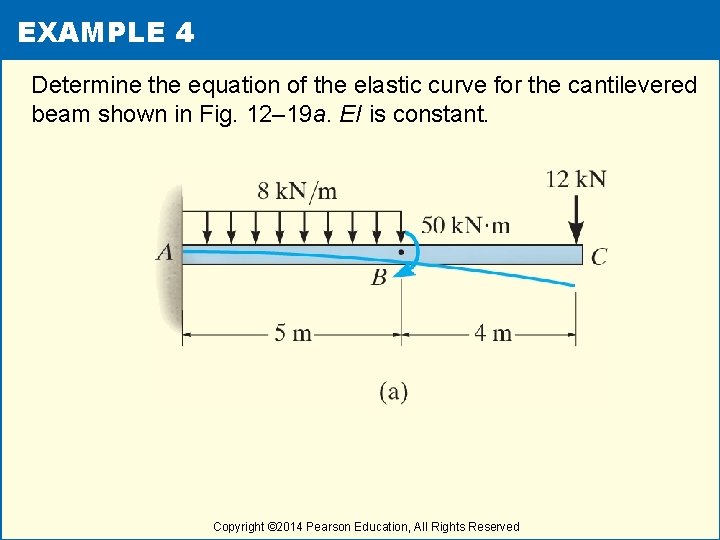
EXAMPLE 4 Determine the equation of the elastic curve for the cantilevered beam shown in Fig. 12– 19 a. EI is constant. Copyright © 2014 Pearson Education, All Rights Reserved
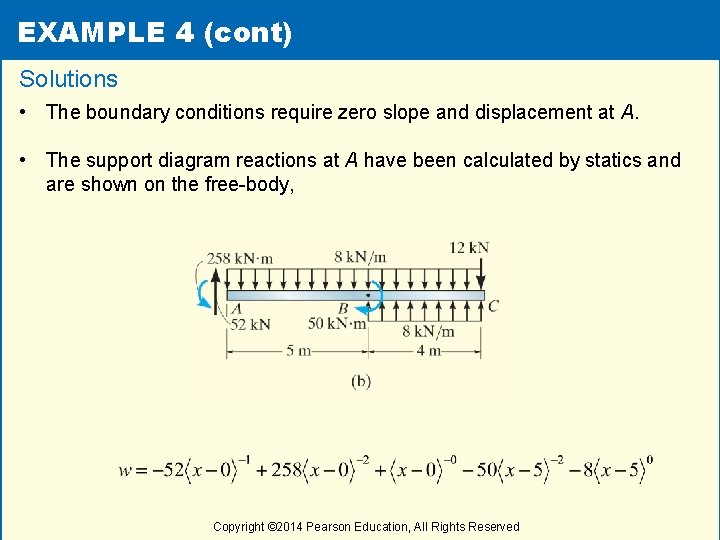
EXAMPLE 4 (cont) Solutions • The boundary conditions require zero slope and displacement at A. • The support diagram reactions at A have been calculated by statics and are shown on the free-body, Copyright © 2014 Pearson Education, All Rights Reserved
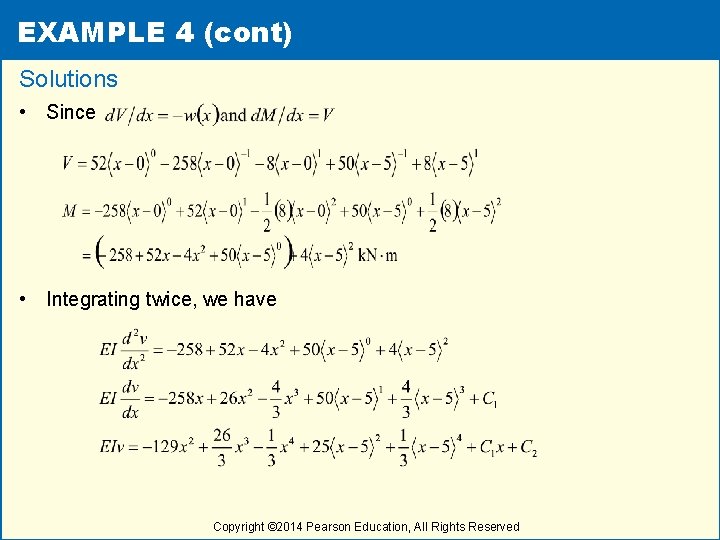
EXAMPLE 4 (cont) Solutions • Since • Integrating twice, we have Copyright © 2014 Pearson Education, All Rights Reserved
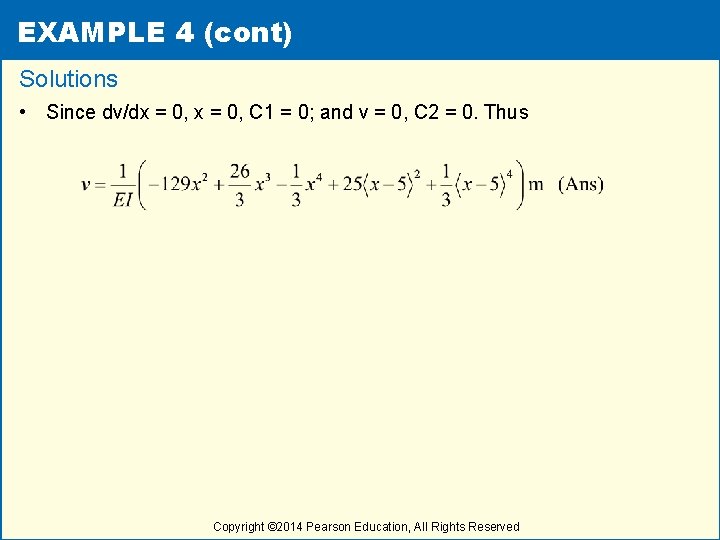
EXAMPLE 4 (cont) Solutions • Since dv/dx = 0, C 1 = 0; and v = 0, C 2 = 0. Thus Copyright © 2014 Pearson Education, All Rights Reserved
METHOD OF SUPERPOSITION • Necessary conditions to be satisfied: 1. The load w(x) is linearly related to the deflection v(x), 2. The load is assumed not to change significantly the original geometry of the beam of shaft. • Then, it is possible to find the slope and displacement at a point on a beam subjected to several different loadings by algebraically adding the effects of its various component parts. Copyright © 2014 Pearson Education, All Rights Reserved
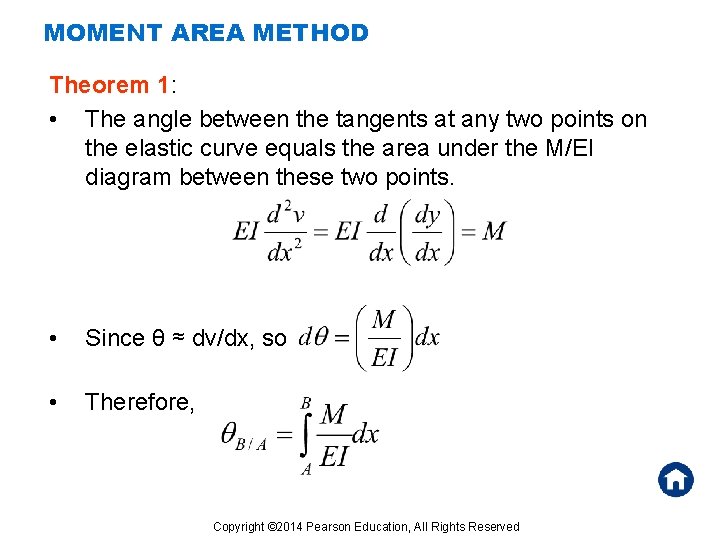
MOMENT AREA METHOD Theorem 1: • The angle between the tangents at any two points on the elastic curve equals the area under the M/EI diagram between these two points. • Since θ ≈ dv/dx, so • Therefore, Copyright © 2014 Pearson Education, All Rights Reserved
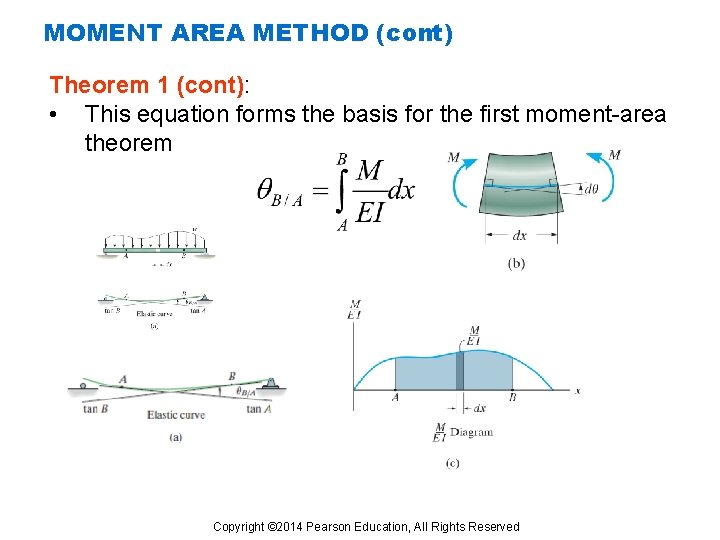
MOMENT AREA METHOD (cont) Theorem 1 (cont): • This equation forms the basis for the first moment-area theorem Copyright © 2014 Pearson Education, All Rights Reserved
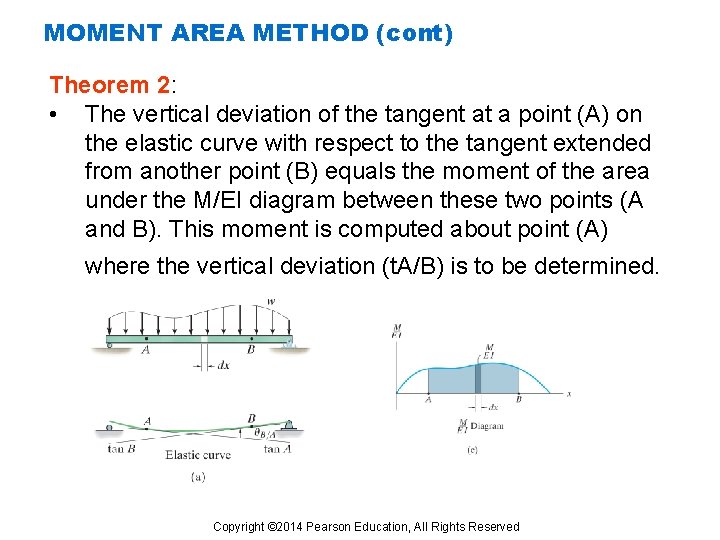
MOMENT AREA METHOD (cont) Theorem 2: • The vertical deviation of the tangent at a point (A) on the elastic curve with respect to the tangent extended from another point (B) equals the moment of the area under the M/EI diagram between these two points (A and B). This moment is computed about point (A) where the vertical deviation (t. A/B) is to be determined. Copyright © 2014 Pearson Education, All Rights Reserved
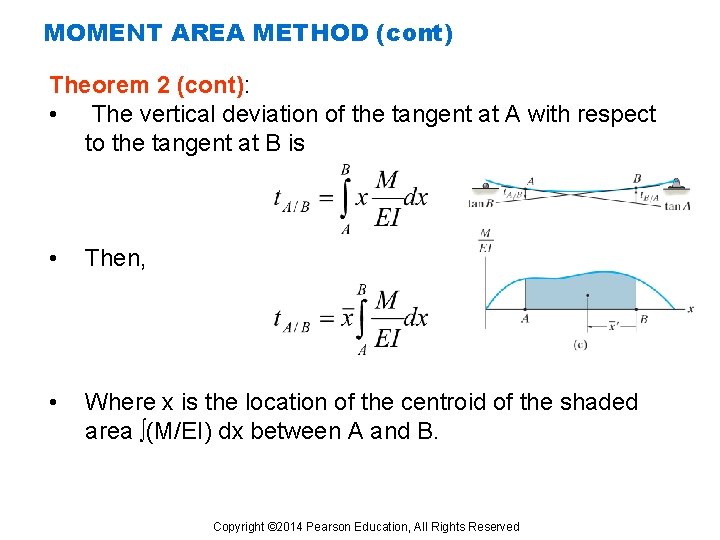
MOMENT AREA METHOD (cont) Theorem 2 (cont): • The vertical deviation of the tangent at A with respect to the tangent at B is • Then, • Where x is the location of the centroid of the shaded area ∫(M/EI) dx between A and B. Copyright © 2014 Pearson Education, All Rights Reserved
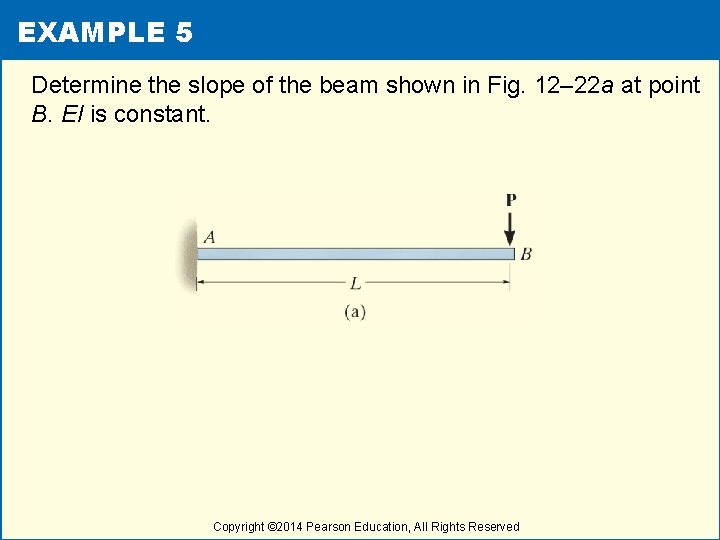
EXAMPLE 5 Determine the slope of the beam shown in Fig. 12– 22 a at point B. EI is constant. Copyright © 2014 Pearson Education, All Rights Reserved
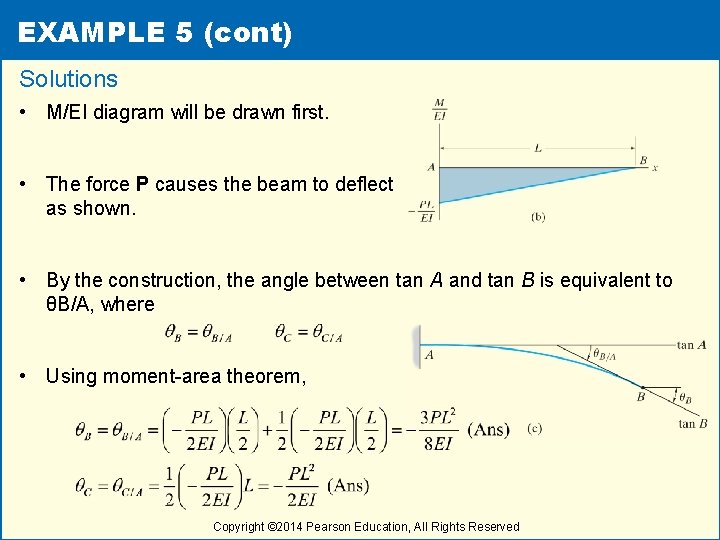
EXAMPLE 5 (cont) Solutions • M/EI diagram will be drawn first. • The force P causes the beam to deflect as shown. • By the construction, the angle between tan A and tan B is equivalent to θB/A, where • Using moment-area theorem, Copyright © 2014 Pearson Education, All Rights Reserved

EXAMPLE 6 Determine the displacement of points B and C of the beam shown in Fig. 12– 23 a. EI is constant. Copyright © 2014 Pearson Education, All Rights Reserved
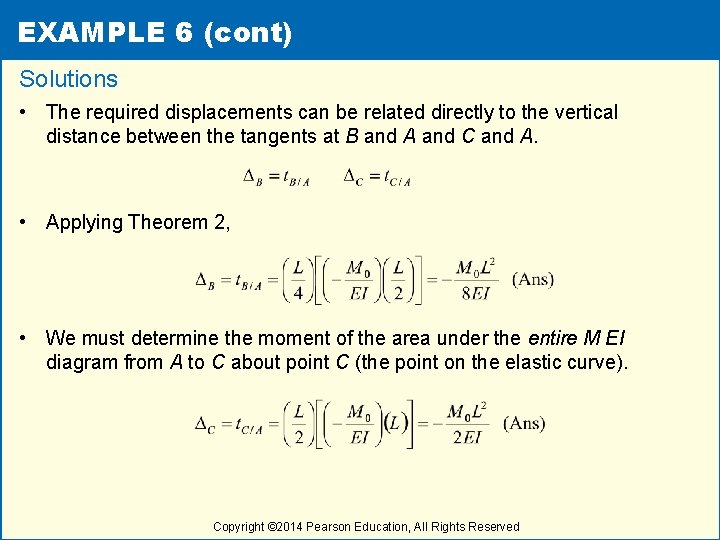
EXAMPLE 6 (cont) Solutions • The required displacements can be related directly to the vertical distance between the tangents at B and A and C and A. • Applying Theorem 2, • We must determine the moment of the area under the entire M EI diagram from A to C about point C (the point on the elastic curve). Copyright © 2014 Pearson Education, All Rights Reserved
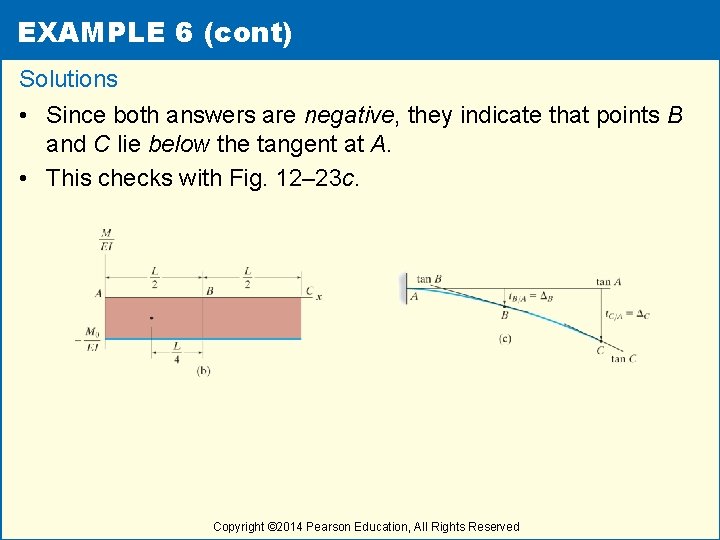
EXAMPLE 6 (cont) Solutions • Since both answers are negative, they indicate that points B and C lie below the tangent at A. • This checks with Fig. 12– 23 c. Copyright © 2014 Pearson Education, All Rights Reserved
CONCEPT QUIZ 1) The moment-curvature equation 1/ρ = M/EI is applicable to a) Statically determined member only b) Beams having uniform cross-sections only c) Beams having constant Young’s Modulus E only d) Beams having varying moment of inertia I. Copyright © 2014 Pearson Education, All Rights Reserved
CONCEPT QUIZ 2) The flexure equations imply that a) Slope and deflection at a point of a beam are independent b) Moment and shear at a point of a beam are independent c) Maximum moment occurs at the locations where the shear is zero d) Maximum moment occurs at the inflection point. Copyright © 2014 Pearson Education, All Rights Reserved
Chapter Objectives ü ü Determine the deflection and slope at specific points on beams and shafts, using various analytical methods including: Ø The integration method Ø The use of discontinuity functions Ø The method of superposition Determine the same, using a semi-graphical technique, called the moment-area method. Copyright © 2014 Pearson Education, All Rights Reserved
In-class Activities 1. 2. 3. 4. 5. 6. Reading Quiz Applications Statistically indeterminate beams and shafts Use of the integration method Use of the method of superposition Use of the moment-area method Copyright © 2014 Pearson Education, All Rights Reserved
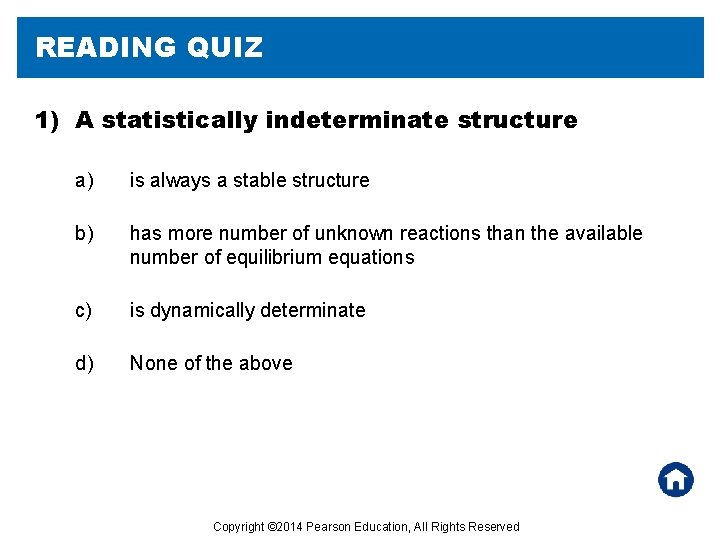
READING QUIZ 1) A statistically indeterminate structure a) is always a stable structure b) has more number of unknown reactions than the available number of equilibrium equations c) is dynamically determinate d) None of the above Copyright © 2014 Pearson Education, All Rights Reserved
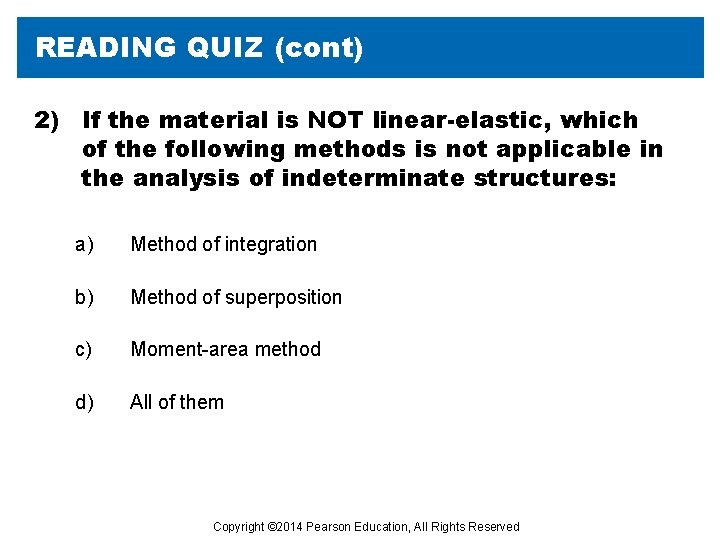
READING QUIZ (cont) 2) If the material is NOT linear-elastic, which of the following methods is not applicable in the analysis of indeterminate structures: a) Method of integration b) Method of superposition c) Moment-area method d) All of them Copyright © 2014 Pearson Education, All Rights Reserved

APPLICATIONS Copyright © 2014 Pearson Education, All Rights Reserved

STATISTICALLY INDETERMINATE BEAMS AND SHAFT • Definition: A member of any type is classified statically indeterminate if the number of unknown reactions exceeds the available number of equilibrium equations, e. g. a continuous beam having 4 supports Copyright © 2014 Pearson Education, All Rights Reserved
STATISTICALLY INDETERMINATE BEAMS AND SHAFT (cont) Strategy: • The additional support reactions on the beam or shaft that are not needed to keep it in stable equilibrium are called redundants. It is first necessary to specify those redundant from conditions of geometry known as compatibility conditions. • Once determined, the redundants are then applied to the beam, and the remaining reactions are determined from the equations of equilibrium. Copyright © 2014 Pearson Education, All Rights Reserved
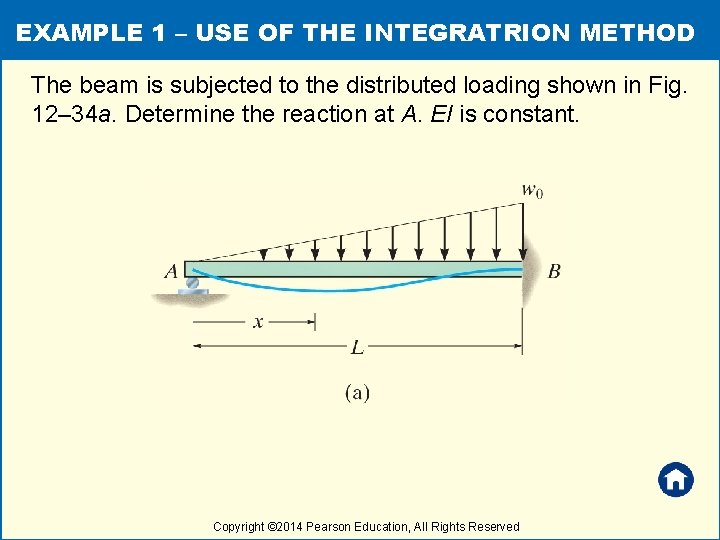
EXAMPLE 1 – USE OF THE INTEGRATRION METHOD The beam is subjected to the distributed loading shown in Fig. 12– 34 a. Determine the reaction at A. EI is constant. Copyright © 2014 Pearson Education, All Rights Reserved
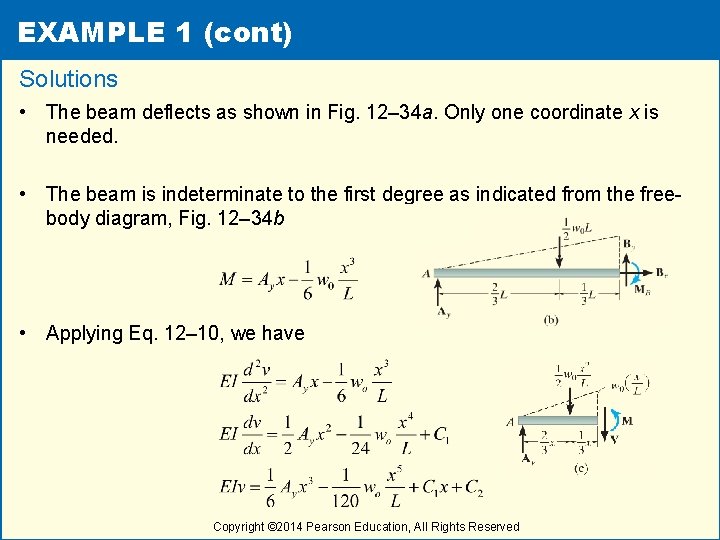
EXAMPLE 1 (cont) Solutions • The beam deflects as shown in Fig. 12– 34 a. Only one coordinate x is needed. • The beam is indeterminate to the first degree as indicated from the freebody diagram, Fig. 12– 34 b • Applying Eq. 12– 10, we have Copyright © 2014 Pearson Education, All Rights Reserved
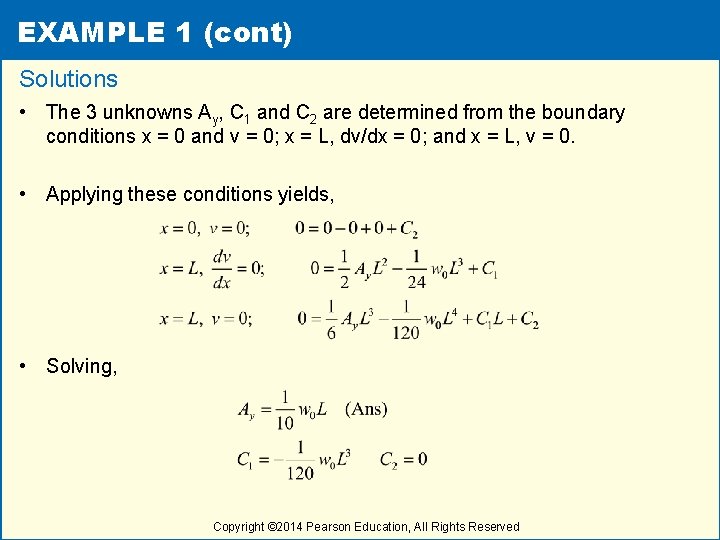
EXAMPLE 1 (cont) Solutions • The 3 unknowns Ay, C 1 and C 2 are determined from the boundary conditions x = 0 and v = 0; x = L, dv/dx = 0; and x = L, v = 0. • Applying these conditions yields, • Solving, Copyright © 2014 Pearson Education, All Rights Reserved
USE OF THE METHOD OF SUPERPOSITION Procedures: Elastic Curve • Specify the unknown redundant forces or moments that must be removed from the beam in order to make it statistically determinate and stable. • Using the principle of superposition, draw the statistically indeterminate beam and show it equal to a sequence of corresponding statistically determinate beams. Copyright © 2014 Pearson Education, All Rights Reserved
USE OF THE METHOD OF SUPERPOSITION (cont) Procedures: Elastic Curve (cont) • The first of these beams, the primary beam, supports the same external loads as the statistically indeterminate beam, and each of the other beams “added” to the primary beam shows the beam loaded with a separate redundant force or moment. • Sketch the deflection curve for each beam and indicate the symbolically the displacement or slope at the point of each redundant force or moment. Copyright © 2014 Pearson Education, All Rights Reserved
USE OF THE METHOD OF SUPERPOSITION (cont) Procedures: Compatibility Equations • Write a compatibility equation for the displacement or slope at each point where there is a redundant force or moment. • Determine all the displacements or slopes using an appropriate method as explained in Secs. 12. 2 through 12. 5. Copyright © 2014 Pearson Education, All Rights Reserved
USE OF THE METHOD OF SUPERPOSITION (cont) Procedures: Compatibility Equations (cont) • Substitute the results into the compatibility equations and solve for the unknown redundant. • If the numerical value for a redundant is positive, it has the same sense of direction as originally assumed. Similarly, a negative numerical value indicates the redundant acts opposite to its assumed sense of direction. Copyright © 2014 Pearson Education, All Rights Reserved
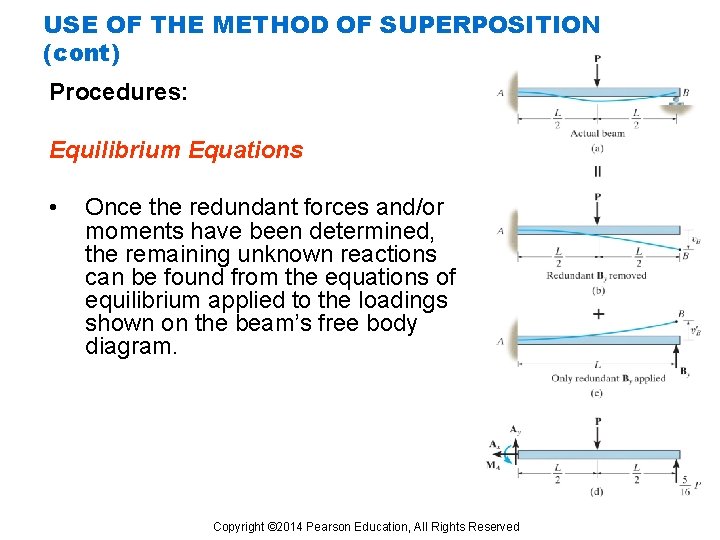
USE OF THE METHOD OF SUPERPOSITION (cont) Procedures: Equilibrium Equations • Once the redundant forces and/or moments have been determined, the remaining unknown reactions can be found from the equations of equilibrium applied to the loadings shown on the beam’s free body diagram. Copyright © 2014 Pearson Education, All Rights Reserved
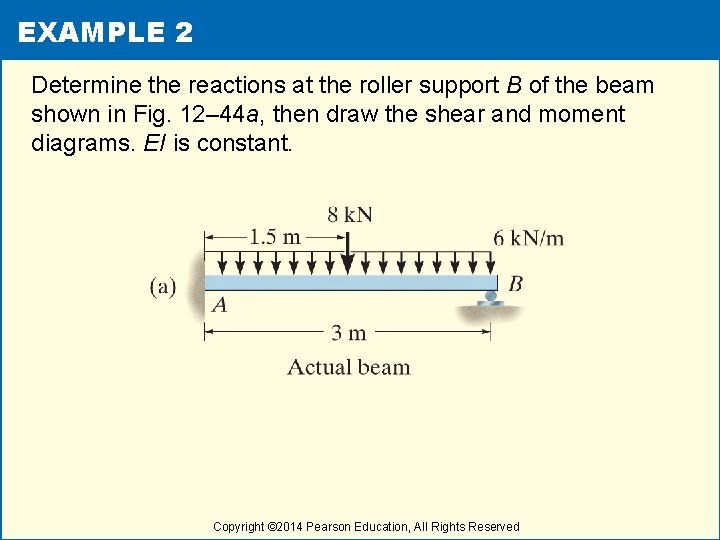
EXAMPLE 2 Determine the reactions at the roller support B of the beam shown in Fig. 12– 44 a, then draw the shear and moment diagrams. EI is constant. Copyright © 2014 Pearson Education, All Rights Reserved
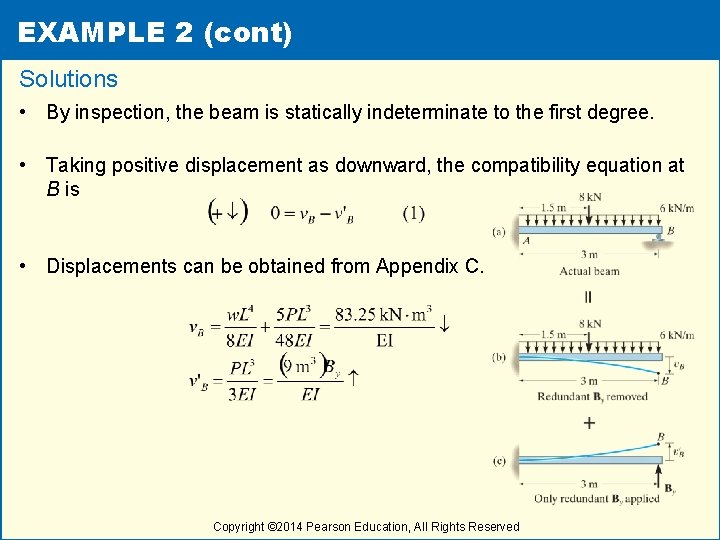
EXAMPLE 2 (cont) Solutions • By inspection, the beam is statically indeterminate to the first degree. • Taking positive displacement as downward, the compatibility equation at B is • Displacements can be obtained from Appendix C. Copyright © 2014 Pearson Education, All Rights Reserved
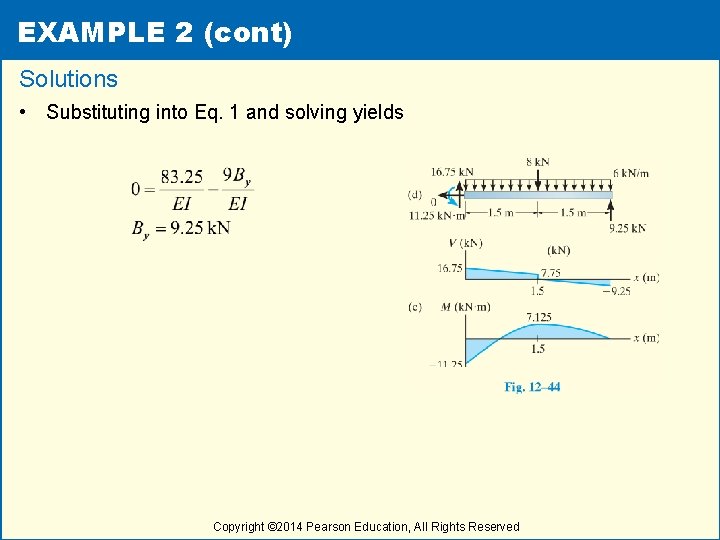
EXAMPLE 2 (cont) Solutions • Substituting into Eq. 1 and solving yields Copyright © 2014 Pearson Education, All Rights Reserved
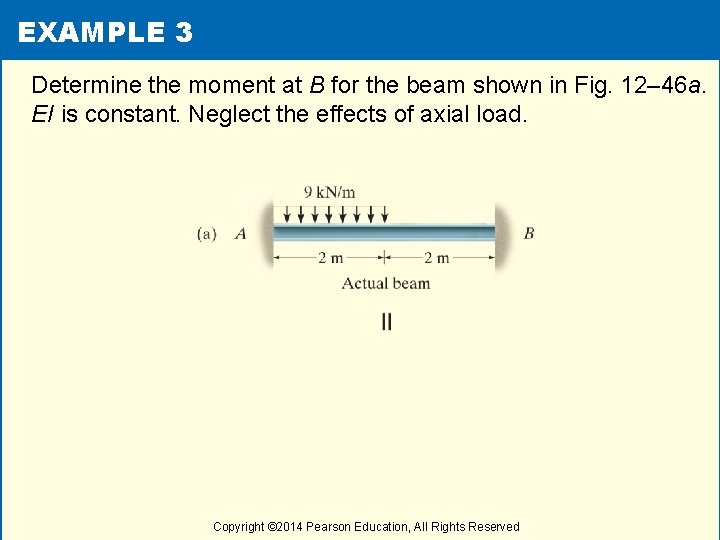
EXAMPLE 3 Determine the moment at B for the beam shown in Fig. 12– 46 a. EI is constant. Neglect the effects of axial load. Copyright © 2014 Pearson Education, All Rights Reserved
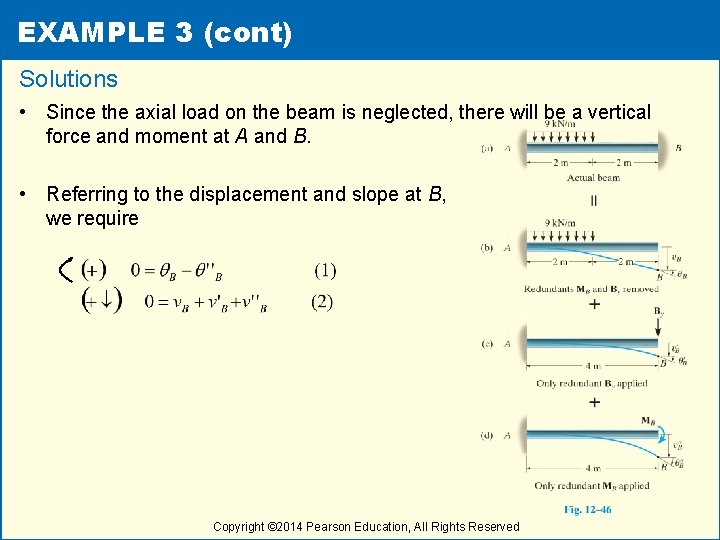
EXAMPLE 3 (cont) Solutions • Since the axial load on the beam is neglected, there will be a vertical force and moment at A and B. • Referring to the displacement and slope at B, we require Copyright © 2014 Pearson Education, All Rights Reserved
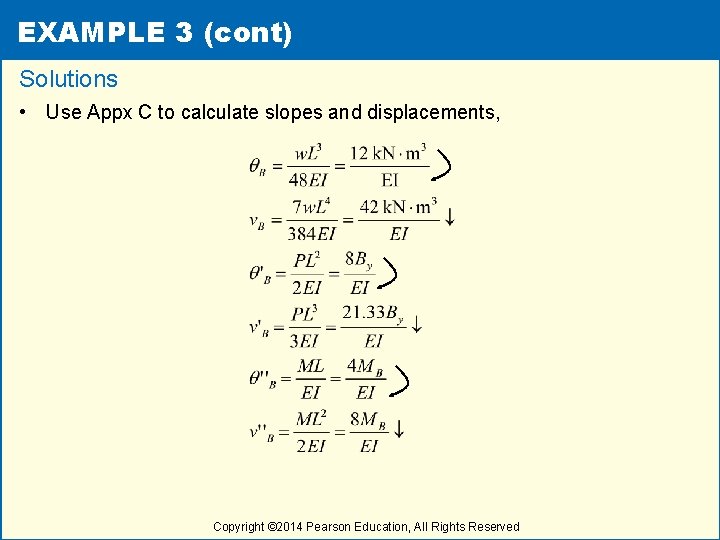
EXAMPLE 3 (cont) Solutions • Use Appx C to calculate slopes and displacements, Copyright © 2014 Pearson Education, All Rights Reserved
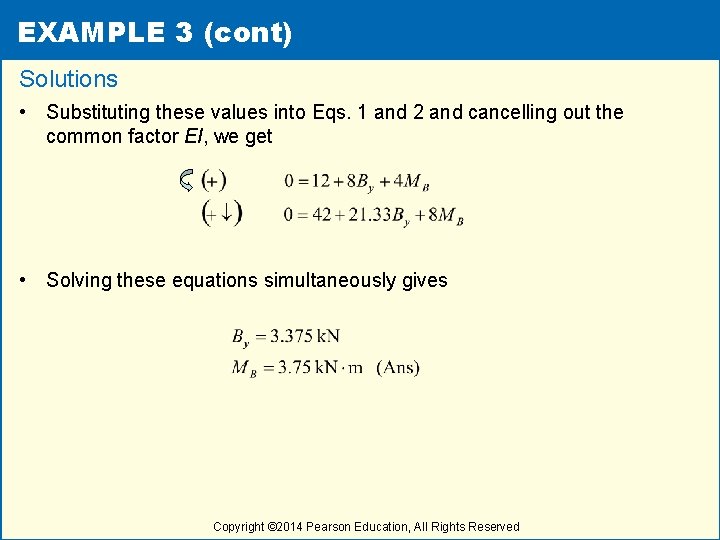
EXAMPLE 3 (cont) Solutions • Substituting these values into Eqs. 1 and 2 and cancelling out the common factor EI, we get • Solving these equations simultaneously gives Copyright © 2014 Pearson Education, All Rights Reserved
USE OF THE MOMENT-AREA METHOD Procedures: • Construct separately the M/EI diagrams for each applied force or moment, and each redundant as well. • Then use the method of superposition and apply the two moment area theorems to obtain the proper relationship between the tangents on the elastic curve in order to meet the conditions of displacement and/or slope at the supports of the beam or shaft. • Note: If the two end-moments 20 k. N. m are redundants, they remain as unknown in the M/EI diagram Copyright © 2014 Pearson Education, All Rights Reserved
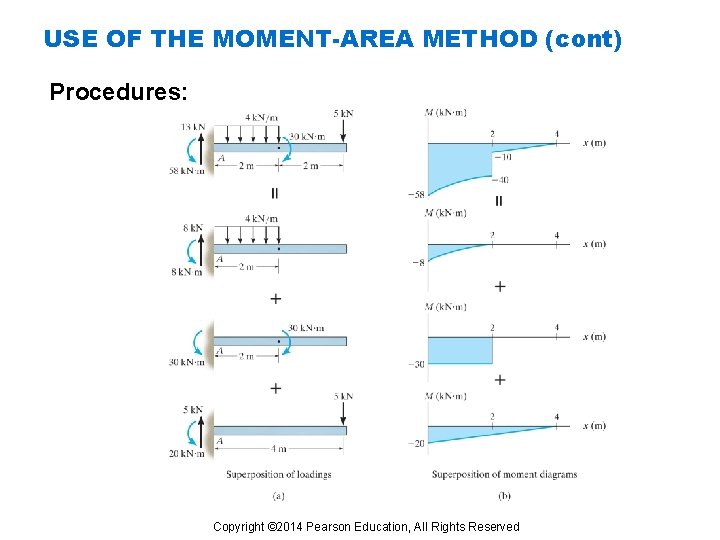
USE OF THE MOMENT-AREA METHOD (cont) Procedures: Copyright © 2014 Pearson Education, All Rights Reserved
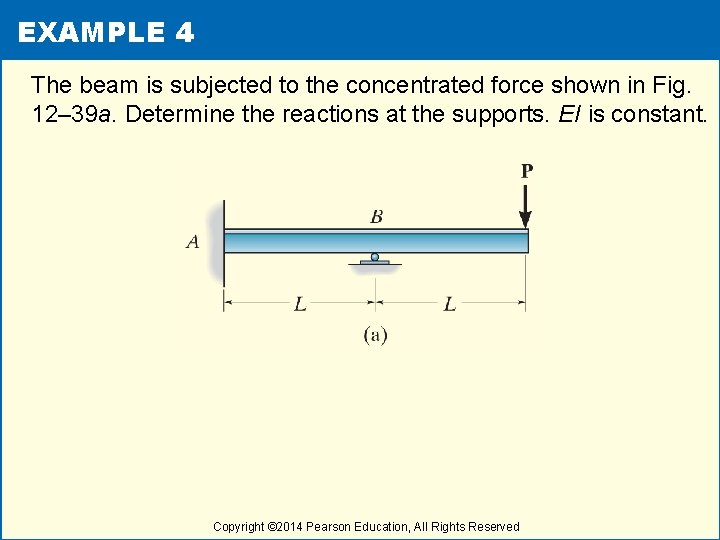
EXAMPLE 4 The beam is subjected to the concentrated force shown in Fig. 12– 39 a. Determine the reactions at the supports. EI is constant. Copyright © 2014 Pearson Education, All Rights Reserved
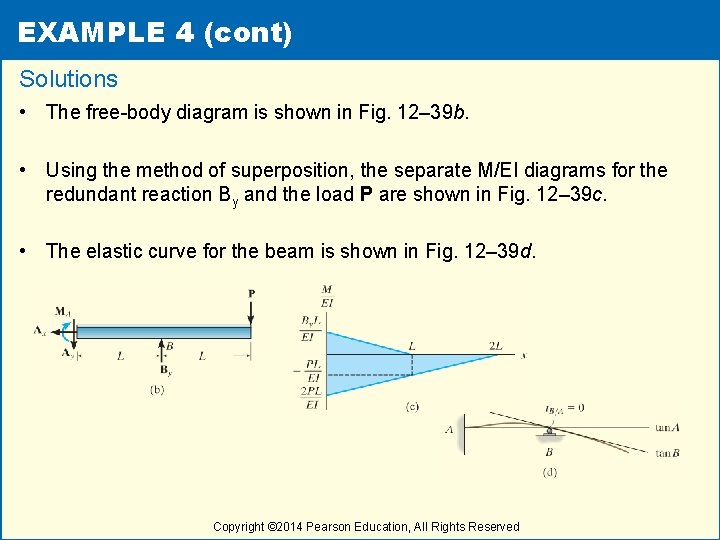
EXAMPLE 4 (cont) Solutions • The free-body diagram is shown in Fig. 12– 39 b. • Using the method of superposition, the separate M/EI diagrams for the redundant reaction By and the load P are shown in Fig. 12– 39 c. • The elastic curve for the beam is shown in Fig. 12– 39 d. Copyright © 2014 Pearson Education, All Rights Reserved
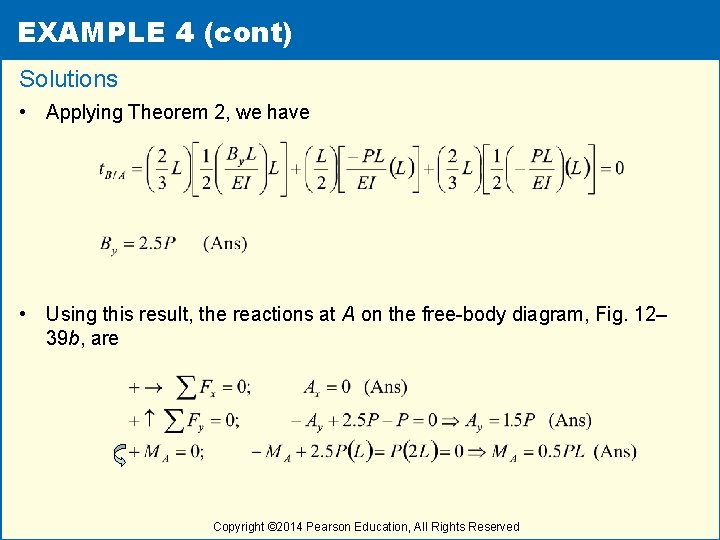
EXAMPLE 4 (cont) Solutions • Applying Theorem 2, we have • Using this result, the reactions at A on the free-body diagram, Fig. 12– 39 b, are Copyright © 2014 Pearson Education, All Rights Reserved
- Slides: 72