
Chapter Notes 5 Classical Europe I Ancient Greece

- Slides: 6
Chapter Notes 5 “Classical Europe” I. Ancient Greece “Birthplace of Democracy” Athens was the home of the world’s first democratic constitution. A. ____ Aristotle B. 3 great philosophers were Socrates, Plato, and _______. C. During this period, city-states like Athens and Sparta often fought Peloponnesian War against each other (__________). Alexander the Great D. 300 B. C. , Phillip II and ___________ conquered all of Greece. II. The Rise of Rome A. ______ was settled sometime in 1000 B. C. as a city-state and dominated much of the Italian Peninsula. republic B. Rome started as a monarchy, but changed to ______(choose) Julius Caesar who tried to become the 1 st emperor. C. Senators killed ______
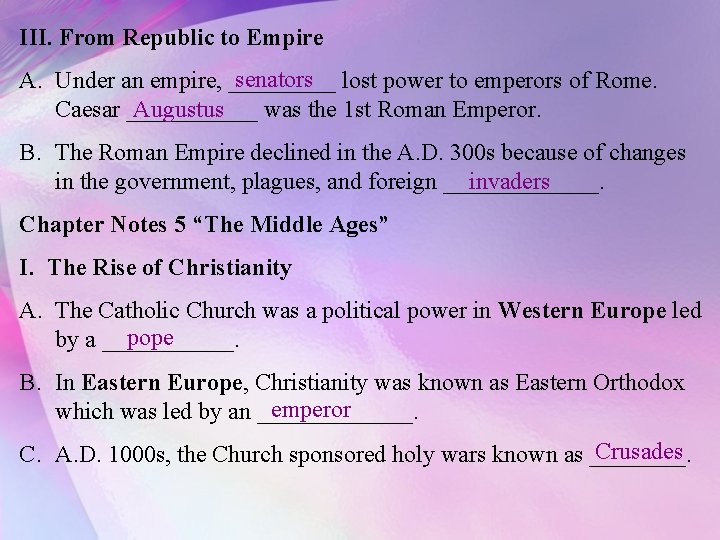
III. From Republic to Empire senators lost power to emperors of Rome. A. Under an empire, _____ Augustus Caesar ______ was the 1 st Roman Emperor. B. The Roman Empire declined in the A. D. 300 s because of changes invaders in the government, plagues, and foreign _______. Chapter Notes 5 “The Middle Ages” I. The Rise of Christianity A. The Catholic Church was a political power in Western Europe led pope by a ______. B. In Eastern Europe, Christianity was known as Eastern Orthodox emperor which was led by an _______. Crusades C. A. D. 1000 s, the Church sponsored holy wars known as ____.
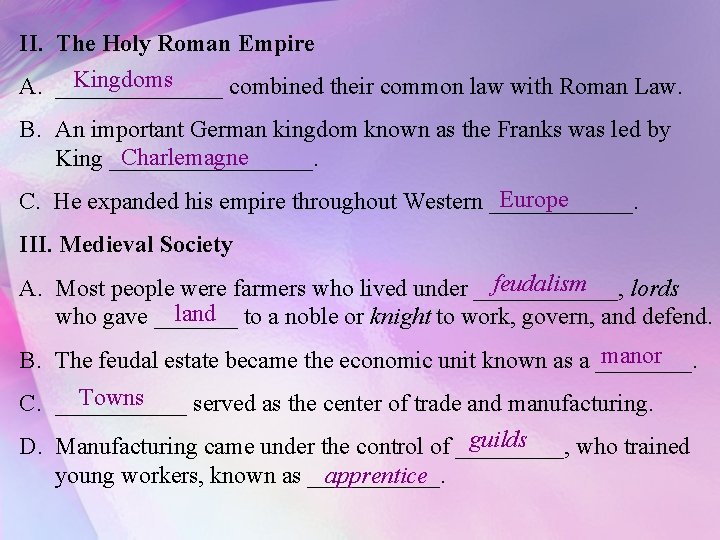
II. The Holy Roman Empire Kingdoms A. _______ combined their common law with Roman Law. B. An important German kingdom known as the Franks was led by Charlemagne King _________. Europe C. He expanded his empire throughout Western ______. III. Medieval Society feudalism A. Most people were farmers who lived under ______, lords land to a noble or knight to work, govern, and defend. who gave _______ manor B. The feudal estate became the economic unit known as a ____. Towns C. ______ served as the center of trade and manufacturing. guilds D. Manufacturing came under the control of _____, who trained young workers, known as ______. apprentice
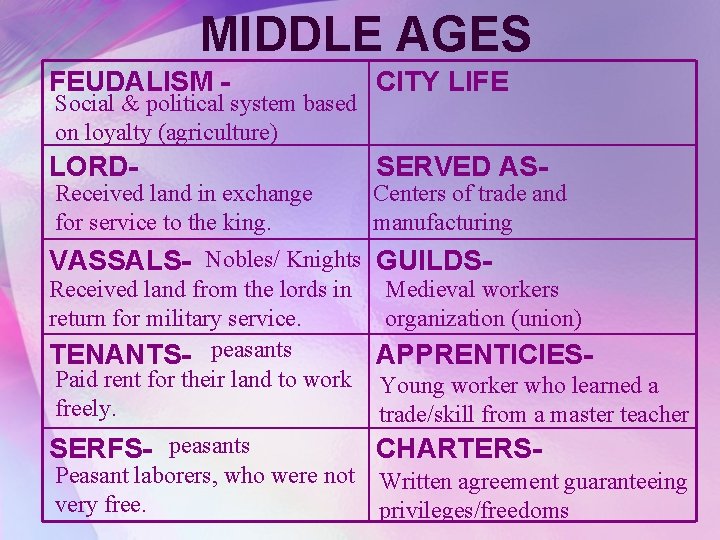
MIDDLE AGES FEUDALISM - CITY LIFE LORD- SERVED AS- Social & political system based on loyalty (agriculture) Received land in exchange for service to the king. Centers of trade and manufacturing VASSALS- Nobles/ Knights GUILDS- Received land from the lords in Medieval workers return for military service. organization (union) TENANTS- peasants APPRENTICIESPaid rent for their land to work Young worker who learned a freely. trade/skill from a master teacher SERFS- peasants CHARTERSPeasant laborers, who were not Written agreement guaranteeing very free. privileges/freedoms
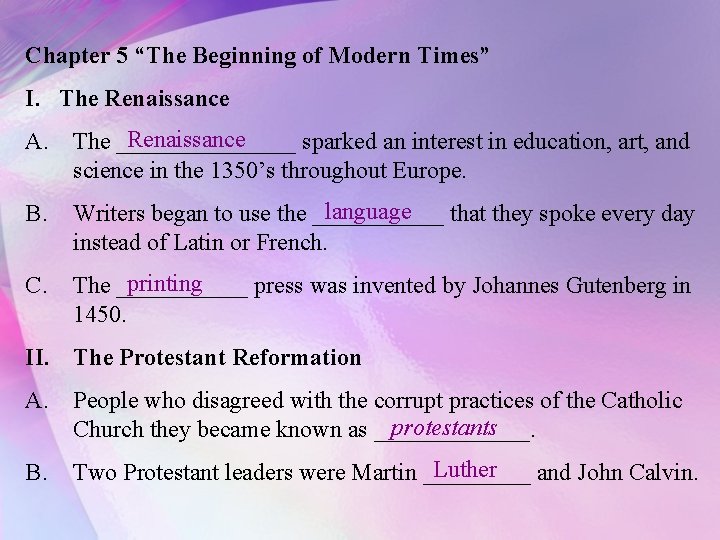
Chapter 5 “The Beginning of Modern Times” I. The Renaissance A. The ________ sparked an interest in education, art, and science in the 1350’s throughout Europe. B. language Writers began to use the ______ that they spoke every day instead of Latin or French. C. printing The ______ press was invented by Johannes Gutenberg in 1450. II. The Protestant Reformation A. People who disagreed with the corrupt practices of the Catholic protestants Church they became known as _______. B. Luther Two Protestant leaders were Martin _____ and John Calvin.
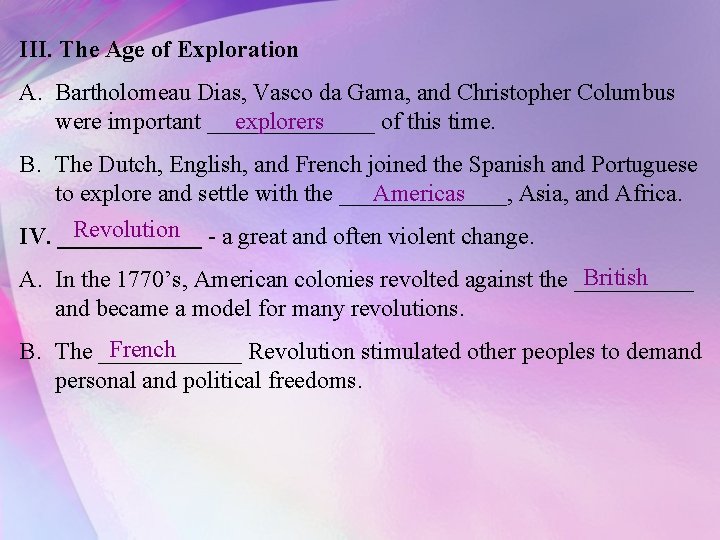
III. The Age of Exploration A. Bartholomeau Dias, Vasco da Gama, and Christopher Columbus explorers were important _______ of this time. B. The Dutch, English, and French joined the Spanish and Portuguese Americas to explore and settle with the _______, Asia, and Africa. Revolution - a great and often violent change. IV. ______ British A. In the 1770’s, American colonies revolted against the _____ and became a model for many revolutions. French B. The ______ Revolution stimulated other peoples to demand personal and political freedoms.