
Chapter no 7 Purchasing and inventory control Purchasing
- Slides: 23
Chapter no 7 Purchasing and inventory control
Purchasing and Inventory Control in MM Material Management is one of the critical and crucial part of every organization involved in manufacturing process. Bad Management of inventory, purchasing methods has lead to fall of organizations. Total number of Spares varies from organization to organization. An Efficient and Effective Material Management System is important in the purchasing and inventory control for Effective Cost Control in maintenance.
Inventory Control OBJECTIVES To minimize the capital blocked up in inventory or in other words maintain optimum level of inventory. To strike a balance between production costs and operating and maintenance costs. To avoid wastages, losses and optimum utilization.
Inventory Control - Spares FUNCTIONS Identify the spares required for maintaining the equipments. Asses annual requirements. Determine how-much to procure and when. Standardization of spares.
Identify slow moving, obsolete, defective or damaged items and life of spares where ever it is applicable. Preparation of policies and procedures to suit to the organization. Prepare spare parts specifications. Auditing of Inventories regularly.
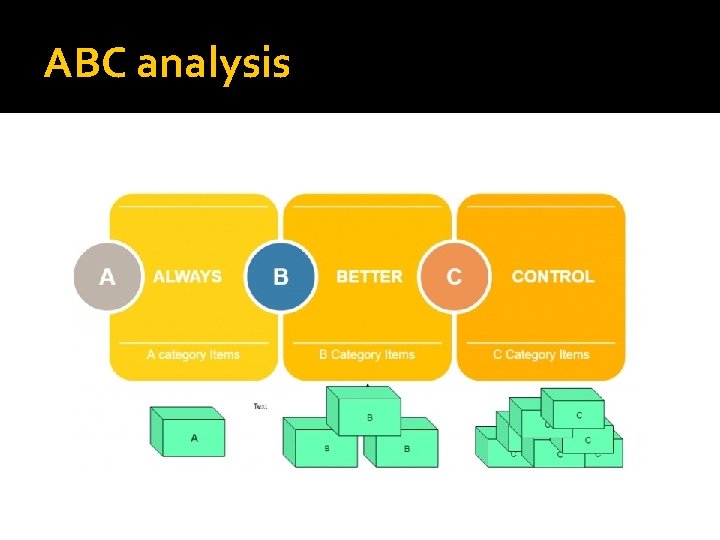
Inventory Analysis For inventory control a selective approach for each item according to its importance is to be chosen. Most important analysis are : (1) A B C Analysis- Annual consumption (2) V E D Analysis-Vital, Essential, Desirable (3) F S N Analysis-Fast moving , Slow moving, Non moving
ABC analysis
Design of Inventory Order Quantity Economic Order Quantity(EOQ) Order Timing Reorder Point EOQ minimizes the sum of holding and setup costs Q = 2 DCo/Ch D = annual demand Co = ordering/setup costs Ch = cost of holding one unit of inventory
Order Quantity To determine the quantity of spares to be ordered for each of the item, the following are kept in mind. (1) Order cost – Cost due to processing of purchase order. (2) Inventory carrying cost – Interest on capital, storage cost insurance, maintenance cost. (3) Economic order quantity is the one which considers the cost of ordering and inventory carrying cost.
Spare Parts Development of alternate source of supply of spares form station to build up a competitive atmosphere among the vendors. The objectives are To optimize the spares cost. Reduction in lead time. Quality.
Identification Process 1) High value critical spares of imported origins. 2) Spares whose manufacturing has been discontinued or spares for which poor response from the manufacturers. 3) Spares of Indigenous proprietary origin.
Inventory Control – Central Pool Objective is to keep high cost, high lead time, spares of interchangeable type with similar stations at one centrally located place. When need arises any member station can draw from central pool and replenish immediately.
Spare Parts and Procurement action depends upon Identification of spares of common in nature for the equipments and allocation of material Codification number accordingly. Consumption History Fast moving spares Slow moving spares Procurement practices Lead time Price discounts and bulk purchases.
Purchasing Objectives Purchasing’s responsibility is to buy materials of the right quality, in the right quantity, at the right time, at the right price, from the right source, with delivery at the right place. Furthermore, this objective must be achieved with a minimum investment in inventories. Achieving this objective of security with a minimum investment demands a fine balancing of various factors: risk of shutdown, the cost inherent in forward buying, and the economies of quantity purchases. Weighing these factors calls for experience and a high order of professional judgment.
Purchasing Procurement cycle Review selection Determine needed quantities Reconcile needs & funds Choose procurement method Select suppliers Specify contract terms Monitor order status Receipt & inspection
In Purchasing • Purchasing Strategy & Forecasting • Purchasing Procedures and Techniques • Supplier Selection & Evaluation • International Purchasing
Purchasing Strategy & Forecasting How to make a make-or-buy decision. How many suppliers do you need? Which suppliers should be selected?
Purchasing Strategy & Forecasting How do we forecast the quantity to be purchased? What kind of forecasting methods should be used? Time of forecasting
Purchasing Procedures What are the basic steps of purchasing Capital Purchases Requisition Preparation of Purchase Order Placing Order Receiving Purchasing documentation and forms. Requisition Purchase Order Invoice
Purchasing can be done Open tender Restricted or limited tender – From limited suppliers (about 10) Negotiated procurement – Buyer approaches selected potential Suppliers & bargain directly, Used in long time supply contracts Direct procurement – Purchased from single supplier, at his quoted price, Prices may be high Rate contract – Firms are asked to supply stores at specified Rates during the period covered by the Contract Spot purchase – It is done by a committee, which includes an officer from stores, accounts &purchasing departments
Purchasing Procedures and Technique Some recent trends in procurement: Electronic Ordering Stockless Purchasing Standardization Just in Time Purchasing
Supplier Selection & Evaluation How do we find the suppliers and types – Brokers, Wholesalers, Producers , etc Supplier selection standards Price, Quality, Service, Reliability, Evaluate Performance Advantages of buying direct and buying from distribution.
International Purchasing Have to locate the best sources internationally Differences in currency, language and culture Legal issues Types of agreements Protection in international purchasing