
CHAPTER NO 6 RECEIVABLES MANAGEMENT RECEIVABLES MANAGEMENT A
CHAPTER NO. 6 RECEIVABLES MANAGEMENT
RECEIVABLES MANAGEMENT A sound managerial control requires proper management of liquid assets & inventory. These assets are part of working capital of the business. Receivables constitute a significant portion of current assets of a firm. For the investment in receivable a firm has to incur certain costs like bad debts, collection costs etc. , Therefore it is necessary to have a proper control & management of receivable. Meaning of Receivables represent amounts owed to the firm as a result of sale of goods Or services in the ordinary course of business. Receivables also known as accounts receivables, trade receivables, customer receivables, book debts. The purpose of maintaining or investing in receivables is to meet competition & to increase the sales & profits of the firms.
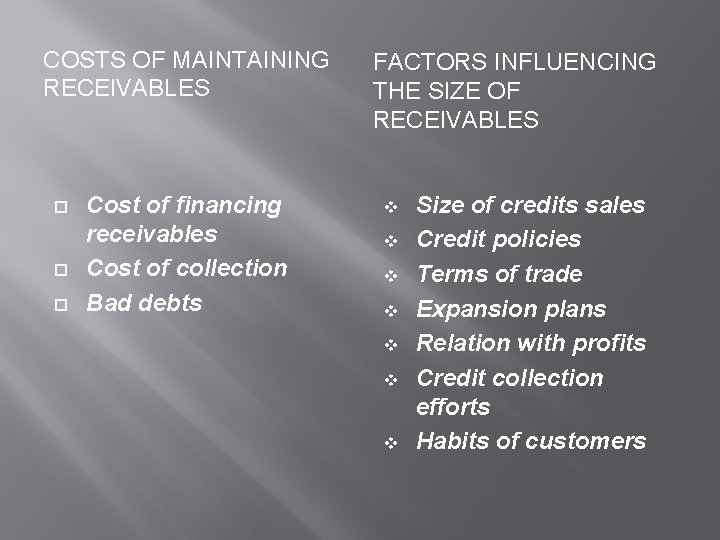
COSTS OF MAINTAINING RECEIVABLES Cost of financing receivables Cost of collection Bad debts FACTORS INFLUENCING THE SIZE OF RECEIVABLES v v v v Size of credits sales Credit policies Terms of trade Expansion plans Relation with profits Credit collection efforts Habits of customers
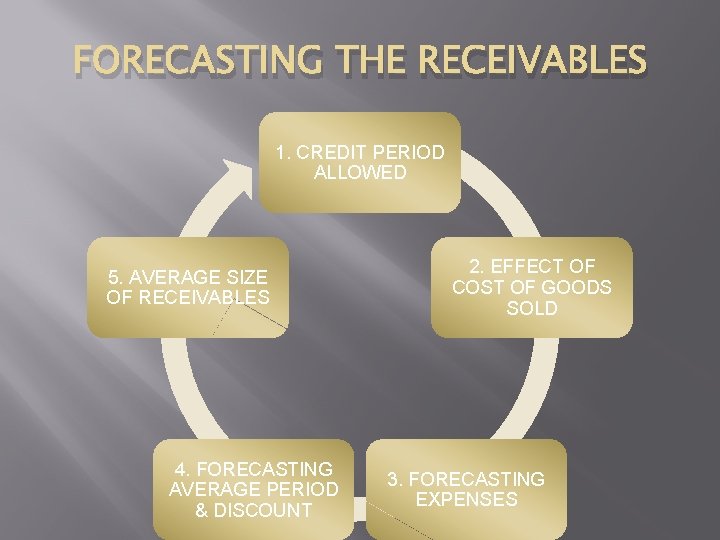
FORECASTING THE RECEIVABLES 1. CREDIT PERIOD ALLOWED 5. AVERAGE SIZE OF RECEIVABLES 4. FORECASTING AVERAGE PERIOD & DISCOUNT 2. EFFECT OF COST OF GOODS SOLD 3. FORECASTING EXPENSES
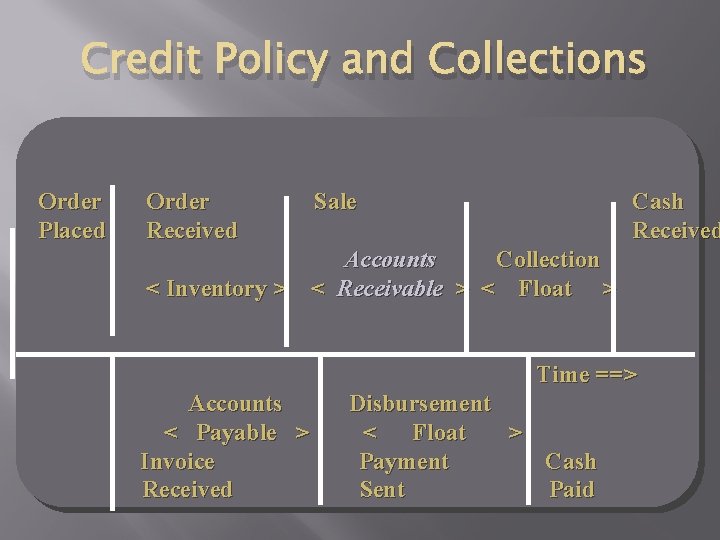
Credit Policy and Collections Order Placed Order Received Sale Cash Received Accounts Collection < Inventory > < Receivable > < Float > Time ==> Accounts < Payable > Invoice Received Disbursement < Float > Payment Cash Sent Paid
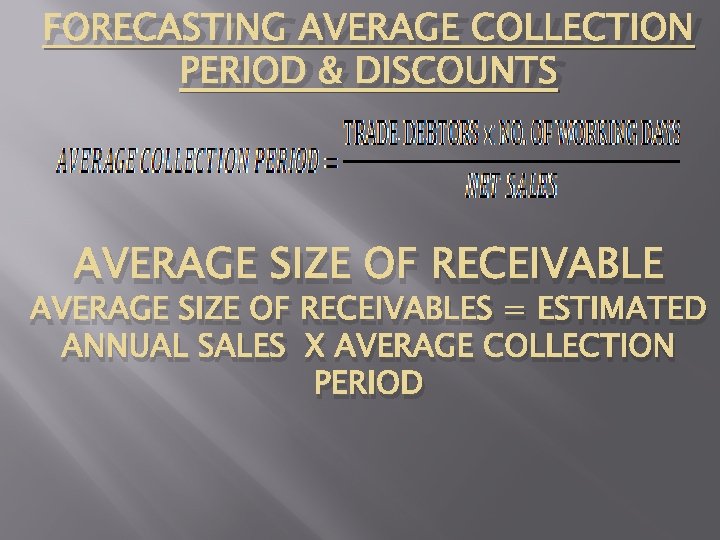
FORECASTING AVERAGE COLLECTION PERIOD & DISCOUNTS AVERAGE SIZE OF RECEIVABLES = ESTIMATED ANNUAL SALES X AVERAGE COLLECTION PERIOD
MEANING & OBJECTIVES OF RECEIVABLE MANAGEMENT Receivables management is the process of making decision relating to investment in trade debtors. The objective of receivables management is to take a sound decision as regards investment in debtors. Convert premium to cash as quickly and efficiently as possible Ensure an uninterrupted flow of services to your customers “The objective of receivable management is to take a sound decision to promote sales & profits until that point is reached where the return on investment is to receivables is less than the cost of funds raised to finance that additional credit”. BOLTON

BENEFITS OF EFFECTIVE COLLECTIONS Increased investment income from enhanced cash flow Higher underwriting capacity from lower nonadmitted assets Reduced revenue leakage/concessions on disputed retro adjusted, loss sensitive, etc. premium Increased subrogation and reinsurance recovery Lower cost of collection function Lower bad debt expense STRATEGY – THE THREE LEVELS Corporate strategy for receivables Financing customers as competitive advantage Maximize cash flow Minimize bad debt Least cost to manage Undefined A Shared Corporate Vision for Receivables Payment expected on due date Disputes are customer satisfaction issues first Vision shared by C level management Portfolio Strategy Different approach for different customer categories, just like the Marketing segmentation approach Agents and Brokers vs. Direct Commercial vs. Personal Workers’ Compensation Major account vs. small account Government vs. private sector Credit risk rating
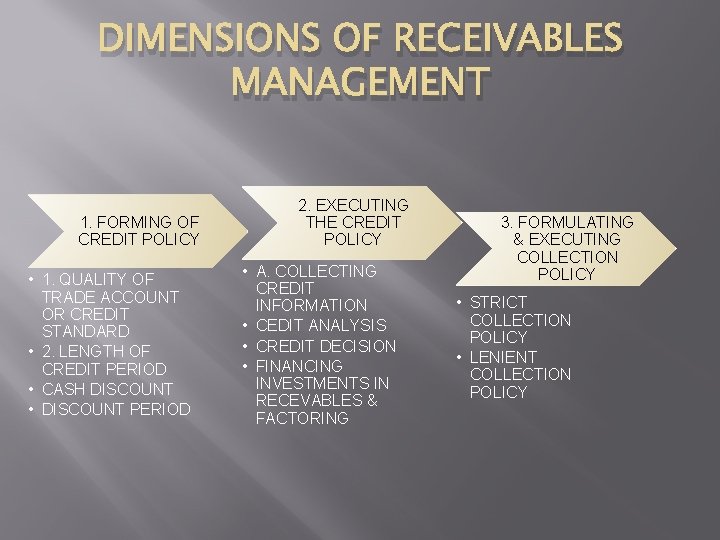
DIMENSIONS OF RECEIVABLES MANAGEMENT 1. FORMING OF CREDIT POLICY • 1. QUALITY OF TRADE ACCOUNT OR CREDIT STANDARD • 2. LENGTH OF CREDIT PERIOD • CASH DISCOUNT • DISCOUNT PERIOD 2. EXECUTING THE CREDIT POLICY • A. COLLECTING CREDIT INFORMATION • CEDIT ANALYSIS • CREDIT DECISION • FINANCING INVESTMENTS IN RECEVABLES & FACTORING 3. FORMULATING & EXECUTING COLLECTION POLICY • STRICT COLLECTION POLICY • LENIENT COLLECTION POLICY
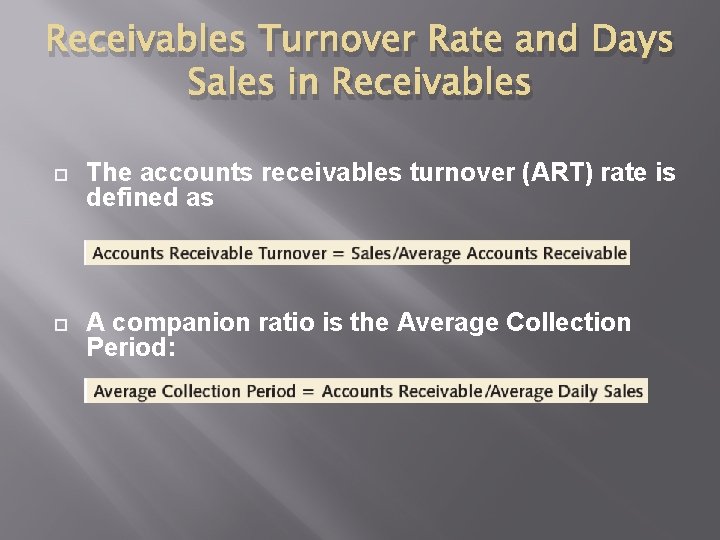
Receivables Turnover Rate and Days Sales in Receivables The accounts receivables turnover (ART) rate is defined as A companion ratio is the Average Collection Period:
Account Receivable Monitoring and Control Monitoring and control is the responsibility of the credit manager. Receivables turnover least favored technique Monitoring conducted on individual accounts through aging schedules. Monitoring conducted at the aggregate level using days’ sales outstanding (DSO).
FACTORING & RECEIVABLES MANAGEMENT For the investment in receivables, a firm has to incur certain costs such as cost of financing, cost of collection, cost of bad debts etc. , To save these costs specifically large concerns hires the factor services. A factor is a financial institution which offers services relating to management & financing of debts arising out of credit sales. In this factor purchases receivables from the firm, control & administers the receivables on the behalf of the firm.
MECHANISM OF FACTORING Ø Ø Ø An agreement is entered in to between the selling firm & the factor firm The sales documents should contain the instructions to make payments directly to factor. When the payments received by the factors, the account of the selling firm is credited by the factor after deducting their fees & expenses.
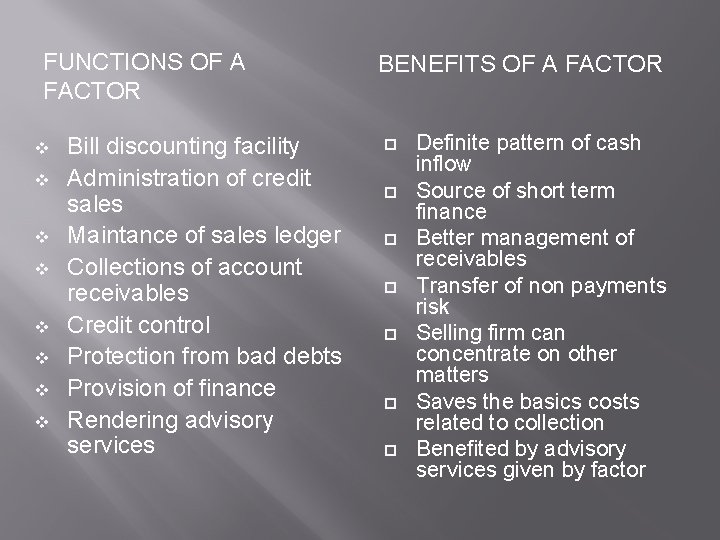
FUNCTIONS OF A FACTOR v v v v Bill discounting facility Administration of credit sales Maintance of sales ledger Collections of account receivables Credit control Protection from bad debts Provision of finance Rendering advisory services BENEFITS OF A FACTOR Definite pattern of cash inflow Source of short term finance Better management of receivables Transfer of non payments risk Selling firm can concentrate on other matters Saves the basics costs related to collection Benefited by advisory services given by factor

Types of factoring 1. Recourse & non recourse factoring 5. Forfaiting factoring 4. Domestic & export factoring 2. Advance & maturity factoring 3. conventional & full factoring

Thank you
- Slides: 16