
Chapter Nine Social Cognitive Theory Overview The Triadic

- Slides: 10
Chapter Nine Social Cognitive Theory
Overview • The Triadic Reciprocal Causation Model • Self-Control, Self-Regulation, and Self. Efficacy • Becoming a Self-Regulated Learner • Research on Social Cognitive Theory • Using Technology to Promote Self. Regulated Learning Copyright © Houghton Mifflin Company. All rights reserved. 2
Triadic Reciprocal Causation Model • Personal characteristics – Mental and emotional factors such as goals, anxiety, metacognition, and self-efficacy • Behavioral patterns – Include self-observation, self-evaluation, making changes in behavior to overcome or reduce perceptions, and creating productive study environments • Environmental factors – An individual’s social and physical environment Copyright © Houghton Mifflin Company. All rights reserved. 3
Self Control, Self-Regulation, & Self-Efficacy • Self control – Ability to control one’s actions in the absence of external reinforcement or punishment • Self-regulation – The consistent and appropriate application of self-control skills to new situations • Self-efficacy – How capable or prepared we believe we are for handling particular kinds of tasks Copyright © Houghton Mifflin Company. All rights reserved. 4
Factors That Affect Self-Efficacy • • Performance accomplishments Verbal persuasion Emotional arousal Vicarious experience Copyright © Houghton Mifflin Company. All rights reserved. 5
Behaviors Affected by Self-Efficacy • • Selection processes Cognitive processes Motivational processes Affective processes Copyright © Houghton Mifflin Company. All rights reserved. 6
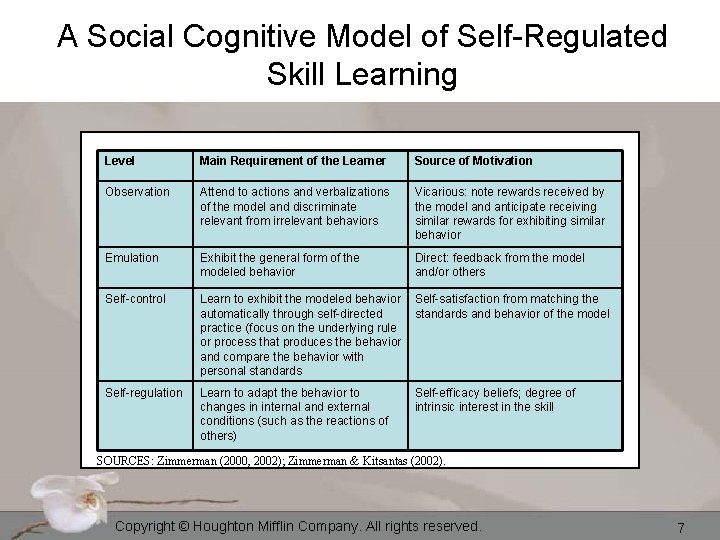
A Social Cognitive Model of Self-Regulated Skill Learning Level Main Requirement of the Learner Source of Motivation Observation Attend to actions and verbalizations of the model and discriminate relevant from irrelevant behaviors Vicarious: note rewards received by the model and anticipate receiving similar rewards for exhibiting similar behavior Emulation Exhibit the general form of the modeled behavior Direct: feedback from the model and/or others Self-control Learn to exhibit the modeled behavior automatically through self-directed practice (focus on the underlying rule or process that produces the behavior and compare the behavior with personal standards Self-satisfaction from matching the standards and behavior of the model Self-regulation Learn to adapt the behavior to changes in internal and external conditions (such as the reactions of others) Self-efficacy beliefs; degree of intrinsic interest in the skill SOURCES: Zimmerman (2000, 2002); Zimmerman & Kitsantas (2002). Copyright © Houghton Mifflin Company. All rights reserved. 7
Effects of Modeling on Self-Efficacy, Self-Regulation, and Achievement • Mathematics – Effect of peer models – Effect of perceived similarity in learning ability – Effect of self-modeling – Effect of learning-goal orientation Copyright © Houghton Mifflin Company. All rights reserved. 8
Effects of Modeling on Self-Efficacy, Self. Regulation, and Achievement • Writing – Modeling for strategy development – Observing weak and strong models – Modeling versus practice – Observation and emulation Copyright © Houghton Mifflin Company. All rights reserved. 9
Using Technology to Promote Self-Regulated Learning • Modeling • Providing Metacognitive Feedback • Providing Scaffolded Instruction Copyright © Houghton Mifflin Company. All rights reserved. 10