
Chapter Nine Bacterial Genetics Acknowledgment Addis Ababa University
Chapter Nine Bacterial Genetics
Acknowledgment • • • Addis Ababa University Jimma University Hawassa University Haramaya University of Gondor American Society of Clinical Pathologists (ASCP) • Center for Disease Control-Ethiopia (CDCEthiopia)
Course objective At the end of the chapter, students will be able to • Describe the difference between prokaryotic and eukaryotic cell • Define bacteria culture media • Explain about conjugation processes • Explain about transduction processes

Course outline
Prokaryote Basics • The largest and most obvious division of living organisms is into prokaryotes vs. eukaryotes. • Eukaryotes are defined as having their genetic material enclosed in a membrane-bound nucleus, separate from the cytoplasm. In addition, eukaryotes have other membrane-bound organelles such as mitochondria, lysosomes, and endoplasmic reticulum. almost all multicellular organisms are eukaryotes. • In contrast, the genome of prokaryotes is not in a separate compartment: it is located in the cytoplasm (although sometimes confined to a particular region called a “nucleoid”). Prokaryotes contain no membranebound organelles; their only membrane is the membrane that separates the cell form the outside world. Nearly all prokaryotes are unicellular.

Three Domains of Life
Prokaryote vs. Eukaryote Genetics • Prokaryotes are haploid, and they contain a single circular chromosome. - identify loss-of-function mutations easier - recessive mutations not masked In addition, prokaryotes often contain small circular DNA molecules called “plasmids”, that confer useful properties such as drug resistance. Only circular DNA molecules in prokaryotes can replicate. • In contrast, eukaryotes are often diploid, and eukaryotes have linear chromosomes, usually more than 1. • In eukaryotes, transcription of genes in RNA occurs in the nucleus, and translation of that RNA into protein occurs in the cytoplasm. The two processes are separated from each other. • In prokaryotes, translation is coupled to transcription: translation of the new RNA molecule starts before transcription is finished.
Escherichia coli • A model organism: useful for discovering general principles common to all organisms. • The focus of genetic research from the 1940’s to 1960’s: What is a gene and how does it work? • Advantages: short doubling time (30 min), simple culture media, pure cultures, haploid, lots of mutations. • The advantage of being haploid is that a mutation in the parent is always seen in the offspring. • In diploid organisms, mutations can be covered up if they are recessive. • Bacteria are haploid
Bacterial Culture • Bacteria need a set of specific nutrients, the correct amount of oxygen, and a proper temperature to grow. The common gut bacterium Escherichia coli (E. coli) grows easily on partially digested extracts made from yeast and animal products, at 37 degrees in a normal atmosphere. These simple growth conditions have made E. coli a favorite lab organism, which is used as a model for other bacteria.
Growth • E. coli can grow on carbon source (e. g. glucose) + minimal inorganic salts. – Prototrophs: Grow well, are wildtype. – Auxotrophs: Require some other organic molecule that it cannot make, due to a mutation (e. g. amino acid leucine - leu- ). • Grow in liquid culture flask or petri dish.
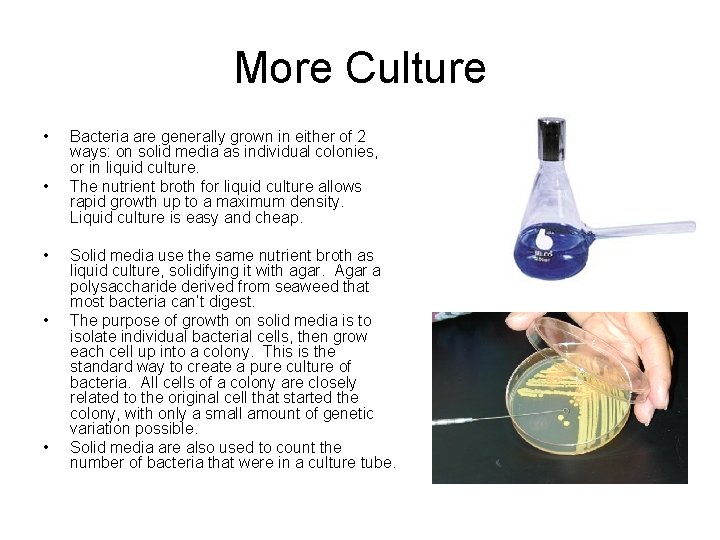
More Culture • • • Bacteria are generally grown in either of 2 ways: on solid media as individual colonies, or in liquid culture. The nutrient broth for liquid culture allows rapid growth up to a maximum density. Liquid culture is easy and cheap. Solid media use the same nutrient broth as liquid culture, solidifying it with agar. Agar a polysaccharide derived from seaweed that most bacteria can’t digest. The purpose of growth on solid media is to isolate individual bacterial cells, then grow each cell up into a colony. This is the standard way to create a pure culture of bacteria. All cells of a colony are closely related to the original cell that started the colony, with only a small amount of genetic variation possible. Solid media are also used to count the number of bacteria that were in a culture tube.
Bacterial Mutants • Mutants in bacteria are mostly biochemical in nature, because we can’t generally see the cells. • The most important mutants are auxotrophs. An auxotroph needs some nutrient that the wild type strain (prototroph) can make for itself. For example, a trp- auxotroph can’t make its own tryptophan (an amino acid). To grow trp- bacteria, you need to add tryptophan to the growth medium. Prototrophs are trp+; they don’t need any tryptophan supplied since they make their own. • Chemoauxotrophs are mutants that can’t use some nutrient (usually a sugar) that prototrophs can use as food. For example, lac- mutants can’t grow on lactose (milk sugar), but lac+ prototrophs can grow on lactose. • Resistance mutants confer resistance to some environmental toxin: drugs, heavy metals, bacteriophages, etc. For instance, Amp. R causes bacteria to be resistant to ampicillin, a common antibiotic related to penicillin. • Auxotrophs and chemoauxotrophs are usually recessive; drug resistance mutants are usually dominant.

Replica Plating • A common way to find bacterial mutants is replica plating, which means making two identical copies of the colonies on a petri plate under different conditions. • For instance, if you were looking for trp- auxotrophs, one plate would contain added tryptophan and the other plate would not have any tryptophan in it. • Bacteria are first spread on the permissive plate, the plate that allows both mutants and wild type to grow, the plate containing tryptophan in this case. They are allowed to grow fro a while, then a copy of the plate is made by pressing a piece of velvet onto the surface of the plate, then moving it to a fresh plate with the restrictive condition (no tryptophan). The velvet transfers some cells from each colony to an identical position on the restrictive plate. • Colonies that grow on the permissive plate but not the restrictive plate are (probably) trp- auxotrophs, because they can only grow if tryptophan is supplied.

Replica Plating, pt. 2
Bacterial Sexual Processes • Eukaryotes have the processes of meiosis to reduce diploids to haploidy, and fertilization to return the cells to the diploid state. Bacterial sexual processes are not so regular. However, they serve the same aim: to mix the genes from two different organisms together. • The three bacterial sexual processes: – 1. conjugation: direct transfer of DNA from one bacterial cell to another. – 2. transduction: use of a bacteriophage (bacterial virus) to transfer DNA between cells. – 3. transformation: naked DNA is taken up from the environment by bacterial cells.
Transformation • In transformation, pieces of DNA released from donor bacteria are taken up directly from the extracellular environment by recipient bacteria • Discovered by Frederick Griffith, 1928, while working with strains of Streptococcus pneumoniae • To be active in transformation, DNA molecules must be at least 500 nucleotides in length, and transforming activity is destroyed rapidly by treating DNA with deoxyribonuclease. • , .
• The ability of bacteria to take up extracellular DNA and to become transformed, called competence • Many bacteria that are not usually competent can be made to take up DNA by laboratory manipulations, such as calcium shock or exposure to a high-voltage electrical pulse (electroporation).
Transformation • There are two types – Natural transformation • – DNA uptake occurs without outside help Artificial transformation • DNA uptake occurs with the help of special techniques Copyright ©The Mc. Graw-Hill Companies, Inc. Permission required for reproduction or display
Transformation • Natural transformation occurs in a wide variety of bacteria • Bacteria able to take up DNA = competent • carry genes encoding competence factors • proteins that uptake DNA into bacterium & incorporate it into the chromosome
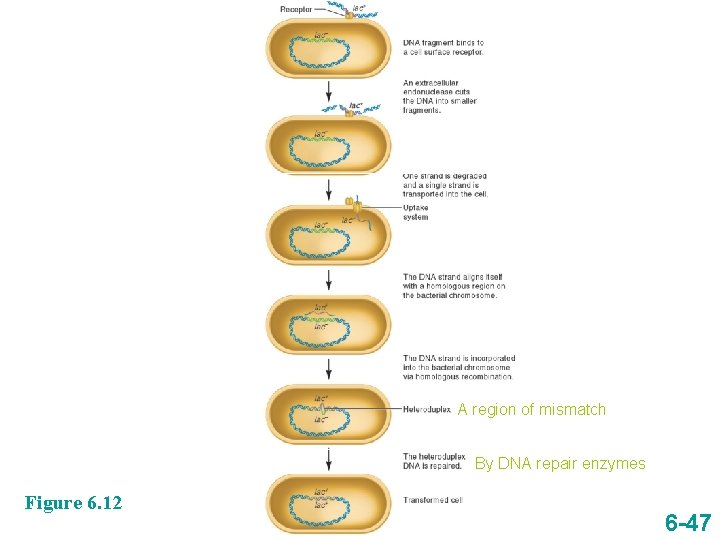
A region of mismatch By DNA repair enzymes Figure 6. 12 6 -47
Transformation • Sometimes, the DNA that enters the cell is not homologous to any genes on the chromosome – It may be incorporated at a random site on the chromosome – This process is termed nonhomologous recombination • Like cotransduction, transformation mapping is used for genes that are relatively close together Copyright ©The Mc. Graw-Hill Companies, Inc. Permission required for reproduction or display 6 -48
Gene Transfer • Horizontal gene transfer of genes between different species vs • Vertical gene transfer - transfer of genes from mother to daughter cell or from parents to offspring • Sizable fraction of bacterial genes have moved by horizontal gene transfer – Over 100 million years ~ 17% of E. coli & S. typhimurium genes have been shared by horizontal transfer
Horizontal Gene Transfer • Genes acquired by horizontal transfer – Genes that confer the ability to cause disease – Genes that confer antibiotic resistance • Horizontal transfer has contributed to acquired antibiotic resistance
• In the case of E. coli, cells are made “competent” to be transformed by treatment with calcium ions and heat shock. E. coli cells in this condition readily pick up DNA from their surroundings and incorporate it into their genomes
Conjugation • • Conjugation is the closest analogue in bacteria to eukaryotic sex. The ability to conjugate is conferred by the F plasmid. A plasmid is a small circle of DNA that replicates independently of the chromosome. Bacterial cells that contain an F plasmid are called “F+”. Bacteria that don’t have an F plasmid are called “F-”. F+ cells grow special tubes called “sex pilli” from their bodies. When an F+ cell bumps into an F- cell, the sex pilli hold them together, and a copy of the F plasmid is transferred from the F+ to the F-. Now both cells are F+. Why aren’t all E. coli F+, if it spreads like that? Because the F plasmid can be spontaneously lost.
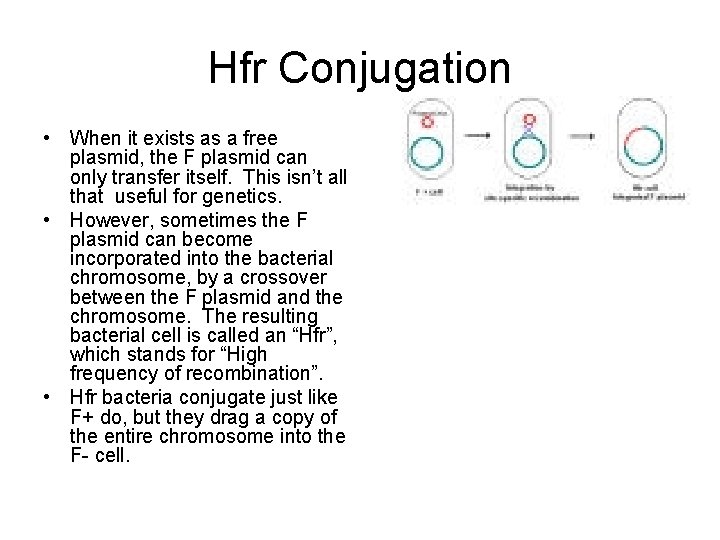
Hfr Conjugation • When it exists as a free plasmid, the F plasmid can only transfer itself. This isn’t all that useful for genetics. • However, sometimes the F plasmid can become incorporated into the bacterial chromosome, by a crossover between the F plasmid and the chromosome. The resulting bacterial cell is called an “Hfr”, which stands for “High frequency of recombination”. • Hfr bacteria conjugate just like F+ do, but they drag a copy of the entire chromosome into the F- cell.
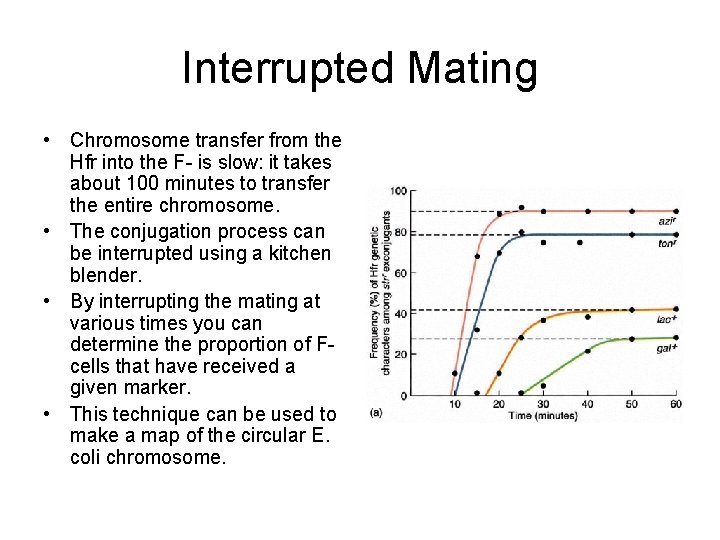
Interrupted Mating • Chromosome transfer from the Hfr into the F- is slow: it takes about 100 minutes to transfer the entire chromosome. • The conjugation process can be interrupted using a kitchen blender. • By interrupting the mating at various times you can determine the proportion of Fcells that have received a given marker. • This technique can be used to make a map of the circular E. coli chromosome.
• Wollman & Jacob started the experiment with two E. coli strains – Hfr strain (donor) genotype • • thr+ : Can synthesize threonine leu+ : Can synthesize leucine azis : Killed by azide tons : Can be infected by T 1 phage lac+ : Can metabolize lactose gal+ : Can metabolize galactose strs : Killed by streptomycin – F– strain (recipient) genotype • thr– leu– azir tonr lac – gal – strr Copyright ©The Mc. Graw-Hill Companies, Inc. Permission required for reproduction or display 6 -21

Figure 6. 6
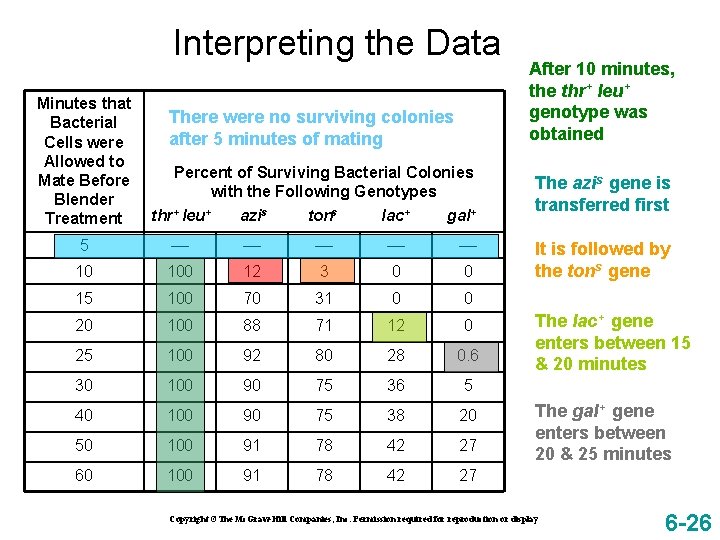
Interpreting the Data Minutes that Bacterial Cells were Allowed to Mate Before Blender Treatment There were no surviving colonies after 5 minutes of mating Percent of Surviving Bacterial Colonies with the Following Genotypes thr+ leu+ azis tons lac+ gal+ 5 –– –– –– 10 100 12 3 0 0 15 100 70 31 0 0 20 100 88 71 12 0 25 100 92 80 28 0. 6 30 100 90 75 36 5 40 100 90 75 38 20 50 100 91 78 42 27 60 100 91 78 42 27 After 10 minutes, the thr+ leu+ genotype was obtained The azis gene is transferred first It is followed by the tons gene The lac+ gene enters between 15 & 20 minutes The gal+ gene enters between 20 & 25 minutes Copyright ©The Mc. Graw-Hill Companies, Inc. Permission required for reproduction or display 6 -26
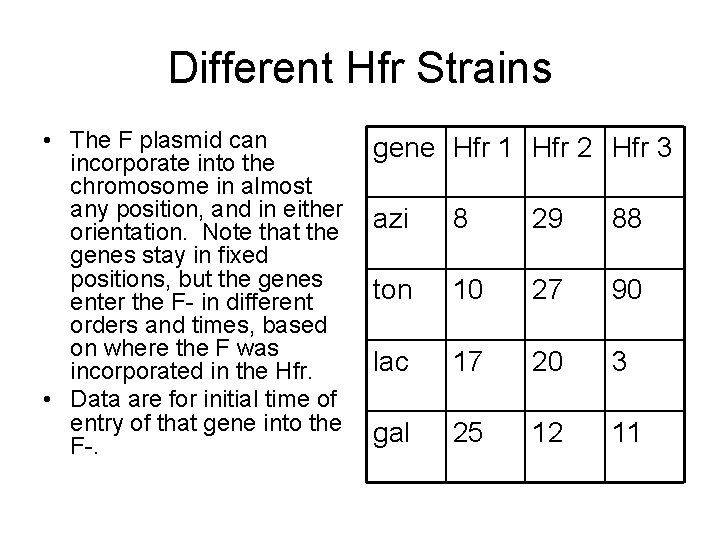
Different Hfr Strains • The F plasmid can incorporate into the chromosome in almost any position, and in either orientation. Note that the genes stay in fixed positions, but the genes enter the F- in different orders and times, based on where the F was incorporated in the Hfr. • Data are for initial time of entry of that gene into the F-. gene Hfr 1 Hfr 2 Hfr 3 azi 8 29 88 ton 10 27 90 lac 17 20 3 gal 25 12 11

Intracellular Events in Conjugation • The piece of chromosome that enters the F- form the Hfr is linear. It is called the “exogenote”. • The F- cell’s own chromosome is circular. It is called the “endogenote”. • Only circular DNA replicates in bacteria, so genes on the exogenote must be transferred to the endogenote for the F- to propagate them. • This is done by recombination: 2 crossovers between homologous regions of the exogenote and the endogenote. In the absence of recombination, conjugation in ineffective: the exogenote enters the F-, but all the genes on it are lost as the bacterial cell reproduces.
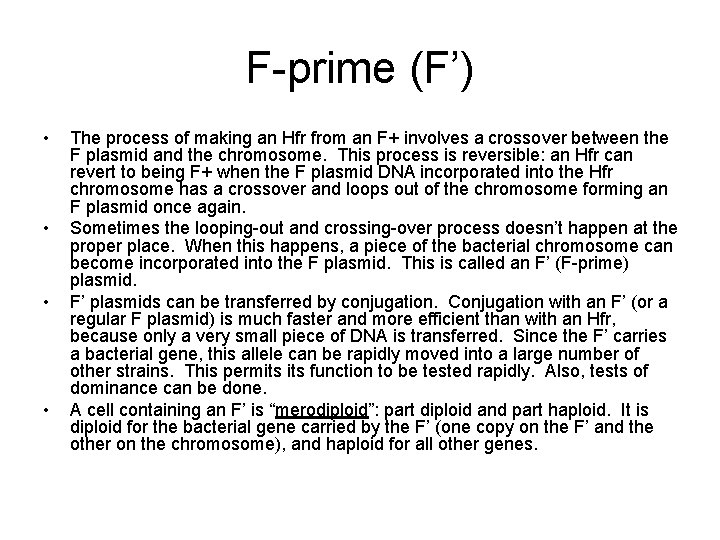
F-prime (F’) • • The process of making an Hfr from an F+ involves a crossover between the F plasmid and the chromosome. This process is reversible: an Hfr can revert to being F+ when the F plasmid DNA incorporated into the Hfr chromosome has a crossover and loops out of the chromosome forming an F plasmid once again. Sometimes the looping-out and crossing-over process doesn’t happen at the proper place. When this happens, a piece of the bacterial chromosome can become incorporated into the F plasmid. This is called an F’ (F-prime) plasmid. F’ plasmids can be transferred by conjugation. Conjugation with an F’ (or a regular F plasmid) is much faster and more efficient than with an Hfr, because only a very small piece of DNA is transferred. Since the F’ carries a bacterial gene, this allele can be rapidly moved into a large number of other strains. This permits function to be tested rapidly. Also, tests of dominance can be done. A cell containing an F’ is “merodiploid”: part diploid and part haploid. It is diploid for the bacterial gene carried by the F’ (one copy on the F’ and the other on the chromosome), and haploid for all other genes.
Transduction • Transduction is the process of moving bacterial DNA from one cell to another using a bacteriophage. • Bacteriophage or just “phage” are bacterial viruses. They consist of a small piece of DNA inside a protein coat. The protein coat binds to the bacterial surface, then injects the phage DNA. The phage DNA then takes over the cell’s machinery and replicates many virus particles. • Two forms of transduction: – 1. generalized: any piece of the bacterial genome can be transferred – 2. specialized: only specific pieces of the chromosome can be transferred.
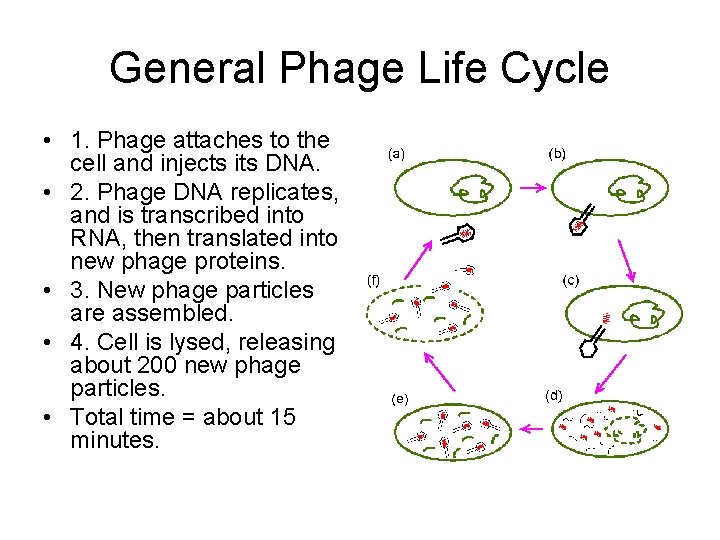
General Phage Life Cycle • 1. Phage attaches to the cell and injects its DNA. • 2. Phage DNA replicates, and is transcribed into RNA, then translated into new phage proteins. • 3. New phage particles are assembled. • 4. Cell is lysed, releasing about 200 new phage particles. • Total time = about 15 minutes.

Generalized Transduction • Some phages, such as phage P 1, break up the bacterial chromosome into small pieces, and then package it into some phage particles instead of their own DNA. • These chromosomal pieces are quite small: about 1 1/2 minutes of the E. coli chromosome, which has a total length of 100 minutes. • A phage containing E. coli DNA can infect a fresh host, because the binding to the cell surface and injection of DNA is caused by the phage proteins. • After infection by such a phage, the cell contains an exogenote (linear DNA injected by the phage) and an endogenote (circular DNA that is the host’s chromosome). • A double crossover event puts the exogenote’s genes onto the chromosome, allowing them to be propagated.
Transduction Mapping • Only a small amount of chromosome, a few genes, can be transferred by transduction. The closer 2 genes are to each other, the more likely they are to be transduced by the same phage. Thus, “co-transduction frequency” is the key parameter used in mapping genes by transduction. • Transduction mapping is for fine-scale mapping only. Conjugation mapping is used for mapping the major features of the entire chromosome.
Mapping Experiment • Important point: the closer 2 genes are to each other, the higher the co-transduction frequency. • We are just trying to get the order of the genes here, not put actual distances on the map. • Expt: donor strain is azi. R leu+ thr+. Phage P 1 is grown on the donor strain, and then the resulting phage are mixed with the recipient strain: azi. S leu- thr-. The bacteria that survive are then tested for various markers • 1. Of the leu+ cells, 50% are azi. R, and 2% are thr+. From this we can conclude that azi and leu are near each other, and that leu and thr are far apart. • But: what is the order: leu--azi--thr, or azi--leu--thr ?
Mapping Experiment, pt. 2 • 2. Do a second experiment to determine the order. Select the thr+ cells, then determine how many of them have the other 2 markers. 3% are also leu+ and 0% are also azi. R. • By this we can see that thr is closer to leu than it is to azi, because thr and azi are so far apart that they are never co-transduced. • Thus the order must be thr--leu--azi. • Note that the co-transduction frequency for thr and leu are slightly different for the 2 experiments: 2% and 3%. This is attributable to experimental error.
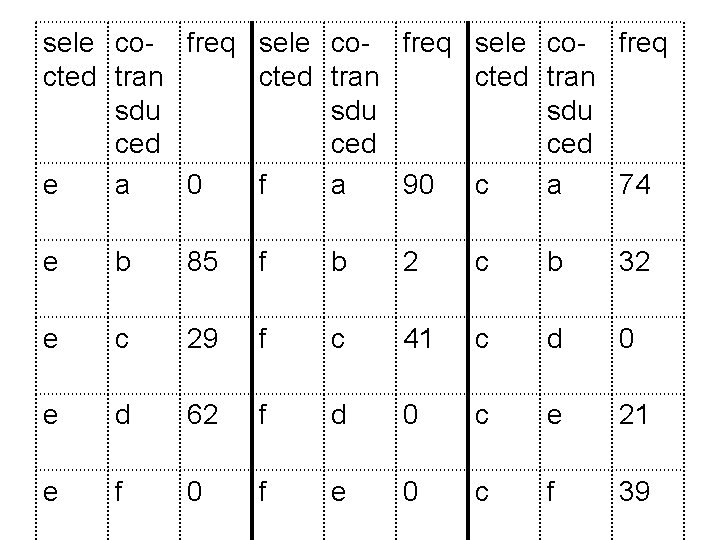
Larger Experiment • A few hints: – 1. There are 3 experiments shown. In each, 1 gene is selected, and the frequencies of co-transduction with the other genes is shown. – 2. start with 2 genes that are selected and that have a non-zero co-transduction frequency. Put them on the map. – 3. Then locate the other genes relative to the first 2.
sele co- freq cted tran sdu sdu ced ced e a 0 f a 90 c a 74 e b 85 f b 2 c b 32 e c 29 f c 41 c d 0 e d 62 f d 0 c e 21 e f 0 f e 0 c f 39
Intro to Specialized Transduction • Some phages can transfer only particular genes to other bacteria. • Phage lambda (λ) has this property. To understand specialized transduction, we need to examine the phage lambda life cycle. • lambda has 2 distinct phases of its life cycle. The “lytic” phase is the same as we saw with the general phage life cycle: the phage infects the cell, makes more copies of itself, then lyses the cell to release the new phage.
Lysogenic Phase • The “lysogenic” phase of the lambda life cycle starts the same way: the lambda phage binds to the bacterial cell and injects its DNA. Once inside the cell, the lambda DNA circularizes, then incorporates into the bacterial chromosome by a crossover, similar to the conversion of an F plasmid into an Hfr. • Once incorporated into the chromosome, the lambda DNA becomes quiescent: its genes are not expressed and it remains a passive element on the chromosome, being replicated along with the rest of the chromosome. The lambda DNA in this condition is called the “prophage”. • After many generations of the cell, conditions might get harsh. For lambda, bad conditions are signaled when DNA damage occurs. • When the lambda prophage receives the DNA damage signal, it loops out and has a crossover, removing itself from the chromosome. Then the lambda genes become active and it goes into the lytic phase, reproducing itself, then lysing the cell.
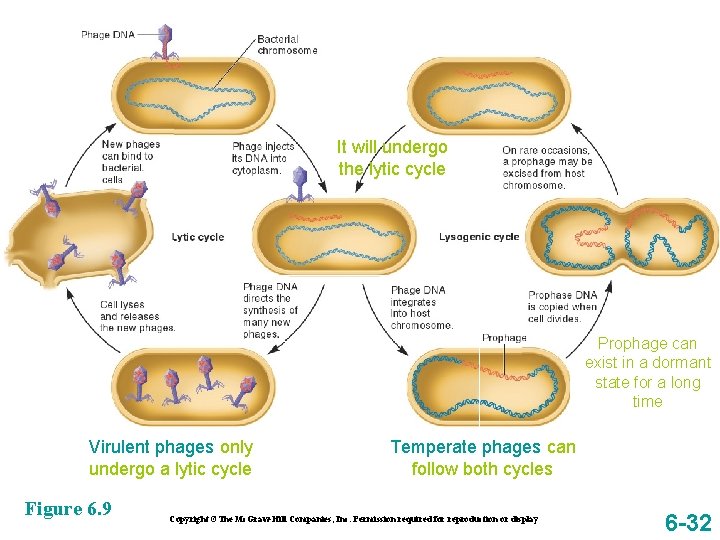
It will undergo the lytic cycle Prophage can exist in a dormant state for a long time Virulent phages only undergo a lytic cycle Figure 6. 9 Temperate phages can follow both cycles Copyright ©The Mc. Graw-Hill Companies, Inc. Permission required for reproduction or display 6 -32

More Lysogenic Phase
Specialized Transduction • Unlike the F plasmid that can incorporate anywhere in the E. coli genome, lambda can only incorporate into a specific site, called attλ. The gal gene is on one side of attλ and the bio gene (biotin synthesis) is on the other side. • Sometimes when lambda come out of the chromosome at the end of the lysogenic phase, it crosses over at the wrong point. This is very similar to the production of an F’ from an Hfr. • When this happens, a piece of the E. coli chromosome is incorporated into the lambda phage chromosome • These phage that carry an E. coli gene in addition to the lambda genes are called “specialized transducing phages”. They can carry either the gal gene or the bio gene to other E. coli. • Thus it is possible to quickly develop merodiploids (partial diploids) for any allele you like of gal or bio. Note that this trick can’t be used with other genes, but only for genes that flank the attachment site for lambda or another lysogenic phage.
Summery questions 1. Mention at least two differences between prokaryote and eukaryotic cells 2. What is the difference between prototroph and autotroph bacteria 3. Discuss the difference between - Natural versus artificial transformation -Vertical and horizontal gene transformation 4. Define plasmid 5. Explain about conjugation processes
Summery questions, continued. . 6. Discuss about generalized and specialized transduction processes 7. What is the difference between lytic and lysogenic phage virus life cycles
Reference • Robert F. weaver, Philip W. Hedrick. Genetics. • Darnel, Lodish, Baltimore. Molecular Cell Biology • James D. Watson: Recombinant DNA • Robert F. Weaver. Molecular biology • Benjamin Lewin: Genes VI and above
Reference continued…. • Richard J. Epistein: Human Molecular Biology • P. K. Gupta: Cell and Molecular Biology • Vertualtext erigito. com/Molecular biology www. ergito. com • http: //www. emporia. edu/biosci/genetics/no tegene. html • http: //www. biol. wwu. edu/young/321_07 a. h tml
- Slides: 50