
Chapter Menu Lesson 1 Structure of the Solar


- Slides: 98
Chapter Menu Lesson 1: Structure of the Solar System Lesson 2: The Sun-Earth-Moon System Lesson 3: The Planets and Their Moons Lesson 4: Asteroids, Comets, and Meteoroids Click on a hyperlink to view the corresponding lesson.
11. 1 Structure of the Solar System axis of rotation period of revolution ellipse astronomical unit
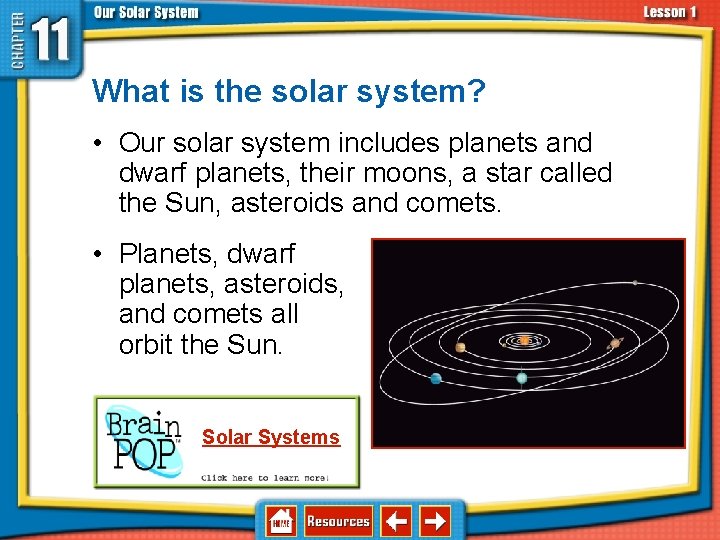
11. 1 Structure of the Solar System What is the solar system? • Our solar system includes planets and dwarf planets, their moons, a star called the Sun, asteroids and comets. • Planets, dwarf planets, asteroids, and comets all orbit the Sun. Solar Systems
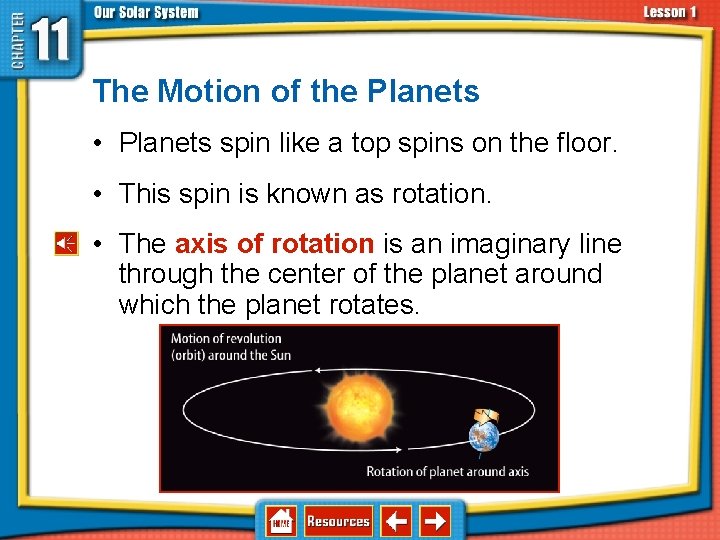
11. 1 Structure of the Solar System The Motion of the Planets • Planets spin like a top spins on the floor. • This spin is known as rotation. • The axis of rotation is an imaginary line through the center of the planet around which the planet rotates.
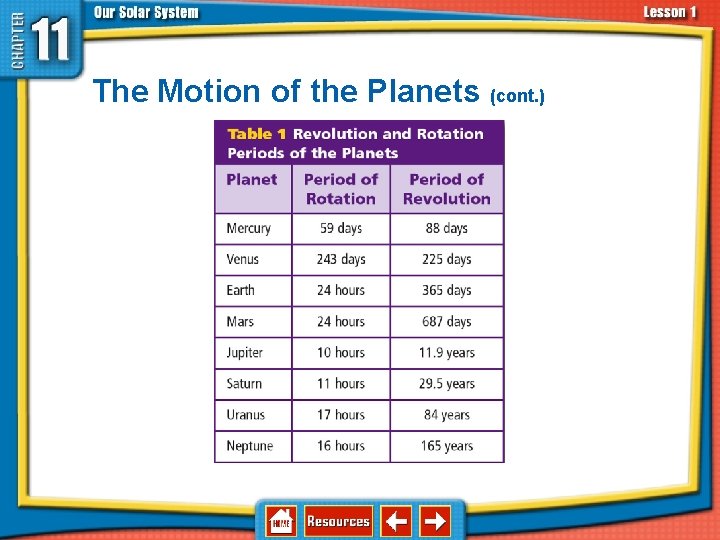
11. 1 Structure of the Solar System The Motion of the Planets (cont. ) • Period of rotation—the amount of time it takes to make one complete rotation • Period of revolution—the time it takes a planet to move around the Sun.
11. 1 Structure of the Solar System The Motion of the Planets (cont. )
11. 1 Structure of the Solar System Kepler’s Laws of Planetary Motion • Kepler studied the motion of planets in the early 1600 s. • He proposed three laws that govern the motion of the planets.
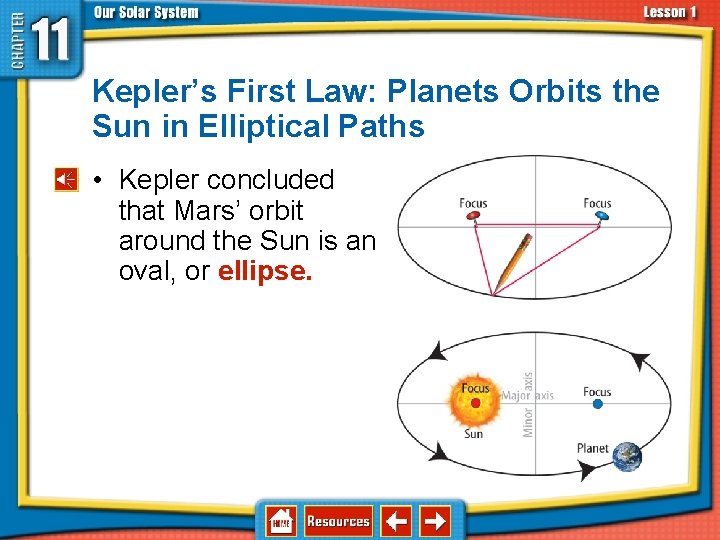
11. 1 Structure of the Solar System Kepler’s First Law: Planets Orbits the Sun in Elliptical Paths • Kepler concluded that Mars’ orbit around the Sun is an oval, or ellipse.
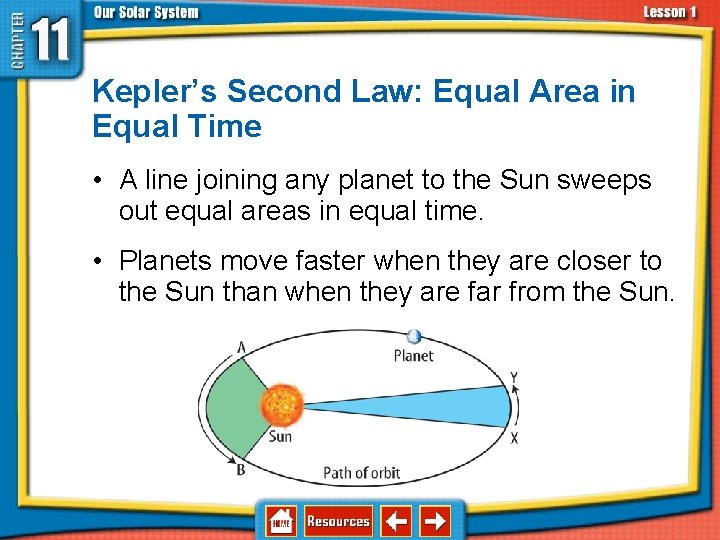
11. 1 Structure of the Solar System Kepler’s Second Law: Equal Area in Equal Time • A line joining any planet to the Sun sweeps out equal areas in equal time. • Planets move faster when they are closer to the Sun than when they are far from the Sun.
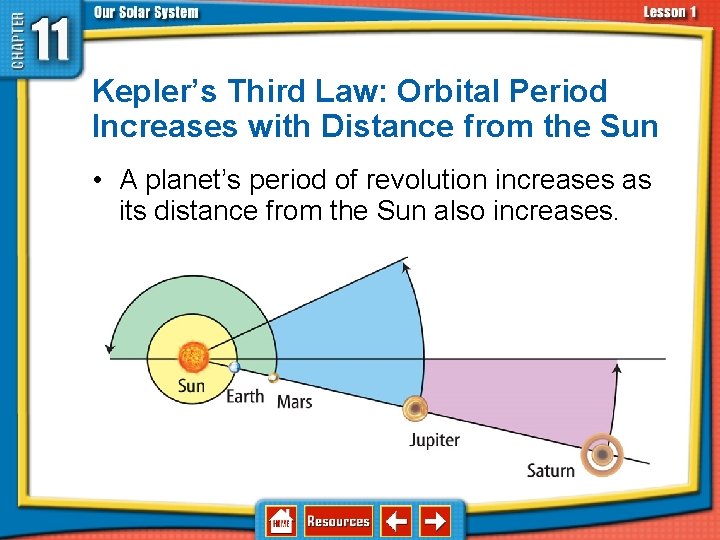
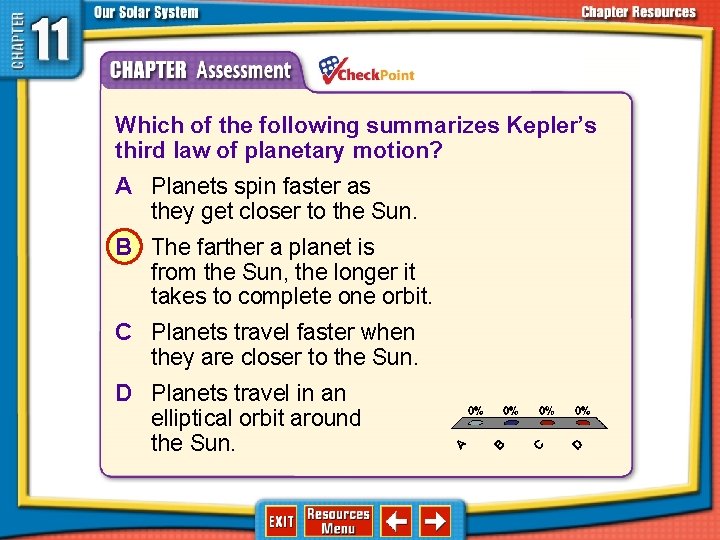
11. 1 Structure of the Solar System Kepler’s Third Law: Orbital Period Increases with Distance from the Sun • A planet’s period of revolution increases as its distance from the Sun also increases.
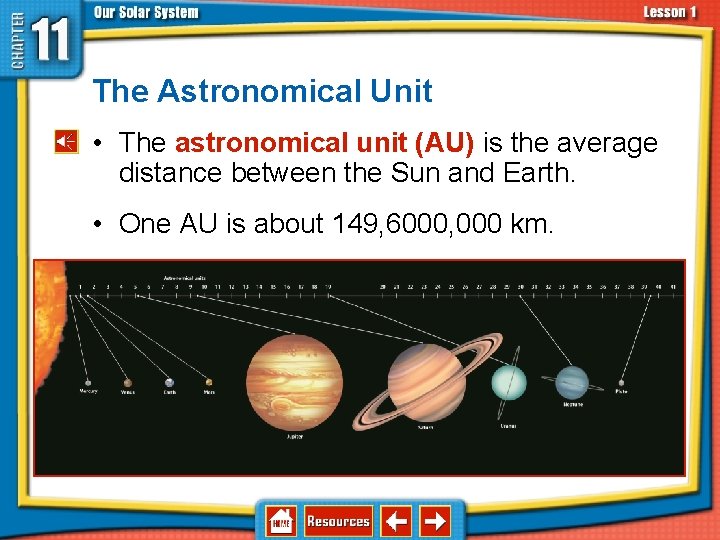
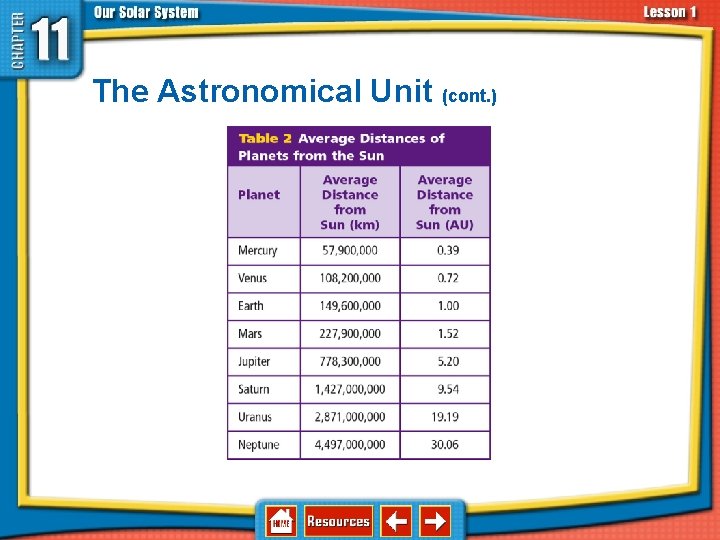
11. 1 Structure of the Solar System The Astronomical Unit • The astronomical unit (AU) is the average distance between the Sun and Earth. • One AU is about 149, 6000, 000 km.
11. 1 Structure of the Solar System The Astronomical Unit (cont. )
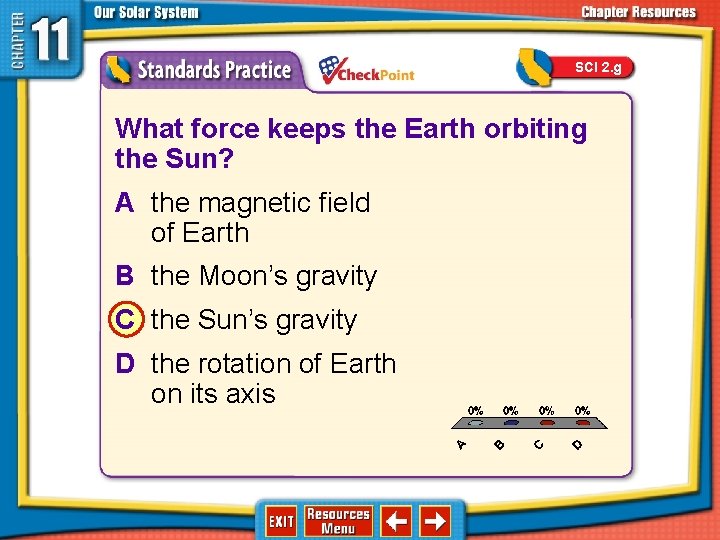
11. 1 Structure of the Solar System Gravity and the Solar System • Recall that all objects that have mass attract each other. • The planets are attracted towards the Sun.
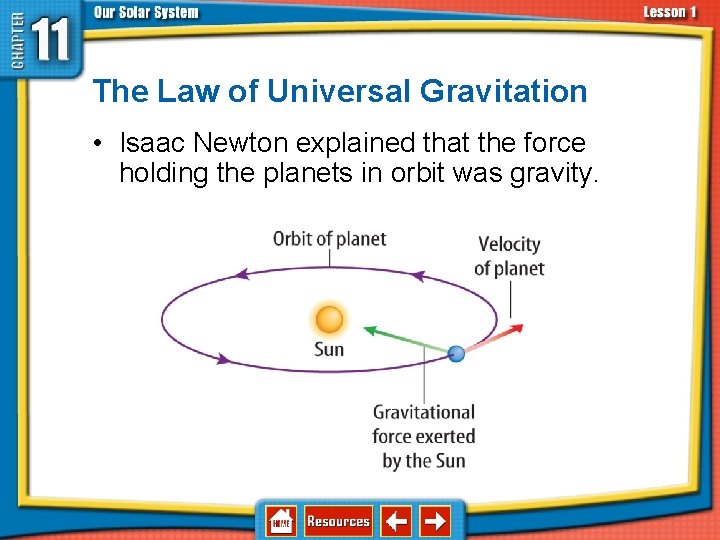
11. 1 Structure of the Solar System The Law of Universal Gravitation • Isaac Newton explained that the force holding the planets in orbit was gravity.
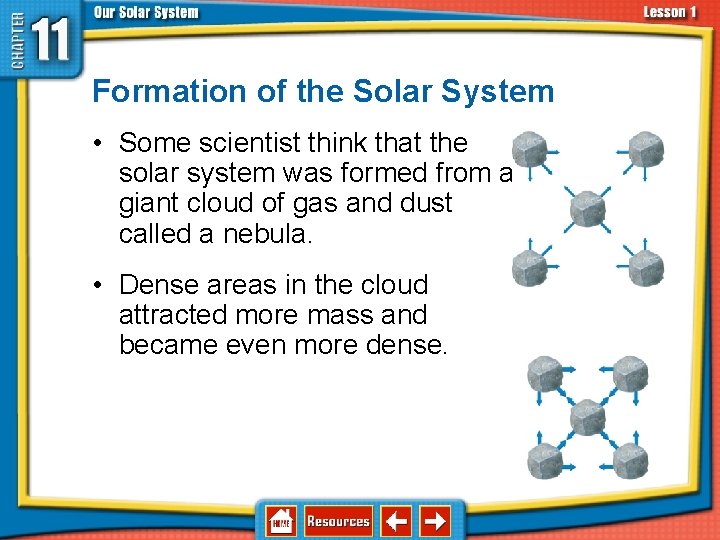
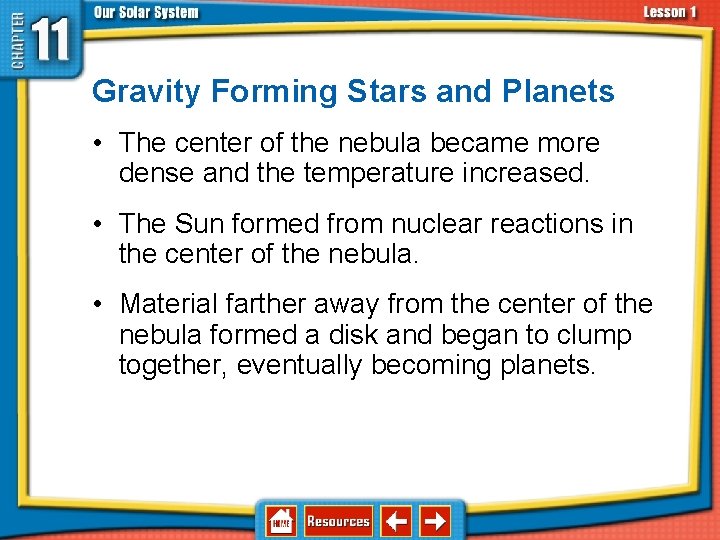
11. 1 Structure of the Solar System Formation of the Solar System • Some scientist think that the solar system was formed from a giant cloud of gas and dust called a nebula. • Dense areas in the cloud attracted more mass and became even more dense.
11. 1 Structure of the Solar System Gravity Forming Stars and Planets • The center of the nebula became more dense and the temperature increased. • The Sun formed from nuclear reactions in the center of the nebula. • Material farther away from the center of the nebula formed a disk and began to clump together, eventually becoming planets.
11. 1 Structure of the Solar System 1. 2. 3. 4. A B C D The period of rotation is the amount of time is takes a planet to ____. A travel around Mars B travel one AU C travel around the Sun D spin once on its axis
11. 1 Structure of the Solar System 1. 2. 3. 4. A B C D One AU is equal to ____. A 1 million miles B the average distance between the Earth and its moon C the average distance from the Sun to Pluto D the average distance from the Earth to the Sun
11. 1 Structure of the Solar System 1. 2. 3. 4. A B C D Kepler’s first law of planetary motion states ____. A the farther a planet is from the Sun, the longer it takes to complete a revolution B planets rotate faster when they are closer to the Sun C planets travel in an elliptical orbit D planets travel faster when they are closer to the Sun
11. 2 The Sun-Earth-Moon System satellite lunar phase eclipse
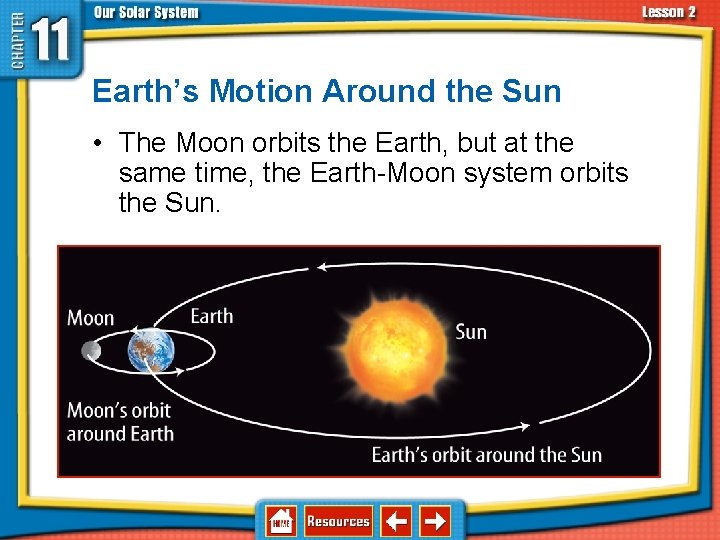
11. 2 The Sun-Earth-Moon System Earth’s Motion Around the Sun • The Moon orbits the Earth, but at the same time, the Earth-Moon system orbits the Sun.
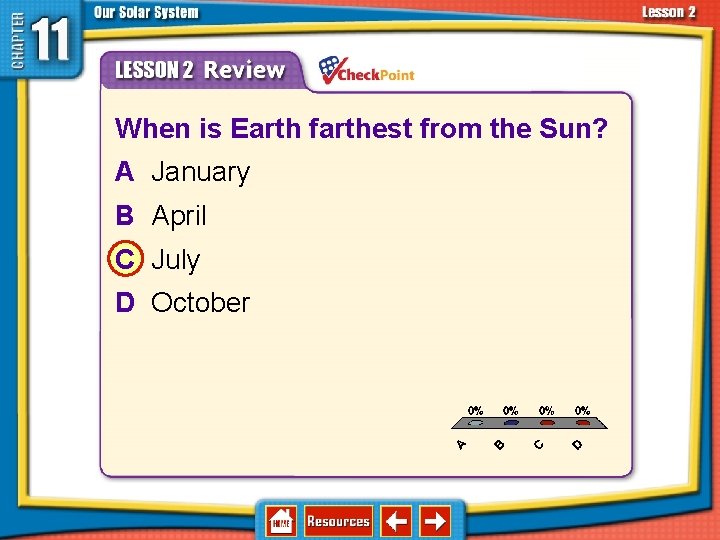
11. 2 The Sun-Earth-Moon System Earth’s Orbit • The actual path is an ellipse. • Earth is closest to the Sun in January. • Earth is farthest from the Sun in July.
11. 2 The Sun-Earth-Moon System Earth’s Rotation • Earth rotates on its axis once every 24 hours. • The rotation causes day and night. • Earth’s axis of rotation is 23. 5° tilted to the plane of orbit around the Sun.
11. 2 The Sun-Earth-Moon System The Moon—Earth’s Satellite • Earth has one moon revolving around it. • A satellite is an object that revolves around a planet.
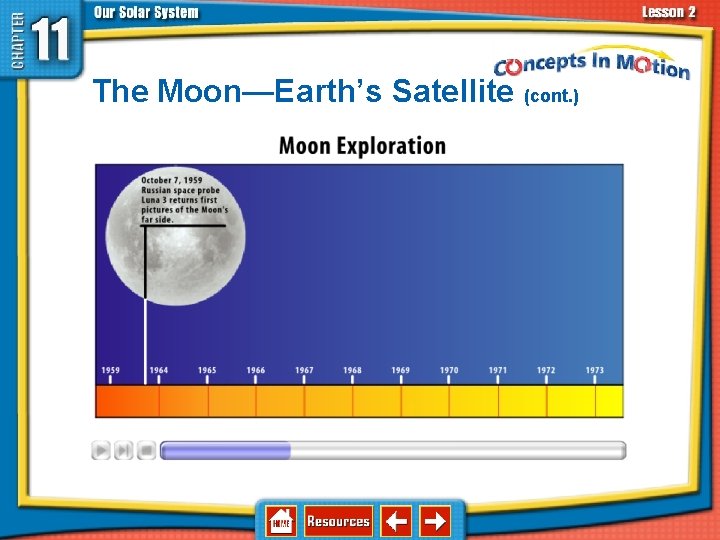
The Moon—Earth’s Satellite (cont. )
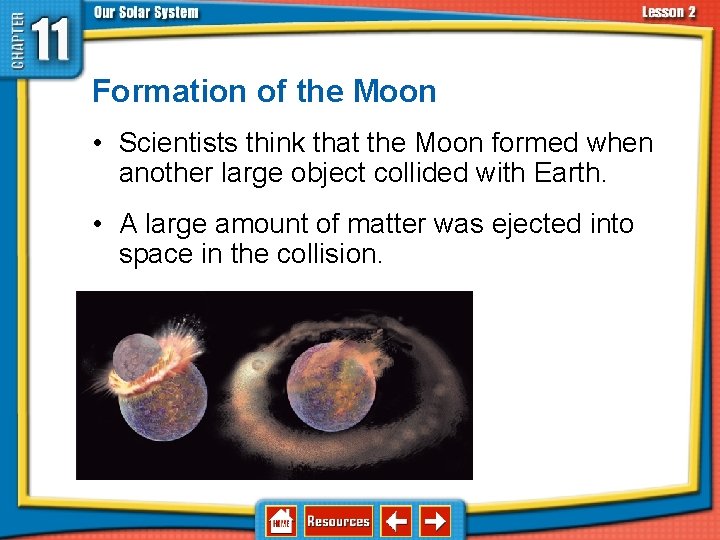
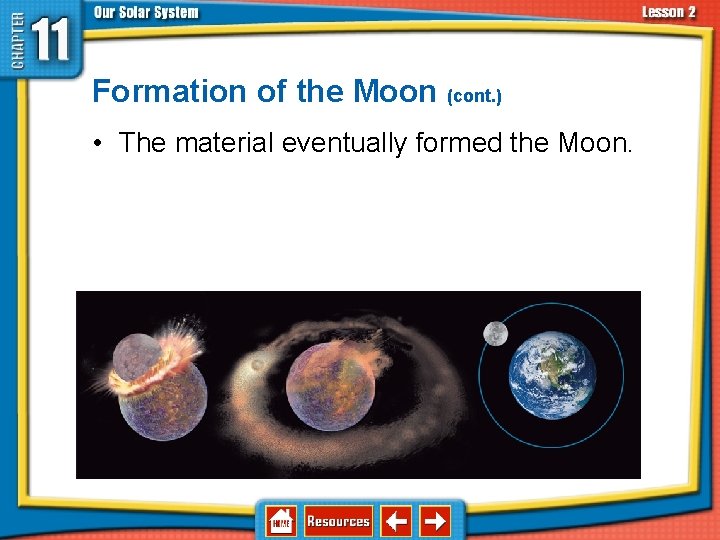
11. 2 The Sun-Earth-Moon System Formation of the Moon • Scientists think that the Moon formed when another large object collided with Earth. • A large amount of matter was ejected into space in the collision.
11. 2 The Sun-Earth-Moon System Formation of the Moon (cont. ) • The material eventually formed the Moon.
11. 2 The Sun-Earth-Moon System The Motion of the Moon • Gravitational force between Earth and the Moon causes the Moon to orbit the Earth. • The Moon rotates on its axis once every 28 days. Tides
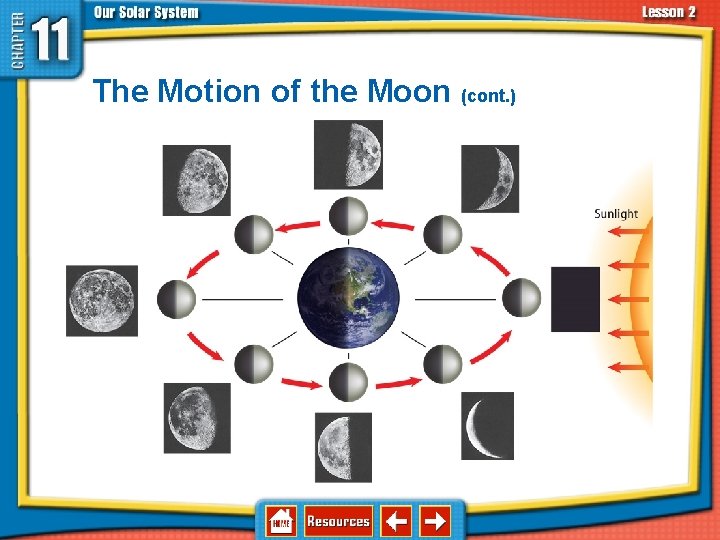
11. 2 The Sun-Earth-Moon System The Motion of the Moon (cont. )
11. 2 The Sun-Earth-Moon System Phases of the Moon • The Moon reflects sunlight. • As the Moon travels around Earth, the illuminated portion changes. • The different appearances of the Moon are called lunar phases. How do Earth and the moon interact to cause the moon’s phases?
11. 2 The Sun-Earth-Moon System Eclipses • An eclipse is a total or partial obscuring of one celestial body by another. • There are two types of eclipses: – Lunar – Solar
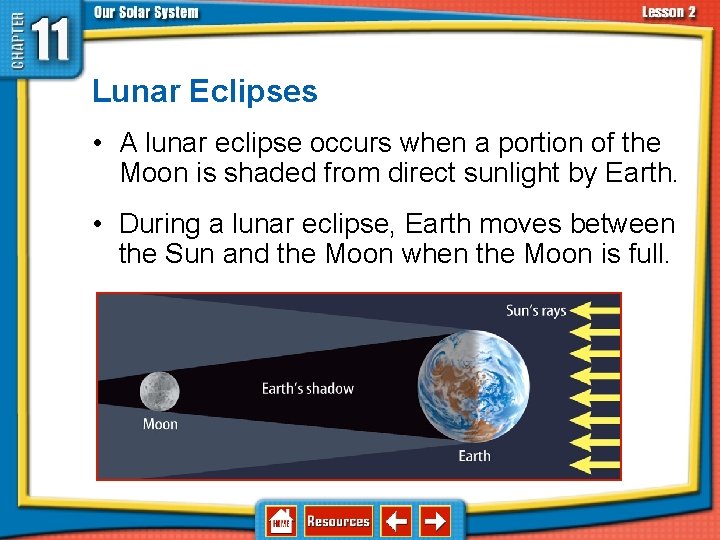
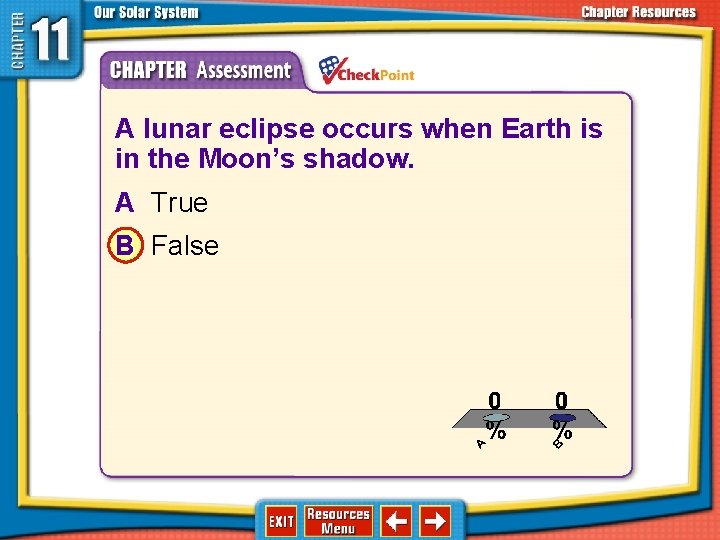
11. 2 The Sun-Earth-Moon System Lunar Eclipses • A lunar eclipse occurs when a portion of the Moon is shaded from direct sunlight by Earth. • During a lunar eclipse, Earth moves between the Sun and the Moon when the Moon is full.
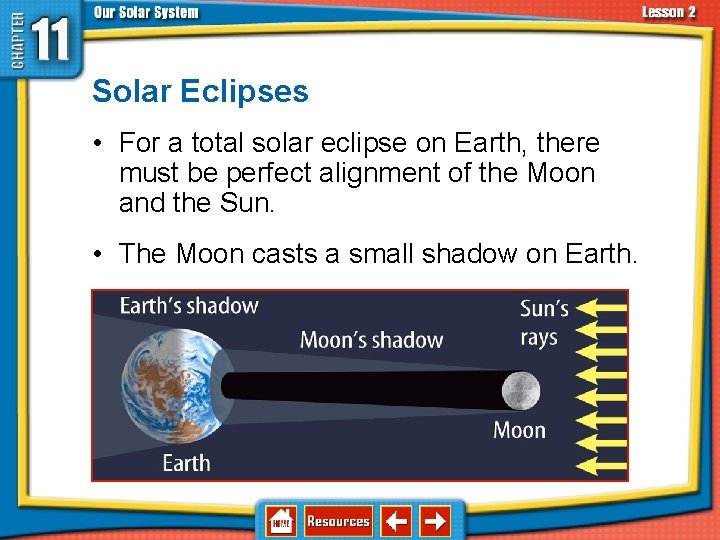
11. 2 The Sun-Earth-Moon System Solar Eclipses • For a total solar eclipse on Earth, there must be perfect alignment of the Moon and the Sun. • The Moon casts a small shadow on Earth.
11. 2 The Sun-Earth-Moon System 1. 2. 3. 4. A B C D When is Earth farthest from the Sun? A January B April C July D October
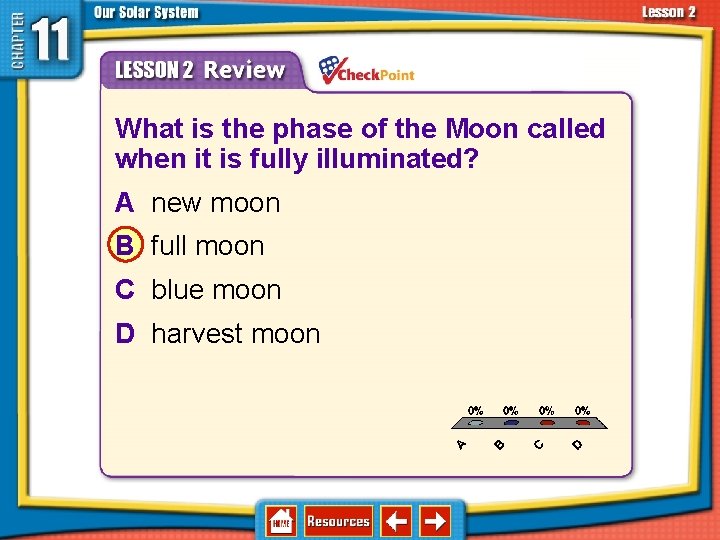
11. 2 The Sun-Earth-Moon System 1. 2. 3. 4. A B C D What is the phase of the Moon called when it is fully illuminated? A new moon B full moon C blue moon D harvest moon
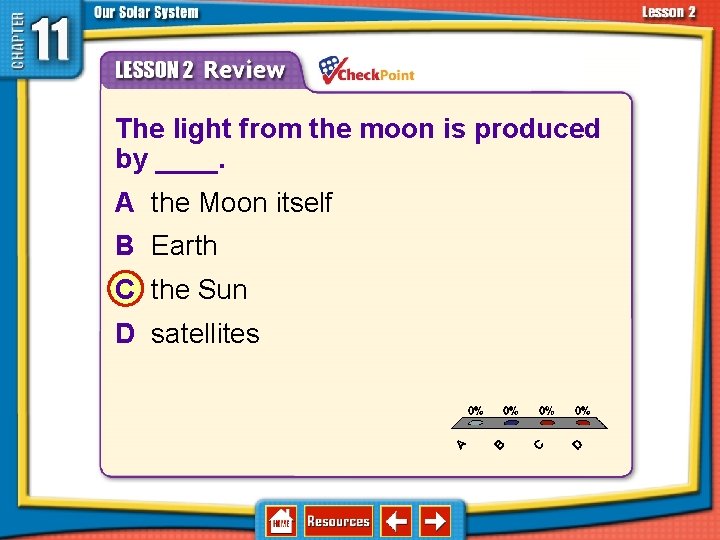
11. 2 The Sun-Earth-Moon System 1. 2. 3. 4. A B C D The light from the moon is produced by ____. A the Moon itself B Earth C the Sun D satellites
11. 3 The Planets and Their Moons inner planet outer planet
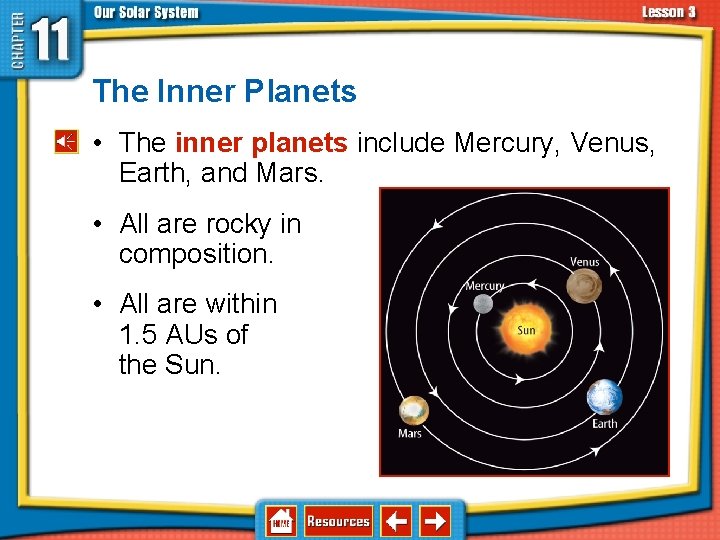
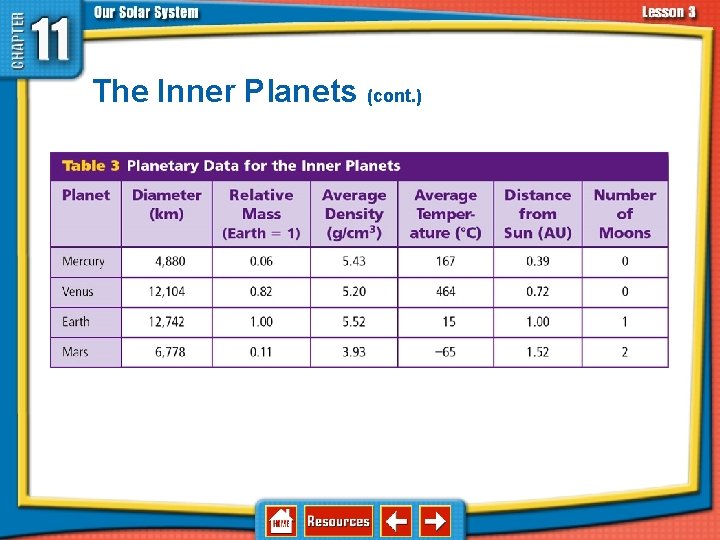
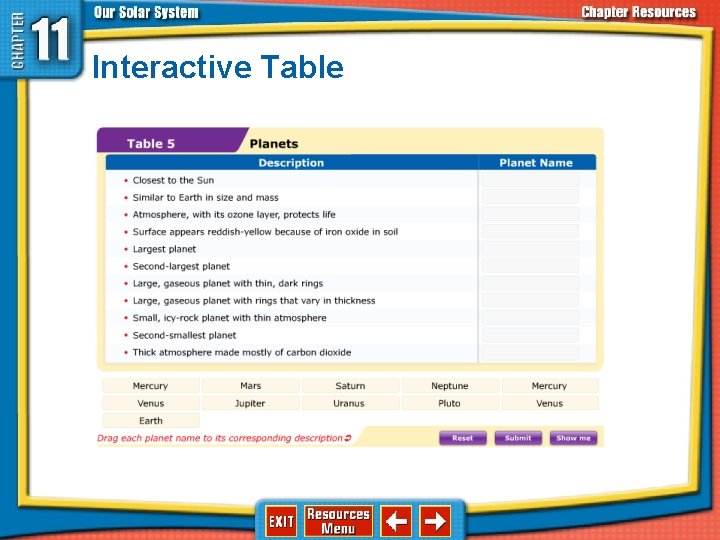
11. 3 The Planets and Their Moons The Inner Planets • The inner planets include Mercury, Venus, Earth, and Mars. • All are rocky in composition. • All are within 1. 5 AUs of the Sun.
11. 3 The Planets and Their Moons The Inner Planets (cont. )
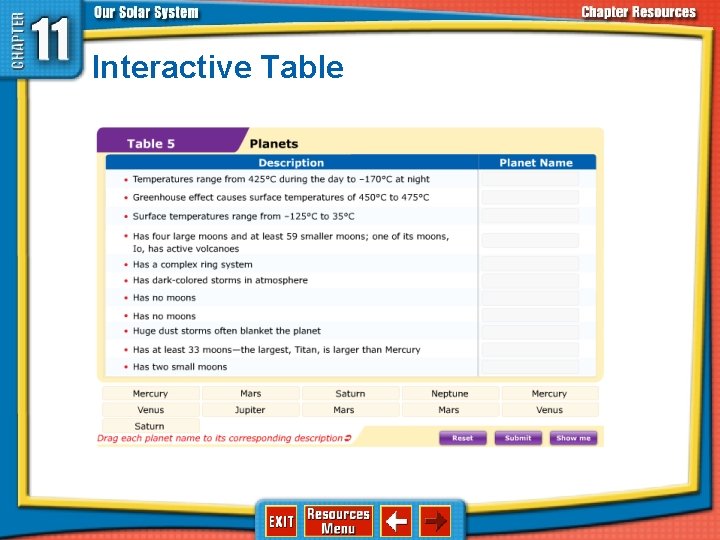
11. 3 The Planets and Their Moons Mercury • Mercury is the closest planet to the Sun. • Mercury has a highly elliptical orbit and travels faster than any other planet. • Surface temperatures often reach 467°C.
11. 3 The Planets and Their Moons Venus • Venus is the second planet from the Sun. • Venus is similar to Earth in size, mass, composition, and distance from the Sun. • Venus is covered by thick clouds of carbon dioxide. • Venus is often the brightest object in the sky except for the Moon.
11. 3 The Planets and Their Moons Earth • Earth is the third planet from the Sun. • Earth is the only body in our solar system known to have life on it. • Earth’s atmosphere affects the climate, shields the surface from harmful radiation, and burns up most meteoroids before they strike the surface.
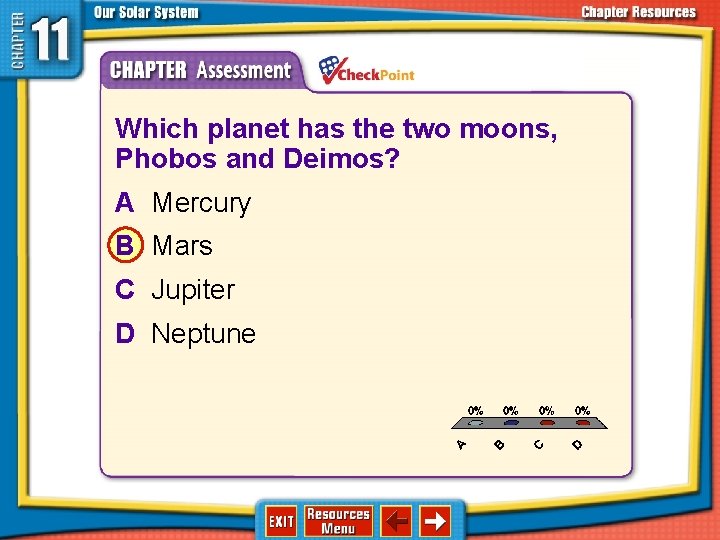
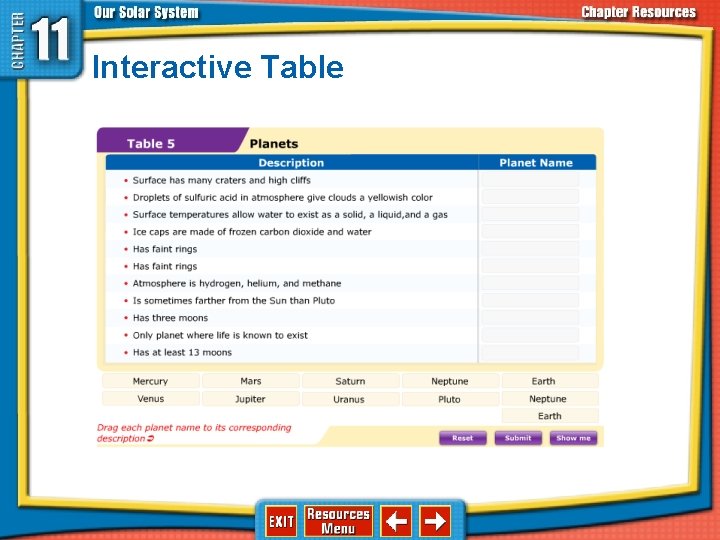
11. 3 The Planets and Their Moons Mars • Mars is the fourth planet from the Sun. • Mars has two small moons, Phobos and Deimos. • Mars may once have had flowing water.
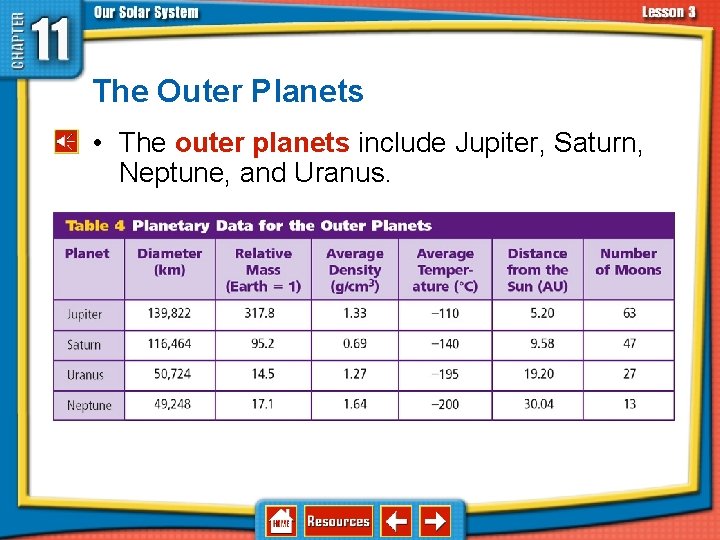
11. 3 The Planets and Their Moons The Outer Planets • The outer planets include Jupiter, Saturn, Neptune, and Uranus.
11. 3 The Planets and Their Moons Jupiter • Jupiter is the largest planet in our solar system. • Jupiter’s composition is of mostly hydrogen and helium and resembles a small star. • Jupiter is the first planet from the Sun to have rings.
11. 3 The Planets and Their Moons Jupiter (cont. ) • Jupiter has more than 60 moons; the four largest are Ganymede, Callisto, Io, and Europa.
11. 3 The Planets and Their Moons Saturn • Saturn is composed mostly of hydrogen and helium. • Saturn’s rings are composed mainly of ice and rock. • Saturn has over 30 known moons, the largest is Titan.
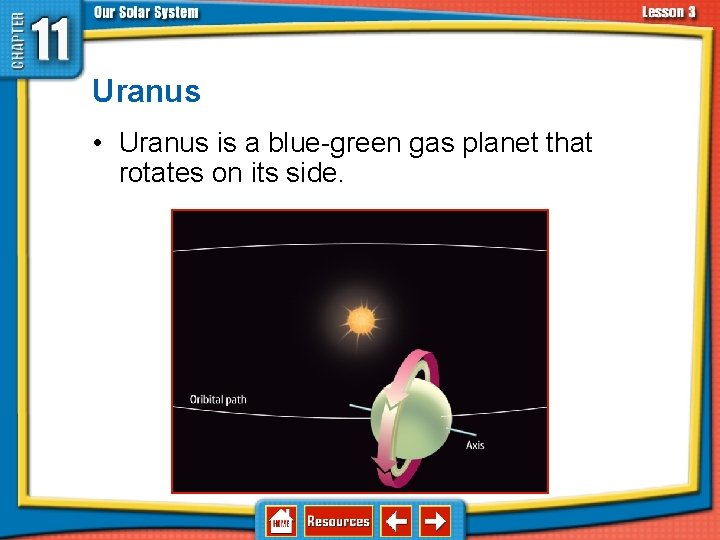
11. 3 The Planets and Their Moons Uranus • Uranus is a blue-green gas planet that rotates on its side.
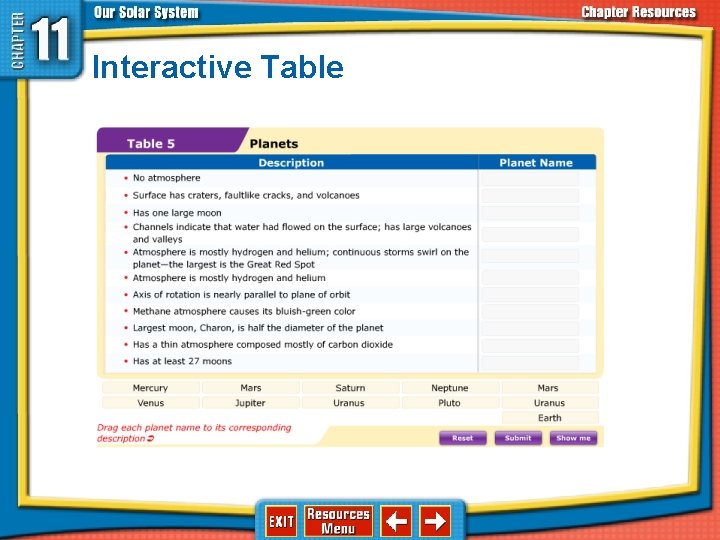
11. 3 The Planets and Their Moons Uranus (cont. ) • Uranus has 27 known moons and a series of small rings. • The atmosphere is mainly hydrogen and helium.
11. 3 The Planets and Their Moons Neptune • Neptune was the first planet located by theoretical predictions rather than through ordinary observations. • Neptune has 13 known moons and several rings. • Neptune’s atmosphere is mostly hydrogen, helium, and methane.
11. 3 The Planets and Their Moons Dwarf Planets • Ceres, Pluto, and Eris are dwarf planets. • A dwarf planets differs from a planet because a dwarf planet has not cleared the neighborhood around its orbit.
11. 3 The Planets and Their Moons Ceres • Ceres was discovered in 1801. • It has an average diameter of 940 km. • It is about 2. 7 AU from the Sun. • It orbits the Sun in about 4. 6 years.
11. 3 The Planets and Their Moons Pluto • From the time of Pluto’s discovery in 1930 until 2006, it was known as a planet. • Its average distance to the Sun is 39. 2 AU. • Its orbit lasts 248 years. • Its largest moon, Charon, has a diameter of about 1, 200 km. • Charon is about half as large as Pluto.
11. 3 The Planets and Their Moons Eris • Astronomers at the California Institute of Technology discovered Eris in 2005. • Its elliptical orbit varies from about 38 AU to 98 AU from the Sun. • Its orbit lasts 557 years. • It has one moon, Dysnomia. • It has a diameter of about 2, 400 km. • Eris is slightly larger than Pluto.
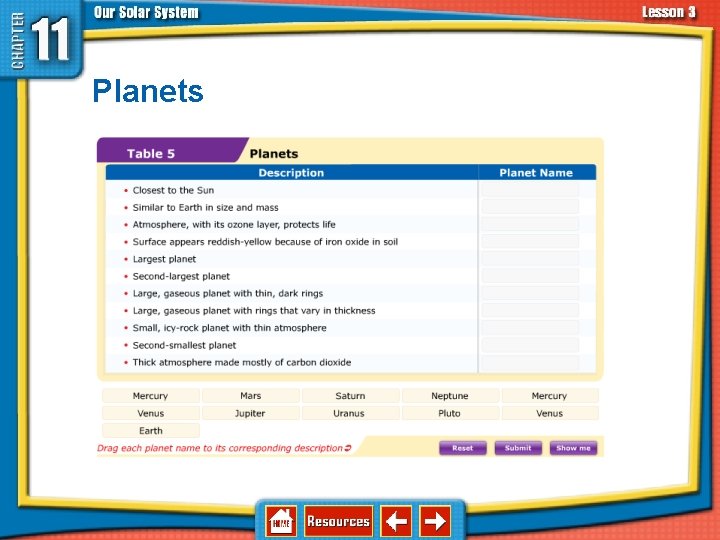
11. 3 The Planets and Their Moons Planets
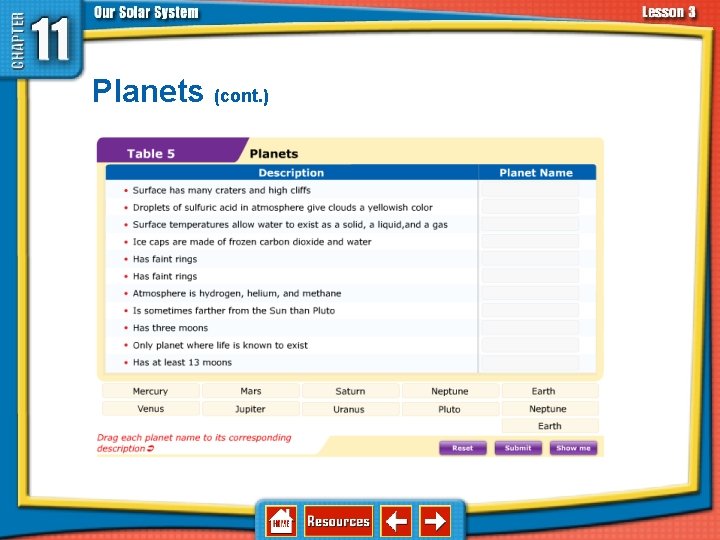
11. 3 The Planets and Their Moons Planets (cont. )
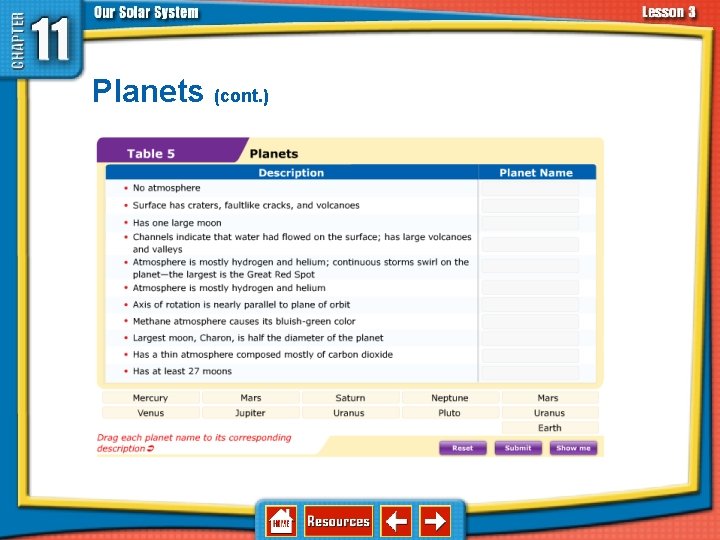
11. 3 The Planets and Their Moons Planets (cont. )
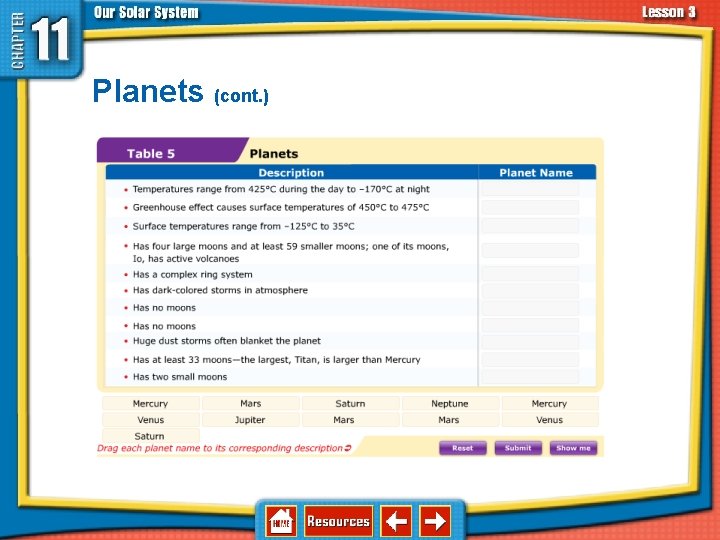
11. 3 The Planets and Their Moons Planets (cont. )
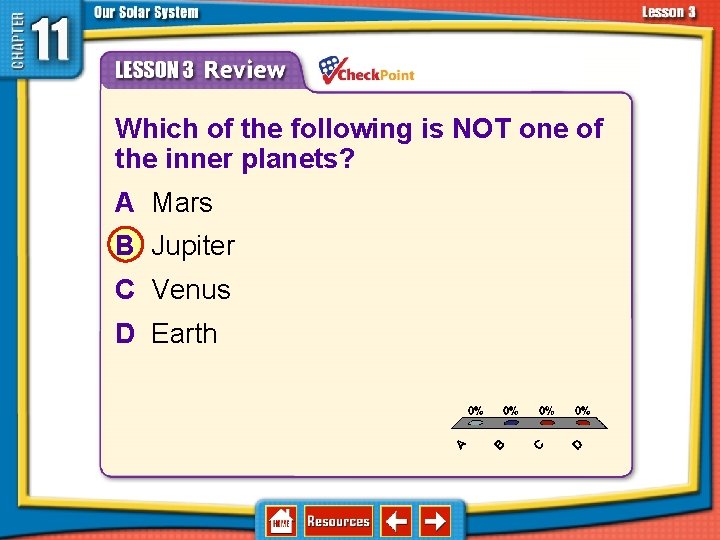
11. 3 The Planets and Their Moons 1. 2. 3. 4. A B C D Which of the following is NOT one of the inner planets? A Mars B Jupiter C Venus D Earth
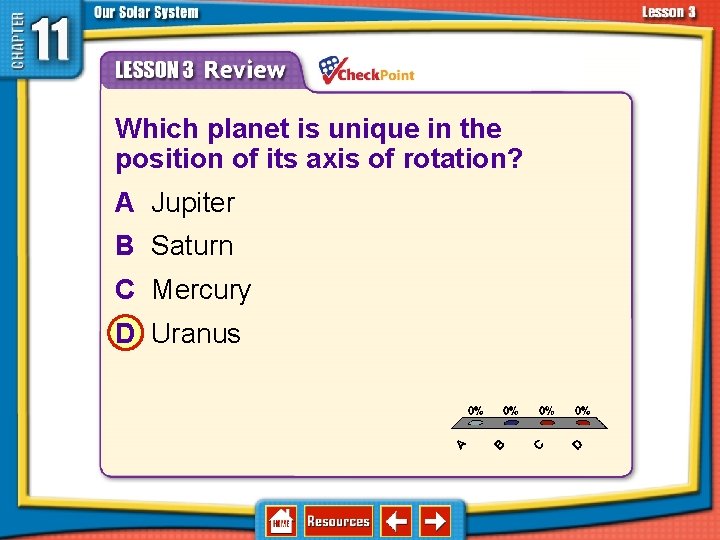
11. 3 The Planets and Their Moons 1. 2. 3. 4. A B C D Which planet is unique in the position of its axis of rotation? A Jupiter B Saturn C Mercury D Uranus
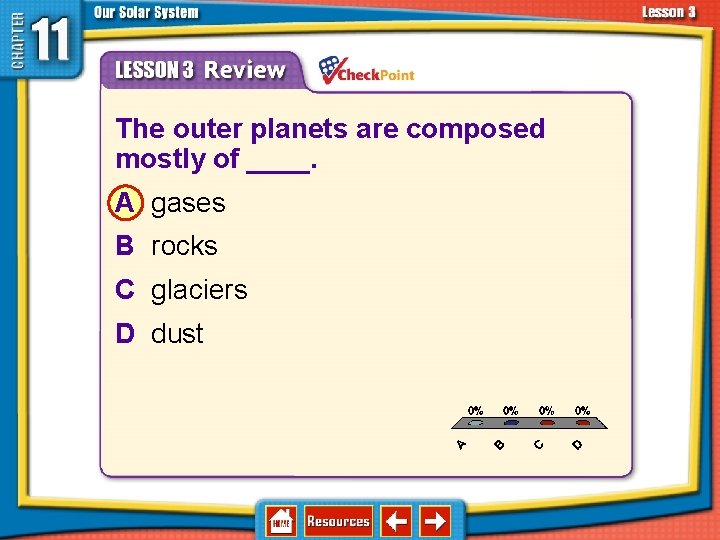
11. 3 The Planets and Their Moons 1. 2. 3. 4. A B C D The outer planets are composed mostly of ____. A gases B rocks C glaciers D dust
11. 4 Asteroids, Comets and Meteoroids asteroid comet meteoroid
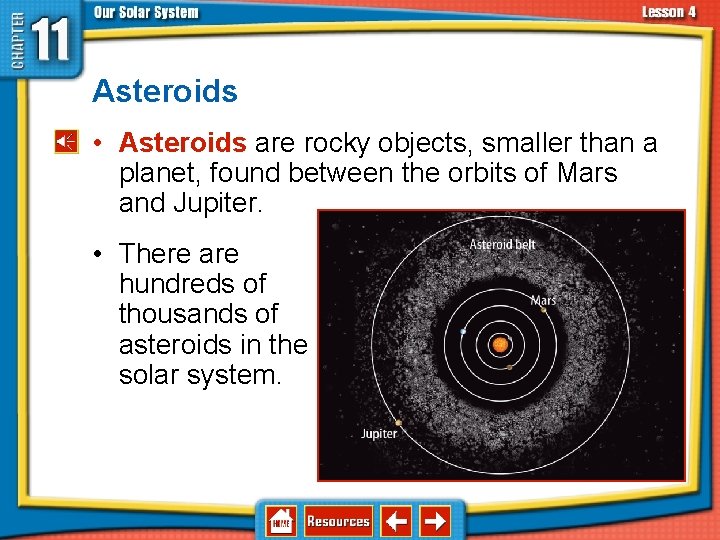
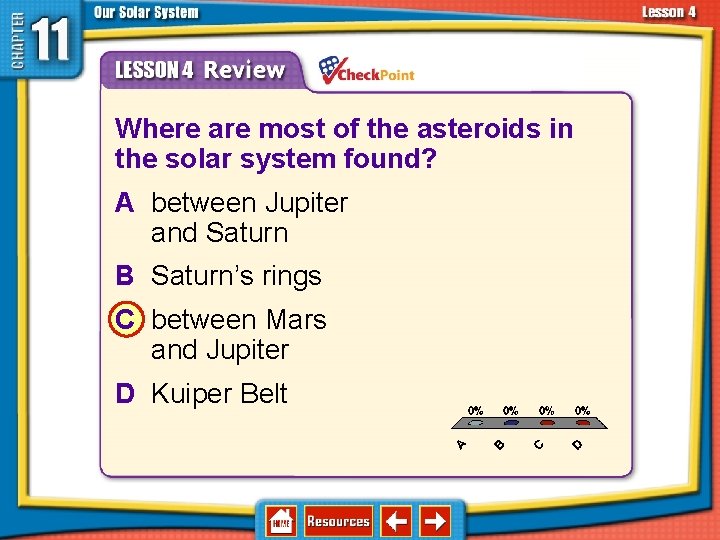
11. 4 Asteroids, Comets, and Meteoroids Asteroids • Asteroids are rocky objects, smaller than a planet, found between the orbits of Mars and Jupiter. • There are hundreds of thousands of asteroids in the solar system.
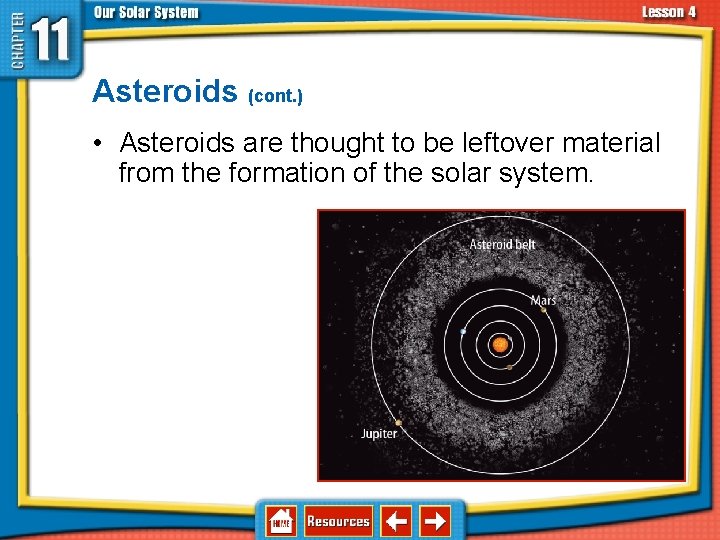
11. 4 Asteroids, Comets, and Meteoroids Asteroids (cont. ) • Asteroids are thought to be leftover material from the formation of the solar system.
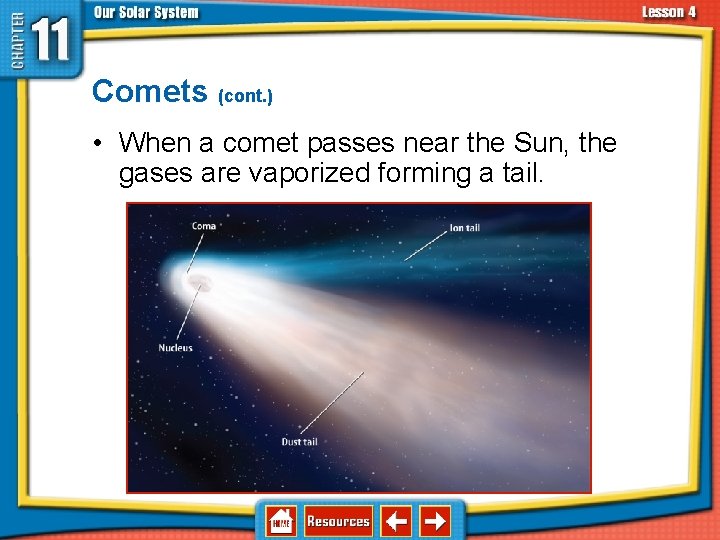
11. 4 Asteroids, Comets, and Meteoroids Comets • A comet is a small, icy body in orbit around the Sun. • Some comets have highly elliptical orbits bringing them close to the Sun. • The solid part of a comet is called the nucleus and is made of icy material. • The comet also contains dust, frozen gases, and bits of rock.
11. 4 Asteroids, Comets, and Meteoroids Comets (cont. ) • When a comet passes near the Sun, the gases are vaporized forming a tail.
11. 4 Asteroids, Comets, and Meteoroids The Kuiper Belt • Most short-period comets come from a region of Kuiper Belt objects. • The Kuiper Belt is an area of the solar system that extends about 50 AU from the Sun toward the orbit of Neptune.
11. 4 Asteroids, Comets, and Meteoroids Long-Period Comets and the Oort Cloud • Some long-period comets have orbital periods in the millions or tens of millions of years. • Some scientists have proposed that these comets originated from the Oort cloud. • The Oort cloud surrounds the solar system. • It might be as far as 100, 000 AU from the Sun.
11. 4 Asteroids, Comets, and Meteoroids • Meteoroids are solid, interplanetary particles passing through Earth’s atmosphere. • A meteor is the streak of light seen in the sky produced by a meteorite. • A meteorite is the remaining portion of the meteoroid that reaches Earth’s surface.
11. 4 Asteroids, Comets, and Meteoroids (cont. ) • Most scientists think that meteoroids came from planets that broke apart during the formation of our solar system.
11. 4 Asteroids, Comets, and Meteoroids Impact Craters on Earth • Most meteoroids burn up in the atmosphere. • Some large meteors produce impact craters, such as the Barringer Crater in Arizona.
11. 4 Asteroids, Comets, and Meteoroids 1. 2. 3. 4. A B C D A meteoroid that strikes the surface of the Earth is called a(n) ____. A asteroid B meteor C comet D meteorite
11. 4 Asteroids, Comets, and Meteoroids 1. 2. 3. 4. A B C D What protects Earth from most meteoroids? A oceans B the atmosphere C the Moon D Mars
11. 4 Asteroids, Comets, and Meteoroids 1. 2. 3. 4. A B C D Where are most of the asteroids in the solar system found? A between Jupiter and Saturn B Saturn’s rings C between Mars and Jupiter D Kuiper Belt
Chapter Resources Menu Chapter Assessment California Standards Practice Concepts in Motion Image Bank Science Online Interactive Table Virtual Lab Brain. POP Click on a hyperlink to view the corresponding feature.
1. 2. 3. 4. A B C D Which planet has the two moons, Phobos and Deimos? A Mercury B Mars C Jupiter D Neptune
1. A A lunar eclipse occurs when Earth is 2. B in the Moon’s shadow. A True B False
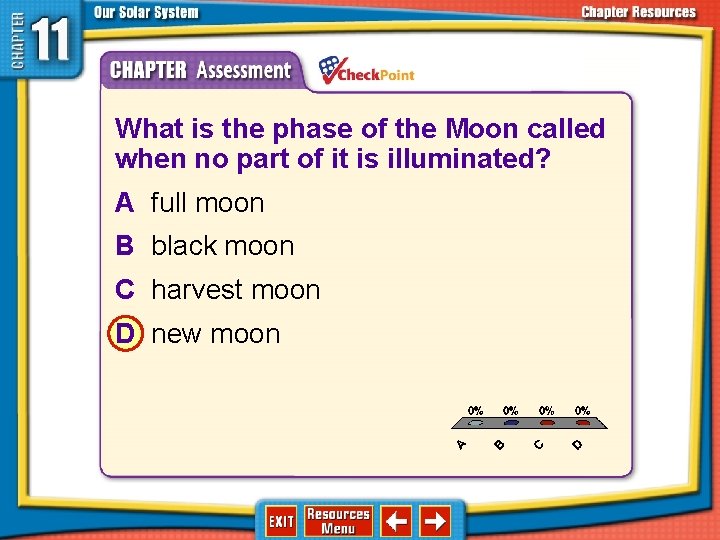
1. 2. 3. 4. A B C D What is the phase of the Moon called when no part of it is illuminated? A full moon B black moon C harvest moon D new moon
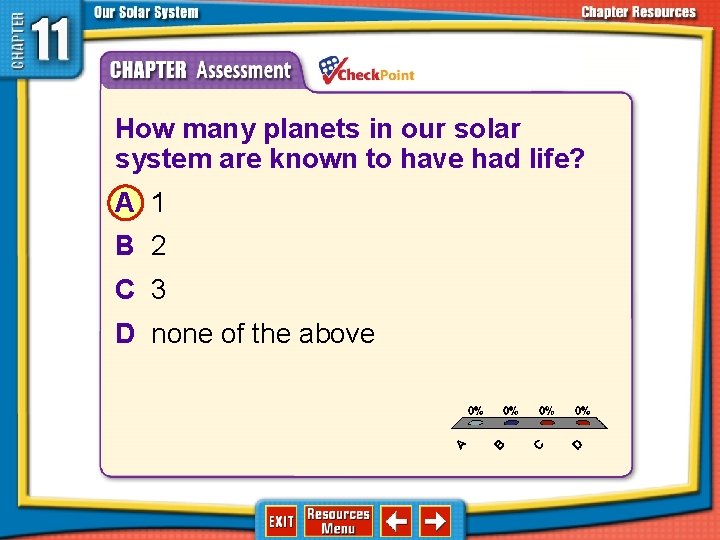
1. 2. 3. 4. A B C D How many planets in our solar system are known to have had life? A 1 B 2 C 3 D none of the above
1. 2. 3. 4. A B C D Which of the following summarizes Kepler’s third law of planetary motion? A Planets spin faster as they get closer to the Sun. B The farther a planet is from the Sun, the longer it takes to complete one orbit. C Planets travel faster when they are closer to the Sun. D Planets travel in an elliptical orbit around the Sun.
SCI 4. e 1. 2. 3. 4. A B C D Who discovered the 4 largest moons of Jupiter? A Kepler B Newton C Copernicus D Galileo
SCI 4. e 1. 2. 3. 4. A B C D What is the closest outer planet to the Sun? A Mercury B Jupiter C Mars D Saturn
SCI 4. e 1. 2. 3. 4. A B C D Which of the following consists of a frozen ball of rock? A a comet B an asteroid C a meteor D Mars
SCI 4. e 1. 2. 3. 4. A B C D What is the third planet from the Sun? A Venus B Mars C Earth D Titan
SCI 2. g 1. 2. 3. 4. A B C D What force keeps the Earth orbiting the Sun? A the magnetic field of Earth B the Moon’s gravity C the Sun’s gravity D the rotation of Earth on its axis
Image Bank
Image Bank
Interactive Table
Interactive Table
Interactive Table
Interactive Table