
Chapter Menu Lesson 1 Reproductive Systems Lesson 2



- Slides: 56
Chapter Menu Lesson 1: Reproductive Systems Lesson 2: Development Before Birth Click on a hyperlink to view the corresponding lesson.
13. 1 Reproductive Systems scrotum uterus seminiferous tubule fallopian tube epididymis follicle penis ovulation urethra menstrual cycle vagina
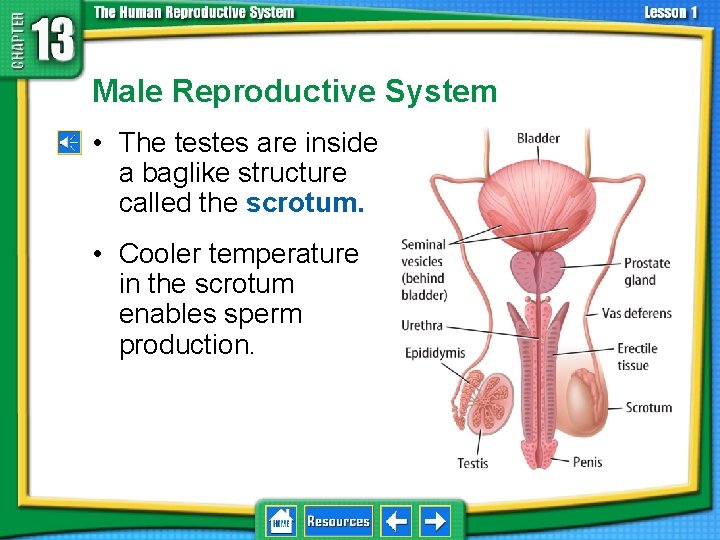
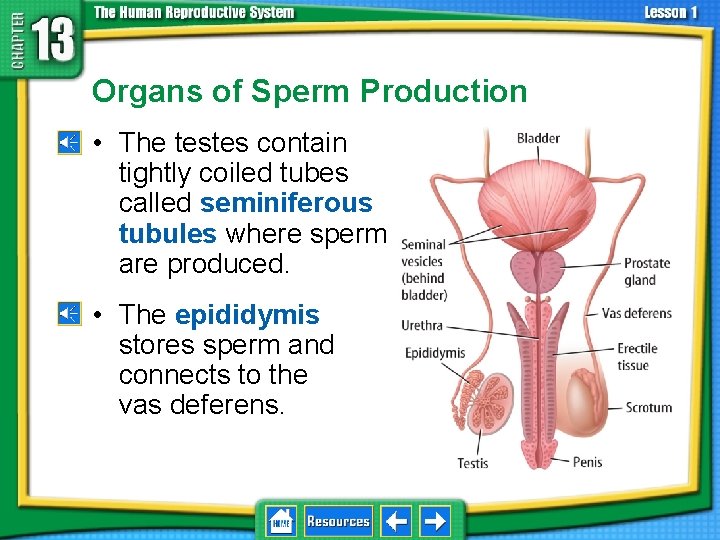
13. 1 Reproductive Systems Male Reproductive System • The testes are inside a baglike structure called the scrotum. • Cooler temperature in the scrotum enables sperm production.
13. 1 Reproductive Systems Organs of Sperm Production • The testes contain tightly coiled tubes called seminiferous tubules where sperm are produced. • The epididymis stores sperm and connects to the vas deferens.
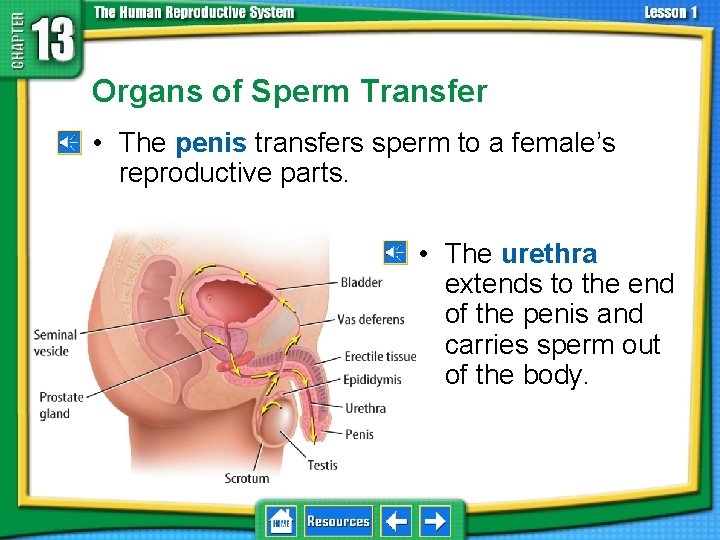
13. 1 Reproductive Systems Organs of Sperm Transfer • The penis transfers sperm to a female’s reproductive parts. • The urethra extends to the end of the penis and carries sperm out of the body.
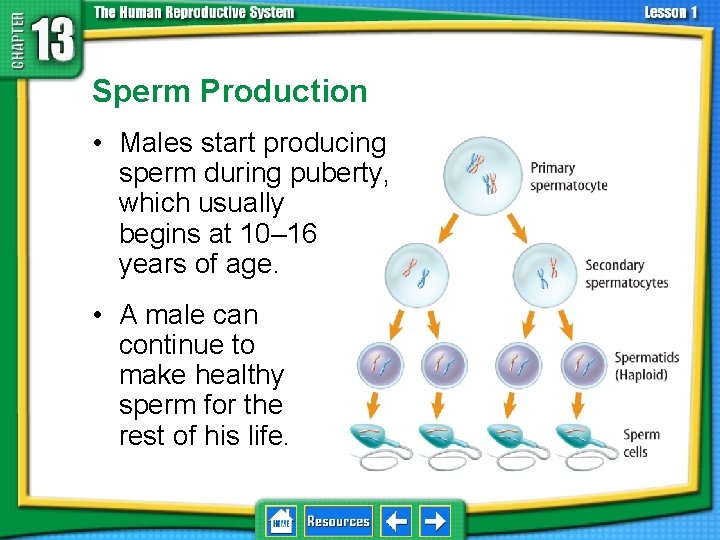
13. 1 Reproductive Systems Sperm Production • Males start producing sperm during puberty, which usually begins at 10– 16 years of age. • A male can continue to make healthy sperm for the rest of his life.
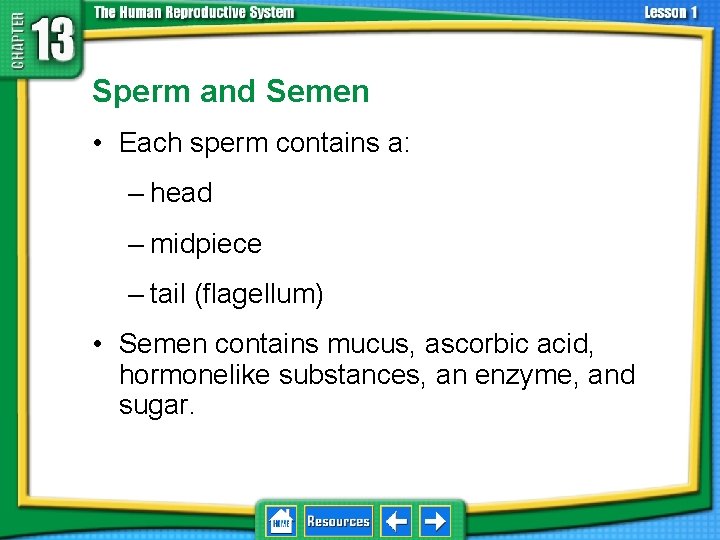
13. 1 Reproductive Systems Sperm and Semen • Each sperm contains a: – head – midpiece – tail (flagellum) • Semen contains mucus, ascorbic acid, hormonelike substances, an enzyme, and sugar.
13. 1 Reproductive Systems Female Reproductive System • A female’s reproductive system produces eggs before she is born. • This system is also where a fertilized egg can grow and develop into a baby.
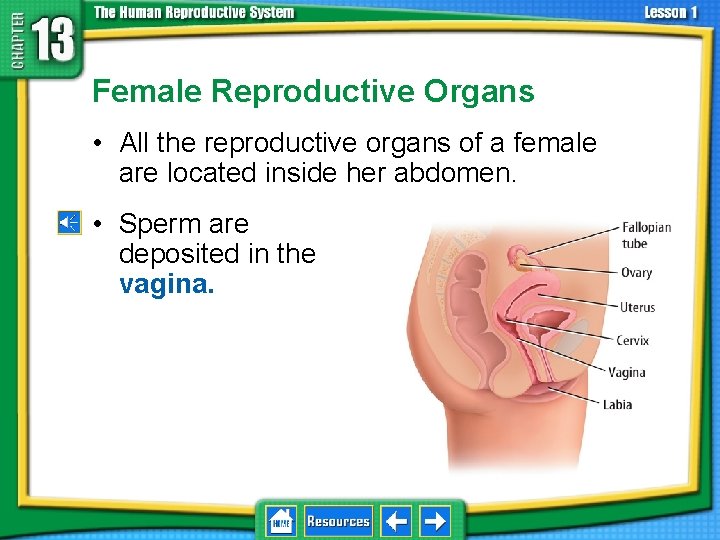
13. 1 Reproductive Systems Female Reproductive Organs • All the reproductive organs of a female are located inside her abdomen. • Sperm are deposited in the vagina.
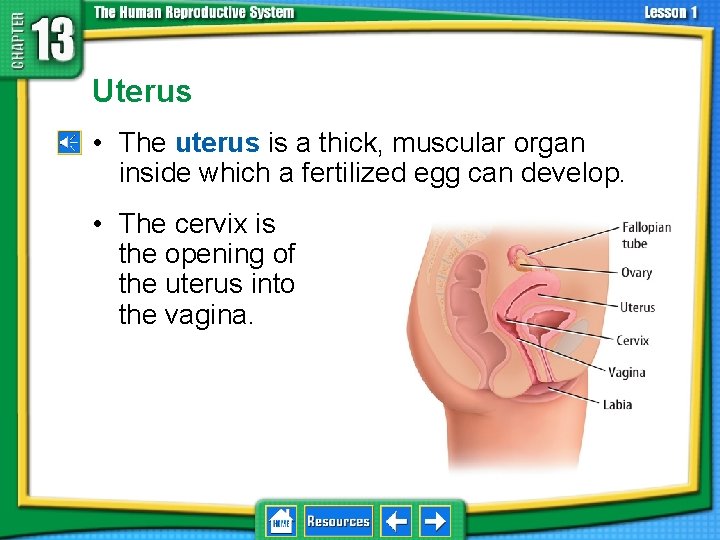
13. 1 Reproductive Systems Uterus • The uterus is a thick, muscular organ inside which a fertilized egg can develop. • The cervix is the opening of the uterus into the vagina.
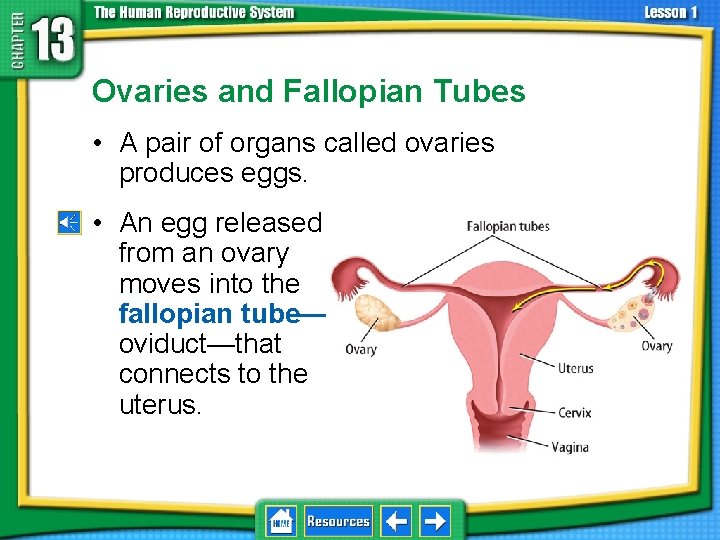
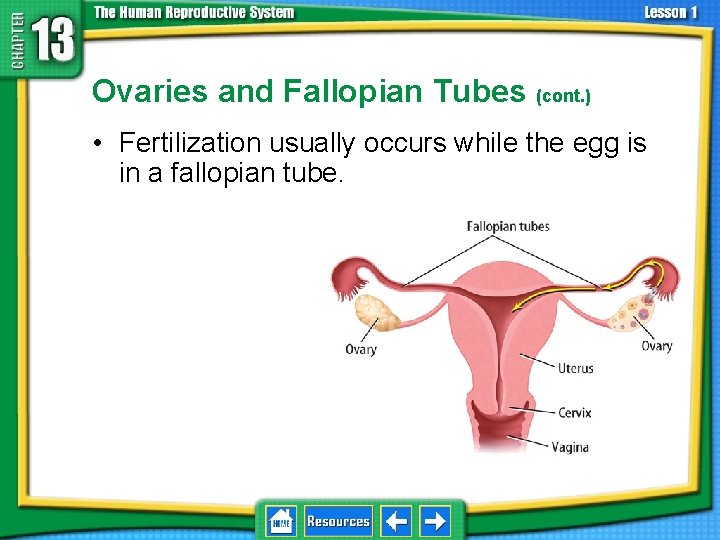
13. 1 Reproductive Systems Ovaries and Fallopian Tubes • A pair of organs called ovaries produces eggs. • An egg released from an ovary moves into the fallopian tube— oviduct—that connects to the uterus.
13. 1 Reproductive Systems Ovaries and Fallopian Tubes (cont. ) • Fertilization usually occurs while the egg is in a fallopian tube.
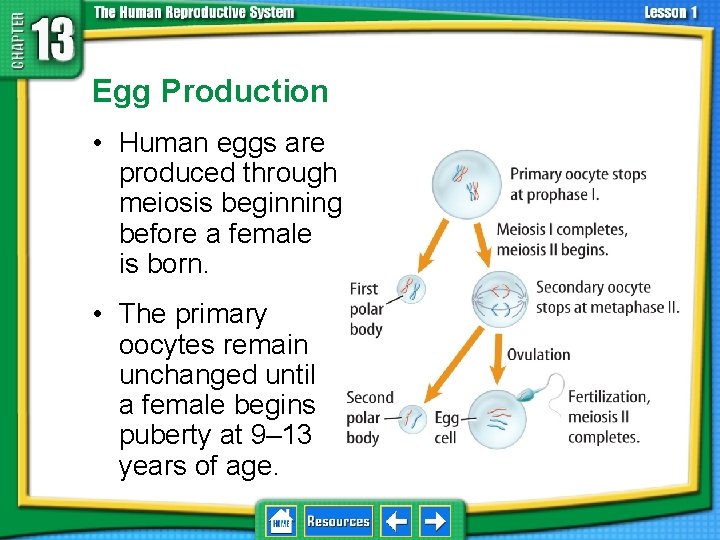
13. 1 Reproductive Systems Egg Production • Human eggs are produced through meiosis beginning before a female is born. • The primary oocytes remain unchanged until a female begins puberty at 9– 13 years of age.
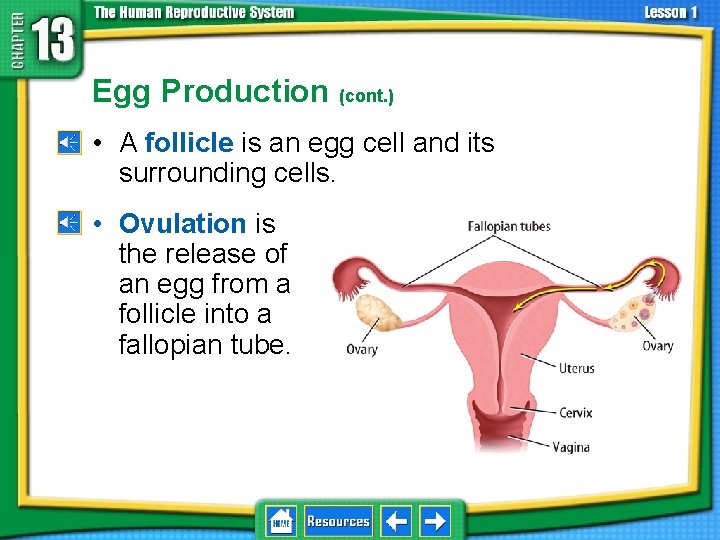
13. 1 Reproductive Systems Egg Production (cont. ) • A follicle is an egg cell and its surrounding cells. • Ovulation is the release of an egg from a follicle into a fallopian tube.
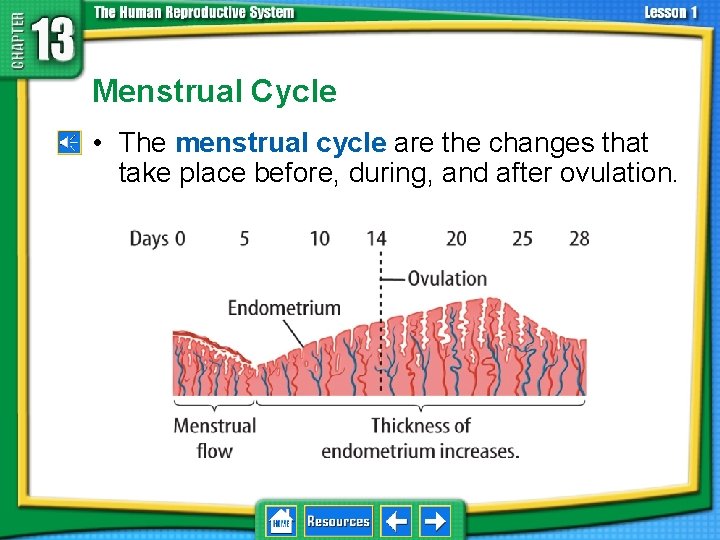
13. 1 Reproductive Systems Menstrual Cycle • The menstrual cycle are the changes that take place before, during, and after ovulation.
13. 1 Reproductive Systems Menstrual Flow • If a released egg is not fertilized, the endometrium breaks down. • The tissue, some blood, and the unfertilized egg leave the vagina as menstrual flow.
13. 1 Reproductive Systems Ovulation • Ovulation occurs about two weeks after the first day of menstrual flow. • If the egg is fertilized, a zygote forms, cell divisions begin, and an embryo begins to develop.
13. 1 Reproductive Systems Hormones • Chemical messengers called hormones regulate the timing of the menstrual cycle and ovulation.
13. 1 Reproductive Systems Menopause • Most women enter menopause between the ages of 46 and 54. • They stop ovulating and no longer have menstrual cycles.
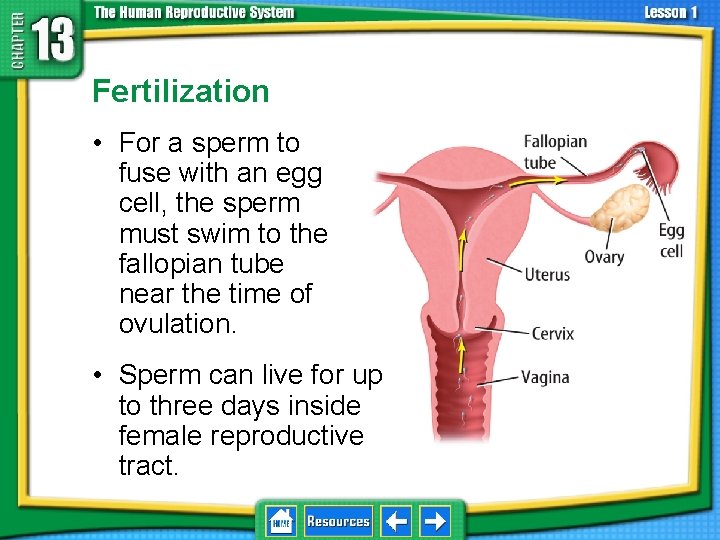
13. 1 Reproductive Systems Fertilization • For a sperm to fuse with an egg cell, the sperm must swim to the fallopian tube near the time of ovulation. • Sperm can live for up to three days inside female reproductive tract.
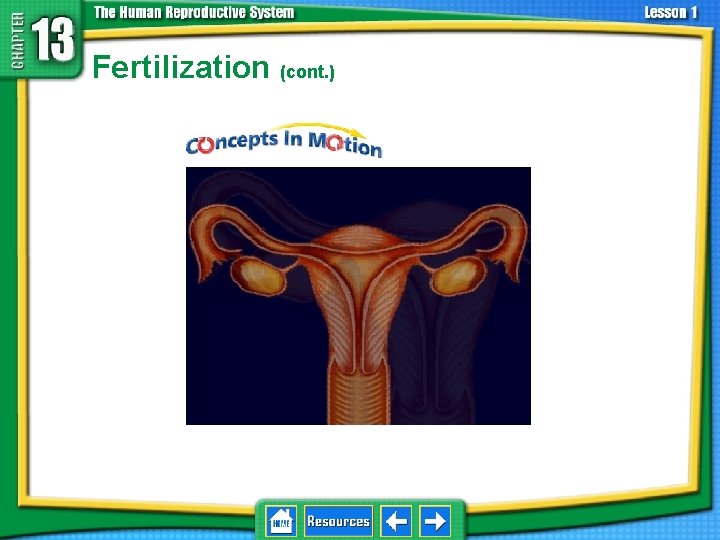
Fertilization (cont. ) 13. 1 Reproductive Systems
13. 1 Reproductive Systems 1. 2. 3. 4. A B C D Where are sperm stored? A testis B vas deferens C epididymis D urethra
13. 1 Reproductive Systems 1. 2. 3. 4. A B C D How long does a menstrual cycle last? A 7 days B 16 days C 28 days D 36 days
13. 1 Reproductive Systems 1. 2. 3. 4. A B C D Where does fertilization of eggs occur? A vagina B ovary C uterus D fallopian tube
13. 2 Development Before Birth pregnancy trimester fetus prenatal care placenta umbilical cord
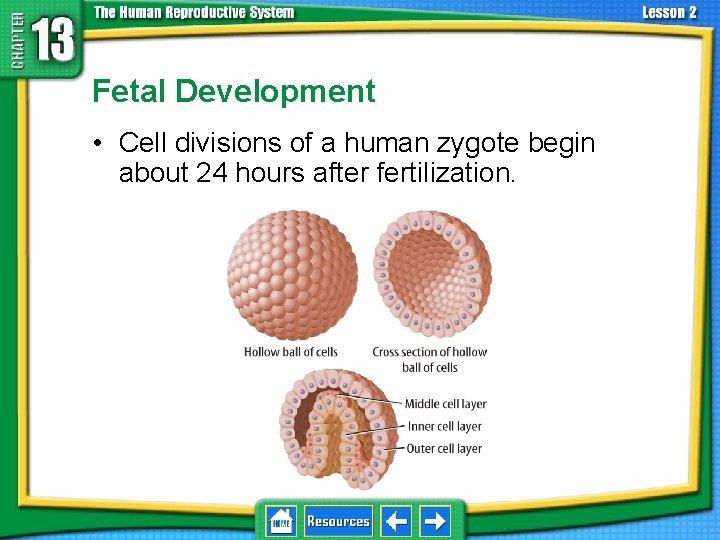
13. 2 Development Before Birth Fetal Development • Cell divisions of a human zygote begin about 24 hours after fertilization.
13. 2 Development Before Birth Growth and Development of Body Systems • Pregnancy is the development of a baby within a female’s uterus. – Usually lasts 38 weeks after fertilization, or about 40 weeks after the beginning of the last menstrual cycle – Nine months of pregnancy divided into trimesters Fertilization and Birth
13. 2 Development Before Birth Premature Babies • Some of their organs, including lungs, are not ready to function • Can have physical and behavioral problems as they grow older Stages of Pregnancy What are the stages of development before birth?
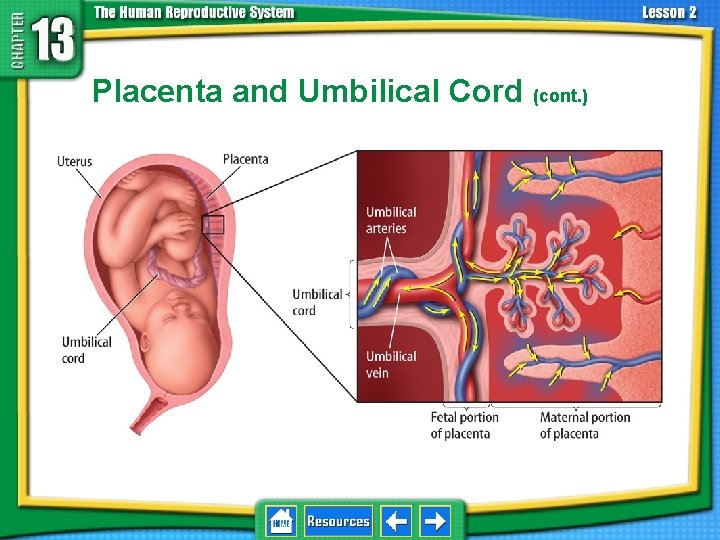
13. 2 Development Before Birth Placenta and Umbilical Cord • The exchange of materials between a pregnant woman and her fetus takes place through a placenta. • Substances enter and leave the body of a fetus through an umbilical cord.
13. 2 Development Before Birth Placenta and Umbilical Cord (cont. )
13. 2 Development Before Birth Prenatal Care • Everything that happens in a woman’s body has an effect on her developing fetus. • Prenatal care is the health care designed to protect the health of a pregnant woman and prevent problems in her developing fetus.
13. 2 Development Before Birth Nutrition • The energy and nutrients a fetus needs must come from its mother. – A pregnant woman is usually advised to add about 300 extra calories a day to her diet. – Without a certain amount of folic acid, spinal cord formation is abnormal. – A pregnant woman should avoid caffeine or consume very little.
13. 2 Development Before Birth Environmental Factors • Harmful substances can be consumed in food, and absorbed through the skin. • A pregnant woman is advised to avoid substances that could harm her or her fetus. • Lead is especially dangerous to a fetus, infant, or young child.
13. 2 Development Before Birth Viruses • Viruses can pass from a pregnant woman to her fetus through the placenta or during childbirth. • Some viruses do not cause harm to adults, but can be very harmful to a fetus or a newborn. • Some examples are: – Chicken pox – Genital herpes
13. 2 Development Before Birth Drugs and Alcohol • A medicine that is safe for an adult might not be safe for a developing fetus. • Nicotine has serious negative effects on a fetus. • The use of alcohol excessively risks having a baby with fetal alcohol syndrome (FAS). • Illegal drugs increase the chances for miscarriage, premature birth, low birth weight, and behavioral problems.
13. 2 Development Before Birth 1. 2. 3. 4. A B C D When does an embryo develop the structures that will become the major organ systems? A fertilization B first trimester C second trimester D third trimester
13. 2 Development Before Birth 1. 2. 3. 4. A B C D How do substances enter and leave a fetus? A through the uterus B through the endometrium C through an umbilical cord D through the mouth
13. 2 Development Before Birth 1. 2. 3. 4. A B C D Which of the following would not describe good prenatal care? A eating healthy foods B taking vitamin supplements C avoiding pesticides D taking over-the-counter medications without doctor approval
Chapter Resources Menu Chapter Assessment California Standards Practice Concepts in Motion Image Bank Science Online Interactive Table Virtual Lab Brain. POP Click on a hyperlink to view the corresponding feature.
1. 2. 3. 4. A B C D Where are sperm produced? A vas deferens B epididymis C seminiferous tubules D urethra
1. 2. 3. 4. A B C D When do females begin producing eggs? A before birth B puberty C at the beginning of their menstrual cycle D ovulation
1. 2. 3. 4. A B C D What is the term for cells undergoing meiosis that stop during metaphase II? A egg B primary oocyte C secondary oocyte D follicle
1. 2. 3. 4. A B C D How long can sperm live inside a female’s reproductive system? A 12 hours B 24 hours C 48 hours D 72 hours
1. 2. 3. 4. A B C D On average, how many more calories per day does a pregnant woman need? A 0 B 300 C 1, 000 D 2, 000
SCI 5. d 1. 2. 3. 4. A B C D When do males start producing sperm? A before birth B birth C puberty D around age 5
SCI 5. d 1. 2. 3. 4. A B C D Where does a fertilized egg develop? A ovary B uterus C stomach D fallopian tube
SCI 5. d 1. 2. 3. 4. A B C D Which organs produce eggs? A ovaries B testis C fallopian tubes D uterus
SCI 5. d 1. 2. 3. 4. A B C D What structure moves sperm through a female’s reproductive system? A muscle B cilia C fallopian tube D flagellum
SCI 5. d 1. 2. 3. 4. A B C D Which is not exchanged between mother and fetus in the placenta? A nutrients B blood C fetal wastes D medicines
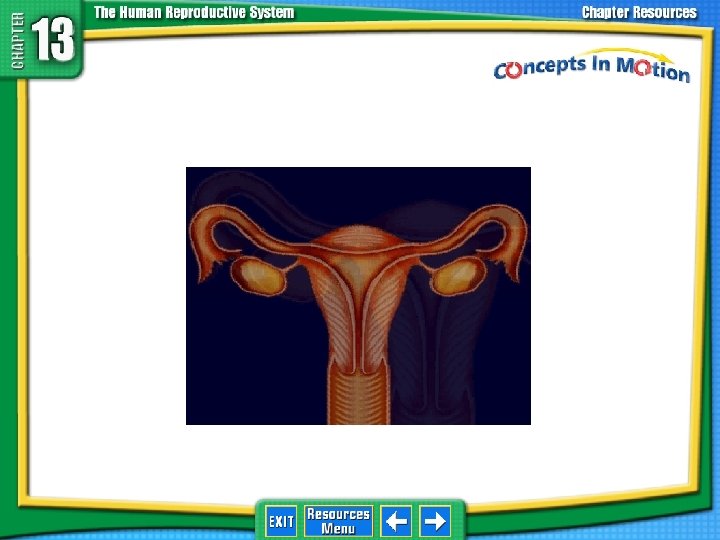
Concepts in Motion 1
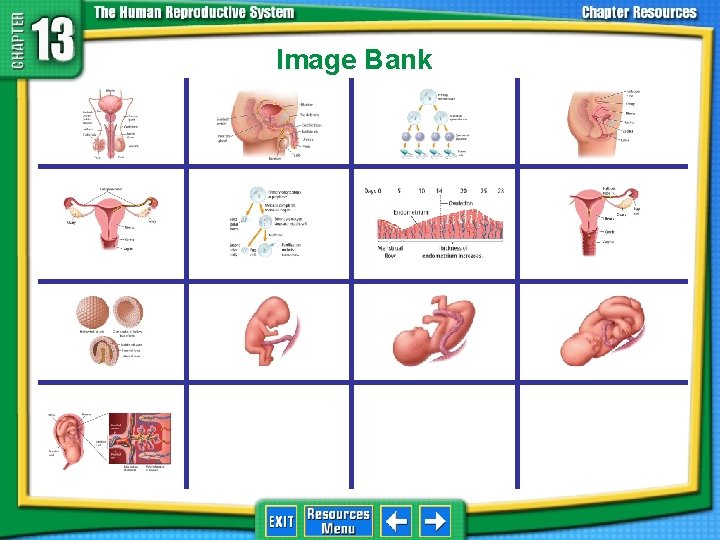
Image Bank
Interactive Table Stages of Pregnancy