
Chapter Menu Lesson 1 Foundations of Genetics Lesson


- Slides: 67
Chapter Menu Lesson 1: Foundations of Genetics Lesson 2: Understanding Inheritance Click on a hyperlink to view the corresponding lesson.
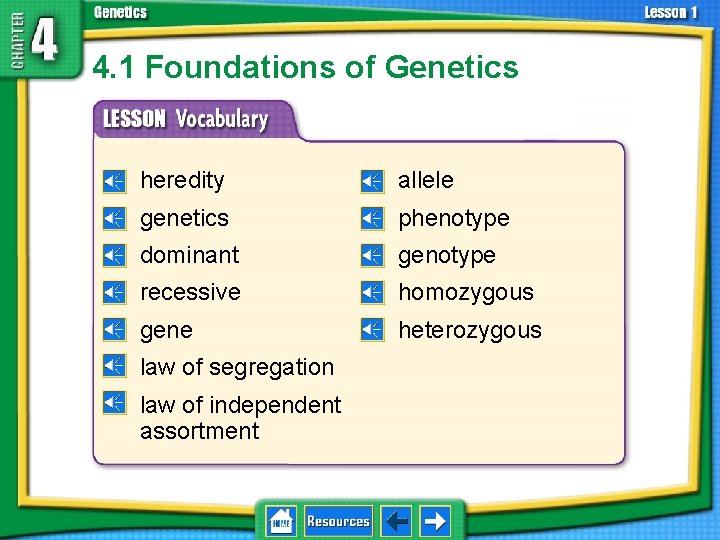
4. 1 Foundations of Genetics heredity allele genetics phenotype dominant genotype recessive homozygous gene heterozygous law of segregation law of independent assortment
4. 1 Foundations of Genetics Early Ideas About Heredity • Combined genetic material from a sperm and an egg determines the traits or features of an offspring. • Heredity is the passing of traits from parents to offspring.
4. 1 Foundations of Genetics Early Ideas About Heredity (cont. ) • The idea of blending inheritance is offspring are a blend of genetic material from both parents. – The genetic material mixed or blended like colors of paint. – Over many generations, populations would eventually look alike. – Blending inheritance cannot explain why some traits skip a generation.
4. 1 Foundations of Genetics Gregor Mendel and His Experiments • Gregor Mendel was the first to record evidence that traits are determined by factors passed from parents to offspring. • Mendel established the basic laws of heredity. • Genetics is the study of how traits of organisms are passed from parents to offspring.
4. 1 Foundations of Genetics Mendel’s Experimental Methods • Mendel conducted breeding experiments by studying seven traits of pea plants and each traits had only two variations. Pea Traits Studied by Mendel
4. 1 Foundations of Genetics Controlled Experiments • Mendel controlled fertilization in the pea plants, allowing him to see how traits pass from one generation to another. • Mendel allowed some flowers to self-fertilize. • He also performed cross-fertilization by transferring pollen from one pea flower to another.
4. 1 Foundations of Genetics Mendel’s Unique Methods • Used true-breeding plants for each trait— plants that always produce offspring with that trait when they self-pollinate • Recorded the inheritance of traits for several generations • Used a mathematical approach
4. 1 Foundations of Genetics Mendel’s Experimental Results • Mendel concluded that two factors control each inherited trait. • When organisms reproduce, each gamete— sperm or egg—contributes one factor for each trait.
4. 1 Foundations of Genetics Dominant Factors • A genetic factor that blocks another genetic factor is called dominant. • A dominant trait is observed when offspring have one or two dominant factors.
4. 1 Foundations of Genetics Recessive Factors • A genetic factor that is hidden by the presence of a dominant factor is recessive. • A recessive trait can be observed only when two recessive genetic factors are present in offspring.
4. 1 Foundations of Genetics Mendel’s Laws of Heredity • Law of segregation: the two factors for each trait segregate—separate from each other— during meiosis when gametes form • Law of independent assortment: the factors for one trait separate independently of how factors for other traits separate
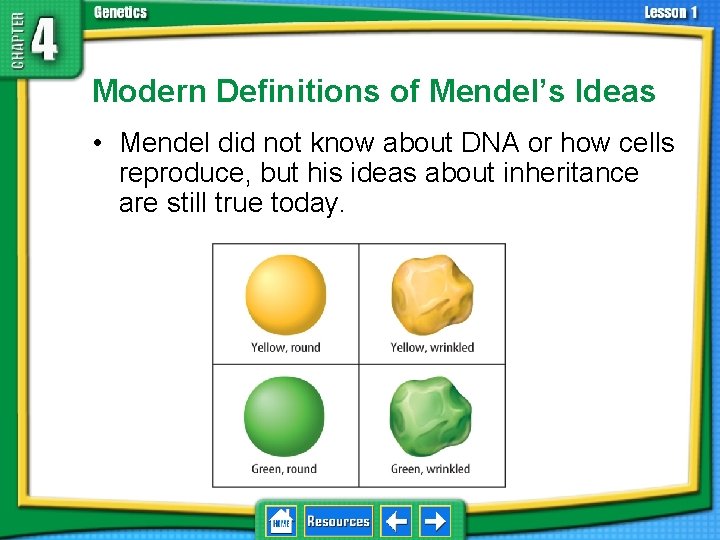
4. 1 Foundations of Genetics Modern Definitions of Mendel’s Ideas • Mendel did not know about DNA or how cells reproduce, but his ideas about inheritance are still true today.
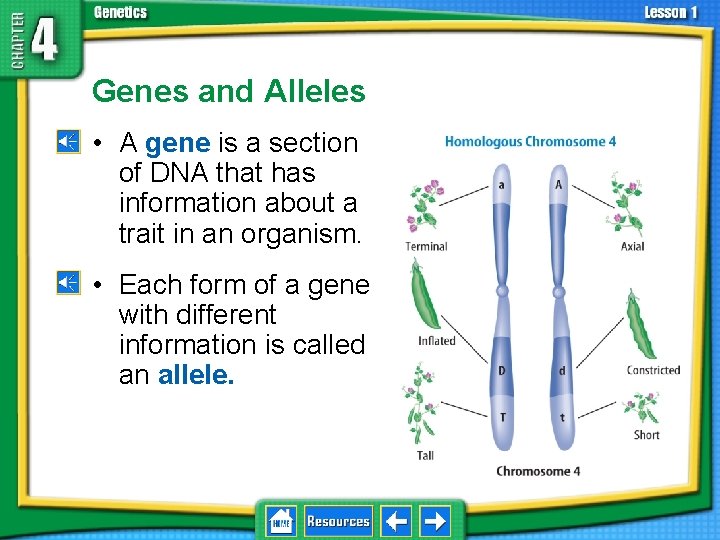
4. 1 Foundations of Genetics Genes and Alleles • A gene is a section of DNA that has information about a trait in an organism. • Each form of a gene with different information is called an allele.
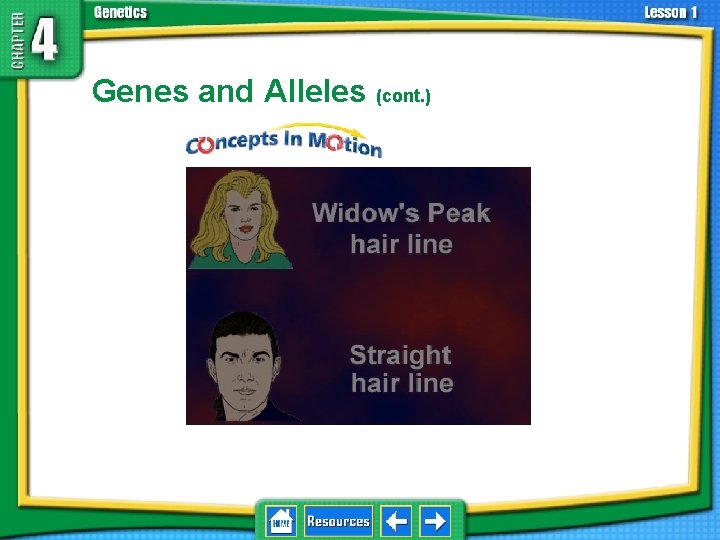
4. 1 Foundations of Genetics Genes and Alleles (cont. )
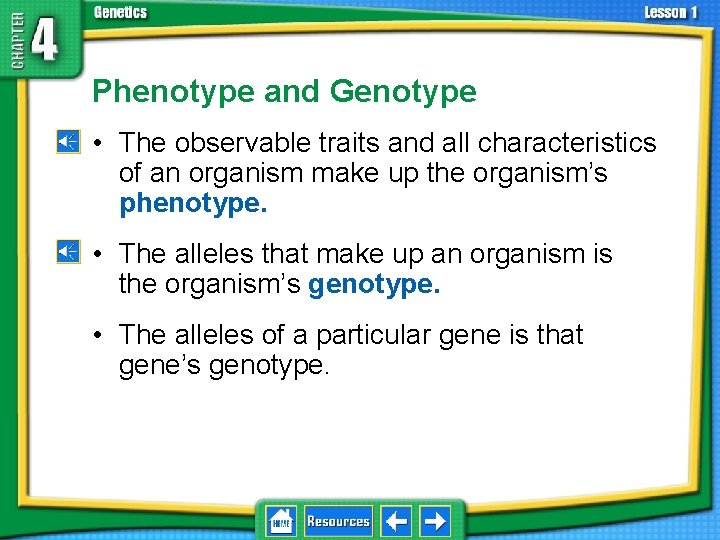
4. 1 Foundations of Genetics Phenotype and Genotype • The observable traits and all characteristics of an organism make up the organism’s phenotype. • The alleles that make up an organism is the organism’s genotype. • The alleles of a particular gene is that gene’s genotype.
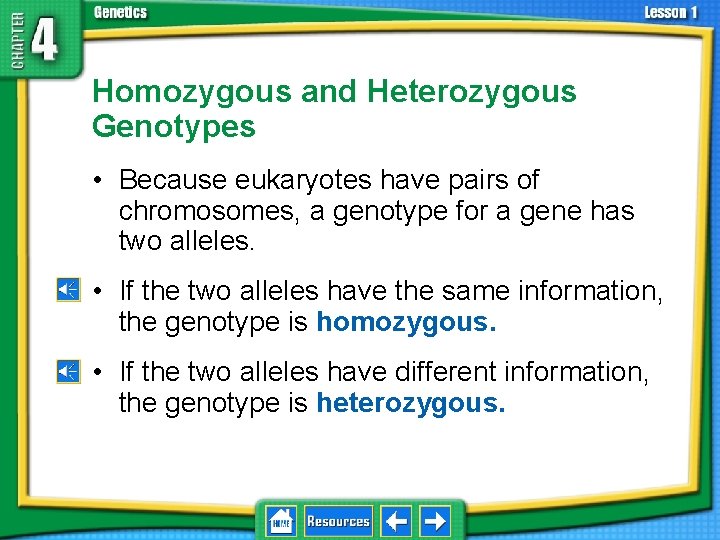
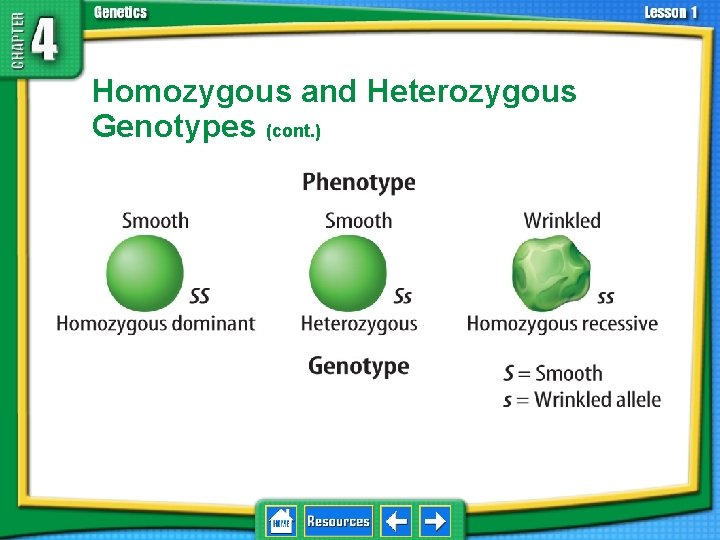
4. 1 Foundations of Genetics Homozygous and Heterozygous Genotypes • Because eukaryotes have pairs of chromosomes, a genotype for a gene has two alleles. • If the two alleles have the same information, the genotype is homozygous. • If the two alleles have different information, the genotype is heterozygous.
4. 1 Foundations of Genetics Homozygous and Heterozygous Genotypes (cont. )
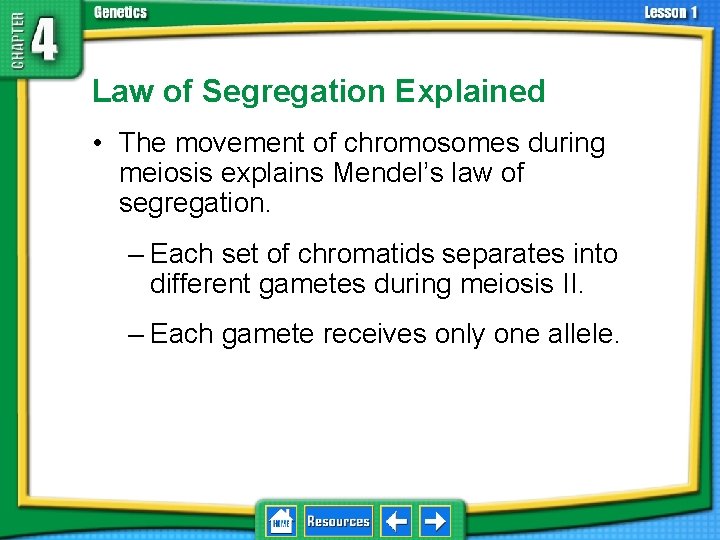
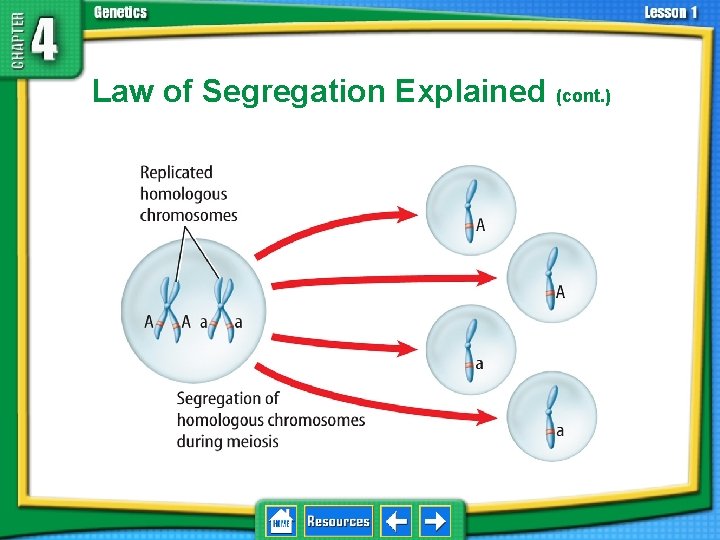
4. 1 Foundations of Genetics Law of Segregation Explained • The movement of chromosomes during meiosis explains Mendel’s law of segregation. – Each set of chromatids separates into different gametes during meiosis II. – Each gamete receives only one allele.
4. 1 Foundations of Genetics Law of Segregation Explained (cont. )
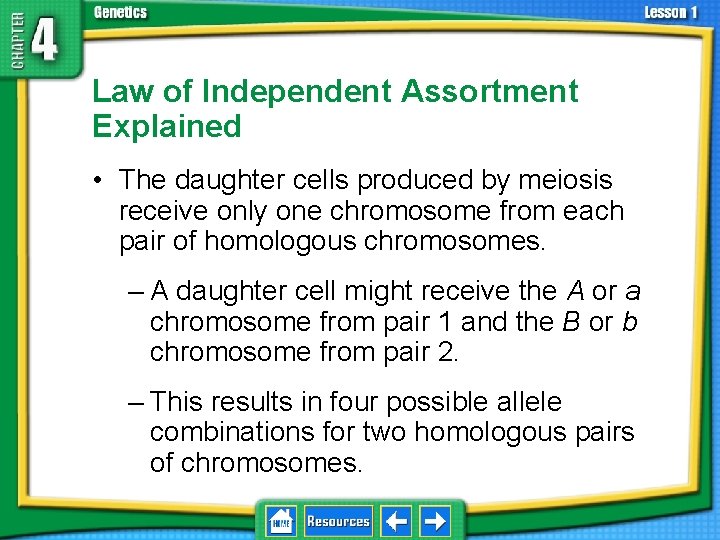
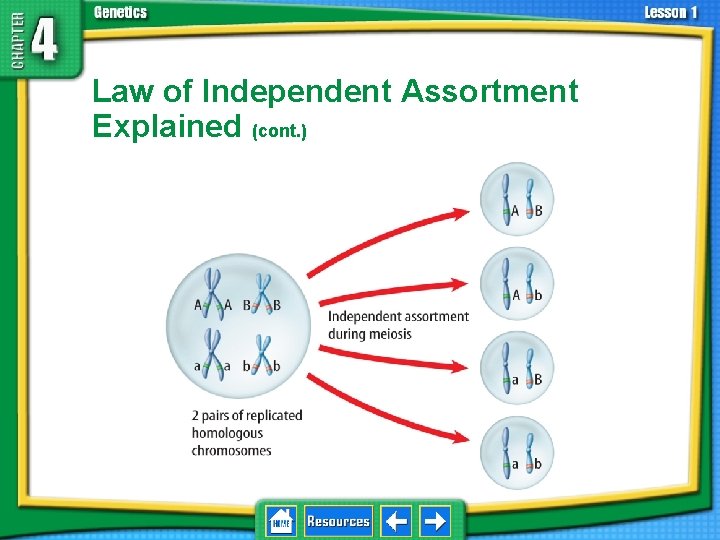
4. 1 Foundations of Genetics Law of Independent Assortment Explained • The daughter cells produced by meiosis receive only one chromosome from each pair of homologous chromosomes. – A daughter cell might receive the A or a chromosome from pair 1 and the B or b chromosome from pair 2. – This results in four possible allele combinations for two homologous pairs of chromosomes.
4. 1 Foundations of Genetics Law of Independent Assortment Explained (cont. )
4. 1 Foundations of Genetics Importance of Mendel’s Genetic Studies • In the 1860 s, no one knew about chromosomes or meiosis so it was hard to understand Mendel’s discoveries. • All the research of modern genetics is based on Mendel’s conclusions from his work with pea plants.
4. 1 Foundations of Genetics 1. 2. 3. 4. A B C D What is the passing of traits from parents to offspring called? A inheritance B genetics C heredity D allele
4. 1 Foundations of Genetics 1. 2. 3. 4. A B C D What are the alleles that make up an organism called? A genes B genotype C phenotype D factors
4. 1 Foundations of Genetics 1. 2. 3. 4. A B C D If two alleles for a gene have the same information, what kind of genotype does that gene have? A homologous B recessive C heterozygous D homozygous
4. 2 Understanding Inheritance Punnett square pedigree incomplete dominance codominance multiple alleles sex chromosomes polygenic inheritance genetic disorder
4. 2 Understanding Inheritance Modeling Inheritance • Two tools can be used to identify and predict traits among genetically related individuals. – Punnett square – pedigree Heredity
4. 2 Understanding Inheritance Punnett Squares • A Punnett square is a model used to predict possible genotypes and phenotypes of offspring. • If the genotypes of the parents are known, the genotypes and phenotypes of the offspring can be predicted.
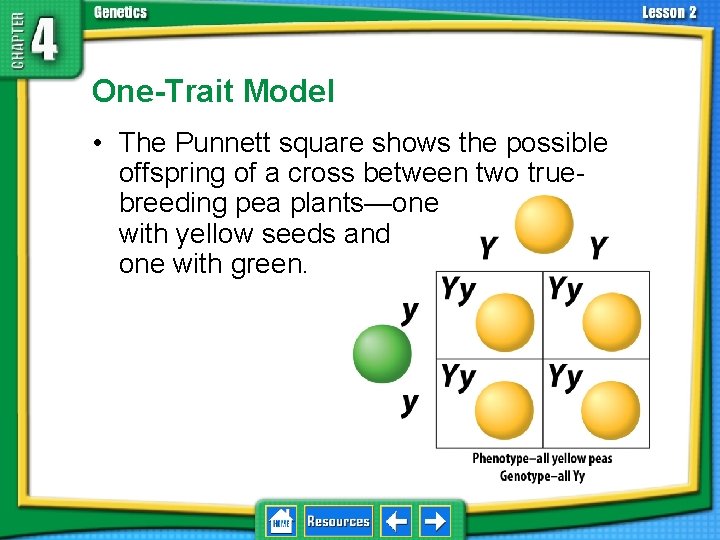
4. 2 Understanding Inheritance One-Trait Model • The Punnett square shows the possible offspring of a cross between two truebreeding pea plants—one with yellow seeds and one with green.
4. 2 Understanding Inheritance One-Trait Model (cont. ) – The only possible genotype for hybrid offspring is heterozygous—Yy. – The phenotype will be yellow seeds because Y is dominant to y.
4. 2 Understanding Inheritance One-Trait Model (cont. )
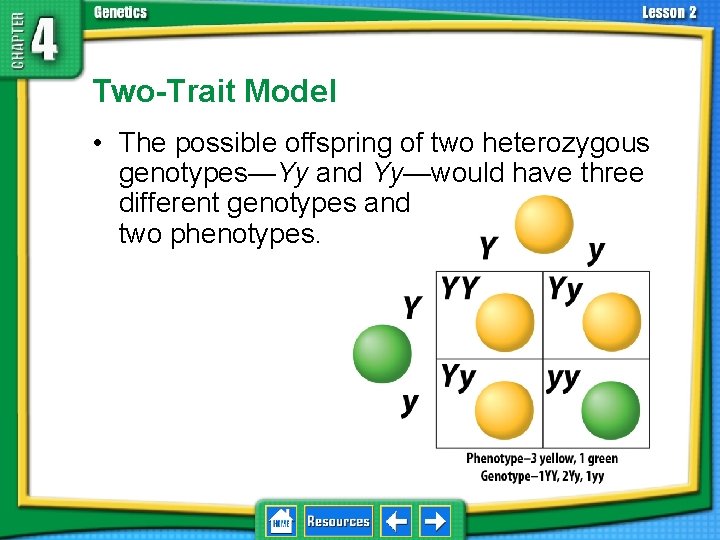
4. 2 Understanding Inheritance Two-Trait Model • The possible offspring of two heterozygous genotypes—Yy and Yy—would have three different genotypes and two phenotypes.
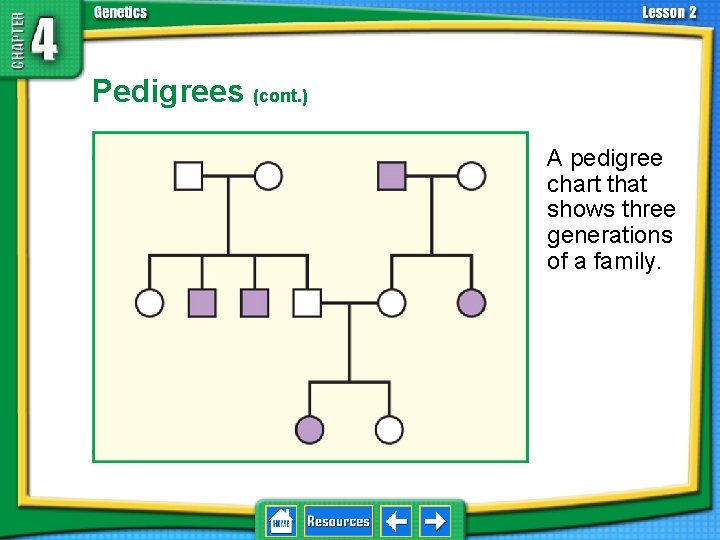
4. 2 Understanding Inheritance Pedigrees • All the genetically related members of a family are part of a family tree. • A pedigree shows genetic traits that were inherited by members of a family tree. • Pedigrees are important tools for tracking complex pattern of inheritance and genetic disorders in families.
4. 2 Understanding Inheritance Pedigrees (cont. ) A pedigree chart that shows three generations of a family.
4. 2 Understanding Inheritance Types of Dominance • Alleles show incomplete dominance when they produce a phenotype that is a blend of the parents’ phenotypes. • When both alleles can be observed in the phenotype, the interaction is called codominance. – The human blood type AB is an example of codominance.
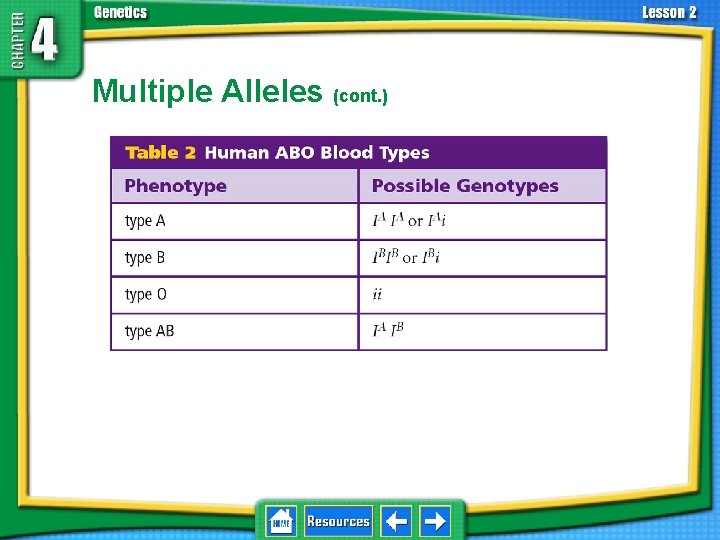
4. 2 Understanding Inheritance Multiple Alleles • Some genes have more than two alleles, or multiple alleles. • The human ABO blood group is determined by multiple alleles as well as codominance. • There are three different alleles for the ABO blood type—IA, IB, and i.
4. 2 Understanding Inheritance Multiple Alleles (cont. )
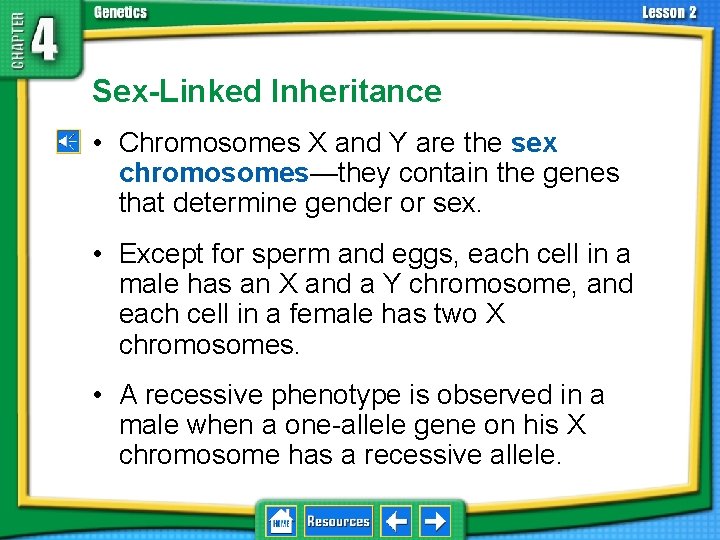
4. 2 Understanding Inheritance Sex-Linked Inheritance • Chromosomes X and Y are the sex chromosomes—they contain the genes that determine gender or sex. • Except for sperm and eggs, each cell in a male has an X and a Y chromosome, and each cell in a female has two X chromosomes. • A recessive phenotype is observed in a male when a one-allele gene on his X chromosome has a recessive allele.
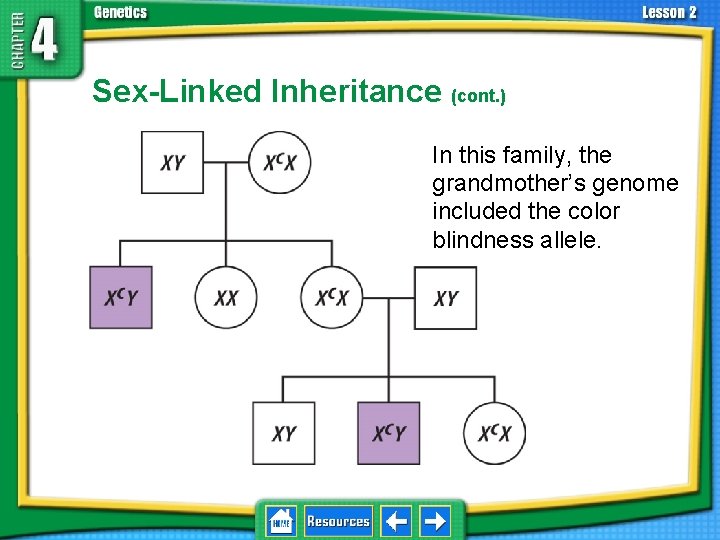
4. 2 Understanding Inheritance Sex-Linked Inheritance (cont. ) In this family, the grandmother’s genome included the color blindness allele.
4. 2 Understanding Inheritance Polygenic Inheritance • Polygenic inheritance is when multiple genes determine the phenotype of a trait. • Many phenotypes are possible when polygenic inheritance determines a trait.
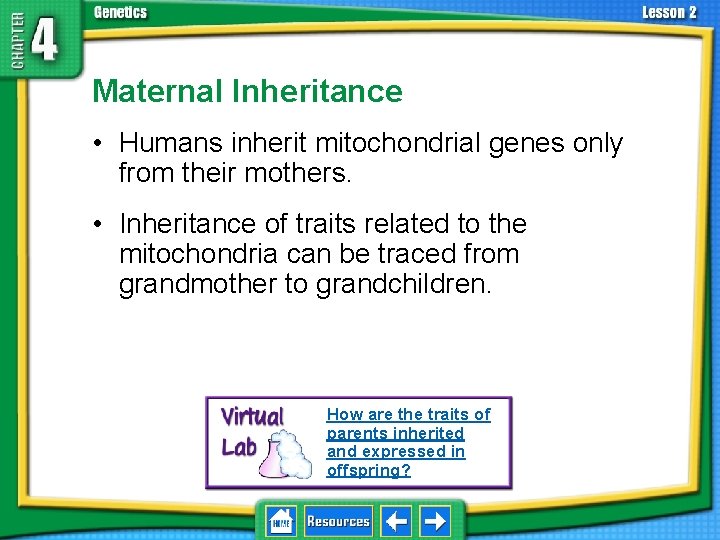
4. 2 Understanding Inheritance Maternal Inheritance • Humans inherit mitochondrial genes only from their mothers. • Inheritance of traits related to the mitochondria can be traced from grandmother to grandchildren. How are the traits of parents inherited and expressed in offspring?
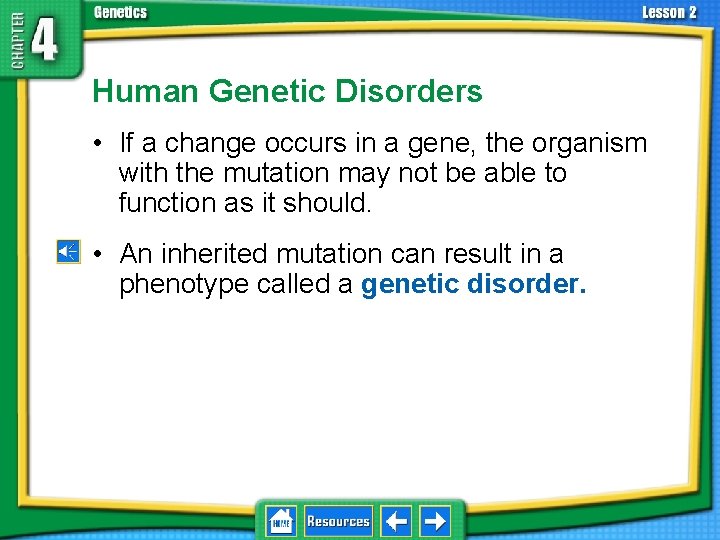
4. 2 Understanding Inheritance Human Genetic Disorders • If a change occurs in a gene, the organism with the mutation may not be able to function as it should. • An inherited mutation can result in a phenotype called a genetic disorder.
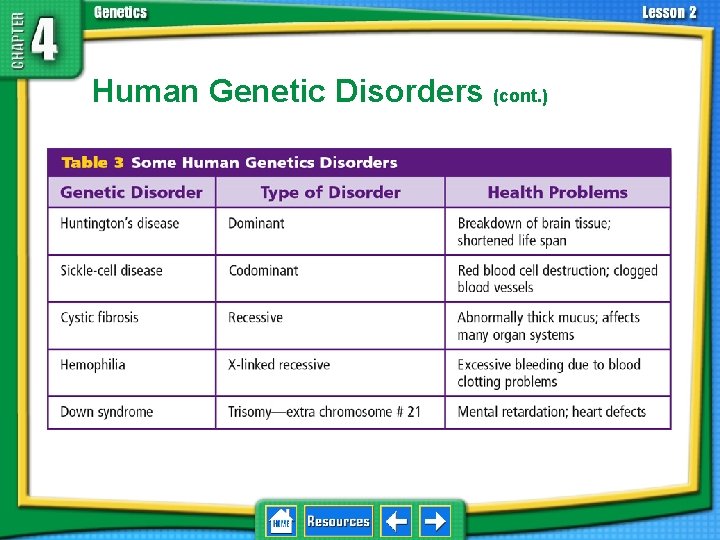
4. 2 Understanding Inheritance Human Genetic Disorders (cont. )
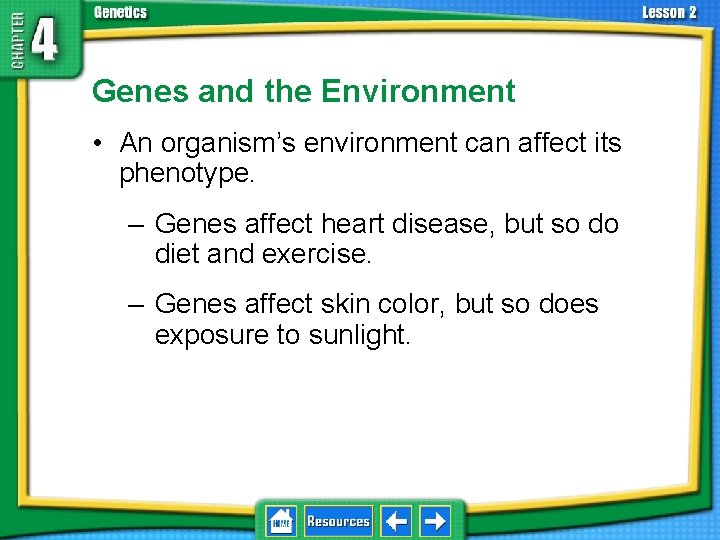
4. 2 Understanding Inheritance Genes and the Environment • An organism’s environment can affect its phenotype. – Genes affect heart disease, but so do diet and exercise. – Genes affect skin color, but so does exposure to sunlight.
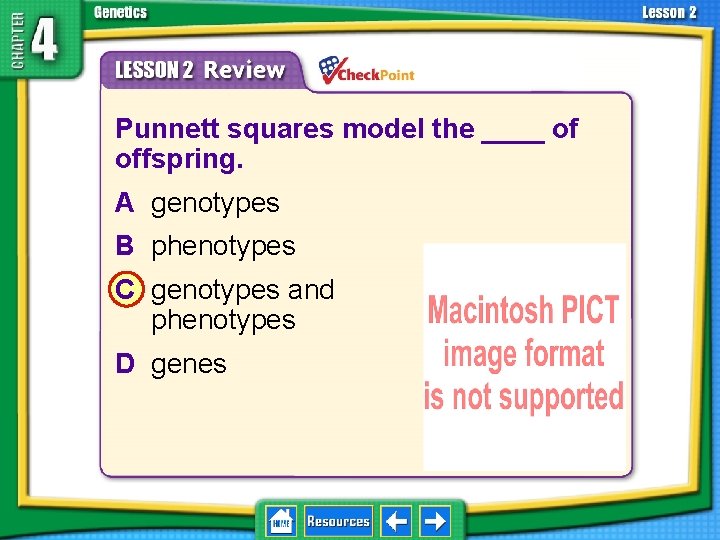
4. 2 Understanding Inheritance 1. 2. 3. 4. A B C D Punnett squares model the ____ of offspring. A genotypes B phenotypes C genotypes and phenotypes D genes
4. 2 Understanding Inheritance 1. 2. 3. 4. A B C D What is the term for when alleles produce a phenotype that is a blend of the parents’ phenotypes? A incomplete dominance B codominance C multiple alleles D polygenic inheritance
4. 2 Understanding Inheritance 1. 2. 3. 4. A B C D How many Y chromosomes do females have? A 0 B 1 C 2 D 4
Chapter Resources Menu Chapter Assessment California Standards Practice Concepts in Motion Image Bank Science Online Interactive Table Virtual Lab Brain. POP Click on a hyperlink to view the corresponding feature.
1. 2. 3. 4. A B C D What is the term for the idea that offspring are a blend of genetic material from both parents? A polygenic inheritance B sex-linked inheritance C maternal inheritance D blending inheritance
1. 2. 3. 4. A B C D What type of alleles can only be observed in the phenotype when they are present as a homozygous genotype? A dominant B recessive C inherited D heterozygous
1. 2. 3. 4. A B C D What is the term for the idea that inheritance of one trait is not influenced by inheritance of another trait? A law of independent assortment B law of heredity C law of segregation D maternal inheritance
1. 2. 3. 4. A B C D What is a good example of a trait that is determined by multiple alleles? A color of camellia flowers B human AB blood type C color blindness D human ABO blood group
1. 2. 3. 4. A B C D Why are male humans more likely to be color-blind than females? A maternal inheritance B sex-linked inheritance C polygenic inheritance D incomplete dominance
SCI 2. c 1. 2. 3. 4. A B C D Which pea trait did Mendel not study? A seed color B pod color C flower position D flower shape
SCI 2. d 1. 2. 3. 4. A B C D If two plants with genotypes Mm are crossed, what percent of the offspring will have phenotype M? A 0% B 25% C 75% D 100%
SCI 2. c, 2. d 1. 2. 3. 4. A B C D What is the term for when more than one gene determine a trait? A incomplete dominance B multiple alleles C polygenic inheritance D sex-linked inheritance
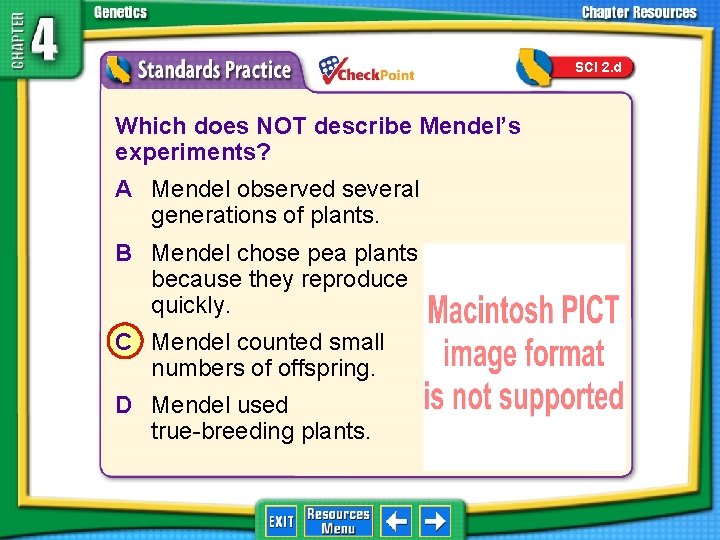
SCI 2. d 1. 2. 3. 4. A B C D Which does NOT describe Mendel’s experiments? A Mendel observed several generations of plants. B Mendel chose pea plants because they reproduce quickly. C Mendel counted small numbers of offspring. D Mendel used true-breeding plants.
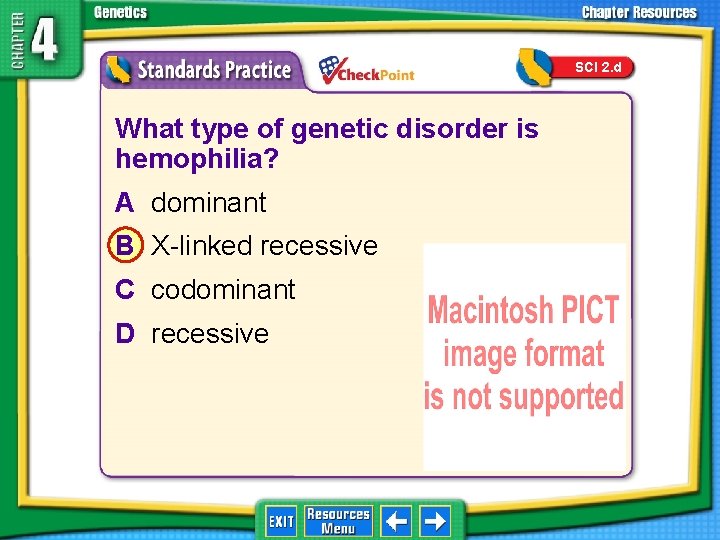
SCI 2. d 1. 2. 3. 4. A B C D What type of genetic disorder is hemophilia? A dominant B X-linked recessive C codominant D recessive
Image Bank
Interactive Table Pea Traits Studied by Mendel