
Chapter M 4 Producing Goods and Services Continuous

- Slides: 47
Chapter M 4 Producing Goods and Services: Continuous Processing Power. Point Presentation by Douglas Cloud Professor Emeritus of Accounting Pepperdine University © Copyright 2005 South-Western, a division of Thomson Learning. All rights reserved. Task Force Image Gallery clip art included in this electronic presentation is used with the permission of NVTech Inc. 1
2 Once you have completed this chapter, you should be able to: Objective 1 Distinguish between job-order and process costing and describe when each method should be used.
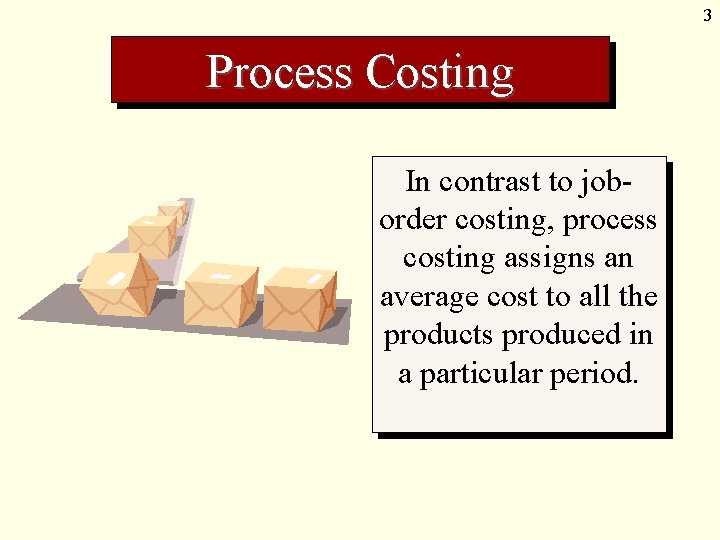
3 Process Costing In contrast to joborder costing, process costing assigns an average cost to all the products produced in a particular period.
4 Assigning Unit Cost Job-order costing is best suited for production situations with the following characteristics: The units of a particular job are easy to identify because they are unique. Much of the cost of producing the product or service can be traced directly to a particular job.
5 Assigning Unit Cost Process costing is best suited for production situations with the following characteristics: The products are alike. The processes used to manufacture those products flow from one into another. The costs of producing the products cannot be traced easily to individual units.
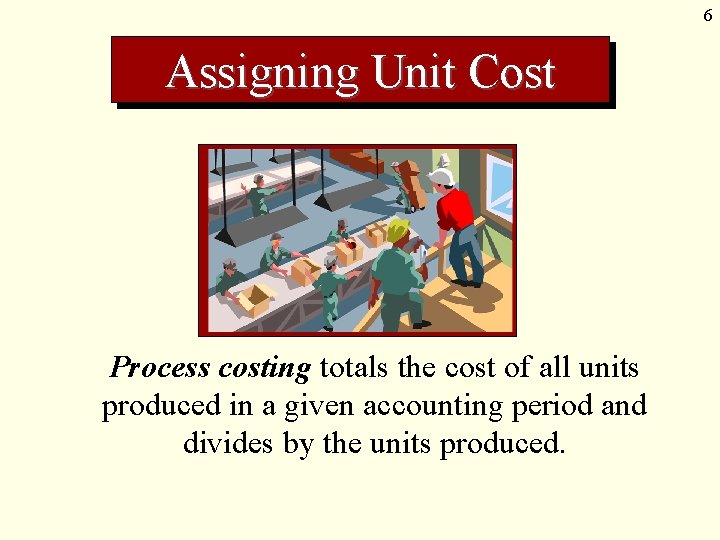
6 Assigning Unit Cost Process costing totals the cost of all units produced in a given accounting period and divides by the units produced.
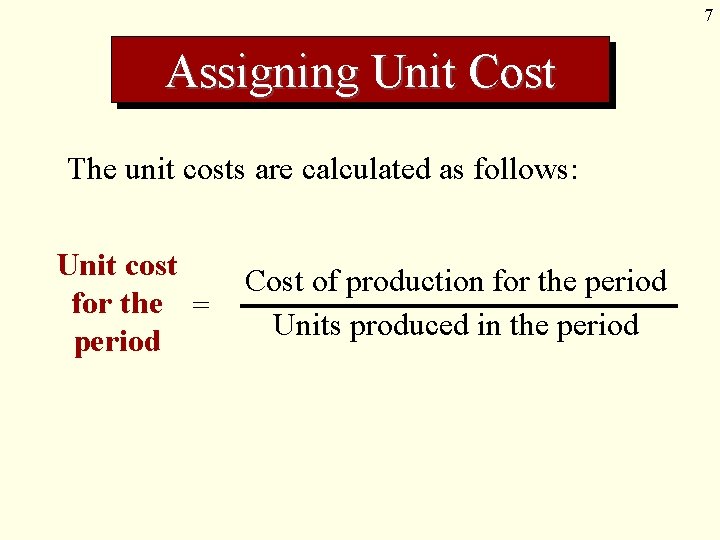
7 Assigning Unit Cost The unit costs are calculated as follows: Unit cost for the = period Cost of production for the period Units produced in the period
8 Batch Processing Batch processing combines elements of individual-job and continuous-flow processing.
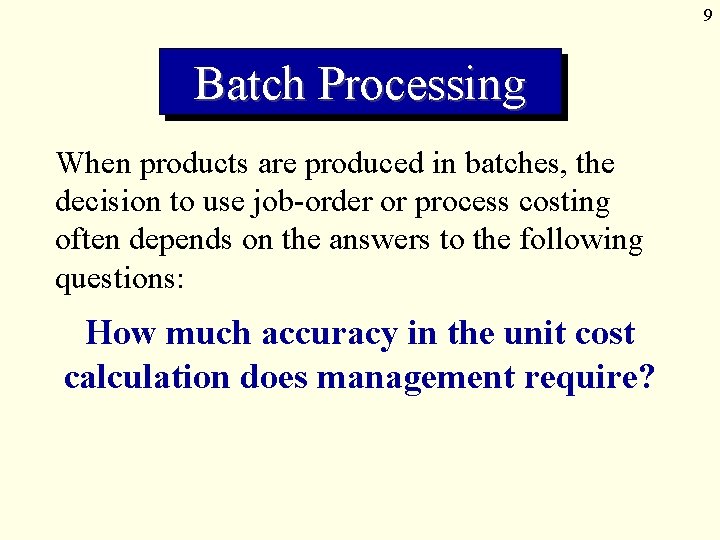
9 Batch Processing When products are produced in batches, the decision to use job-order or process costing often depends on the answers to the following questions: How much accuracy in the unit cost calculation does management require?
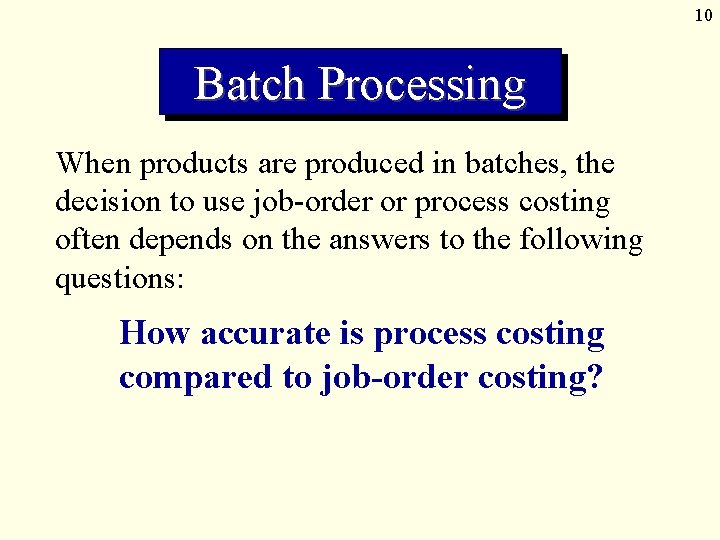
10 Batch Processing When products are produced in batches, the decision to use job-order or process costing often depends on the answers to the following questions: How accurate is process costing compared to job-order costing?
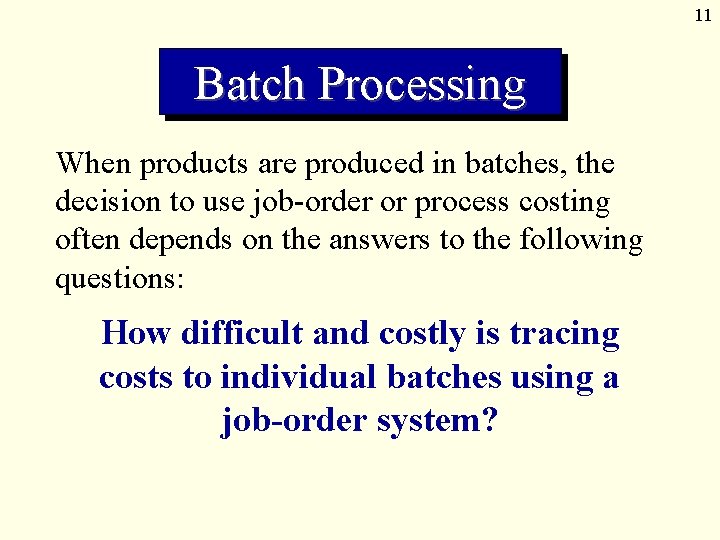
11 Batch Processing When products are produced in batches, the decision to use job-order or process costing often depends on the answers to the following questions: How difficult and costly is tracing costs to individual batches using a job-order system?
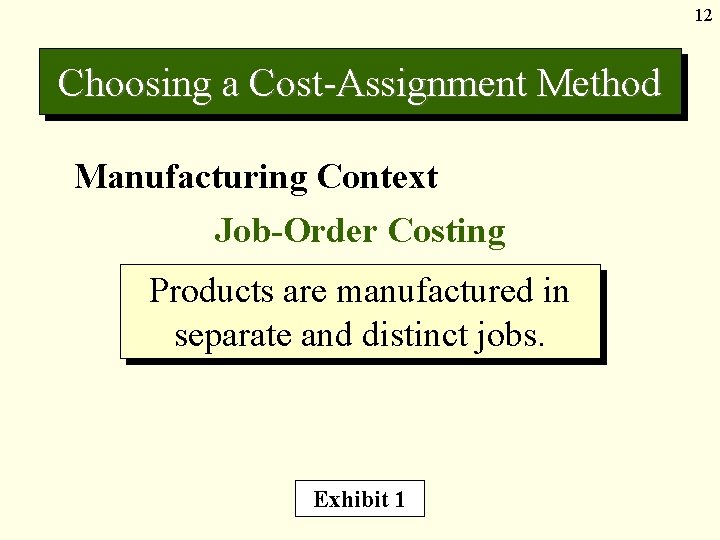
12 Choosing a Cost-Assignment Method Manufacturing Context Job-Order Costing Products are manufactured in separate and distinct jobs. Exhibit 1
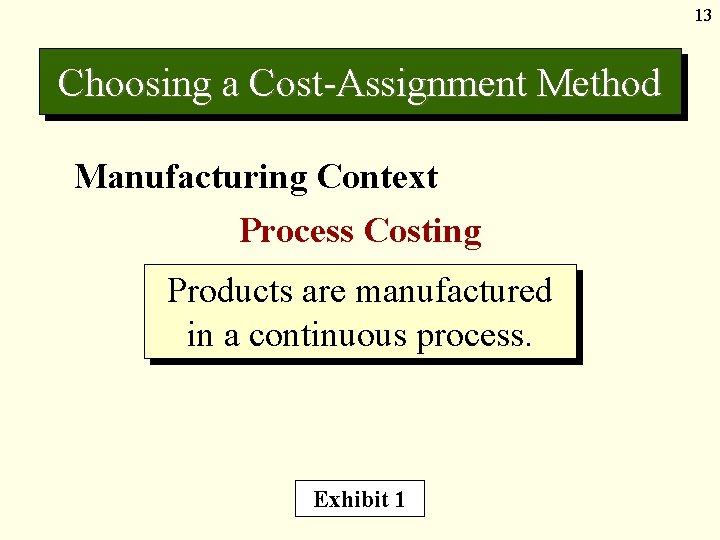
13 Choosing a Cost-Assignment Method Manufacturing Context Process Costing Products are manufactured in a continuous process. Exhibit 1
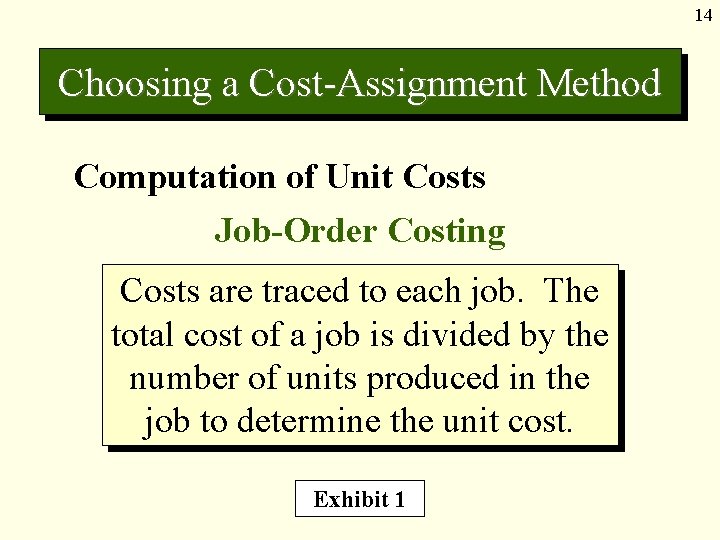
14 Choosing a Cost-Assignment Method Computation of Unit Costs Job-Order Costing Costs are traced to each job. The total cost of a job is divided by the number of units produced in the job to determine the unit cost. Exhibit 1
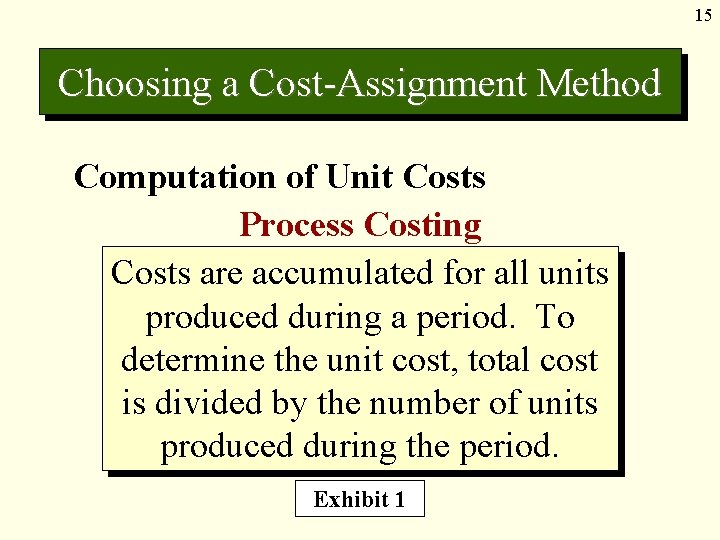
15 Choosing a Cost-Assignment Method Computation of Unit Costs Process Costing Costs are accumulated for all units produced during a period. To determine the unit cost, total cost is divided by the number of units produced during the period. Exhibit 1
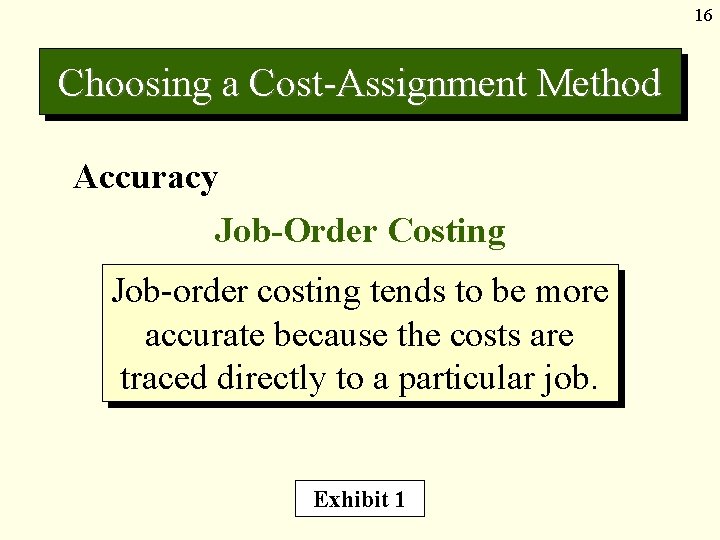
16 Choosing a Cost-Assignment Method Accuracy Job-Order Costing Job-order costing tends to be more accurate because the costs are traced directly to a particular job. Exhibit 1
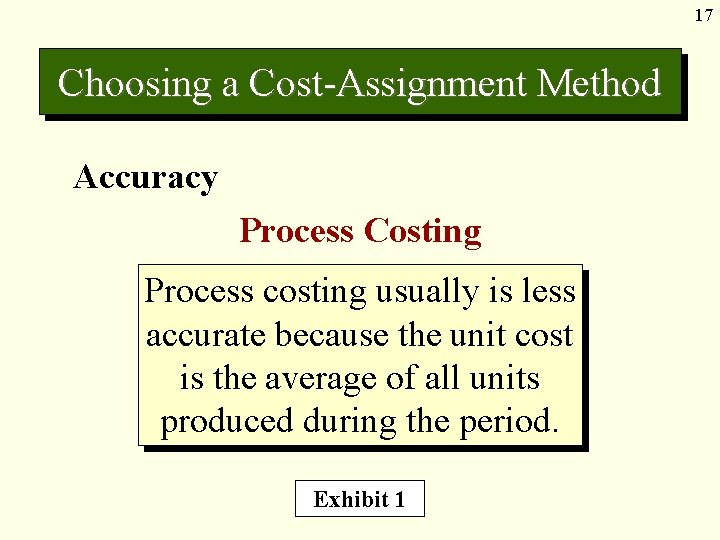
17 Choosing a Cost-Assignment Method Accuracy Process Costing Process costing usually is less accurate because the unit cost is the average of all units produced during the period. Exhibit 1
18 Once you have completed this chapter, you should be able to: Objective 2 Explain the concept of equivalent units.
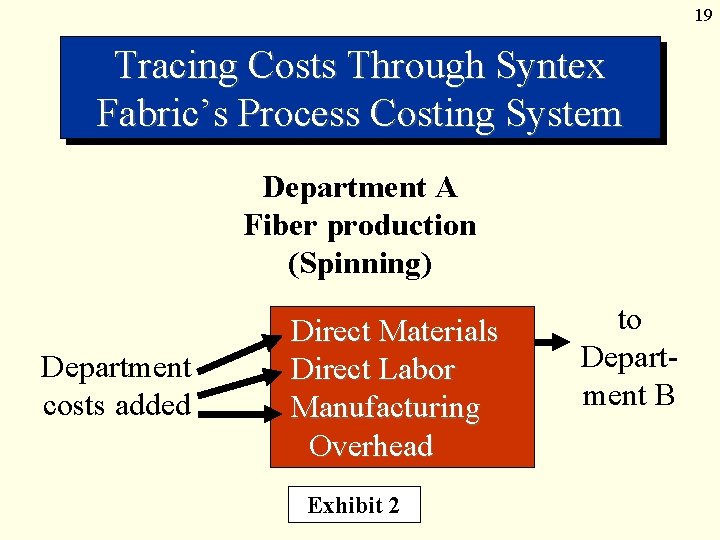
19 Tracing Costs Through Syntex Fabric’s Process Costing System Department A Fiber production (Spinning) Department costs added Direct Materials Direct Labor Manufacturing Overhead Exhibit 2 to Department B
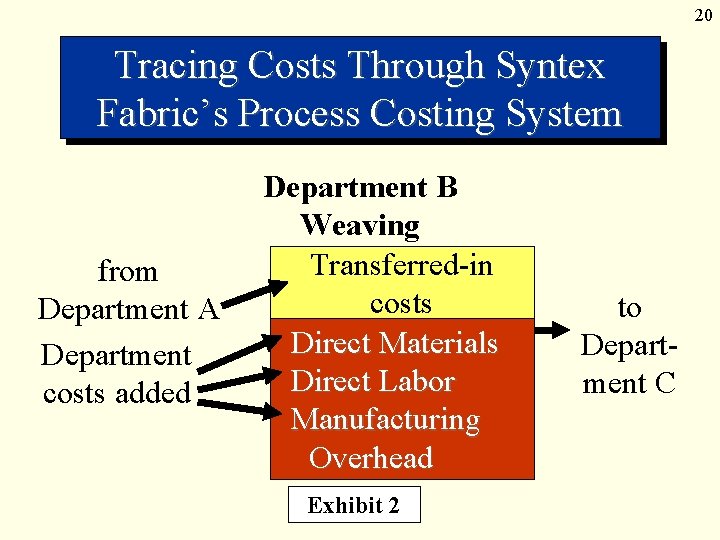
20 Tracing Costs Through Syntex Fabric’s Process Costing System from Department A Department costs added Department B Weaving Transferred-in costs Direct Materials Direct Labor Manufacturing Overhead Exhibit 2 to Department C
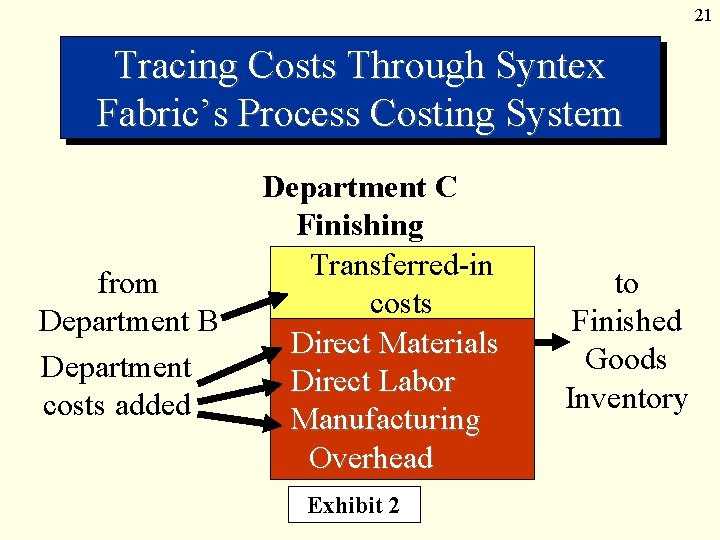
21 Tracing Costs Through Syntex Fabric’s Process Costing System from Department B Department costs added Department C Finishing Transferred-in costs Direct Materials Direct Labor Manufacturing Overhead Exhibit 2 to Finished Goods Inventory
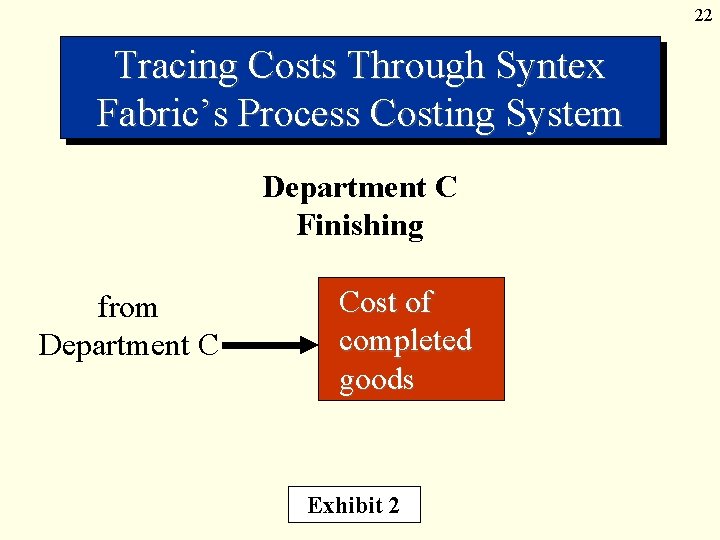
22 Tracing Costs Through Syntex Fabric’s Process Costing System Department C Finishing from Department C Cost of completed goods Exhibit 2
23 Equivalent Units Equivalent units are the number of units that would have been produced during a period if all the department’s efforts had resulted in completed units.
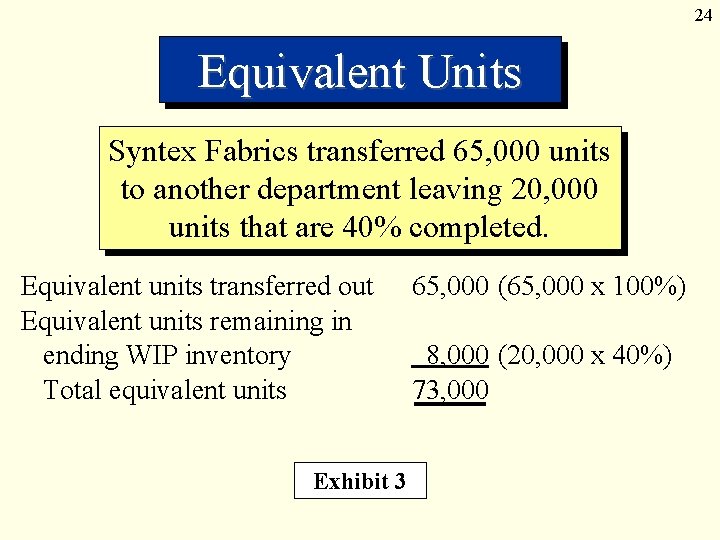
24 Equivalent Units Syntex Fabrics transferred 65, 000 units to another department leaving 20, 000 units that are 40% completed. Equivalent units transferred out Equivalent units remaining in ending WIP inventory Total equivalent units Exhibit 3 65, 000 (65, 000 x 100%) 8, 000 (20, 000 x 40%) 73, 000
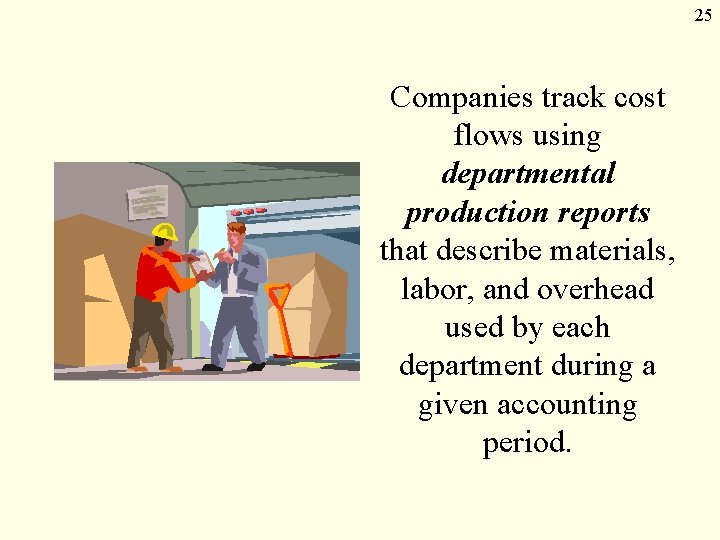
25 Companies track cost flows using departmental production reports that describe materials, labor, and overhead used by each department during a given accounting period.
26 Transferred-in costs are costs that have been transferred to a subsequent department in the production process. om r f t s Co ing k a B the ent m t r a Dep
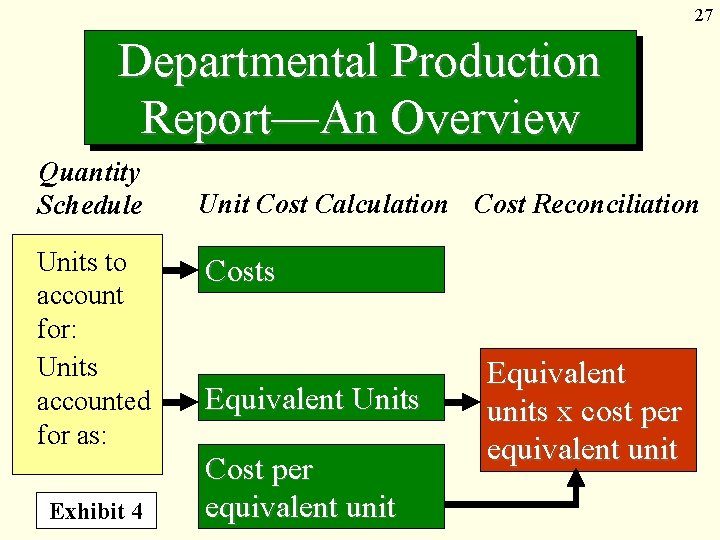
27 Departmental Production Report—An Overview Quantity Schedule Units to account for: Units accounted for as: Exhibit 4 Unit Cost Calculation Cost Reconciliation Costs Equivalent Units Cost per equivalent unit Equivalent units x cost per equivalent unit
28 Once you have completed this chapter, you should be able to: Objective 3 Prepare an evaluate a departmental production report.
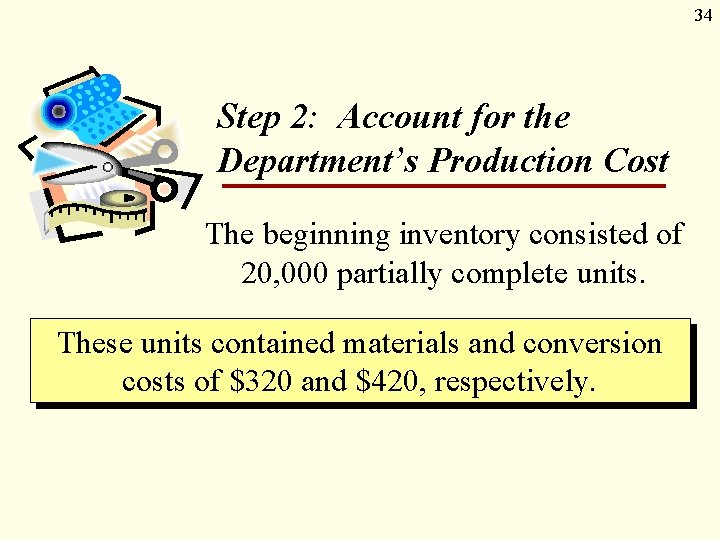
29 Syntex Fabrics requires three departments, fiber production (or spinning), weaving, and finishing, to produce a completed roll of fabric. The spinning department had 20, 000 yards of partially completed fiber as WIP inventory on October 1, 2004. Materials and conversion costs associated with the beginning inventory were $320 and $420, respectively.
30 Conversion costs are the direct labor and manufacturing overhead costs required to convert raw materials into finished goods.
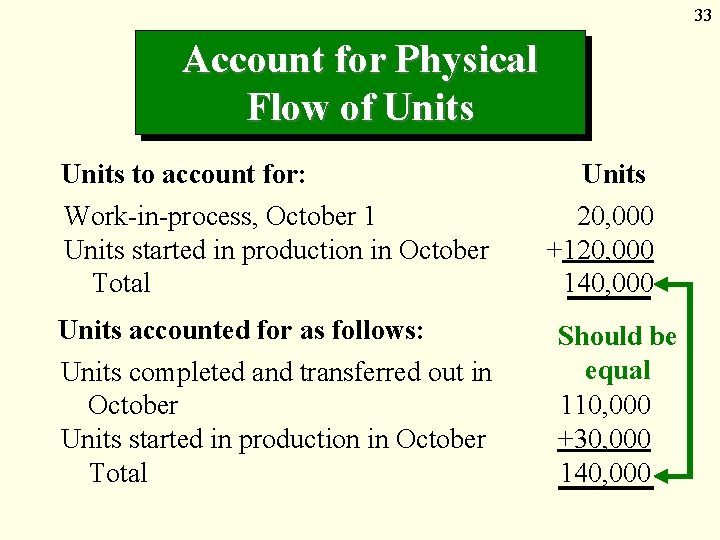
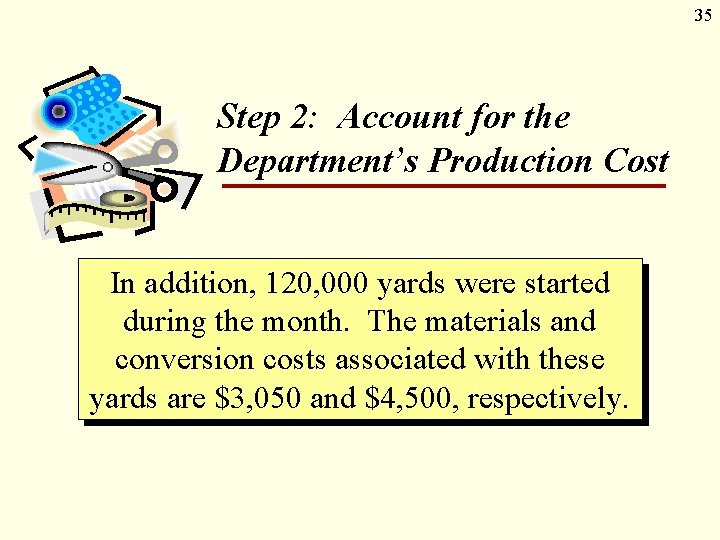
31 Step 1: Account for the Physical Flow of Units During the month the department began working on an additional 120, 000 yards of fiber. Costs of material and conversion added during the month were $3, 050 and $4, 500, respectively.
32 Step 1: Account for the Physical Flow of Units In addition to the 20, 000 yards the spinning department had in progress on October 1, work began on an additional 140, 000 yards of fiber. The department completed and transferred to the weaving department 110, 000 yards of fiber.
33 Account for Physical Flow of Units to account for: Work-in-process, October 1 Units started in production in October Total Units accounted for as follows: Units completed and transferred out in October Units started in production in October Total Units 20, 000 +120, 000 140, 000 Should be equal 110, 000 +30, 000 140, 000
34 Step 2: Account for the Department’s Production Cost The beginning inventory consisted of 20, 000 partially complete units. These units contained materials and conversion costs of $320 and $420, respectively.
35 Step 2: Account for the Department’s Production Cost In addition, 120, 000 yards were started during the month. The materials and conversion costs associated with these yards are $3, 050 and $4, 500, respectively.
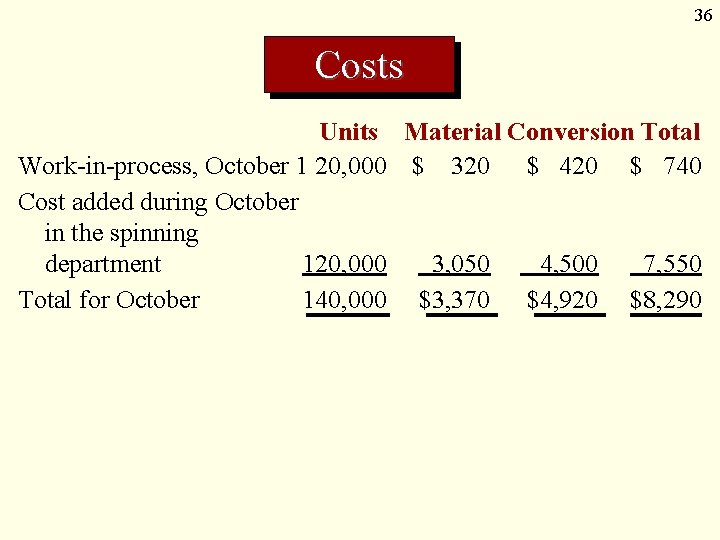
36 Costs Units Material Conversion Total Work-in-process, October 1 20, 000 $ 320 $ 420 $ 740 Cost added during October in the spinning department 120, 000 3, 050 4, 500 7, 550 Total for October 140, 000 $3, 370 $4, 920 $8, 290
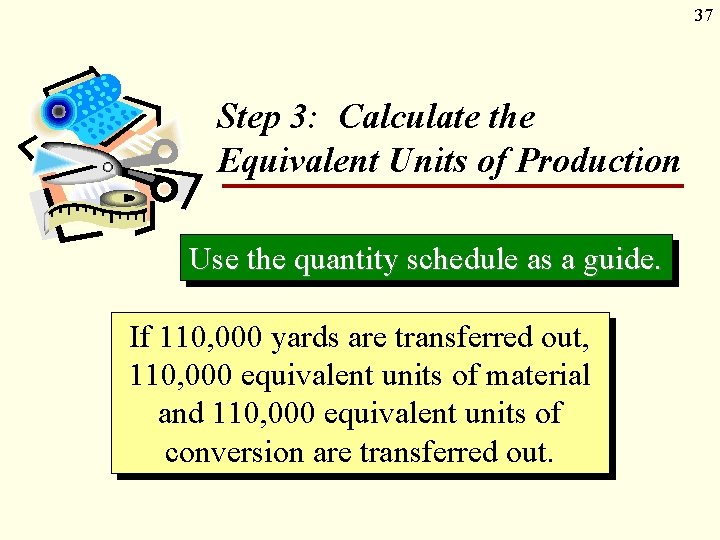
37 Step 3: Calculate the Equivalent Units of Production Use the quantity schedule as a guide. If 110, 000 yards are transferred out, 110, 000 equivalent units of material and 110, 000 equivalent units of conversion are transferred out.
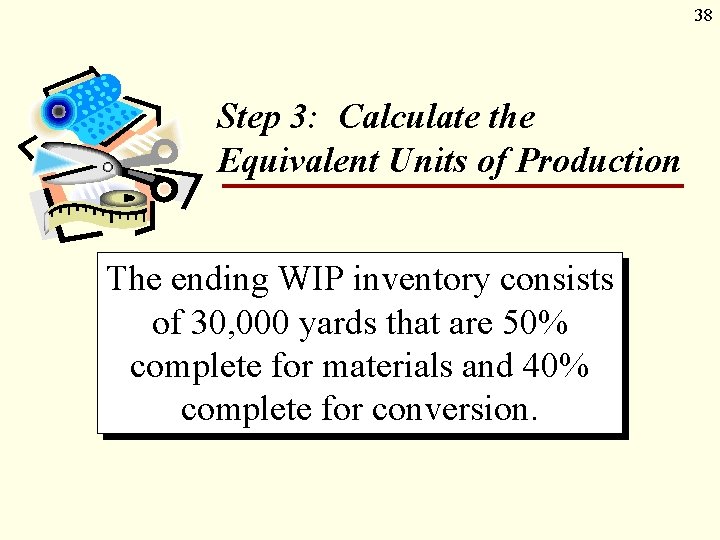
38 Step 3: Calculate the Equivalent Units of Production The ending WIP inventory consists of 30, 000 yards that are 50% complete for materials and 40% complete for conversion.
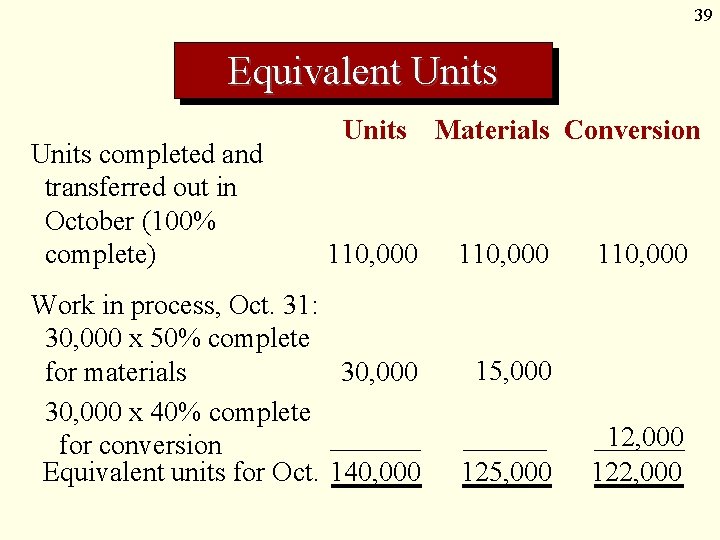
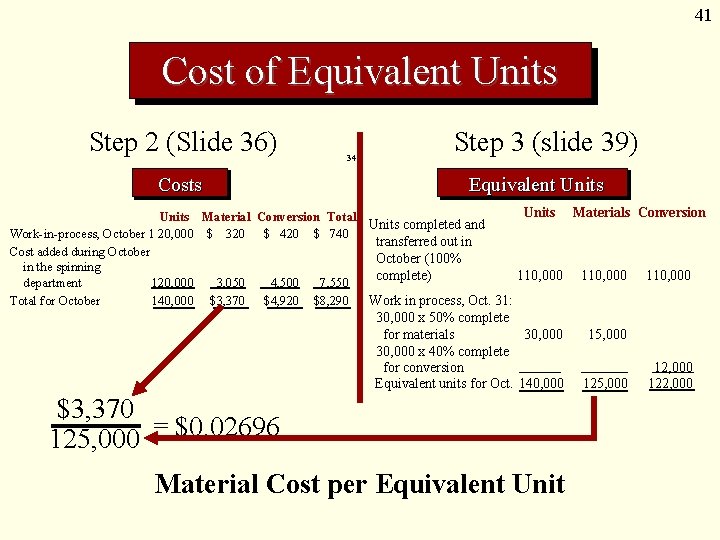
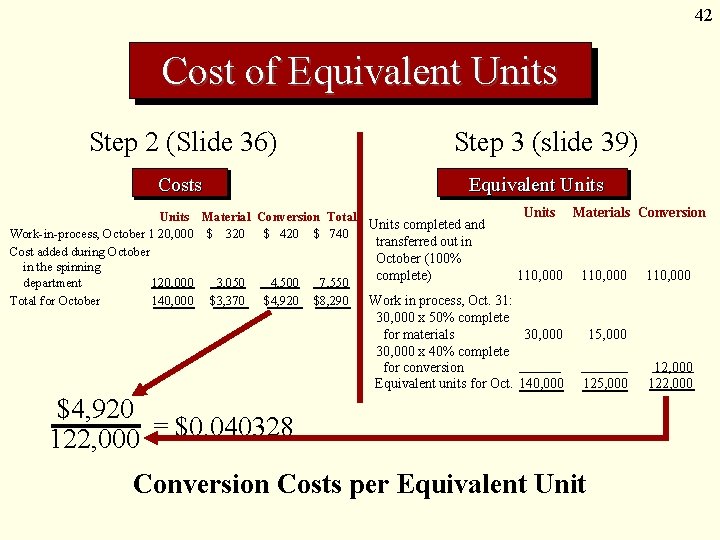
39 Equivalent Units completed and transferred out in October (100% complete) Units 110, 000 Work in process, Oct. 31: 30, 000 x 50% complete for materials 30, 000 x 40% complete for conversion Equivalent units for Oct. 140, 000 Materials Conversion 110, 000 15, 000 12, 000 122, 000
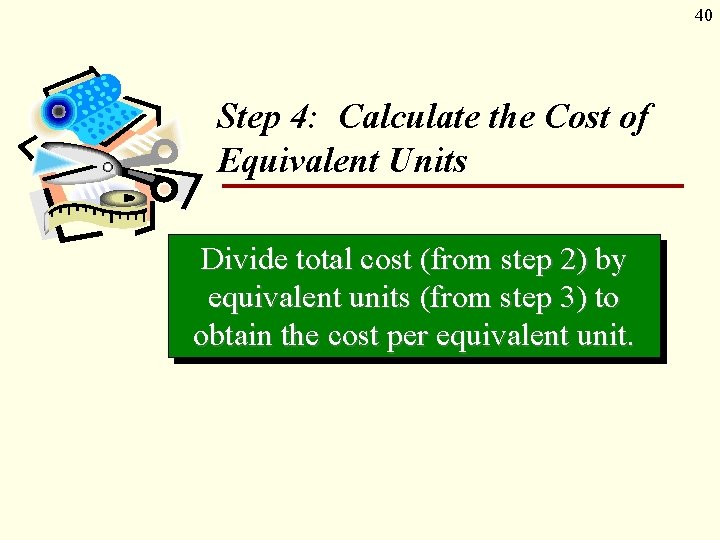
40 Step 4: Calculate the Cost of Equivalent Units Divide total cost (from step 2) by equivalent units (from step 3) to obtain the cost per equivalent unit.
41 Cost of Equivalent Units Step 2 (Slide 36) Costs 34 Step 3 (slide 39) Equivalent Units Materials Conversion Units Material Conversion Total Units completed and Work-in-process, October 1 20, 000 $ 320 $ 420 $ 740 transferred out in Cost added during October (100% in the spinning complete) 110, 000 department 120, 000 3, 050 4, 500 7, 550 Total for October 140, 000 $3, 370 $4, 920 $8, 290 Work in process, Oct. 31: 30, 000 x 50% complete for materials 30, 000 x 40% complete for conversion Equivalent units for Oct. 140, 000 $3, 370 125, 000 = $0. 02696 Material Cost per Equivalent Unit 15, 000 12, 000 122, 000
42 Cost of Equivalent Units Step 2 (Slide 36) Costs Step 3 (slide 39) Equivalent Units Materials Conversion Units Material Conversion Total Units completed and Work-in-process, October 1 20, 000 $ 320 $ 420 $ 740 transferred out in Cost added during October (100% in the spinning complete) 110, 000 department 120, 000 3, 050 4, 500 7, 550 Total for October 140, 000 $3, 370 $4, 920 $8, 290 Work in process, Oct. 31: 30, 000 x 50% complete for materials 30, 000 x 40% complete for conversion Equivalent units for Oct. 140, 000 15, 000 125, 000 $4, 920 122, 000 = $0. 040328 Conversion Costs per Equivalent Unit 12, 000 122, 000
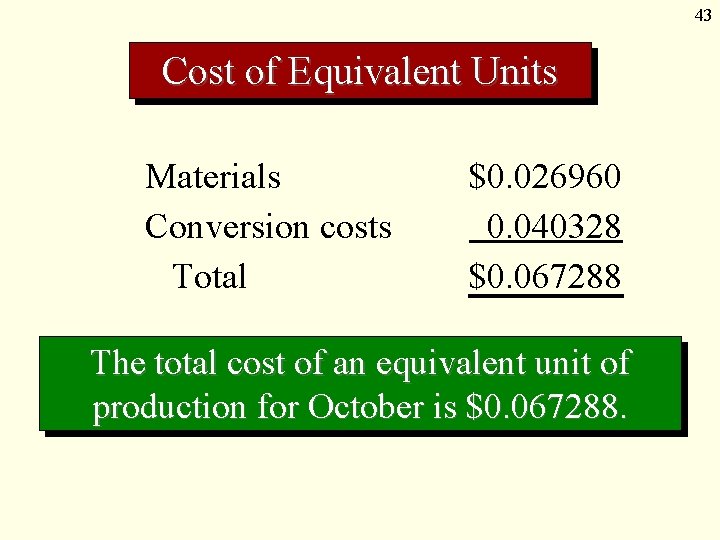
43 Cost of Equivalent Units Materials Conversion costs Total $0. 026960 0. 040328 $0. 067288 The total cost of an equivalent unit of production for October is $0. 067288.
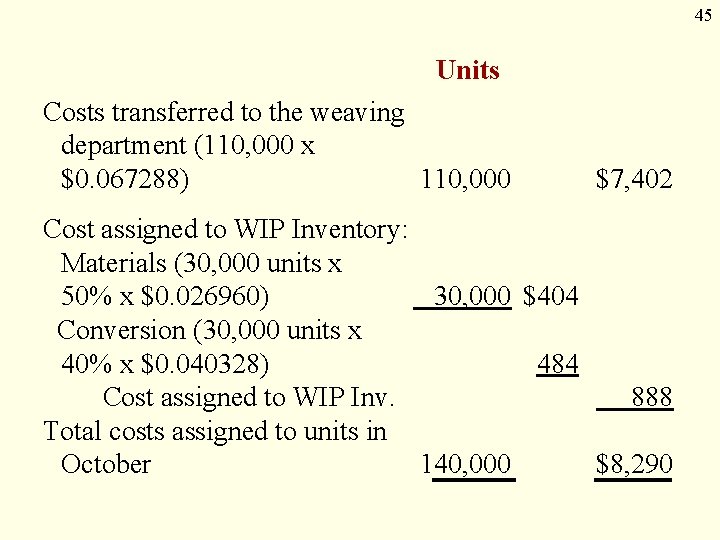
44 Step 5: Assign Costs to Inventory In this final step of the departmental production report, the company assigns production costs for the period to units that are transferred out.
45 Units Costs transferred to the weaving department (110, 000 x $0. 067288) 110, 000 $7, 402 Cost assigned to WIP Inventory: Materials (30, 000 units x 50% x $0. 026960) 30, 000 $404 Conversion (30, 000 units x 40% x $0. 040328) 484 Cost assigned to WIP Inv. 888 Total costs assigned to units in October 140, 000 $8, 290
46 Chapter M 4 THE END
47