
CHAPTER IX NORMAL FLORA ACKNOWLEDGMENT ADDIS ABABA UNIVERSITY
CHAPTER IX NORMAL FLORA

ACKNOWLEDGMENT • • ADDIS ABABA UNIVERSITY JIMMA UNIVERSITY HAWASSA UNIVERSITY HARAMAYA UNIVERSITY OF GONDAR AMERICAN SOCIETY OF CLINICAL PATHOLOGY CDC- Ethiopia
• The term "normal microbial flora" denotes the population of microorganisms that inhabit the skin and mucous membranes of healthy normal persons. • Viruses and parasites are not considered members of the normal microbial flora by most investigators because they are not commensals and do not aid the host.
• The skin and mucous membranes always harbor a variety of microorganisms that can be arranged into two groups: (1) The resident flora consists of relatively fixed types of microorganisms regularly found in a given area at a given age; if disturbed, it promptly reestablishes itself. (2) The transient flora consists of nonpathogenic or potentially pathogenic microorganisms that inhabit the skin or mucous membranes for hours, days, or weeks; it is derived from the environment, and does not establish itself permanently on the surface.

• • Members of the transient flora are generally of little significance so long as the normal resident flora remains intact. However, if the resident flora is disturbed, transient microorganisms may colonize, proliferate, and produce disease.

FIGURE: Numbers of bacteria that colonize different parts of the body. Numbers represent the number of organisms per gram of homogenized tissue or fluid or per square centimeter of skin surface. NB: The human body, which contains about 1013 cells, routinely harbors about 1014 bacteria
Significance of the Normal Flora • Can cause infection - When misplaced, e. g. , fecal flora to urinary tract or abdominal cavity, or skin flora to catheter - if person becomes compromised, normal flora may overgrow (e. g. oral thrush). • Contributes to health - Protective host defense - Produce antimicrobial substances against pathogens - Compete for attachment and nutrient with pathogenic bacteria - Serve as nutritional resource by synthesizing: vitamin K and B.

FIGURE: Mechanisms by which the normal flora competes with invading pathogens. .
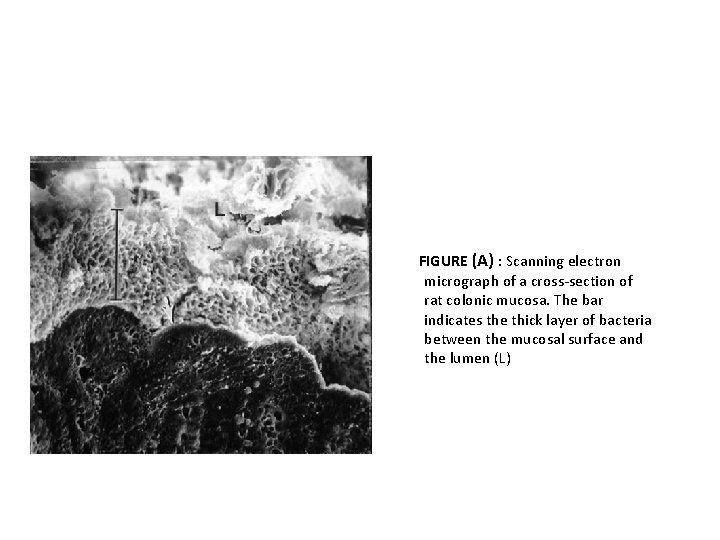
FIGURE (A) : Scanning electron micrograph of a cross-section of rat colonic mucosa. The bar indicates the thick layer of bacteria between the mucosal surface and the lumen (L)
Normal Flora of the Skin • Because of its constant exposure to and contact with the environment, the skin is particularly apt to contain transient microorganisms. • Nevertheless, there is a constant and well-defined resident flora, modified in different anatomic areas by secretions, habitual wearing of clothing, or proximity to mucous membranes (mouth, nose, and perineal areas).

• The predominant resident microorganisms of the skin are: - aerobic and anaerobic diphtheroid bacilli (eg, corynebacterium, propionibacterium); - Nonhemolytic aerobic and anaerobic staphylococci (Staphylococcus epidermidis and other coagulasenegative staphylococci, occasionally S aureus, and Peptostreptococcus species);

- gram-positive, aerobic, spore-forming bacilli that are ubiquitous in air, water, and soil; alpha-hemolytic streptococci (viridans streptococci) and enterococci (Enterococcus species); and gram-negative coliform bacilli and acinetobacter. - Fungi and yeasts are often present in skin folds; acid-fast, nonpathogenic mycobacteria occur in areas rich in sebaceous secretions (genitalia, external ear).
• Among the factors that may be important in eliminating nonresident microorganisms from the skin are the low p. H, the fatty acids in sebaceous secretions, and the presence of lysozyme. • Neither profuse sweating nor washing and bathing can eliminate or significantly modify the normal resident flora. • Placement of an occlusive dressing on skin tends to result in a large increase in the total microbial population and may also produce qualitative alterations in the flora.
• Normal Flora of the Mouth & Upper Respiratory Tract The flora of the nose consists of prominent corynebacteria, staphylococci (S epidermidis, S aureus), and streptococci. • The mucous membranes of the mouth and pharynx are often sterile at birth but may be contaminated by passage through the birth canal. Within 4– 12 hours after birth, viridans streptococci become established as the most prominent members of the resident flora and remain so for life. They probably originate in the respiratory tracts of the mother and attendants.
• Early in life, aerobic and anaerobic staphylococci, gramnegative diplococci (neisseriae, Moraxella catarrhalis), diphtheroids, and occasional lactobacilli are added. • When teeth begin to erupt, the anaerobic spirochetes, Prevotella species, Fusobacterium species, Rothia species, and Capnocytophaga species establish themselves, along with some anaerobic vibrios and lactobacilli. • Actinomyces species are normally present in tonsillar tissue and on the gingivae in adults, and various protozoa may also be present. Yeasts (Candida species) occur in the adult mouth.
• In the pharynx and trachea, a similar flora establishes itself, whereas few bacteria are found in normal bronchi. Small bronchi and alveoli are normally sterile. • The predominant organisms in the upper respiratory tract, particularly the pharynx, are nonhemolytic and alphahemolytic streptococci and neisseriae. Staphylococci, diphtheroids, haemophili, pneumococci, mycoplasmas, and prevotellae are also encountered.
• Infections of the mouth and respiratory tract are usually caused by mixed oronasal flora, including anaerobes. • Periodontal infections, perioral abscesses, sinusitis, and mastoiditis may involve predominantly Prevotella melaninogenica, fusobacteria, and peptostreptococci. • Aspiration of saliva (containing up to 102 of these organisms and aerobes) may result in necrotizing pneumonia, lung abscess, and empyema.
Normal Flora of the Intestinal Tract • At birth the intestine is sterile, but organisms are soon introduced with food. • In breast-fed children, the intestine contains large numbers of lactic acid streptococci and lactobacilli. These aerobic and anaerobic, gram-positive, nonmotile organisms (eg, Bifidobacterium species) produce acid from carbohydrates and tolerate p. H 5. 0.
• In bottle-fed children, a more mixed flora exists in the bowel, and lactobacilli are less prominent. As food habits develop toward the adult pattern, the bowel flora changes. • Diet has a marked influence on the relative composition of the intestinal and fecal flora. • Bowels of newborns in intensive care nurseries tend to be colonized by Enterobacteriaceae, eg, klebsiella, citrobacter, and enterobacter.
• In the normal adult, the esophagus contains microorganisms arriving with saliva and food. • The stomach's acidity keeps the number of microorganisms at a minimum (103– 105/g of contents). • The normal acid p. H of the stomach markedly protects against infection with some enteric pathogens, eg, cholera. • As the p. H of intestinal contents becomes alkaline, the resident flora gradually increases.
• In the adult duodenum, there are 103– 106 bacteria per gram of contents; • In the jejunum and ileum, 105– 108 bacteria per gram; • In the cecum and transverse colon, 108– 1010 bacteria per gram. • In the upper intestine, lactobacilli and enterococci predominate.
• In the sigmoid colon and rectum, there about 1011 bacteria per gram of contents, constituting 10– 30% of the fecal mass. • Anaerobes outnumber facultative organisms by 1000 -fold. • In diarrhea, the bacterial content may diminish greatly, whereas in intestinal stasis the count rises.
• In the normal adult colon, 96– 99% of the resident bacterial flora consists of anaerobes: Bacteroides species, especially B fragilis; Fusobacterium species; anaerobic lactobacilli, eg, bifidobacteria; clostridia (C perfringens, 103– 105/g); and anaerobic gram-positive cocci (Peptostreptococcus species). • Only 1– 4% are facultative aerobes (gram-negative coliform bacteria, enterococci, and small numbers of protei, pseudomonads, lactobacilli, candidae, and other organisms). NB: More than 100 distinct types of organisms, which can be cultured routinely in the laboratory, occur regularly in normal fecal flora. There probably are more than 500 species of bacteria in the colon including many that are likely unidentified.
• Intestinal bacteria are important in synthesis of vitamin K, conversion of bile pigments and bile acids, absorption of nutrients and breakdown products, and antagonism to microbial pathogens. • Among aerobic coliform bacteria, only a few serotypes persist in the colon for prolonged periods, and most serotypes of Escherichia coli are present only over a period of a few days.
• Antimicrobial drugs taken orally can, in humans, temporarily suppress the drug-susceptible components of the fecal flora. This is commonly done by the oral administration of insoluble drugs. - For example, neomycin plus erythromycin can in 1– 2 days suppress part of the bowel flora, especially aerobes. Metronidazole accomplishes that for anaerobes.
• The anaerobic flora of the colon, including B fragilis, clostridia, and peptostreptococci, plays a main role in abscess formation originating in perforation of the bowel.
Normal Flora of the Urethra • The anterior urethra of both sexes contains small numbers of the same types of organisms found on the skin and perineum. • These organisms regularly appear in normal voided urine in numbers of 102– 104/m. L.
Normal Flora of the Vagina • Soon after birth, aerobic lactobacilli appear in the vagina and persist as long as the p. H remains acid (several weeks). • When the p. H becomes neutral (remaining so until puberty), a mixed flora of cocci and bacilli is present. • At puberty, aerobic and anaerobic lactobacilli reappear in large numbers and contribute to the maintenance of acid p. H through the production of acid from carbohydrates, particularly glycogen. – This appears to be an important mechanism in preventing the establishment of other, possibly harmful microorganisms in the vagina.
- If lactobacilli are suppressed by the administration of antimicrobial drugs, yeasts or various bacteria increase in numbers and cause irritation and inflammation.
• After menopause, lactobacilli again diminish in number and a mixed flora returns. • The normal vaginal flora includes group B streptococci in as many as 25% of women of childbearing age. • During the birth process, a baby can acquire group B streptococci, which subsequently may cause neonatal sepsis and meningitis.
• The normal vaginal flora often includes also alpha hemolytic streptococci, anaerobic streptococci (peptostreptococci), Prevotella species, clostridia, Gardnerella vaginalis, Ureaplasma urealyticum, and sometimes listeria or Mobiluncus species. • The cervical mucus has antibacterial activity and contains lysozyme.
Normal Flora of the Conjunctiva • The predominant organisms of the conjunctiva are diphtheroids, S epidermidis, and nonhemolytic streptococci. • Neisseriae and gram-negative bacilli resembling haemophili (Moraxella species) are also frequently present. • The conjunctival flora is normally held in check by the flow of tears, which contain antibacterial lysozyme.
7. Normal flora of the external auditory meatus • It is an extension of skin normal flora and often profusely colonized. • Staphylococcus epidermidis • Diphtheroids • Alpha-hemolytic and non-hemolyic streptococci • N. B there is no normal flora in blood and CSF
REFERENCES 1. 2. 3. 4. 5. 6. 7. 8. 9. 10. 11. Mackie and Mc. Cartney, Practical medical microbiology 13 th ed. 1989 Monica Cheesbrough. Medical Laboratory Manual for Tropical Countries, Microbiology, volume II, 2 nd edition. Tropical Health Technology and Butter Worth-Heinemannith, 2006. Geo. F. Brooks, Janet s. Butel, Staphen A. Morse. Jawetz, Malnick and Adelberg's Medical Microbiology. 21 st edition. Appelton & Langh, 1998. T. D. Sleight, M. C. Murphy. Notes on Medical bacteriology, 2 nd edition. Churchill livingstone, Medical division of Longman group UK limited, 1986. Rajesh Bhatia, Rattan Lal Ichhpujmai, Essentials of Medial Microbiology, 1 st edition. Jaypee brothers Medical Publishers Ltd. 1994. Salle(1981). Fundamental principles of bacteriology, Ta. Ta Mc. Graw – Hill publishing Company Ltd, New Dalhi Mackie and Mc. Cartney(1989). Practical medical microbiology 13 th edition. Churchill Livingston Bernand D. Davis, Renanto Dulbecco, Herman N. Eisen and Harold S. Ginsberg(1990). Microbiology 4 th edition. Lipinocott Company. Richard A. Harvey, Pamella C. Champ, Microbiology, Lippincott’s illustrated reviews, 2 nd ed. Benson’s microbiological application, Laboratory manual in general microbiology, 8 th ed. 2001 Sherris, Medical microbiology, an introduction to infectious disease. 4 th ed. 2004. 12. Baron's Medical Microbiology 4 th edition, 2000 13. Jawetz, Melnick, & Adelberg's Medical Microbiology, 24 th Ed, 2007 14. Abilo Tadesse, Meseret Alem, University of Gondar. , Ethiopia Public Health Training Initiative, The Carter Center, Minstry of Health, and the Ethiopia Ministry of Education, 2006
- Slides: 34