
Chapter IV Decision Making and Problem Solving Conflict

Chapter IV: Decision Making and Problem. Solving, Conflict management • Objectives 1. Define decision making 2. Steps of decision making 3. Steps of problem solving 4. Define conflict 5. School of thought 6. Conflict management styles nure 113@gmail. com 1
Decision making • The process of identifying & selecting a course of action to solve a specific problem. • A process through which managers bring about change in relation with other decision makers. • It is an integral to all management functions or processes 2
Decision making… • Time & human relationships are important elements in the process of decision making • Decision making connects the present conditions to the tasks to be performed in the future • Past experiences of any type help managers learn a lot to choose best alternatives for present decision making 3
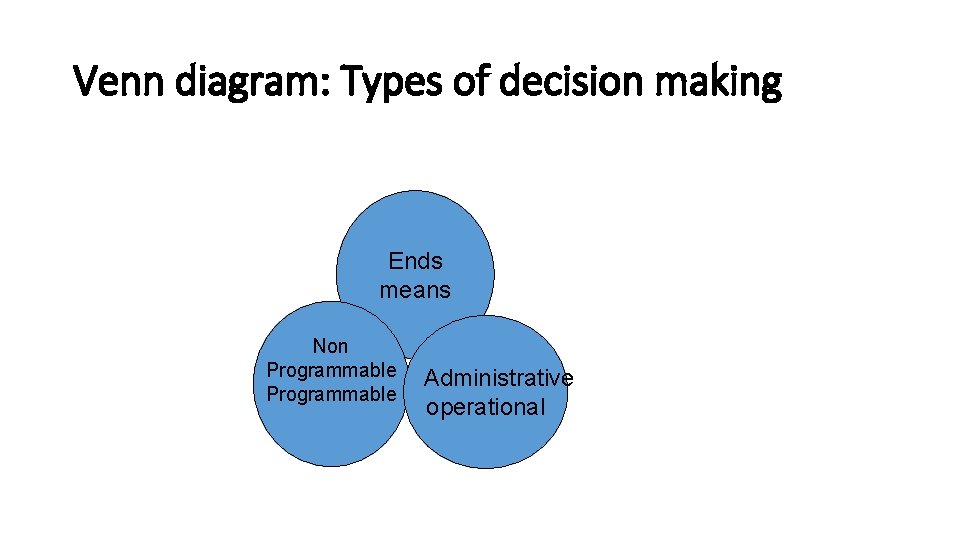
Venn diagram: Types of decision making Ends means Non Programmable Administrative operational 4
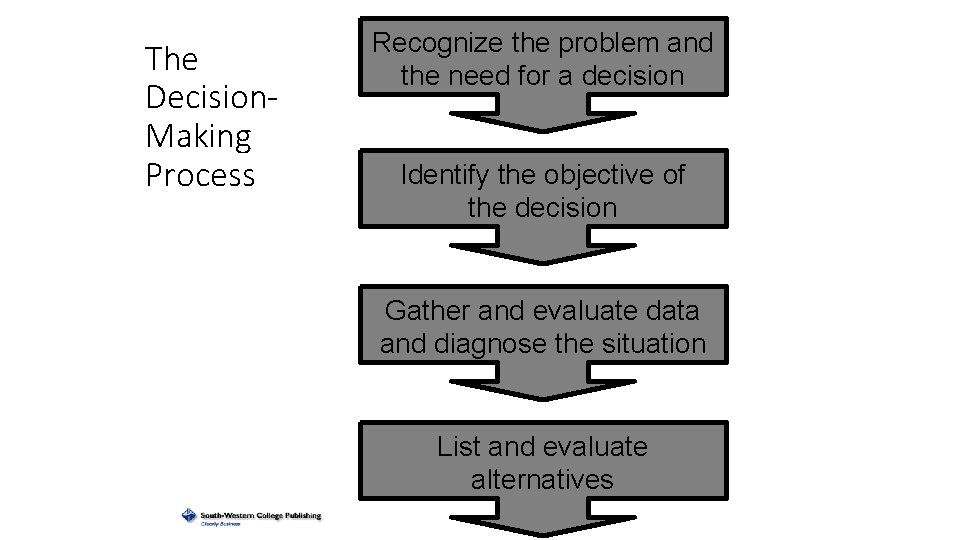
The Decision. Making Process Recognize the problem and the need for a decision Identify the objective of the decision Gather and evaluate data and diagnose the situation List and evaluate alternatives
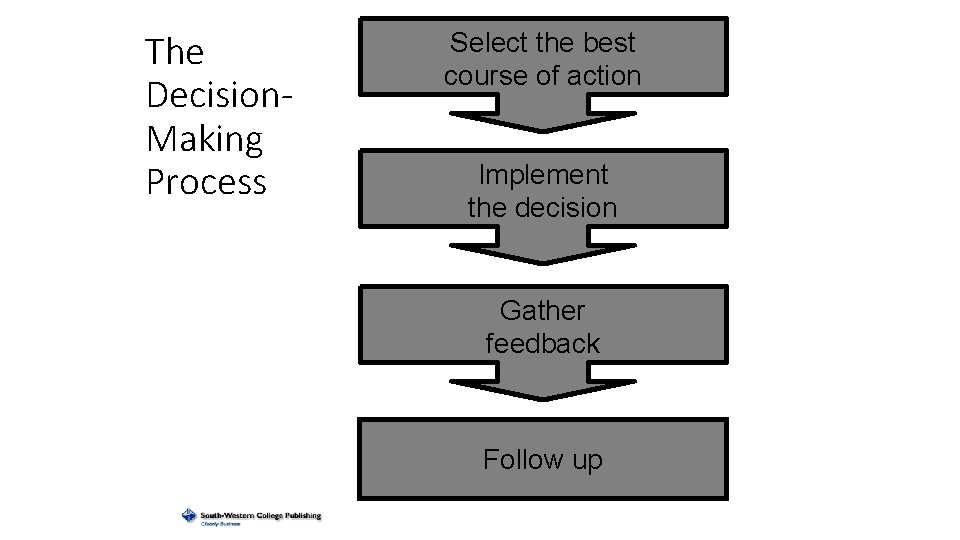
The Decision. Making Process Select the best course of action Implement the decision Gather feedback Follow up

Decision-making process steps 1. Identify existing problems. 2. List possible alternatives for solving the problem. 3. Select the most beneficial of these alternatives. 4. Implement the selected alternatives. 5. Gather feedback to find out if the implemented alternative is solving the identified problem. 7
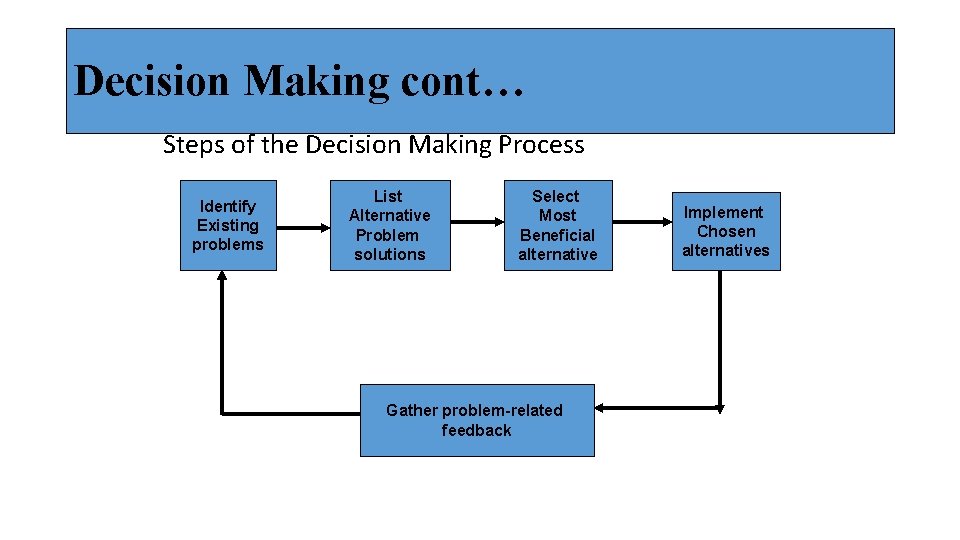
Decision Making cont… Steps of the Decision Making Process Identify Existing problems List Alternative Problem solutions Select Most Beneficial alternative Implement Chosen alternatives Gather problem-related feedback 8
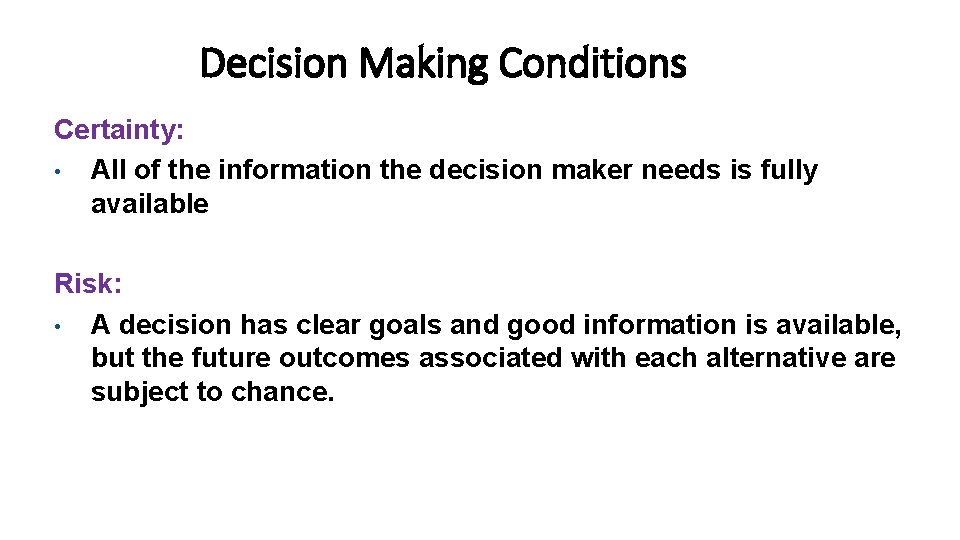
Decision Making Conditions Certainty: • All of the information the decision maker needs is fully available Risk: • A decision has clear goals and good information is available, but the future outcomes associated with each alternative are subject to chance. 6 -9
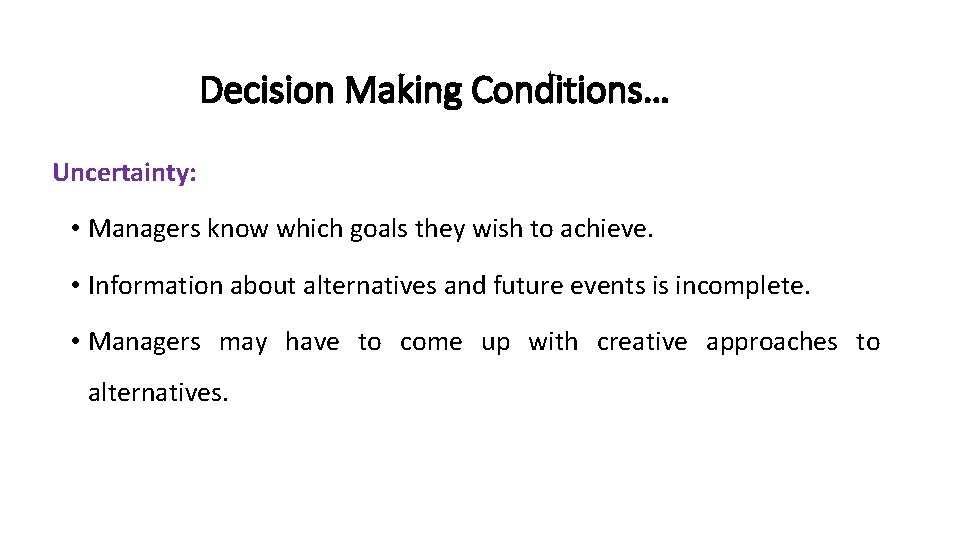
Decision Making Conditions… Uncertainty: • Managers know which goals they wish to achieve. • Information about alternatives and future events is incomplete. • Managers may have to come up with creative approaches to alternatives. 6 -10
Decision Making Conditions … Ambiguity • The goals to be achieved or the problem to be solved is unclear • Alternatives are difficult to define • Information about outcomes is unavailable. 6 -11

Conditions that affect the possibility of decision failure Organizational Problem Low Possibility of Failure Certainty Risk Uncertainty Programmed Decisions High Ambiguity Nonprogrammed Decisions Problem Solution 6 -12
Problem solving A Problem is a situation that endangers the organization’s ability to reach its desired objectives Problem solving is a process by which managers analyze situations & make decisions to bring about change so that actual organization results (outputs) more closely approximate those that are desired 13
Problem solving & decision-making model • Prospective Problem solving : • When performed in an anticipation of an events that might cause organizational failure • Retrospective Problem solving • When applied to deviations between actual & desired results • Concurrent Problem solving • When HSOs are committed to continuous improvement of quality & productivity 14

Basic steps in problem solving processes • Problem analysis : problem recognition & definition include data collection & evaluation. • Making assumptions • Developing tentative alternative solutions & selecting those to be considered in depth • Evaluating alternative solutions by applying decision criteria • Selecting the alternative that best fits the criteria • Implementing the solution • Evaluating results 15
Conflict Management in the Health Sector 16
Definition • Conflict is the perception of differences of interests among people. • Conflict is a process of social interaction involving a struggle over claims to resources, power and status, beliefs, and other preferences and desires. • Conflict is a process; • it develops out of existing relationships between individuals or groups and reflects their past interactions and the contexts in which these took place; and • Actions by one or both sides do, in fact, produce obstructing of others’ goals 17
Philosophies of Organizational Conflict • Robbins (1974) presented three philosophies of organizational conflict: 1. The classicists’, or traditionalists’ philosophy which was based on the assumption that conflict is detrimental to an organization and, as such, must be reduced or eliminated. 2. The behaviourists’ philosophy, which can best be described as • the recognition that conflict is inevitable in organizations. • Behavioralists accept the presence of conflict and even occasionally advocate the enhancement of conflict for increasing organizational effectiveness. • But they have not actively created conditions that generate conflict in 18
Philosophies… 3. The interactionist philosophy is characterized by : • Recognition of the absolute necessity of conflict; • Explicit encouragement of opposition; • Defining conflict management to include stimulation as well as resolution methods; and Considering the management of conflict as a major responsibility of all administrators • Therefore, the central theme is that too little conflict may encourage group thinking, but too much conflict may lead to organizational disintegration. 19
Causes of conflict in modern organizations • Globalization with the consequent need for greater understanding and effectiveness in dealing with cross-cultural dynamics • Constant and a more rapid rate of change especially in the external environment for organizations causing a lag effect 20
Causes of conflict… • Increasing complexity of work in most organizations, which leads to many perspectives and viewpoints • Increasing electronic communication, particularly e-mail, which causes • less face-to-face contact (losing the benefit of non-verbal cues) and • more “freedom” to communicate in confrontive, potentially hostile ways 21
Outcomes of conflict • Functional Outcomes • Conflict may stimulate innovation, creativity, and growth. • Organizational decision making may be improved. • Alternative solutions to a problem may be found. • Conflict may lead to synergistic solutions to common problems. • Individual and group performance may be enhanced. • Individuals and groups may be forced to search for new approaches. • Individuals and groups may be required to articulate and clarify their positions. 22
Outcomes… • Dysfunctional Outcomes • Conflict may cause job stress, burnout, and dissatisfaction. • Communication between individuals and groups may be reduced. • A climate of distrust and suspicion can be developed. • Relationships may be damaged. • Job performance may be reduced. • Resistance to change can increase. • Organizational commitment and loyalty may be affected. 23
Classifying conflict • Conflict in organizations can be addressed and understood at four levels or interfaces: • the individual with the organization • individuals with one another • organizational units with other units • inter-organizational relationships. 24
Conflict Management • Although conflict is often said to be functional for organizations, most recommendations relating to organizational conflict still fall within the realm of conflict resolution, reduction, or minimization. • If we have to confirm with the suggestion that “conflict is functional for organizations” the emphasis must be in conflict management, as opposed to resolution of conflict. • Conflict resolution implies reduction, elimination, or termination of conflict. 25
Conflict Management… • Conflict management does not necessarily imply avoidance, reduction, or termination of conflict. • It involves designing effective strategies to minimize the dysfunctions outcome of conflict and enhancing the constructive functions of conflict in order to enhance learning and effectiveness of an organization. 26
Conflict Management… • When conflict arises, managers and supervisors who are in a position to influence and affect the attitudes and actions of those in disagreement may find it helpful to • • identify the causes and feelings of the parties involved, redirect tension and hostility, work to integrate ideas rather than accept a compromise, achieve unity between the parties in conflict, accomplish real and permanent solutions, achieve a sense of fairness among those involved, and result in satisfaction for all of the parties involved 27
Conflict Management… • Individuals and groups with a positive outlook tend to be more • optimistic and have hope for a good resolution of conflict • forgiving of others and will use more creativity in seeking solutions • accurately perceive the arguments that others may present and • relaxed so that defensive barriers are lowered and listening is done more effectively 28
Approaches for conflict management • The Leadership Grid Approach • The Thomas-Kilmann Conflict Mode • Robbins’ Approach to Conflict Management • The modern approach ( Filly's categories) 29
1. The Leadership Grid Approach • Developed by Blake and Mc. Canse • Each of the Grid positions represents a different philosophy and a different set of priorities. 30

The Leadership Grid 31
The Leadership Grid … • The (1, 1) type of leader • is afraid that performance goals and people-related efforts are in conflict; • the supervisor’s role is to remain neutral and not get involved in the struggle • The (9, 1) leader • has a primary concern for productivity. • all efforts are directed at getting work done whatever the cost may be. • The 1, 9 leader has • a low concern for performance but a high desire to have happy, satisfied people. • Whatever makes people happy is what the 1, 9 leader concentrates upon. • The 5, 5 leader has • a moderate concern for performance and for human needs simultaneously. 32
The Leadership Grid … • The 9, 9 leader • believes that high performance results from the integration of task and human requirements. • aims to attain high performance as well as a high level of satisfaction through participation and involvement 33
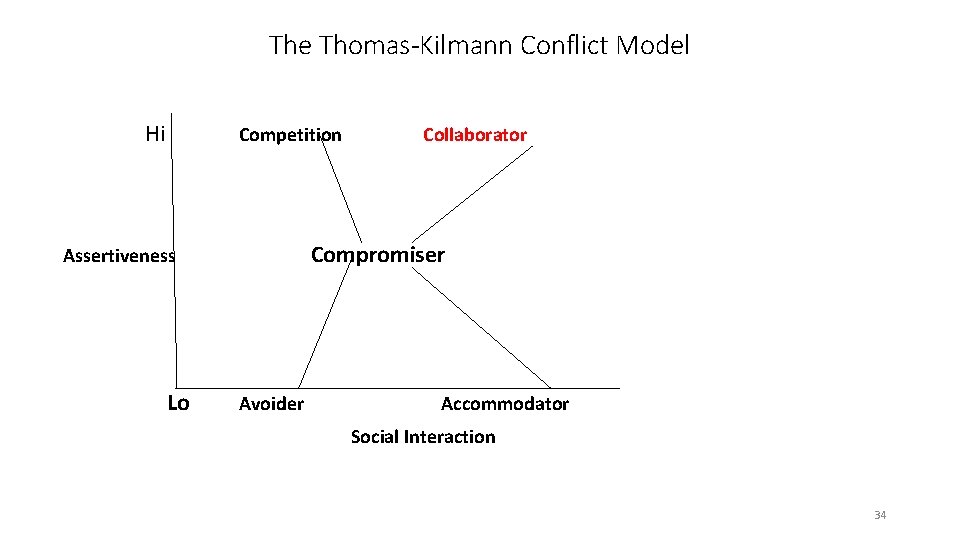
The Thomas-Kilmann Conflict Model Hi Competition Compromiser Assertiveness Lo Collaborator Avoider Accommodator Social Interaction 34
Cont… 1. Avioder/withdrawal/ • • Low assertiveness and social interaction “ It is ok, I will sit alone in the dark’’ 35
Avoiding or Inaction The goal is to do nothing or delay • Denial of the existence of conflict or unwillingness to deal with the issues • “No way’’ You may be using this style if you: 1. Avoid situations that create tension 2. Avoid controversy 3. Avoid open discussions of issues or concerns 4. Postpone difficult negotiations 36
2. Accommodator • Low assertiveness but high social interaction • “Let’s all sit together in the dark’’ 37
Accommodating or Obliging The goal is to let the other party win • Giving the other side what they ask or demand • “Your way” You may be using this style if you: 1. Focus on other parties concerns more than your own 2. Trying to help the other party even when it means giving something up 3. Trying to keep the other party happy 4. Trying not to hurt the other parties feelings 38
Cont… 3. Collaborator/problem solving/ • • High assertiveness and high social interaction “ Let’s change the light bulb together’’ 39
Collaborating or Integrating The goal is to find a win/win solution • An open problem-solving approach to meet everyone’s interests to greatest extent possible • “Our way” You are negotiating with a collaborating style if you: 1. Bring issues into the open. 2. Issues are important to both parties. 3. Looking for creative solutions. 4. Seek to build trust and satisfy both parties. 5. Exchange information and ideas freely 40
4. Competitor • High assertiveness and low concern for social acceptance • “ My room is better, let them yours’’ 41
Cont… 5. Compromiser/ Sharing/ • Combines qualities of the above • “ Today we will sit in the dark, tomorrow we will sit in the light ” 42
Compromising The goal is to find a middle ground • A pragmatic approach of trading concessions to make a deal • “Half way” You may be using this style if you are: 1. Splitting the difference. 2. Giving up something for something in return. 3. Taking an intermediate position 4. Engaging in give and take 43
3. Robbins’ Approach to Conflict Management • In his description of managerial actions related to conflict, Robbins identifies nine possible responses: • • • problem solving, development of super ordinate goals, expansion of resources, avoidance, suppression, smoothing, compromise, authoritative command, and alteration of the behaviour of one or more parties involved. 44
Robbins’ Approach… • Robbins states that the scientific process used as causes of conflict are identified and solutions are developed. • Individuals affected by a decision are involved in making the decision. • Conflict is avoided or reduced as people come to share common goals requiring combined efforts. • Expansion of resources may be useful when it is possible to obtain more money, equipment, inventory, or whatever scarcity is causing conflict. • Behavior alteration comes about when employee actions are changed by rising education, training, reinforcement, and so forth. 45
Mediation and Arbitration • Are additional procedures frequently discussed as management activities for handling conflict • Mediation • similar to compromise in its result; it aims to bring about a middle-ground, mutually acceptable decision or solution. • similar to collaboration in that people are brought together to talk about their positions and to find a solution. • Manager’s role is to act as a leader in bringing the parties and their views together. • The leader does not make decisions for the parties involved. 46
Mediation and Arbitration… • Arbitration • the arbitrator listens to all sides of an issue as the different parties in conflict are encouraged to state their positions. • The arbitrator reviews the evidence and then makes a decision or agrees to a solution. • Usually, the arbitrator’s decision is binding for all individuals and groups involved. 47
Choosing an Appropriate Approach • The best approach selected from the styles for dealing with conflict can be determined by factors in the situation in addition to the philosophical desires of the manager. • There is no one best way to handle all conflict, since each situation is different. • Robbins suggests that the interactionist approach to conflict is appropriate today. • He sees conflict as absolutely essential for growth and change. • He suggests creating conflict if necessary, but he expects conflict to occur naturally in vibrant, thriving organizations. 48
Choosing… • His view • recognizes the absolute necessity of conflict, • explicitly encourages opposition, • defines conflict management to include stimulation as well as resolution methods, and • considers the management of conflict as a major responsibility of all administrators. 49
Choosing… • The choice of approaches will be dependent upon forces within the • leader, • other employees, • organization, and • task situation. 50
Choosing… • Although the collaborative approach to the resolution of conflict has the potential for accomplishing all of the objectives of conflict management, it also requires skill and commitment to this approach from the manager. 51
Cont… The modern approach ( Filly's categories) a) Win-Lose method – Is based on force – Personal goals are satisfied at another expense through the use of authorities b) Lose-Lose Method – – Neither party being truly satisfied With no clear winner 52
Cont… c) Win - Win method • The most constructive resolution but most difficult to reach • Finally settle the most mutually beneficial solution 53
- Slides: 53