
Chapter Introduction Section 1 Forming Public Opinion Section
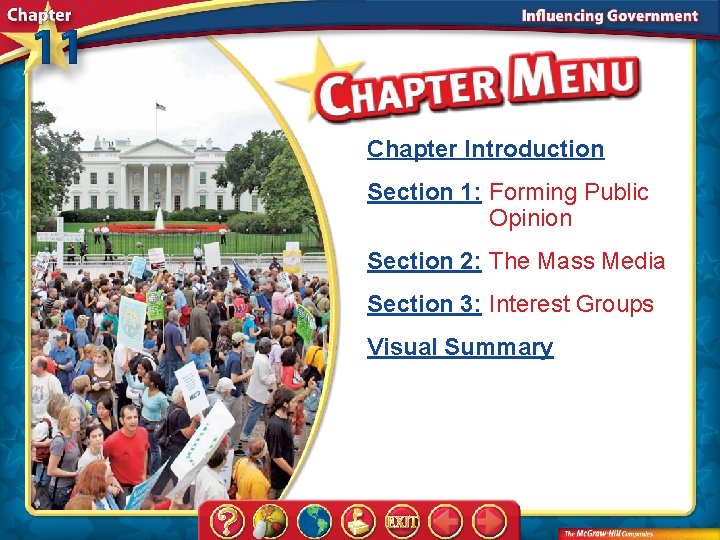
Chapter Introduction Section 1: Forming Public Opinion Section 2: The Mass Media Section 3: Interest Groups Visual Summary
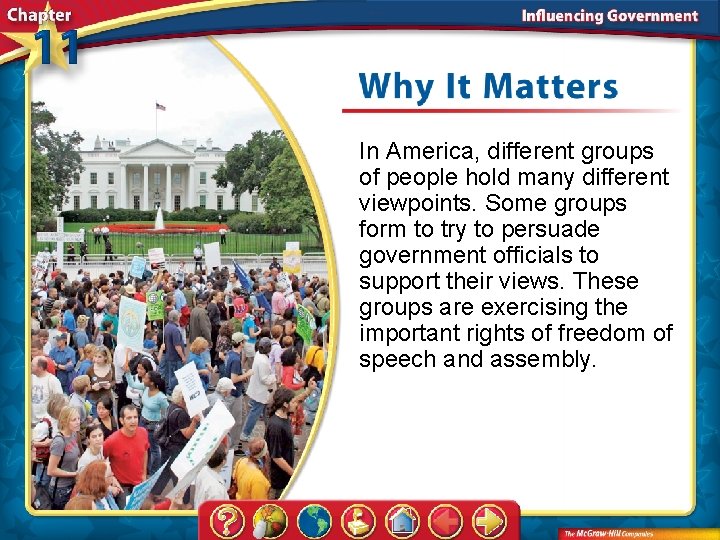
In America, different groups of people hold many different viewpoints. Some groups form to try to persuade government officials to support their views. These groups are exercising the important rights of freedom of speech and assembly.
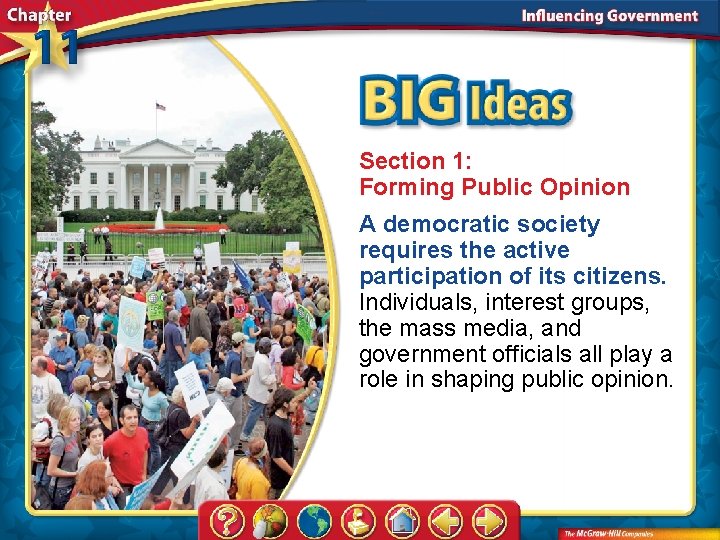
Section 1: Forming Public Opinion A democratic society requires the active participation of its citizens. Individuals, interest groups, the mass media, and government officials all play a role in shaping public opinion.
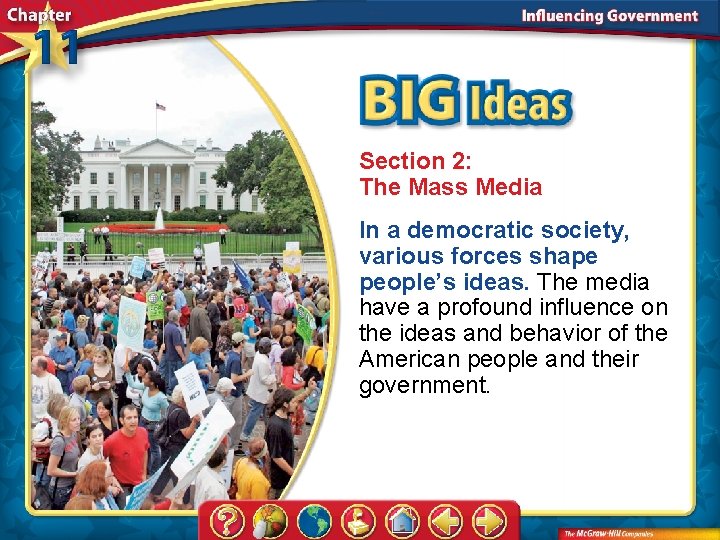
Section 2: The Mass Media In a democratic society, various forces shape people’s ideas. The media have a profound influence on the ideas and behavior of the American people and their government.

Section 3: Interest Groups Political and economic institutions evolve to help individuals and groups accomplish their goals. Interest groups, a powerful force in our democracy, use various techniques to influence public opinion and policy.
Guide to Reading Big Idea A democratic society requires active participation of its citizens.
Guide to Reading Content Vocabulary • public opinion • mass media • interest group • public opinion poll • pollster Academic Vocabulary • uniform • gender • survey
Do you agree that politicians should ignore public opinion and do what they believe is best for the country? A. Agree B. Disagree A. A B. B
Public Opinion Public opinion, the ideas and attitudes most people hold, plays a vital role in our democracy.
Public Opinion (cont. ) • Public opinion refers to ideas and attitudes people hold about a particular issue or person. • Public opinion is of political importance.
Public Opinion (cont. ) • Sources of public opinion: – Personal background (age, gender, income, race, religion, occupation, place of residence) – Mass media – Public officials – Interest groups
Public Opinion (cont. ) • Three features of public opinion: – Direction – Intensity – Stability
The mass media A. have little influence on the public’s understanding of important issues. B. distort the public’s understanding of important issues. C. help the public to understand important issues. D. have a significant impact on the public’s understanding of important issues. A. B. C. D. A B C D
Measuring Public Opinion The most common way of measuring public opinion is with public opinion polls.
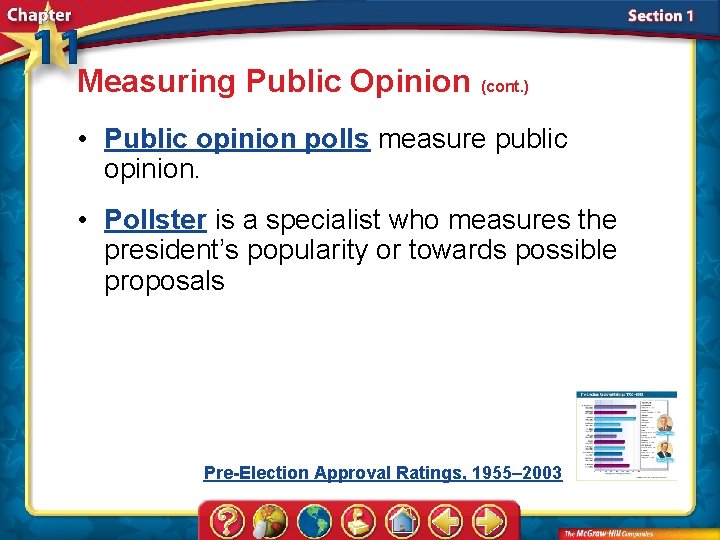
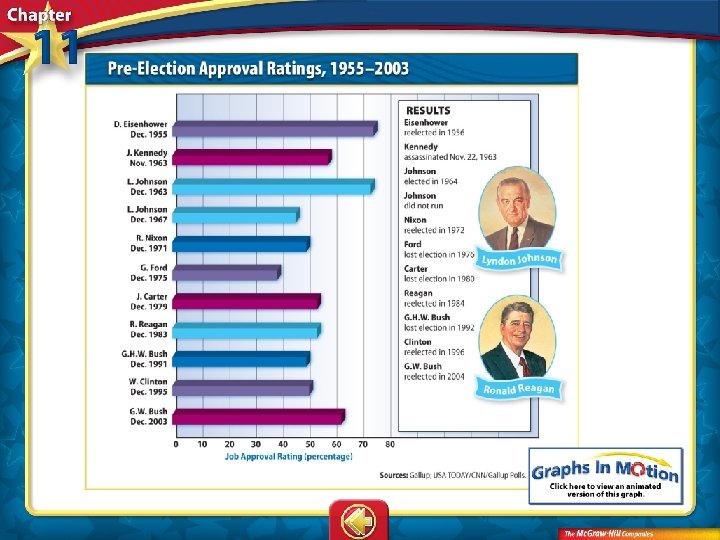
Measuring Public Opinion (cont. ) • Public opinion polls measure public opinion. • Pollster is a specialist who measures the president’s popularity or towards possible proposals Pre-Election Approval Ratings, 1955– 2003
Measuring Public Opinion (cont. ) • Sampling public opinion: – People in sample are selected at random – Well-constructed sample reflects the entire population – Wording questions to find people’s true opinions – Push polls worded to influence responses
Measuring Public Opinion (cont. ) • Arguments for and against polling: – Allows officeholders to keep in touch with citizens’ ideas – Makes officials more concerned with public opinion than leadership and decision-making – Affect elections and voter turnout
Do you think pollsters hired by elected officials should use push polls? A. Yes B. No A. A B. B
Guide to Reading Big Idea In a democratic society, various forces shape people’s ideas.
Guide to Reading Content Vocabulary • print media • leak • electronic media • prior restraint • public agenda • libel • malice Academic Vocabulary • acknowledge • benefit • regulatory
Do you think that the media’s need to make a profit causes the media to misrepresent some issues? A. Yes B. No A. A B. B
The Media’s Impact The nation’s media are an important influence on politics and government and also help set the public agenda.
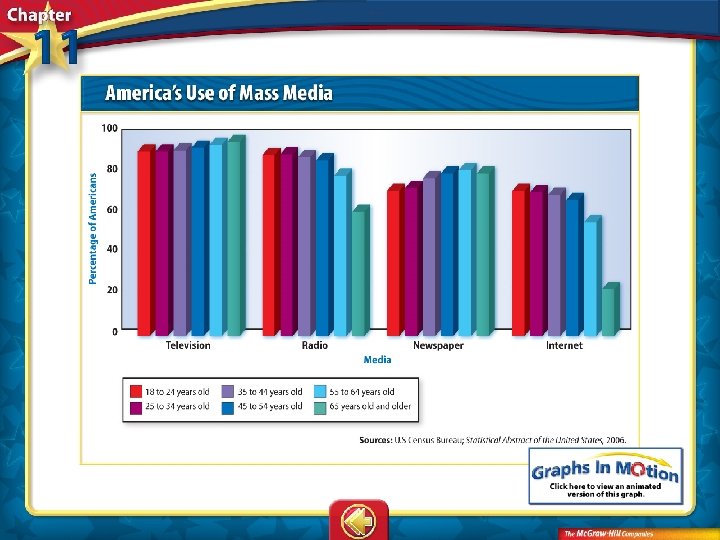
The Media’s Impact (cont. ) • The mass media influences politics and government, and connects the people and elected officials. America’s Use of Mass Media
The Media’s Impact (cont. ) • Newspapers, magazines, newsletters, and books as examples of print media • Radio, television, and the Internet as examples of electronic media • Influence of profit on news coverage America’s Use of Mass Media
The Media’s Impact (cont. ) • Influence of the media on: – The public agenda – Political candidates America’s Use of Mass Media
The Media’s Impact (cont. ) • Relationship between politicians and journalists • Purpose of government leaks to the media • Watchdog role of the mass media • Conflicts between national security and citizens’ need for information America’s Use of Mass Media
Government leaks A. allow officials to test public reactions to specific policies. B. are sometimes intended to damage a competitor’s reputation. C. can be of great benefit to journalists. D. All the above A. B. C. D. A B C D
Media Safeguards Freedom of the press is protected by the U. S. Constitution, although some regulation is permitted.
Media Safeguards (cont. ) • The government protects the ability of the mass media to operate freely. • The First Amendment and freedom of the press • Freedom from prior restraint • Libel and limits to freedom of the press • Supreme Court ruled that public officials must prove actual malice, or evil intent, by publisher
Media Safeguards (cont. ) • The media’s right to keep sources secret • The Federal Communications Commission (FCC) as a regulatory commission of the federal bureaucracy
Do you think the FCC should have increased powers to censor the content of television broadcasts? A. Yes B. No A. A B. B
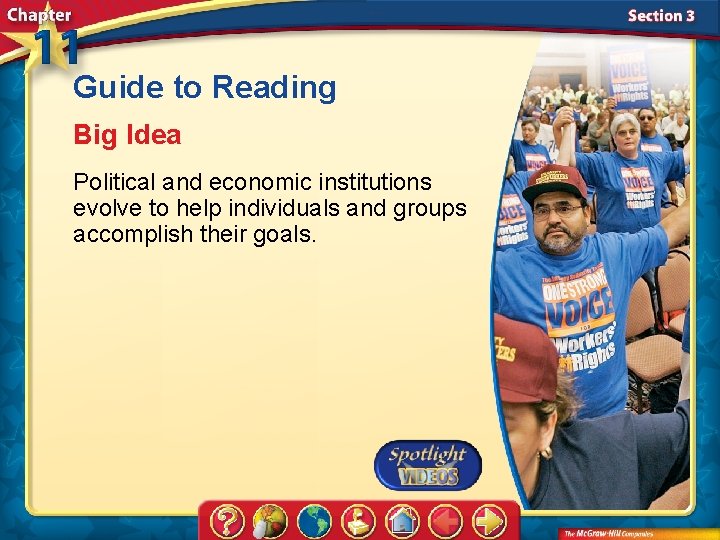
Guide to Reading Big Idea Political and economic institutions evolve to help individuals and groups accomplish their goals.
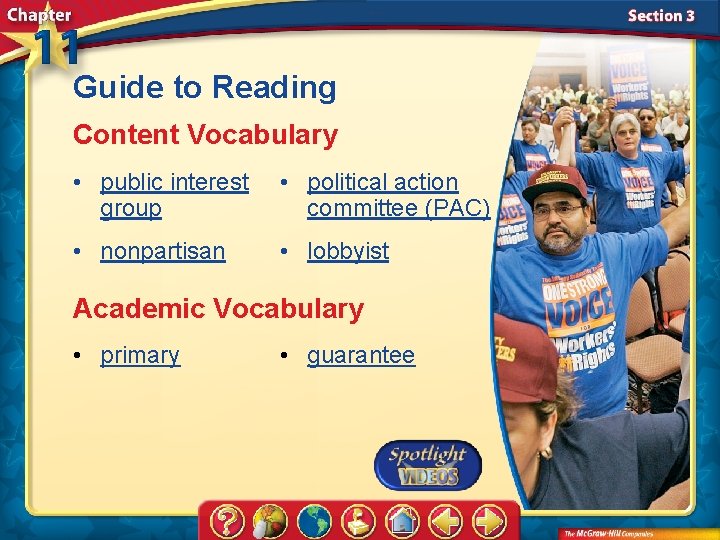
Guide to Reading Content Vocabulary • public interest group • political action committee (PAC) • nonpartisan • lobbyist Academic Vocabulary • primary • guarantee
Do you agree that groups with greater financial resources can exercise more influence over public policy than groups with fewer financial resources? A. Agree B. Disagree A. A B. B
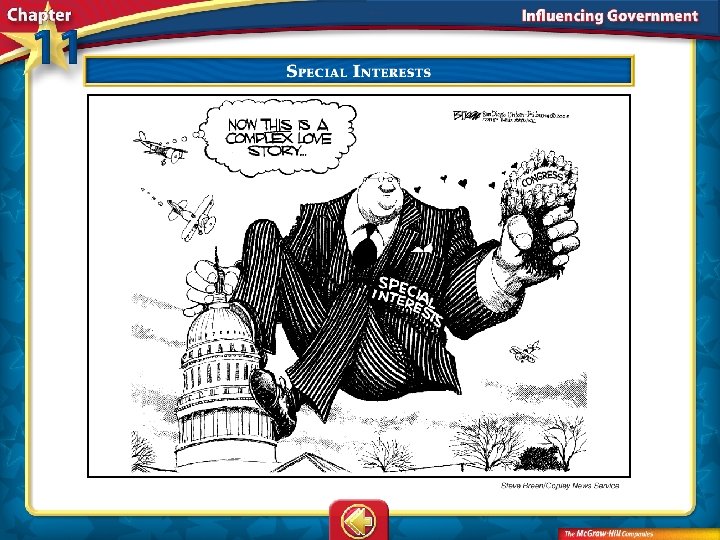
Types of Interest Groups Interest groups are an important part of our democratic process because they influence public policy.
Types of Interest Groups (cont. ) • Interest groups are organizations of people who unite to promote their ideas.
Types of Interest Groups (cont. ) • Economic interest groups: – U. S. Chamber of Commerce promoting free enterprise – Tobacco Institute representing cigarette manufacturers – AFL-CIO representing workers – The American Medical Association representing doctors
Types of Interest Groups (cont. ) • Other interest groups: – NAACP improving the lives of African Americans – NOW representing women’s interests – AARP promoting interests of older Americans – Sierra Club protecting nature – NRA looking after interests of gun owners
Types of Interest Groups (cont. ) • Public interest groups working to benefit Americans in general − League of Women Voters is an example of a nonpartisan, or impartial group • Interests groups supporting candidates and forming political action committees • Interest groups bringing cases to court
Types of Interest Groups (cont. ) • Interest groups influencing lawmakers by using lobbyists who: – have a good understanding of how the government functions. – know which government department to contact about concerns. – supply lawmakers with useful information that help their own cases.
Types of Interest Groups (cont. ) – suggest solutions and problems to lawmakers. – prepare their own drafts of bills for lawmakers. – testify in legislative hearings on bills. – see that laws are enforced.
Do you think that interest groups have too much influence in determining the laws and policies of the United States? A. Yes B. No A. A B. B
Techniques Interest Groups Use Interest groups use various techniques to influence public opinion and policy.
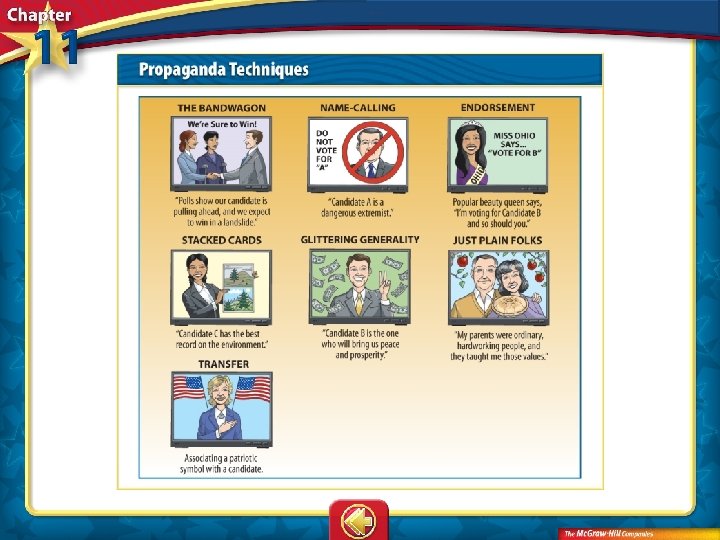
Techniques Interest Groups Use (cont. ) • Interest groups use a variety of techniques to influence public opinion and policy: – Direct mail – Advertising – Organize public events and protests – Propaganda Techniques
Techniques Interest Groups Use (cont. ) • Regulating interest groups: – Limits on PAC contributions – Registration and disclosure requirements for lobbyists – Waiting period before former government officials can become lobbyists
Techniques Interest Groups Use (cont. ) • Controversy surrounding interest groups and lobbying
Do you agree that the practice of lobbying can easily lead to corruption and should therefore be outlawed? A. Agree B. Disagree A. A B. B
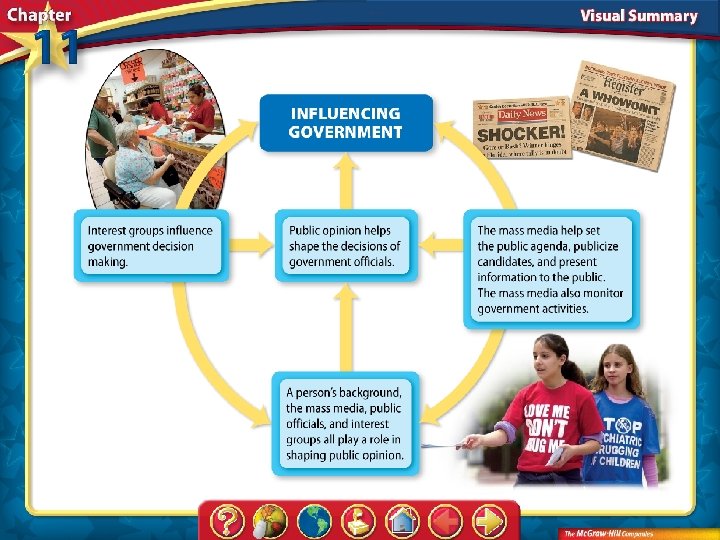
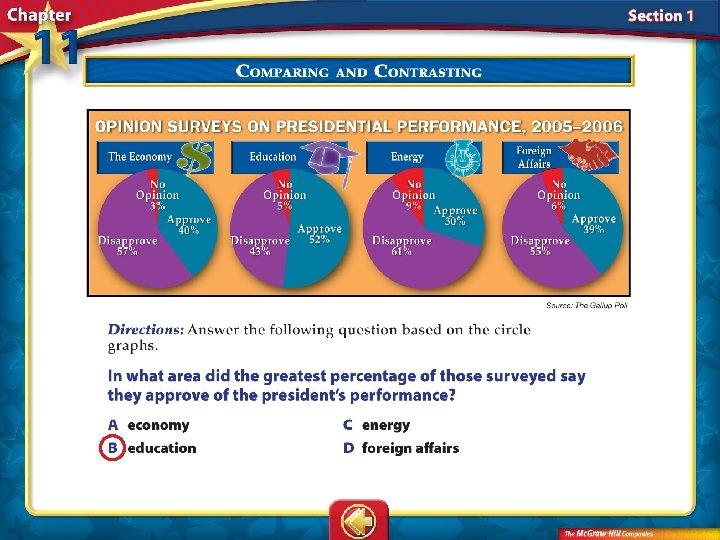
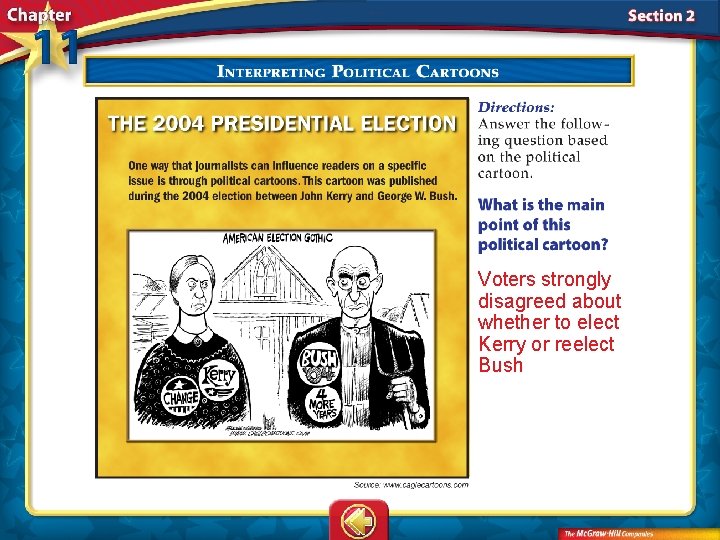
Voters strongly disagreed about whether to elect Kerry or reelect Bush
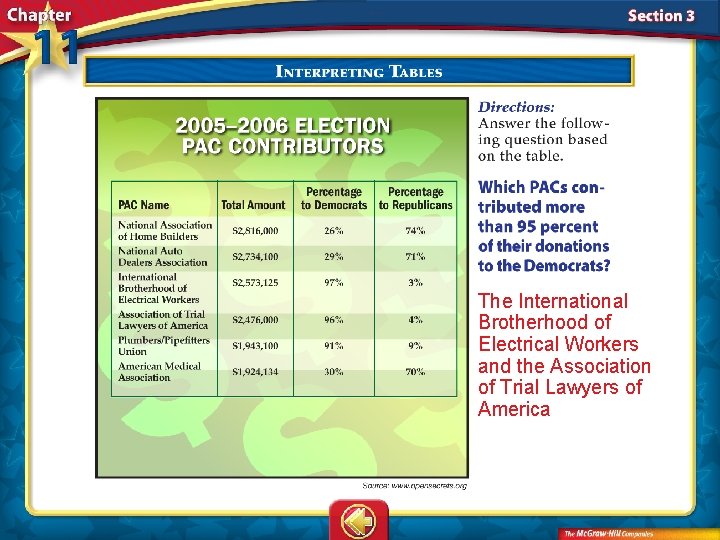
The International Brotherhood of Electrical Workers and the Association of Trial Lawyers of America
public opinion the ideas and attitudes that most people hold about elected officials, candidates, government, and political issues
mass media a mechanism of mass communication, including television, radio, newspapers, magazines, recordings, movies, and books
interest group a group of people who share a point of view about an issue and unite to promote their beliefs
public opinion poll a survey in which individuals are asked to answer questions about a particular issue or person
pollster a specialist whose job is to conduct polls regularly
uniform consistent or unvarying
gender a notion of the sex of a person
survey to determine the size, shape, and position of; to gather information about, as in a poll
print media newspapers, magazines, newsletters, and books
electronic media radio, television, and the Internet
public agenda issues considered most significant by government officials
leak the release of secret government information by anonymous government officials to the media
prior restraint government censorship of material before it is published
libel written untruths that are harmful to someone’s reputation
malice evil intent
acknowledge to recognize the existence of or to make something known
benefit to be useful or profitable to
regulatory used to describe an agency or body whose function is to control or govern
public interest group an organization that supports causes that affect the lives of Americans in general
nonpartisan free from party ties or bias
political action committee (PAC) political organization established by a corporation, labor union, or other special-interest group designed to support candidates by contributing money
lobbyist representative of an interest group who contacts lawmakers or other government officials directly to influence their policy making
primary first in time or importance
guarantee to promise or give security
To use this Presentation Plus! product: Click the Forward button to go to the next slide. Click the Previous button to return to the previous slide. Click the Home button to return to the Chapter Menu. Click the Transparency button from the Chapter Menu or Chapter Introduction slides to access the TIME Transparency that is relevant to this chapter. From within a section, click on this button to access the relevant Daily Focus Skills Transparency. Click the Return button in a feature to return to the main presentation. Click the Economics Online button to access online textbook features. Click the Reference Atlas button to access the Interactive Reference Atlas. Click the Exit button or press the Escape key [Esc] to end the chapter slide show. Click the Help button to access this screen. Links to Presentation Plus! features such as Graphs in Motion, Charts in Motion, and figures from your textbook are located at the bottom of relevant screens.

This slide is intentionally blank.
- Slides: 87