
Chapter Introduction Lesson 1 Sexual Reproduction and Meiosis
- Slides: 66
Chapter Introduction Lesson 1 Sexual Reproduction and Meiosis Lesson 2 Asexual Reproduction Chapter Wrap-Up Digital Vision Ltd. /Super. Stock
Why do living things reproduce?
What do you think? Before you begin, decide if you agree or disagree with each of these statements. As you view this presentation, see if you change your mind about any of the statements.
Do you agree or disagree? 1. Humans produce two types of cells: body cells and sex cells. 2. Environmental factors can cause variation among individuals. 3. Two parents always produce the best offspring.
Do you agree or disagree? 4. Cloning produces identical individuals from one cell. 5. All organisms have two parents. 6. Asexual reproduction occurs only in microorganisms.
Sexual Reproduction and Meiosis • What is sexual reproduction, and why is it beneficial? • What is the order of the phases of meiosis, and what happens during each phase? • Why is meiosis important?
Sexual Reproduction and Meiosis • sexual reproduction • diploid • egg • homologous chromosomes • sperm • haploid • fertilization • meiosis • zygote
What is sexual reproduction? • Sexual reproduction is a type of reproduction in which the genetic materials from two different cells combine, producing an offspring. • The female sex cell, an egg, forms in an ovary. • The male sex cell, a sperm, forms in the testis.
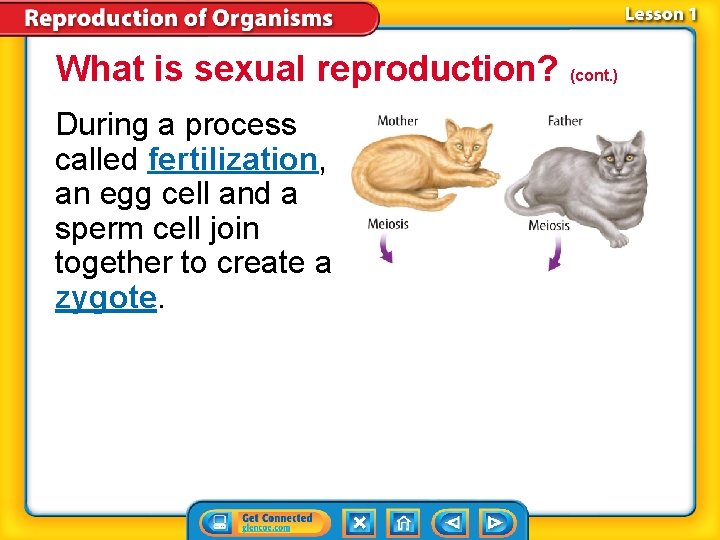
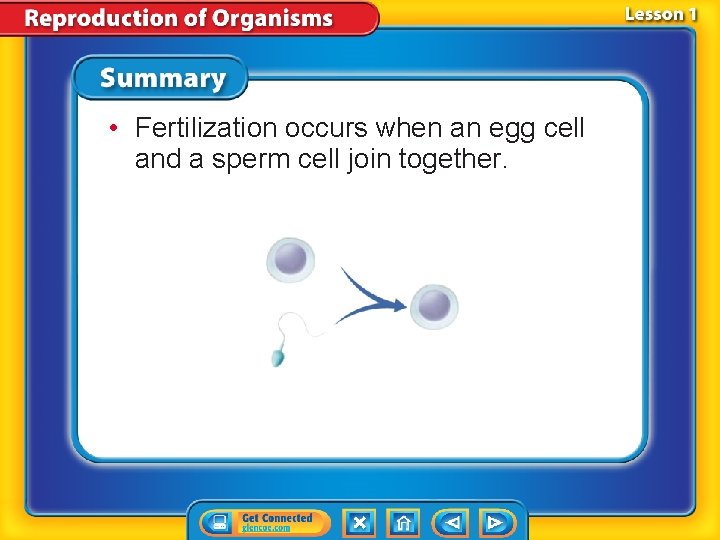
What is sexual reproduction? (cont. ) During a process called fertilization, an egg cell and a sperm cell join together to create a zygote.
Diploid Cells • Organisms that reproduce sexually form body cells and sex cells. • In body cells of most organisms, similar chromosomes occur in pairs. • Diploid cells are cells that have pairs of chromosomes.
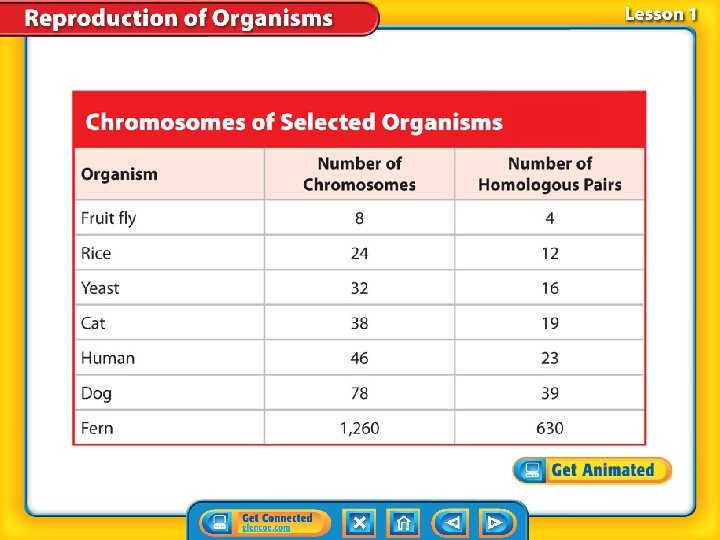
Diploid Cells (cont. ) • Pairs of chromosomes that have genes for the same traits arranged in the same order are called homologous chromosomes. • Because one chromosome is inherited from each parent, the chromosomes are not identical. • Different organisms have different numbers of chromosomes.
Haploid Cells Haploid cells are cells that have only one chromosome from each pair of chromosomes. haploid from Greek haploeides, means “single”
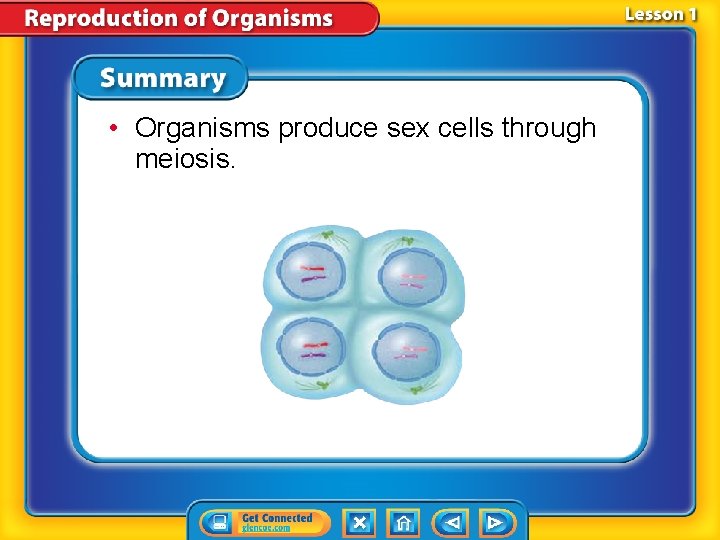
Haploid Cells (cont. ) • In meiosis, one diploid cell divides and makes four haploid sex cells. • Meiosis occurs only during the formation of sex cells. • Meiosis involves two divisions of the nucleus, meiosis I and meiosis II. • A reproductive cell goes through interphase before beginning meiosis I.
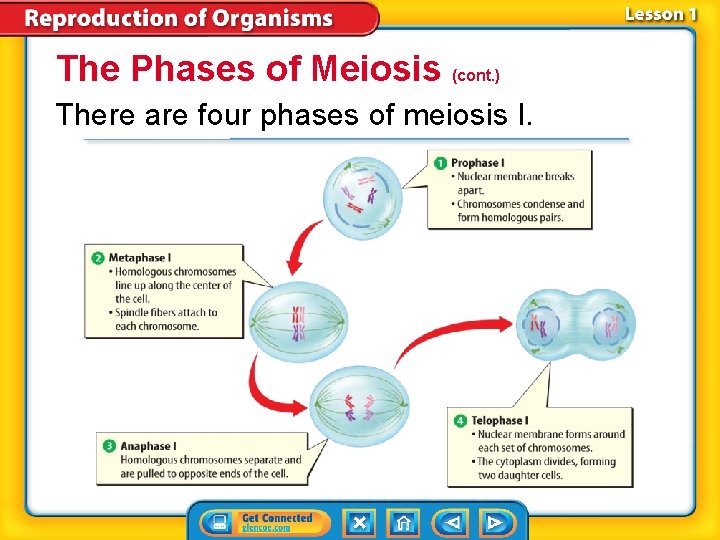
The Phases of Meiosis (cont. ) There are four phases of meiosis I.
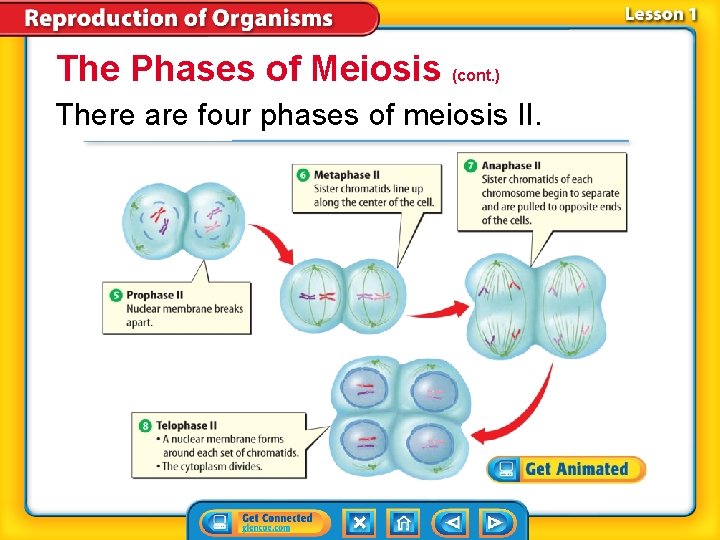
The Phases of Meiosis (cont. ) There are four phases of meiosis II.
The Phases of Meiosis (cont. ) List the phases of meiosis in order.
Why is meiosis important? • Meiosis forms sex cells with the correct haploid number of chromosomes. • Meiosis also creates genetic variation by producing haploid cells. • When haploid sex cells join together during fertilization, they make a diploid zygote, or fertilized egg.
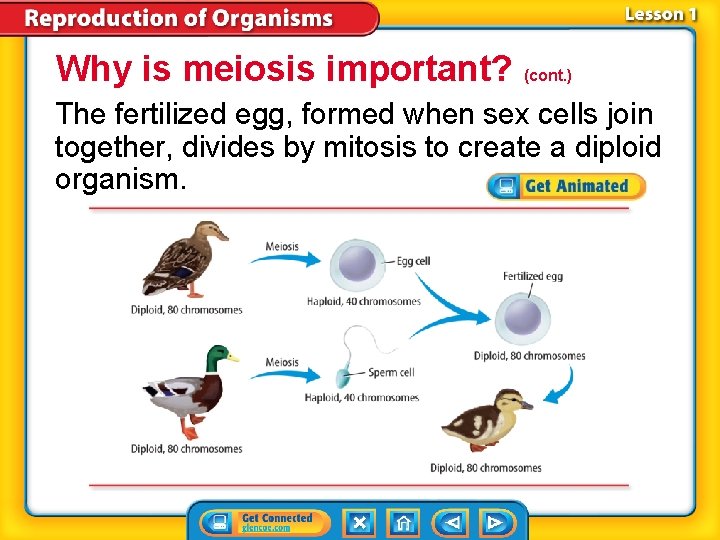
Why is meiosis important? (cont. ) The fertilized egg, formed when sex cells join together, divides by mitosis to create a diploid organism.
Why is meiosis important? (cont. ) Why is meiosis important?
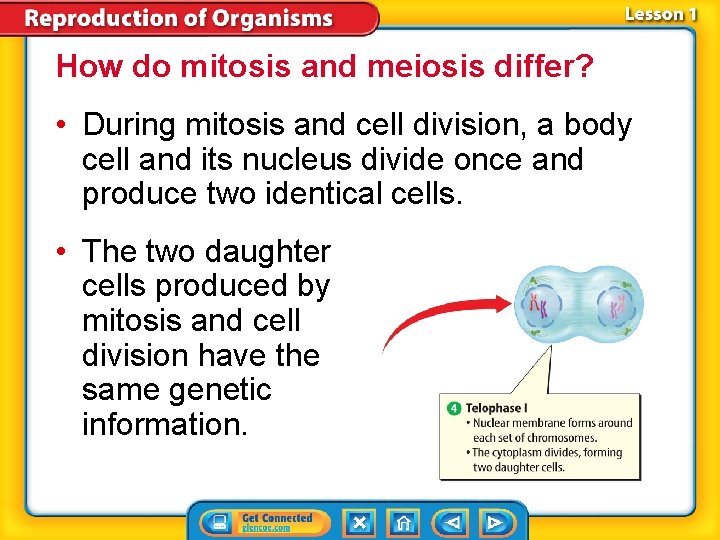
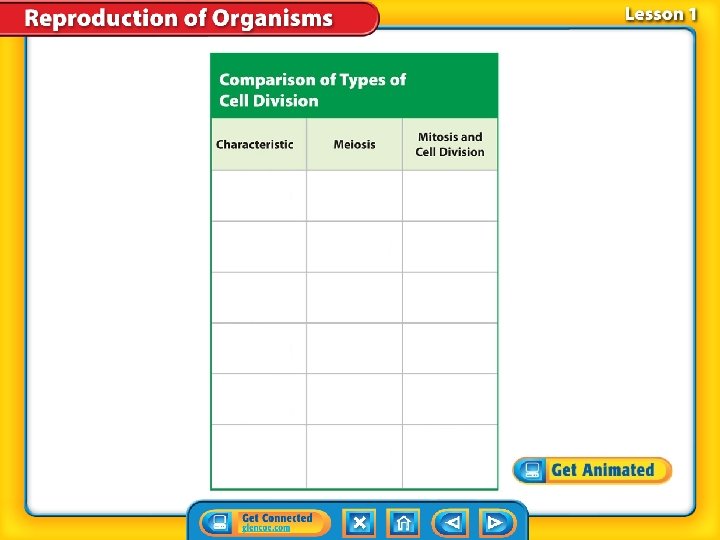
How do mitosis and meiosis differ? • During mitosis and cell division, a body cell and its nucleus divide once and produce two identical cells. • The two daughter cells produced by mitosis and cell division have the same genetic information.
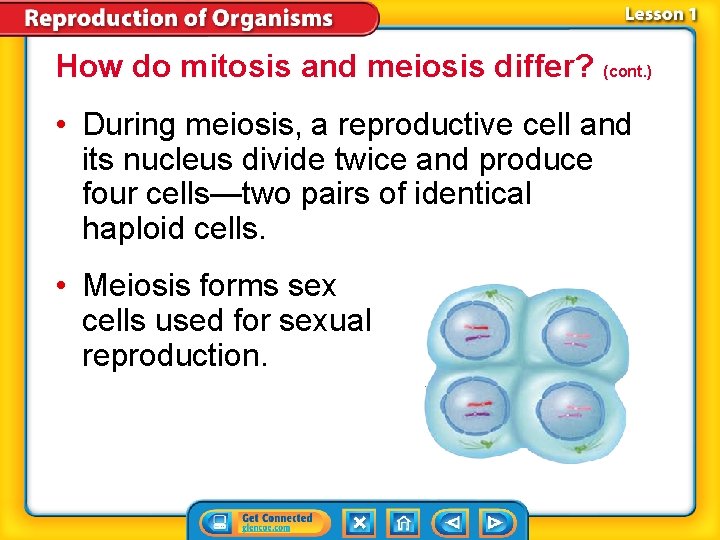
How do mitosis and meiosis differ? (cont. ) • During meiosis, a reproductive cell and its nucleus divide twice and produce four cells—two pairs of identical haploid cells. • Meiosis forms sex cells used for sexual reproduction.
Advantages of Sexual Reproduction • Genetic variation occurs in all organisms that reproduce sexually. • Due to genetic variation, individuals within a population have slight differences.
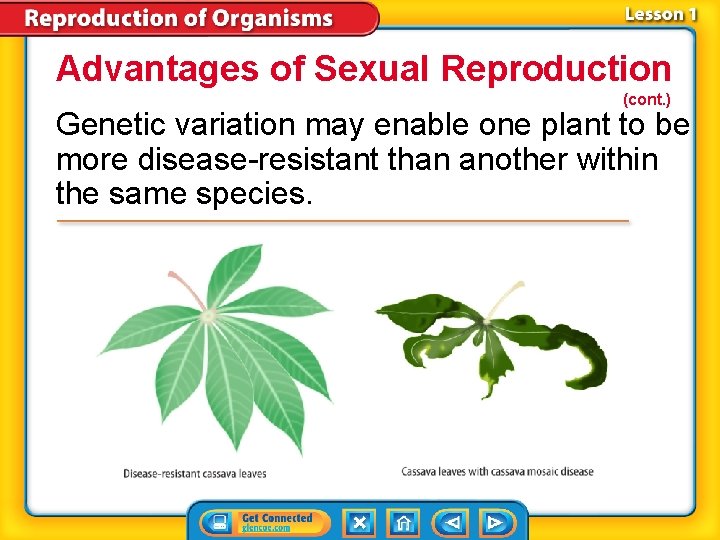
Advantages of Sexual Reproduction (cont. ) Genetic variation may enable one plant to be more disease-resistant than another within the same species.
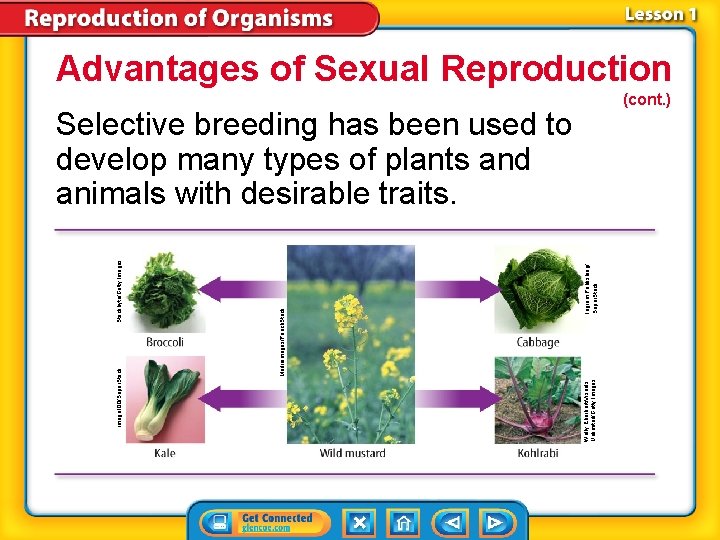
Advantages of Sexual Reproduction (cont. ) Ingram Publishing/ Super. Stock Wally Eberhart/Visuals Unlimited/Getty Images Medioimages/Punch. Stock image 100/Super. Stockbyte/Getty Images Selective breeding has been used to develop many types of plants and animals with desirable traits.
Advantages of Sexual Reproduction (cont. ) Why is sexual reproduction beneficial?
Disadvantages of Sexual Reproduction • Organisms have to grow and develop until they are mature enough to produce sex cells. • Organisms must form sex cells—either eggs or sperm.
• Fertilization occurs when an egg cell and a sperm cell join together.
• Organisms produce sex cells through meiosis.
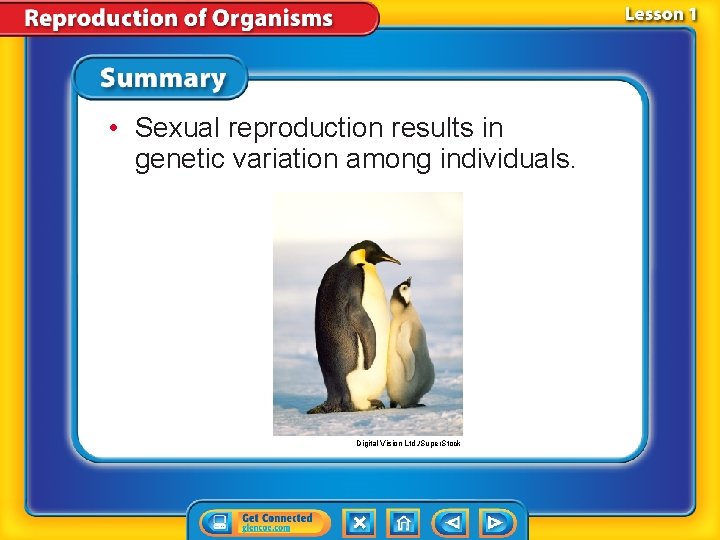
• Sexual reproduction results in genetic variation among individuals. Digital Vision Ltd. /Super. Stock
Cells that have pairs of chromosomes are called ____. A. chromosomes B. body cells C. diploid cells D. sex cells
During which process does one diploid cell divide and make four haploid sex cells? A. osmosis B. fertilization C. reproduction D. meiosis
During which phase of meiosis I do chromosome pairs separate and pull to opposite ends of the cell? A. prophase I C. anaphase II B. metaphase I D. anaphase I
Do you agree or disagree? 1. Humans produce two types of cells: body cells and sex cells. 2. Environmental factors can cause variation among individuals. 3. Two parents always produce the best offspring.
Asexual Reproduction • What is asexual reproduction, and why is it beneficial? • How do the types of asexual reproduction differ?
Asexual Reproduction • asexual reproduction • vegetative reproduction • fission • cloning • budding • regeneration
What is asexual reproduction? • In asexual reproduction, one parent organism produces offspring without meiosis and fertilization. • Because the offspring inherit all their DNA from one parent, they are genetically identical to each other and to their parent.
What is asexual reproduction? (cont. ) Describe asexual reproduction in your own words.
Types of Asexual Reproduction Cell division in prokaryotes is known as fission from Latin fissionem, means “a breaking up, cleaving”
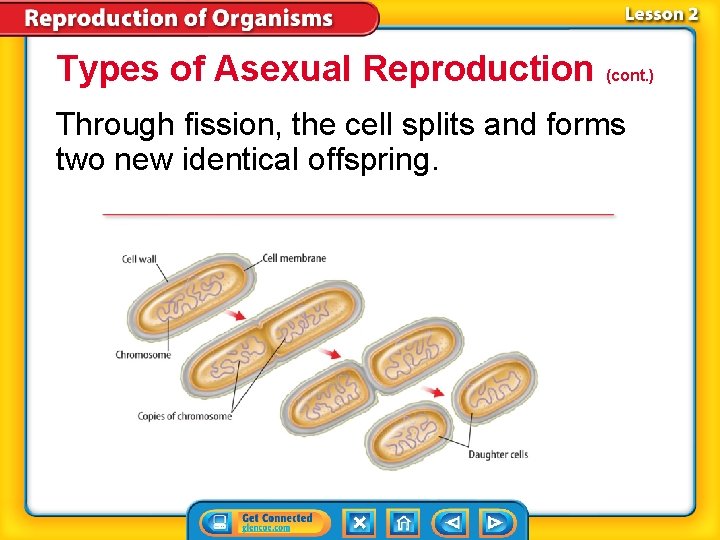
Types of Asexual Reproduction (cont. ) • A prokaryote’s DNA molecule is copied and each copy attaches to the cell membrane. • The cell grows longer, pulling the two copies of DNA apart while the cell membrane begins to pinch inward along the middle of the cell.
Types of Asexual Reproduction (cont. ) Through fission, the cell splits and forms two new identical offspring.
Types of Asexual Reproduction (cont. ) • In mitotic cell division, one organism forms two genetically identical offspring through mitosis and cell division. Many unicellular eukaryotes reproduce in this way. • In budding, a new organism grows by mitosis and cell division on the body of its parent. • Budding produces offspring genetically identical to its parent.
Types of Asexual Reproduction (cont. ) Animal regeneration occurs when an offspring grows from a piece of its parent.
Types of Asexual Reproduction (cont. ) • Vegetative reproduction is a form of asexual reproduction in which offspring grow from a part of a parent plant. • Vegetative reproduction usually involves structures such as the roots, the stems, and the leaves of plants.
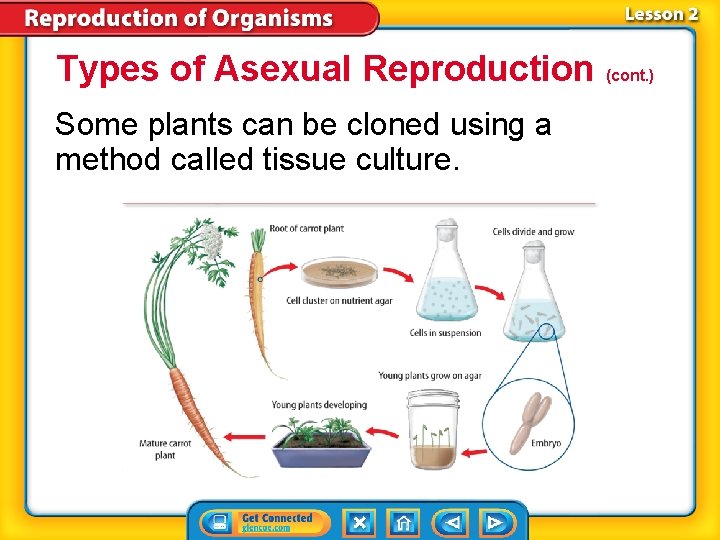
Types of Asexual Reproduction (cont. ) • Cloning is a type of asexual reproduction performed in a laboratory that produces identical individuals from a cell or from a cluster of cells taken from a multicellular organism. • Scientists have been able to clone many animals with the chromosomes from one parent.
Types of Asexual Reproduction (cont. ) Some plants can be cloned using a method called tissue culture.
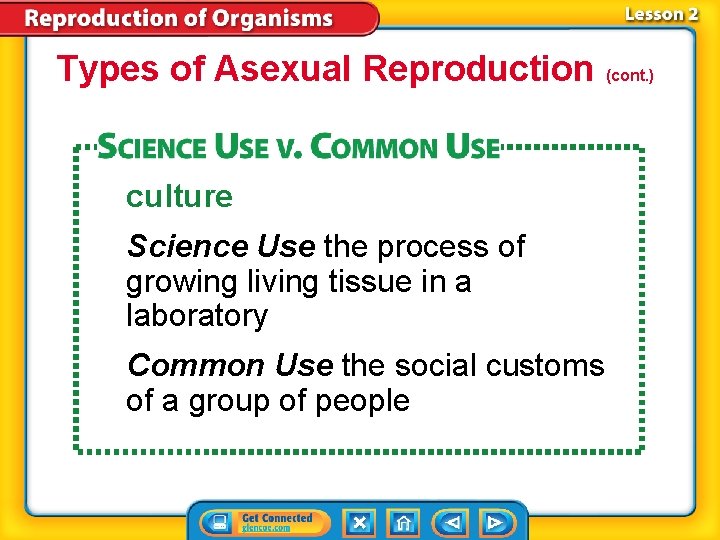
Types of Asexual Reproduction (cont. ) culture Science Use the process of growing living tissue in a laboratory Common Use the social customs of a group of people
Types of Asexual Reproduction (cont. ) Compare and contrast the different types of asexual reproduction.
Types of Asexual Reproduction (cont. ) • One disadvantage of asexual reproduction is that the results offer little genetic variation within the population. • Asexual reproduction can also be responsible for harmful genetic mutations.
Types of Asexual Reproduction (cont. ) • One advantage of asexual reproduction is that it allows organisms to reproduce without a mate, saving time and energy. • Asexual reproduction also enables some organisms to produce large numbers of offspring in a short period of time.
Types of Asexual Reproduction (cont. ) How is asexual reproduction beneficial?
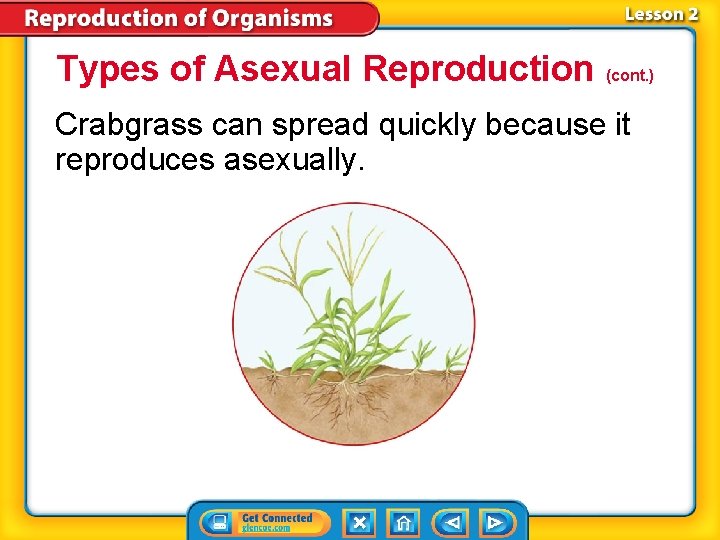
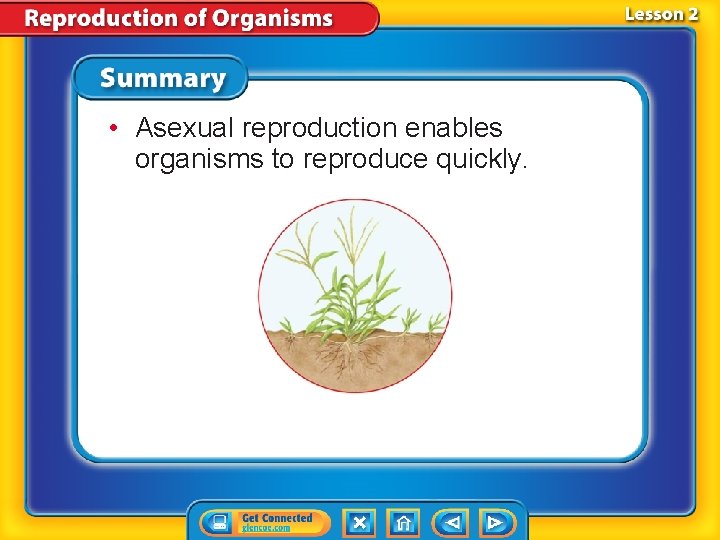
Types of Asexual Reproduction (cont. ) Crabgrass can spread quickly because it reproduces asexually.
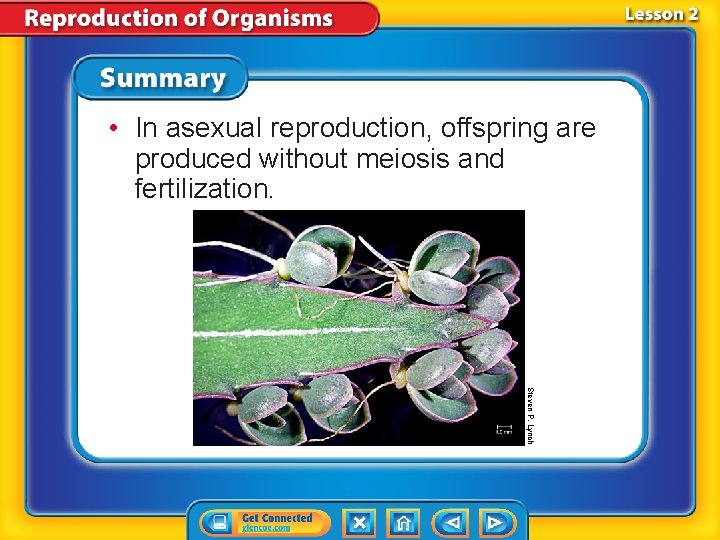
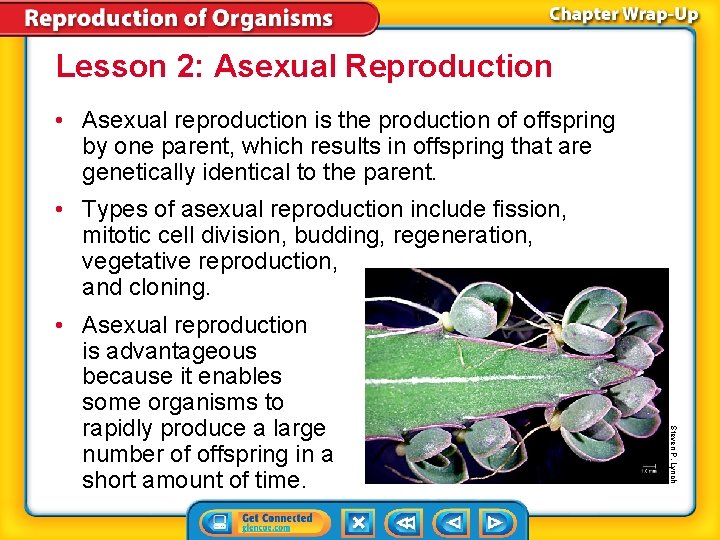
• In asexual reproduction, offspring are produced without meiosis and fertilization. Steven P. Lynch
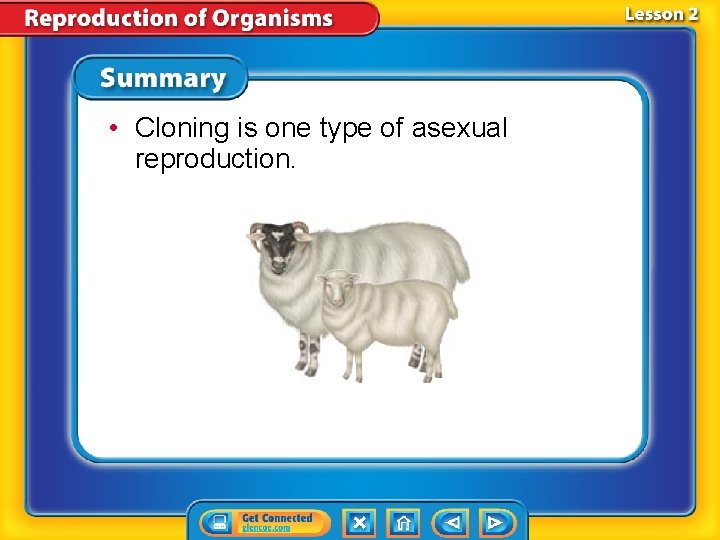
• Cloning is one type of asexual reproduction.
• Asexual reproduction enables organisms to reproduce quickly.
Fission refers to the cell division of which of these? A. DNA B. eukaryotes C. bacteria D. prokaryotes
In mitotic cell division, an organism forms two offspring through cell division and which other process? A. mitosis C. B. regeneration fission D. budding
Which is a method for cloning some plants? A. tissue culture B. tissue budding C. vegetative reproduction D. fission
Do you agree or disagree? 4. Cloning produces identical individuals from one cell. 5. All organisms have two parents. 6. Asexual reproduction occurs only in microorganisms.
Key Concept Summary Interactive Concept Map Chapter Review Standardized Test Practice
Reproduction is essential for the survival of species.
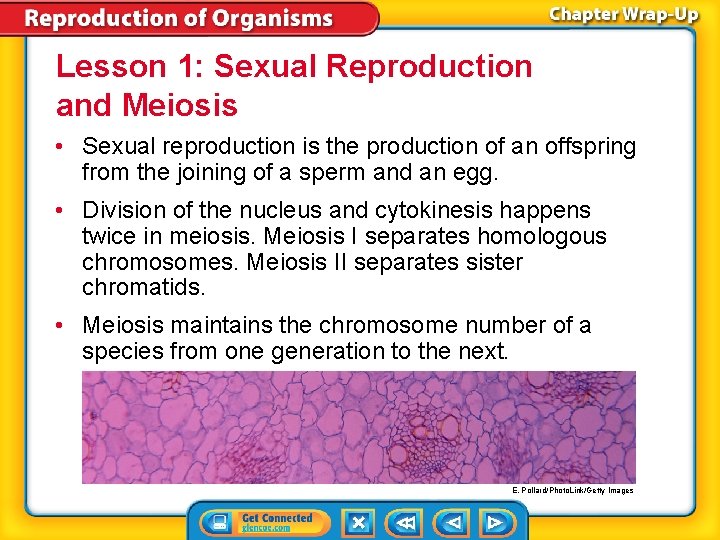
Lesson 1: Sexual Reproduction and Meiosis • Sexual reproduction is the production of an offspring from the joining of a sperm and an egg. • Division of the nucleus and cytokinesis happens twice in meiosis. Meiosis I separates homologous chromosomes. Meiosis II separates sister chromatids. • Meiosis maintains the chromosome number of a species from one generation to the next. E. Pollard/Photo. Link/Getty Images
Lesson 2: Asexual Reproduction • Asexual reproduction is the production of offspring by one parent, which results in offspring that are genetically identical to the parent. • Types of asexual reproduction include fission, mitotic cell division, budding, regeneration, vegetative reproduction, and cloning. Steven P. Lynch • Asexual reproduction is advantageous because it enables some organisms to rapidly produce a large number of offspring in a short amount of time.