
Chapter Intro 1 The Information Systems Strategy Triangle




- Slides: 78
Chapter Intro. & 1: The Information Systems Strategy Triangle Jason C. H. Chen, Ph. D. Professor of MIS School of Business Administration Gonzaga University Spokane, WA 99258 chen@jepson. gonzaga. edu
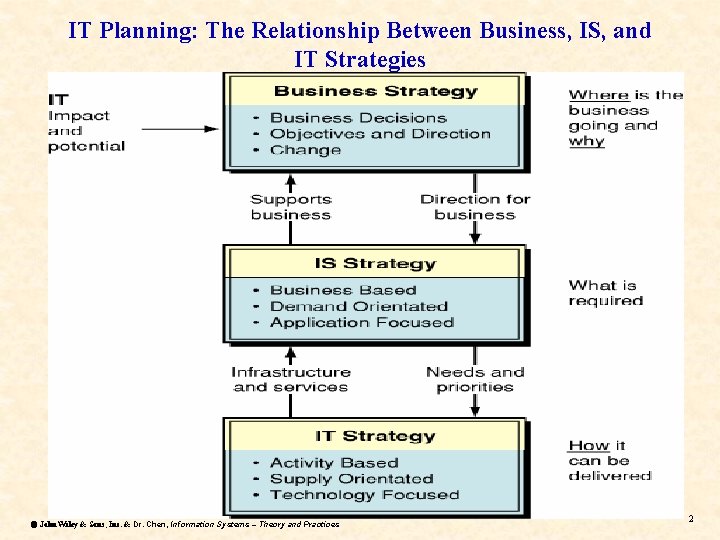
IT Planning: The Relationship Between Business, IS, and IT Strategies ã John Wiley & Sons, Inc. & Dr. Chen, Information Systems – Theory and Practices 2
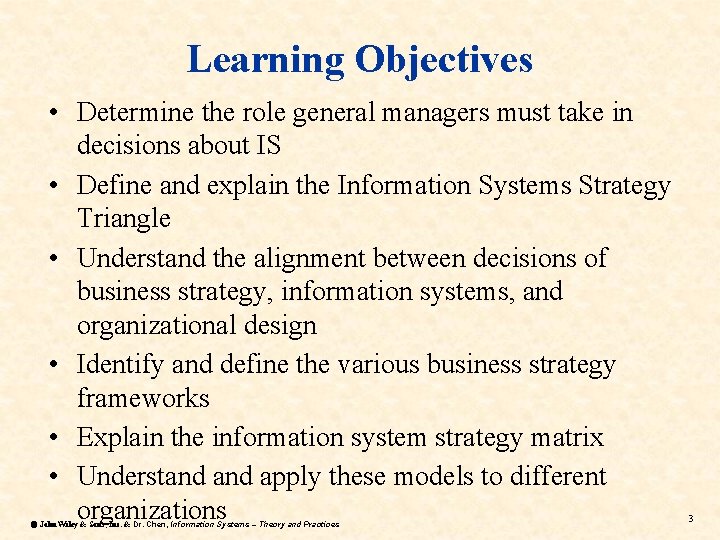
Learning Objectives • Determine the role general managers must take in decisions about IS • Define and explain the Information Systems Strategy Triangle • Understand the alignment between decisions of business strategy, information systems, and organizational design • Identify and define the various business strategy frameworks • Explain the information system strategy matrix • Understand apply these models to different organizations ã John Wiley & Sons, Inc. & Dr. Chen, Information Systems – Theory and Practices 3
DBQ: Why IS Strategy Triangle Model Matters? • Suppose managers in an organization decided to hand out tablets (i. Pad) to all salespeople without making any other formal changes in organizational strategy or business strategy. What might be the outcome? What unintended consequences might occur? (Why IS Strategy Triangle Model Matters? ) ã John Wiley & Sons, Inc. & Dr. Chen, Information Systems – Theory and Practices 4
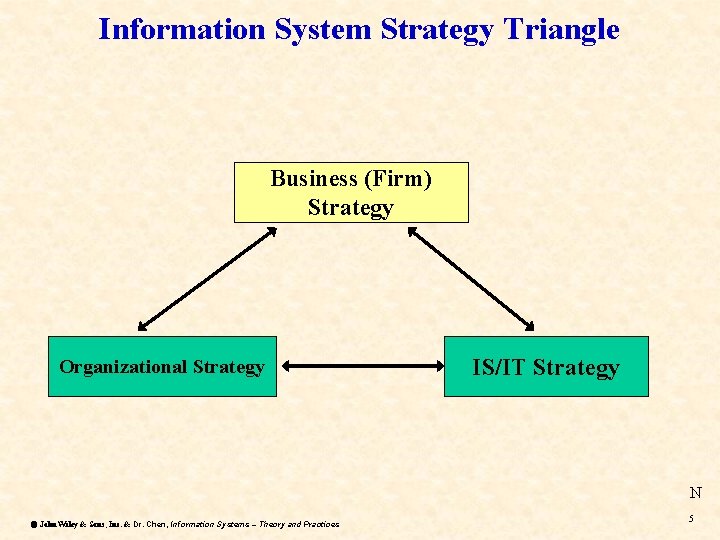
Information System Strategy Triangle Business (Firm) Strategy Organizational Strategy IS/IT Strategy N ã John Wiley & Sons, Inc. & Dr. Chen, Information Systems – Theory and Practices 5
Information System Strategy Triangle for i. PAD 1. Innovation/ Revenue Creation 2. Improve Organization’s Productivity Business (Firm) Strategy 1. Organizational Redesign (e. g. , order processs) 2. Training Organizational Strategy IS/IT Strategy 1. i. PAD 2. Internet, Wireless and Social Networking ã John Wiley & Sons, Inc. & Dr. Chen, Information Systems – Theory and Practices N 6
• DBQ (answer) • Salespeople might not use them, without training and modifications to their jobs. They may be accustomed to a manual, paper system and resist moving to the tablet devices. They might not appreciate the added benefits of the mobility, choosing familiar business processes instead. If they do use the devices, there will eventually be strain on the rest of the organization if it doesn't adapt to this new technology. For example, messaging might become ineffective if salespeople use e-mail on their tablets and voice mail. Where is the primary place or method to contact them? • When someone is urgently needed, it is a hindrance to have multiple places to check. Likewise, if the tablets are used for order entry, but the order process is not changed to accommodate the tablets, there will be problems. Lack of integration could lead to unnecessary delays and frustrated customers. ã John Wiley & Sons, Inc. & Dr. Chen, Information Systems – Theory and Practices 7
• DBQ (answer) – cont. • Support systems must also be redesigned. It does a salesperson little good to have to bring a tablet device into the office for repairs, especially if this involves a substantial geographical distance. • Many troubleshooting activities can be performed by the salespeople, but only if they have been trained and feel confident. Support processes will have to adapt to the mobility of the technology, or the company can expect to have agents further resist. Employees are adept at creating their own “workarounds, ” particularly when they do not support a mandatory change. ã John Wiley & Sons, Inc. & Dr. Chen, Information Systems – Theory and Practices 8
Real World Example • The 2010 Deepwater Horizon oil spill became the largest marine oil spill in human history • An estimated four million barrels per day flowed freely into the gulf waters • Straining the marine ecosystem and threatening the shoreline from Texas to Florida • A sequence of failures involving multiple companies and work teams • Repeated failures to follow safety procedures ã John Wiley & Sons, Inc. & Dr. Chen, Information Systems – Theory and Practices 9
Real World Example (Cont. ) • A series of Information Technology (IT) failures coupled with organizational misalignments that ultimately catalyzed the accident • The crisis illustrates the need for proper alignment of • • Business strategy _____ Information (IS) _____ Systems _____ Organizational mechanisms _______ Practices for designing safety mechanisms • Issues in organizational culture, process, and leadership at British Petroleum (BP) ã John Wiley & Sons, Inc. & Dr. Chen, Information Systems – Theory and Practices 10
INTRODUCTION • Shouldn’t managers rely on experts when it comes to making the decisions on IS for their organizations? – Managers today need to know about their organization’s capabilities and uses of information as much as they need to understand how to obtain and budget financial resources. – A manager who does not understand the basics of managing and using information cannot expect to be successful in today’s business environment. ã John Wiley & Sons, Inc. & Dr. Chen, Information Systems – Theory and Practices 11
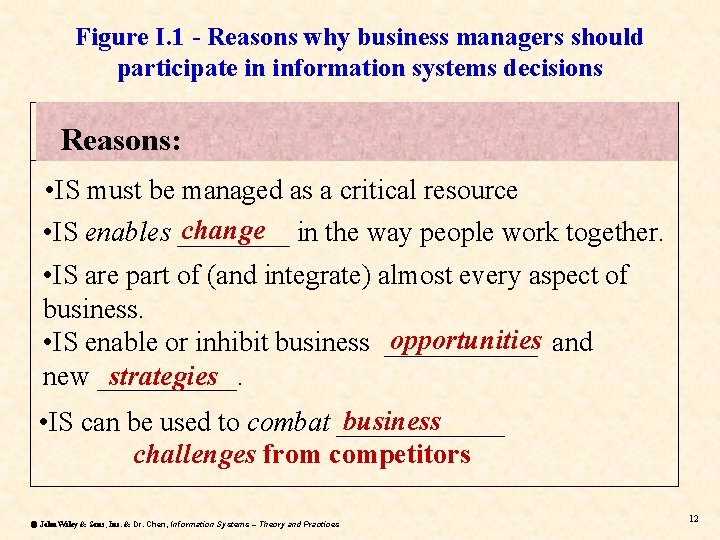
Figure I. 1 - Reasons why business managers should participate in information systems decisions Reasons: • IS must be managed as a critical resource change in the way people work together. • IS enables ____ • IS are part of (and integrate) almost every aspect of business. opportunities and • IS enable or inhibit business ______ strategies new _____. business • IS can be used to combat ______ challenges from competitors ã John Wiley & Sons, Inc. & Dr. Chen, Information Systems – Theory and Practices 12
The Role of the General Manager • A key decisions maker. deep technical knowledge • Not necessary to have a ____ of there is. • Aggressively seek to understand the consequences of using technologies relevant to the business’s environment. • Ask questions when it’s not clear. • Should not leave IS decisions solely to the IS professionals ã John Wiley & Sons, Inc. & Dr. Chen, Information Systems – Theory and Practices 13
Technology vs. Technique • Technology – is the making, usage, and knowledge of tools, machines, techniques, crafts, systems or methods of organization in order to solve a problem or perform a specific function. – It can also refer to the collection of such tools, machinery, and procedures. • Technique – Personal habits – Work style ã John Wiley & Sons, Inc. & Dr. Chen, Information Systems – Theory and Practices 14
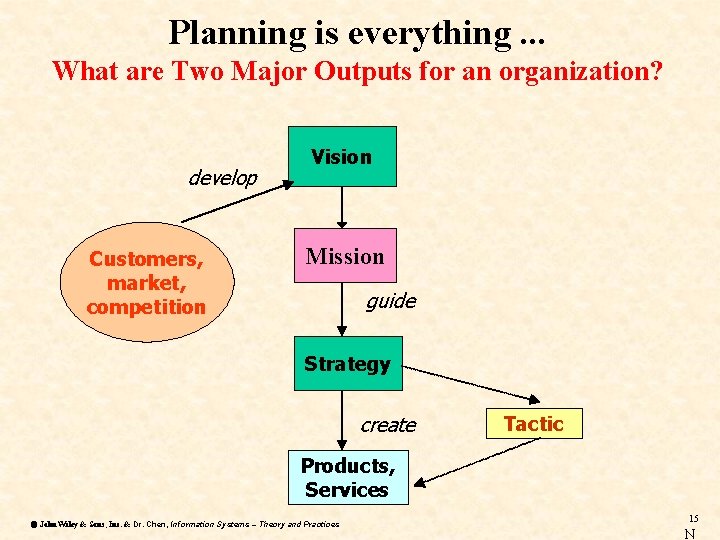
Planning is everything. . . What are Two Major Outputs for an organization? develop Customers, market, competition Vision Mission guide Strategy create Tactic Products, Services ã John Wiley & Sons, Inc. & Dr. Chen, Information Systems – Theory and Practices 15 N
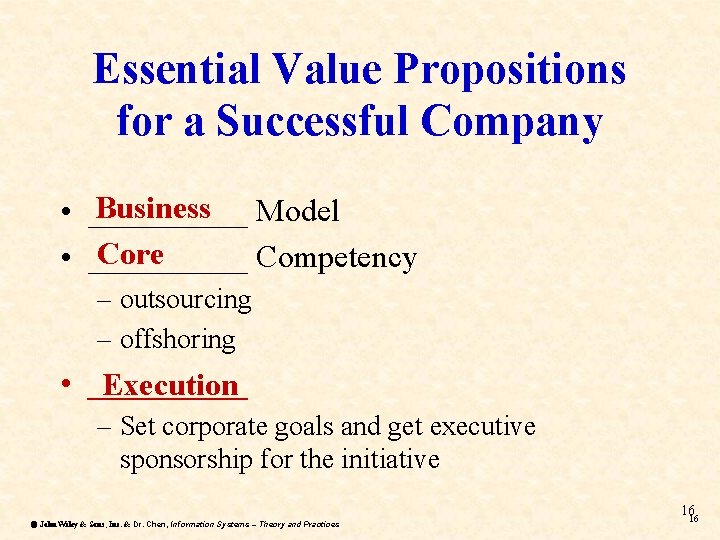
Essential Value Propositions for a Successful Company Business Model • _____ Core • _____ Competency – outsourcing – offshoring • _____ Execution – Set corporate goals and get executive sponsorship for the initiative ã John Wiley & Sons, Inc. & Dr. Chen, Information Systems – Theory and Practices 1616
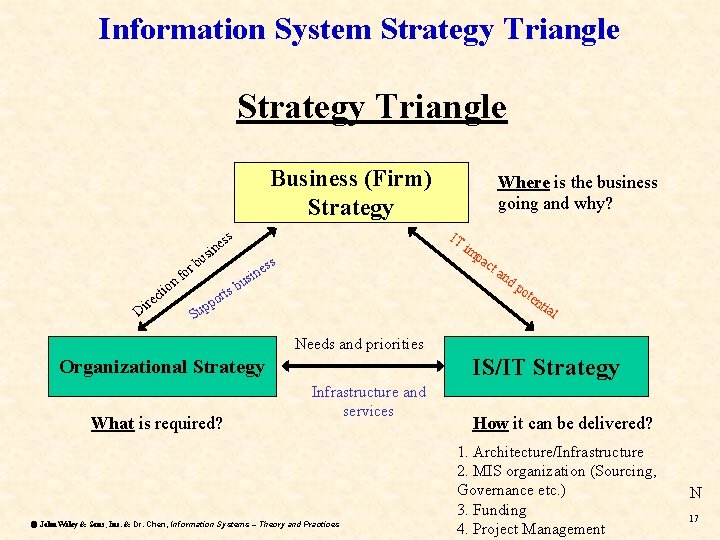
Information System Strategy Triangle Business (Firm) Strategy IT ss on i t c ire D r fo e sin bu p Su po b rts Where is the business going and why? ess n i us im pa ct an dp ote nti al Needs and priorities IS/IT Strategy Organizational Strategy What is required? Infrastructure and services ã John Wiley & Sons, Inc. & Dr. Chen, Information Systems – Theory and Practices How it can be delivered? 1. Architecture/Infrastructure 2. MIS organization (Sourcing, Governance etc. ) 3. Funding 4. Project Management N 17
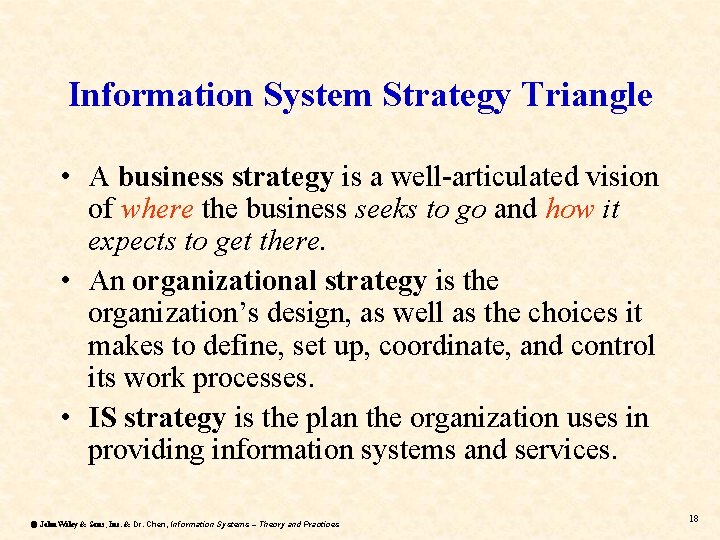
Information System Strategy Triangle • A business strategy is a well-articulated vision of where the business seeks to go and how it expects to get there. • An organizational strategy is the organization’s design, as well as the choices it makes to define, set up, coordinate, and control its work processes. • IS strategy is the plan the organization uses in providing information systems and services. ã John Wiley & Sons, Inc. & Dr. Chen, Information Systems – Theory and Practices 18
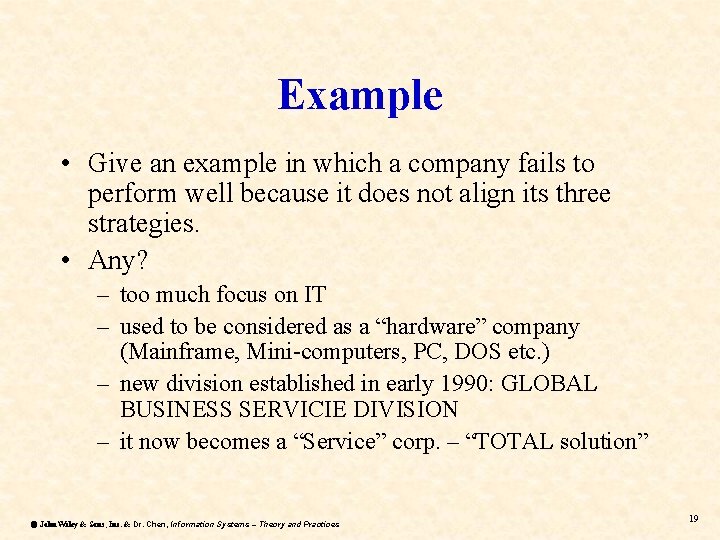
Example • Give an example in which a company fails to perform well because it does not align its three strategies. • Any? – too much focus on IT – used to be considered as a “hardware” company (Mainframe, Mini-computers, PC, DOS etc. ) – new division established in early 1990: GLOBAL BUSINESS SERVICIE DIVISION – it now becomes a “Service” corp. – “TOTAL solution” ã John Wiley & Sons, Inc. & Dr. Chen, Information Systems – Theory and Practices 19
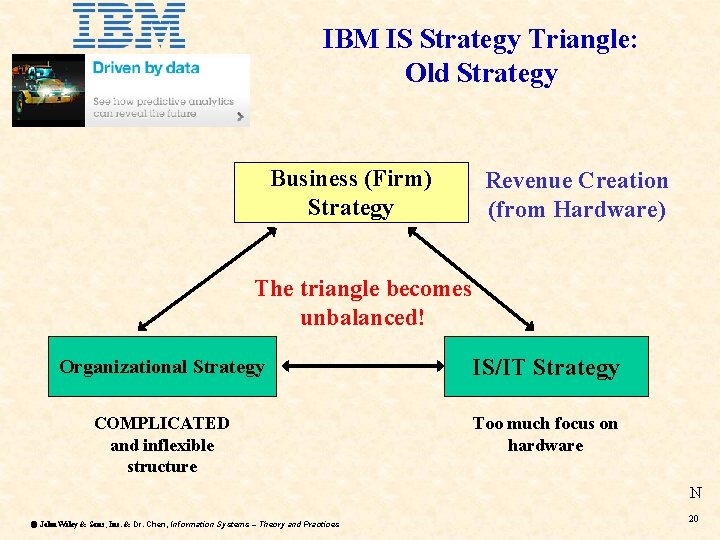
IBM IS Strategy Triangle: Old Strategy Business (Firm) Strategy Revenue Creation (from Hardware) The triangle becomes unbalanced! Organizational Strategy IS/IT Strategy COMPLICATED and inflexible structure Too much focus on hardware N ã John Wiley & Sons, Inc. & Dr. Chen, Information Systems – Theory and Practices 20
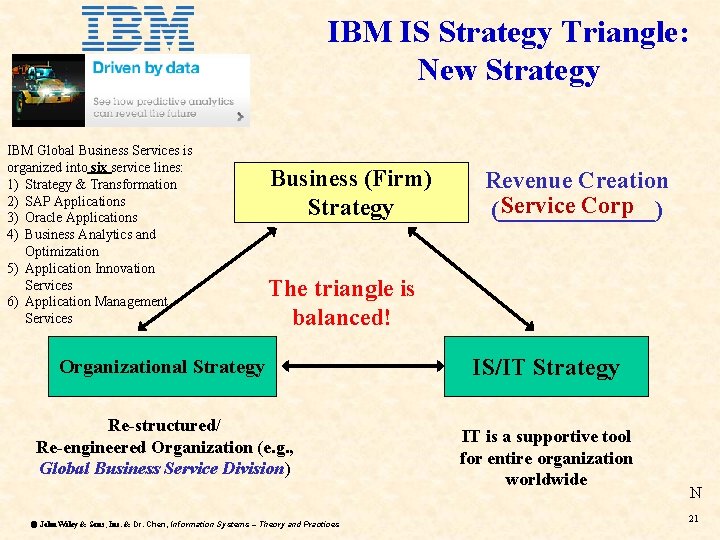
IBM IS Strategy Triangle: New Strategy IBM Global Business Services is organized into six service lines: 1) Strategy & Transformation 2) SAP Applications 3) Oracle Applications 4) Business Analytics and Optimization 5) Application Innovation Services 6) Application Management Services Business (Firm) Strategy Revenue Creation Service Corp (_______) The triangle is balanced! Organizational Strategy Re-structured/ Re-engineered Organization (e. g. , Global Business Service Division) ã John Wiley & Sons, Inc. & Dr. Chen, Information Systems – Theory and Practices IS/IT Strategy IT is a supportive tool for entire organization worldwide N 21
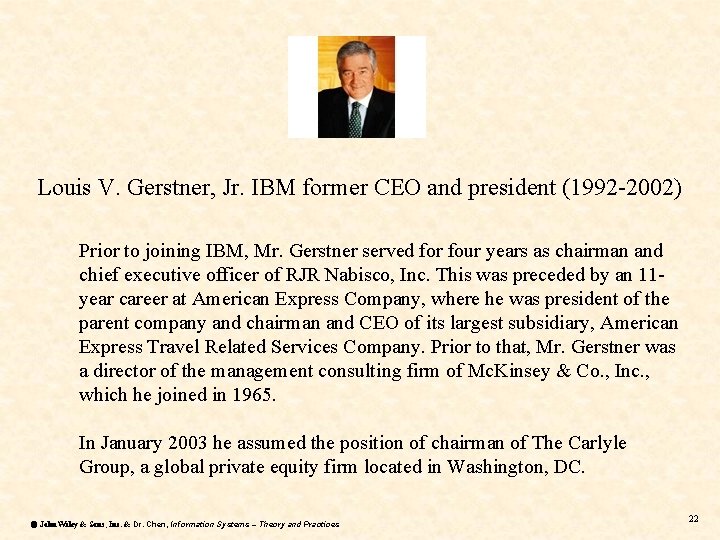
Louis V. Gerstner, Jr. IBM former CEO and president (1992 -2002) Prior to joining IBM, Mr. Gerstner served for four years as chairman and chief executive officer of RJR Nabisco, Inc. This was preceded by an 11 year career at American Express Company, where he was president of the parent company and chairman and CEO of its largest subsidiary, American Express Travel Related Services Company. Prior to that, Mr. Gerstner was a director of the management consulting firm of Mc. Kinsey & Co. , Inc. , which he joined in 1965. In January 2003 he assumed the position of chairman of The Carlyle Group, a global private equity firm located in Washington, DC. ã John Wiley & Sons, Inc. & Dr. Chen, Information Systems – Theory and Practices 22
HW • Each Group finds out another example (not limited to the high-tech industry) and analyze it using the IS/IT Triangle Strategy model. ã John Wiley & Sons, Inc. & Dr. Chen, Information Systems – Theory and Practices 23
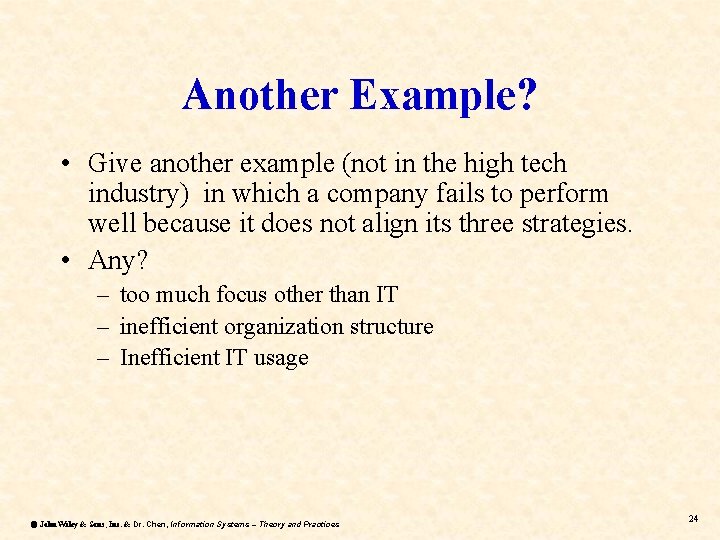
Another Example? • Give another example (not in the high tech industry) in which a company fails to perform well because it does not align its three strategies. • Any? – too much focus other than IT – inefficient organization structure – Inefficient IT usage ã John Wiley & Sons, Inc. & Dr. Chen, Information Systems – Theory and Practices 24
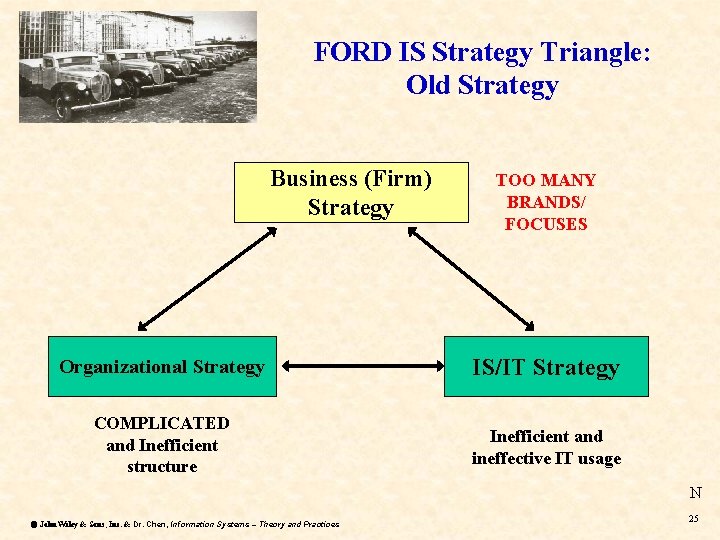
FORD IS Strategy Triangle: Old Strategy Business (Firm) Strategy TOO MANY BRANDS/ FOCUSES Organizational Strategy IS/IT Strategy COMPLICATED and Inefficient structure Inefficient and ineffective IT usage N ã John Wiley & Sons, Inc. & Dr. Chen, Information Systems – Theory and Practices 25
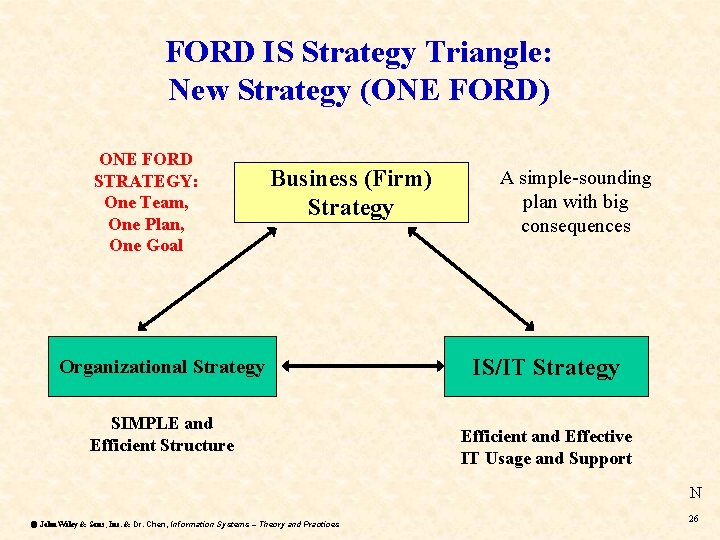
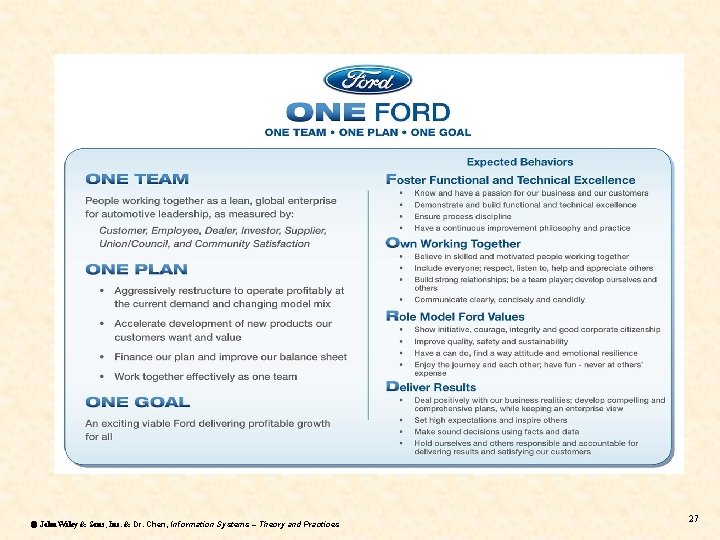
FORD IS Strategy Triangle: New Strategy (ONE FORD) ONE FORD STRATEGY: One Team, One Plan, One Goal Business (Firm) Strategy Organizational Strategy SIMPLE and Efficient Structure A simple-sounding plan with big consequences IS/IT Strategy Efficient and Effective IT Usage and Support N ã John Wiley & Sons, Inc. & Dr. Chen, Information Systems – Theory and Practices 26
ã John Wiley & Sons, Inc. & Dr. Chen, Information Systems – Theory and Practices 27
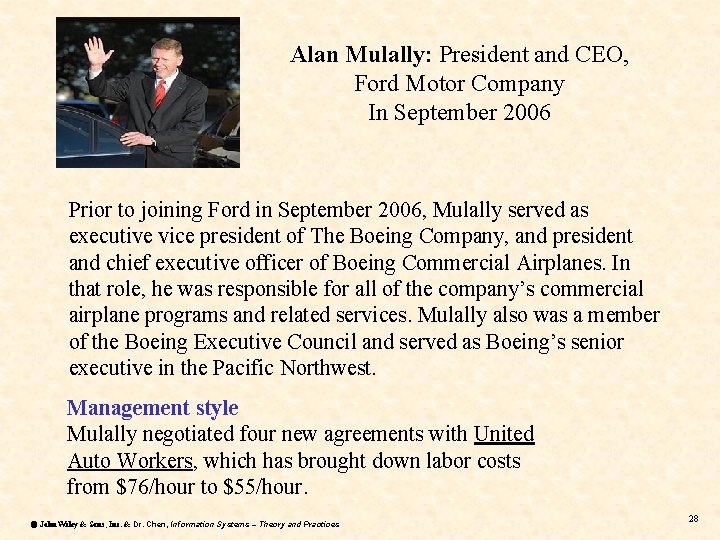
Alan Mulally: President and CEO, Ford Motor Company In September 2006 Prior to joining Ford in September 2006, Mulally served as executive vice president of The Boeing Company, and president and chief executive officer of Boeing Commercial Airplanes. In that role, he was responsible for all of the company’s commercial airplane programs and related services. Mulally also was a member of the Boeing Executive Council and served as Boeing’s senior executive in the Pacific Northwest. Management style Mulally negotiated four new agreements with United Auto Workers, which has brought down labor costs from $76/hour to $55/hour. ã John Wiley & Sons, Inc. & Dr. Chen, Information Systems – Theory and Practices 28
The Information Systems Strategy Triangle drives both • Successful firms’ business strategy ______ their organizational and IS strategies: • They must, therefore, seek to balance business, organizational, and IS strategies • Changes in any strategy requires changes in the others to maintain balance. • IS Strategy is affected by the other strategies a firm uses. • IS strategy can have (sometimes unintentional) consequences on business and organizational strategies ã John Wiley & Sons, Inc. & Dr. Chen, Information Systems – Theory and Practices 29
BRIEF OVERVIEW OF BUSINESS STRATEGY FRAMEWORKS ã John Wiley & Sons, Inc. & Dr. Chen, Information Systems – Theory and Practices 30
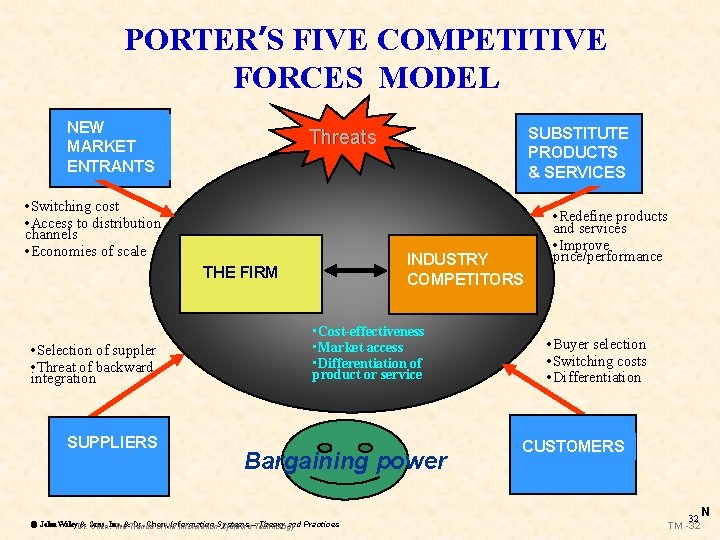
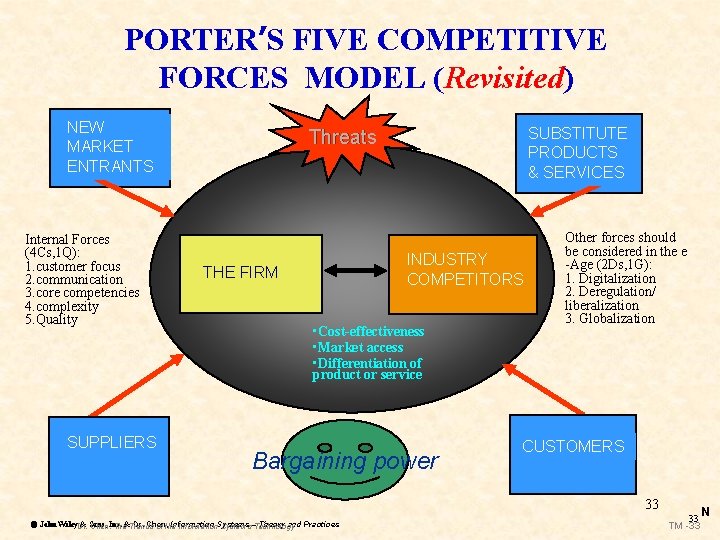
Striving for Competitive Advantage Firm level: Industry & Competitive Analysis • ______ (across the firms) üCompetitive Forces Model (more details will be discussed in chap. 2) Business üCompetitive Strategy üD’Aveni’s Hypercompetition Model/ Strategy Framework Framewrok (7 s) Business level (inside the firm) • _____ üValue-Chain Analysis (more details will be discussed in chap. 2) ã John Wiley & Sons, Inc. & Dr. Chen, Information Systems – Theory and Practices 31
PORTER’S FIVE COMPETITIVE FORCES MODEL NEW MARKET ENTRANTS • Switching cost • Access to distribution channels • Economies of scale INDUSTRY COMPETITORS THE FIRM • Selection of suppler • Threat of backward integration SUPPLIERS SUBSTITUTE PRODUCTS & SERVICES Threats • Cost-effectiveness • Market access • Differentiation of product or service Bargaining power ã John Wiley. Dr. & Sons, Dr. Chen, Information Theory and Practices Chen, Inc. The&Trends of the Information. Systems –Technology • Redefine products and services • Improve price/performance • Buyer selection • Switching costs • Differentiation CUSTOMERS 32 TM -32 N
PORTER’S FIVE COMPETITIVE FORCES MODEL (Revisited) NEW MARKET ENTRANTS Internal Forces (4 Cs, 1 Q): 1. customer focus 2. communication 3. core competencies 4. complexity 5. Quality SUPPLIERS SUBSTITUTE PRODUCTS & SERVICES Threats INDUSTRY COMPETITORS THE FIRM • Cost-effectiveness • Market access • Differentiation of product or service Bargaining power Other forces should be considered in the e -Age (2 Ds, 1 G): 1. Digitalization 2. Deregulation/ liberalization 3. Globalization CUSTOMERS 33 ã John Wiley. Dr. & Sons, Dr. Chen, Information Theory and Practices Chen, Inc. The&Trends of the Information. Systems –Technology 33 TM -33 N
Business Strategy Frameworks • Porter’s Generic Strategies Framework (and its variants) • Hypercompetition and the New 7 -Ss framework (D’Aveni) N ã John Wiley & Sons, Inc. & Dr. Chen, Information Systems – Theory and Practices 34
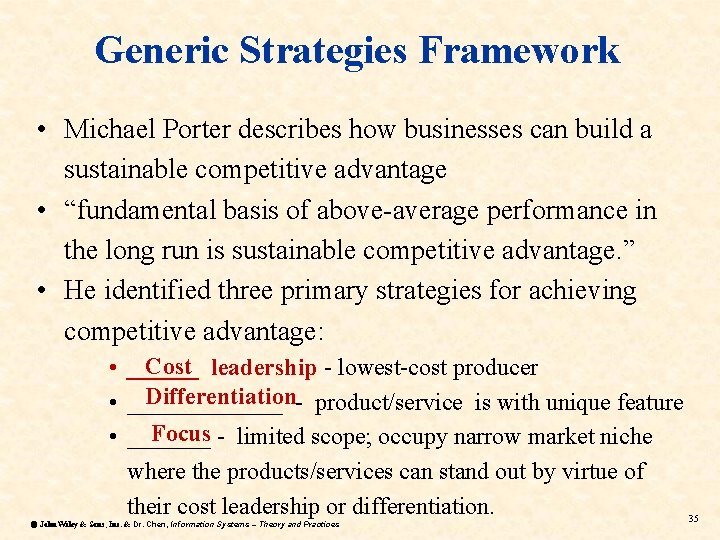
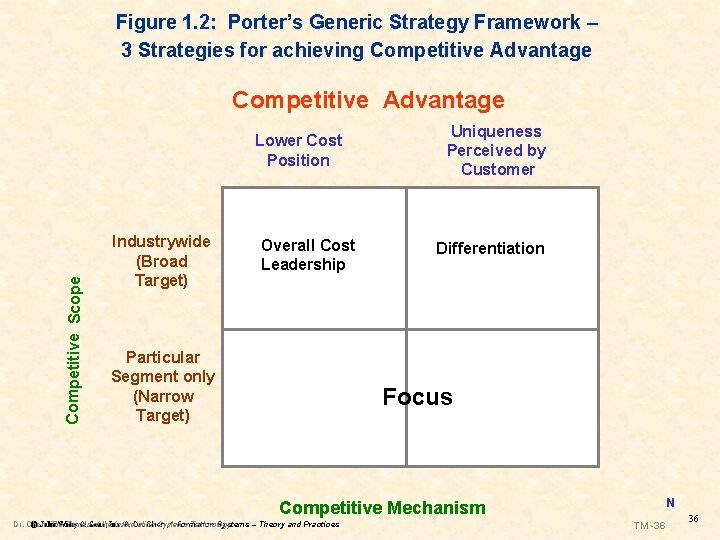
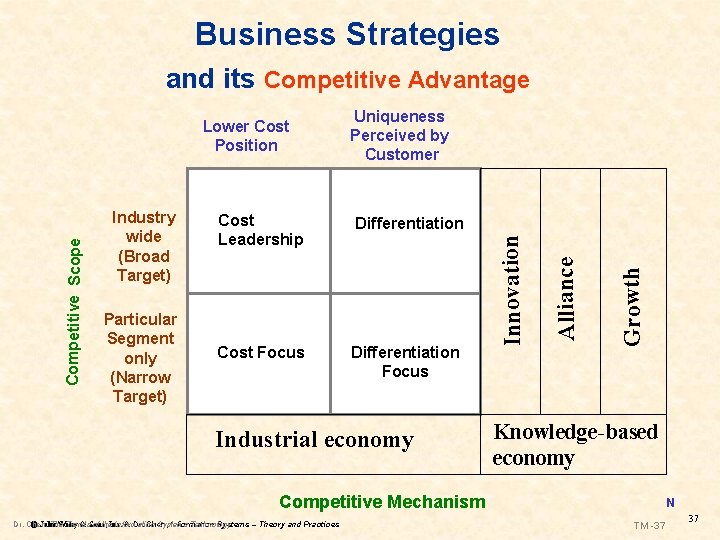
Generic Strategies Framework • Michael Porter describes how businesses can build a sustainable competitive advantage • “fundamental basis of above-average performance in the long run is sustainable competitive advantage. ” • He identified three primary strategies for achieving competitive advantage: Cost leadership - lowest-cost producer • ______ Differentiation- product/service is with unique feature • _______ Focus - limited scope; occupy narrow market niche • _______ where the products/services can stand out by virtue of their cost leadership or differentiation. 35 ã John Wiley & Sons, Inc. & Dr. Chen, Information Systems – Theory and Practices
Figure 1. 2: Porter’s Generic Strategy Framework – 3 Strategies for achieving Competitive Advantage Competitive Scope Lower Cost Position Industrywide (Broad Target) Overall Cost Leadership Particular Segment only (Narrow Target) Uniqueness Perceived by Customer Differentiation Focus N Competitive Mechanism ã John Wiley & Sons, & Dr. Chen, Information Systems – Theory and Practices Dr. Chen, The Trends of the. Inc. Information Systems Technology TM -36 36
Business Strategies and its Competitive Advantage Differentiation Cost Focus Differentiation Focus Industrial economy Growth Particular Segment only (Narrow Target) Cost Leadership Alliance Industry wide (Broad Target) Uniqueness Perceived by Customer Innovation Competitive Scope Lower Cost Position Knowledge-based economy Competitive Mechanism ã John Wiley & Sons, & Dr. Chen, Information Systems – Theory and Practices Dr. Chen, The Trends of the. Inc. Information Systems Technology N TM -37 37
Dynamic Environment Strategies • Porter’s model is useful for diagnostics, or understanding how a business seeks to profit in its chosen marketplace, and for prescriptions, or building new opportunities for advantage • Porter model was developed at a time where the rate of change in any given industry was slow and _____. manageable (i. e. , stable) relatively _____ • Newer models were developed to take into account the increasing turbulence and velocity of the marketplace ã John Wiley & Sons, Inc. & Dr. Chen, Information Systems – Theory and Practices 38
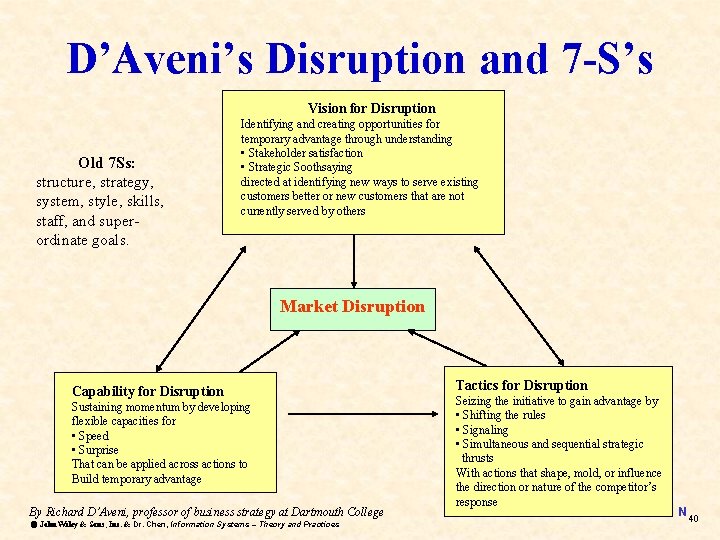
Hypercompetition and the New 7 -S’s framework (D’Aveni) Every advantage is eroded. • ____________ • Sustaining an advantage uses too much time and resources that can be a deadly distraction. disruption not • The goal should be______, sustainability of advantage. ________ • Initiatives are achieved with a series of small steps. • Hypercompetiton occurs when technologies or offerings are so new that standards and rules are influx, resulting in competitive advantages that cannot be sustained. It is characterized by intense and rapid competitive moves, in which competitors must move quickly to build new advantages and erode the advantages of their rivals. ã John Wiley & Sons, Inc. & Dr. Chen, Information Systems – Theory and Practices 39
D’Aveni’s Disruption and 7 -S’s Vision for Disruption Old 7 Ss: structure, strategy, system, style, skills, staff, and superordinate goals. Identifying and creating opportunities for temporary advantage through understanding • Stakeholder satisfaction • Strategic Soothsaying directed at identifying new ways to serve existing customers better or new customers that are not currently served by others Market Disruption Capability for Disruption Sustaining momentum by developing flexible capacities for • Speed • Surprise That can be applied across actions to Build temporary advantage By Richard D’Aveni, professor of business strategy at Dartmouth College ã John Wiley & Sons, Inc. & Dr. Chen, Information Systems – Theory and Practices Tactics for Disruption Seizing the initiative to gain advantage by • Shifting the rules • Signaling • Simultaneous and sequential strategic thrusts With actions that shape, mold, or influence the direction or nature of the competitor’s response N 40
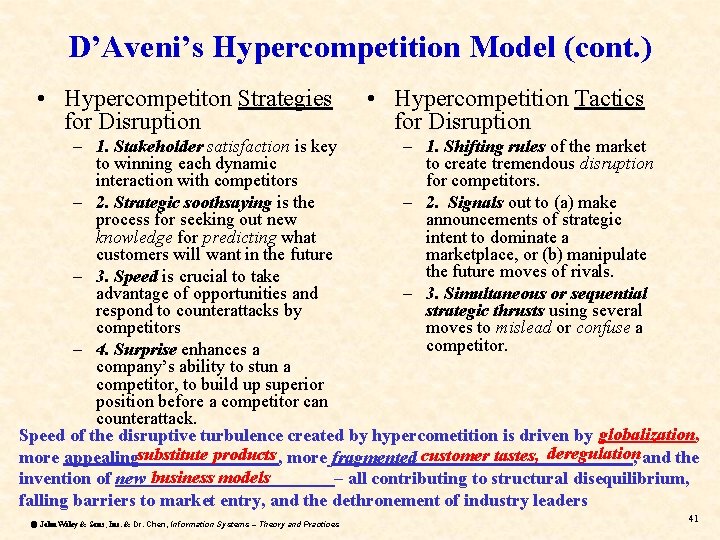
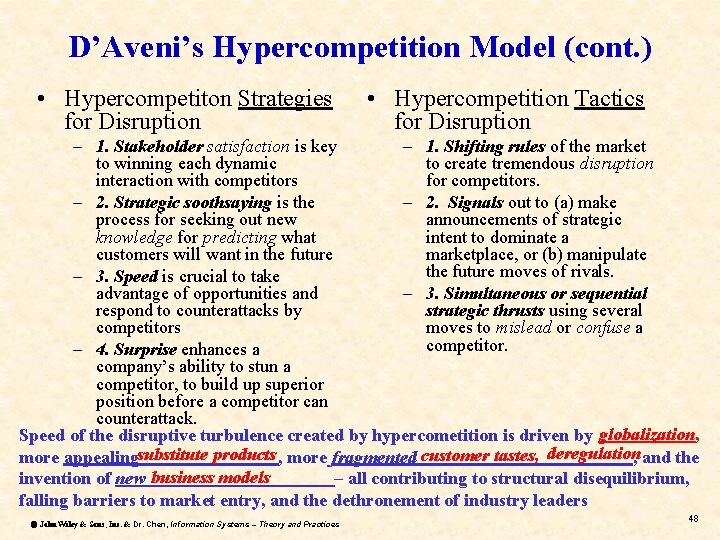
D’Aveni’s Hypercompetition Model (cont. ) • Hypercompetiton Strategies for Disruption • Hypercompetition Tactics for Disruption – 1. Stakeholder satisfaction is key – 1. Shifting rules of the market to winning each dynamic to create tremendous disruption interaction with competitors for competitors. – 2. Strategic soothsaying is the – 2. Signals out to (a) make process for seeking out new announcements of strategic knowledge for predicting what intent to dominate a customers will want in the future marketplace, or (b) manipulate the future moves of rivals. – 3. Speed is crucial to take advantage of opportunities and – 3. Simultaneous or sequential respond to counterattacks by strategic thrusts using several competitors moves to mislead or confuse a competitor. – 4. Surprise enhances a company’s ability to stun a competitor, to build up superior position before a competitor can counterattack. Speed of the disruptive turbulence created by hypercometition is driven by globalization, more appealingsubstitute products , more fragmented customer tastes, deregulation, and the invention of new business models – all contributing to structural disequilibrium, falling barriers to market entry, and the dethronement of industry leaders ã John Wiley & Sons, Inc. & Dr. Chen, Information Systems – Theory and Practices 41
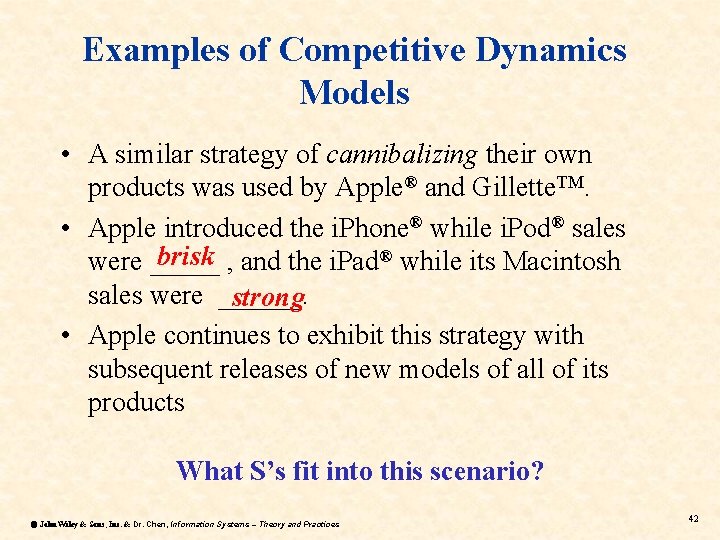
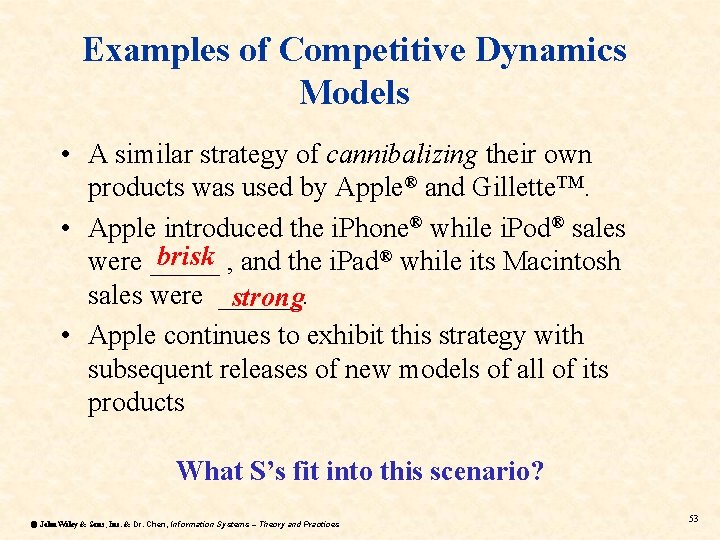
Examples of Competitive Dynamics Models • A similar strategy of cannibalizing their own products was used by Apple® and Gillette. TM. • Apple introduced the i. Phone® while i. Pod® sales brisk , and the i. Pad® while its Macintosh were _____ sales were ______. strong • Apple continues to exhibit this strategy with subsequent releases of new models of all of its products What S’s fit into this scenario? ã John Wiley & Sons, Inc. & Dr. Chen, Information Systems – Theory and Practices 42
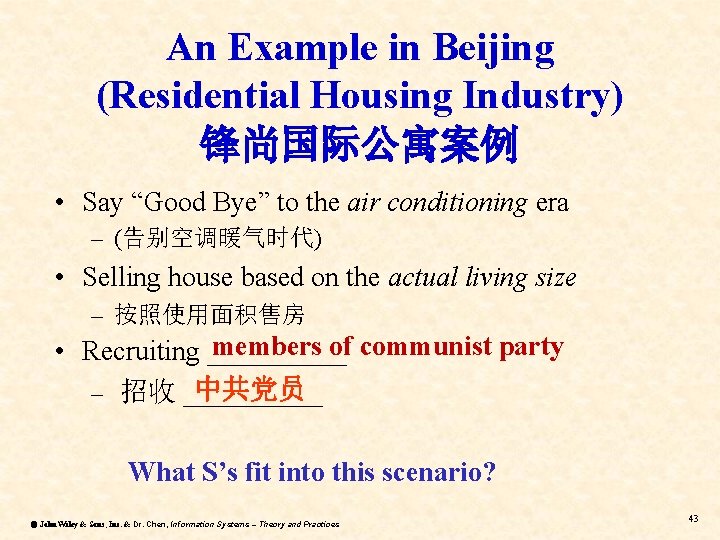
An Example in Beijing (Residential Housing Industry) 锋尚国际公寓案例 • Say “Good Bye” to the air conditioning era – (告别空调暖气时代) • Selling house based on the actual living size – 按照使用面积售房 members of communist party • Recruiting _____ 中共党员 – 招收 _____ What S’s fit into this scenario? ã John Wiley & Sons, Inc. & Dr. Chen, Information Systems – Theory and Practices 43
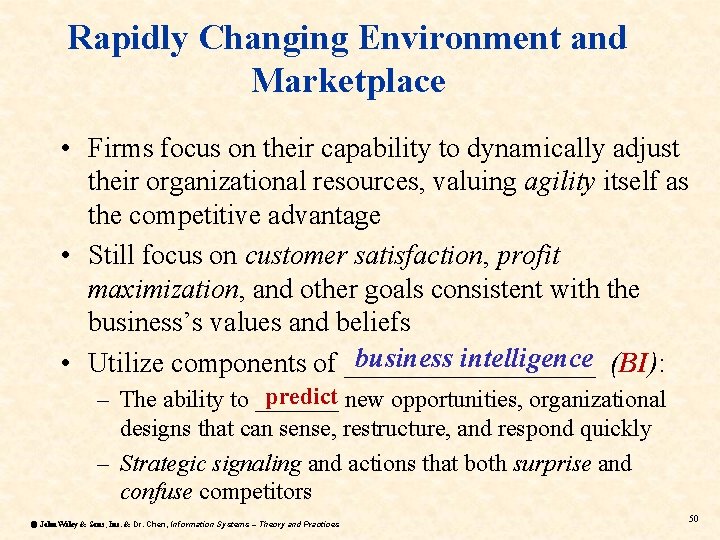
Rapidly Changing Environment and Marketplace • Firms focus on their capability to dynamically adjust their organizational resources, valuing agility itself as the competitive advantage • Still focus on customer satisfaction, profit maximization, and other goals consistent with the business’s values and beliefs • Utilize components of business intelligence (BI): – The ability to predict new opportunities, organizational designs that can sense, restructure, and respond quickly – Strategic signaling and actions that both surprise and confuse competitors ã John Wiley & Sons, Inc. & Dr. Chen, Information Systems – Theory and Practices 44
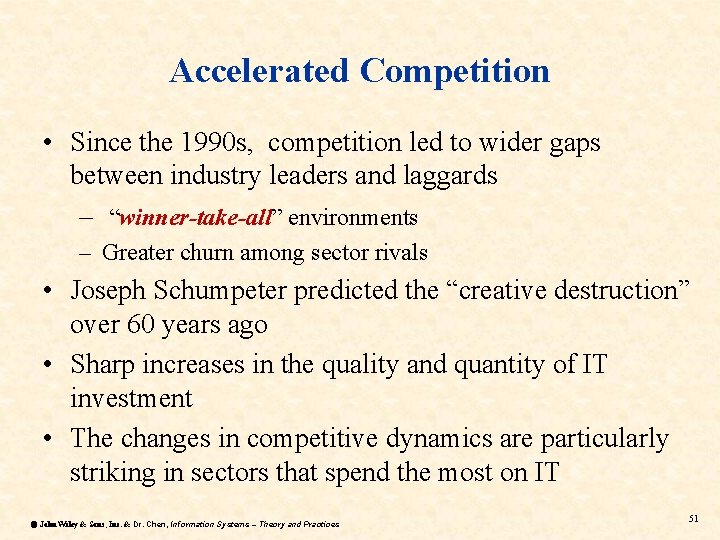
Accelerated Competition • Since the 1990 s, competition led to wider gaps between industry leaders and laggards – “winner-take-all” environments – Greater churn among sector rivals • Joseph Schumpeter predicted the “creative destruction” over 60 years ago • Sharp increases in the quality and quantity of IT investment • The changes in competitive dynamics are particularly striking in sectors that spend the most on IT ã John Wiley & Sons, Inc. & Dr. Chen, Information Systems – Theory and Practices 45
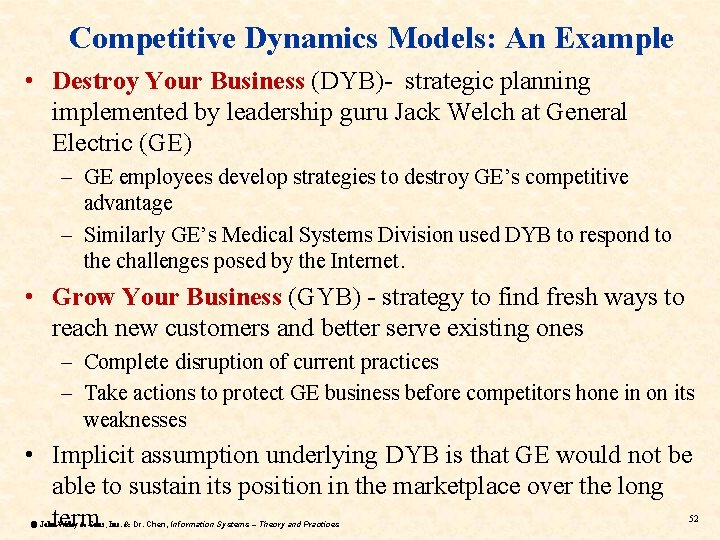
Competitive Dynamics Models: An Example • Destroy Your Business (DYB)- strategic planning implemented by leadership guru Jack Welch at General Electric (GE) – GE employees develop strategies to destroy GE’s competitive advantage – Similarly GE’s Medical Systems Division used DYB to respond to the challenges posed by the Internet. • Grow Your Business (GYB) - strategy to find fresh ways to reach new customers and better serve existing ones – Complete disruption of current practices – Take actions to protect GE business before competitors hone in on its weaknesses • Implicit assumption underlying DYB is that GE would not be able to sustain its position in the marketplace over the long term ã John Wiley & Sons, Inc. & Dr. Chen, Information Systems – Theory and Practices 46
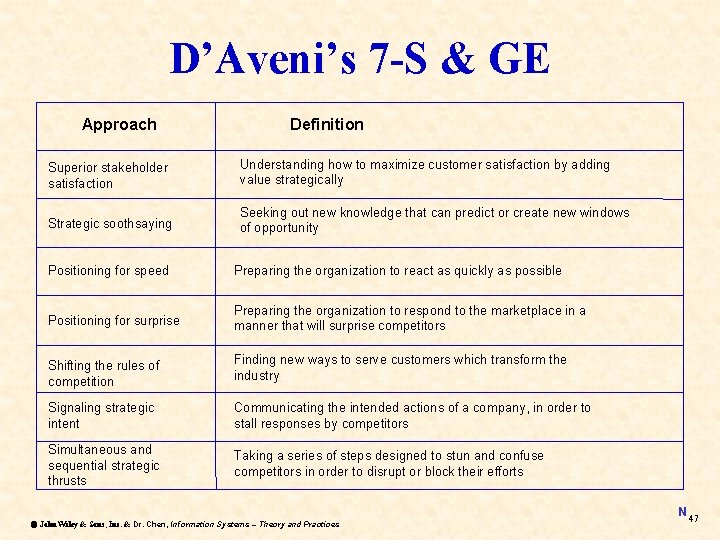
D’Aveni’s 7 -S & GE Approach Definition Superior stakeholder satisfaction Understanding how to maximize customer satisfaction by adding value strategically Strategic soothsaying Seeking out new knowledge that can predict or create new windows of opportunity Positioning for speed Preparing the organization to react as quickly as possible Positioning for surprise Preparing the organization to respond to the marketplace in a manner that will surprise competitors Shifting the rules of competition Finding new ways to serve customers which transform the industry Signaling strategic intent Communicating the intended actions of a company, in order to stall responses by competitors Simultaneous and sequential strategic thrusts Taking a series of steps designed to stun and confuse competitors in order to disrupt or block their efforts N ã John Wiley & Sons, Inc. & Dr. Chen, Information Systems – Theory and Practices 47
D’Aveni’s Hypercompetition Model (cont. ) • Hypercompetiton Strategies for Disruption • Hypercompetition Tactics for Disruption – 1. Stakeholder satisfaction is key – 1. Shifting rules of the market to winning each dynamic to create tremendous disruption interaction with competitors for competitors. – 2. Strategic soothsaying is the – 2. Signals out to (a) make process for seeking out new announcements of strategic knowledge for predicting what intent to dominate a customers will want in the future marketplace, or (b) manipulate the future moves of rivals. – 3. Speed is crucial to take advantage of opportunities and – 3. Simultaneous or sequential respond to counterattacks by strategic thrusts using several competitors moves to mislead or confuse a competitor. – 4. Surprise enhances a company’s ability to stun a competitor, to build up superior position before a competitor can counterattack. Speed of the disruptive turbulence created by hypercometition is driven by globalization, more appealingsubstitute products , more fragmented customer tastes, deregulation, and the invention of new business models – all contributing to structural disequilibrium, falling barriers to market entry, and the dethronement of industry leaders ã John Wiley & Sons, Inc. & Dr. Chen, Information Systems – Theory and Practices 48
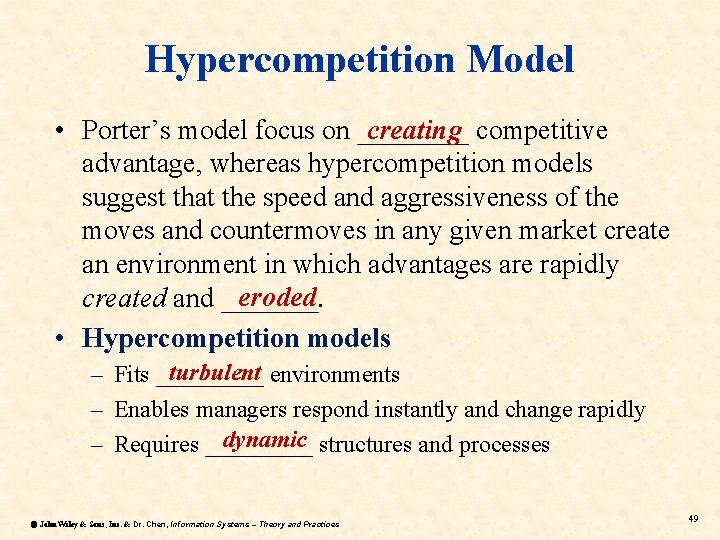
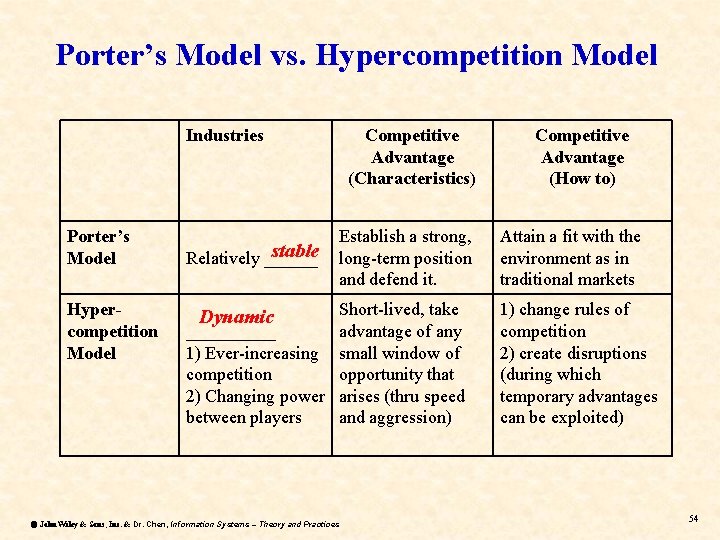
Hypercompetition Model creating competitive • Porter’s model focus on ____ advantage, whereas hypercompetition models suggest that the speed and aggressiveness of the moves and countermoves in any given market create an environment in which advantages are rapidly eroded created and _______. • Hypercompetition models turbulent environments – Fits _____ – Enables managers respond instantly and change rapidly dynamic structures and processes – Requires _____ ã John Wiley & Sons, Inc. & Dr. Chen, Information Systems – Theory and Practices 49
Rapidly Changing Environment and Marketplace • Firms focus on their capability to dynamically adjust their organizational resources, valuing agility itself as the competitive advantage • Still focus on customer satisfaction, profit maximization, and other goals consistent with the business’s values and beliefs business intelligence (BI): • Utilize components of _________ predict new opportunities, organizational – The ability to _______ designs that can sense, restructure, and respond quickly – Strategic signaling and actions that both surprise and confuse competitors ã John Wiley & Sons, Inc. & Dr. Chen, Information Systems – Theory and Practices 50
Accelerated Competition • Since the 1990 s, competition led to wider gaps between industry leaders and laggards – “winner-take-all” environments – Greater churn among sector rivals • Joseph Schumpeter predicted the “creative destruction” over 60 years ago • Sharp increases in the quality and quantity of IT investment • The changes in competitive dynamics are particularly striking in sectors that spend the most on IT ã John Wiley & Sons, Inc. & Dr. Chen, Information Systems – Theory and Practices 51
Competitive Dynamics Models: An Example • Destroy Your Business (DYB)- strategic planning implemented by leadership guru Jack Welch at General Electric (GE) – GE employees develop strategies to destroy GE’s competitive advantage – Similarly GE’s Medical Systems Division used DYB to respond to the challenges posed by the Internet. • Grow Your Business (GYB) - strategy to find fresh ways to reach new customers and better serve existing ones – Complete disruption of current practices – Take actions to protect GE business before competitors hone in on its weaknesses • Implicit assumption underlying DYB is that GE would not be able to sustain its position in the marketplace over the long term ã John Wiley & Sons, Inc. & Dr. Chen, Information Systems – Theory and Practices 52
Examples of Competitive Dynamics Models • A similar strategy of cannibalizing their own products was used by Apple® and Gillette. TM. • Apple introduced the i. Phone® while i. Pod® sales brisk , and the i. Pad® while its Macintosh were _____ sales were ______. strong • Apple continues to exhibit this strategy with subsequent releases of new models of all of its products What S’s fit into this scenario? ã John Wiley & Sons, Inc. & Dr. Chen, Information Systems – Theory and Practices 53
Porter’s Model vs. Hypercompetition Model Industries Porter’s Model Hypercompetition Model stable Relatively ______ Competitive Advantage (Characteristics) Establish a strong, long-term position and defend it. Short-lived, take _____ advantage of any 1) Ever-increasing small window of competition opportunity that 2) Changing power arises (thru speed between players and aggression) Dynamic ã John Wiley & Sons, Inc. & Dr. Chen, Information Systems – Theory and Practices Competitive Advantage (How to) Attain a fit with the environment as in traditional markets 1) change rules of competition 2) create disruptions (during which temporary advantages can be exploited) 54
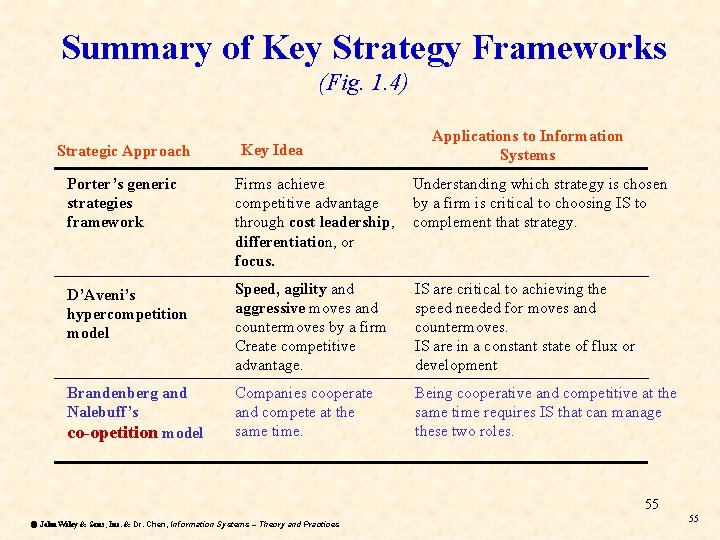
Summary of Key Strategy Frameworks (Fig. 1. 4) Strategic Approach Key Idea Applications to Information Systems Porter’s generic strategies framework Firms achieve competitive advantage through cost leadership, differentiation, or focus. Understanding which strategy is chosen by a firm is critical to choosing IS to complement that strategy. D’Aveni’s hypercompetition model Speed, agility and aggressive moves and countermoves by a firm Create competitive advantage. IS are critical to achieving the speed needed for moves and countermoves. IS are in a constant state of flux or development Brandenberg and Nalebuff’s co-opetition model Companies cooperate and compete at the same time. Being cooperative and competitive at the same time requires IS that can manage these two roles. 55 ã John Wiley & Sons, Inc. & Dr. Chen, Information Systems – Theory and Practices 55
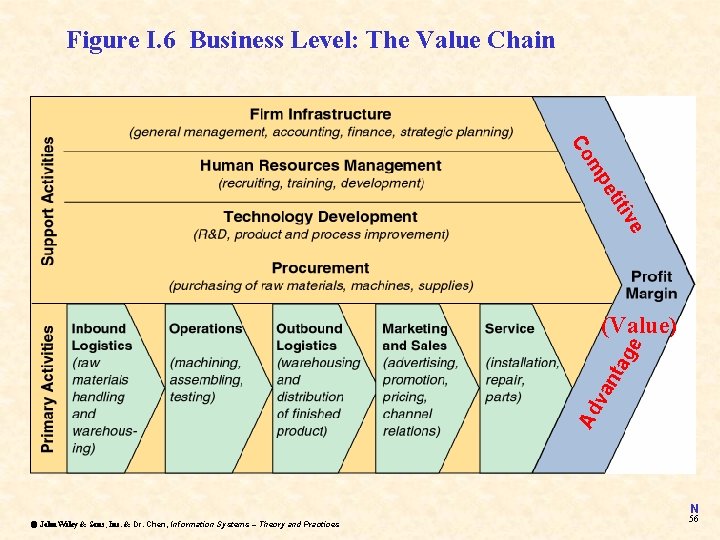
Figure I. 6 Business Level: The Value Chain e tiv eti mp Co Ad v an tag e (Value) N ã John Wiley & Sons, Inc. & Dr. Chen, Information Systems – Theory and Practices 56
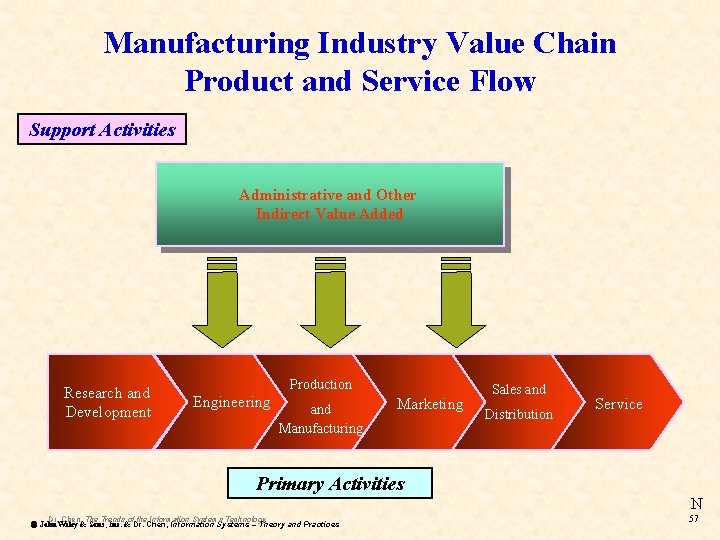
Manufacturing Industry Value Chain Product and Service Flow Support Activities Administrative and Other Indirect Value Added Research and Development Production Engineering and Manufacturing Marketing Primary Activities Dr. Chen, The Trends of the Information Systems Technology ã John Wiley & Sons, Inc. & Dr. Chen, Information Systems – Theory and Practices Sales and Distribution Service N 57
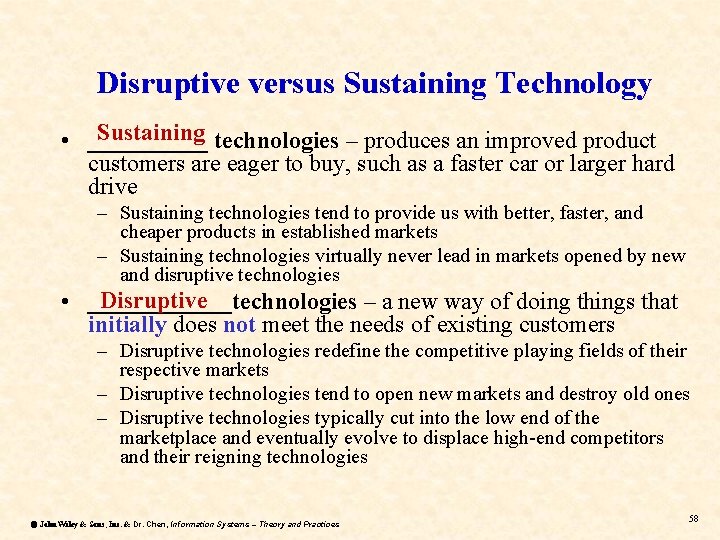
Disruptive versus Sustaining Technology Sustaining technologies – produces an improved product • _____ customers are eager to buy, such as a faster car or larger hard drive – Sustaining technologies tend to provide us with better, faster, and cheaper products in established markets – Sustaining technologies virtually never lead in markets opened by new and disruptive technologies Disruptive • ______technologies – a new way of doing things that initially does not meet the needs of existing customers – Disruptive technologies redefine the competitive playing fields of their respective markets – Disruptive technologies tend to open new markets and destroy old ones – Disruptive technologies typically cut into the low end of the marketplace and eventually evolve to displace high-end competitors and their reigning technologies ã John Wiley & Sons, Inc. & Dr. Chen, Information Systems – Theory and Practices 58
Disruptive versus Sustaining Technology • Please name two (or more) of Disruptive and Sustaining Technologies on the market now? ã John Wiley & Sons, Inc. & Dr. Chen, Information Systems – Theory and Practices 59
“Be fearful when others are greedy, and be greedy when others are fearful. ” -- Warren E. Buffett, CEO, Berkshire Hathawy, Inc. ã John Wiley & Sons, Inc. & Dr. Chen, Information Systems – Theory and Practices 60
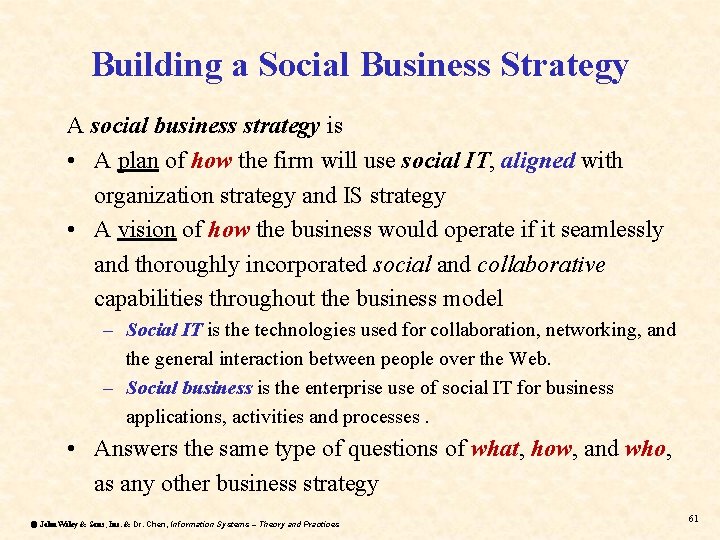
Building a Social Business Strategy A social business strategy is • A plan of how the firm will use social IT, aligned with organization strategy and IS strategy • A vision of how the business would operate if it seamlessly and thoroughly incorporated social and collaborative capabilities throughout the business model – Social IT is the technologies used for collaboration, networking, and the general interaction between people over the Web. – Social business is the enterprise use of social IT for business applications, activities and processes. • Answers the same type of questions of what, how, and who, as any other business strategy ã John Wiley & Sons, Inc. & Dr. Chen, Information Systems – Theory and Practices 61
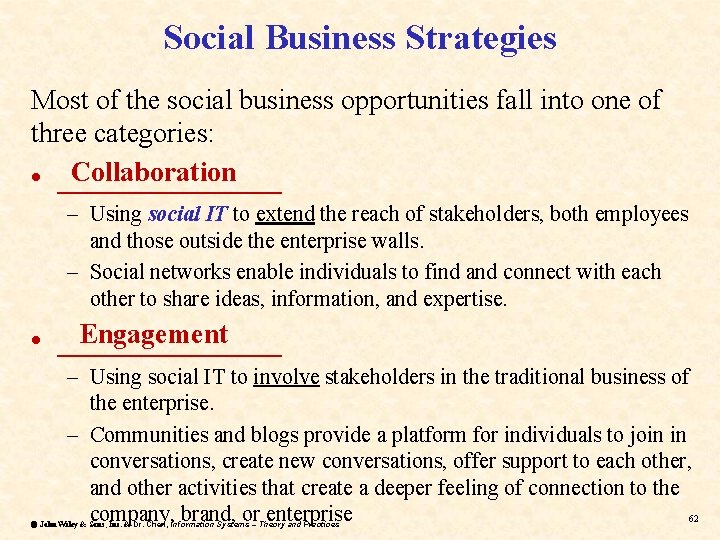
Social Business Strategies Most of the social business opportunities fall into one of three categories: Collaboration • _______ – Using social IT to extend the reach of stakeholders, both employees and those outside the enterprise walls. – Social networks enable individuals to find and connect with each other to share ideas, information, and expertise. Engagement • _______ – Using social IT to involve stakeholders in the traditional business of the enterprise. – Communities and blogs provide a platform for individuals to join in conversations, create new conversations, offer support to each other, and other activities that create a deeper feeling of connection to the company, brand, or enterprise 62 ã John Wiley & Sons, Inc. & Dr. Chen, Information Systems – Theory and Practices
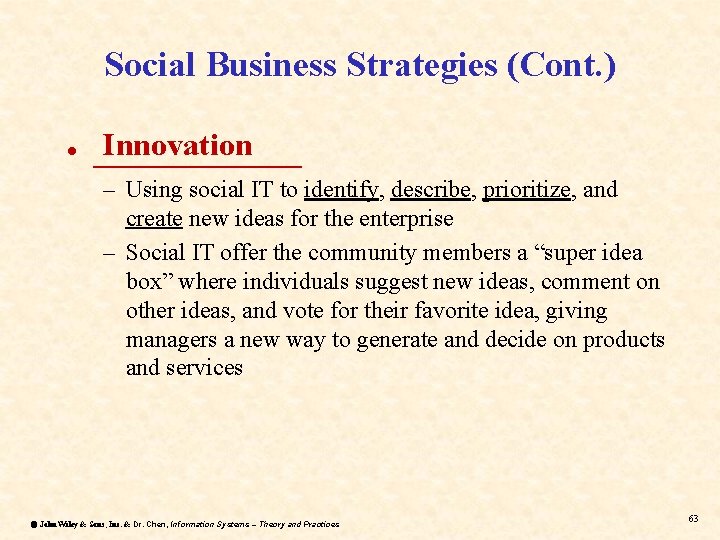
Social Business Strategies (Cont. ) Innovation • _______ – Using social IT to identify, describe, prioritize, and create new ideas for the enterprise – Social IT offer the community members a “super idea box” where individuals suggest new ideas, comment on other ideas, and vote for their favorite idea, giving managers a new way to generate and decide on products and services ã John Wiley & Sons, Inc. & Dr. Chen, Information Systems – Theory and Practices 63
Applications of Social IT • National Instruments (ni. com) has embraced social IT and created a social business strategy • Managers developed a branded community consisting of a number of social IT tools like Facebook®, Twitter®, blogs, forums, and more • Thinking holistically about all of the ways customers and employees might interact with each other, the branded community has become the hub of collaboration, engagement and idea generation ã John Wiley & Sons, Inc. & Dr. Chen, Information Systems – Theory and Practices 64
BRIEF OVERVIEW OF ORGANIZATIONAL STRATEGIES ã John Wiley & Sons, Inc. & Dr. Chen, Information Systems – Theory and Practices 65
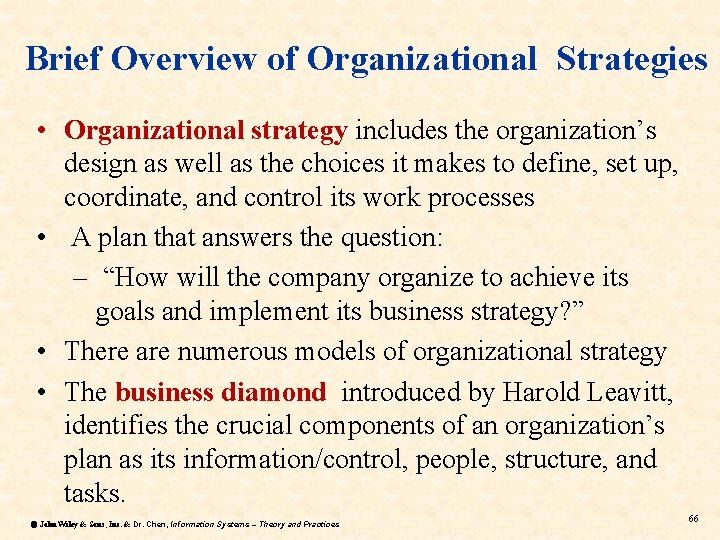
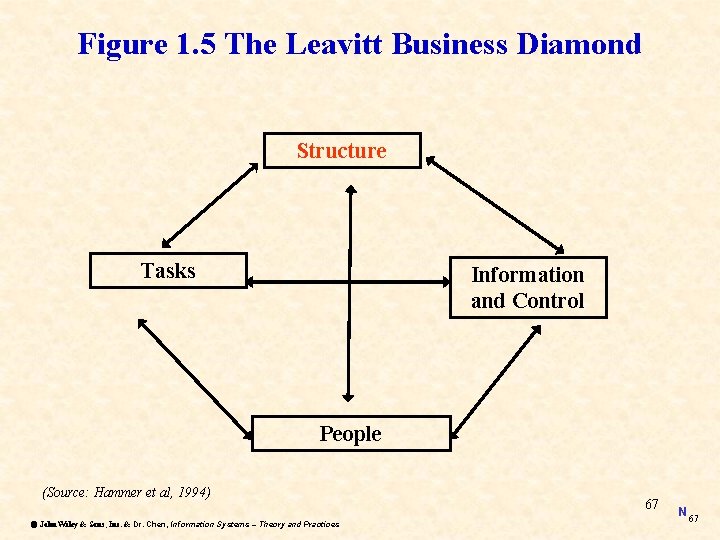
Brief Overview of Organizational Strategies • Organizational strategy includes the organization’s design as well as the choices it makes to define, set up, coordinate, and control its work processes • A plan that answers the question: – “How will the company organize to achieve its goals and implement its business strategy? ” • There are numerous models of organizational strategy • The business diamond introduced by Harold Leavitt, identifies the crucial components of an organization’s plan as its information/control, people, structure, and tasks. ã John Wiley & Sons, Inc. & Dr. Chen, Information Systems – Theory and Practices 66
Figure 1. 5 The Leavitt Business Diamond Structure Tasks Information and Control People (Source: Hammer et al, 1994) ã John Wiley & Sons, Inc. & Dr. Chen, Information Systems – Theory and Practices 67 N 67
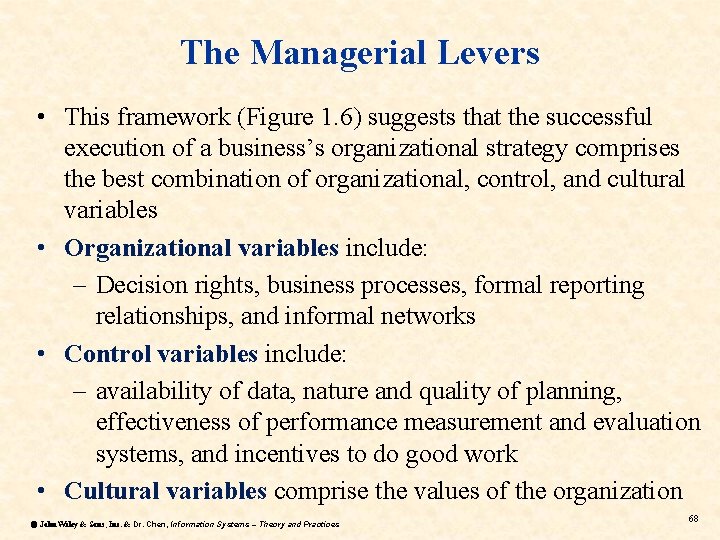
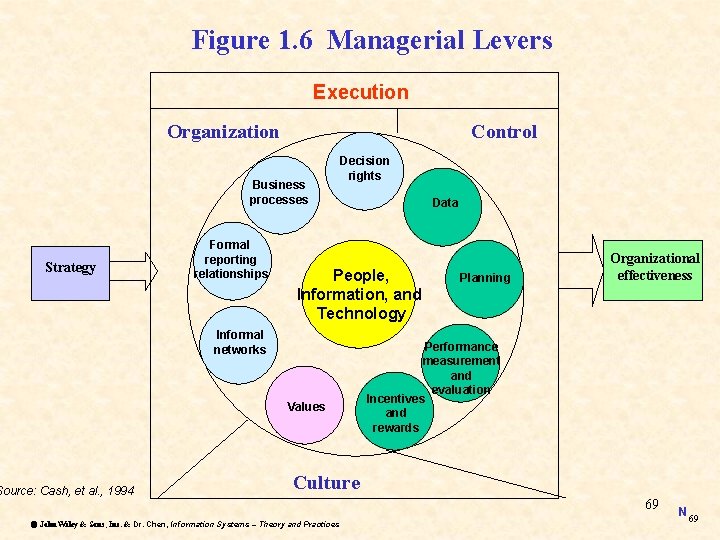
The Managerial Levers • This framework (Figure 1. 6) suggests that the successful execution of a business’s organizational strategy comprises the best combination of organizational, control, and cultural variables • Organizational variables include: – Decision rights, business processes, formal reporting relationships, and informal networks • Control variables include: – availability of data, nature and quality of planning, effectiveness of performance measurement and evaluation systems, and incentives to do good work • Cultural variables comprise the values of the organization ã John Wiley & Sons, Inc. & Dr. Chen, Information Systems – Theory and Practices 68
Figure 1. 6 Managerial Levers Execution Organization Control Business processes Strategy Formal reporting relationships Decision rights People, Information, and Technology Informal networks Values Source: Cash, et al. , 1994 Data Planning Organizational effectiveness Performance measurement and evaluation Incentives and rewards Culture ã John Wiley & Sons, Inc. & Dr. Chen, Information Systems – Theory and Practices 69 N 69
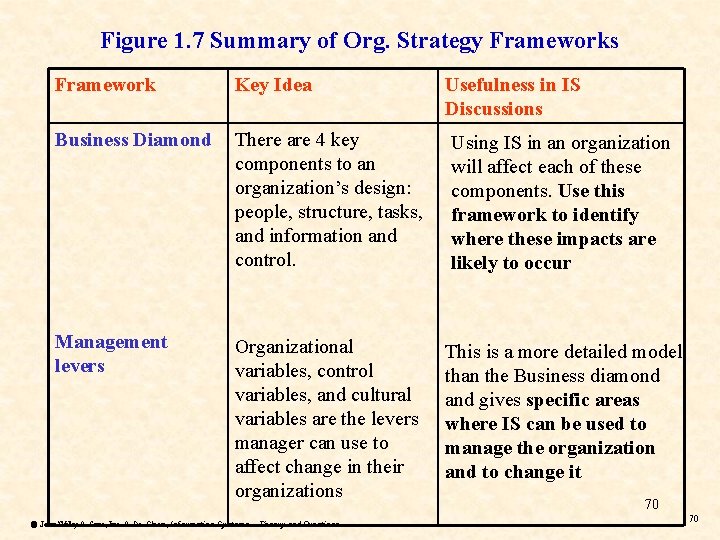
Figure 1. 7 Summary of Org. Strategy Frameworks Framework Key Idea Usefulness in IS Discussions Business Diamond There are 4 key components to an organization’s design: people, structure, tasks, and information and control. Using IS in an organization will affect each of these components. Use this framework to identify where these impacts are likely to occur Management levers Organizational variables, control variables, and cultural variables are the levers manager can use to affect change in their organizations This is a more detailed model than the Business diamond and gives specific areas where IS can be used to manage the organization and to change it ã John Wiley & Sons, Inc. & Dr. Chen, Information Systems – Theory and Practices 70 70
BRIEF OVERVIEW OF INFORMATION SYSTEMS STRATEGY 71 ã John Wiley & Sons, Inc. & Dr. Chen, Information Systems – Theory and Practices 71
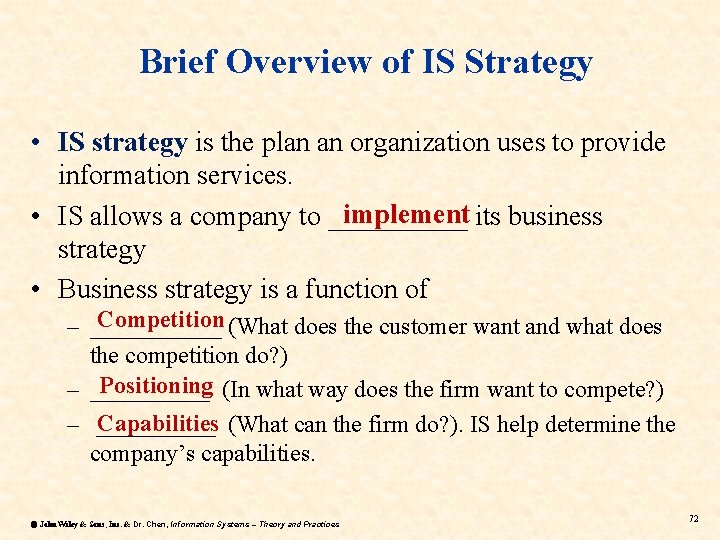
Brief Overview of IS Strategy • IS strategy is the plan an organization uses to provide information services. implement its business • IS allows a company to _____ strategy • Business strategy is a function of Competition (What does the customer want and what does – ______ the competition do? ) Positioning (In what way does the firm want to compete? ) – _____ Capabilities (What can the firm do? ). IS help determine the – _____ company’s capabilities. ã John Wiley & Sons, Inc. & Dr. Chen, Information Systems – Theory and Practices 72
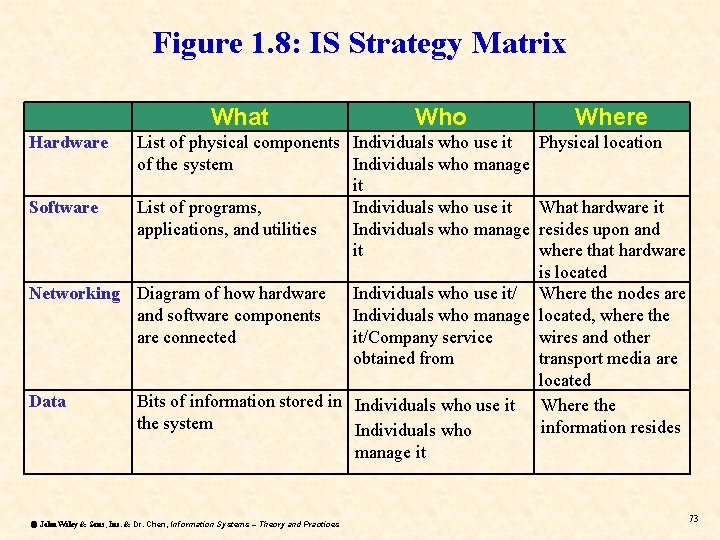
Figure 1. 8: IS Strategy Matrix What Hardware Software Who List of physical components Individuals who use it of the system Individuals who manage it List of programs, Individuals who use it applications, and utilities Individuals who manage it Where Physical location What hardware it resides upon and where that hardware is located Networking Diagram of how hardware Individuals who use it/ Where the nodes are and software components Individuals who manage located, where the are connected it/Company service wires and other obtained from transport media are located Data Bits of information stored in Individuals who use it Where the system information resides Individuals who manage it ã John Wiley & Sons, Inc. & Dr. Chen, Information Systems – Theory and Practices 73
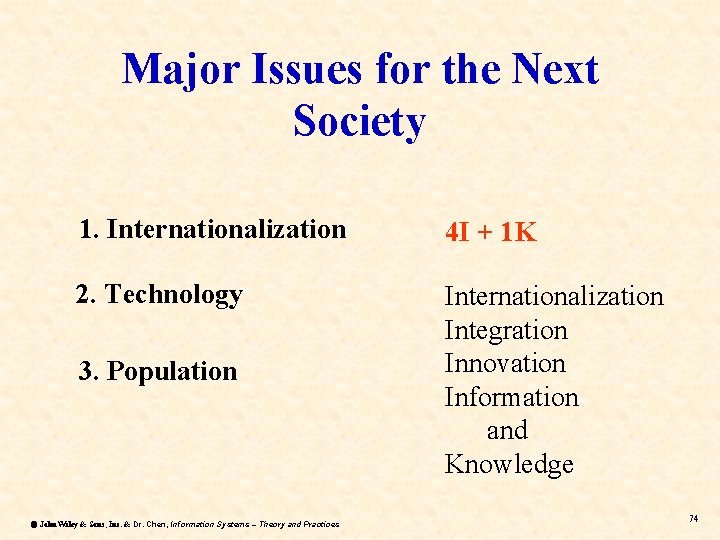
Major Issues for the Next Society 1. Internationalization 4 I + 1 K 2. Technology Internationalization Integration Innovation Information and Knowledge 3. Population ã John Wiley & Sons, Inc. & Dr. Chen, Information Systems – Theory and Practices 74
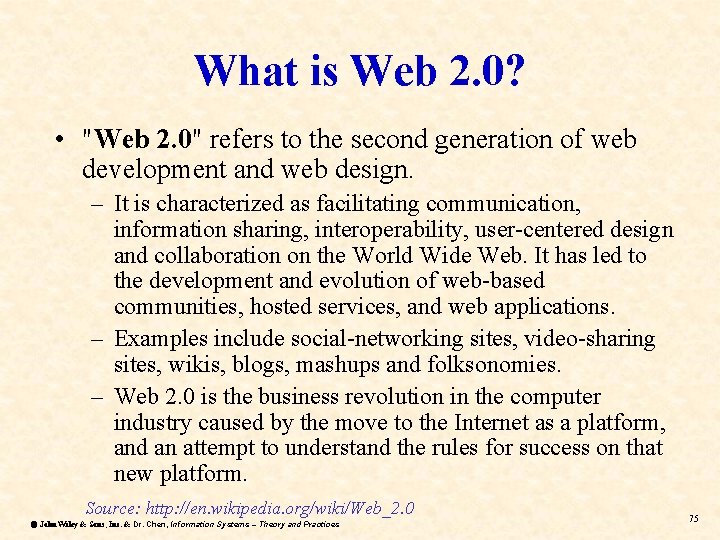
What is Web 2. 0? • "Web 2. 0" refers to the second generation of web development and web design. – It is characterized as facilitating communication, information sharing, interoperability, user-centered design and collaboration on the World Wide Web. It has led to the development and evolution of web-based communities, hosted services, and web applications. – Examples include social-networking sites, video-sharing sites, wikis, blogs, mashups and folksonomies. – Web 2. 0 is the business revolution in the computer industry caused by the move to the Internet as a platform, and an attempt to understand the rules for success on that new platform. Source: http: //en. wikipedia. org/wiki/Web_2. 0 ã John Wiley & Sons, Inc. & Dr. Chen, Information Systems – Theory and Practices 75
An extra HW: gmail and google accounts • You are required to create and complete the following before next class: – a gmail (email) account automatically provides you a google account – since GU email is now “powered” by gmail, you only need to create another google email account – you then have “two” gmail (Google) accounts – Complete “Collaboration Software Project” and – click “Assignments” on the Bb and select “Collaboration Software Project” for detailed instruction of how to submit your answer to the instructor. 76 ã John Wiley & Sons, Inc. & Dr. Chen, Information Systems – Theory and Practices 76
File name on your group work • Please name your group files as follows: • mbus 626 -G 1 -Soutth. West Airlines (. pptx or. docx) • Other group, please change G 1 to your designated group#. • Same way for IT Seminar – Make sure upload to the Bb (from the group leader only) and – Prepare an outline for your classmates. ã John Wiley & Sons, Inc. & Dr. Chen, Information Systems – Theory and Practices 77
End of Chapter 1 ã John Wiley & Sons, Inc. & Dr. Chen, Information Systems – Theory and Practices 78