
Chapter III OPTICS Lecture 3 8 Books i
Chapter III OPTICS Lecture 3. 8 Books: (i) Optics, 3 rd edition: Ajoy Ghatak, Mc. Graw-Hill Companies (ii) A Modern Book of Engineering Physics by S. L. Gupta and Sanjeev Gupta
Here we shall discuss about: • Phenomena of double refraction • Nicol prism • Production and analysis of plane • circular and elliptical polarized light • Fresnel’s theory of optical activity • Polarimeters
Production of Polarized light: We can produce the polarization by following methods (i) Polarization by wire grid polarizer and polaroid (ii) Polarization by reflection (Brewster’s Law) (iii) Polarization by double refraction Here we shall discuss the phenomenon of double refraction in detail
Double refraction: Physical properties of a isotropic medium are same in all directions but in anisotropic substances physical properties are different in different direction. The crystal of calcite, quartz and tourmaline are examples of Anisotropic substances. When an unpolarized beam enters an anisotropic crystal, it splits up into two beams. Each beam is characterized by a certain state of polarization. If, by some method, we could eliminate one of the beam, then we would obtain a linearly polarized beam.
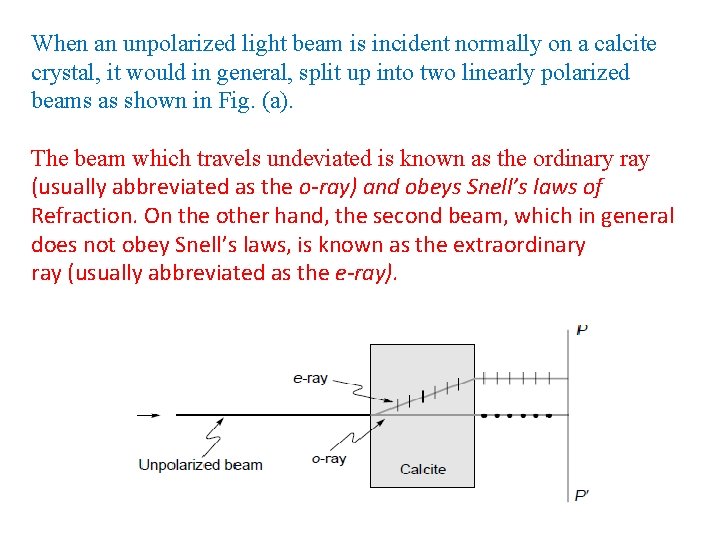
When an unpolarized light beam is incident normally on a calcite crystal, it would in general, split up into two linearly polarized beams as shown in Fig. (a). The beam which travels undeviated is known as the ordinary ray (usually abbreviated as the o-ray) and obeys Snell’s laws of Refraction. On the other hand, the second beam, which in general does not obey Snell’s laws, is known as the extraordinary ray (usually abbreviated as the e-ray).
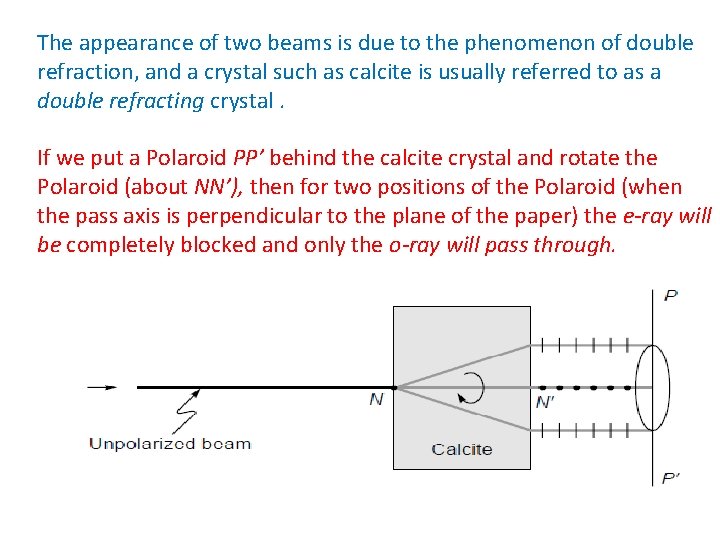
The appearance of two beams is due to the phenomenon of double refraction, and a crystal such as calcite is usually referred to as a double refracting crystal. If we put a Polaroid PP’ behind the calcite crystal and rotate the Polaroid (about NN’), then for two positions of the Polaroid (when the pass axis is perpendicular to the plane of the paper) the e-ray will be completely blocked and only the o-ray will pass through.
On the other hand, when the pass axis of the Polaroid is in the plane of the paper (i. e. , along the line PP’), then the o-ray will be completely blocked and only the e-ray will pass through. Further, if we rotate the crystal about NN’, then the e-ray will rotate about the axis [Fig. (b)].
The velocity of the ordinary ray is the same in all directions whereas the velocity of the extraordinary ray is different in different directions. As discussed earlier a substance (such as as calcite, quartz) which exhibits different properties in different directions is called an anisotropic substance. There is a particular direction (fixed in the crystal) along which the two velocities are equal and this direction is known as the optic axis of the crystal. In a crystal such as calcite, the two rays have the same speed only along one direction (which is the optic axis). Such crystals are known as uniaxial crystals whereas the biaxial crystals are the one In which there are two directions along which the velocities ares. Same (e. g. Topaz, aragonite etc. ).
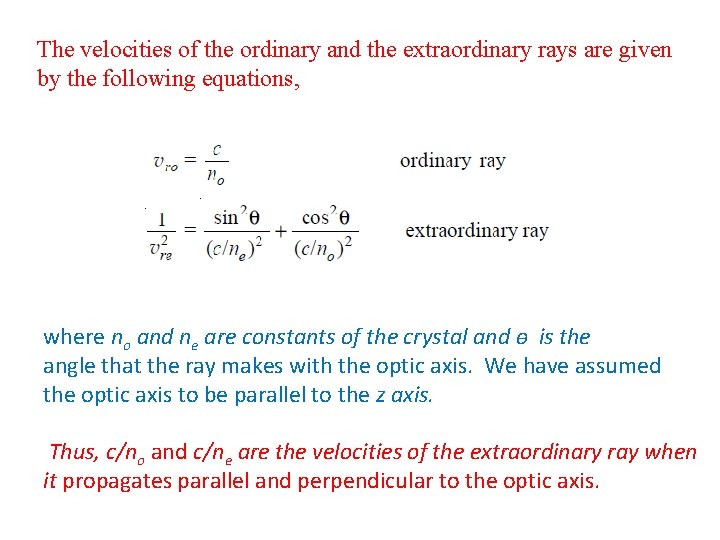
The velocities of the ordinary and the extraordinary rays are given by the following equations, where no and ne are constants of the crystal and ɵ is the angle that the ray makes with the optic axis. We have assumed the optic axis to be parallel to the z axis. Thus, c/no and c/ne are the velocities of the extraordinary ray when it propagates parallel and perpendicular to the optic axis.
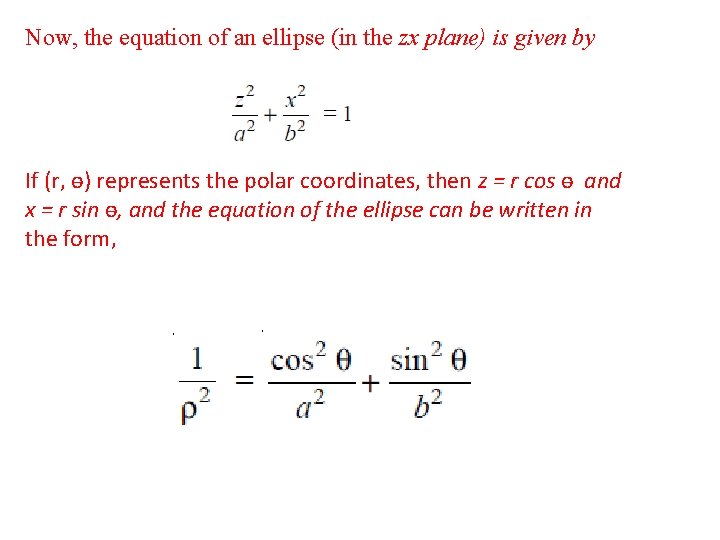
Now, the equation of an ellipse (in the zx plane) is given by If (r, ɵ) represents the polar coordinates, then z = r cos ɵ and x = r sin ɵ, and the equation of the ellipse can be written in the form,
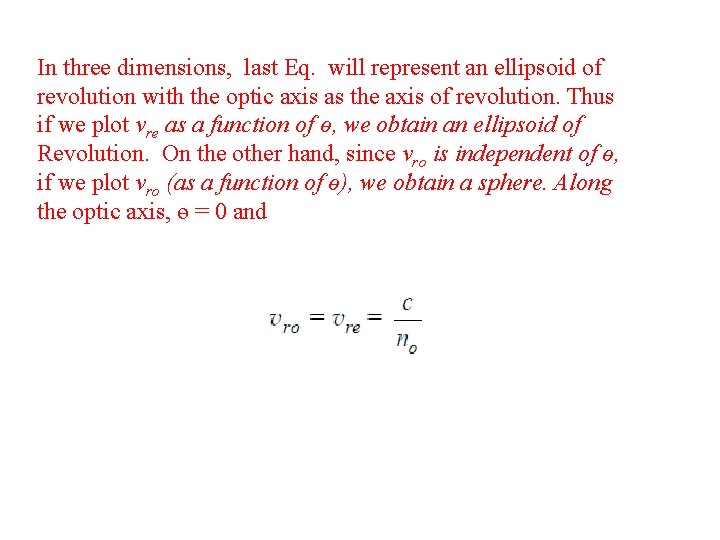
In three dimensions, last Eq. will represent an ellipsoid of revolution with the optic axis as the axis of revolution. Thus if we plot vre as a function of ɵ, we obtain an ellipsoid of Revolution. On the other hand, since vro is independent of ɵ, if we plot vro (as a function of ɵ), we obtain a sphere. Along the optic axis, ɵ = 0 and
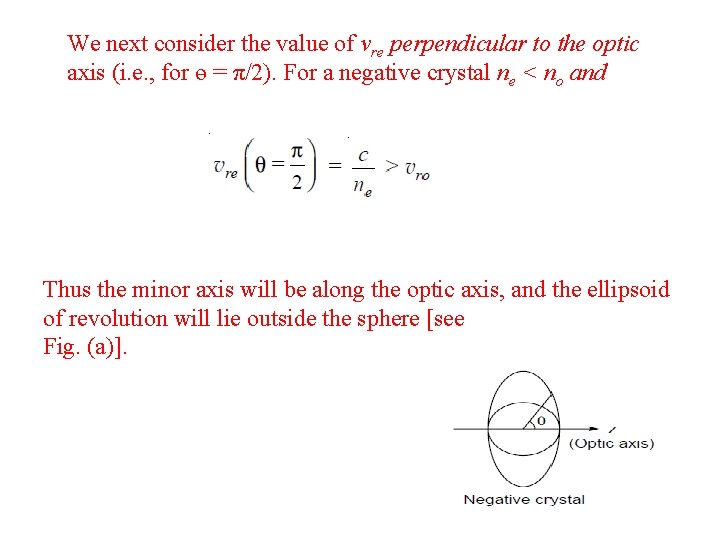
We next consider the value of vre perpendicular to the optic axis (i. e. , for ɵ = π/2). For a negative crystal ne < no and Thus the minor axis will be along the optic axis, and the ellipsoid of revolution will lie outside the sphere [see Fig. (a)].
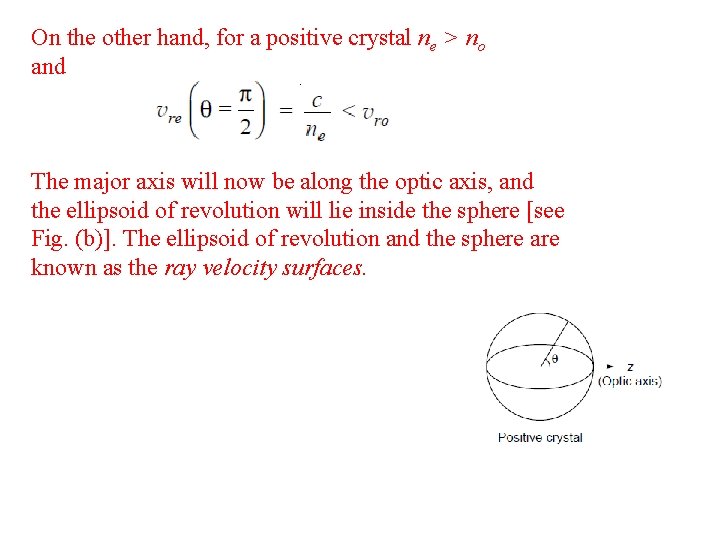
On the other hand, for a positive crystal ne > no and The major axis will now be along the optic axis, and the ellipsoid of revolution will lie inside the sphere [see Fig. (b)]. The ellipsoid of revolution and the sphere are known as the ray velocity surfaces.
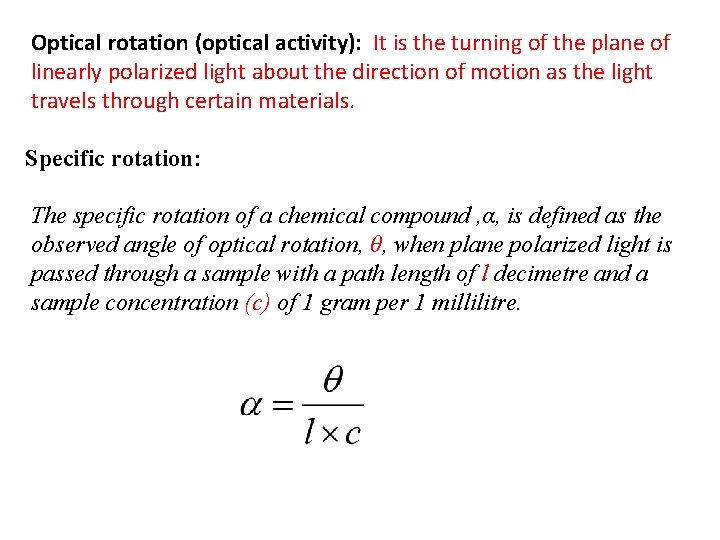
Optical rotation (optical activity): It is the turning of the plane of linearly polarized light about the direction of motion as the light travels through certain materials. Specific rotation: The specific rotation of a chemical compound , α, is defined as the observed angle of optical rotation, θ, when plane polarized light is passed through a sample with a path length of l decimetre and a sample concentration (c) of 1 gram per 1 millilitre.
- Slides: 14