
Chapter III OPTICS Lecture 3 1 Books 1
Chapter III OPTICS Lecture 3. 1 Books: (1) Optics, 3 rd edition: Ajoy Ghatak, Mc. Graw-Hill Companies
Optics It is the branch of Physics which deals with the study of the behaviour and properties of light. There are certain phenomenon which can be explained by considering the wave nature of light e. g. Interference of light, diffraction or polarization. However, certain phenomenon e. g. Photoelectric effect, Compton Effect etc can be explained by considering the particle nature of Light. Thus light is now supposed to have dual character.
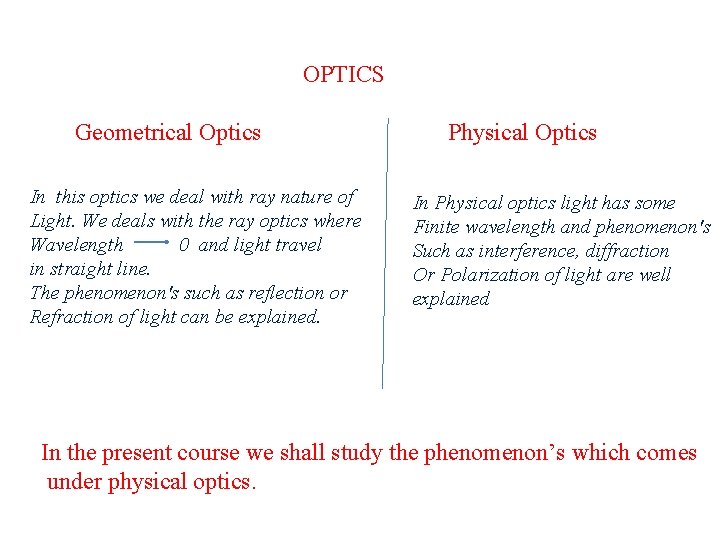
OPTICS Geometrical Optics In this optics we deal with ray nature of Light. We deals with the ray optics where Wavelength 0 and light travel in straight line. The phenomenon's such as reflection or Refraction of light can be explained. Physical Optics In Physical optics light has some Finite wavelength and phenomenon's Such as interference, diffraction Or Polarization of light are well explained In the present course we shall study the phenomenon’s which comes under physical optics.

Interference of Light: Interference of light deals with the superposition of light waves coming from two coherent sources. Coherent sources are those sources of light which emit continuous light waves of same wavelength, same frequency and are in same phase or have constant phase difference. Incoherent waves Coherent waves
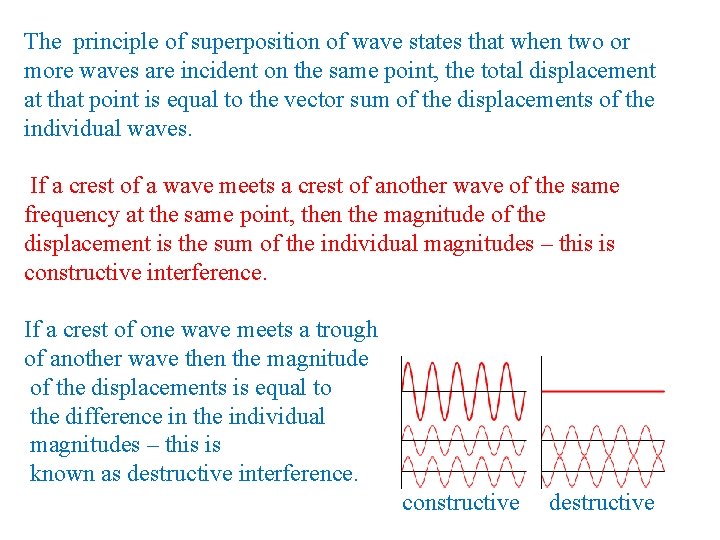
The principle of superposition of wave states that when two or more waves are incident on the same point, the total displacement at that point is equal to the vector sum of the displacements of the individual waves. If a crest of a wave meets a crest of another wave of the same frequency at the same point, then the magnitude of the displacement is the sum of the individual magnitudes – this is constructive interference. If a crest of one wave meets a trough of another wave then the magnitude of the displacements is equal to the difference in the individual magnitudes – this is known as destructive interference. constructive destructive
Constructive interference occurs when the phase difference between the waves is a multiple of 2π, whereas destructive interference occurs when the difference is π, 3π, 5π, etc. If the difference between the phases is intermediate between these two extremes, then the magnitude of the displacement of the summed waves lies between the minimum and maximum values.
• For observing interference phenomenon coherence of light waves is a must. • For light waves emitted by two sources of light , to remain coherent the initial phase difference between waves should remain constant in time. If the phase difference changes continuously or randomly with time then the sources are incoherent. • Two independent sources of light are not coherent and hence can not produce interference because light beam is emitted by millions of atoms radiating independently so the phase difference between waves from such sources fluctuates randomly many times per second.
• The coherent sources can be obtained either by the source and obtaining its virtual image or by obtaining two virtual images of the same source. This is because any change of phase in real source will cause a simultaneous and equal change in its image. v. Laser light is almost monochromatic light with little spreading and two independent sources of laser light can produce observable interference pattern.
Generally coherence in interference is obtained by two methods (1) Division of wave front where wave front is divided into two parts by reflection, refraction or diffraction and those two parts reunite at a small angle to produce interference as done in case of Young's double slit experiment and Fresnel's Biprism experiment. (2) Division of amplitude where amplitude of a section of wave front is divided into two parts and reunited later to produce interference such as in case of thin films.
- Slides: 9