
Chapter II Ways of Presenting Evidence Established by

Chapter II Ways of Presenting Evidence
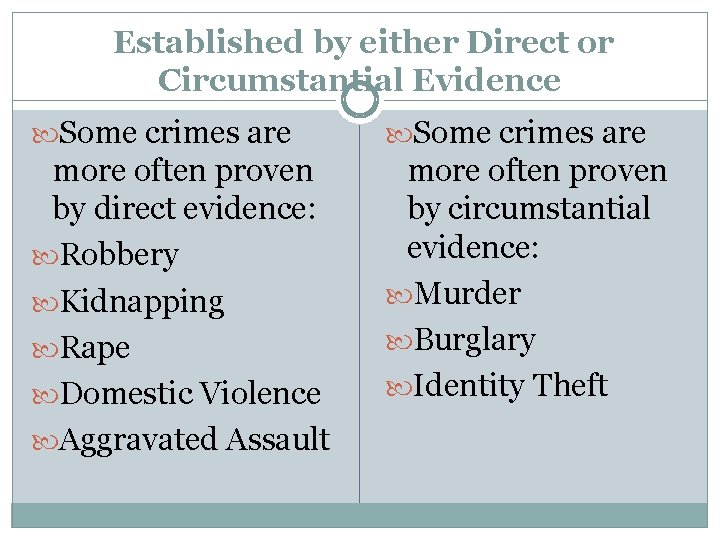
Established by either Direct or Circumstantial Evidence Some crimes are more often proven by direct evidence: Robbery Kidnapping Rape Domestic Violence Aggravated Assault more often proven by circumstantial evidence: Murder Burglary Identity Theft
Direct Evidence: Any evidence that directly proves a fact, without inference or presumption, and which in itself, if true, conclusively establisher the fact (410 E. C. ) Most often involves the testimony of a witness who personally observed or otherwise perceived a fact (sound, smell, touch) which is relevant to the case.
Direct Evidence as Proof: Direct evidence of one witness is sufficient to prove a fact without the necessity of offering other evidence Example – testimony of a rape or child molest victim, standing alone, could be sufficient to establish the facts of a crime.

When a Witness Testifies: I saw (this) I found (this) I did (this) I recovered I heard (this) I said (this) I was told (this) I smelled (this) I wrote (this) I collected (this)
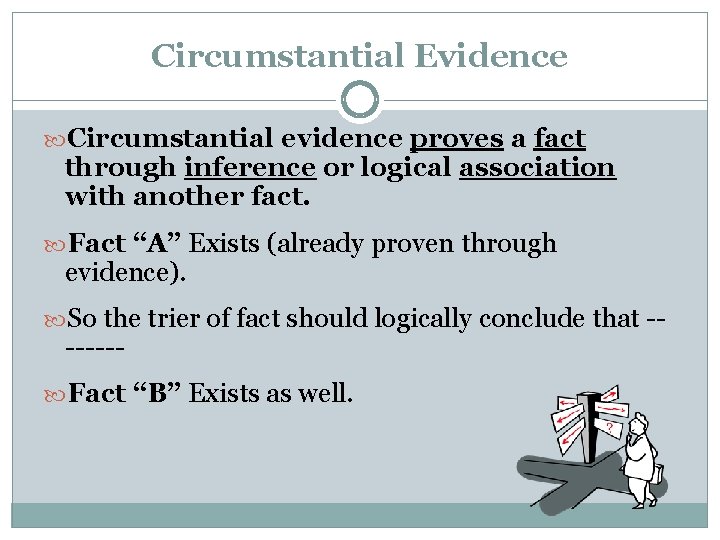
Circumstantial Evidence Circumstantial evidence proves a fact through inference or logical association with another fact. Fact “A” Exists (already proven through evidence). So the trier of fact should logically conclude that -- ------ Fact “B” Exists as well.

Circumstantial Evidence FACT A: the defendant’s latent fingerprints were found at the crime scene. ( established through a technician who recovered the evidence and an expert witness who compared and matched the evidence). The trier of fact may infer or logically conclude that ------ Fact B: the defendant was present and had the opportunity to commit the crime.
Circumstantial Evidence Fact A: during a search warrant service, indicia of ownership belonging to the defendant (cancelled checks, utility bills, rent receipts, photographs, keys, etc. ) were found in the same room as narcotics packaged for sale. the trier of fact may infer or logically conclude that ------- Fact B: the defendant occupied the bedroom and was is “constructive possession” of the contraband.

Circumstantial Evidence as Proof: CA law prohibits a conviction based upon circumstantial evidence alone, unless the proven circumstances are not only consistent with guilt, but also irreconcilable with any other rational conclusion of the events. This type of evidence could carry more weight with the trier of fact than eyewitness testimony (direct evidence)
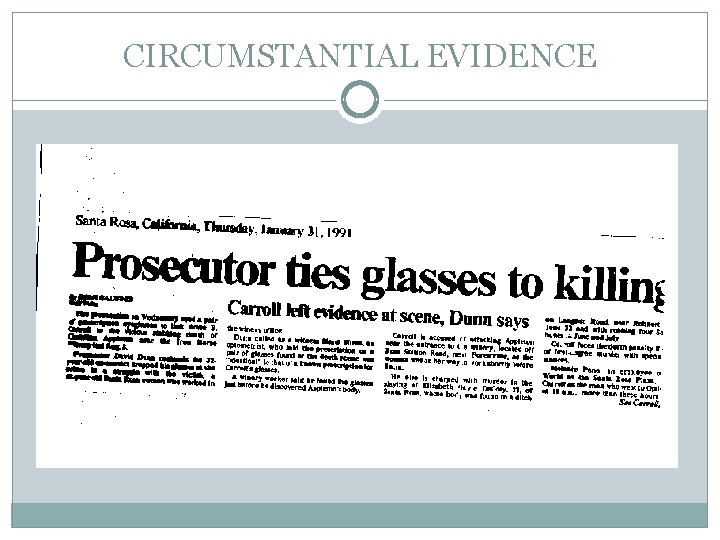
CIRCUMSTANTIAL EVIDENCE
Prima Facie Evidence Is any evidence which “on its face” or clearly at “fact value” proves a fact. This evidence is sufficient for proof of a fact unless it is rebutted by evidence to the contrary. Often associated with proving the corpus delicti (elements) of a crime. Example – the fact that a person leaves a restaurant without paying for the meal.
Corroborative Evidence: Is that evidence which tends to support other evidence previously presented. Example – the deft’s fingerprints are found on a windowsill after a attempted rape. As well, a bloodstain was left when the suspected rapist apparently cut himself on the latch while crawling through the window. This stain matches the blood type of the defendant. One type of physical evidence corroborates another and circumstantially establishes the deft’s presence at the crime scene.
A conviction cannot be based solely upon the testimony of an accomplice A co-principal in a crime who turns state’s evidence and testifies against another co-principal, unless it is corroborated with such other evidence that tends to connect the deft with the commission of the offense
Presumptions: • A presumption is an assumption of fact that the law requires to be made from another fact or group of facts, found or otherwise established in the action (600 E. C. ) • Example – a person not heard from in five years is presumed to be dead (667 E. C. ) • An unlawful purpose is presumed from knowingly and willfully doing an unlawful act (general intent – speeding) or failing to perform a duty required by law (criminal negligence) as an element of the offense.
Categories of Presumptions: Conclusive – a presumption which the law demands or directs be made from a given set of facts which cannot be overcome by evidence to the contrary. These presumptions are for all practical purposes non-existent in CA criminal evidence.
Rebuttable Presumption (630 E. C. ) – a presumption that can be made from a given set of facts which stands unless overcome by evidence to the contrary. (presumptions in CA criminal evidence are rebuttable in nature). Example: ü Presumption of innocence ü Presumption of sanity ü Children under 14 yrs. are incapable of committing a crime ü Presumption of witness competency
Inferences: Is a deduction of fact that may be logically and reasonably drawn from another fact or group of facts, found or otherwise established in the action (600 E. C. ). Lifeblood of circumstantial evidence. Embedded in the presentation of evidence (testimony, writings, and material objects). The weight to which an inference is entitled is a matter for the judge or jury to determine.
Example – when the body of a young woman was found unclothed, with a broken jaw, and dumped in a remote irrigation ditch, and inference arises that a rape had occurred. A jury could reasonably infer the crime of rape occurred through medical testimony showing that vaginal redness was present. “Consciousness of Guilt” (admission by conduct or implied admission) Ø Flight from the crime scene Ø Destroying or altering evidence Ø Lies concerning one’s involvement in a crime
Judicial Notice: • Involves matters of common fact, general • • knowledge, or law that are universally known, easily referenced, and are not reasonably subject to dispute. These facts can be offered into evidence without adversarial argument. Saves court time No need to reinvent the wheel by reproving each known fact Judge has the final decision as to whether or not evidence meets the legal requirements of judicial notice
1. Matters of general knowledge: ü Liquor is intoxicating ü Diesel fuel is flammable ü Gunpowder is explosive ü Arsenic is poisonous 2. Legal Procedures: ü Constitutional provisions ü Appellate court decisions ü Words and phrases in statutory codes
3. Courses of nature: ü Documenting sunset/sunrise ü Weather circumstances for establishing wet, icy, or foggy conditions 4. Scientific facts and principles: ü Mathematical formulas for determining speed from skid marks ü Operation of intoxilyzer machine to measure blood alcohol level (DUI) ü DNA analysis meets the Kelly-Frye test for scientific reliability of evidence 5. Miscellaneous: ü Geographic factors ü Historical facts ü Weights and measures
Stipulations: Is a fact (s) upon which counsel (prosecution or defense) agree can be presented to the trier of fact without a formal offering of proof being required. Example – Ø Qualifications of a medical expert witness Ø Competency of a 10 year old child molest victim Ø Legality of a detention and arrest
Discovery: Is the right of the defense or prosecution to examine reports, notes, witness statements, etc, or any other evidence held by the other side in preparation for trial The Crime Victim’s Justice Reform Initiative (Prop 115) 1990 – discovery was made a 2 way street
Purposes: Ø Promote the ascertainment of truth in trials by requiring timely pretrial discovery Ø Save court time Ø Protect victims and witnesses from danger, harassment, and undue delay of proceedings. q Mutual disclosure of information shall be made 30 days prior to trial unless “good cause” exists. q Prosecution’s duty to disclose – extends to all evidence that reasonably appears favorable to the accused
q. Defense duty to disclose – all information regarding witnesses, statements of same, statements & reports from experts, results of scientific tests and lists of real evidence. q. Failure to comply – court can apply sanctions to either side. Could be held in contempt and evidence could be excluded
Pitchess Motion: (1538. 5) Discovery of peace officer personnel records. ü Deft has the right to discover names of persons who have filed past citizen complaints against an officer, include: Use of force Unlawful arrest Illegal search Falsification of police reports Etc Judge determines what is relevant to current case, defense must lay a foundation & show good cause
In-Camera Hearing: If the Pitchess motion is granted – ØIs held outside the presence of both counsel ØJudge reviews any complaints in the personal file ØIf relevant info. is found judge will order release to the defense ØDefense not entitled to records over 5 years old without showing of exculpatory value (evidence tending to prove guiltless or blameless)
- Slides: 27