
Chapter II Storage devices and interfacing Storage devices





- Slides: 36
Chapter -II Storage devices and interfacing
Storage devices Storage device Storgae device is hardware device designed to store information • Primary storgae device-(volatile memory) main memory RAM • Secondary storage devices-(Magnetic storage devices ) storing data permanently hard disk, CD ROM drive or DVD drive and pen Drive
Recording techniques Recoding Methods Three methods have been employed in recording the data on a hard disk. They are: Magnetic recording on disk surface is done by magnetic read/write head By passing current through read/write head causes the magnetization • FM -Frequency Modulation (was used in floppy) • MFM -Modified Frequency Modulation (is being used in floppy and was in earlier hard disks) • RLL -Run Length Limited (is being used in hard disk) only RLL method is being used in hard disk, and MFM in floppy disk. FM is not used because it occupies more space in hard disk comparing with other two recording methods. FM recording is referred to as single density and MFM as double density.
FM recording technique referred as single density recording Data encoding scheme used to store data on magnetic recording surface FM Usually a clock is recorded at the beginning of each bit cell. (Maximum one data bit can be recorded in a bit cell). The data is written as a pulse in the middle of a bit cell. In case the data bit is 1, a pulse is recorded otherwise no pulse is recorded on the media. FM recording also referred as (0, 1) RLL recording A binary digit 1011 is stored as Binary digit 1 store two pulses(PP) Binary digit 0 store as one pulse or no pulse(PN) 1 0 1 1 PP PN PP PP
FM recording technique FM : Maximum one data bit can be recorded in a bit cell. In case the data bit is 1, a pulse is recorded otherwise no pulse is recorded on the media. Each bit cell is of 4 micro sec duration for floppy disk and 110010110 Recording Format
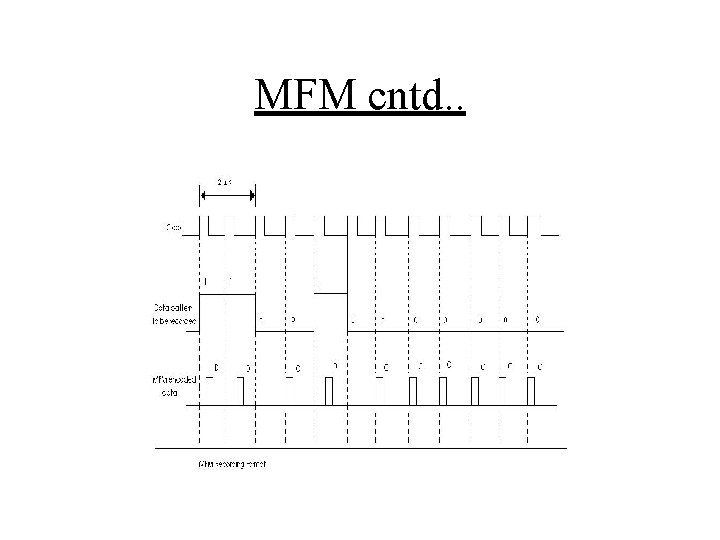
MFM recording technique MFM In MFM recording method, no clock pulse is recorded at the beginning of a bit cell. When the data bit is 1, only a single pulse is recorded in the center of a bit cell and no clock recorded. If a data bit is 0 subsequent to a data bit 1 recorded in the previous cell, no clock/data pulse is recorded in the particular cell. If two or more 0 s are to be recorded subsequently, only a single clock pulse has to be recorded at the beginning of each bit cell (Remember data pulse is recorded in the center of a bit cell). In MFM only one pulse is recorded in the center and clock pulse is omitted. From the above it is understood that MFM method occupies only half of the disk space used by FM method and increase the data recoding (storing) capacity by two. In other words doubles the density of the disk. Duration of bit cell is reduced to 2 microsec and disk capacity are doubled in MFM
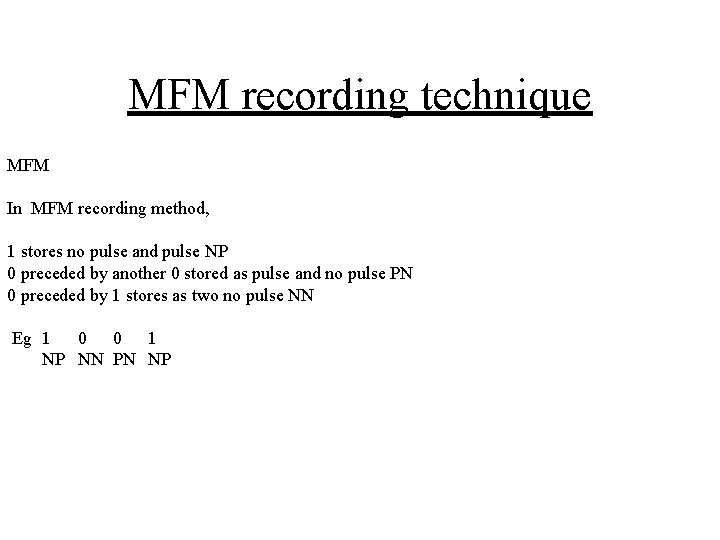
MFM recording technique MFM In MFM recording method, 1 stores no pulse and pulse NP 0 preceded by another 0 stored as pulse and no pulse PN 0 preceded by 1 stores as two no pulse NN Eg 1 0 0 1 NP NN PN NP
MFM cntd. .
RLL ENCODING Run-Length Limited (RLL) It records information twice then the MFM and three times than the FM RLL name is from min or max of no pulse values allowed in between two pulses Faster data transfer then compared to other encoding schemes It works on group of bits the group of 2, 3, or 4 bits pattern. RLL recording method provides most efficient way to encode data than any other methods. The most popular recording method used in hard disk drive is referred to as 2, 7 RLL. This process uses no clock signals at all. This deficiency is made up for by recording on the disk patterns that are different from the ones in the data to be stored. If these patterns are chosen correctly, the controller can reverse that process when it is time to read the data.
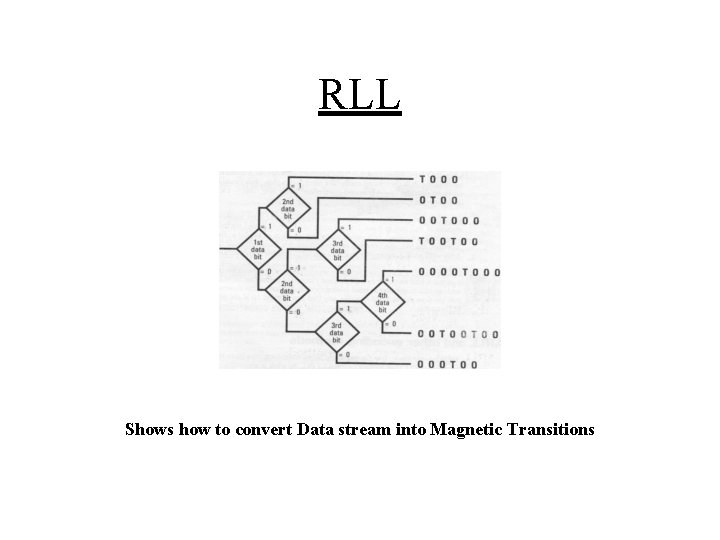
RLL Shows how to convert Data stream into Magnetic Transitions
RLL Rather than simply translating the each incoming data bit into transitions, the controller divides and selects a group of bits at a time for encoding. For each group, a specially chosen sequence of transitions and lack of transitions gets stored. In 2, 7 RLL the sequences of Ps and Ns must be chosen such that, no matter what the incoming data bit stream, there will always be at least two and never more than seven Ns between any two Ps. shows how to convert a data bit stream into magnetic transitions (Ps) and spaces between them (Ns) by using 2, 7 RLL encoding. Bit stream Magnetic Transitions and spaces Sequence 11 = PNNN 10 = NPNN 000 = NNNPNN 011 = NNPNNN 010 = PNNPNN 0011 = NNNNPNNN 0010 = NNPNNPNN N-no pulse P-pulse
Perpendicular Encoding Perpendicular magnetic recording is a technology for data recording on hard disk. Virtually all hard drives record data using longitudinal recording which stores magnetic bits horizontally across the surface of the media. perpendicular recording which aligns magnetic signals vertically on the media surface has the potential to achieve higher data intensities because vertically oriented magnetic bits use less space than longitudinally stored bits. Manufacturer decreases the size of the magnetic grains that comprise data bits to increase storage capacity, but the size of magnetic grains are so small that they could start interfering with one other causes losing their magnetic orientations resulting causes lose of data or data corruption this is known as super paramagnetic effect(SPE)
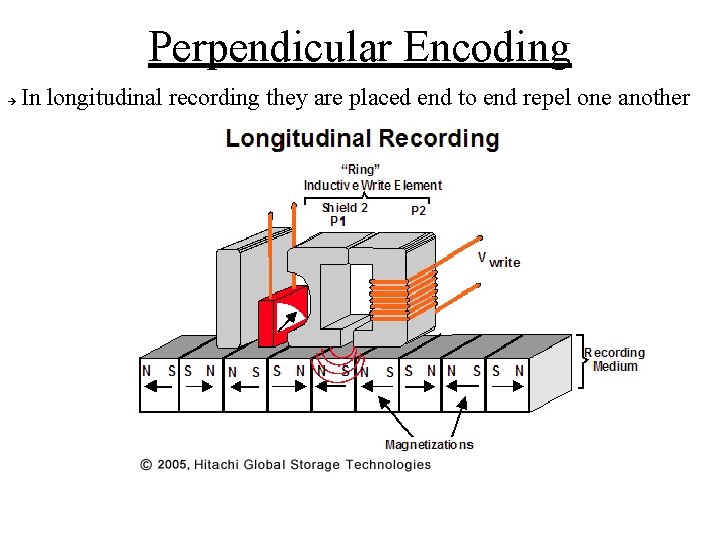
Perpendicular Encoding In longitudinal recording they are placed end to end repel one another
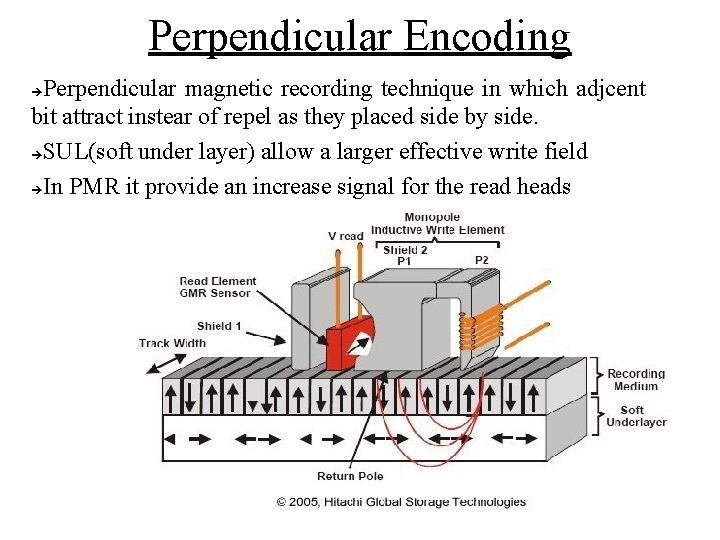
Perpendicular Encoding Perpendicular magnetic recording technique in which adjcent bit attract instear of repel as they placed side by side. SUL(soft under layer) allow a larger effective write field In PMR it provide an increase signal for the read heads
Hard disk drive construction &working HDD referred as (secondary storage devices) it is non volatile storage device it stores huge data on magnetic rotating platters Three types of HDD IDE HDD SATA HDD SCSI HDD
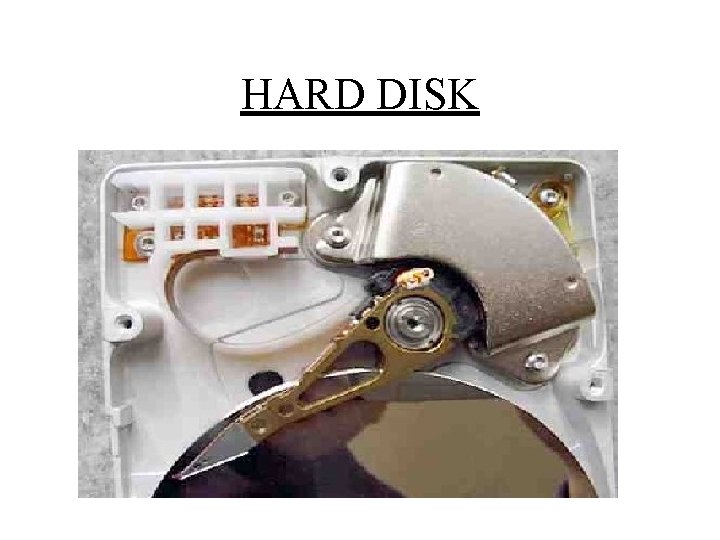
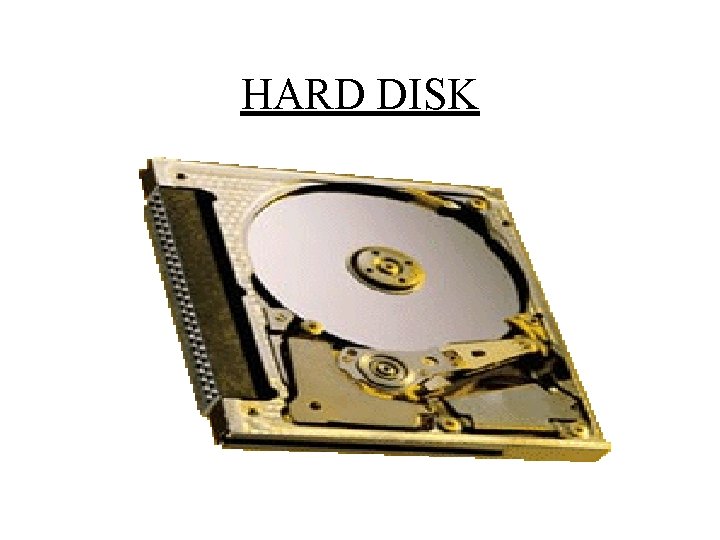
HARD DISK Drive Construction 1. Disk platters 2. Read/write heads 3. Head actuator mechanism 4. Spindle motor 5. Logic board 6. Cables and connectors 7. Bezel / Front Plate 8. Air Filter
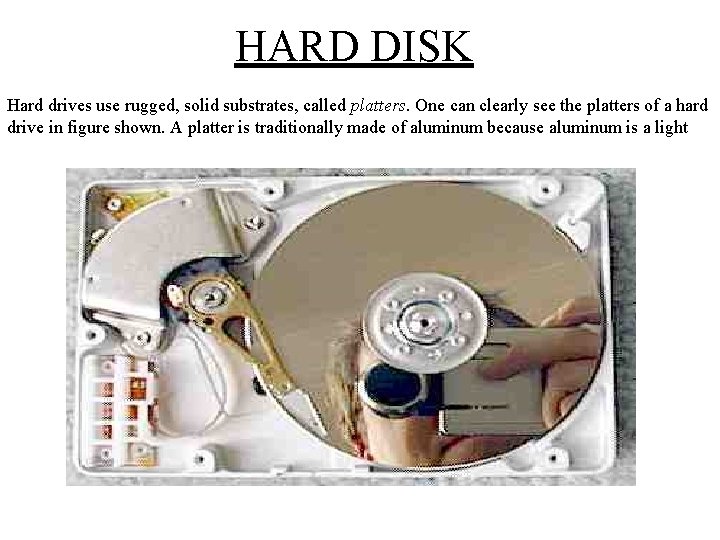
HARD DISK Hard drives use rugged, solid substrates, called platters. One can clearly see the platters of a hard drive in figure shown. A platter is traditionally made of aluminum because aluminum is a light
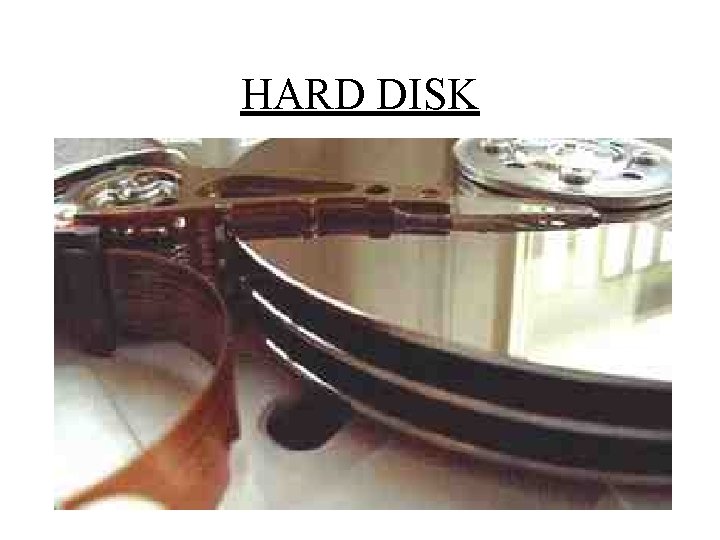
HARD DISK Drives Disk platters: The platters stores information. It comes in varying sizes like 5. 12”, 3. 14”, 0. 85” etc. The physical size of a drive is expressed as the size of the platters Most hard disk have two or more platters Platters were originally made from an aluminium/magnesium alloy which provides both strangth and light weight All modern drives use glass or glass ceramic plates. advantage of a hard drive is speed, platters are rotated from about 7600 RPM to as much as 10, 000 RPM (compared to older hard drives, which ran at 3600 to 5200 RPM). A hard drive commonly uses two or more platters, Two types of recording media Iron oxide media: HDD platter surface coated with iron oxide , recording density is less. Thin film media very thin coating compared to iron oxide coating
HARD DISK Drives Disk platters: Thin film media due to thin coating it allows hard disk head to be very close to the disk surface which give very high density recording. Thin film media provides a very heard and perfectly formard media coating Once film media spread evenly across platter surface , surface is cured and polished nd it is coated with lubircant material which protect surface from crashes. Media is created 1). plating process. 2). sputtering process 1)Coated with 2 to 3 micro inch thickcobalt alloy coating. 2) thin coating, sputtering provide thinnest , hardest, finest media surface. High cost.
HARD DISK Drives Read/write head: A hard disk drive usually has one read/write head for each platter surface(meaning that each platter has two sets of read/write headsone for top side and one for bottom side These heads are connected on a single movement mechanism so heads across the platters in unison. The HDD uses various types of heads for read/write purpose. Ferrite head Metal-In-Gap Head, Thin Film Head Magneto Resistive Head Giant Magneto Resistive Head: smaller,
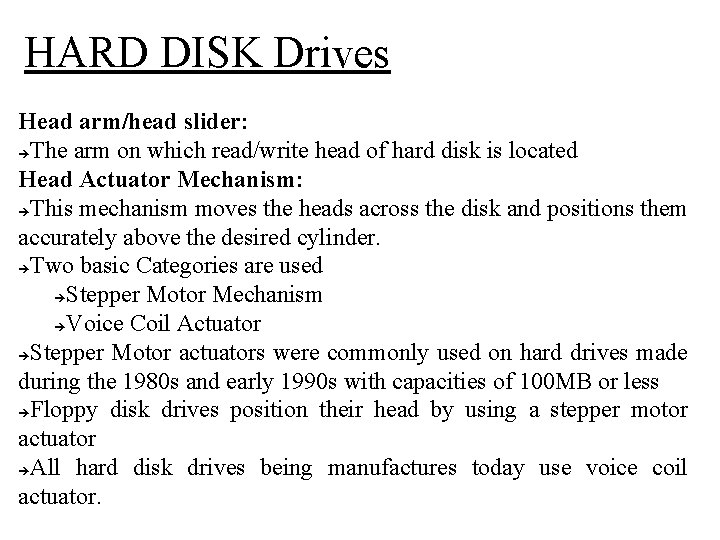
HARD DISK Drives Head arm/head slider: The arm on which read/write head of hard disk is located Head Actuator Mechanism: This mechanism moves the heads across the disk and positions them accurately above the desired cylinder. Two basic Categories are used Stepper Motor Mechanism Voice Coil Actuator Stepper Motor actuators were commonly used on hard drives made during the 1980 s and early 1990 s with capacities of 100 MB or less Floppy disk drives position their head by using a stepper motor actuator All hard disk drives being manufactures today use voice coil actuator.
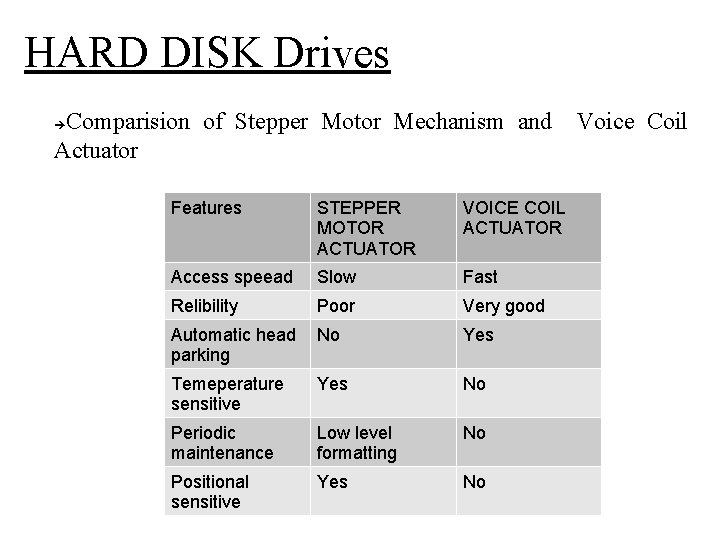
HARD DISK Drives Comparision of Stepper Motor Mechanism and Voice Coil Actuator Features STEPPER MOTOR ACTUATOR VOICE COIL ACTUATOR Access speead Slow Fast Relibility Poor Very good Automatic head parking No Yes Temeperature sensitive Yes No Periodic maintenance Low level formatting No Positional sensitive Yes No
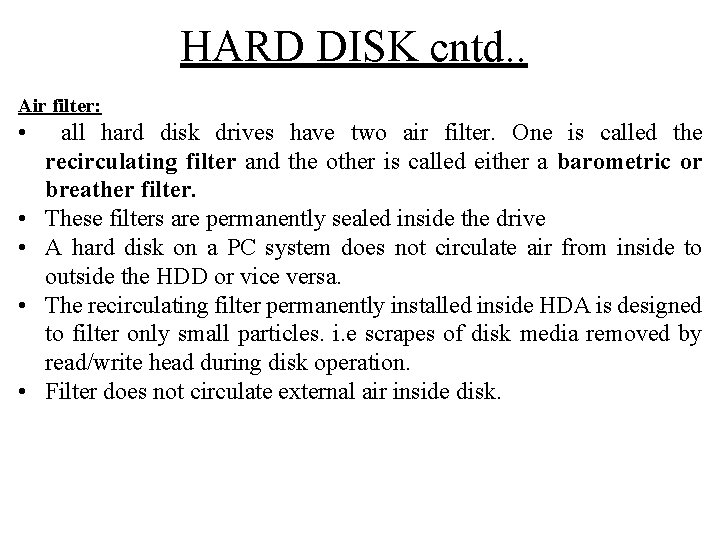
HARD DISK cntd. . Air filter: • all hard disk drives have two air filter. One is called the recirculating filter and the other is called either a barometric or breather filter. • These filters are permanently sealed inside the drive • A hard disk on a PC system does not circulate air from inside to outside the HDD or vice versa. • The recirculating filter permanently installed inside HDA is designed to filter only small particles. i. e scrapes of disk media removed by read/write head during disk operation. • Filter does not circulate external air inside disk.
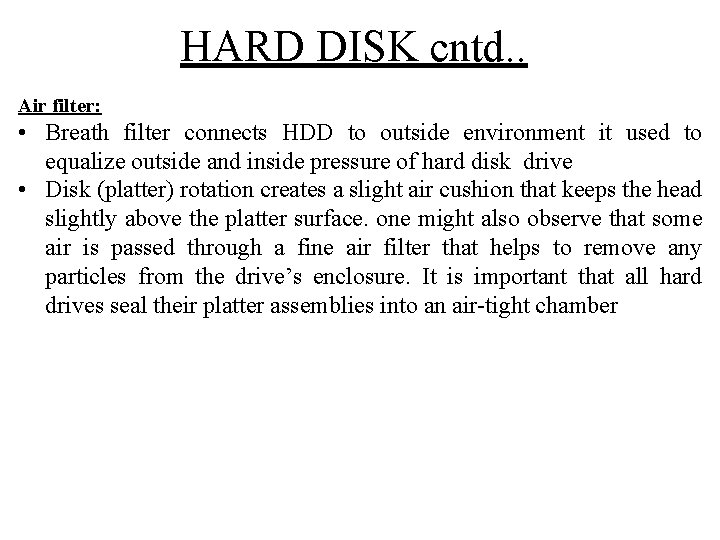
HARD DISK cntd. . Air filter: • Breath filter connects HDD to outside environment it used to equalize outside and inside pressure of hard disk drive • Disk (platter) rotation creates a slight air cushion that keeps the head slightly above the platter surface. one might also observe that some air is passed through a fine air filter that helps to remove any particles from the drive’s enclosure. It is important that all hard drives seal their platter assemblies into an air-tight chamber
HARD DISK
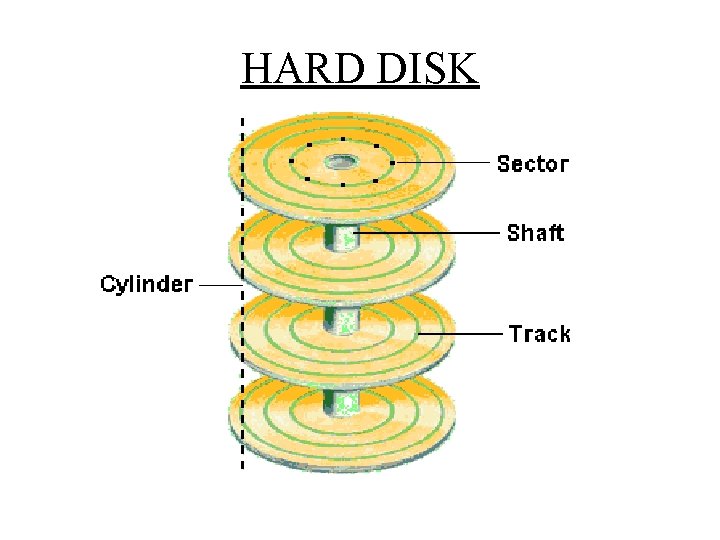
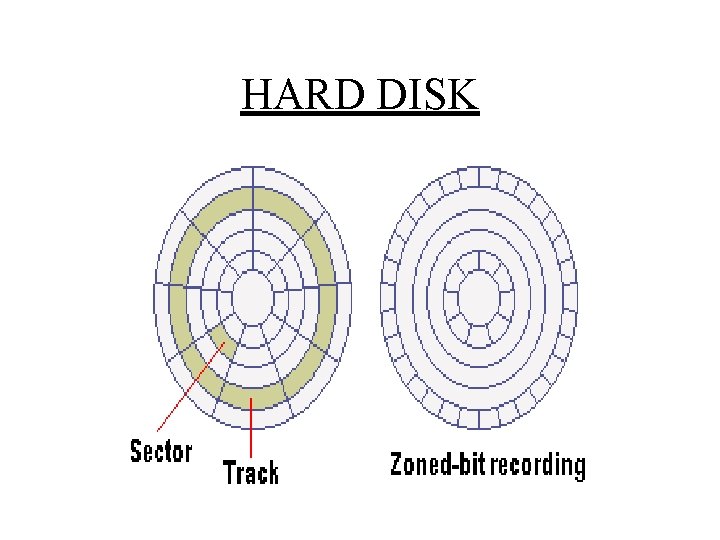
HARD DISK Tracks, Sectors, and Cylinders • As with floppy drives, one cannot simply place data anywhere on a hard-drive platter—the drive would have no idea where to look for data, or if the data is even valid. A drive can move its R/W heads over the spinning media to locate needed data or programs in a matter of milliseconds. Every concentric circle on a platter is known as a track. All information on hard disk is recorded in tracks, A current platter generally contains 2048 to more than 16278 tracks. • Tracks number starts from 0 start at the outside of the platter as we go in it is increased. • Sectors: sectors on which actual data is stored each track is divided into smaller units of sectors each sector holds 512 bytes of data The number of cylinders is equal to the number of tracks on one side of a platter. Once a R/W head finishes reading one track, the head must be stepped to another (usually adjacent) track. This stepping process, no matter how rapid, does require some finite amount of time. This is called seek time and it is often less than 1 ms for track-to-track seeks. When the head tries to step directly from the end of one track to the beginning of another, the head will arrive too late to
HARD DISK Latency A finite period of delay occurs between the moment that a read or write command is initiated over the drive’s physical interface and the moment that desired information is available (or placed). This delay is known as latency. More specifically, latency refers to the time it takes for needed bytes to pass under a R/W head. If the head has just missed the desired location, the head must wait almost a full rotation before the needed bits are available again, so latency can be rather long. In general, a disk drive is specified with average latency, which (statistically) is time for the spindle to make half of a full rotation. For a disk rotating at 3600 RPM (60 rotations per second), a full rotation is completed in (1/60) = 16. 7 ms. Average latency would then be (16. 7/2) = 8. 3 ms. Disks spinning at 5200 RPM offer an average latency of 5. 8 ms, etc. As a rule, the faster a disk spins, the lower its latency will be. Ultimately, disk speed is limited by centrifugal forces acting on the platters.
HARD DISK
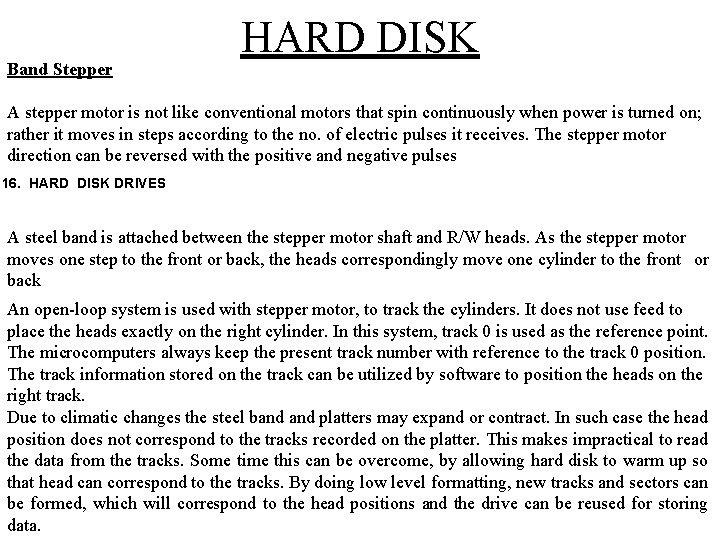
HARD DISK Band Stepper A stepper motor is not like conventional motors that spin continuously when power is turned on; rather it moves in steps according to the no. of electric pulses it receives. The stepper motor direction can be reversed with the positive and negative pulses 16. HARD DISK DRIVES A steel band is attached between the stepper motor shaft and R/W heads. As the stepper motor moves one step to the front or back, the heads correspondingly move one cylinder to the front or back An open-loop system is used with stepper motor, to track the cylinders. It does not use feed to place the heads exactly on the right cylinder. In this system, track 0 is used as the reference point. The microcomputers always keep the present track number with reference to the track 0 position. The track information stored on the track can be utilized by software to position the heads on the right track. Due to climatic changes the steel band platters may expand or contract. In such case the head position does not correspond to the tracks recorded on the platter. This makes impractical to read the data from the tracks. Some time this can be overcome, by allowing hard disk to warm up so that head can correspond to the tracks. By doing low level formatting, new tracks and sectors can be formed, which will correspond to the head positions and the drive can be reused for storing data.
HARD DISK
HARD DISK
HARD DISK
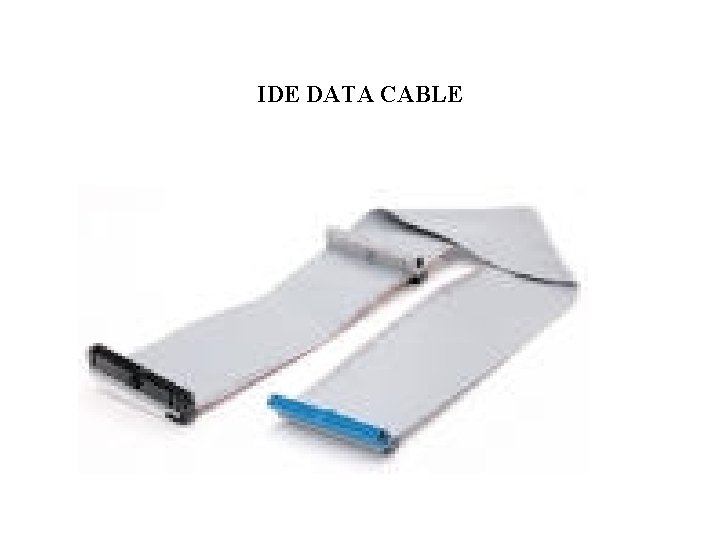
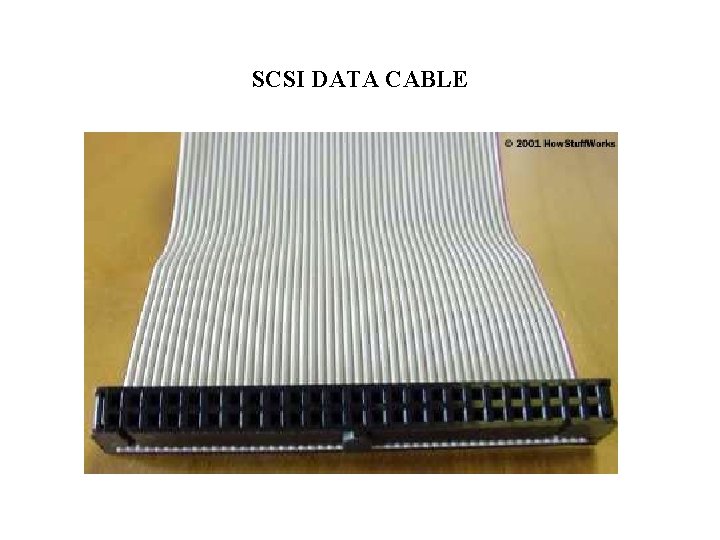
Cables and connectors • To connect HDD to main computer system, HDD contains data/control interface connector : HDD uses IDE, SATA, PATA AND SCSI uses only one cable for data as well as control signal • Power connector: provides 5 V, 12 V(run spindle motor & for head moment assembly) and ground signal
HARD DISK
IDE DATA CABLE
SCSI DATA CABLE